




Abstract
This paper presents a selective cooperative transmission scheme (abbreviated SCT) for ad hoc network with directional antennas that leverages the benefits of directional-only antenna approach and cooperative communication. The main feature of SCT is its adaptability to the channel condition in the network. In other words, when the node sends data, SCT determines its transmission strategy on either direct or cooperative transmission via a relay node called a forwarder, depending on the transmission time. Simulation results are provided to validate the effectiveness of the proposed scheme.
1. Introduction
The use of directional antennas in wireless ad hoc networks has advantages such as high antenna gain, high spatial reuse, and extended transmission range. Especially, it is indispensable in the emerging millimeter-wave (mmWave) systems, which operate in the license-free frequency band from 57 to 64 GHz, because the communication signals at 60 GHz suffer from high path loss [1]. However, the asynchronous feature for the antenna beam directions and transmission ranges between the nodes causes new challenge such as deafness problem, since the nodes do not have prior knowledge about their neighbors.
In order to resolve the deafness problem, Choudhury et al. [2] and Nasipuri et al. [3] present the antenna mode selection scheme, in which the node chooses either the omnidirectional or directional antenna modes, depending on the received control message. This approach definitely alleviates the deafness problem, but maintaining both types of antennas not only induces a high cost but also results in the asymmetric-in-gain problem, which is another form of the deafness problem caused by the different antenna transmission range sizes of the two nodes. To overcome the asymmetric-in-gain problem, Shihab et al. [4] and Jakllari et al. [5] present a directional-only antenna approach where the nodes operate with a single directional antenna. However, their performance can be significantly degraded, due to the high control message overhead accrued for searching neighbors.
Liu et al. [6] and Zhu and Cao [7] propose a two-hop relay transmission approach for ad hoc networks with the omnidirectional-only antenna. They improve the network performance by reducing the transmission time of data packets via a concept of cooperative transmission. However, under high path loss conditions such as mmWave systems, they still suffer from the disadvantages of omnidirectional antennas.
In this paper, we present a selective cooperative transmission scheme (abbreviated SCT) for ad hoc network with directional antennas that leverages the benefits of directional-only antenna approach and cooperative communication. The main feature of SCT is its adaptability to the channel condition in the network. In other words, when the node sends data, SCT determines its transmission strategy on either direct or cooperative transmission via a relay node called a forwarder, depending on the transmission time. Simulation results are provided to validate the effectiveness of the proposed scheme.
This paper is organized as follows: Section 2 gives an overview of the directional antenna model and the neighbor discovery procedure. SCT scheme is described in Section 3. The performance evaluations of SCT are presented in Section 4. The conclusions are given in Section 5.
2. System Model
2.1. Directional Antenna
In our work, we consider the distributed wireless network where every node is equipped with a single directional antenna. Figure 1 shows a directional antenna model supporting multiple data rates. For simplicity of analysis, we employ the flat-top antenna model, where the antenna gain is a constant within the beamwidth and zero outside the beamwidth. Therefore, for a beam with beamwidth θ, the antenna gains of the mainlobe and sidelobe are given by

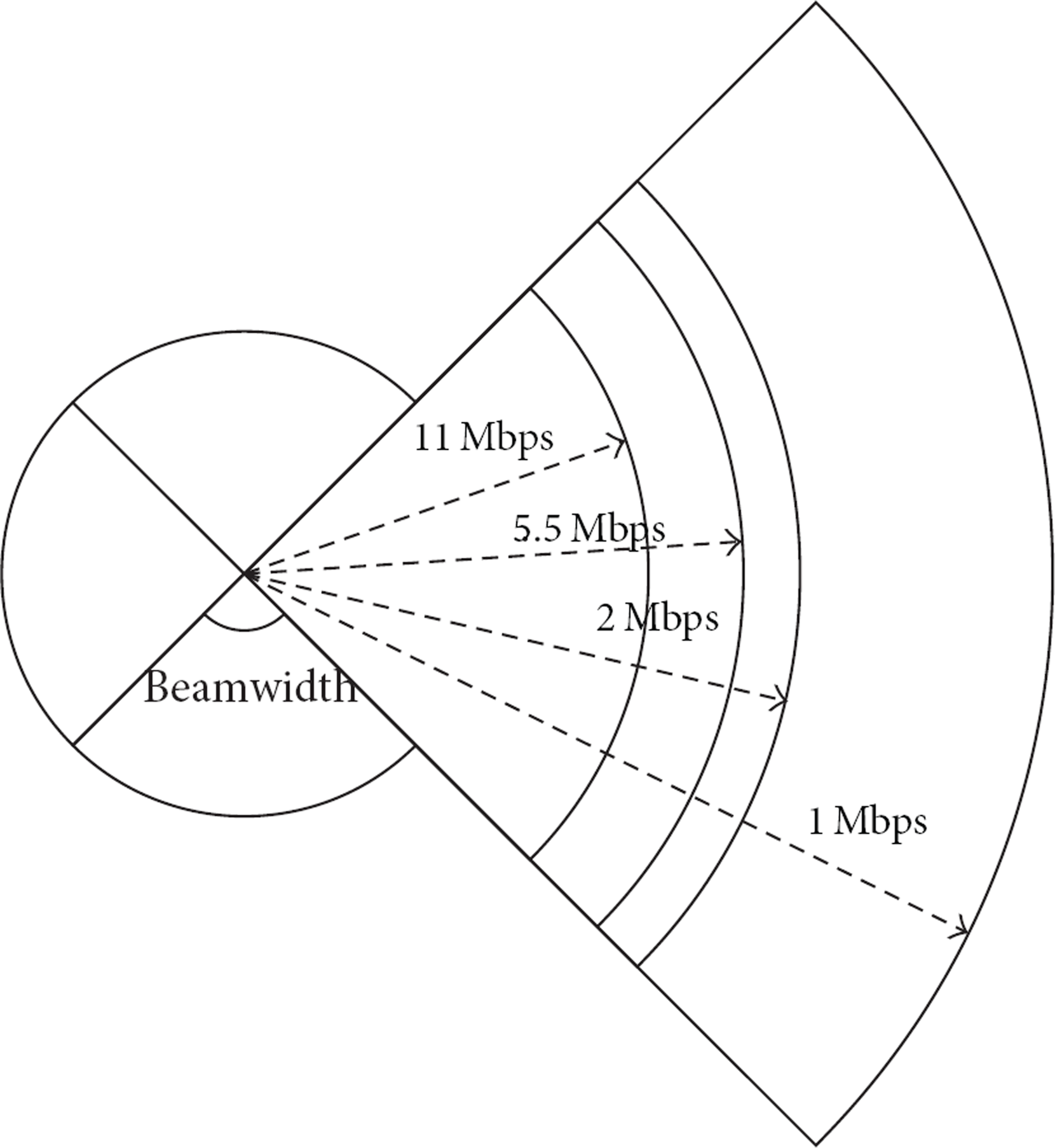
Directional antenna model supporting multiple data rates.
2.2. Neighbor Discovery
Due to the asynchronous feature of beam direction in the different nodes, neighbor discovery procedure has to be considered. In SCT, the directional network allocation vector (DNAV) [2] and the one-way neighbor discovery (one-way ND) [8] are used for neighbor discovery. With DNAV, the nodes keep a record of the ongoing transmissions by their neighbors in each direction. As a node starts up, it first runs the one-way ND procedure to create the neighbor table, whose entries include the sector number, node ID, distance, sequence number, DNAV status, and sector-switching timing information. Note that the sector-switching timing information indicates the time difference between its sector-switching schedule and neighbor's one [9]. In one-way ND, each node in the network periodically transmits an advertisement message to announce its presence and discovers its neighbors by receiving advertisement messages from the other nodes. Once a node receives a neighbor's advertisement message, it caches the information in its neighbor table. If a node receives a previously cached advertisement message, it updates the corresponding fields of the table. Consequently, all the nodes in the network can sustain the latest information for their neighbors via this preliminary procedure.
3. Design of SCT
SCT is inherently a cooperative communication solution under a single directional antennas condition. In SCT, high data rate nodes, called forwarders, assist the transmission of low data rate nodes by forwarding their traffic. Major components of SCT design are the mechanism for each node to learn about candidate forwarder nodes, and the corresponding data structures, called a SctTable, used to store the information related to those identified candidates. Using SCT, the node in the network can choose a forwarder from this list of potential forwarders to use at the time of its transmissions, depending on the possibility of reducing the transmission time for the packet. In the following, we present the operation of the SCT, in detail.
3.1. Forwarder Selection
Each node in the network should maintain a table, referred to as the SctTable, whose entries include node ID, sequence number,
Every node within the antenna sector coverage of the sender toward the receiver can be a forwarder node, except for those that set DNAV. To select the forwarder, the sender checks its neighbor table and creates the entries of SctTable. Note that if one sets DNAV, it is deleted from the SctTable entries. The sender finds that the nodes belong to the sector including the receiver by referring to the sector number field of the neighbor table and then brings them to the SctTable entries.

3.2. Transmission Mode Determination
As mentioned above, we use the concept of cooperative communication to improve the network performance by reducing the transmission time of data packets, under a single directional antenna condition. The idle nodes scan a sector for a specific time period and continuously switch their beams in a clockwise or anticlockwise direction in order to circumvent the deafness problem. The basic exchange procedure of control messages in SCT is shown in Figure 2. Assuming that the number of antenna sectors of every node is M, DRTS messages are repeatedly sent to the receiver up to M times. Note that, the scanning time duration for all sectors is equal to the time from the sending moment of the first DRTS to that of the Mth DRTS. Cooperative transmission mode (CTM) via a forwarder is selected if it satisfies

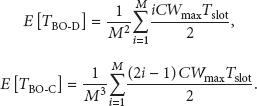

Exchange of control messages.
The DRTS includes the information on the forwarder, receiver, and payload size. The forwarder overhears the DRTS while the sender sends multiple DRTSes. Upon overhearing the DRTS, the forwarder sends a Ready-To-Forward (RTF) message to the sender. When the receiver receives the DRTS, it responses with the DCTS and then fixes its beam direction toward the forwarder to receive the data packet. If the sender receives both the RTF and DCTS messages, it first sends the data packet to the forwarder, which subsequently transfers it to the receiver. If nonparticipating idle nodes overhear the control packet, DNAV for the transmission duration is set up.
In (3),


4. Simulation Results
We evaluated the performance of the SCT through experimental simulations using the QualNet 5.0 simulator [10]. We created the azimuth file shown in Figure 3 to implement the flat-top directional antenna model. Common simulation parameters are listed in Table 1. Note that, due to the limitations of the simulator that does not support mmWave transmissions, we implement our work on top of the IEEE 802.11b physical layer model.
Simulation parameters.


Flat-top directional antenna model in Qualnet 5.0.
4.1. Performance Study in DTM
In ad hoc networks that support multiple data rates, as the data rate or the number of antenna sectors increases, the antenna transmission range decreases. The relation between the data rates/the number of sectors and the transmission ranges is shown in Table 2. So, it can be inferred that the narrow beamwidth of the sector makes its gain relatively higher. To analyze the throughput performance for various numbers of sectors, we perform a simple experiment, in which the packet payload size and the arrival rate are 1250 bytes and 200 packets/sec, respectively. Figure 4 shows the throughput for varying distances between sender and receiver. In the case of small number of sectors (e.g.,
Antenna transmission range.

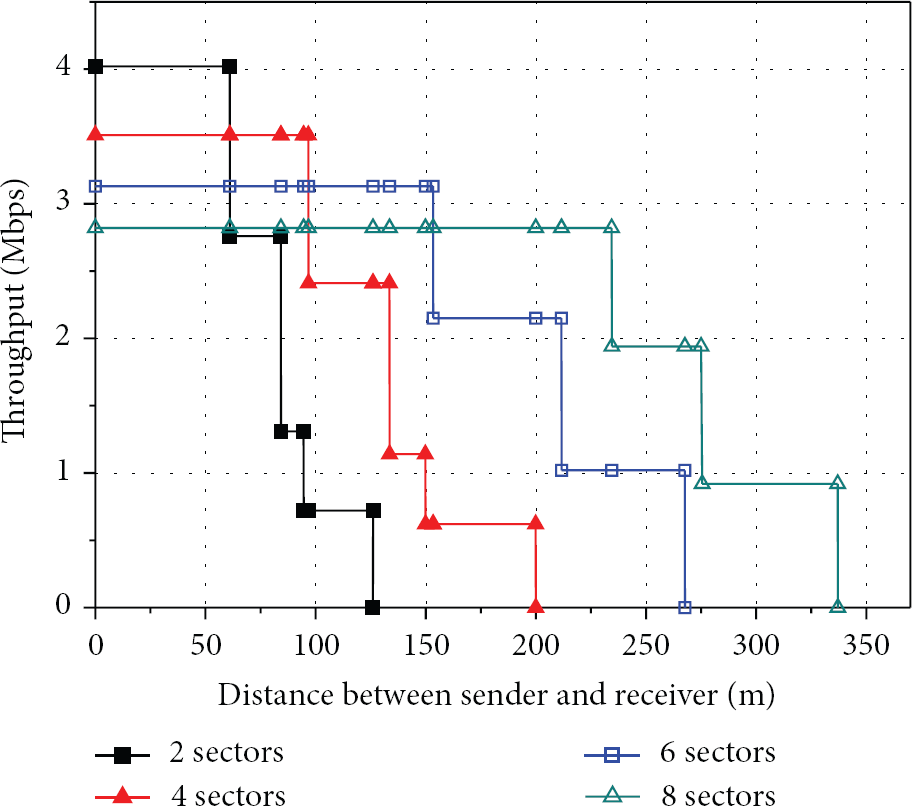
Throughput as a function of distance between sender and receiver.
4.2. Performance Comparison of DTM and CTM
The throughput is expressed as the average payload size during the average transmission time of a data packet and is given by


Figure 5 shows the transmission time for various transmission modes. Since the node can use various data rates according to the position of the forwarder in CTM, we change the forwarder's position from the 2 Mbps area to the 11 Mbps area in the experiment. In the figure, the case of CTM where both sender and receiver use the 11 Mbps link exhibits the shortest transmission time. In DTM, the node takes less time for the transmission of data packets than CTM with the 2 Mbps-2 Mbps, because the overhead time for exchanging the control messages is relatively small in DTM. Figure 6 shows the throughput performance for various payload sizes. Overall, SCT exhibits higher network throughput than the DTM stand-alone solution, because SCT can be supported by the high data rate link (e.g., 11 Mbps link). However, in the cases that the payload size is below 100 bytes, the throughput of the DTM-only solution is slightly higher than SCT, due to the control message overhead.

Transmission time with various data rates.
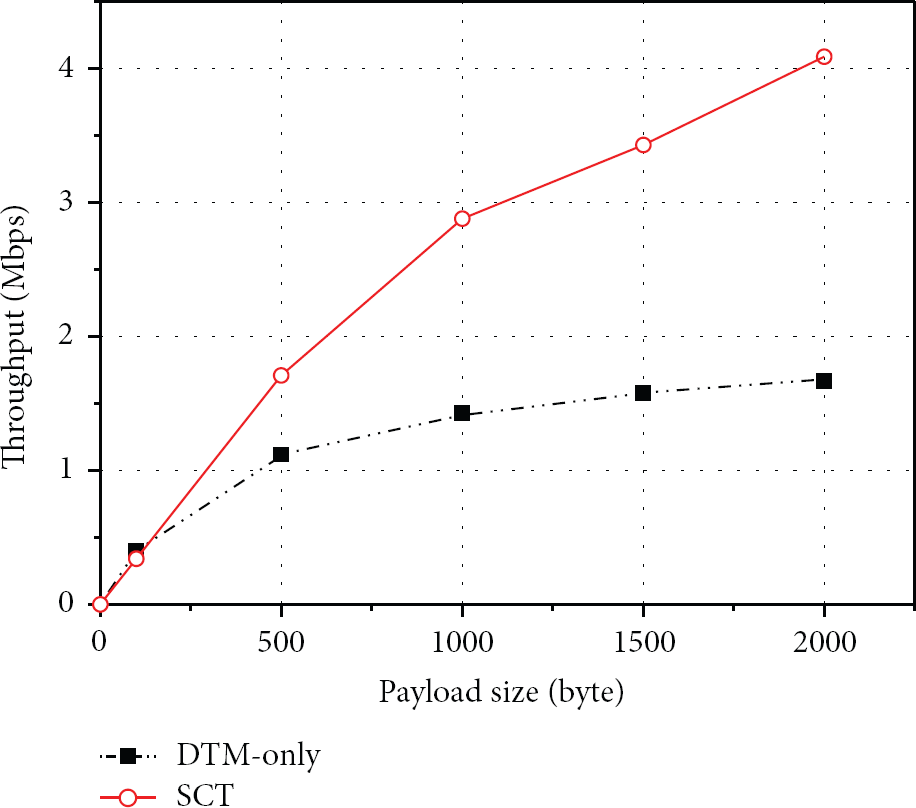
Throughput as a function of payload size.
Figure 7 shows the performance comparison of average overhead time for initiating the cooperative transmissions. In directional-only antenna approach, each node may have different sector-switching timing; thus the overhead time for initiating cooperative transmission is mainly affected by sector-scanning time of the node, which is the time that the sender needs to transmit one or more DRTS messages at each sector for trying cooperative transmission with the receiver. We measure the overhead time of SCT and DC-MAC [11] for varying numbers of sectors. On the whole, SCT exhibits better performance compared to DC-MAC. In SCT, it is assumed that the advertisement message of neighbor discovery procedure contains the information for sector-switching timing; thus the sender can initiate cooperative transmission with one DRTS message. On the other hand, in DC-MAC, the node sends two DRTS messages at each sector to keep its high probability of successful transmission, which leads the increase of average sector-scanning time.
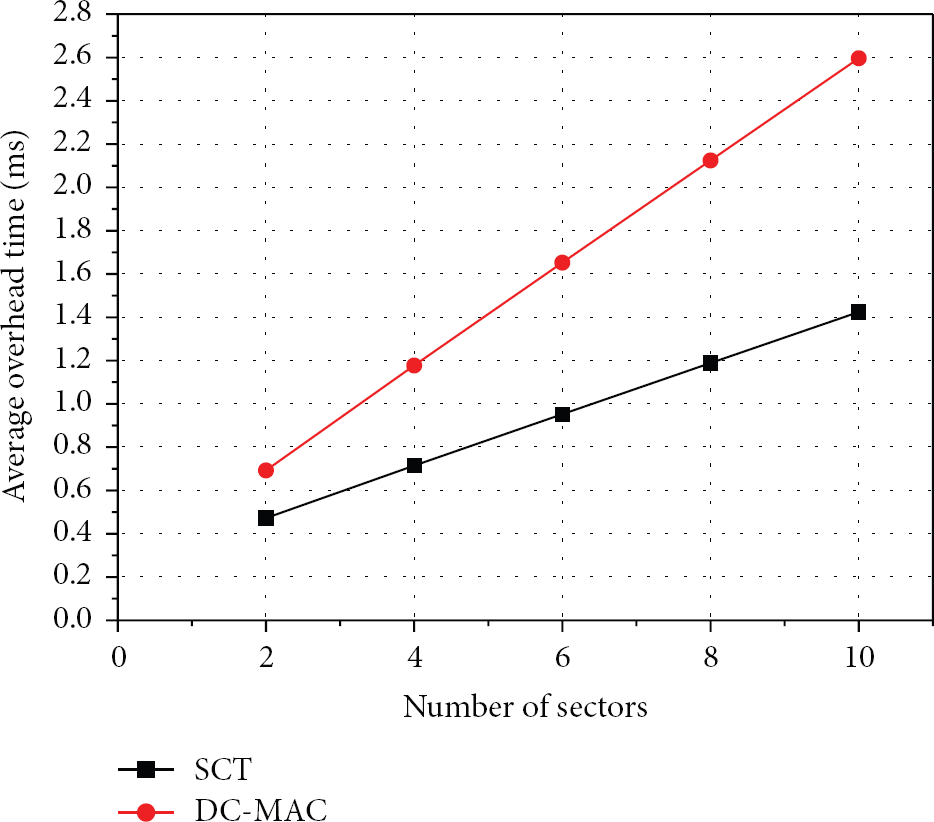
Comparison of average overhead time.
5. Conclusion
This paper presents SCT, which is a selective cooperative transmission scheme for ad hoc network with directional antennas. Under directional antenna only environments, SCT improves the network performance by reducing the transmission time of data packets through adopting selectively either CTM or DTM. The simulation results verify that the proposed scheme exhibits high network performance in terms of both the throughput and transmission time.
