




Abstract
Recently, vehicular sensor networks (VSNs) have emerged as a new intelligent transport networking paradigm in the Internet of Things. By sensing, collecting, and delivering traffic-related information, VSNs can significantly improve both driving experience and traffic flow control, especially in constrained urban environments. Latest technological advances enable vehicular devices to be equipped with multiple wireless interfaces, which can support cooperative communications for concurrent multipath transfer (CMT) in VSNs. However, path heterogeneity and vehicle mobilitycauseCMT not to achieve the same high transport efficiency recorded in wired nonmobile network environments. This paper proposes a novel vehicular network-based CMT solution (VN-CMT) to address the above issues and improve data delivery efficiency. VN-CMT is based on a CMT disorder analytic model which can effectively and accurately evaluate the degree of out-of-order data. Based on this proposed model, a series of mechanisms are introduced as follows: (1) a packet disorder-reducing retransmission policy to reduce retransmission delay; (2) a path group selection algorithm to find the best path set for data multipath concurrent transfer; and (3) a data scheduling mechanism to distribute data according to each path's capacity. Simulation results show how VN-CMT improves data delivery efficiency in comparison with an existing state-of-the-art solution.
1. Introduction
Vehicular sensor networks (VSNs) are expected to be at the centre of one of the major new application areas for intelligent transport systems [1, 2] in the Internet of Things (IoT) world. Unlike most of the nodes in other wireless sensor networks [3, 4], in VSNs vehicles can be equipped easily with large-capacity-storage and powerful-computing devices. This offers the opportunity to deploy a broad range of innovative solutions, including peer-to-peer content sharing [5, 6], quality-oriented multimedia content delivery [7, 8], user-personalised multimedia content delivery [9], energy-aware traffic management solutions [10], and traffic information dissemination applications [11]. These applications are designed to improve safety, traffic management, navigation, and user convenience. Additionally we are witnessing extensive developments in the area of wireless access technologies in VSNs. Vehicles can carry multiple types of wireless interfaces, and they can interact with each other and access the Internet via several communication technologies such as IEEE 802.11p, 3G/4G, and WiMAX [12].
Transport protocols play an increasingly important role in IoT to comply with the emerging new devices and applications and support efficient data transmissions. The Stream Control Transmission Protocol (SCTP) [13] is a new multihoming-based transport layer protocol. It has been widely used in vehicular networks for the support of concurrent multipath transfer (CMT) [14]. Viewed as support to reliable and high-throughput services by utilizing several paths to transmit data packets concurrently, CMT can achieve good level of bandwidth aggregation [15]. Figure 1 illustrates CMT usage in a heterogeneous VSN environment. It shows how a vehicle can concurrently use both 3G and 802.11p (WAVE) access links to communicate with the server through the Internet. This approach significantly improves data transmission efficiency in VSNs.

Concurrent multipath transfer in vehicle sensor networks.
Unfortunately, as vehicles move rapidly, intervehicle connections are always broken and reestablished. This problem leads to frequent change of network topology, which means continual variation of round trip time (RTT) and loss rate in the transport layer. In CMT, paths having similar and stable bandwidth, delays, and loss rates are prerequisites for good data delivery performance. When the conditions of heterogeneous paths are very different and keep changing, packet disorder at the receiver side becomes serious. Since the receive buffer is finite, frequent disorderly arrived packets will lead to receiving buffer-blocking issue that drastically decreases CMT performance. Recently, some research work [16] has been proposed to improve delivery performance by reducing reordering. However, to the best of our knowledge, there are no proposed CMT disorder analytic models which can effectively and accurately investigate the characteristics of out-of-order data and then optimize the CMT-related algorithms.
In this paper, we introduce an efficient analytic model for CMT disorder in intelligent transport systems. This model derives a function of bandwidth, RTT, and loss rate, which can accurately compute the degree of data disorder. Based on this model, we propose novel path group selection algorithm, data scheduling scheme, and retransmission policy for concurrent multipath transfer over VSNs in order to reduce reordering and improve data delivery performance. These were integrated into a newly designed solution vehicle network-CMT (VN-CMT) which was evaluated by simulations in comparison with an existing state-of-the-art method.
2. Related Work
Many researchers focus on exploiting SCTP features to support efficient CMT. Dreibholz et al. [17] investigated the ongoing SCTP standardization progress in the IETF and gave an overview of activities and challenges in the areas of CMT and security. Shailendra et al. [18] proposed the MPSCTP protocol which enhances the basic SCTP. MPSCTP changed the SCTP header structure and introduced newly designed algorithms to provide greater reliability during concurrent multipath usage. Kim et al. [19] introduced a modification of SACK handling in CMT to prevent a SCTP sender from updating the congestion control window size when availability of the path is ambiguous. We previously proposed a novel realistic evaluation tool set [20–22] to analyze and optimize the performance of multimedia distribution when making use of a CMT-based multihoming SCTP approach. SCTP CMT is currently in the discussion of standardization within the IETF [15].
In recent years, increasing number of researchers are using the promising SCTP in both vehicular networks and wireless sensor networks. Lu and Wu [23] adopted SNMP and SIP over SCTP as network management protocols and evaluated their behaviors in wireless sensor networks. Kim and Lee [24] proposed a Mobile Stream Control Transmission Protocol- (MSCTP-) based handover scheme for vehicular networks which seamlessly adapts to different delivery conditions. Unfortunately, both of these works did not take into account any of the benefits brought by CMT. Huang and Lin [25] proposed a fast retransmission solution enabled by the use of relay gateways for CMT (RG-CMT) in vehicular networks. When packets are lost due to error or handoff loss in the wireless link, RG-CMT can retransmit lost packets fast from the relay gateway to the vehicle, which enables achieving higher throughput than the basic CMT.
However, there is still significant ongoing work addressing many challenges of the SCTP CMT. The SCTP CMT strategy makes use of a round-robin scheduling to distribute data packets via different independent network interfaces to utilize the aggregated bandwidth. However this “blind” round-robin scheme sends the packets to all available multiple paths equally without considering their different communication conditions such as bandwidth and delay. As a result, CMT will lead to serious out-of-order data chunks for reordering. It causes even more serious concerns in vehicular sensor networks, as in VSNs the asymmetric paths with different quality characteristics are more common and sensitive to variations than in wired networks. Consequently, CMT often suffers from significant receiver buffer-blocking problems, which degrades transmission efficiency and network utilization.
3. VN-CMT Disorder Analytic Model
We define the degree of data disorder as the distance between packets' sending order and their receiving order. The disorder degree can be estimated through the Euclidean distance algorithm as follows:

The average packet gap in path i can be estimated by the average gap for packets transmitted on this path times the number of packets sent on path i. We assume that the N packets are transmitted over n paths concurrently. The total packet gap in the given data distribution time can be computed by (2) and is the sum of packet gaps computed on every path:

We consider two situations to derive


Model of packet gap.
From (4) and (6), (7) can be deduced as the following:

Next, we start to derive
3.1. Packet Disorder-Reducing Retransmission Policy
A preferable retransmission policy accelerates retransmissions in order to reduce packet disorder, namely, can make the average retransmission time shorter. In SCTP, the recommended CMT retransmission policies are RTX-CWND and RTX-SSTHRESH. Equation (6) shows how the average CWND is mainly decided by loss rate. The smaller the loss rate is, the larger the average CWND is. As SSTHRESH always changes when packets are lost, it is also decided by loss rate. It is obvious that preferred packet retransmission is on the path with the lowest loss rate. In our model, besides loss rate, RTT is also considered as an important factor for retransmission. Smaller RTT means smaller packet gaps on this path and smaller gaps indicate less reordering. Considering those two factors, a path having smaller
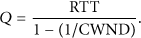
The packet disorder-reducing retransmission policy is based on the fact that the path with the smallest Q value is chosen as the packet retransmission path. Algorithm 1 describes the retransmission strategy.
(1) //Let (2) // (3) (4) (5) (6) obtain (7) (8) (9) (10) (11) (12) (13) retransmit the packet
Assuming that the retransmission path is path x, then the

As the lost detection and transmitting a packet successfully on path i both perform in one round (10) can be writtenas follows:

Similarly, (7) is derived and the formula for computing


By combining (11) and (12), (13) can be deduced as follows:

By following (3), (7), (9), (10), and (13), the total gap of a packet sent on path i can be computed as follows:
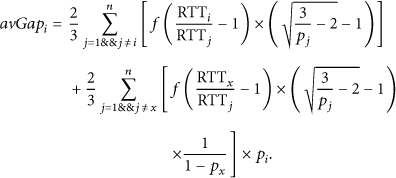
We have derived the average gap of a packet sent on path i. Next, we employ the path i's bandwidth denoted as
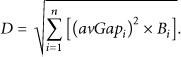
D characterizes the disorderly degree of a path group. Large D value will influence the throughput. This proposed disorder analytic model captures the essence of packet disorder in CMT. Based on the model and taking D into account, we can design and optimize CMT-related algorithms, such as the above proposed retransmission policy and also path group selection and data scheduling algorithms to reduce packet disorder and increase CMT throughput.
3.2. Packet Disorder-Reducing Path Group Selection Algorithm
As mentioned above, in VSNs, frequent break and reestablishment of connections lead to often changes in paths' conditions. Making use of bad paths will cause serious out-of-order data deliveries. So, good path group selection algorithms are required to find a good path group for concurrent data transmissions in dynamic wireless environments. We aim to make the selected paths in the path group have similar communication quality in order to reduce received data reordering and alleviate receiver buffer blocking. Two factors, namely, disorder degree D and total bandwidth are considered in our packet disorder-reducing path group selection algorithm. The disorder degree is expected to be small, while the total bandwidth is expected to be large. These two parameters are employed to compute a new parameter σ to evaluate a path group (set) as the following:

(1) //Let (2) // (3) (4) (5) get the path set (6) (7) (8) (9) (10) (11) (12) /* (13) (14) obtain the path (15) (16) (17) obtain the path set (18) (19) (20) (21) (22) (22)
3.3. Packet Disorder-Reducing Data Scheduling Algorithm
The data scheduling algorithm of standard CMT uses a “blind” round-robin strategy. It splits SCTP packets over all available paths in an equal-share way without considering various path quality differences. This method is simple but not reasonable and can cause many out-of-order data packet deliveries. Hence, a better algorithm is required. To reduce the disorder, the smaller a packet TSN is, the earlier the packet should arrive successfully at receiver. Namely, the smallest TSN packet should be sent over the path whose gap is the smallest possible one. In formula (14), we have derived a function to compute the average gap of a path. So, we propose packet disorder-reducing data scheduling algorithm as follows: any packet is sent on the path whose average gap is the smallest and its CWND allows transmission. By using this simple, but highly efficient, path data scheduling algorithm, the disorder is significantly reduced and data delivery performance is greatly improved. The above process is detailed in Algorithm 3.
(1) //Let (2) // (3) (4) (5) compute the path (6) (7) sort items in (8) (9) (10) transmit the packet (11) break; (12) (13) (14)
4. Application and Performance Evaluation
In this section, we first give an example application scenario for the disorder analytic model-based CMT algorithms in vehicular sensor networks, then we evaluate the proposed VN-CMT strategy and compare its performance with the basic CMT of SCTP by making use of the network simulator (NS-2.35) [27] in a realistic application scenario.
4.1. Application Scenario
Lately, many cities around the world have witnessed large-scale deployment of traffic-related mobile TV broadcasting services. For example, following the Beijing Olympics, almost all taxis (out of the over 700 thousand vehicles in the Chinese capital city) are equipped with on-board equipment which supports traffic TV broadcasting signal retrieval and multimedia playback. Additionally, we are witnessing extensive developments in wireless access technologies including WiFi, LTE, LTE-A, and WiMAX and especially in vehicular wireless technologies such as Wireless Access in the Vehicular Environment (WAVE) (IEEE 802.11p), enabling data delivery via vehicle-to-vehicle (V2V), vehicle-to-infrastructure (V2I), and vehicle-to-road-side-unit (V2R) communications. This paves the way towards multihomed wireless networks, where vehicles in vehicular networks can be equipped with multiple wireless interfaces. Each vehicle can establish multiple connections with other vehicles or servers across different networks and distribute data employing concurrent multipath transfer mechanism. Figure 3 illustrates the application scenario which follows our previous work [28]. Vehicle A can download the real-time traffic video, that it interests from traffic information server through WiFi, LTE(3G/4G), and 802.11p network concurrently. It can aggregate bandwidth and accelerate video downloading speed to ensure the traffic video playback smoothly and timely. The driver can promptly adjust his driving route in terms of the viewed traffic information, which significantly improves both driving experience and traffic flow control.
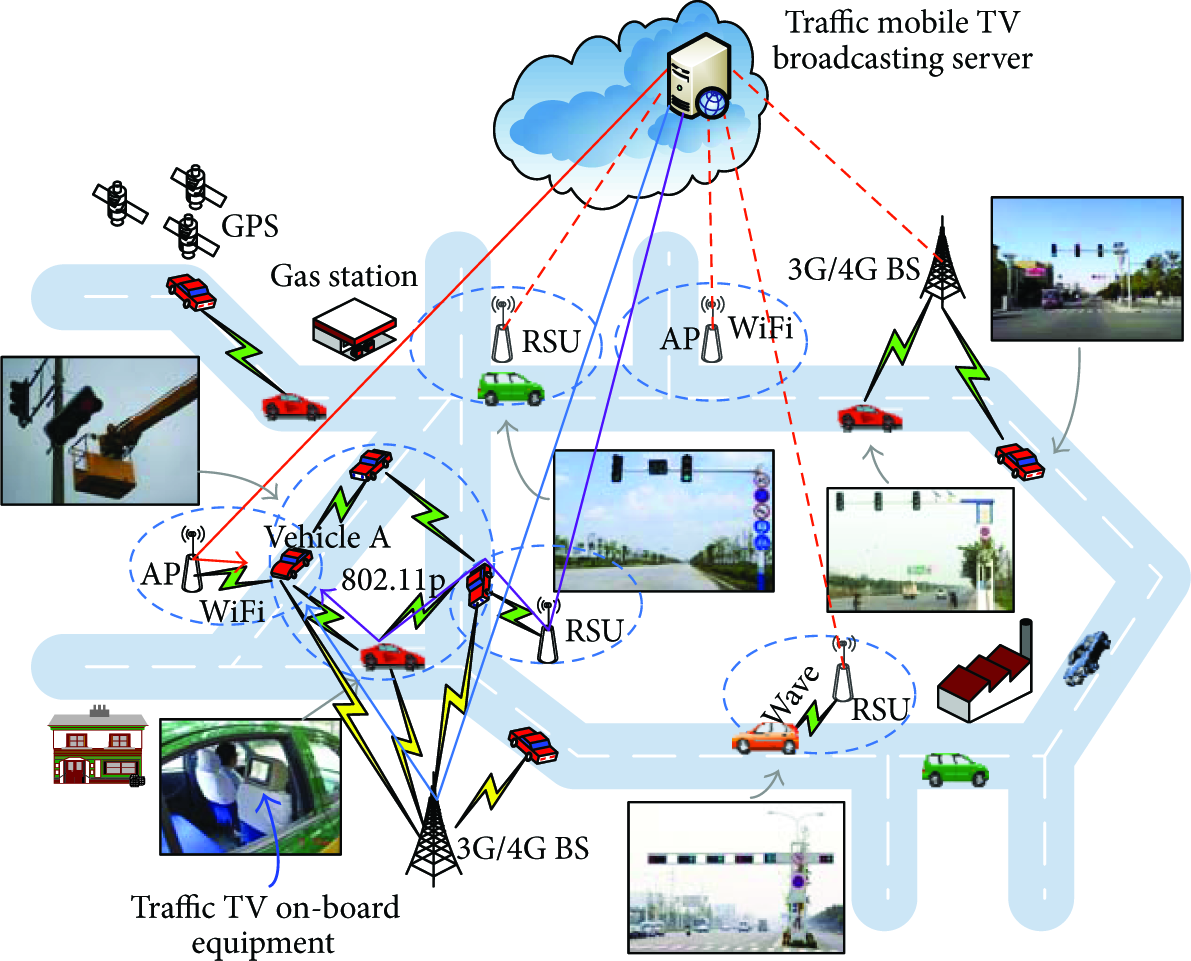
A application scenario of traffic mobile TV broadcasting services.
4.2. Performance Evaluation
VN-CMT's performance is assessed in comparison with the basic CMT of SCTP in an application scenario of the traffic real-time TV broadcasting system as presented in Figure 3. We have implemented our VN-CMT by modifying the NS2 standard CMT module accordingly. Figure 4 illustrates the simulation network topology which is described in terms of Figure 3 application scenario. Two endpoints, namely, Sender and Receiver, communicate through three paths which denote WiFi, LTE, and 802.11p connections, respectively and having different bandwidths.

Simulation network topology.

Comparison of out-of-order TSN.

Comparison of packet sending and receiving times in CMT.

Comparison of packet sending and receiving times in VN-CMT.
The packets are received out-of-order due to the dissimilar path characteristics and their reordering. This is likely to cause performance degradations. For example, when using CMT, a packet lost in path 2 around 20.2 s is detected and retransmitted at around 20.5 s. The path with the lost trunk fails abruptly for about 0.3 s seconds and resumes later. The subsequent data chunks which arrived in this period are held in the transport layer receive buffer and unable to be delivered to the application. This phenomenon blocks the receiver buffer and seriously decreases the delivery performance. With packet disorder-reducing path group selection and retransmission policy, VN-CMT discards the bad path and retransmits packets in the path with high performance. In this way, VN-CMT greatly reduces disorder and data chunks are received smoothly, as shown in Figure 7. Another important impact factor on performance is spurious retransmission. Spurious retransmission brings additional useless packets and decreases data transfer rate. It is mainly caused by disorder of packets. In order to compare the spurious retransmission between CMT and VM-CMT, we define the rate of spurious retransmission (RSR) to be


Comparison of spurious retransmission.

Comparison of throughput. Rbuf = 32 K.
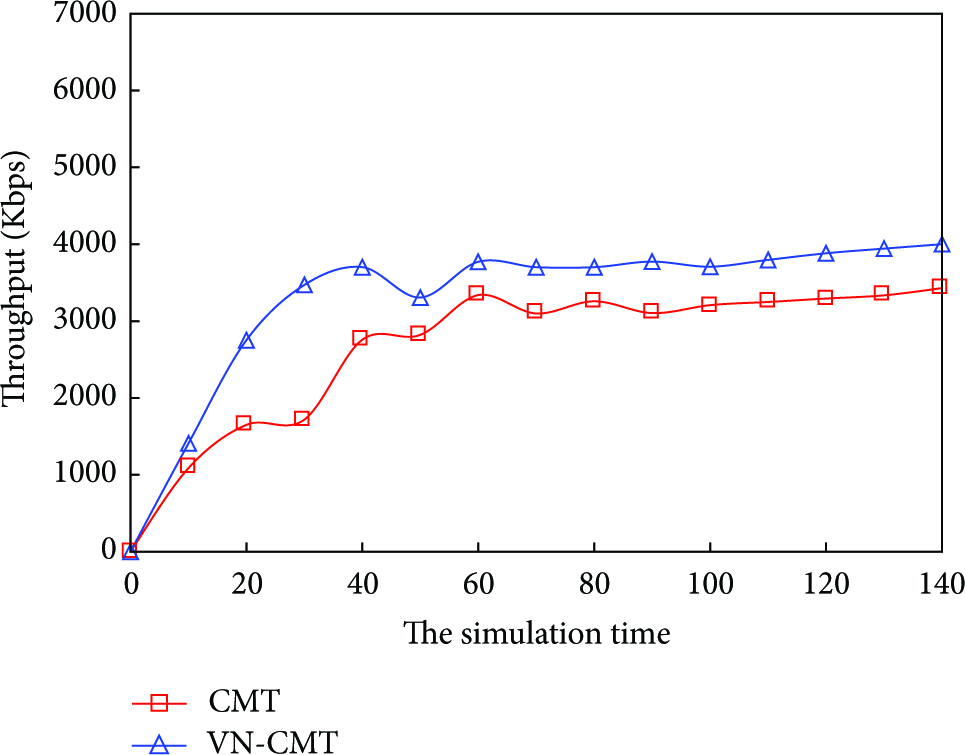
Comparison of throughput. Rbuf = 64 K.

Comparison of throughput. Rbuf = 128 K.
It can be noted how VN-CMT performs better than CMT in all cases. The difference is very much in favour of VN-CMT in limited receiver buffer situations. The packet disorder-reducing path group selection algorithm, retransmission policy, and data scheduling algorithm employed by VN-CMT mitigate the disorder of received packets and enable VN-CMT not to need large receiver buffer to store the out-of-order data chunks. Figures 9–11 fully show how VN-CMT outperforms CMT in terms of the throughput.
5. Conclusion
This paper addresses the packet disorder issue for SCTP concurrent multipath transfer in future heterogeneous vehicular sensor networks. A disorder analytic model is proposed which generates useful disorder degree information for CMT. Based on it, a novel packet disorder reducing retransmission policy, a new path group selection algorithm, and a novel data scheduling algorithm were proposed. The path group selection algorithm aims to find the optimum path set for data concurrent transfer. The data scheduling algorithm analyses every path's quality before considering the average path packet gap in its decision process. The retransmission policy combines both RTT and loss rate factors to find a preferred retransmission path, which ensures that packets are retransmitted quickly and successfully. The simulation results fully show how VN-CMT alleviates out-of-data problem and achieves large and steady throughput in comparison with the classic CMT solution.
Footnotes
Acknowledgments
This work was supported in part by the National High-Tech Research and Development Program of China (863) under Grant no. 2011AA010701, in part by the National Basic Research Program of China (973 Program) under Grant 2013CB329102, in part by the National Natural Science Foundation of China (NSFC) under Grants no. 61001122, 61003283, and 61232017, in part by the Jiangsu Natural Science Foundation of China under Grant no. BK2011171, in part by the Jiangxi Natural Science Foundation of China under Grant no. 20122BAB201042, in part by the Fundamental Research Funds for the Central Universities under Grant No. 2012RC0603, and in part by Lero under Grant no. 10/CE/I1855.