




Abstract
Depending upon the technological developments, the same fast evolution has occurred in the structures of sensor networks, their composing devices which are sensor nodes, and their application areas. Those tiny, energy-constrained, mostly non-real-time data transmitting sensor nodes have evolved to more energy-containing, camera-adapted, real-time multimedia-data-transmitting devices. Developments in the usage areas and the capabilities have revealed some other problems such as time limited data transmission. In this paper, we propose a multichannel cross-layer architecture for Quality of Service (QoS) constrained multimedia sensor networks. The proposed architecture considers both the time and energy efficiency concepts. Energy efficiency is succeeded by ensuring the fair load distribution among the nodes during a real-time multimedia packet stream transmission. Besides ensuring the fair load distribution, on-time packet transmission is also assured by constructing the paths with a hard reservation technique depending on the predetermined QoS constraints. Simulations show that the proposed architecture provides higher performance than the Greedy approach and the LEERA scheme.
1. Introduction
Technological advances have provided great facilities and opportunities for human life. Many tasks have been carried out by computerized systems recently. Those computer-based tasks include surveillance control, fire preventing, health monitoring, and agricultural watering systems. There have been many developments that took place on issues such as hardware technology, signal processing, and communication protocols. Hence, it has become cumbersome to carry out those jobs by human beings.
Wireless Sensor Networks (WSNs) are one of those computerized systems that have started to take mission of man-power in the tasks, which are especially dangerous, time consuming, and expensive to perform manually. WSNs consist of a data collection mechanism called sink, the sensor nodes composing the backbone, and the communication protocols that define the way of data exchange between the devices. Sensor nodes are so small and low cost devices, such that to employ hundreds or thousands of them in a task is not costly. Those devices embody mainly three units: a sensing mechanism for gathering data from physical environment, a processor, and a battery unit with a radio subunit for data communication [1]. In addition to low cost, those networks also have the ability of selforganizing, which makes them the samples of ad hoc networks [2, 3].
In order to use thousands or millions of these sensor nodes, they must be very small to be produced with minimal costs. However, their small sizes cause some disadvantages, such as limited energy resources and coverage areas. Therefore, the energy limitation for WSNs must be considered while designing their protocols [4].
Recently, as a result of rapid technological evolutions, it is possible to equip the sensor nodes with tiny cameras and microphones to gather multimedia data from the environment. This new network type is called the Multimedia Wireless Sensor Network (MWSN) [5, 6]. After these new technologies, new problems and requirements emerge, such as on time transmission, low loss rate, and small jitter. Obviously, like all other communication technologies, a constant QoS value must be supplied by the network and its communication protocols during the transmission of multimedia data. Most of the traditional WSNs gather and transmit the physical data, which is delay tolerant and does not require a specific service quality [6].
In this paper, we propose a multichannel, cross-layer structure, in which packet forwarding is made according to the residual energy levels and geographical coordinates of the nodes. These nodes are positioned along the paths, which ensure the QoS parameters defined at the beginning of the data transmission. In order to provide load distribution, next hop selection is done by considering the residual energy levels of the nodes in the coverage area. Besides, to increase channel utilization, overall channel frequency is divided into n data channels and a control channel, which is only used for request message and non-real-time data transmission. Multiple paths with different QoS constraints can be constructed by using multiple channels. Hence, different node sets can be employed in lifetime maximization. Additionally, higher channel utilization is succeeded by using multiple channels. Before the start of real-time data transmission, hard bandwdith reservation is employed as done in the ATM networks. Thereby, the required QoS is assured.
The rest of this paper is organized as follows. Section 2 gives brief information about the structure, features, and requirements of MWSNs. In Section 3, related studies about MWSNs are discussed. Section 4 defines the architecture we construct. Section 5 gives the simulation results, and finally Section 6 concludes the paper.
2. Multimedia Wireless Sensor Networks
MWSNs differ from traditional WSNs by their hardware and the data they transmit to the data collection center. Conventional sensor networks gather scalar physical data such as temperature, humidity, and pressure from environment and transmit this delay-tolerant data to the data collection center according to the protocols specific for WSNs [6]. Those protocols mainly consider energy conservation, thereby giving lifetime maximization. Many solutions at different levels of the communication protocol stack have been proposed. One of them is the duty-cycling method, on which several researches focus and develop additional features. In this method, nodes are arranged on a schedule, periodically sleep, and then wake up to employ in the data communication. Another method contributing to the lifetime maximization occurs in the next hop selection at the routing layer. Here, the purpose is to find an exact path towards the sink, which will contribute to the network lifetime maximization. Actually, the computation of the best load balance is important while finding a path towards the sink. This means that if all packets are sent along a specific path or several nodes located in the same region send their data along the same path, the nodes of this path lose their energies quickly. So, the transmission of the packets along different possible paths maintains the network lifetime [7, 8].
As described before, researches about WSNs mostly focus on energy conservation challenge. However, MWSNs have more challenges to be dealt with. Those challenges stem from the characteristics of data they gather from the environment. WSNs can measure one-dimensional scalar data. However, MWSNs can process two-dimensional data, which is called image. This increase in the dimension induces some other challenges to be considered. Firstly, all data gathered by cameras should be selected to reduce the amount of transmitted data. Different intelligent image processing algorithms have to be applied depending upon the application type [9]. The more complicated image processing there is, the more energy consumption occurs. Another challenge is that large amount of data requires a larger bandwidth. Consequently, multimedia data requires real-time and reliable transmission. Therefore, MWSNs require a specific QoS value, which is not a crucial issue for WSNs. Lastly, in order to prevent a collision caused by continuously sending of the packets inside the network, the obtained data must be stored inside the nodes for a while. But this situation causes another challenge because the sensor nodes are small sized devices and contain limited storage areas [10].
Challenges described eariler are general issues that researchers work on. Communication scientists generally deal with the delay and reliability aspects that define the QoS requirements of the application. As far as we know, researches about MWSNs mainly focus on satisfying those QoS parameters. However, in this paper, we propose a cross-layer approach, in which both the QoS and the energy issues are considered together.
3. Related Work
As described in the previous section, not all of the methods or protocols, which have been applied in traditional WSNs, are suitable in MWSN applications. Though it is a new area, several studies have been done to satisfy the requirements of MWSNs. In this section, we mention the studies dealing with the QoS aspect of MWSNs.
Magri et al. [11] investigated the delay and energy consumption aspects of the duty-cycling approach for MWSNs. They analyzed the power consumptions of different tasks that comprise the whole cycle. Besides, different duty-cycling configurations were tested and the energy consumption of each configuration was presented. By defining the energy consumption model for each individual task, it can be identified with the complete cycle too. Thereby, the authors tried to make estimation about the lifetime of an MWSN.
Isik et al. proposed two distinct routing methods. Those methods were contributed to prevent load balancing and thus a possible congestion. Reducing the congestion probability causes a reliable data transmission. The first method they proposed is the Load Balanced Reliable Forwarding (LBRF). LBRF considers the occupancy rate of the buffers of all neighbor nodes. The node with the smallest buffer occupancy rate is chosen as the next hop. The drawback of this method is that if all of the neighbors' buffers have the same buffer occupancy ratei, next hop that is closest to the sink is chosen among the candidate ones. This idea does not include anything about residual energy levels of the candidate nodes. The second idea they presented is Directional Load Balanced Spreading (DLBS). DLBS is a combination of the LBRF and Directional Geographical Routing (DGR) methods [12]. In DGR method, a video stream is divided into multiple streams and transmitted over multiple disjoint paths towards the sink. However, while constructing the paths, none of the QoS parameters are considered. Traditionally, the authors considered the delay parameter while making their simulations. However, in this method, number of hops of the paths is just estimated according to an angle towards the sink. This idea may not always give the convenient result. Besides, the intelligence of the sensor nodes during the determination of the number of substreams was mentioned, but the details were left out. Here, when the estimated number of hops of a path is not correct and the packet arrives to the sink with an unreasonable delay, other packets of the same flow sent over this path will be able to be directed to other paths. DBLS employs the spatial disjoint multipath construction of the DGR method. Besides, load balance is provided by LBRF while transmitting the packets over those disjoint paths. However, end-to-end delay, which is vital for multimedia data communication, was not carefully considered in these studies.
Yaghmaee and Adjeroh [13], proposed a differentiated service model. With this model, packets are classified into two main groups, real-time and non-real-time. Non-real-time packets are also classified into multiple sub groups depending on the resource requirements of the packets. According to this service model, packets belonging to different service classes are stored in different queues. For the packets in real-time queue priority queuing and for the non-real-time packet queues weighted round robin methods are employed. This study only presented a model that is employed inside the node however, much more care should be taken for the events occur outside the node such as data communication.
González-Valenzuela et al. [14] presented a multichannel scheme for wireless sensor networks which is not a new idea. On the contrary, it has been applied in other types of ad hoc networks for a long time. They did not consider anything about QoS. In their method, two disjoint paths with different frequency conditions are constructed in order to prevent collisions which is a popular, already applied idea. Besides, lots of the recent studies have been done about how to assign those multiple frequencies more efficiently to the nodes on those multiple paths.
MMSPEED [15] was basely constructed on the idea of SPEED [16]. Satisfying the QoS is tried to be achieved in two domains: reliability and delay. Routing decisions are given locally by employing geographical routing method. Besides, depending on the QoS requirements of different packets, different paths are tried to be constructed. At the end, only a single path is found in SPEED protocol. However, in MMSPEED, multiple SPEED layers are virtually built and each of them is used for the packets with different QoS requirements. The delay parameter defined at the source node is revised dynamically at the intermediate nodes in order to satisfy the average original value predefined at source. In order to achieve a reliable packet delivery, multiple paths are used for the same packet delivery. The number of these paths changes according to the packet loss rate. When the loss rate and reliability demand increases, the number of paths that a packet is multicasted also increases. However, as the authors mentioned before, the drawback of this method is that it is an application specific scheme convenient for networks, which have lifetime of hours or at most a day, in that the scheme does not consider anything about energy consumption. The only challenge considered here is providing a certain QoS.
Mao et al. presented MRTP [17] that facilitates multiflow real-time data communication with the help of its companion protocol MRTCP. MRTP employs at the application layer. It mainly deals with supporting the applications to partition data into flows and to transmit these subdata over the paths associated with the subflows. MRTCP helps its companion by accomplishing tasks such as QoS feedback, session, and flow control. MRTP utilizes the paths maintained by its underlying multipath routing protocol.
Another QoS considering method for sensor networks was proposed by Gelenbe et al. [18–20]. Their routing method gives priority levels to the nodes in their coverage area according to their distances to the sink. High priorities are assigned to the neighbors located closer to the sink and vice versa. GPSR [21] is utilized when the packet generation rate decreases under a threshold value. Otherwise, the packets are classified and higher level priorities are assigned to the packets with higher QoS values. Those packets having higher priorities are forwarded to the next nodes. Remaining packets, which have low levels, are sent through the low level nodes randomly or fairly.
Saxena et al. [22] proposed an MAC protocol that considers both the energy conservation and QoS. Nodes adaptively adjust their contention window sizes according to the QoS that the packet transmission requires. Besides, duty-cycle mechanism of the nodes is also adaptively rearranged due to the QoS parameters. During delay-tolerated nonreal packet transmissions, nodes can be put into sleep state for longer times and thereby can save more energy.
A multipath power efficient transmission method was proposed by Politis et al. [23], for video transmission over sensor networks. In that study, two scheduling algorithms are proposed. First algorithm is the baseline scheduling algorithm that calculates multiple paths towards the sink that can fulfill the bandwidth requirements of the transmission. Due to the possibility of total aggregated bandwidth of the specified paths not being able to fulfill the QoS, a packet elimination mechanism, which weeds out some of the packets depending on their importance levels, is utilized. The second method, power aware packet scheduling, can estimate the residual energy levels of the nodes in the network and adaptively adjusts packet elimination according to the bandwidth requirements of the transmission and the residual energy levels of the nodes in the network. Thereby, network lifetime is tried to be maximized.
AGEM routing protocol [24] was proposed as a developed version of GPSR protocols to support multimedia data transmission requiring certain QoS values. Enhancement is accomplished by adding a load-balancing feature to GPSR method. In GPSR method, packets emerge from a single node and always follow the same path towards the sink. In contrast, in the AGEM protocol, nodes choose next hop on the path to the sink according to a policy. The policy comprises four major criteria:
residual energy levels of the nodes; number of nodes being visited before the existing node; distances between neighbor nodes and the existing node; statistics about the packets belonging to the same flow.
The most popular approach utilized by the researchers is transmitting a video stream over multiple paths. In another sample of this approach [25], a heuristic method aims to find those multiple paths, which satisfy the QoS required by the source node towards the sink. According to their simulation results, possibility of satisfying the required QoS is reasonably higher than the shortest-path or the shortest-feasible methods. The second contribution of the study is a video segmentation and a scheduling algorithm. By utilizing this algorithm, source node segments the original stream, and the packets are sent through the paths defined by the heuristic mentioned earlier. After that, the sink can combine the arriving packets at the earliest time.
4. The Proposed Architecture
The architecture we proposed comprises five major components, each of which is utilized in order to prolong network lifetime and satisfy the required QoS. These essential components are briefly identified in the following subsections.
4.1. Scheduler
Recent sensor nodes are capable of gathering different types of information, such as scalar and multimedia data. Hence, different types of data require different types of QoS. Each node, whether it is a data generator or an intermediate one, contains schedulers that classify the emerging or arriving packets into different queues and pick them out from the queues according to their priorities. There are three types of packets processed in the queues. Route request message packets are employed for constructing paths and reserving resources before sending real time packets. They have the highest priority in the system, so as to construct the path and start the real-time packet transmission immediately. The second type is the real-time packet emerged during an unusual event such as surveillance applications. The priority level of these packets stays in the middle of the hierarchy. The lowest priority leveled packet is the non-real-time packet. Non-real-time packets emerge periodically and contain delay-tolerant data. Therefore, they can suffer from delays encountered in the queues. The structure of the scheduler subsystem is given in Figure 1.

Schedulers utilized in the system.
As it is depicted in Figure 1, there are three schedulers employed in the architecture. Scheduler 1 classifies the arriving packets and places them into the appropriate queues. During data transmission, real-time packets are transmitted by the data channels. Non-real-time packets and the route-request messages are conveyed over the control channel. Therefore, Scheduler 3 is concerned only with the real-time packet queues. Packets are pulled from the real-time queues in a round-robin manner. Scheduler 2 pops only from the request queue until no request message remains. After that, it comes the turn for the non-real-time packets.
4.2. Adaptive Subflow Generation
In Multimedia Sensor Networks, such as utilized for surveillance, a continuous packet stream emerges after an unusual event occurs. If this stream is transmitted through a single path, the nodes on this path deplete the energy. However, in order to provide the load balance, if the required QoS is supplied, then the original stream is segmented into a number of flows. This flow number is defined according to the number of paths constructed during the bandwidth reservation. Each packet in the queue is labeled with a flow number in the round-robin manner and sent over the path reserved for the related flow.
If there are three paths that satisfy the required QoS, as in Figure 2, then the multimedia data flow is segmented into three subflows as shown in Figure 3.

A sample scenario.

Flow segmentation.
4.3. Multichannel Structure
Single channel structures do not provide the same fair channel utilization among the nodes as do the multiple channel architectures. Since the wireless medium is a broadcast environment, during a packet transmission between a node pair, all the other nodes deployed inside the coverage area of this pair cannot send/receive any packet which is called CSMA/CA. Contention-based protocols like CSMA/CA are not convenient for multimedia applications carried on static networks. Since the packets of the stream should arrive to the destination in a definite time, a standard resource usage opportunity should be provided for these real-time packets. That is to say, the ability of using the common resources in parallel increases the network throughput and reduces the delay [26–29]. In the scheme we proposed, total bandwidth is divided into N nonoverlapping channels. One of the channels is dedicated to carrying control messages and the non-real-time data. Remaining

Partition of the total available bandwidth into N non-overlapping channels.
4.4. Resource Reservation and Route Discovery
Some of the multichannel MAC protocols, especially the earlier ones, do not concern with the QoS and look through the data transmission as a single task. Thus, they make channel allocation and handshaking per packet. However, for data streams such as multimedia, instead of channel allocation and deallocation per packet, reservation of the channels until the end of the stream would be more efficient. Thus, the nodes suffer less overhead caused by the handshaking mechanism which occurs at the beginning of each transmission [30].
After the segmentation of the stream into flows, a route request message is created for each flow and put into the request queue. Hence, the number of request messages depends on the number of the flows created. After that, each request is pulled and sent over the control channel to the next hop defined by the routing algorithm.
In the scheme we proposed, resource reservation is made during the path construction. Paths towards the sink are discovered by using an ad hoc on-demand distance vector (AODV) [31] based route discovery algorithm. In contrast to AODV method, requests are not sent to all neighbors as flooding. Next hops are defined according to our load-balanced routing algorithm. Number of hops traveled is considered as the QoS parameter. Resource reservation is made per flow. In other words, once a path-channel pair is defined and the resources are reserved for a flow, each packet belonging to that flow follows the same path along the defined channel. The node getting the request looks at the number-of-hops-traveled field and checks whether the constraint is exceeded or not. If the requested value is exceeded, then a NackForRouteRequest message is sent back to the previous hop. This NackForRouteRequest message follows back the path up to the source node, and all the nodes on the path release their resources reserved for that request. Conversely, if the QoS parameter is not exceeded, the value in the number-of- hops-traveled field is increased, and the related resources are reserved. Then, the request message is forwarded to the next hop defined by the routing algorithm.
4.5. Load Balanced Routing with a Certain QoS
As mentioned in the previous section, path discovery is made by an AODV algorithm. However, the major difference is that request message is not sent to all of the neighbors. The receiver of the request message is identified according to a developed version of the load balanced routing algorithm (LEERA-MS) we proposed before [1]. We have proposed LEERA-MS for traditional sensor networks, which concern with non-real-time scalar data. Since the data being transmitted is best-effort, the major idea while sending a packet becomes to provide load balance. Hence, the first criteria while choosing the next hop is the residual energy level of the neighbors. If all of them include the same amount of energy, their distance to the corresponding sink of the sending node is considered. For the first packet, the shortest path is chosen as the next hop, which starts with

Next hop selection by LEERA-MS.
As clearly seen in Figure 5, paths
-
In the developed version (QS_LEERA-MS), paths are defined depending on the type of packet being sent. Non-real-time packets are sent according to LEERA-MS method. For real-time transmissions, as we described eariler, firstly a path must be constructed and resources should be reserved. In contrast to LEERA-MS, paths that are located in the center of the topology are chosen first. By the time the QoS constraints are fulfilled, the paths at the edges are constructed. The idea in LEERA-MS is out-to-in, and in contrary, it is in-to-out in QS-LEERA-MS.
The operational description of QS-LEERA-MS is shown later.
As seen in Figures 6 and 3, packets emerge from

Scenario 1: Real-packet transmission, number of nonoverlapping channels = 5, number of hops traveled (QoS parameter) = 6, and number of packets = 3.

Route request message.
SRC_ID denotes the packet generator node. It is considered in the system that a single node can generate more than one stream. Thus, for each stream, a distinct EVENT_ID is assigned. FLOW_ID represents the flow for which the resources are being reserved. HOP_COUNT identifies the number of hops traveled up to the current node. The QoS constraint is defined as the number of nodes traveled and is denoted by the field NUM_OFHOPS_TRAVELED. The receiver of the request message is identified by the routing algorithm, and the identification number of the next hop is put into the field REQ_NEXT_HOP_ID.
Request messages are sent over the control channel. According to QS-LEERA-MS, since all candidate next hops have the same amount of residual energy, the first request is sent through the shortest path, which begins with node

Route request report.
Obviously, this message announces to all nodes in the network that the path belonging to the substream denoted with the triple (SRC_ID, EVENT_ID, FLOW_ID) is constructed successively. Each node employed along the path creates a record in its routing table that holds the information about the constructed route. The structure of each record is given in Figure 9.

Route record.
As the source node gets the request report, it puts the first real-time packet (the structure given in Figure 10) on the way. Since the packet is the first in the substream, the field SEQ_NO_IN_FLOW equals 1. The real-time packet 1 is sent to

Real-time data packet.
In another scenario, as similar to the one illustrated in Figures 6 and 5, packets are generated at

NACK for route request.
Figure 12 gives another scenario in which number of hops traveled (QoS parameter) is more delay tolerated. Thus, in addition to the paths constructed in the first scenario, two more routes are utilized in this way. By employing two additional paths, bandwidth utilization also increases. Besides, transmission load is distributed over the nodes more fairly than the previous scenario.
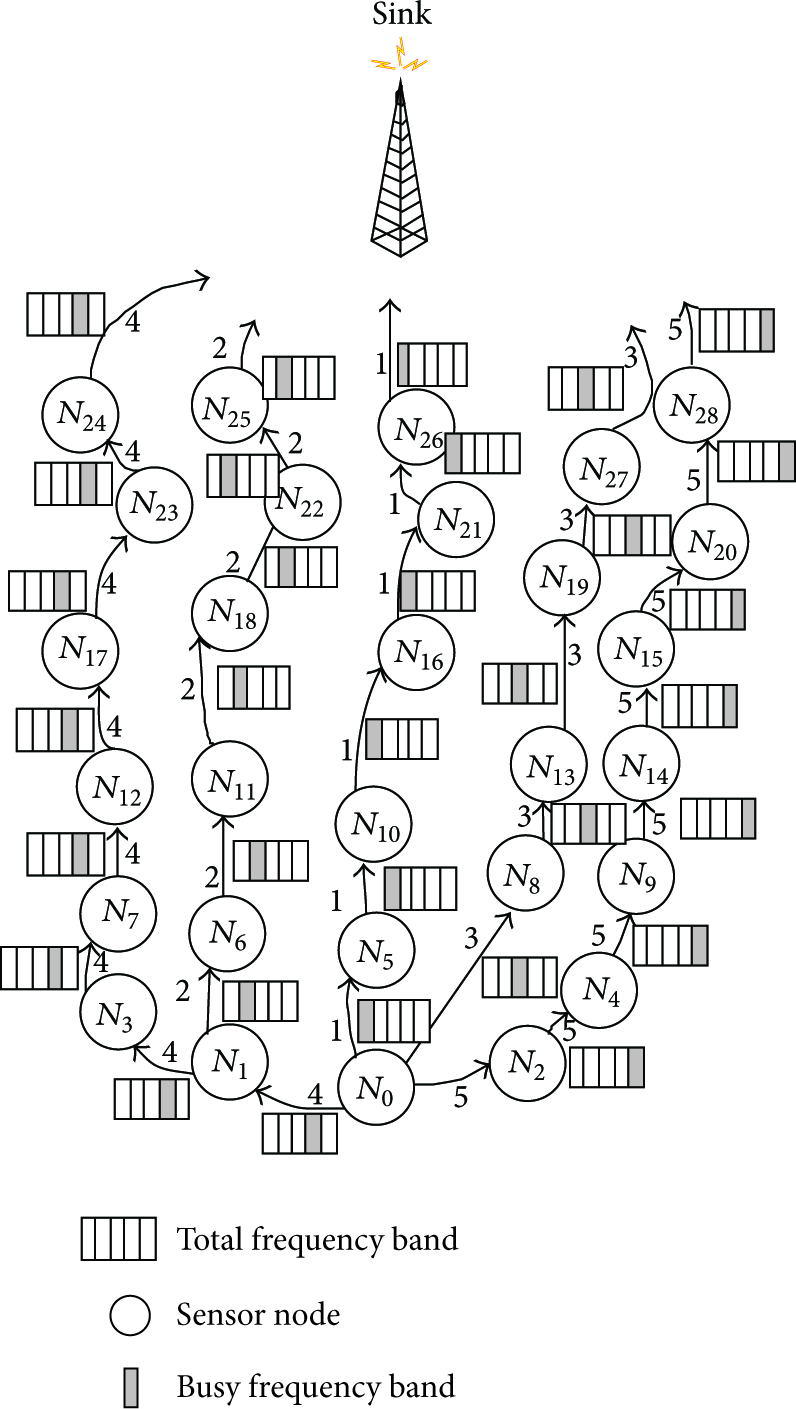
Scenario 2: real-packet transmission, number of non-overlapping channels = 5, number of hops traveled (QoS parameter) = 7, and number of packets = 5.
5. Evaluation and Performance Analysis
We evaluated the performance of our proposed method by comparing it with the methods of Greedy and our earlier proposal LEERA-MS. As the authors exposed before [32, 33], due to the fact that much more energy is consumed during the data communication compared with the data processing, sensor nodes consume much more energy during data transmission. As far as we know, the authors have only discussed their contributions by concerning the QoS, such as delay or reliability. However, the major issue to be considered for sensor networks is the energy scarcity problem. Therefore, we did not only concern the QoS in our method. We also considered the lifetime maximization by implementing a load distributed routing algorithm. We did the calculations of energy consumptions during the data communication both in the sending and receiving stages according to the following formulas:

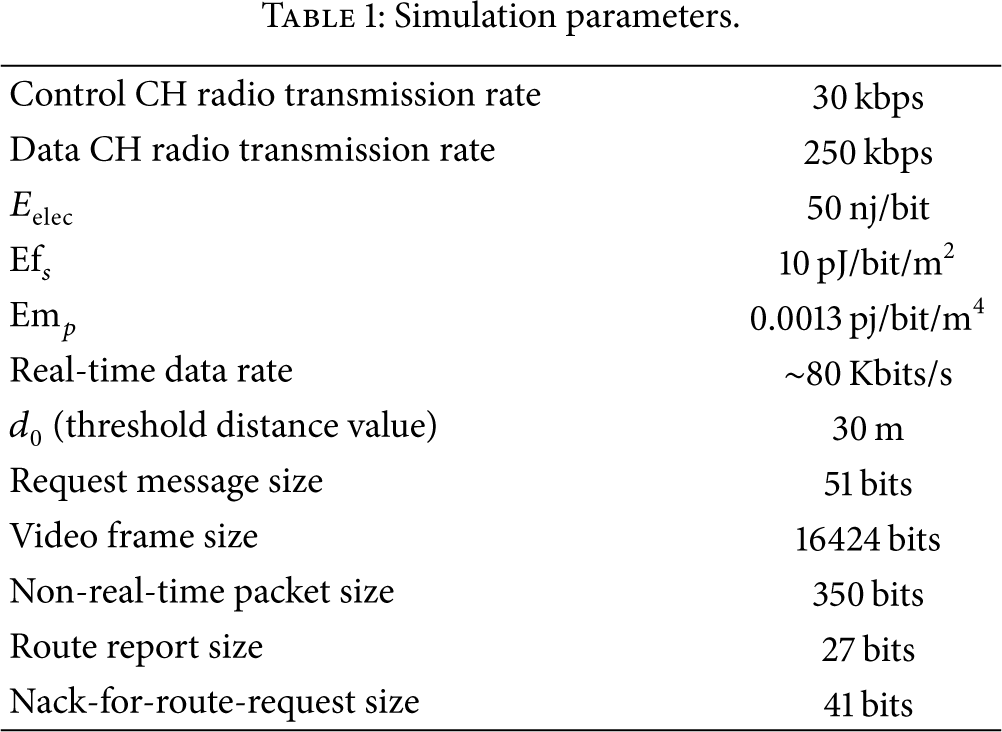
We prepared our simulations in JAVA. It is assumed that there are n non-overlapping channels and each node has two half-duplex radios. The radio with low speed and low power is statically assigned to the control channel. The other radio, which is with high speed and power, dynamically switches to the convenient channel after the approval of the route request. Besides, the sensor nodes have the ability of sensing both scalar and multimedia data. The parameters applied in simulation are represented in Table 1.
Simulation parameters.
5.1. Performance Analysis of Delay and Energy Consumption versus Data Rate
Figure 13 presents the comparison of our new model with the Greedy and our earlier method LEERA-MS in terms of delay and energy consumption. Data rate affects only the network lifetime. Other parameters, such as bandwidth utilization rate, end-to-end delay, or load balance, are not affected by the data rate.

Comparison of energy consumptions.
As clarified in Figure 13, the amount of energy wasted by the most energy spender node in the network is the smallest in QS-LEERA-MS. That yields the network lifetime maximization. The network using Greedy approach as the routing method has the shortest network lifetime, because of that the path employed for the first packet's transmission is also used for the remaining packets of the same stream. However, in LEERA-MS and QS-LEERA-MS, packets use different paths in order to arrive to the sink. Network lifetime comparison is depicted in Figure 14.

Comparison of network lifetimes.
As it is mentioned before, increase in the number of non-overlapping channels contributes to the fair distribution of the load balance. Besides, bandwidth utilization increases due to enabling more than one node using the common broadcast medium at the same time. By utilizing multiple channels, it becomes possible to divide the original stream into multiple subflows and transmit these flows over distinct paths by considering the QoS levels. As illustrated in Figure 15, with the increase in the number of channels operated, fair distribution in the load balance is more likely to be provided. This is because much more nodes will share the mission of conveying the packets towards the sink.
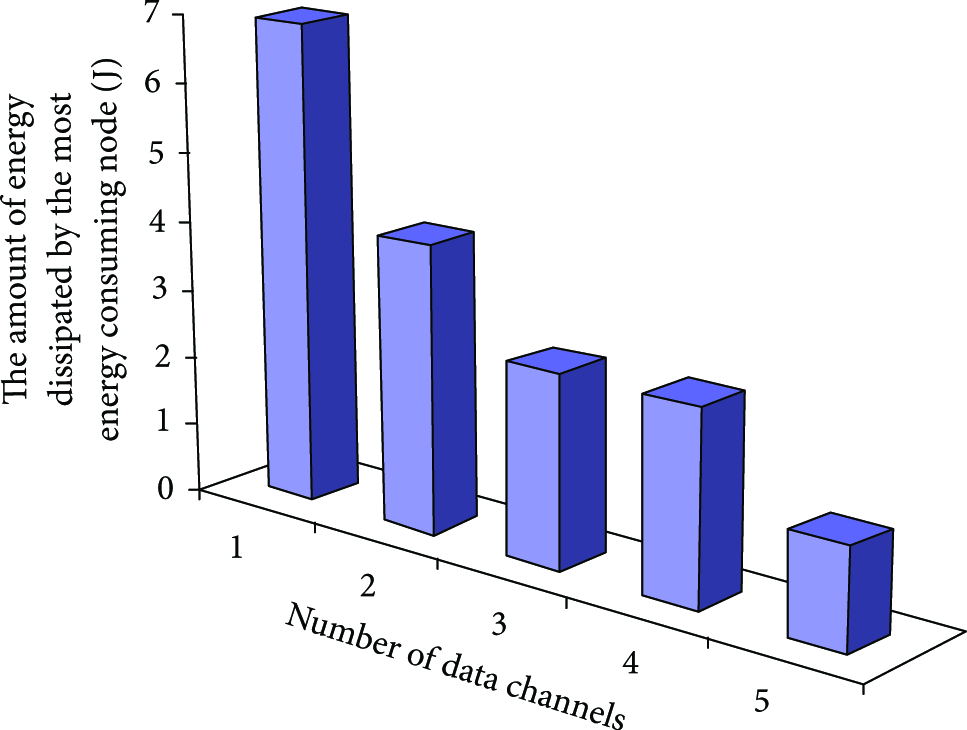
Effect of the number of non-overlapping data channels on the energy consumption.
However, employing multiple longer paths towards the sink causes an increase in the end-to-end delay. Nevertheless, during the path construction and resource reservation stage, QoS is already considered. Paths violating the QoS are not permitted.
Another factor affecting the network lifetime is the requested QoS. As mentioned previously, as the QoS constraint (maximum number of hops that a packet can pass over towards the sink denoted by number of hops traveled in Figure 16) gets loose, more alternative paths emerge. Thus, more nodes take in charge during packet relaying process that provides load balancing. As shown in Figure 16, loosening in the QoS constraint prolongs the network lifetime.

Effect of the requested QoS to the network lifetime.
Besides, loosening in the service quality also increases the throughput because that providing by utilizing a certain number of channels, and multiple paths can be used for relaying packets to the sink. Therefore, packets do not have to travel along the same path and wait in the queues of the nodes located on this path. Consequently, as shown in Figure 17, utilizing multiple paths by loosening the service quality causes an enhancement in the throughput.

Effect of the requested QoS on the throughput.
6. Concluding Remarks
Energy scarcity is the major problem of WSNs. Hence, traditional methods and protocols used for conventional ad hoc networks are not convenient for WSNs. These traditional approaches do not mostly concern with the energy issue. However, while designing architectures or protocols to employ in WSNs, energy scarcity problem should also be considered in addition to concerning the traditional issues faced with in ad hoc networks.
With the evolution of plain sensor networks into MWSNs, additional challenges have emerged to be considered. Those sensing-capability-enhanced nodes have to transmit their captured multimedia data to the sink in some reasonable delays. Thus, while designing a protocol for MWSNs, QoS should also be considered as well as the energy scarcity issue.
In this paper, we proposed a multichannel cross-layer architecture with a novel load balanced routing method. The main feature of our scheme is that multiple path construction is made possible by employing multichannel structure. A single multimedia stream including multiple video frames is segmented into multiple flows according to the number of paths constructed with respect to not exceeding the QoS constraint defined in the request messages. The key point is that while constructing these multiple paths, a packet must travel maximum number of hops. We utilized this parameter in our simulations as the QoS criteria. Because, an increase in the number of hops traveled towards the sink causes additional service delays at the additional nodes. These additional service waiting delays cause an increase in the end-to-end delay. During path construction, if the QoS constraint is not exceeded, the resources on the path are reserved for that particular flow.
We compared the performance of our scheme (QS-LEERA-MS) with the Greedy method and our earlier method LEERA-MS. As the simulation results clarified, the network in our method significantly prolonged its lifetime when compared to the networks applying Greedy or LEERA-MS. Simulation results also stated that the packets transmitted over distinct paths prevented possible congestions in a single channel—single path architecture. Thereby, throughput of the system, which is a significant factor for real-time data transmission, is also increased.