




Abstract
This paper studies the ageing effect of mechanical joints reflecting from the tyre/joint impacting noise by measuring the vehicle structure-borne noise change. Field data is collected applying two measurement methods suitable for newly installed and existing old expansion joints. The measurement methodology is improved by designing and applying a trailer for equipment installation. The main advantage of this method is not to disturb existing traffic by lane closure for measurement. Field measurements were conducted regularly for a study period up to 16 months after new joint replacement to monitor the variation of the structure-borne noise change inside a test vehicle while passing through mechanical joints. Empirical relationship is developed based on the field data of the roadside airborne noise change and the vehicle structure-borne noise change. The roadside tyre/joint noises could be converted using calibrated empirical formula. Key result findings include the following. (1) The vehicle structure-borne noise change is found smallest during the 3rd–6th months even lower than that measured when a new joint is installed. The structure-borne noise change then keeps increasing afterwards till the end of the study period. (2) Similar observations are found in all study cases incorporating various mechanical joint types and test vehicle types.
1. Introduction
Bridge joint performances and assessment methods have been an important research area [1, 2]. Noise generated due to traffic over different road surfaces was measured in site and studied [3, 4]. A pavement condition index was developed numerically relating the field-measured data for evaluating the structural integrity and operational condition of pavements [5]. Application of nondestructive infrared thermography for detecting airport pavement defects was proposed [6]. Falling weight deflectometer was also a nondestructive method for monitoring and assessing rigid pavement systems [7]. A mathematical model of a 3D automobile and the interaction between wheels and the road surface and the geometry of the road surface were developed to confirm that stability of moving automobiles on pavements was closely related to road surface conditions including depth of ruts [8]. Statistical relationships among noise and pavement surface texture and friction were established using field measured data [9]. Bendtsen et al. [10] promoted nondestructive acoustic approach for analyzing the aging trend and effect of road pavements so as to assist road administrators to develop maintenance policies and strategies for traffic noise reduction. Traffic noise due to installing traffic calming devices to promote safety driving and speed reduction could not be avoided but should be minimized [11]. More recently, Donavan and Rymer [12] conducted a study to relate the effects of aging to tire-pavement noise generation for concrete pavements. Murugan et al. [13] studied the ageing problem of wind turbines by monitoring the trend of power output. Kamaitis [14] investigated the deterioration of bridge deck with site survey and condition evaluation for movement joints. Asphalt plug joints were specifically investigated and found to be effective to connect pavement decks together in terms of gap plate width, thickness, and edge geometry to reduce tire/joint noise [15].
In Hong Kong, there are over 580,000 licensed vehicles running along 2,000 kilometers of roads with 15 major tunnels, nearly 1,300 flyovers, and bridges. Lots of highway bridges were built and put into services in the past few decades of ages up to 40–50 years. Movement expansion joints are generally installed for connecting different sections of bridge decks over supporting piers. Riding qualities of movement joints on those highway bridges, especially noise nuisance generated by moving vehicles, are one major source of complaints received by the authority concerned in Hong Kong. In view of the close proximity of bridges to residential blocks due to the special situations in crowded cities like Hong Kong, such noise nuisance problem generated from traffic running on bridges becomes a severe environmental problem leading to frequent public complaints. Such issue becomes controversial as local residents are very subjective to make their complaints without scientific justification. Over 20,000 complaints were received in 1999 by the Environmental Protection Department (EPD). Among them, over 1/3 of them was noise related [16]. On average, the annual budget in the Highways Department of Hong Kong for road maintenance work is around HK$1.0 billion [17]. There are two main kinds of traffic noise which are bridge related: the tyre/pavement noise and the tyre/joint noise. The tyre/pavement noise refers to the noise created while the tyres of vehicles run on the pavement of bridges. Skid resistance representing the pavement surface condition has been measured adjacent to the joint noise to refer to the pavement condition as given in Figure 1. Indirect relationship was established between tyre/pavement noise and skid resistance value. The tyre/joint noise refers to the noise created while the tyres of vehicles collide with the mechanical joints on bridges. Many previous studies have focused on the former while fewer studies on the latter. In this paper, the study will focus on tyre/joint noise.
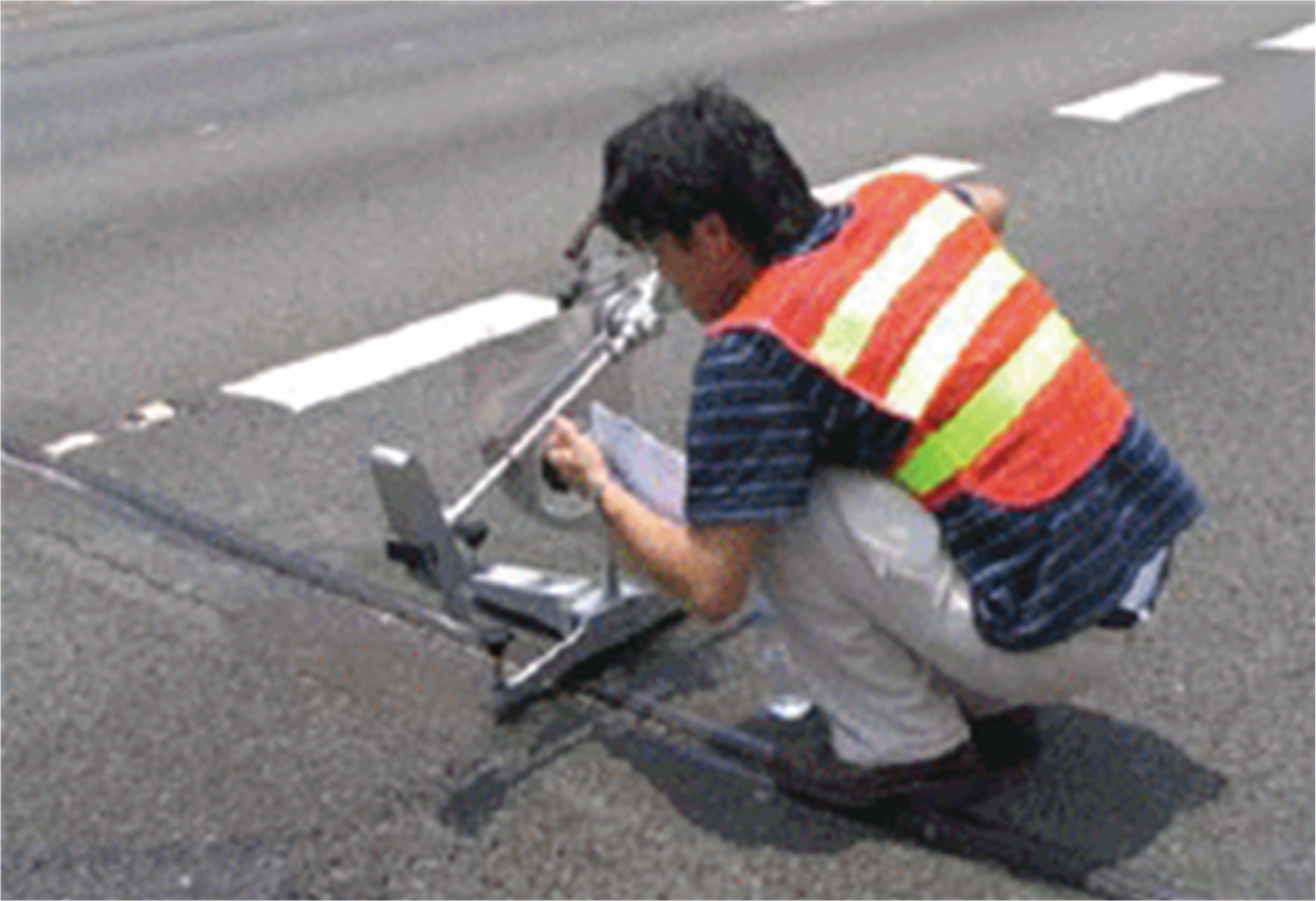
Field measurement of skid resistance by the first author.
In UK, Transport for London (TfL) also realized that deck expansion joints are important bridge component to ensure road user safety, bridge durability, and riding quality and should be maintained in good condition. Inside the “inspection guidance for bridge expansion joints” [18], it is highly recommended to keep a full inspection record for each movement joint including the entire history of defects, repair items, and methods to monitor the performance and working condition of each joint. Recommended inspection intervals are also specified as given in Table 1.
Lifespan and recommended inspection interval for 7 common expansion joints.

Visual inspection is considered most effective for identifying missing sealant, joint spalling, large-scale cracks, and damaged transition strip/nosing material/resin strip. Visual inspection becomes difficult if not totally impossible to check vertical movement under heavy traffic loading and hairline cracks due to the blocking of moving vehicles according to the Oregon Department of Transportation.
In general, pavement surface condition in terms of surface frictional level usually decreases with increasing service age as the rough surface wears off under repetitive axial traffic loading. It was also revealed that the reduction in the pavement surface roughness over time can be expressed as a mathematical function of cumulative axial loading. Pavement age and accumulated traffic loading are almost statistically collinear [19]. Since expansion joints are installed to connect successive bridge pavement decks, it is reasonable to further relate the joint condition and performance or the ageing effect of joint with the road surface roughness. Field measurement of skid resistance near the expansion joint noise has been carried out to verify this indirect relationship. One major weakness of this method is the requirement of lane closure that is seriously disturbing daily traffic and is thus considered not efficient for urban areas with heavy vehicular traffic. Measurement works involved can become unmanageable to put forward a full history record.
The present research team has realized such practical difficulty and therefore established our own measurement technique, namely, Acoustic-box-in-vehicle methodology, to measure tyre/joint noise. As the proposed methodology has been refined, the present one is modified from a previous version [4]. The key difference between the two methods is that a trailer is designed and employed in the enhanced version containing all necessary measuring equipments. The trailer method is more reliable to produce consistent measurement results eliminating the potential problems of replacing test vehicles. Six movement joints from 4 selected bridges managed by the HKSAR government, namely, Bridge A–D, are scheduled for on-site field tests. Two joints of two different types with noise-reduction design have been newly installed on Bridges A and B. Site tests were conducted periodically nearly 1.5-year to continuously monitor their noise performances using a test vehicle without the trailer. Another 4 existing joints of two different types on Bridges C and D were also tested periodically for about 6 months to keep monitoring their noise performances by the measurement method using the trailer.
In order to examine the actual difference and correlate the results obtained by the two different measurement methods, both methods have been applied on Bridge D. Numerical measurement results of Acoustic-box-in-vehicle methodology with the trailer and that without using the trailer can be directly compared and reported in the present study.
2. Methodology
2.1. Measurement Using a Control Vehicle
A previous study has been carried out using Acoustic-box-in-vehicle methodology [4]. A microphone placed on roadside and another microphone placed in a control vehicle will capture the changes of the noise levels measured while the test vehicle approaches, pass through, and leave a joint. The roadside microphone and the in-vehicle microphone will measure different natures of the noise generated. The microphone on the roadside is used to measure the airborne noise change while the control vehicle is passing through the joint, that is, the tyre/joint noise. The microphone in the control vehicle is used to measure the structure-borne noise change of the test vehicle while the test vehicle is passing over the joint. An acoustic box, which is mounted rigidly in the control vehicle, is used to envelope the microphone to facilitate the measurement of the structure-borne noise change. In the proposed methodology, the airborne noise change and vibration change are focused and measured. It is because the tyre/joint noise is induced within the short time when the control vehicle passing a joint. The instruments capture the sound and vibration responses before and after the control vehicle passing through the movement joint. Hence, the airborne noise and vibration due to other sources should be eliminated. The roadside airborne noise change and the vehicle structure-borne noise change are calculated by (1) and (2).
The airborne noise level change captured by microphone on the roadside is

where ΔLair = Airborne Noise Level Change, P
a
is the sound pressure captured by the roadside microphone just before the control vehicle passing through the joint, Pref, a is the sound pressure captured by the roadside microphone when the control vehicle is passing over the joint, and
The structure-borne noise level change captured by the microphone inside the acoustic box is

where ΔLstru = Structure-borne Noise Level Change, Pref, s is the sound pressure captured by the microphone inside the acoustic box just before the test vehicle passing over the joint, P
s
is the sound pressure captured by the microphone inside the acoustic box when the test vehicle passing over the joint, and
From a previous study, statistics show that the vehicle structure-borne noise change is linearly proportional to the roadside airborne noise change. Therefore, the vehicle structure-borne noise change can be used as an indicator to show the noise performance of mechanical joints, including joint types with noise reduction performance. Acoustic-box-in-vehicle methodology without using the trailer has been used for noise measurement on Bridges A and B.
2.2. Enhanced Measurement Using a Trailer
Damping system of a test vehicle would affect the structure-borne noise received by the microphone installed inside the acoustic box. The previous measurement method is thus modified. A trailer without damping system, as shown in Figures 2 and 3, is used to carry the acoustic box for conducting practical field measurement. Figure 4 shows a schematic overview of the modified methodology. The frame of the trailer is self-manufactured using galvanized iron angles and galvanized iron bars. The junctions of the frame are connected by metal arc welding. A piece of hardwood is employed to form a deck for the placement of the acoustic box. The axle, wheels, and tyres of the trailer are detached from a sedan with the removal of its original damping system. There are no powered moving parts on the trailer with bearings and wheels only. The trailer itself is a rigid body.

Trailer towed by a towing vehicle.
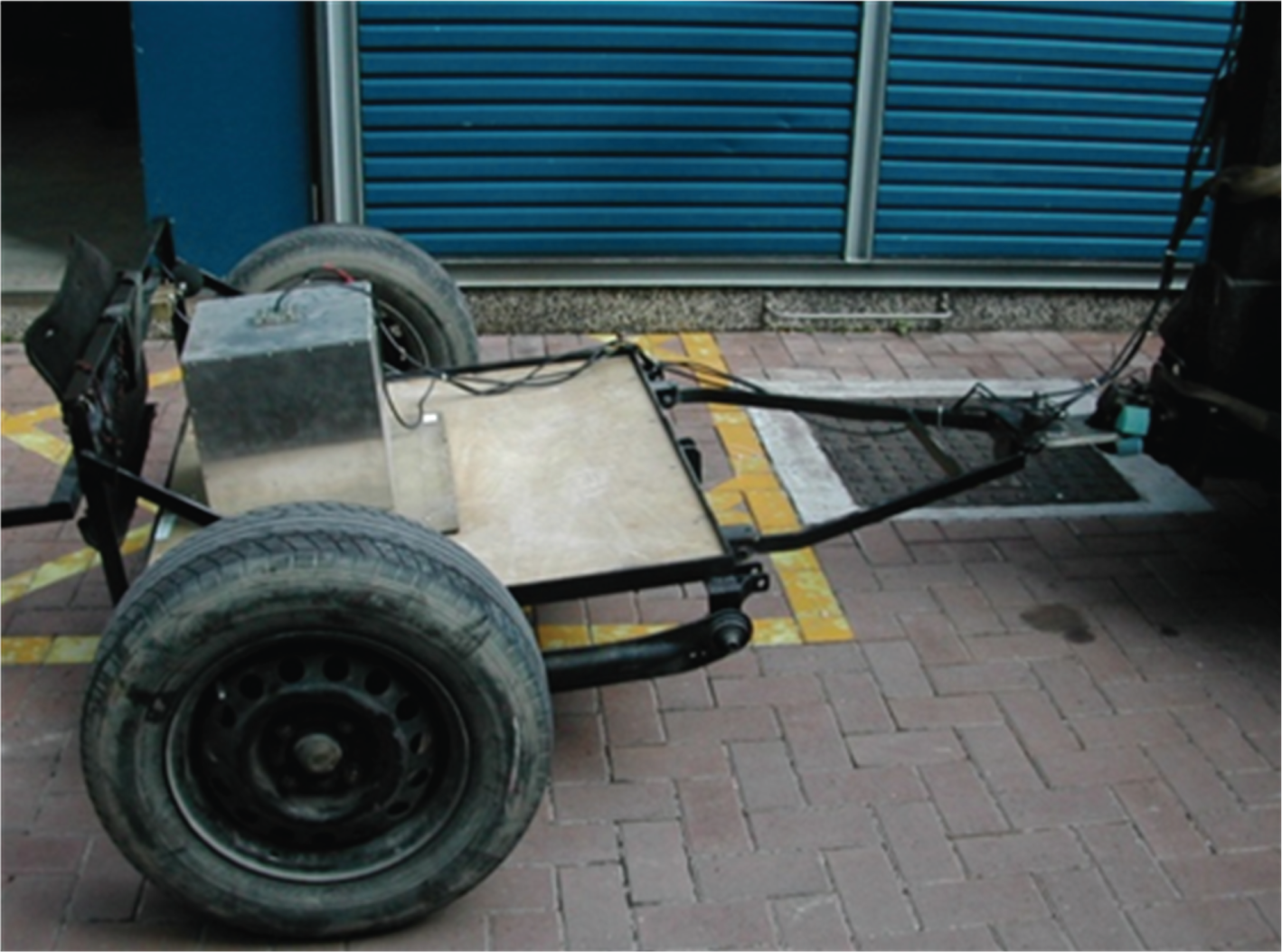
Trailer with an acoustic box.

Schematic diagram of setting up the Acoustic-box-in-vehicle methodology with trailer.
Having no damping system, the trailer cannot travel at high speed level as proven from trial tests. Cases were reported that the trailer would “fly through” the joints instead of passing over the joints with direct contact. With experiences on testing mechanical joints along the high traffic volume highways in Hong Kong, it is recommended that the maximum traveling speed for conducting meaningful measurements with the trailer is around 15 km/hr.
The proposed methodology using the trailer has been used on Bridges C and D. The structure-borne noise change captured by the microphone inside the acoustic box is calculated by (2).
3. Case Study and Measurement Results
Six movement joints installing in 4 different bridges, denoted as Bridges A, B, C, and D, are selected for measurement tests. Each joint consists of a series of measurements which are carried out on a regular basis. The structure-borne change as time goes can then be monitored.
Table 2 shows the summary of all the tests. Acoustic-box-in-vehicle methodology is used for all the measurements. The trailer is absent in the tests on Bridge A and Bridge B. In contrast, the trailer is employed for the tests on Bridge C and Bridge D. The speed limits of Bridge A, Bridge B, Bridge C, and Bridge D are 70, 50, 70, and 70 km/h, respectively.
Summary of the measurement and test results.

The speed of the control vehicle is maintained above 90% of the speed limit when it runs across the joints on Bridge A and Bridge B. The speed of the trailer is maintained at 15 km/h when it runs across the joints on Bridge C and Bridge D.
Old joints are selected, respectively, from Bridge A and Bridge B. Both old joints have been installed and used for more than 5 years. A measurement is firstly carried out to measure the structure-borne noise change of the old joints. After that, the old joints are replaced with the new joints with noise-reduction design. A series of monitoring measurements is then carried out on a regular basis up to 16 months after the joint replacement. Two more joints are selected, respectively, from Bridge C and Bridge D. These joints are relatively new joints which have been installed and used for about 2 years. No joint replacement work has been carried out during the monitoring period; however, maintenance work has been carried out to repair the joint nosing on Bridge D after the second monitoring measurement.
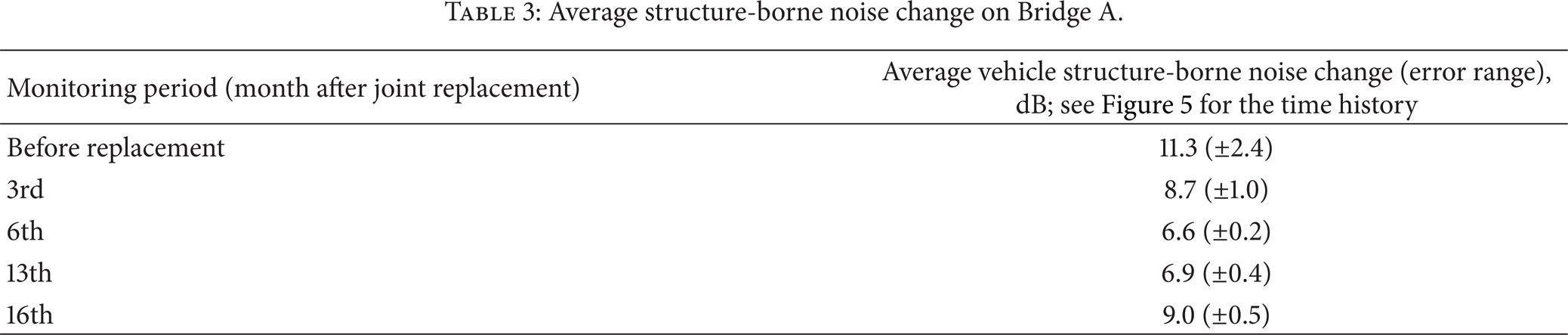
For all the monitoring measurements carried out on Bridge A and Bridge B, the respective highest structure-borne noise change is found in the measurements which are carried out before the joint replacement. This is reasonable as both joints are old joints with more than 5 service years. After joint replacement, structure-borne noise change keeps decreasing to reach a minimum noise level and then increases again. For the monitoring measurements carried out on Bridge C and Bridge D, the respective structure-borne noise change increases generally as the joints age. The structure-borne noise change of the joints on Bridge C increases along with the joints age. The structure-borne noise change of the joints on Bridge D has increased and then decreased. The decrease of structure-borne noise change in the third monitoring measurement of Bridge D is attributed to the scheduled maintenance work. The nosing of the joints on Bridge D has been repaired in the fourth month after the commencement of the monitoring measurement period. All test results are given in Tables 3, 4, 5, and 6 and Figures 5–8 and Figures 9, 10, 11, and 12.
Average structure-borne noise change on Bridge A.
Average structure-borne noise change on Bridge B.

Average structure-borne noise change on Bridge C.

Average structure-borne noise change on Bridge D.
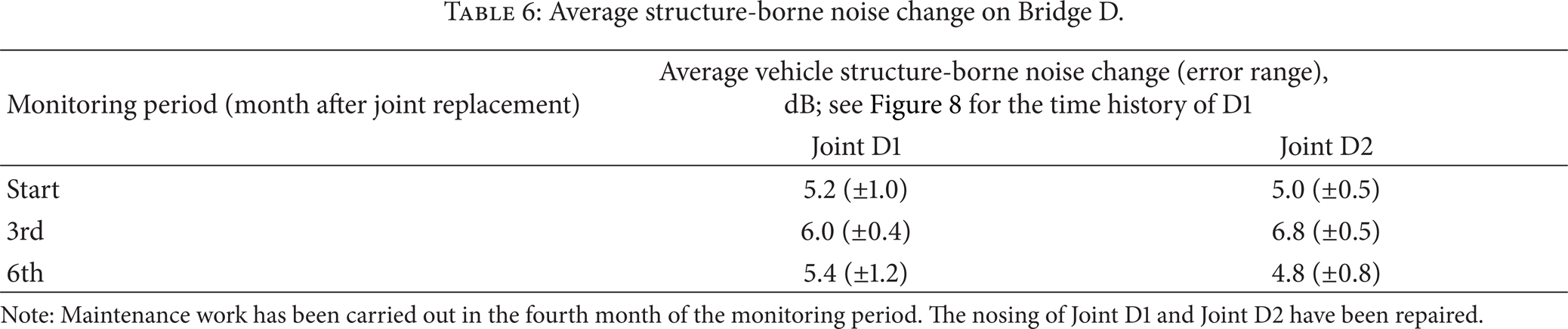
Note: Maintenance work has been carried out in the fourth month of the monitoring period. The nosing of Joint D1 and Joint D2 have been repaired.

Joint type on Bridge A and the time history of the measured vibration level when the control vehicle passing the joint.
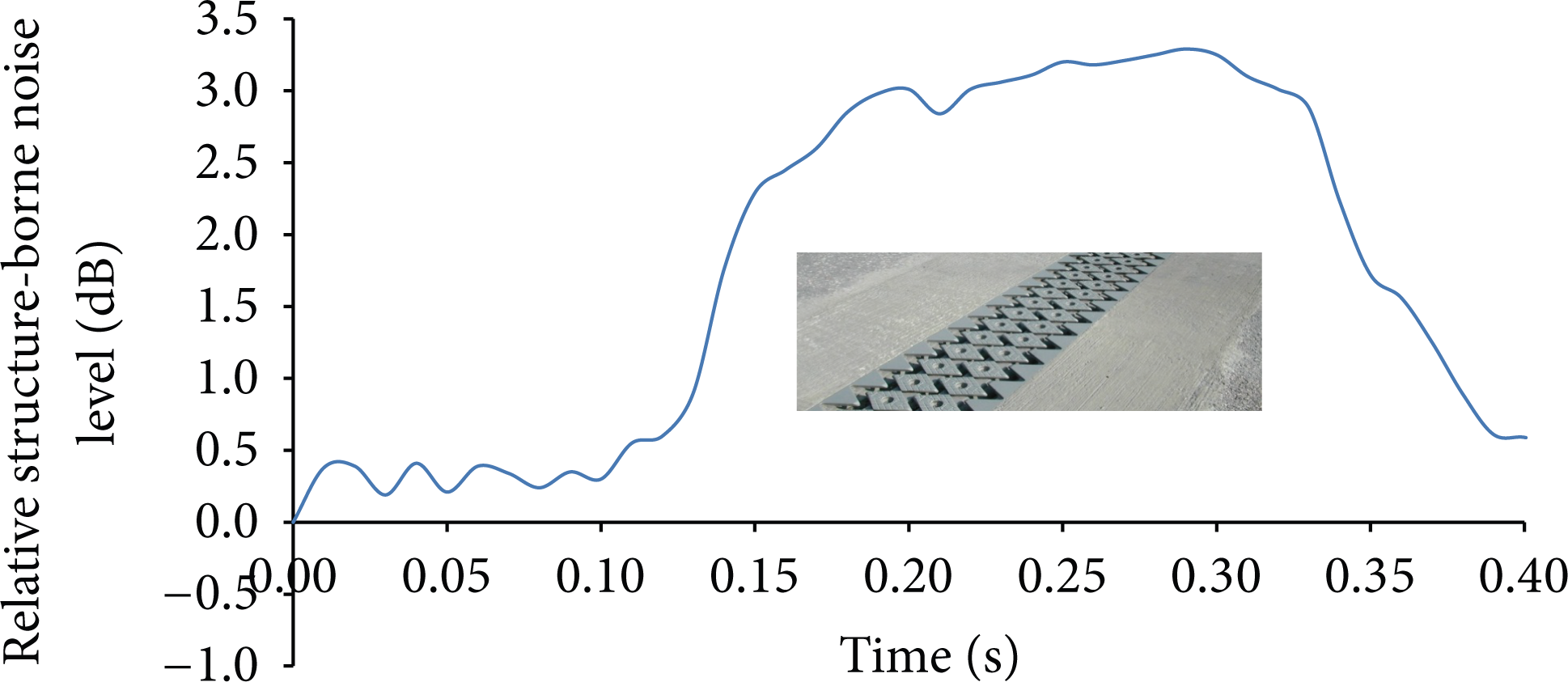
Joint type on Bridge B and the time history of the measured vibration level when the control vehicle passing the joint.

Joint type on Bridge C and the time history of the measured vibration level when the control vehicle passing the joint.

Joint type on Bridge C and the time history of the measured vibration level when the control vehicle passing the joint.

Average structure-borne noise change on Bridge A.
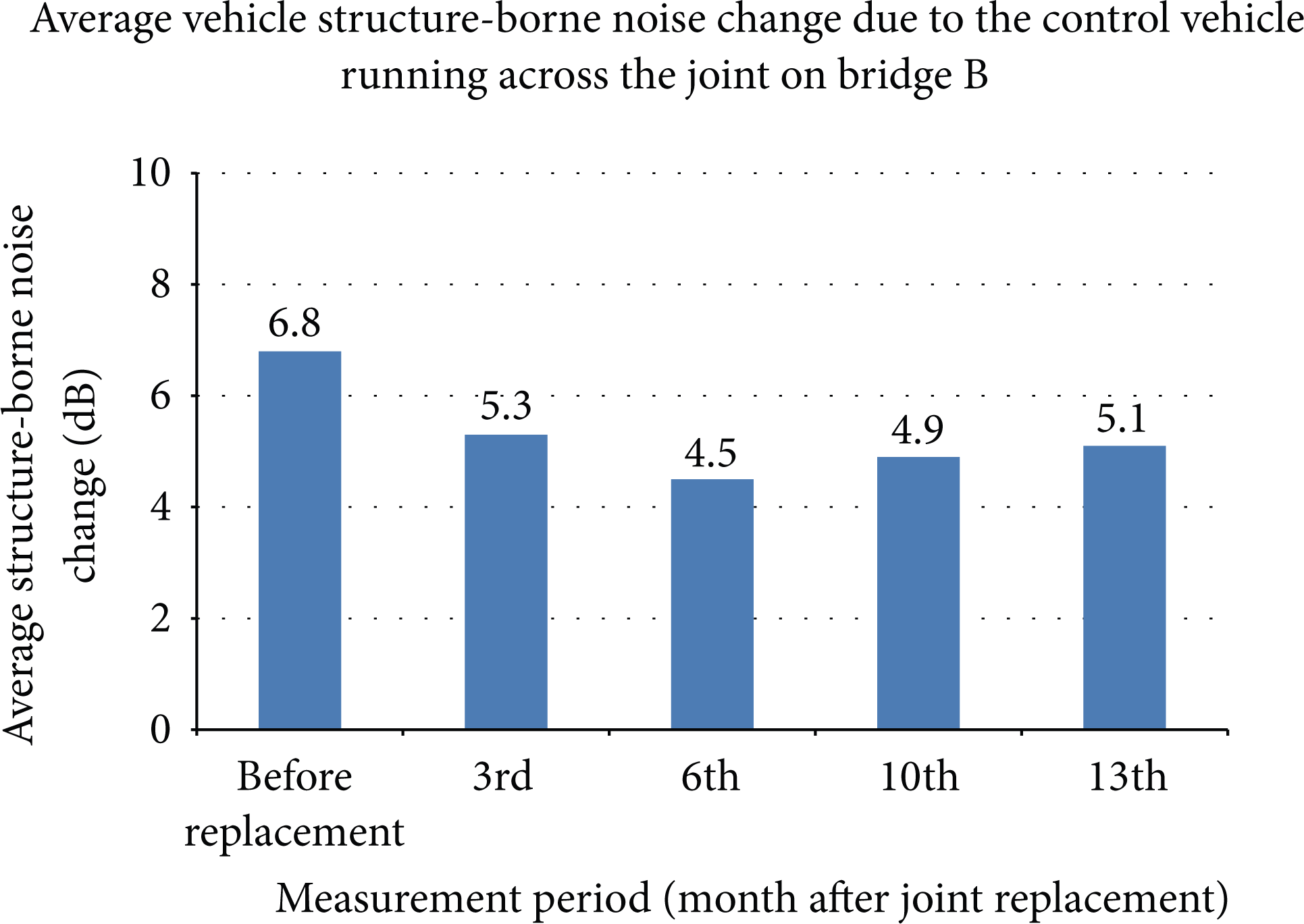
Average structure-borne noise change on Bridge B.
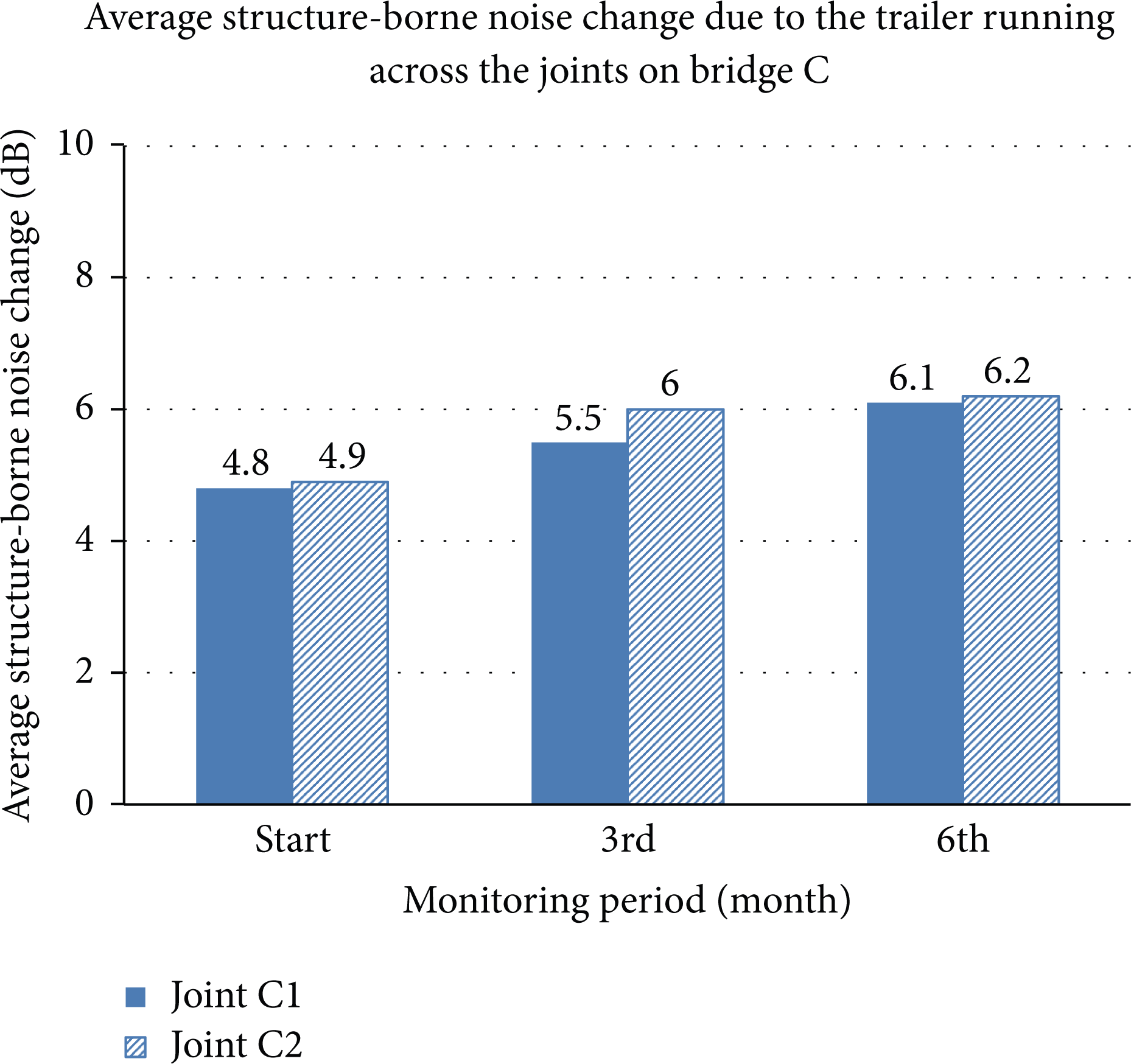
Average structure-borne noise change on Bridge C.

Average structure-borne noise change on Bridge D (joint nosing of respective joints has been renovated after the third month of the monitoring period).
Bridge D is planned to be tested with the trailer. However, an extra measurement has been carried out on Bridge D. The structure-borne noise change captured by Acoustic-box-in-vehicle methodology with the trailer is plotted against the structure-borne noise change captured by the Acoustic-box-in-vehicle methodology without using the trailer. The results are shown in Figure 13 and Table 7. A strong linear relationship is observed for Joints D1 and D2.
Structure-borne noise change captured by Acoustic-box-in-vehicle method with and that without using the trailer on Bridge D.


Comparison between the Acoustic-box-in-vehicle methodology.
4. Discussions and Recommendations
Intensities of tyre/joint noise level measured on Bridges A and B are found to keep decreasing during the first 6 months after joint replacement work. The reason is that contractors for joint replacement work do intend to allow some level difference between the nosing of two bridge decks in the joint installation. Such level difference starts to diminish after opening to traffic where vertical wheel loadings are applying on the joint and it results in decreasing the tyre/joint noise. An increasing trend of tyre/joint noise is then found on Bridges A and B after the noise level has reached lowest values. Similar trend has also been found on Bridges C and D, regardless of the third measurement carried out on Bridge D as prior maintenance work has been completed. This trend is normal due to the inherent ageing effects of the mechanical joints. Damages, such as cracks at the nosing of the joint as shown in Figure 14, can be detected accordingly and confirmed by visual inspection.
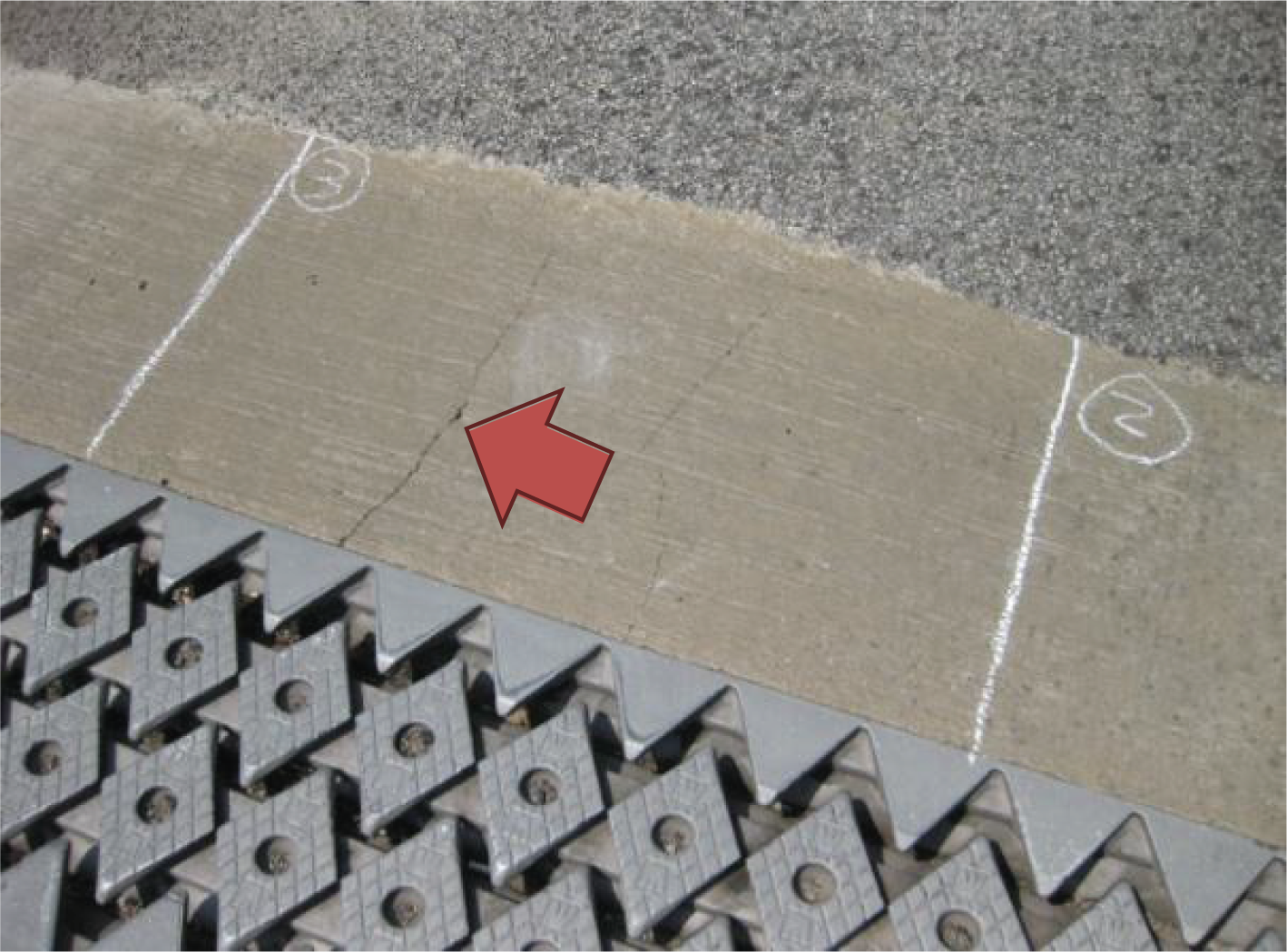
Cracks at the nosing of the bridge joint on Bridge B.
It is recommended that noise levels on mechanical joints should be monitored at least once a year in Hong Kong by an approved monitoring and measurement method. The noise reduction capability of joints may probably be degraded to an unacceptable level if the noise level is found to exceed a threshold when vehicles run over a movement joint. Inspectors should report this to the authority concerned for seeking appropriate follow-up actions, such as noise measurement, maintenance work, or joint replacement. Once a mechanical joint is detected with abnormal noise problems and decided for replacement, contractors should pay attentions to the following areas.
A reasonable minimum curing time for concrete hardening should be provided.
Never install different types of joints across different lanes along a road section.
Level difference between the nosing of two consecutive bridge decks near the movement joint should be restricted to within +3 mm.
Movement joints with finger type design and noise reduction capability features should be used whenever possible. The design of the joint should consider facilitating joint replacement operation, improvement of nosing/bitumen interface, and reinforcement details. A typical design of the currently used joint type as shown in Figure 15 has top rebars (in blue color) extending from the pavement to cross the rebars (in green color) of the nosing and bending vertically as shear reinforcement (in blue color) of the joint. Such complex overlapping of reinforcement causes difficulty and will be timeconsuming in joint replacement. A better finger-type zigzag design for the nosing/bitumen interface and reconnecting the cut top reinforcement to the preinstalled coupler (in blue and green colors) is proposed to replace the current joint design, as given in Figure 16.

Typical design of currently used bridge joints (with top rebars extending from pavement to nosing).
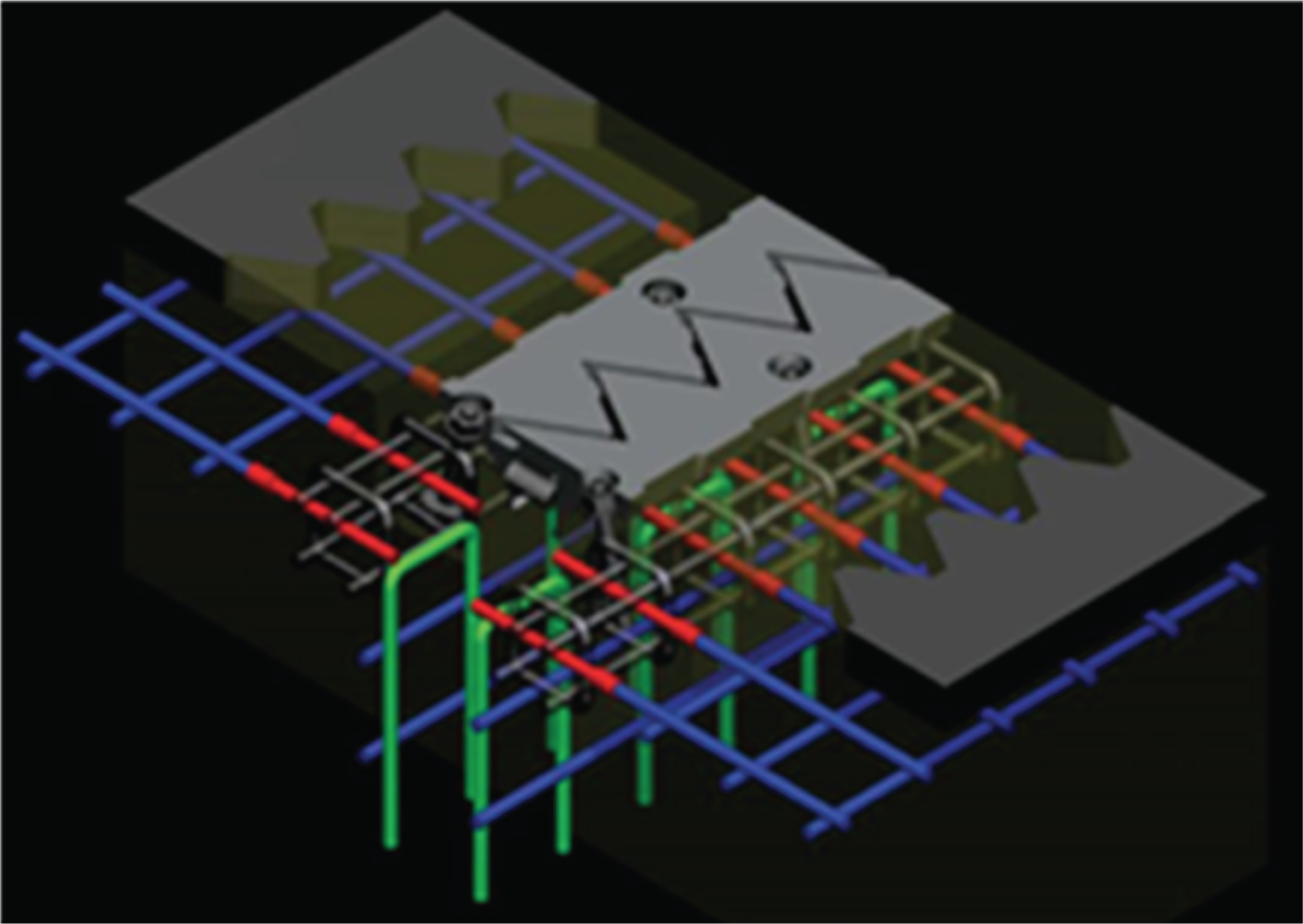
A new proposed design of bridge joint for easier joint replacement.
One of the main features for noise reduction joint design is the finger-type design that the noise reduction plates can effectively reduce the angle of transition with the vehicle wheels. As vehicle tyres while traveling across the interface of two surfacing materials will generate noise, adopting the new zigzag joint design to the nosing/bitumen interface can further enhance the noise reduction at joint by reducing the angle of transition at the noising/bitumen interface. The proposed zigzag nosing/bitumen interface is a design with steps of width 75 mm and pitch spacing at 150 mm (in Figures 16 and 17). The shape of the stud can maintain the necessary strength of concrete pavement for vehicle wheel load and limits the contact length of vehicle tyre across the nosing/bitumen interface to be 75 mm. The introduction of angle of transition provides a phasing in design for the vehicle so that tyre contact would reduce from line contact to point contact across the nosing/bitumen interface.
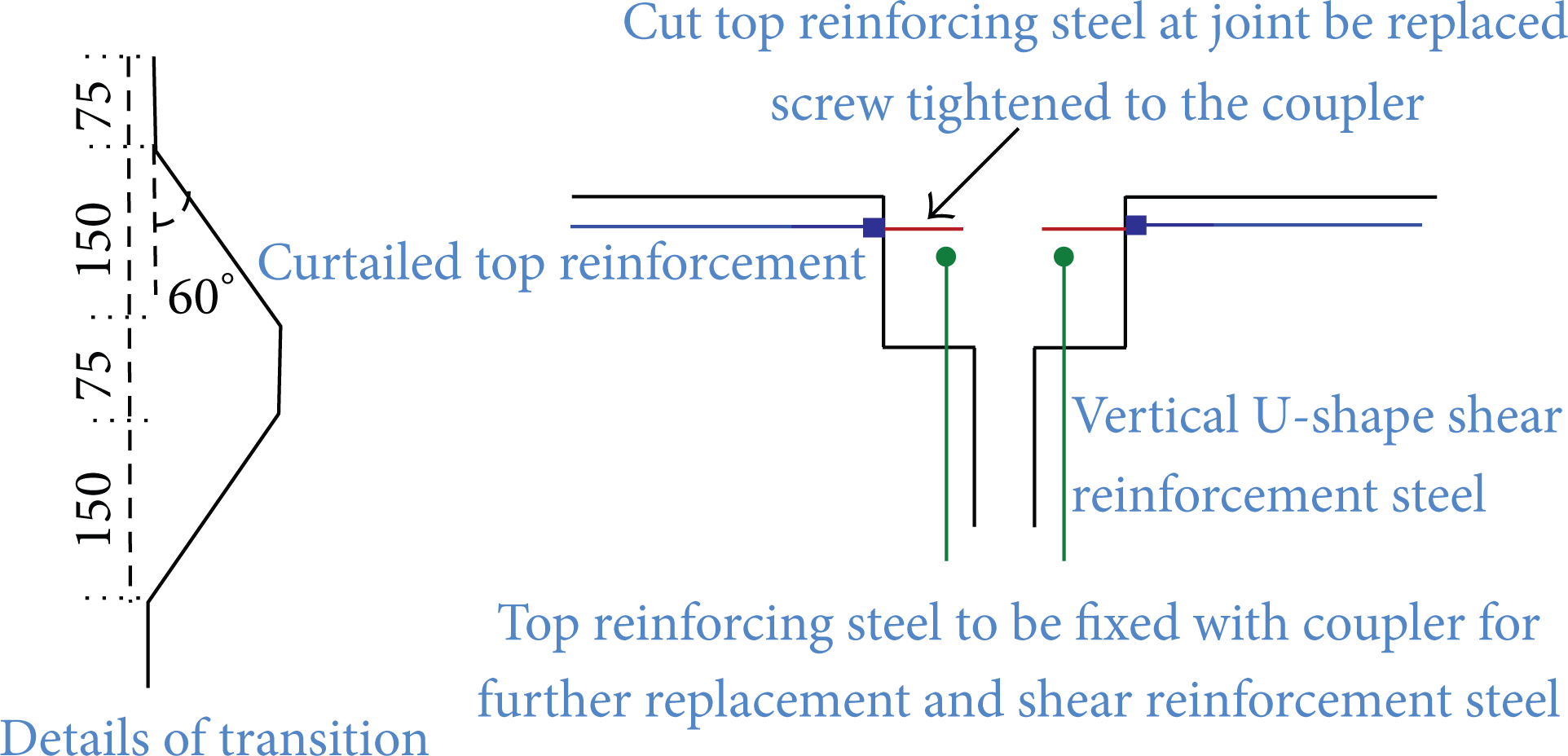
Details of the proposed nosing/bitumen interface design.
5. Conclusions
In general, the tyre/joint noise increases as the age of the mechanical joint grows due to normal deterioration. According to the nondestructive measurement results in the present study, this general trend is also matched for joints with noise-reduction design on four studied bridges. It is found that the tyre/joint noise levels of new installed mechanical joints will first reach a certain level and then drop in the next 6 months right after joint installation works. Percentage of such drop in the tyre/joint noise is around the average range of 10–30% for the 4 studied bridges. After this tyre/joint noise reduction period, the noise level will then be increased steadily and linearly with the time line. It can be concluded that either joint replacement or standard maintenance works can be carried out to help reduce the tyre/joint noise level. In order to keep a bridge joint in good condition for traffic based on the measured noise level, regular joint replacement work must be conducted.
Footnotes
Acknowledgment
This research was supported by a research Grant (SRG 7002569) from the City University of Hong Kong.