




Abstract
This paper proposes a multiday nonlinear pairwise swapping dynamic (MNPSD) model to describe travelers' day-to-day selfish rerouting behaviors. By introducing a perceived route cost measure, formulated as the descending weighted average of the actual route costs experienced in the past several days, MNPSD can capture various experiential perception levels. It is proved that both stationary path flow pattern and stationary link flow pattern of MNPSD are equivalent to Wardrop user equilibrium. Given that the perceived weight decreases exponentially, numerical sensitivity analyses are executed to explore the effects of experiential perceptions on rerouting behaviors. Numerical results suggest that (1) the ultimate states of route swaps depend much more on the reaction sensitivity than on the capacity interference, (2) too much dependence on the historical experience can increase the risk of instability rather than stability, and (3) for high reaction sensitivity network, the instability can be remedied by incorporating proper perception experience.
1. Introduction
Day-to-day traffic assignment approach, also termed as day-to-day route swapping, is devoted to identifying a traveler's microscopic rerouting behavior and further revealing the laws that traffic flows evolve from day to day in an aggregate level. Usually, this kind of microscopic behavior is described as a Markov process; that is, a traveler adjusts the routes just according to the travel experiences in the past one day rather than more days. Given that the advanced traffic information service is available and feedback information is supplied to the drivers, many route swapping models are proposed (see [1] for a brief review) during the past three decades. Considering the focus of this study, only the pairwise route swapping models are reviewed here. Smith [2] proposed the classical proportional-switch adjustment process (PAP) to describe the day-to-day traffic evolution on the network. PAP assumes that traffic adjusts from the previous costly routes to less costly ones with revision rate being proportional to the pairwise absolute cost differences. PAP is viewed as (perhaps) the most natural route swapping process [3]. It has simple mathematic formulation and intuitive behavior basis; in addition, PAP explicitly addresses the original micromechanism of network traffic evolution; that is, how will traffic swap between two routes connecting the same OD-pair? Based on PAP, Cho and Hwang [4, 5] built a stimulus-reaction dynamic, where an artificial constraint was added to prevent negative path flows. However, the revision protocol had no change and the artificial constraint lacked reasonable behavior basis. More extensions could be found in [3, 6–12].
Walting and Hazelton [13] mentioned the superiorities of day-to-day traffic modeling method; however, they also pointed out two major limitations for the continuous models (PAP included), that is, the continuous-time trip adjustment and homogeneous user assumptions. Recently, Zhang et al. [14] pointed out another two behavior deficiencies of PAP, that is, weak robustness and overswapping, and then developed a nonlinear pairwise swapping dynamic (NPSD) which was able to overcome the above-mentioned limitations and behavioral deficiencies. Meanwhile, NPSD inherits many advantages of PAP.
It is necessary to strengthen that both PAP and NPSD assume that a traveler's rerouting decision depends solely on the perceived experience in the previous one day. This assumption is questionable. In reality, a traveler usually evaluates a route and makes his/her travel decision according to the experiences perceived during the past several days more than the previous one day. Hence, to make the day-to-day route swapping model sounder, more experiences perceived in the past ought to be considered. However, to the best of our knowledge, until now few studies have addressed this problem using a UE-oriented rerouting dynamics from a quantitative prospective. Based on the Logit-based rerouting dynamics, Horowitz [15] applied the weighted average of travel times experienced in the past to study the stability of stochastic user equilibrium. Such a weighted average method, later, was used in the studies on the effect of travel information on route choice behaviors (e.g., Nakayama et al. [16, 17]). For this reason and to explore the effects of experiential perceptions on rerouting, a multiday NPSD (MNPSD) model is developed in this paper. Since MNPSD is born out of NPSD, it inherits the advantages of NPSD.
The rest of the paper is organized as follows. In Section 2, the proposed MNPSD model is illustrated and some qualitative properties for MNPSD are proved rigorously. Numerical sensitivity analyses are performed in Section 3 to explore the effects of different experiential perceptions on rerouting. Section 4 concludes this study.
2. Multiday Nonlinear Pairwise Route Swapping Dynamic System
Firstly, we give four assumptions for the proposed rerouting dynamic model: (1) the travel demand is inelastic; (2) each traveler has perfect information (e.g., obtained from the feedback information released by ATIS) of the traffic network during the past several days; (3) a traveler evaluates the performance of a route and makes the route swapping decisions, based on the perceived cost function built on the travel experiences in previous several days; (4) a traveler only changes his/her route to a less costly one, and at least some travelers, if not all, will do so unless all the travelers were all on the least costly routes on the previous day.
The above four assumptions and those assumptions made in PAP and NPSD differ from each other just in the amount of perceived travel experiences. Subsequently, we introduce a perceived route cost measure to incorporate the multiprevious travel experiences into a traveler's rerouting behaviors. Mathematically, the perceived route cost is formulated as

Here, t is the time index, w is the OD-pair index, k is the route index (k ∊ K
w
, where K
w
is the set of acyclic routes between OD-pair w), C
k
wt
is the real route cost on route k between OD-pair w at time t, I is the experiential number of days considered into rerouting decision, β
i
is the perceived weight towards the i-days-ago real route cost, and
Based on the above preparations, the proposed multiday NPSD (MNPSD) model is formulated as follows:

where

where

and the initial route flows meet

In (2)-(3), f
k
wt
denotes the route flow on route k between OD-pair w at time t, θ
w
is a dimensionless parameter that reflects the travelers' reaction sensitivity between OD-pair w, ρ
kp
wt
is the revision protocol for computing the percentage of traffic flow shifting from route k to route p between OD-pair w at time t, R
k
wt
is the set of routes, between OD-pair w at time t, which are not more costly than route k, and
Obviously, when I = 1, we have G k wt = C k wt from (1), and then MNPSD returns to NPSD. Below we present three properties of MNPSD model.
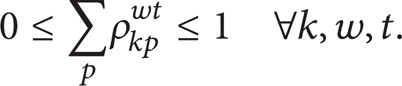
Property 1 (contrary sign). The following inequality holds in general, that is,

Proof. According to (3), it could be concluded that ρ
kp
wt
= 0 if and only if G
k
wt
≤ G
p
wt
and ρ
kp
wt
> 0 if and only if G
k
wt
> G
p
wt
. Then, we have
Property 2 (nonoverswapping). During an adjustment, the total swap-out flow from a route cannot spill its initial value, mathematically, that is,
Proof. Since
Property 3 (solution invariance). If the initial path flow pattern is feasible, so do the remaining path flow patterns, namely, the equilibrium constraint in terms of travel demand and the nonnegativity of path flow hold in general.
Proof. Given a feasible initial path flow pattern, Property 3 requires that the remaining path flows are still nonnegative and the travel demands still satisfy the conservation constraint, that is,

Nonnegativity. According to (3) and Property 2, ρ
kp
wt
≥ 0 and
Conservation. Since

according to (1), we have

Accordingly, Property 3 is owned by MNPSD.
Definition 1 (Wardrop user equilibrium [18]). At the equilibrium state, all the used paths connecting the same OD-pair have the minimal and equal travel costs when the travel demand is fixed. Mathematically, the following equalities and inequalities hold:

where π w is the minimum real route cost between OD-pair w.
Definition 2 (stationary path flow pattern). The stationary path flow pattern of MNPSD is a set of network path flow states; starting from these I-repeated path flow states, MNPSD reproduces them.
Theorem 3. The stationary path flow pattern of MNPSD system is equivalent to Wardrop user equilibrium.
Proof. Firstly, we provide the sufficiency proof of Theorem 3.
Sufficiency. Suppose f t , grouping f k wt , belongs to stationary path flow pattern; we have, for all i ≥ 1, k, w, f k w(t + i) = f k wt and in further C k w(t + i) = C k wt as well as G k w(t + i) = G k wt , where vectors C t and G t orderly group C k wt and G k wt . G k wt = C k wt for all k, w, t still hold according to (1). Suppose also route p has the minimum general cost among those routes between w, then we have G k wt ≥ G p wt if f k wt ≥ 0. For conviction, suppose that G k wt > G p wt if f k wt > 0; we can conclude from MNPSD that f p w(t + 1) = f p wt (because new flow will shift to p from k). This conflicts with the fact that f t belongs to the stationary path flow pattern. Hence, G k wt = G p wt if f k wt > 0, and further G k wt ≥ G p wt if f k wt = 0. Let π w = C k wt = G k wt ; it means C k wt = π w if f k wt > 0 and C k wt ≥ π w if f k wt = 0, which shows that f t is a Wardrop user equilibrium.
Necessity. Suppose f
t
is a Wardrop user equilibrium; that is, C
k
wt
= π
w
if f
k
wt
> 0 and C
k
wt
≥ π
w
if f
k
wt
= 0; we can conclude C
k
wt
≤ C
p
wt
if f
k
wt
> 0 and C
k
wt
= C
p
wt
if f
k
wt
> 0 and f
p
wt
> 0. Given I-repeated f
t
, we deduce G
k
wt
= C
k
wt
for all k, w, t from (1). Then, we can conclude G
k
wt
≤ G
p
wt
if f
k
wt
> 0 and G
k
wt
= G
p
wt
if f
k
wt
> 0 and f
p
wt
> 0. Recall (3); we have ρ
kp
wt
= 0 if f
k
wt
> 0 and ρ
pk
wt
= 0 if f
k
wt
> 0 and f
p
wt
> 0 can be promised. Accordingly, we can derive
Definition 4 (stationary link flow pattern). MNPSD's stationary link flow pattern is a set of network link flow states; starting from these I-repeated link flow states, MNPSD reproduces them.
Theorem 5. MNPSD's stationary link flow pattern is equivalent to Wardrop user equilibrium.
Proof. Firstly, we provide the sufficiency proof of Theorem 5.
Sufficiency. Suppose v t , grouping v a t , belongs to stationary link flow pattern; we have, for all i ≥ 2, vt + i = v t and further Gt + i = G t , where vector G t groups G k wt : = G k w (f t ). Let vector f t , grouping f k wt , and g a t : = g a (v t ) denote the general cost of link a at time t; we can conclude

Expanding

Because of Property 1 and the nonnegativity of path flows,

From (14), given f p wt > 0 and f k wt = 0, we have G p wt ≤ G k wt ; given f p wt > 0 and f k wt > 0, we have G p wt ≥ G k wt and G p wt ≤ G k wt , and then G p wt = G k wt . In other words, those used paths have the minimum and equal general cost. Since v t belongs to the stationary link flow pattern, we have C k w(t + i) ≤ C k wt for all i ≥ 1 and futher G k wt = C k wt for all k, w from (1). Then, we can also conclude from (14) that the used paths have the same cost which is not larger than that of those unused ones, which exactly implies Wardrop user equilibrium.
Necessity. Since the link flow pattern is generated from the path flow pattern and Theorem 3 has proved that the stationary path flow pattern is equivalent to Wardrop user equilibrium, the necessity can be easily promised.
As is known to all, without extra behavioral conditions, Wardrop user equilibria are not unique with respect to the path flow pattern but to the link flow pattern. However, according to Theorem 5, we can judge whether MNPSD has reached equilibrium or not by detecting the states of network link flows.
3. Numerical Studies
In this section, several numerical sensitivity analyses are conducted on a hypothetical network to analyze the impacts of experiential perceptions on rerouting behaviors.
3.1. Testing Network and Scenario
The numerical network (see Figure 1) has 12 nodes, 17 links, 2 OD-pairs, and 8 paths. In Figure 1, the bracketed numbers in each link correspond to its label, free-flow travel time (min), and initial designed capacity (pcu/min). OD-pair (1, 11) is connected by Path 1 (1 → 9 → 14), Path 2 (1 → 5 → 10), Path 3 (2 → 6 → 10), and Path 4 (2 → 11 → 15); OD-pair (2, 12) is connected by Path 5 (3 → 11 → 16), Path 6 (3 → 7 → 12), Path 7 (4 → 8 → 12), and Path 8 (4 → 13 → 17).

The travel demands for two OD-pairs are both 90 (pcu/min). Obviously, Figure 1 is symmetric. The travel time on each link is computed as follows:

where A is the set of links on the network and c a 0, v a , and O a are orderly the free-flow travel time, traffic flow, and initial designed capacity on link a. For brevity, the units are omitted in the remaining presentation.
Here we assume that the initial traffic flow pattern of network is at Wardrop user equilibrium state with f0 = (20, 20, 25, 25, 25, 25, 20, 20) T and all travelers have the same reaction sensitivity θ. For observing the rerouting behaviors, we impose multiple levels of one-day capacity reduction interferences on Link 11, and denote Cap11 as the percentage of capacity reduction. Note that the capacity reduces only at day 0 and goes back to normal after day 0. Obviously, Figure 1 remains symmetric after the capacity reduction.
Assume that, when I ≥ 2, the experiential perception weights between two adjacent days satisfy the following relationship; for example,

where 0 < b ≤ 1. 0 < b < 1 implies that the experiential perception weight reduces as time goes back; b = 1 implies that travelers have equal perceived weight to experiences. Based on (1), I = 1 (i.e., travelers only consider the travel experience in previous day) implies that the weight is equal to 1. We stipulate the importance of perceived experience rises as I and b increase.
In these numerical studies, we carry out the sensitivity analyses on four parameters (i.e. Cap11, θ, I, and b) and set Cap11 = [20%: 30%: 80%], θ = [1.0: 1.0: 4.0], I = [1: 1: 7], and b = [0.25: 0.25: 1.0]. Since the purpose is to explore the effects of perceived experiences, I and b are of major interest. Theorem 3 has proved that the stationary path flow pattern of MNPSD is equivalent to Wardrop user equilibrium. Hence, we use
3.2. Numerical Results and Analyses
The numerical results show that, when route swaps are not convergent, the traffic flows of network will finally (within 500 iterates) step into twodays of periodical oscillations if I = 1 and into multidays of quasiperiodical oscillations if I ≥ 2. To measure the dispersion degrees of the final flow states, we introduce the following average deviation AD; that is,

Obviously, AD is positively correlated to the dispersion degrees of the final flow states. AD = 0 if route swap is convergent; otherwise, AD > 0. Since the oscillation manners under different specified parameters are not identical, without loss of generality, the path flow data from iterate 940 to 979 are chosen to compute AD.
Tables 1, 2, and 3 present the numerical results of MNPSD-conducted route swapping under different levels of link capacity reductions; that is, Cap11 is equal to 20%, 50%, and 80%. Those bolded decimals represent the route swaps which are not convergent, and the values are the corresponding ADs. While the unbolded integers imply that the route swaps can converge to the initial Wardrop user equilibrium, and the values correspond to the terminative numbers of iterations. We found that the numbers in the columns with I = 1 are identical. This is because MNPSD returns to discrete NPSD when I = 1, and b does not work in those cases.
Numerical results of route swapping under Cap11 = 20%.

Numerical results of route swapping under Cap11 = 50%.

Numerical results of route swapping under Cap11 = 80%.

It is uniformly found from Tables 1, 2, and 3 that the bolded areas increase with θ; however, the distribution features of bolded areas do not vary as Cap11 increases and the corresponding ADs also change a little. This suggests that, in contrast to the capacity reduction, the reaction sensitivity has much more significant influence on the convergence of route swapping.
In addition, Tables 1, 2, and 3 jointly show that the bolded areas commonly distribute at the bottom or on the right of those θ-specified rows, and the distribution size of bolded areas increase as θ increases. This phenomenon demonstrates that (1) paying too much attention to the historical experience will increase the risk of instability rather than stability and (2) high reaction sensitivity θ is an important reason for causing instability. Looking into those rows with θ = 4, we find that nonconvergence under I = 1 can recover convergence under I ≥ 2; however, it works only when b is not very large (e.g., b < 0.75); otherwise, recovery is still impossible. This suggests that the instability of network full of extremists can be remedied when the historical experience is perceived properly. For every θ-specified convergent area in Tables 1, 2, and 3, we find that the iterative numbers to stop rerouting under I ≥ 2 are larger than those under I = 1 on the whole. This suggests that adding perceived experience properly can reduce the rates of rerouting, making route swapping behaviors gentler. This may explain why instability under I = 1 can recover to stability under I ≥ 2.
Table 4 gives the convergent supremums of θ under different levels of experiential perception. Those bolded areas mark the differences among Cap11 = 20%, 50%, and 80%, while the left areas are identical. Note that here all the numbers are accurate to 0.005.
The convergent supremum of θ.
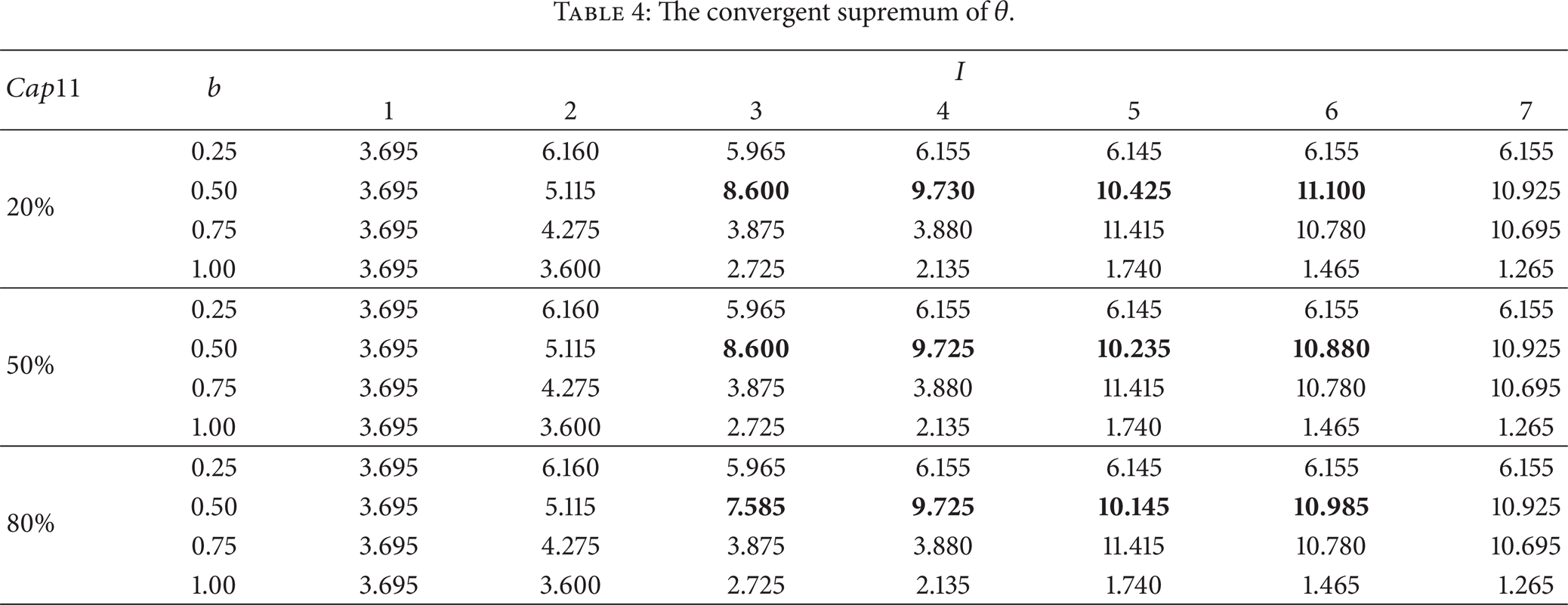
Firstly, we can see from Table 4 that the corresponding bolded supremums for Cap11 = 20%, 50%, and 80% have no much difference, which suggests that capacity interference has a small effect the convergent supremums of θ. Secondly, when b ≤ 0.75, those supremums for all I ≥ 2 are uniformly larger than the 3.695 of I = 1; when b = 1, the supremums decrease strictly as I increases. This suggests that lengthening experience with degressive perception weight helps the network to bear more excessive reaction behaviors and strengthen the antijamming ability, whereas the equal treatment runs counter to the desire.
4. Conclusions
By introducing a perceived route cost measure, formulated as the descending weighted average of the actual route costs experienced in the past several days, this paper suggests a multiday nonlinear pairwise swapping dynamic (MNPSD) system to describe travelers' day-to-day selfish rerouting behaviors under different experiential perception levels. It is proved that both stationary path and link flow patterns of MNPSD are equivalent to the Wardropian user equilibrium. Based on a hypothesized traffic network and assuming that the perceived weight decreases exponentially, a numerical example is conducted. The numerical results suggest that (1) the ultimate states of route swaps depend much more on the reaction sensitivity than the capacity reduction interference; (2) too much reliance on the historical experience can increase the risk of instability rather than stability, and (3) for high reaction sensitivity network, the instability can be remedied by adding proper perception experience. This is because proper experiential perception helps to reduce the rates of rerouting, making route swapping behaviors gentler in another way.
Footnotes
Acknowledgments
This study is sponsored by the NSFC Project (no. 71131001), the National Basic Research Program of China (no. 2012CB725403), and the Fundamental Research Funds for the Central Universities (no. 2013JBM047).