




Abstract
Turbulent drag reduction by additives is an effective approach to save energy in wall turbulence. Improvement of this approach requires a better understanding of the interactions between turbulence and additives including the complex changes in turbulence under various conditions of additives. In this paper we review some recent progress in the investigations of drag reduction in wall turbulence with inhomogeneous polymer solutions via slot-injection and wall-blowing methods. The turbulent statistics characteristics and coherent structures modified by the inhomogeneous polymer additives and the polymer diffusion characteristics in the turbulent boundary layer (TBL) flow and channel flow are discussed in terms of previous experimental and numerical studies. This review also presents a discussion of current limitations and future directions in these areas. Readers may find it helpful in understanding the phenomenon of turbulent drag reduction by inhomogeneous polymer additives and in developing practical applications.
1. Introduction
The skin friction drag appears when fluid flows over a surface in wall turbulence. The drag can consume large amounts of power and cause emission of harmful gases. Therefore, drag reduction technique for wall turbulence is required and important in industrial application. Some kinds of high molecular weight polymer solutions added even at concentrations as small as ten parts per million can significantly reduce skin friction drag in turbulent flow. This phenomenon was first reported by Toms in 1948 and is known as Toms effect [1]. This drag-reducing effect, which depends on the polymer characteristics and concentration, has been the subject of a large number of investigations for understanding the complicated dynamic interactions between polymers and turbulence over the last 60 years [2, 3]. The results of the investigations can be used to ascertain the mechanism of turbulent drag reduction and even the mechanism of self-sustaining wall turbulence. They can also be extended to turbulence control in practical industrial application [4, 5].
During previous studies of polymer drag reduction in turbulent flow, the drag-reducing effect caused by homogeneous solutions in internal flow with polymer uniformly mixed was proposed and studied widely. It has been shown that considerable drag reduction can be achieved via the homogeneous polymer solutions when compared with the solvent alone [6–8]. The various drag-reducing characteristics and turbulent statistics in the drag-reduced flow with homogeneous polymer solutions were described in the literature [9–11]. Among them, Virk [6] has done some fundamental work on the drag-reducing effect in pipe flow and demonstrated the existence of a maximum drag reduction (MDR) asymptote for the first time. Meanwhile, several theories have been proposed to explain some characteristics of polymer drag reduction. Lumley [12, 13] proposed a model accounting for drag reduction based on the viscous effect of polymer molecules. It postulated that the stretching of polymer molecules outside the viscous sublayer can induce a large increase in the effective viscosity that enhances the dissipation of turbulent fluctuations and causes drag reduction. By this mechanism, the MDR phenomenon was explained by the saturated influence of stretching of polymer molecules qualitatively. The onset of drag reducing was interpreted by a threshold criterion, which required that the time scale of polymer relaxation be larger than that of turbulent eddies [12, 14]. In contrast, De Gennes [15, 16] proposed a model based on the elastic effect of polymer molecules, which posited that the moderately stretched polymer molecules can absorb and store the turbulent kinetic energy of small vortices in the energy-containing range. Thus, the turbulent energy cascade was impeded and the dissipation of turbulent kinetic energy decreased, inducing drag reduction. The onset shear stress and MDR asymptotic behavior can be predicted based on this mechanism [17]. The viscous effect and elastic effect constitute two long-lasting and contradictory theories in the subject of polymer drag reduction.
In more recent work, a large number of numerical simulations based on the constitutive equations of polymer solution including the most often used finitely extensible nonlinear elastic with Peterlin approximation (FENE-P) constitutive equation [18] have also been developed for investigating Toms effect with homogeneous polymer solutions [19–25]. Den Toonder et al. [26] posited that viscous anisotropic stress was the main reason for drag reduction by using two different constitutive equations. De Angelis et al. [27] postulated that the eddy viscosity, which increases linearly from the wall, dominated the mechanism of drag reduction [28, 29]. These related findings seem to support the viscous theory. However, the most recent developments seem to advocate elastic theory when explaining the MDR behavior. Dubief et al. [30] demonstrated that the MDR asymptotic phenomenon can be explained as a new flow state as “elasto-inertial” turbulence (EIT) rather than the consequence of an asymptotic adjustment of ordinary turbulence. The related work showed that the elastic instability of stretched polymer can destabilize the flow and the energy can transfer mutually between turbulent kinetic energy of the flow and elastic energy of polymer molecules at small scales [31–33].
There is no doubt that the investigations in the characteristics and mechanism of the drag-reduced flow with homogeneous polymer solutions may help to understand the interaction between polymer solutions and turbulence even for the flow with inhomogeneous polymer solutions. However, the existing research findings are not fully suitable for explaining inhomogeneous case due to its more complicated diffusion process of drag reducers. Based on the requirement of drag reduction in external flow [3, 34], the method of ejecting polymer solutions into water flow to reduce skin friction drag was proposed in some years earlier [35]. It was argued that the efficiency with respect to the cost is by far the best in the case of an inhomogeneous injection [36]. In fact, the inhomogeneous drag reduction flow was also suitable for fundamental research in terms of the polymer diffusion and near-wall turbulent structures. Now it has been a research hotspot and many researchers have been investigating the drag-reducing effect of inhomogeneous polymer solutions by experiments and numerical simulations. Among them, Tiederman et al. [37] investigated the turbulent statistics in the channel flow with polymer injection and concluded that the polymer dispersed into the buffer region was crucial for drag reduction. It was proved by Fontaine et al. [38] that the velocity statistics in the turbulent boundary layer (TBL) were different for the inhomogeneous case and the homogeneous case. White, Dubief, and coworkers [39–41] have researched the drag-reduced TBL flow by slot-injection in the evolution of drag reduction and the modification of near-wall structures. Moreover, in cooperation between the Japanese National Maritime Research Institute and the Fluid Function Laboratory in Tokyo University of Science, a novel method of blowing polymer solution from the whole surface of channel wall to the bulk flow was proposed to achieve drag reduction by inhomogeneous polymer solutions and this method was defined as the wall-blowing method [42–44]. The research showed that this method is still effective for drag reduction owing to the polymer solution remaining near the channel wall to the downstream locations. The slot-injection and wall-blowing methods are schematically shown in Figure 1, where the corresponding distributions of the inhomogeneous polymer solutions are also plotted.

Schematic diagram for the method of: (a) slot injection and (b) wall blowing, and corresponding polymer distribution in the near-wall region. The slot locates on the wall along the spanwise direction. C denotes the local polymer concentration.
In the turbulent flow with polymer injection or blowing from the wall, the polymer can diffuse into the bulk flow and interact with turbulence. Thus, the fluid in the bulk flow becomes an inhomogeneous polymer solution and the drag-reducing effect is generated. Recently, this drag-reduced flow has received increasing attention for explaining the nonequilibrium of polymer solutions and its effect on turbulence. Some systematic studies for the drag reduction caused by inhomogeneous polymer solutions via slot-injection and wall-blowing methods have been conducted [44–49]. They strive to ascertain the development of the drag reduction, the modification of turbulent statistics and coherent structures, and the process of polymer diffusion. More to the point, they try to clarify the relationship among them and find the intrinsic mechanism.
The purpose of this work is to present an overview of the research based on our current understanding of drag reduction in wall turbulence with inhomogeneous polymer solutions via slot-injection and wall-blowing methods. It focuses on the progress in the understanding of predicting drag reduction, turbulent characteristics, and polymer diffusion due to the limited space. In Section 2, we discuss the drag reduction obtained with the effects of injection process and polymer degradation. In Section 3, the turbulent statistics characteristics and coherent structures modified by inhomogeneous polymer additives are discussed. The recent advancements about polymer diffusion in the drag-reduced flow of inhomogeneous polymer solutions are introduced in Section 4. Finally, summary and special remaining questions warranting further investigation follow in Section 5.
2. Drag Reduction
Some studies have concentrated on the polymer drag reduction in TBL and channel flow with injection of polymer solutions [42, 45–49, 51–53]. Drag reduction is found to begin downstream of the location where drag-reducing polymer has been injected into turbulent bulk flow even though the solution is not mixed uniformly in the flow system. The additives can work directly on the flow processes in the near-wall region according to investigations [42, 54–56]. The drag reduction obtained is affected by the synthetical parameters during different injection process. The degradation of polymer additives also has important impacts on drag reduction.
2.1. Effects of Injection Process
In more recent works, experiments were conducted in water tunnels with narrow spanwise injection slots. The concentrations of the injected polymer solutions used were relatively high and Reynolds numbers were set over a large range in the tests. Table 1 gives the experimental conditions and drag reduction obtained by polymer injection in typical researches [48–50]. The polyethylene oxide (PEO) with a mean molecular weight of about 2–8 million was used to be the polymer additive.
Experimental conditions and drag reduction by slot injection in previous experiments.

The abbreviation “DR” denotes the drag reduction rate, hereinafter.
Previous researches indicated that the local concentration of the inhomogeneous polymer solution in near-wall region may determine the level of drag reduction [49, 57]. Three regions of drag reduction with different variations along the streamwise direction can be typically categorized corresponding to the evolution of polymer concentration downstream of the slot. They include a development region in which drag reduction first increases, a steady region in which drag reduction is nominally constant, and an attenuation region in which the drag reduction decreases gradually [45, 46, 51, 58]. It is indicated that the turbulent mixing and the concentration decreasing in near-wall region result in the attenuation of drag reduction [38, 45]. We will discuss the turbulent mass transfer and concentration distribution in the drag-reduced flow of inhomogeneous polymer solutions in detail in Section 4.
The DR obtained by slot injection has been plotted as a function of the K parameter developed by Vdovin and Smol'yakov [59]. Hence the amount of injected polymer solution from the slot is linked to the drag reduction. The K parameter is defined by

where Q i is volumetric injection rate per unit span, C is the weight concentration of the injected polymer solution, ρ is the density of the solvent (water), X i is the downstream distance from the slot, and U∞ is the free stream velocity. The DR is observed to be linearly proportional to log(K) and reaches MDR from a certain K.
In view of this thought, White and Mungal [3] pointed out that one universal plot of DR versus log(K) similar with that proposed by Hou et al. [47] can be obtained over wide ranges of polymers, injection rates, polymer concentrations, and free stream velocities based on the results in [38, 46, 59]. The onset of drag reduction was thought to occur for K > 10−9 and MDR was observed to achieve for K > 10−6 with different types of polymers in the plot, which will be introduced later in this section.
With respect to the wall-blowing method adopted in recent research [60], the attached blowing walls are made of sintered porous metal of 2 μm pore size, which allow polymer solution to be blown into turbulent channel flow from the surface of one-side channel wall. The blowing rate was adjusted by the constant rate pump and flow meter equipped in the blowing system. It was observed that the DR increases as the weight concentration of the polymer solution, blowing rate, and blowing mass flux increase [42–44].
Comparing to the wall-blowing method, slot-injection method requires injection of high weight concentration polymer solution (e.g., 500 ppm or 1000 ppm) to obtain long steady drag reduction. In contrast, the steady region of drag reduction aforementioned can be kept to the downstream by blowing low weight concentration of polymer solution (e.g., 10 ppm or 50 ppm) from the wall. In addition, the wall-blowing method can obtain large drag reduction by blowing relatively small amount of polymer due to the continuous supply of solution along the blowing wall. It will also be discussed in Section 4 in detail.
Figure 2 shows the profile of the relationship between K × 108 and DR in the measurements with injection of polymer solutions obtained by Motozawa et al. [42]. The additional red broken line in the figure denotes the result obtained by Hou et al. [47] using slot-injection method (represented by DR = 46.3 × log(K × 108) + 13.7). The black broken line is a log-linear fit to the experimental data by wall-blowing method (represented by DR = 11.5 × log(K × 108) + 28). It is obvious that this relationship is different from the result of slot injection. Same DR can be obtained by smaller K via wall-blowing method, which indicates that the wall-blowing method is more effective in case that small amount of polymer is blown from the wall. This performance was thought to be the excellent merit of wall-blowing method [44]. However, it can be seen that large deviations exist between the fitting curve and measured values in the figure. In fact, large deviations also exist in the slot-injection case [3, 47]. It can be speculated that the K parameter is not quite suitable for describing the development of drag reduction in inhomogeneous case. So, here one question that needs to be discussed is whether or not the scaled polymer flux is the unique parameter to take into account for drag reduction in the drag-reduced flow with inhomogeneous polymer solutions.
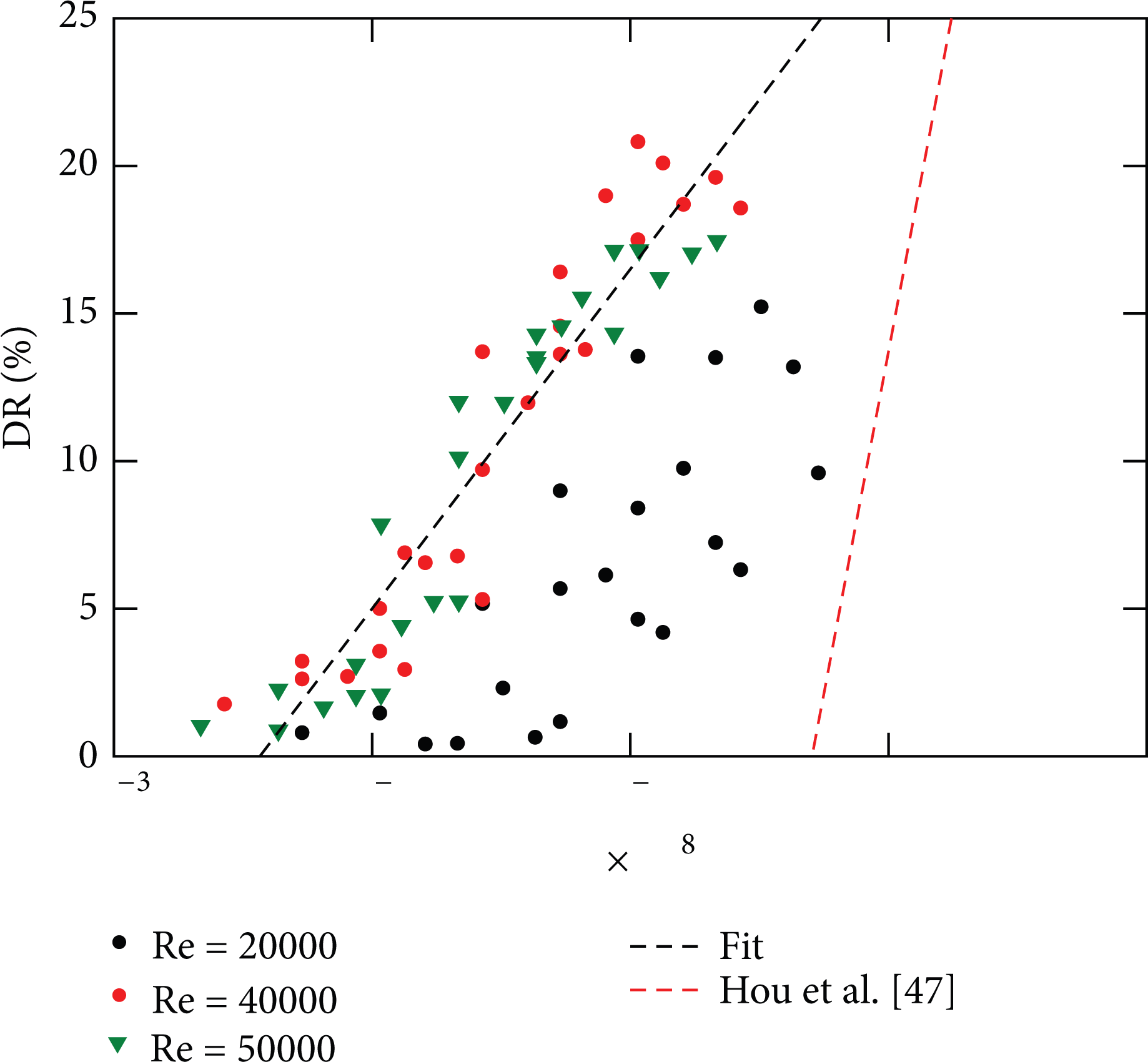
Relationship between K × 108 and DR in the measurements with injection of polymer solutions.
According to previous investigations on the mechanism of drag reduction caused by the viscoelastic polymer solutions [12, 15], the state of stretching and relaxing of polymer molecules may have a significant impact on the development of drag reduction. Hence the relaxation properties of the injected polymer solution should be considered as a major parameter in the prediction model of drag reduction. The K parameter in (1), consisting of dimensionless flow rate and Reynolds number [59], demonstrates the variation of polymer concentration in streamwise direction rather than the state of polymer relaxation in the intermediate region of the TBL. Thus, further investigations on the relaxation properties of polymer solutions during the diffusion process are required to quantify the effect of polymer state and to predict the DR for practical application with inhomogeneous polymer solutions. It needs more understanding about polymer dynamics and rheology.
2.2. Effects of Polymer Degradation
In practical drag-reduced flow by polymer additives, whether in inhomogeneous case or homogeneous case, the degradation of polymer can lead to noticeable decrease of drag reduction [61, 62]. This limits the use of polymer drag-reducing method in practical application, especially in recirculatory flow systems. To minimize the degradation and quantify the effect of degradation on drag reduction is therefore an important issue. Various studies have shown that degradation is a complex process which depends on many factors like chemical, thermal, and mechanical variables. The mechanism is likely to be the scission of molecular entanglements or breaking of individual molecular chains [63].
Thus, the first question that should be determined about the issue is what factors cause the degradation, especially the mechanical degradation. Until now, some researches [60, 64–69] have indicated that polymer molecular weight, molecular weight distribution, temperature, solvent solubility, polymer concentration, turbulent intensity, preparation and storage methods, entrance or end effects, and flow geometry may influence polymer degradation in turbulent flows. Nevertheless, it is noteworthy that due to various experimental conditions some conflicting results still exist when explaining degradation with the above factors. The further investigation of the influence factors of degradation is required.
The second question is how to quantify the degradation and its effects on drag reduction in turbulent flow. After realizing that degradation results in reduction of numbers of monomers in a molecule, Vanapalli et al. [65] derived a relationship between the critical shear rate
Choi et al. [68] investigated the applicability of one empirical exponential decay function, which is proposed by Bello et al. [70] for the polymer degradation in a drag-reduced turbulent pipe flow. The results showed that the single exponential decay model is not universally suitable for all polymeric drag reducers. Recently, Brostow et al. [67] derived an equation, which predicts drag reduction as a function of time and polymer concentration, to describe the degradation quantitatively. The equation contains quadratic term accounting for the overlap between polymer chains as

where, h0, h1, and h2 are constants for a given Reynolds number and polymer-solvent pair, λ and λ0 are drag-reducing efficacy corresponding to degrading state and initial state, W depends on the good/poor sequences ratio of chain pieces, t is time, and c is the polymer concentration. The results showed that the equation can model the effect of degradation on drag reduction within the limits of the experimental accuracy for different drag reducers. However, owing to the complication of high-molar-mass PEO like intermolecular aggregation in aqueous solution [49], the model about the correlation between time-dependent drag reduction and mechanical degradation needs more improvements to gain universal acceptance for all degradation behavior in the drag-reduced turbulent flow.
The last question to consider is what methods can be adopted to reduce the degradation of polymer additives in turbulent flow. White [71] posited that antioxidants may be important to suppress the oxidation initiated by high-frequency turbulent eddies. Brostow et al. [67] used grafted polymer to slower the mechanical degradation in flow. They thought that the side chains enhanced the solvation and overall resistance to scission caused by flow turbulence.
In consideration of the probable operating conditions and factors which may cause mechanical degradation in the drag-reduced flow of inhomogeneous polymer solutions, more attention should be paid to setting-up the flow system and selecting suitable polymer to work with. The method of preparing polymer solutions needs optimization and same preparation procedures should be taken to compare the results of different DRs fairly [72]. The rotating disk apparatus can be utilized to investigate basic problems for external flow in laboratory studies [67, 68]. Furthermore, the polymer degradation should be incorporated into the theoretical model of drag reduction for the drag-reduced flow with inhomogeneous polymer solutions in future.
3. Turbulent Statistics and Coherent Structures
Due to the effect of injected or blown polymer solution, drag reduction is obtained accompanied by the modification of turbulent statistics characteristics and coherent structures in the near-wall region of wall turbulence. Detailed measurements and analyses in the drag-reduced flow of inhomogeneous polymer solutions via slot-injection and wall-blowing methods have been conducted by several researchers using laser-based optical techniques (e.g., LDV, PIV) and numerical simulation (e.g., DNS). The quantities most often concerned in statistics are the mean streamwise velocity, turbulent intensity, Reynolds shear stress, correlation of fluctuations, and turbulent energy spectra, and so forth [3, 73]. The common turbulent coherent structures concerned in wall turbulence are streamwise velocity streaks, bursting processes and quasi-streamwise vortices [5].
3.1. Mean Streamwise Velocity
In the drag-reduced flow of inhomogeneous polymer solutions, the logarithmic region of the mean streamwise velocity profile is observed to shift upward with increasing drag reduction. Recently, it was also reported that in cases of high drag reduction (DR > 40%) the slope of the logarithmic region is increased relative to the Newtonian fluid case but lower than the slope of Virk's asymptote [8, 73, 74]. A reexamining of the logarithmic dependence of the mean velocity distribution in polymer drag-reduced flows by White et al. [75] showed that polymers can modify and even eradicate the logarithmic layer at high drag reductions. The ultimate profile corresponding to the state of MDR was found to be not logarithmic in the channel flow. Figure 3 presents the conceptual diagram of the mean streamwise velocity profiles of water flow with and without injection of polymer solutions based on numerous existing results in [6, 8, 73, 75, 76].

Conceptual diagram of the mean streamwise velocity profiles of water flow with and without injection of polymer solution. The superscript “+” denotes the dimensionless value based on the inner scale. U denotes the mean streamwise velocity and y represents the distance from channel wall in wall-normal direction. The abbreviations “HDR”, “IDR,” and “LDR” denote high drag reduction, intermediate drag reduction, and low drag reduction, respectively.
The related studies also found that the distribution of the mean streamwise velocity may change due to the influences of wall roughness [38, 77]. The measured profile affected by the wall roughness slightly moves down relative to the profile of the case with smooth wall. For the case with polymer injection, although the upward shift of the mean velocity profile in the logarithmic region is very evident, the slope of the logarithmic region is lower than that of the flow with homogeneous polymer solution [22, 37, 38]. When the polymer drag-reduced flow with low DR transforms to the flow with high DR, the logarithmic region representing the inertial effects vanishes gradually. These results indicate that the DR dominants the distribution of the mean velocity over the entire flow region. However, they are confined to the experimental and numerical cases at low Reynolds number. More investigations at high Reynolds number (e.g., ≥1.0 × 10⁶) are required to offer valuable information for ascertaining the underlying mechanism of drag-reduced flow.
3.2. Other Turbulent Statistics
Owing to the continuous variation of the polymer concentration, especially in the near-wall region, the drag-reduced flow with polymer injection presents some significant differences in other statistics quantities compared to the flow of homogeneous polymer solutions. The dimensionless root mean square (r.m.s.) of streamwise velocity fluctuation, which is used to quantify the turbulent intensity in streamwise direction, is observed to increase at all downstream locations of the injecting slot or initial blowing edge [47, 73, 78]. However, it is hardly affected in the region far away from the wall [3, 38, 73, 78]. The r.m.s.of wall-normal and spanwise velocity fluctuations are reduced and decrease with increasing drag reduction. The Reynolds shear stress is reduced severely in near-wall region due to the suppressed bursting process there caused by the injected polymer [3, 73, 78], while the overall decrease is not as large as that of the homogeneous case. It is suggested that the absence of polymer in the outer region of the boundary layer leads to the observed regional differences in statistics. The above analyses indicate that other statistics like correlations of fluctuations and turbulent energy spectra may be modified following the same intrinsic mechanism. The stretching of polymer molecules is deemed to account for all the modifications.
It is worth mentioning that the r.m.s. of the wall-normal velocity fluctuation and Reynolds shear stress may rise a little owing to the abrupt injection of polymer with high concentration near the initial injecting position. It may be explained by the relatively high viscosity and velocity gradient in the near-wall region caused by injection. However, the action of the polymer solution subsequently reduced these quantities significantly below the levels of the water flow at downstream locations [55, 78, 79]. It indicates that the injected polymer which stayed in the viscous sublayer cannot act on turbulence effectively before they can spread to the farther region. These phenomena were also observed in the measurements via wall-blowing method [76].
3.3. Coherent Structures
It has been confirmed that the coherent structures, which can transport momentum and produce turbulent kinetic energy, are coupled with the turbulence regeneration cycle in wall turbulence [3]. They have gained wide discussion and investigation including the hairpin vortices, quasi-streamwise vortices, and their attendant streaks of high and low momentum.
For the drag-reduced flow by polymer additives, the turbulent coherent structures are modified when compared to ordinary turbulence. The near-wall vortices are damped and their strength and numbers also decrease with increasing drag reduction [20, 39, 80, 81]. The spanwise low-speed streaks become relatively regular in the buffer layer with increasing both length and width. [73, 82]. The spacing of the streaks increases and the average bursting rate of the streaks decreases even when the polymer is not yet uniformly mixed with the bulk flow [39, 78]. Furthermore, the motions of ejection and sweep, which produce Reynolds shear stress, decrease distinctly near the wall. The decrease of ejection can extend from the wall, but the decrease of sweep is restricted in the near-wall region due to the contribution of the bulk flow from core region [43, 73]. In contrast, Dubief et al. [24, 41] concluded that polymers not only dampen near-wall vortices but also enhance streamwise velocity fluctuations in high-speed streaks just above the viscous sublayer. Hence, the storage of energy occurs around near-wall vortices, and coherent release of energy is observed in the very near-wall region. Based on these distinct behaviors, they proposed an autonomous regeneration cycle of polymer drag-reduced wall-bounded turbulent flow and thought that polymers locate at the centre of this cycle. Polymers extract energy from the vortices as pulled around the vortices and release energy in the streaks.
Beyond that, special structures existing in the drag-reduced flow with polymer injection, corresponding to the evolution of polymer solutions, have been investigated. Dimitropoulos et al. [22, 40] used DNS to simulate the development of drag reduction associated with some flow characteristics for TBL. It was observed that the turbulence structures and polymer microstructures evolve asynchronously, and the drag-reducing phenomenon is sustained primarily in the vicinity of the low-speed streaks where the injected polymers are most effective. Furthermore, the shear layer, which represents the boundary of conspicuous velocity difference in instantaneous fluctuation velocity field analyzed by Galilean decomposition, was also introduced to illuminate the characteristic structure in measurements via wall-blowing method [76, 83].
Figure 4 shows the conceptual sketch of the development of the characteristic structures in the drag-reduced flow of inhomogeneous polymer solutions according to the results obtained by Sawada et al. [76] via wall-blowing method. The inclination angle of the shear layer is observed to become small due to the suppressed ejection motions. The hairpin vortex cores along the shear layer almost disappear while the vortex cores still exist near the inclined shear layer. In fact, the development of the characteristic structures of the drag-reduced flow in streamwise direction, which can be well investigated in the inhomogeneous cases via slot-injection or wall-blowing methods, is useful for understanding the effect of evolution of polymer solution. However, the quantitative characterization of the relationship between the modified coherent structures and drag reduction is also very limited at present.
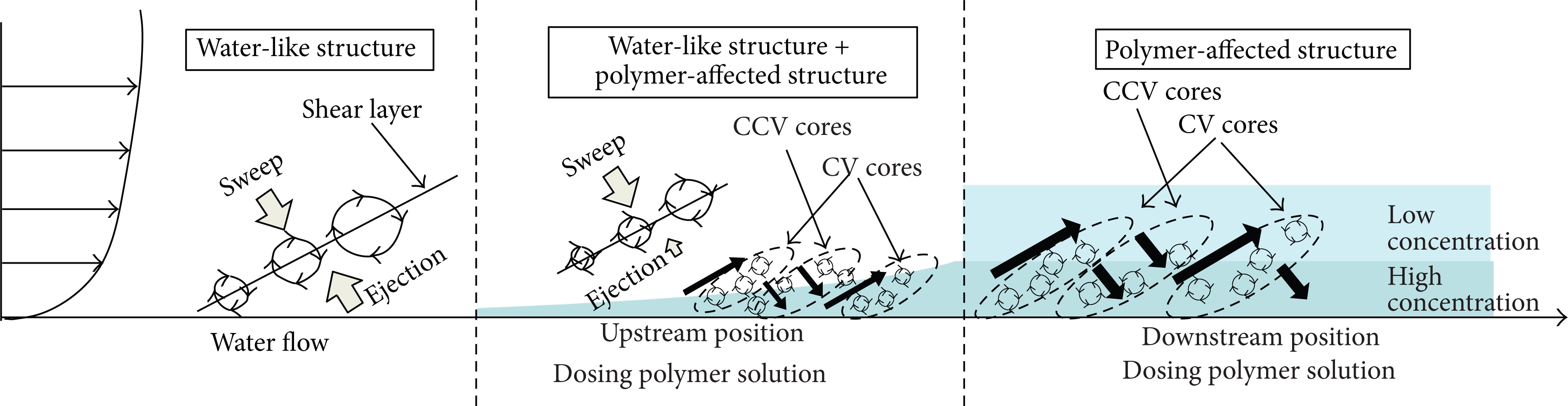
Conceptual sketch of the development of the characteristic structures in the drag-reduced flow of inhomogeneous polymer solutions. The abbreviation “CV” and “CCV” denote the group of clockwise vortex and counterclockwise vortex, respectively. x represents the streamwise direction.
The explanation of how polymers modify the structures and thus disrupt the turbulence regeneration cycle should be traced to the intrinsic mechanism of polymer drag reduction. In general, the modification is correlated with the polymer stress and its coupling with the flow field. Some numerical researches have shown the polymer stress can oppose the motion of the vortices, transfer energy from the vortices to the polymers, and also inject energy to the velocity fluctuation [20, 24, 41]. Thus, the turbulence regeneration cycle is disrupted and drag reduction is achieved. These speculations are based on the perspective that drag reduction is the consequence of an adjustment of common turbulence.
Recently, as mentioned in Section 1, a new state of turbulence called EIT, which is driven by the nonlinear transport of polymer stretch, was found in the drag-reduced channel flow by polymer additives when approaching MDR. A three-dimensional dumbbell-like cylindrical structure of one quantity, which is a second invariant of the velocity gradient tensor, was proposed for EIT [30, 32]. This feature was observed to disappear when the flow is too turbulent or the polymer solution is not elastic enough. The vortical structures may be absent due to the large enough extensional viscosity while the streaks sustain due to injected energy [30]. In this context, the turbulence dynamics with polymer additives are investigated from the perspective of the coupling between flow structures and polymer dynamics, which provides new ideas for in-depth discussion about the phenomenon of drag-reduced flow by whether homogeneous or inhomogeneous polymer solutions.
4. Polymer Diffusion
There are two special problems existing in the drag-reduced flow with inhomogeneous polymer solutions via slot-injection and wall-blowing methods when comparing to the flow with homogeneous polymer solutions. One is the diffusion of polymer solutions after being injected or blown into the bulk flow. The other is the relationship between the diffusion process and drag reduction. The most common issues contained in the topic of polymer diffusion are the time-dependent concentration in near-wall region along streamwise direction, the mixing process of polymer as scalar transport, the evolution of spatial turbulent mass fluxes, and the relative intensities of the turbulent diffusivity of momentum and of mass. To analyze these issues, the taking samples method and planar laser-induced fluorescence (PLIF) techniques were adopted by many researchers to measure polymer concentration in the research as a basis [48, 49, 59, 84].
4.1. Concentration Distribution and Mixing Process
The polymer distribution in TBL flow along the streamwise direction can be described as four individual stages according to the literatures [49, 51–53, 84]. It includes “initial stage” in which the injected polymer occupies largely near the wall and within the sublayer, “intermediate stage” in which the polymer lies within a layer thinner than the boundary layer but larger than the sublayer and buffer layer, “transition stage” in which the polymer diffuses throughout most of the TBL, and “final stage” in which the growth of the polymer diffusion layer is matched by that of the momentum boundary.
Furthermore, during the investigation of polymer distribution, many facts support that the injected polymer is transported away from the wall at a low rate, as an active scalar transportation different from the water-like diffusion in ordinary turbulence due to the reduced turbulent activity. The polymer has been found to greatly suppress the turbulent dispersion in the near-wall region [40, 46, 55, 73, 85]. The suppression increases as the concentration of the injected polymer increases [48]. As a result, most of the injected polymer remains close to the wall along the streamwise direction. In the measurements via wall-blowing method [44], the blown polymer solutions were observed to distribute near the blowing wall for a long time and the obtained drag reduction sustained for a long distance in streamwise direction consequently. The polymer concentration layer at the downstream positions of blowing wall will extend into the outer region. The polymer concentration can become high due to the accumulation of polymer solutions along the flow direction.
Figure 5 shows the distribution of polymer concentration in the drag-reduced flow of inhomogeneous polymer solutions via slot-injection and wall-blowing methods. It can reflect the coincidence with the aforementioned qualitative analyses on concentration distribution. About the polymer's dispersion, one additional interesting observation is that the polymers tend to accumulate around the low-speed streaks in the near-wall region of the boundary layer, which has also been reported in the recent researches [40, 48, 86].
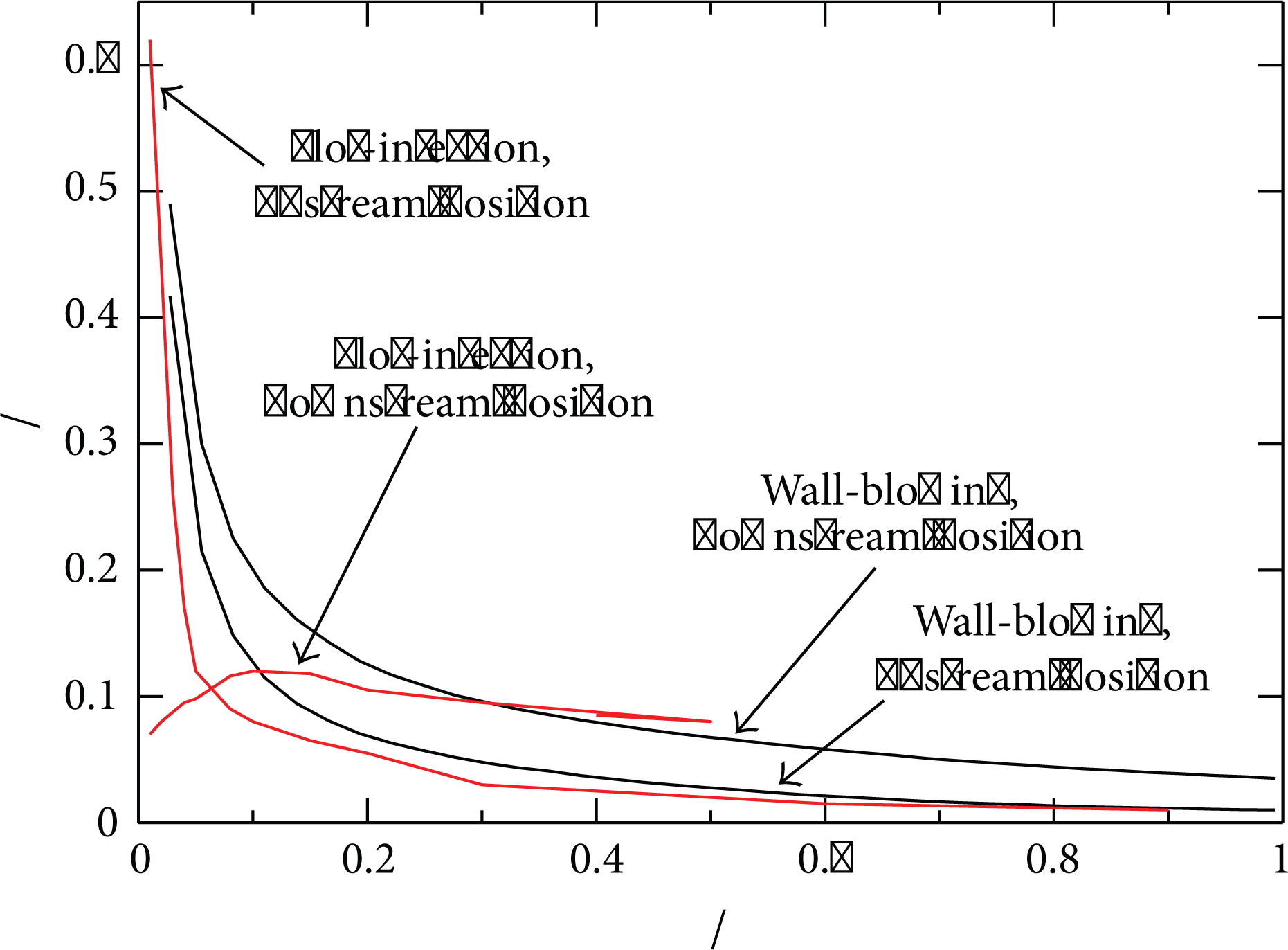
Distribution of polymer concentration in the drag-reduced flow of inhomogeneous polymer solutions via slot-injection and wall-blowing methods. The red lines denote the results of the slot-injection case with 100 ppm polymer solution injected obtained in [48]. The black lines denote the results of the wall-blowing case with 100 ppm polymer solution blown obtained in [87]. C0 is the concentration of the injected polymer solution, L equals half channel height for channel flow but equals boundary layer thickness for TBL.
4.2. Effects on Drag Reduction and Turbulent Fluxes
Some studies have shown that the turbulent mass transport is suppressed by the high concentration polymer in the buffer layer [44, 73, 78]. The obtained drag reduction was observed to increase logarithmically with increasing polymer concentration in the buffer layer via wall-blowing method in [44]. The relationship between near-wall polymer concentration and drag reduction was also examined in a high-Reynolds-number drag-reduced TBL flow by Winkel et al. [49]. The results showed that the intrinsic drag reduction decreases with increasing intrinsic concentration due to the polymer degradation [88]. So it is conceived that this relationship between the concentration and drag reduction cannot be concluded simply which has also been discussed in Section 2. If the suppression of the turbulence becomes larger by the injected higher concentration polymer solution, the drag-reducing effect will become more obvious consequently. The local concentration of polymer solutions in the drag-reduced flow should receive more attention in future measurements.
The spatial turbulent mass fluxes and turbulent Schmidt number (Sc T , expressed by (3), represents the relative intensities of the turbulent diffusivity of momentum and of mass) have been measured and adopted to quantitatively evaluate the effects of polymer diffusion [87, 89]. Consider

where ∊
t
is the eddy diffusivity of momentum transfer and equal to
The action of the polymer is found to reduce the streamwise mass fluxes in the boundary layer with the magnitude of suppression increasing with concentration. The wall-normal fluxes are reduced obviously, which causes the injected polymer to be mixed less effectively in the flow. With the increasing DRs, they also decrease and the peaks in the wall-normal profiles move away from the wall. However, as the polymers begin to mix quickly and lose effectiveness at farther downstream positions in the slot-injection case, the magnitudes of the wall-normal turbulent mass fluxes increase which indicates an increase in the wall-normal mixing in the boundary layer [48, 87, 90].
The eddy diffusivity of turbulent momentum transfer and mass flux obtained are found to decrease throughout in wall-normal direction with increasing drag reduction when compared to water flow. The measured Sc T near the wall in the drag-reduced flow is found to be significantly greater than that of water flow (Sc T ≈ 1). The high Sc T indicates that the turbulent mass flux is affected by the action of the polymer and the dispersion away from the wall is reduced [48, 87]. In Somandepalli et al.'s work [48], the largest Sc T magnitude was around 6 and the measured Sc T was found to increase with increasing concentration of the injected polymer solutions. The Sc T also decreased in streamwise direction along the flat plate showing loss of polymer effectiveness in the slot-injection case. In contrast, the measured Sc T was found to increase in streamwise direction along the blowing wall for wall-blowing case due to the increasing concentration [87].
Somandepalli et al. [48] obtained a line that approximates the trend of Sc T which showed that the Sc T increases with the increasing DR. The Sc T can be used to evaluate the drag reduction and to benchmark numerical models of the drag-reduced flow by polymer additives. According to the most recent discussion in [30], the dynamics of active scalars in the drag-reduced flow, which can cause the backscatter of energy, may be an important issue in future. More comprehensive and accurate measurements of Sc T under various experimental conditions (e.g., different Reynolds number, wall roughness, polymer concentration, and polymer type) are required to investigate polymer dynamics.
5. Summary
In this paper, we reviewed the recent progress in the research on drag-reduced turbulent flow of inhomogeneous polymer solutions which is useful for understanding the polymer diffusion and the mechanism of drag reduction by polymer additives. Based on the findings via slot-injection and wall-blowing methods for adding polymer into wall turbulence, we analyzed the current status of the research on the drag-reduced turbulent flow of inhomogeneous polymer solutions. The development of drag reduction, the turbulent statistics characteristics and coherent structures, distribution of polymer concentration, and turbulent mass transfer in the drag-reduced flow with inhomogeneous polymer additives were discussed.
From the analyses, the near-universal understanding was summarized as follows. The effect of polymer on the flow in the near-wall region plays a central role in the skin friction reduction. The concentration in the near-wall region of inhomogeneous polymer solution determines the level of drag reduction. The turbulent statistics characteristics and coherent structures in near-wall region are modified greatly owing to the intrinsic mechanism. The polymer is dispersed away from the wall at a low rate as an active scalar transportation different from the water-like diffusion in ordinary turbulence due to the reduced turbulent activity. The turbulent Schmidt number increases with the increasing polymer concentration and DR. The eddy diffusivity of momentum transfer is larger when compared with the eddy diffusivity of mass flux in the drag-reduced turbulent flow of inhomogeneous polymer solutions.
Although the research on the drag-reduced flow of inhomogeneous polymer solutions has received wide attention and gained some progress, the remaining open questions warranting further investigation in this subject as well as future directions are discussed as follows.
Different DRs can be obtained by injecting or blowing polymer solutions of different concentrations, even though the same amount of polymers are injected or blown. Here the local concentration and relaxation properties of polymers should be evaluated to explain the variations of drag reduction. Numerical techniques can be used to get the distribution and stretching of polymers by simulating the polymer diffusion process based on comprehensive models. Thus, the diffusion model and constitutive model also need to be improved.
To quantitatively evaluate the interaction between polymer additives and turbulence, the determination of the role of polymer stress, the identification of the near-wall characteristic structures, and statistical characteristics in the drag-reduced turbulent flow of inhomogeneous polymer solutions are required. Since the drag-reducing effect has been confirmed to be closely related to the mass transfer of injected or blown polymer, to pursue the mechanism of this drag-reducing effect, future work should concentrate on the detailed turbulent coherent structures, spatial mass fluxes, and their relation with drag reduction in TBL and channel flow.
The practical application of polymer drag reduction in external flow requires more detailed quantitative investigations of the influences of polymer degradation and wall roughness on drag reduction. The measurements of polymer diffusion and drag reduction at high Reynolds number are also required. The fundamental relationship between molecular degradation and practical shear conditions should be investigated preliminarily.
Conflict of Interests
The authors declare that there is no conflict of interests regarding the publication of this paper.
Footnotes
Acknowledgments
The supports by Japanese REDAS, NEDO, and MEXT are acknowledged and highly appreciated. The authors also thank Masaaki Motozawa, Kaoru Iwamoto, Shota Ishitsuka, Takanobu Sawada, and Tohiro Otsuki for their contributions to this work.