




Abstract
Addressing the energy efficiency in data-centric and application-oriented wireless sensor networks is an eternal theme, and in the practical scenarios deployed multiple flows, often a serious problem of collisions among multiple paths caused by the fierce network resource competition directly influences the whole network performance. To address this issue, in terms of the delay sensitivity imposed on the deployed flows, a feature-aware cooperative relay selection scheme is developed by comprehensively taking both the routing selection and contention avoidance into account, in which the concept of abstract domain is introduced to extend the covered relay nodes. The optimal relays for the deployed multiflow with specific probing and transmission requirements are selected to find collision-free and energy-efficient cooperative routings. Simulations conducted on NS-2 platform demonstrate that the proposed cooperative routing outperforms the compared routing selection strategies in significantly balancing the energy distribution and prolonging the network lifetime.
1. Introduction
Wireless sensor network (WSN) as a data-centric and application-oriented network has numerous delay-sensitive probing tasks but also has numerous delay-tolerant probing tasks. The prime purpose of such sensor network is gathering the information of environments or the sensed objects and sending the information back to end-users. In recent years, there has been a rapid development in building and deploying sensor networks which is promoted by the recent advances in MEMS-based technologies and low-power short-range radios. In addition, as the hardware for sensors has been increasingly more affordable and widely available, sensor networks have emerged as an ideal solution to a number of important potential applications including civilian scenarios in food and safety industries and environmental monitoring, military scenarios for the digital battle field and security services.
In WSN, routing is an important factor affecting the whole system performance, while designing routing protocols for WSN is influenced by many factors, such as hardware restrictions, energy consumption, and network topology. Many large-scale sensor networks consist of battery-powered sensors and the battery unit may not be replaceable. They usually adopt the multihop communication mode to avoid the Source node having a high transmitting power and the limited energy unit being depleted too soon. The restrained storage and computing resource also make the sensors store mass of routing information and calculate complicated routing impossible. Indeed, a major challenge facing the development and deployment of large-scale sensor networks is the scheduling of transmissions among nodes in the manner of (1) automatically adapting to the changes in traffic, node state, and connectivity; and (2) prolonging the battery lifespan of each node.
Concurrently, cooperative communication as efficient physical layer technology has been widely researched, which allows several nodes to cooperatively transmit gathered data to a destination together and can offer significant performance enhancements, but also introduces some new potential problems. To address this issue, a feature-aware cooperative relay selection scheme is developed by comprehensively taking both the routing selection and contention avoidance into account, in which, the concept of abstract domain is introduced to extend the coverage relay nodes. In terms of the specific probing and transmission requirements imposed on the deployed multiflow, the optimal relays are selected to find collision-free and energy-efficient cooperative routings.
The remainder of this paper is organized as follows. Section 2 reviews some related works about the current research achievements of routing selection in WSN. The motivation of our research is given in Section 3. The designed cooperative relaying scheme is thoroughly investigated in detail in Section 4. Section 5 addresses the experimental setup and analysis results. We finally summarize and conclude this paper in Section 6.
2. Related Work
In the past decades, WSN has received tremendous attention from both academia and industry all over the world, and an extensive body of research currently has focused on designing the routing protocols to achieve optimal energy consumption or maximize the network throughput [1], but the design of routing protocols is still challenging because of suffering from several network constraints, such as the limited transmission range, and their processing and storage capabilities as well as their energy resources are also limited. In [2], by taking the tradeoff between the node residual energy and hop count into account, we propose an adaptive energy-aware multipath routing protocol with load balance (AEMRP-LB) to establish multiple node-disjoint paths and then achieve the traffic load balance by using a weighted traffic scheduling algorithm.
With the advantage of broadcast in wireless medium, cooperative communication is proposed recently [3], which allows multiple nodes to simultaneously transmit the same packet to the receiver so that the combined signal at the receiver can be correctly decoded. Since the cooperative communication can reduce the transmission power and extend the transmission coverage, it has been widely advocated in terms of increased capacity, improved transmission reliability, spatial diversity, and diversity-multiplexing tradeoff. Zhang and Chen [4] firstly establish the energy model of single-hop wireless sensor network and then demonstrate that the cooperative communication is more suitable for harsh transmission environment with long-haul distance. Zhou et al. [5] combine selective-relay cooperative communication with physical-layer power control and propose a selective single-relay cooperative scheme achieved in a distributed fashion with minimum signaling overhead. We derive power-control solutions corresponding to two policies on relay selection: one is to minimize the energy consumption per data packet, and the other is to maximize the network lifetime. Wang et al. [6] propose a distributed game-theoretical framework over multiuser cooperative communication networks to achieve optimal relay selection and power allocation. Pan et al. [7] propose a cooperative communication aware link scheduling scheme and investigate the throughput maximization problem in C-VANETs. Maalej et al. [8] use the technique of reinforcement learning by opponent modeling and propose a cooperative communication protocol based on RSSI and node energy consumption in a competitive context (RSSI/Energy CC). Meng et al. [9] comprehensively consider the distance between nodes, the level of receiving signals, and the credibility of relay nodes and then establish an integrated judgment parameter to select the most appropriate transmission scheme adaptively, leading the energy consumption to the minimum. Investigating the problem of broadcast routing to maximum network lifetime, Acharya and Paul [10] propose an energy-aware spanning tree construction scheme by considering three different signal transmission schemes in the physical layer: (a) point-to-point, (b) point-to-multipoint and (c) multipoint-to-point, and firstly present a centralized algorithm that requires global topology information, then extend this to design an approximate distributed algorithm.
However, previous research on cooperative routing only focuses on minimizing the total energy consumption from the Source node to the Sink node, which may lead to the unbalanced energy distribution among nodes. Chen et al. [11] study the impact of cooperative routing on balancing the energy distribution among nodes and introduce a new routing scheme which carefully selects cooperative relay nodes and assigns their transmission power to balance the remaining energy among neighboring nodes to maximize the lifetime of the network.
3. Problem Statement
An example is depicted here to show that the traditional routing strategies without considering the characteristics of the probing tasks and the potential network resource competition among multiple ongoing flows do not work efficiently; a global optimization routing hence may not be achieved. For the sake of argument, we assume that there are three types of nodes in WSN: Sink, regular sensor nodes and Source. They may have different architecture and function. For simplicity, we assume that the Sink is not energy-constrained, the Source will not be burned-out in the probing duration, and all the nodes within the network have the same transmitting power, they will consume the same energy to send or receive a packet. The communication is bi-directional and symmetric and the energy dissipation of transmitting a packet from node A to node B is equal to that from B to A.
As shown in Figure 1, there are two perception Sources deployed in the network, and two data flows are transmitted simultaneously. Sources of Flow-1 and Flow-2 are Source-1 and Source-2, respectively, which have the same destination of Sink, and the other deployed nodes are intermediate node (IN). Please note that Source-1 is a delay-tolerant probing task. To assume that the scope of radio interference equals to the size of the valid radio coverage area. For Flow-1, Source-1 will broadcast message to the neighbor node (INa), and INa will broadcast message to INc and INd simultaneously owing to being in the valid radio coverage area of each other. And then, INc will send the message to the Sink through the INe, while INd will directly send the message to the Sink. In terms of the traditional shortest path routing strategies, the selected routing is Source-1, INa, INd, Sink. Similarly, the selected routing for Flow-2 is Source-2, INb, INd, Sink. The stated problem is now introduced, transmission of Flow-1 and Flow-2 will interfere with each other in INd, which is unable to receive data from two individual Sources simultaneously and decode it correctly. INd can only transmit for the two individual flows alternately in the manner of time division. That is to say, the two individual flows will share the whole throughput of INd. Now, we can come to a conclusion that the per-flow throughput under multiple-flow scenarios will decrease by 50% compared with single-flow scenarios. In addition, the data from the two Sources all are transmitted through the INd whose equipped energy will be exhausted and the problem of energy hole will be caused. INd hence becomes the bottleneck node of the network. Chen et al. [12] use cooperative communication to mitigate energy hole and extend the network lifetime.

Resource competition in the multiflow scenario using traditional routing selection strategy.
In terms of the above conclusion, we should reselect the routing of Source-1, INa, INc, INe, Sink for Flow-1 owing to delay-tolerant probing task accepting the link transmission delay as shown in Figure 2. With the new assigned routings, there will be no resource competition at INd, and higher throughput can be achieved.

Desired collision avoidance in the multiflow scenario.
In the network deployed multiple flows, the traditional routing strategies may cause serious resource competition and result in bottleneck node. Especially, with the number of flows increasing, the resource competition will be dramatically increased, and the whole network performance will be accompanying degraded. We therefore need to investigate more effective multiflows oriented cooperative routing to achieve a reasonable tradeoff between the energy efficiency, collision avoidance and the transmission delay imposed on the deployed probing tasks.
4. Overview of the Feature-Aware Cooperation Routing
4.1. Definition of the Probing Tasks
Most of the probing tasks in sensor networks are data-oriented query requests. We also name the probing task as an Interest just as that defined in AEMRP-LB [2] and extend the definition by adding two attribute-value pairs, one named Importance value represents the importance of the passing Interest, in other words, represents the transmission delay sensitivity. Because the objective of each deployed probing Interest is definite, we can preset the value of Importance accordingly. If the Importance of an Interest is more than a threshold, we believe that the Interest is delay-sensitive; otherwise, it is not delay-sensitive. The threshold is given by the average of the Importance values of all Interests being about to be deployed in the scenario plus a standard deviation. The other one named Delay value represents the maximum acceptable transmission delay and is introduced to impose restrictions on the transmission delay of the selected path.
The simple description of a vehicle tracking task is shown in Figure 3. The acquired data in response to Interests are also named using the similar naming scheme defined in AEMRP-LB.
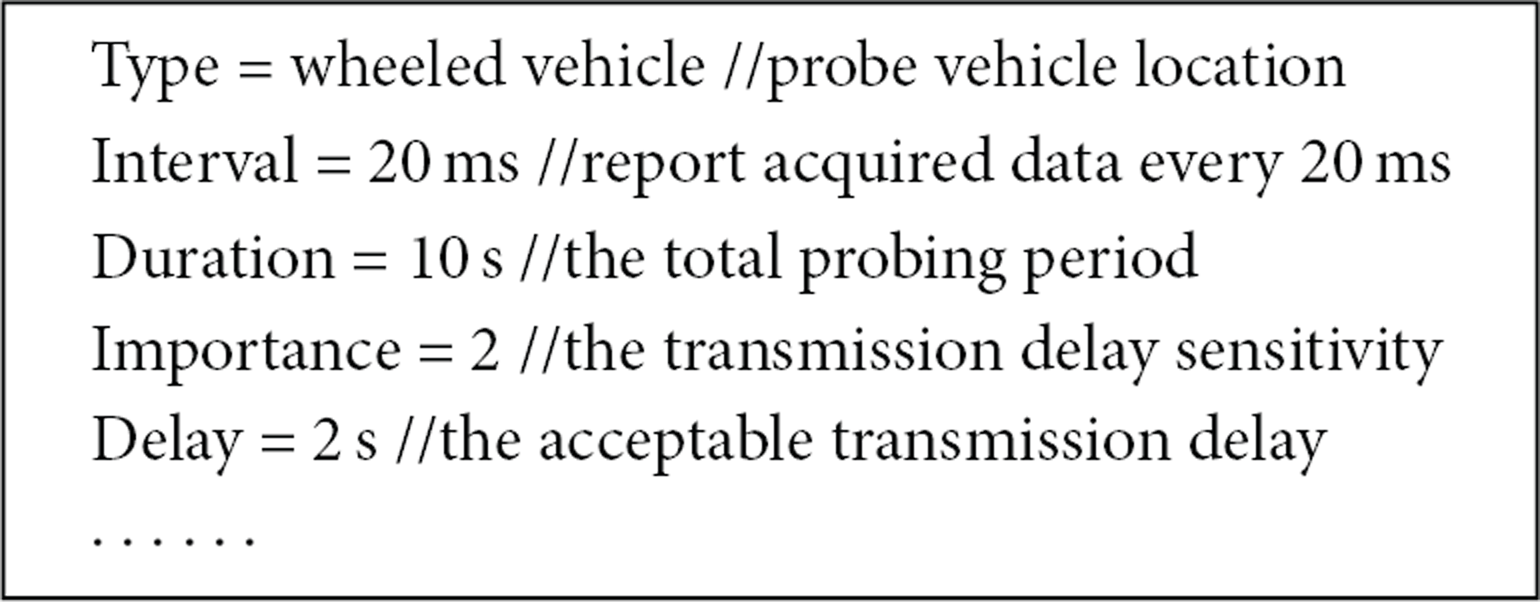
A simple description of a probing task.
4.2. Establishing Routing for Single Flow
When the Source has data to transmit, it first checks its routing table. If there is not a route destined to the Sink in the table, the Source will launch the route request procedure. So long as we know, broadcast is a wasteful approach of route discovery; if we omnidirectionally broadcast the route request, the nodes which are not in the right direction or may be in the just opposite direction can establish some paths that are unacceptable due to the serious link overhead. Hence, the geographic information of the sensors in the practical scenario is very useful for establishing the routings, since it can make the Source communicate with the Sink in the right direction. The Source will first check its neighbor list to find out whether there are distinguishable groups of neighbors satisfying the following three conditions: (1) all these nodes are closer to the Sink; (2) nodes in each group lay at one side of the Source-Sink line, opposite to the side of the other group; (3) each node is distanced within
If such neighbors are found (the nodes squares shown in Figure 4 are the examples), the concept of abstract domain shown in Figure 5 is introduced to coverage these neighbors, and these nodes within the abstract domain are renamed as abstract node to be the candidate relay nodes that simultaneously receive message by a single information under the broadcast mode or cooperatively send message to a single receiver under the cooperative mode. In Figure 5, abstract node IN consists node INc and INd. And then, the cooperative routings are carefully selected in terms of the put forwarded transmission requirements. Under such definition, the link may be sourced in a traditional node and destined in a virtual node under the broadcast mode, or sourced in a virtual node and destined in a traditional node under the cooperative node.

The route request procedure at the Source.
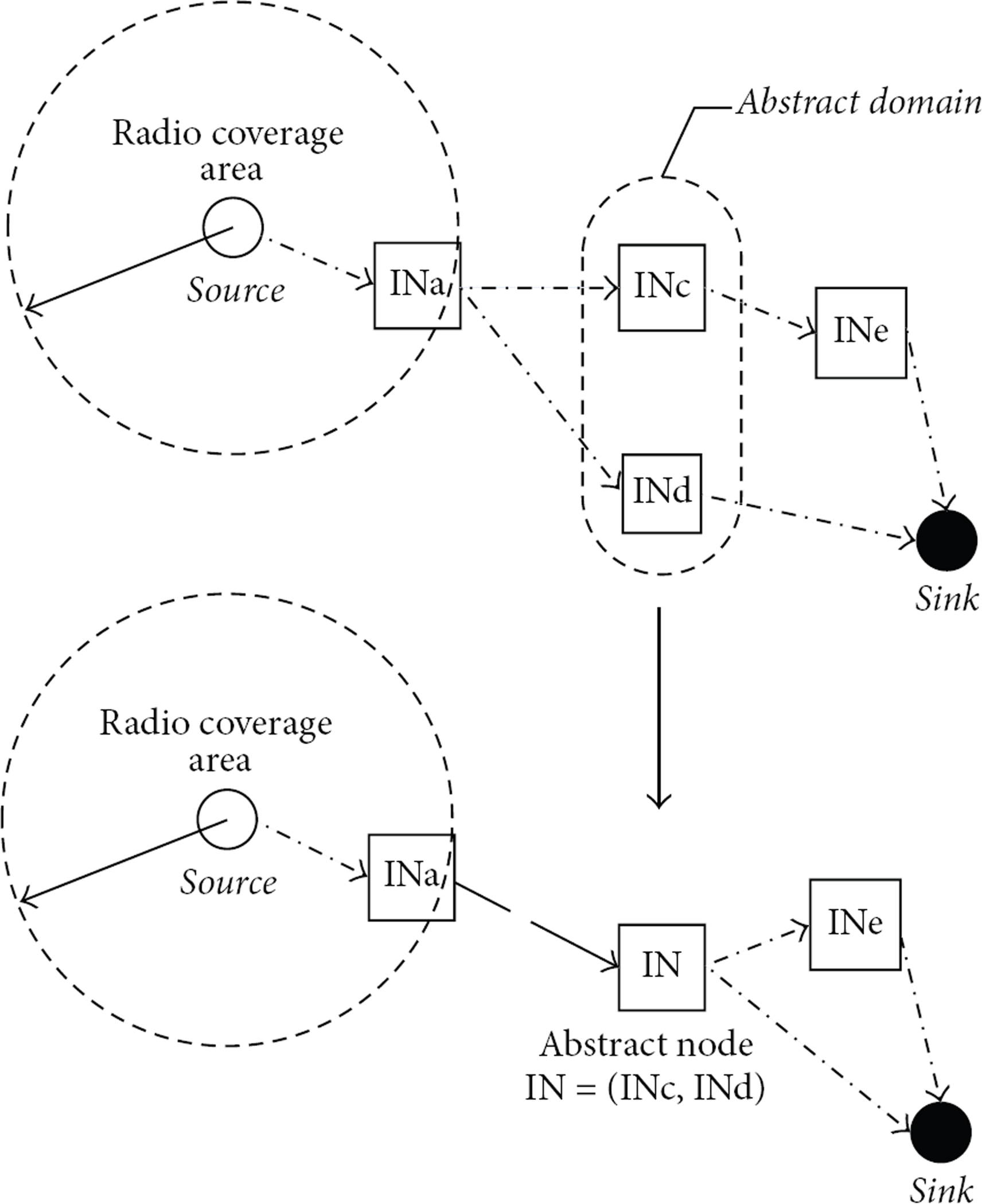
Introducing the abstract domain.
In the scenario of single flow, the Source will choose one node from the abstract domain resulting in the least transmit power as the relay. When an intermediate node receives a route request message from a previous node which is on the same side of the Source-Sink line as itself, it will still use the stated method to find the next relay until the route request message arrives at the Sink.
4.3. Cooperative Relaying for Multiple Flows
In the practical scenarios, the relay nodes for different Interests may be deployed dispersedly, the shared relays however as the hotspots of energy consumption are inevitable among the paths belonging to different Source-Sink pairs. The above example illustrates that the hotspots of energy consumption exist in WSN with multiple flows when the traditional routing strategies are used. To mitigate the energy consumption in the hotspots, as well as to keep the promised reliability and transmission delay, the introduced abstract domain is used to establish the cooperative routing for multiple flows.
Within the process of a delay-tolerant Source launch the route request, it firstly sends the route request to all its neighbor nodes (e.g., INc and INd) covered in the abstract domain under the broadcast mode. If the optimal relay node (e.g., INd) has been on the link of another data Source which is delay-sensitive, the relay node would not be chosen to avoid the resource competition even if it is on the shortest link of the delay-tolerant Source, and another optimal relay node (e.g., INc) would be instead selected. And then, INc will broadcast the route request to its abstract domain, while the other nodes will not broadcast the route request any more. INc will select an optimal relay node in terms of the stated selection process which is repetitively executed until the route request arrives at the Sink.
Notably, if an IN now is serving for a delay-tolerant flow and a new delay-sensitive flow is deployed, while the IN is just on the shortest path selected by the new deployed flow, the delay-tolerant flow would release the IN to meet the performance requirement proposed by the delay-sensitive flow and reselect a new path whose transmission delay is under the promised delay. The path cost of a deployed jth flow denoted as
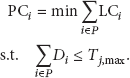
Since communication is a prime factor of energy dissipation for the sensors in WSN, we therefore focus on the communication-related activities of the sensors; however, different assumptions about the radio characteristics, including energy dissipation in the data transmitting, receiving, and fusion pattern, will change the advantages of different protocols, and

The radio model of transmitting n messages.
We assume that each sensor within the network has the same data transmitting rate denoted by r, so the minimal energy dissipation of transmitting messages with the total amount of

For all sensor nodes, the energy dissipation of receiving

Therefore, the total communication-related energy dissipation of relaying

If the shared nodes in the paths for different Source-Sink pairs are inevitable. In order to use the shared nodes reasonably and make them provide different qualities of services for the Interests with different delay sensitivity, we adopt an adaptive method to adjust the residual energy of the nodes and establish the routes for multi-flow. We introduce a parameter ω to dynamically weight their residual energy. If the intermediate node firstly receives an Interest,

If the IN is not in the preferred path of one Interest and the currently received Interest is important, the system will reinforce the residual energy so as to provide more service for the delay-sensitive Interest, otherwise, the process of negative-reinforce is still executed. The reinforced residual energy is defined in (6), where V denotes the value of Importance of the currently received Interest, L denotes the summation of the values of Importance of the Interests being about to be deployed in the scene:

From the routing establishing process stated above, we can clearly find that the cooperative routings formed step by step are hard to be directly obtained in realistic large-scale WSNs, and achieving the cooperative routings in a distributed manner remains interest we hope to further explore in future work.
4.4. Routing Maintenance
When the node with the minimal residual energy in the selected path for one Interest depletes, the path fails. However, there are still many member nodes having good transmitting capacity. In this paper, we use a method named Local-Querying to repair the failed routing by propagating Query in order to make full use of these resources. The upstream neighbor of the dead node struggles a process of local querying towards its abstract domain; if the downriver neighbor of the dead node receives the Query by some intermediate nodes which are not in the preferred paths of the other delay-sensitive Interests, the path satisfies the condition described in (1) which would be selected as the repaired one.
We cite a case to illustrate the repair process in Figure 7, where the intermediate nodes are labeled by their name and the value of residual energy. In the scene, if node B is depleted and the path including it fails, node A struggles a repair process of local querying. Now, there are two repair strategies: (i) A→C→D→F and (ii) A→E→F. We choose the strategy (ii) with the larger selected probability to repair the failed path.

The routing repair process.
5. Simulation and Analysis
5.1. Experiment Setup
NS-2, a network simulator which is discrete event-driven and object-oriented, is taken as the simulation platform, and 100 sensors are randomly deployed in the plane domain with the size of 1000 × 1000, where the position of Sink is fixed and far away from the probing area. The initial energy of the deployed node is set as 10 J. According to the settings of the wireless extendsd modules in NS-2, the dissipated energy of the transmitter and the receiver is respectively supposed as 50 nJ/bit for simplicity, and the energy of the Sink and Source is not depleted during the whole simulation process. In addition, the omnidirectional antenna is used, and the transmitted power is adjusted in terms of the stated transmitted power detection. In the other parameters,
5.2. Results Analysis
To investigate the performance gain of the proposed cooperative routing selection, we elaborately design several distinct simulation scenarios, in which the number of Source-Sink pairs (deployed flows) falls in the range of [1, 5] and AEMRP-LB (noncooperative routing) and a traditional cooperative routing are used for comparative study. To make a fair comparison, the compared routing selection strategies all use the same experimental configurations.
In Figure 8, the dead nodes in the compared routing selection strategies are investigated when the number of deployed flows increases. With the increase of the number of deployed flows, the traffic load in the network increases as well and the probability of sharing relay nodes among the selected paths belonging to different flows is also increased. Although AEMRP-LB uses a method of adaptive adjusting of the residual energy of these shared nodes to use them reasonably, there are still some shared nodes that should provide service for different flows inevitably and the equipped energy would be exhausted quickly. Owing to taking into account the potential characteristics of the probing tasks and the resource competition, the new proposed cooperative routing selection balances the traffic load more evenly, while the traditional cooperative routing selection may not achieve an optimized routing owing to the previous research on cooperative routing only focusing on minimizing the total energy consumption for the Source-Sink pair and leading to the unbalanced energy distribution among nodes.

The dead nodes versus the number of deployed flows.
In Figure 9, the node average energy consumption in the compared routing selection strategies is investigated when the number of deployed flows increases. Owing to the inevitable shared nodes providing services for different flows, the node average energy consumption is in linear growth with the increase of the deployed flows in AEMRP-LB. In terms of the delay sensitivity imposed on the deployed flows, the collision-free and energy-efficient relays are selected in the proposed new cooperative routing, so the energy distribution among nodes is more balanced than the two compared routing selection strategies.

The node average energy consumption versus the number of deployed flows.
In Figure 10, the average End-to-End (E2E) transmission delay in the compared routing selection strategies is investigated when the number of deployed flows increases. When there are few deployed flows in the scenarios, the E2E transmission delays in the three compared routing selection strategies are nearly the same; however, when the number of deployed flows increases, the serious resources competition at the inevitable shared nodes increases the data processing delay in AEMRP-LB, and the total data transmission delay is accordingly increased, while in the proposed new cooperative routing, the collision-free and energy-efficient relays are prior selected and the established routings for the deployed flows are nearly node-disjoint, so the average E2E transmission delay is the most optimal.

The average E2E transmission delay versus the number of deployed flows.
6. Conclusion
Designing a reasonable routing for WSNs is still changeling, especially in the scenarios deployed multiple flows (multiple Source-Sink pairs). Facing the traditional network constrains, there is an extensive body of research currently focusing on developing the cooperative routing with the advantage of broadcast to enhance the whole network performance, but some factors are not comprehensively taken into account. In this paper, we firstly depict an example to show that the existing routing strategies without considering the characteristics of the probing tasks and the potential link resource competition among multiple ongoing flows do not work efficiently, and then, in terms of the delay sensitivity imposed on the deployed flows, a new feature-aware cooperative routing strategy is proposed by taking both the routing selection and contention avoidance into account, where the concept of abstract domain is introduced to extend the covered relay nodes, and the cooperative routings are carefully selected in terms of the specific probing and transmission requirements put forwarded by the deployed flows. On the basis, in the context of specific constrain, the delay-tolerant flows can select alternative transmission paths to guarantee the performance of the delay-sensitive flows. The simulation conducted on the NS-2 platform indicates that the great performance benefit is achieved by using the proposed cooperative routing selection strategy, specifically manifested at balancing the energy distribution and prolonging the network lifetime.
Footnotes
Acknowledgments
This study is supported by National Natural Science Fund, China (Grant nos. 61300198, 61170216, 61103037), Guangdong Province Natural Science Foundation (S2013040016582).