The machine-to-machine (M2M) communication enables information exchange between machine devices, which can be carried out without or with minimal human interaction. In this paper, we analyse the outage probability of satellite M2M communication system using amplify-and-forward (AF) and decode-and-forward (DF) relaying schemes. Both the channel feedback delay and multiple interferers at the relay and destination are taken into consideration. The channels of the two hops are modeled as Rayleigh and Rician, respectively. The closed-form outage probability expressions for both AF fixed-gain and DF relaying system are obtained, and the validness of our analytical results are verified by the Monte Carlo simulations. It is shown that the channel delay affects the outage probability performance more significantly compared with the interferences. It is also worthy to note that the DF relaying system provides better performance than AF fixed-gain relaying system, especially when the feedback delay is short. Moreover, it can be found that the performance gaps of the two relaying schemes become trivial as the feedback delay increases.
1. Introduction
Wireless communication systems can benefit from dual-hop relaying, which is well known as an efficient way to extend coverage area, improve throughputs, obtain spatial diversity, and overcome channel impairments such as fading, shadowing, and path loss [1–4]. Dual-hop relaying can be employed in many different communication scenarios. In the wireless M2M networks, information has to been exchanged between machine devices. Because the machine devices are small and power-limited, so it is hard to guarantee the outage probability performance requirements of the destination devices due to the propagation loss between the source devices and the destination device. Recently, many increasing researches showed interest in the relay devices to deal with this problem [5, 6]. In dual-hop wireless M2M relay networks, signals are transmitted by relay node while they might be attenuated beyond detection by propagation loss if directly targeting the destination nodes, due to the low-power machine devices. Also, with the help of multiple antennas in source and destination, the spatial diversity of MIMO relay can help to mitigate the effect of channel fading. Among various relaying schemes, amplify-and-forward (AF) and decode-and-forward (DF) are two commonly used relaying protocols. If the relay only amplifies the received signal at the relay and forwards it to the destination, it is called amplify-and-forward (AF) relaying system. Whereas, if the relay decodes the received signal, reencodes it, and forwards it to the destination, it is called decode-and-forward (DF) relaying system.
The performance analysis of dual-hop AF and DF relaying systems has been extensively investigated. Some have analyzed the performance of single-antenna AF or DF relaying networks in [7–9]. The significant benefits of deploying multiple antennas in relaying network were demonstrated in [10]. For beamforming being an important multiantenna technique, the dual-hop relaying systems employing beamforming were studied in [11–14]. Among various beamforming techniques, the combination of maximal ratio transmission (MRT) and maximal ratio combining (MRC) is widely used in two-hop multiple input and multiple output (MIMO) relaying networks due to the efficiency and simplicity [11, 13, 14]. In [11, 13], the author studied the end-to-end outage probability and error performance of dual-hop AF and DF relaying system over Rayleigh and Nakagami-m fading channels, respectively, and the outage probability of beamforming with antenna correlation in a two-hop AF MIMO relay network was analyzed in [14]. When multiple antennas are deployed at the source, relay, and destination, the outage probability of MIMO AF relay networks with optimal beamforming was derived in [12].
However, most of literatures assumed perfect channel state information (CSI). In practical scenarios, CSI is feedback from the receiver to the transmitter, where the transmitting delay leads to a mismatch between the available CSI and the actual CSI. The effect of feedback delay on AF relaying network was studied in [15]. It was shown that feedback delay highly degrades the performance of the system since no diversity advantage can be obtained. Along with the feedback delay, the system performance is also highly degraded by the interference [16–18]. In [17, 18], the author investigated the outage probability of AF and opportunistic DF relaying system with interference over Nakagami-m fading channels, respectively. As far as we know, few works have considered the joint effect of feedback delay and interference [19, 20]. In [19], for AF dual-hop relaying system, the author studied the joint effect of feedback delay and interference over Rayleigh fading channels, but it only considered the scenario where each node is equipped with a single antenna. In [20], the authors studied the multiantenna AF relaying networks with feedback delay and interference, but it assumed that the interference only exists at the relay. Furthermore, the above works assumed the dual hops obey the same fading statistics. Nowadays, the support of M2M communication services for the vehicular market using satellite network represents a good opportunity. These services can make use of the backward satellite link capacity for the transmission of telemetry data, requiring only a small fraction of capacity in the forward direction. In the scenario of backward satellite link (from satellite mobile terminal to earth station) of the satellite system, assume satellite mobile terminal and earth station both have multiantennas, the satellite services as relay, then the channel of the satellite mobile terminal to the satellite is often modeled as Rayleigh due to large scattering, while the channel between the satellite and the earth station could be Rician fading because of the composite effect of line of sight component and scattering. To handle this scenario, our paper not only considers the effect of feedback delay but also the interferers at the relay and destination. Furthermore, we also consider the mixed Rayleigh-Rician channel. To the best of the authors' knowledge, no results with the above assumptions have been reported in public.
In this paper, we investigate the joint effect of channel feedback delay and interference for AF fixed-gain and DF dual-hop relaying systems over mixed Rayleigh-Rician channels. We firstly derive the end-to-end equivalent signal-to-interference and noise ratio (SINR), then the expressions for the outage probability of the two systems are given in closed form. Numerical results verify the validness of our theoretical analysis. Simulation results also show the outage probability gaps of AF fixed-gain and DF dual-hop relaying systems with different parameters.
This paper is organized as follows. In Section 2, we describe the system model with feedback delay and interferers at both the relay and destination. In Section 3, we obtain the closed-form expression for the outage probability of the two relaying schemes with channel feedback delay and interferences. In Section 4, the validity of the performance analysis is verified by Monte Carlo simulations. Finally, conclusions are drawn in Section 5.
2. System Model
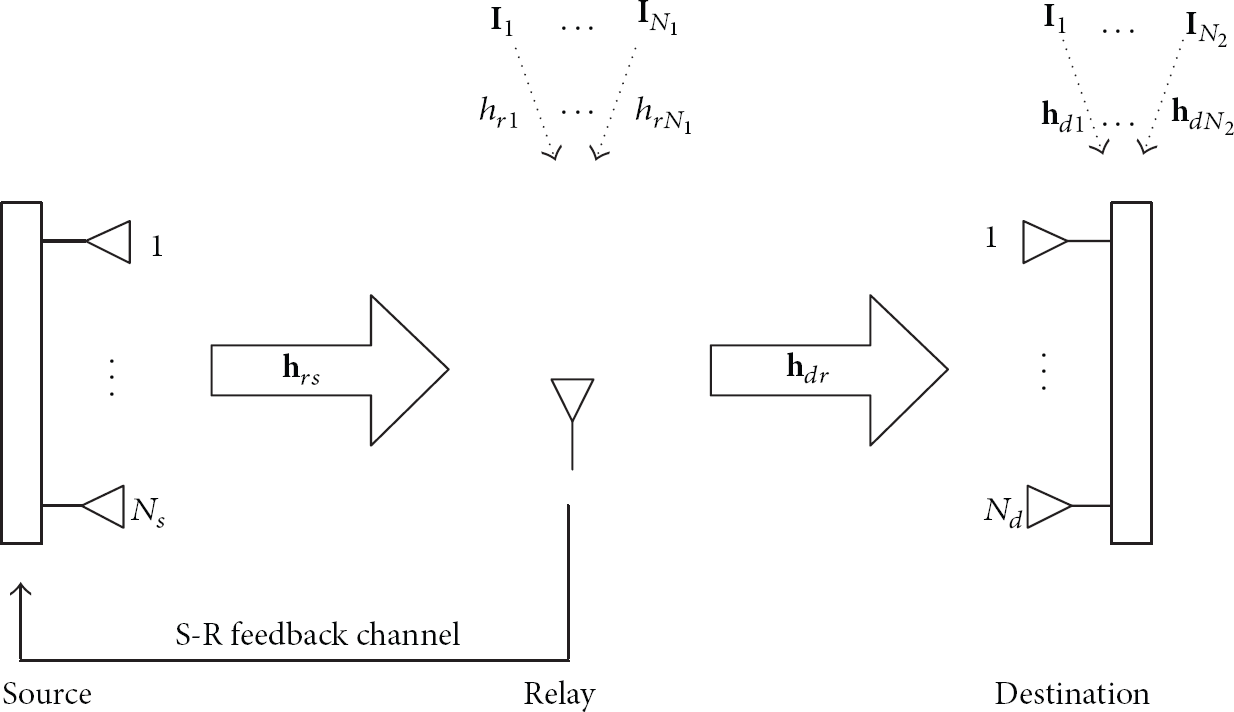
We consider a dual-hop half-duplex relay system in wireless M2M networks as shown in Figure 1, where a source machine device equipped with antennas communicates with a destination machine device equipped with antennas through a single-antenna relay.
System model.
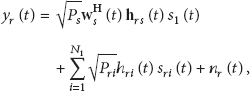
The source employs MRT and the destination employs MRC. Due to the feedback delay, the weight vectors for the MRT are computed based on the delayed CSI. We assume a mixed channel that the source-to-relay link as Rayleigh fading and the relay-to-destination link as Rician fading. We also assume that the relay and destination operate in an interference-limited environment; therefore, the received signal at relay and destination are impaired by and cochannel interferences, respectively. In the first phase, the source transmits the signal to the relay, and then the relay receives the signal and the interfering signals. At the relay, the received signal is given by
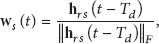
where is the number of interferers at R. , , and are the transmitted signal, the ith interferer, and zero mean additive white Gaussian noise (AWGN) at relay, satisfying , and , respectively. and are the transmitted power of source and the ith interferer at relay, respectively. is the Gaussian channel vector from source to relay satisfying . is the ith Gaussian channel coefficient between the ith interferer and R with . is the beamforming weight vector at the source, satisfying ; the weight vector is computed based on the outdated CSI, which is given by
where is the delayed channel vector by a time delay of the perfect source-relay channel . The relationship between and is given by the following widely adopted time-varying channel model [21]:
where is the normalized correlation coefficient between and . is the zeroth-order Bessel function of the first kind [22], is the Doppler shift, and is the zero mean Gaussian error vector with .
For a dual-hop AF relaying system, in the second phase, the received scalar signal at the relay is multiplied by a gain G and forwarded to the destination, and the destination receives the amplified signal from the relay and the interfering signals. Then, the destination transformed the received vector signal to a scalar with a weight vector , satisfying , and the received signal is given by
where is the Gaussian channel vector from relay to destination. is the jth Gaussian channel vector between the jth interferer and destination with . is the transmitted power of the jth interferer. and are the jth interferer and zero mean additive white Gaussian noise (AWGN) at destination, satisfying and , respectively. According to the principles of MRC, the weight vector is chosen to be
For the fixed-gain relay system, G is given by
where is the transmit power of relay. After some manipulations, the instantaneous end-to-end SINR at destination can be expressed by
Substituting (6) into (7) and with the assumption that relay and destination are interference-limited (i.e., and can be neglected, the SINR is equivalent to signal-to-interference ratio (SIR)), can be further written as
where , , , , and with , .
For the second phase of the dual-hop DF relaying system, the relay decodes the source data , reencodes, and transmits it to the destination, and the destination receives the reencoded signal with and interfering signals. Then, the destination utilizes a weight vector to transform the vector signal to a scalar signal, satisfying , and the received signal is given by
From (1) and (9), the instantaneous equivalent SIR at relay and the destination can be expressed as
where , , and are defined as above.
3. Outage Probability
Outage probability is an important system performance metric in wireless communication. It is defined as the end-to-end instantaneous equivalent SIR falling below a given threshold .
3.1. Amplify-and-Forward Relaying System
For AF relaying system, it can be expressed by
In order to calculate (12), we firstly evaluate the cumulative distribution function (CDF) of , the probability distribution function (PDF) of , , and , and also the value of C, respectively. According to [21], the CDF of can be given by
With the help of [22, Eq. (2-1-118)], The PDF of is given by
where is the ath-order modified Bessel function of the first kind [23, Eq. (8.431.1)], which can be expressed by
Substituting (16) and into (15), The PDF of can be further given by
where we consider as the sum of squares of statistic independence Gaussian random variables which have the same variance and the mean values ; here, we define as the sum of squares of and Rice factor , accordingly.
where , is the number of distinct diagonal elements of A, are the distinct diagonal elements in decreasing order, is the multiplicity of , and is the th characteristic coefficient of A [24]. Similarly, the PDF of is given by
where is the nth-order modified Bessel function of the second kind [23, Eq. (8.432.1)]. Substituting (19) into (28) and after some algebraic manipulations, can be given by
After further calculations, can be finally obtained as
where is the Whittaker function defined in [23, Eq. ]. Now substituting (14) and (32) into (23), the closed-form expression for the outage probability can be obtained in
3.2. Decode-and-Forward Relaying System
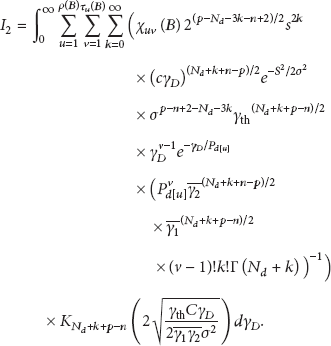
For the dual-hop DF relaying system, the outage probability can be defined as the probability that the minimum of the single-hop SIRs falls below a given threshold . Therefore, it can be expressed by
By using the CDF of in (13), the outage probability of the in (10) can be calculated as
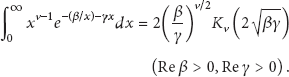
With the help of [23, Eq. (3.351.3)], the outage probability of can be further obtained as
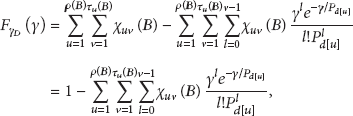
In order to calculate the CDF of , we firstly evaluate the CDF of . Given the PDF of in (19), the CDF of can be calculated as
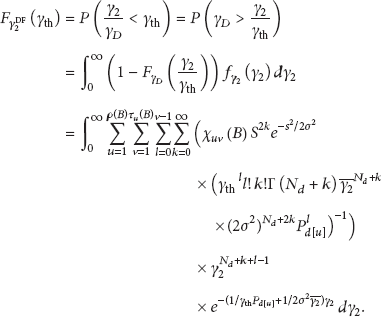
where the fact is utilized. Using the CDF given in (39), the outage probability of in (11) can be derived as
With the help of [23, Eq. (3.351.3)], the outage probability of can be further obtained as
Substituting (36) and (41) into (34), the outage probability can be further derived as
4. Numerical Results
In this section, we verify the theoretical analysis via Monte Carlo simulations. We assume that , the value of C is defined in (22). Here, we consider two interferers as . The power distribution factor of interference is defined as and SIR is defined as . With the help of [24] and the references therein, for , it can be obtained that , , , , , .
Figure 2 shows the outage probability versus average SNR per hop for the dual-hop AF and DF relaying systems. The system parameters are set to be and dB, and the SIR threshold is selected as dB. Figure 3 shows the outage probability with average SIR chosen from 5 dB to 30 dB, and the average SNR is selected as dB. Here, we assume Jake's fading spectrum, and the feedback delay parameters are set as , and corresponding to , , and , respectively. It can be found that the simulation results and analytical results are perfectly matched, which demonstrates the effectiveness of our performance analysis. It can be seen that long feedback delay, that is, , significantly degrades the outage probability performance. We can also find that the outage probability decreases as the SNR per hop or SIR per hop increases. It is also worthy to note that DF relaying system performances are better than AF relaying system when feedback delay is short, while the performance gap becomes small as the feedback delay increases.
Outage probability of AF and DF relaying system for different with dB, and dB.
Outage probability of AF and DF versus different SIR with , dB, and dB.
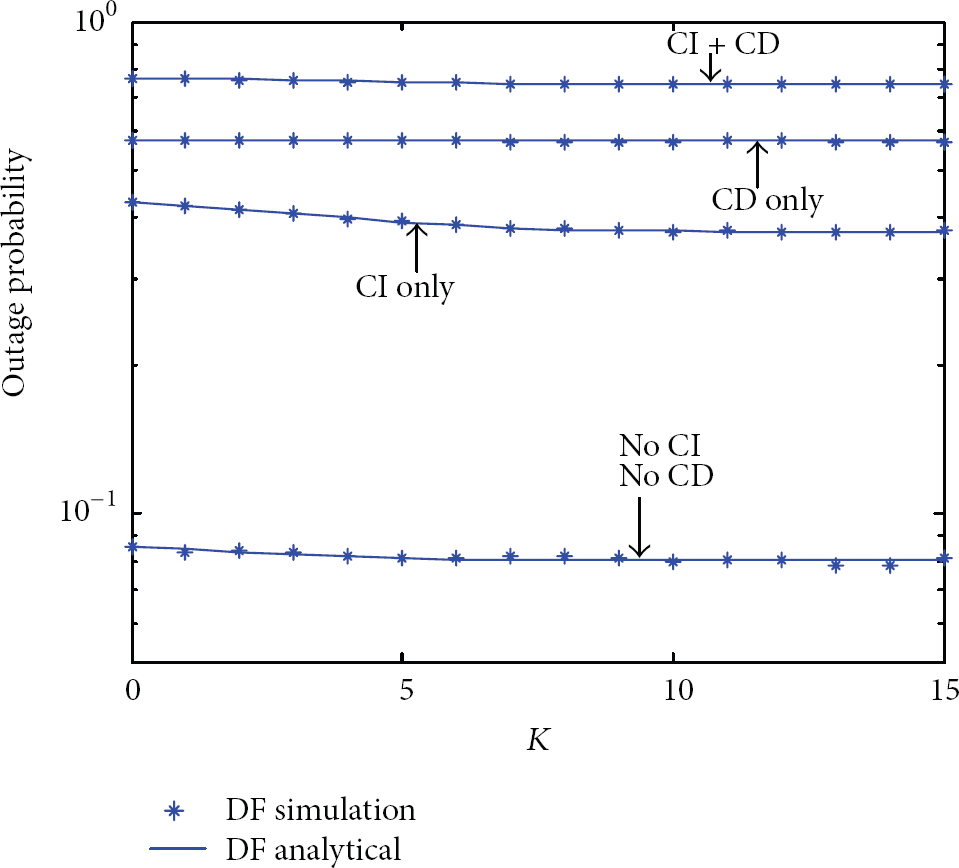
Figures 4 and 5 show the outage probability versus Rician factor K for the two systems. We choose SIR threshold and average SNR per hop as dB and dB, respectively. Here, we consider four different scenarios, that is, channel delay and channel interference (CD + CI), channel delay only (CD only), channel interference only (CI only), and without channel delay and channel interference (No CD, No CI). For the scenarios with CD, we choose and dB. As can clearly be seen from Figures 4 and 5, the outage probability decreases as the K increases for both AF and DF relaying systems, but the improvement is slow and unobvious, which means that the outage probability is not decided by the second hop. It is shown that the simulation results and the analytical results are in perfect agreement. It also can be noticed that the best performance can be obtained without channel delay and interference. Moreover, we can find that channel delay has larger influence on the outage probability compared with the interference.
Outage probability of AF versus different K with dB.
Outage probability of DF versus different K with dB.
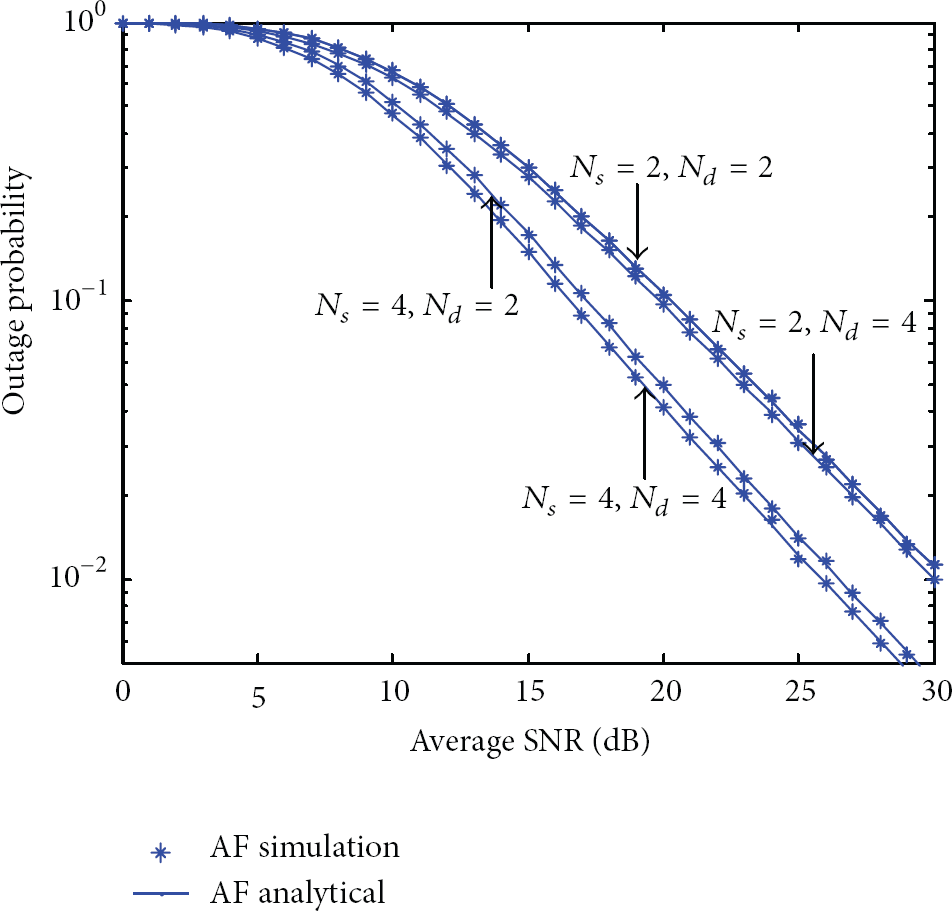
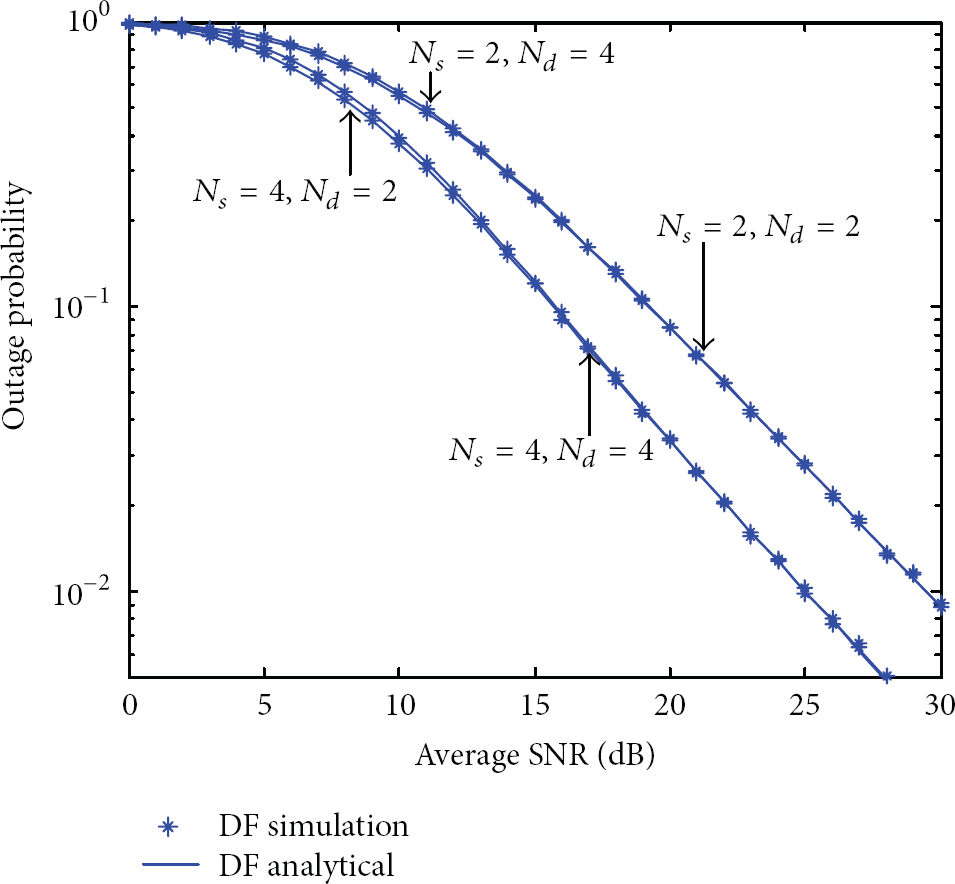
Figures 6 and 7 show the performance of outage probability for different antenna configurations. The system parameters are set as dB, , and dB. It can be seen clearly that the analytical results exactly agree with the simulation results. We can find that the outage probability is improved as the number of antenna increases for both AF and DF relaying system. It is also worthy to note that the number of transmit antennas at source significantly influences the outage probability performance, which means that the channel delay in the first hop is the main cause that affects the outage probability performance.
Outage probability of AF versus different and with dB.
Outage probability of DF versus different and with dB.
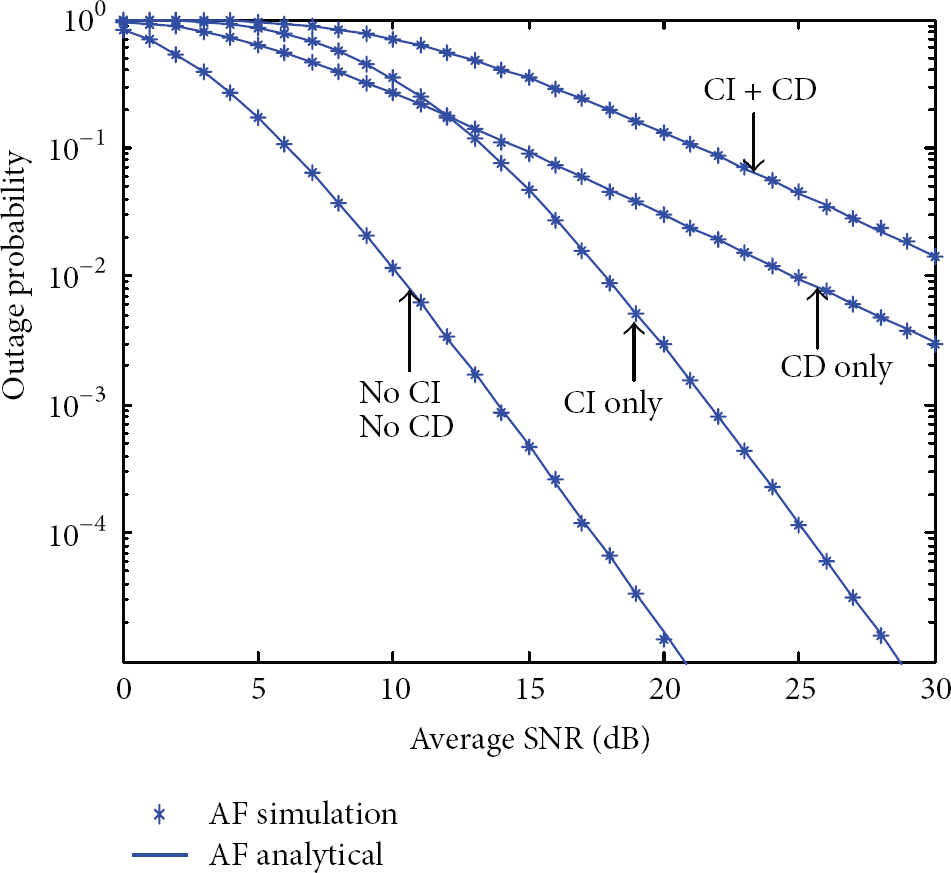
Figures 8 and 9 show the outage probability versus average SNR (dB) per hop for the two systems. Here, we also consider four different scenarios, that is, CD + CI, CD only, CI only, and No CD, No CI. It is shown that the simulation results and the analytical results are in perfect agreement. Similar to Figures 4 and 5, same conclusion can be reached that, without channel delay and interference, the best performance can be obtained, while channel delay degrades the outage probability performance more significantly compared with the interference.
Outage probability of AF versus different scenarios with dB, .
Outage probability of DF versus different scenarios with dB.
5. Conclusions
In this paper, we investigated the effects of channel feedback delay and cochannel interference on the performance of outage probability in dual-hop relaying system. We considered a mixed Rayleigh and Rician fading channel model and obtained closed-form outage probability expressions for both AF fixed-gain and DF relaying system. The validness of our analytical results was verified by Monte Carlo simulations. Our analysis is useful to the system design engineer for performance evaluation of satellite M2M networks.
Footnotes
Acknowledgment
This work was supported by the China National Natural Science Foundation under Grant 61231011.
References
1.
YanikomerogluH.Fixed and mobile relaying technologies for cellular networksProceedings of the 2nd Workshop Applications and Services in Wireless Networks (ASWN '02)July 2002Paris, France7581
2.
PabstR.WalkeB. H.SchultzD. C.HerholdP.YanikomerogluH.MukherjeeS.ViswanathanH.LottM.ZirwasW.DohlerM.AghvamiH.FalconerD. D.FettweisG. P.Relay-based deployment concepts for wireless and mobile broadband radioIEEE Communications Magazine200442980892-s2.0-464426236910.1109/MCOM.2004.1336724
3.
SendonarisA.ErkipE.AazhangB.User cooperation diversity—Part I: system descriptionIEEE Transactions on Communications20035111192719382-s2.0-034525850610.1109/TCOMM.2003.818096
4.
LanemanJ. N.TseD. N. C.WornellG. W.Cooperative diversity in wireless networks: efficient protocols and outage behaviorIEEE Transactions on Information Theory20045012306230802-s2.0-504425200310.1109/TIT.2004.838089
5.
WangD.BaiL.ZhangX.GuanW.ChenC.Collaborative relay beamforming strategies for multiple destinations with guaranteed QoS in wireless machine-to-machine networksInternational Journal of Distributed Sensor Networks201220121052564010.1155/2012/525640
6.
ChenC.BaiL.FengM.HuangM.TianT.Distributed beamforming for relay assisted multiuser machine-to-machine networksInternational Journal of Distributed Sensor Networks20122012921372710.1155/2012/213727
7.
FangZ.LiL.WangZ.Asymptotic performance analysis of multihop relayed transmissions over Nakagami-m fading channelsIEICE Transactions on Communications B2008E9112408140842-s2.0-6765112006510.1093/ietcom/e91-b.12.4081
8.
QuX.XuX.LiH.TaoX.TianH.Analysis of outage capacity for DF dual-hop relay and optimal power allocationProceedings of the IET International Conference on Wireless Sensor Network 2010 (IET-WSN '10)November 20101941972-s2.0-7995310997910.1049/cp.2010.1052
9.
SenaratneD.TellamburaC.Unified exact performance analysis of two-hop amplify-and-forward relaying in nakagami fadingIEEE Transactions on Vehicular Technology2010593152915342-s2.0-7794969596910.1109/TVT.2009.2038784
10.
FanY.ThompsonJ.MIMO configurations for relay channels: theory and practiceIEEE Transactions on Wireless Communications200765177417862-s2.0-3424929763710.1109/TWC.2007.360379
11.
HasnaM. O.AlouiniM.-S.End-to-end performance of transmission systems with relays over Rayleigh-fading channelsIEEE Transactions on Wireless Communications200326112611312-s2.0-004261045110.1109/TWC.2003.819030
12.
LiM.LinM.YuQ.ZhuW. P.DongL.Optimal beamformer design for dual-hop MIMO AF relay networks over Rayleigh fading channelsIEEE Journal on Selected Areas in Communications201230814021414
13.
HasnaM. O.AlouiniM.-S.Harmonic mean and end-to-end performance of transmission systems with relaysIEEE Transactions on Communications20045211301352-s2.0-134228678710.1109/TCOMM.2003.822185
14.
LouieR. H. Y.LiY.SuraweeraH. A.VuceticB.Performance analysis of beamforming in two hop amplify and forward relay networks with antenna correlationIEEE Transactions on Wireless Communications200986313231412-s2.0-6765118082310.1109/TWC.2009.080807
15.
SuraweeraH. A.TsiftsisT. A.KaragiannidisG. K.NallanathanA.Effect of feedback delay on amplify-and-forward relay networks with beamformingIEEE Transactions on Vehicular Technology2011603126512712-s2.0-7995284669110.1109/TVT.2011.2112786
16.
ZhongC.JinS.WongK.-K.Dual-hop systems with noisy relay and interference-limited destinationIEEE Transactions on Communications20105837647682-s2.0-7794941602610.1109/TCOMM.2010.03.080156
17.
Al-QahtaniF. S.DuongT. Q.ZhongC.QaraqeK. A.AlnuweiriH.Performance analysis of dual-hop AF systems with interference in nakagami-m fading channelsIEEE Signal Processing Letters20111884544572-s2.0-7995955717810.1109/LSP.2011.2158820
18.
SalhabA. M.Al-QagtaniF.ZummoS. A.AlnuweiriH.Exact outage probability of opportunistic DF relay systems with interference at both the relay and the destination over Nakagami-m fading channelsGLOBECOM201245604565
19.
Al-QahtaniF. S.ZhongC.AlnuweiriH.QaraqeK. A.Performance analysis of partial relay selection with feedback delay in the presence of interferenceProceedings of the 54th Annual IEEE Global Telecommunications Conference: Energizing Global Communications (GLOBECOM '11)December 2011152-s2.0-8485720411310.1109/GLOCOM.2011.6133813
20.
PhanH.DuongT. Q.ElkashlanM.ZepernickH.-J.Beamforming amplify-and-forward relay networks with feedback delay and interferenceIEEE Signal Processing Letters201219116192-s2.0-8405522202610.1109/LSP.2011.2175217
21.
MaY.ZhangD.LeithA.WangZ.Error performance of transmit beamforming with delayed and limited feedbackIEEE Transactions on Wireless Communications200983116411702-s2.0-6294920892510.1109/TWC.2008.080570