This paper studies the achievable data rate of the two-transmitter and two-receiver interference channel model with cooperative transmission. To implement the cooperation, a finite rate conferencing link is deployed at the transmitters side in order to share the message. A new transmit scheme with private message sharing is proposed based on the dirty paper coding. The achievable rate region is established in both strong interference regime and weak interference regime. In weak interference regime, the asymptotically rate region shows the conferencing link can improve the achievable rate region for cooperative receiver. In strong interference regime, the conferencing link not only improves the achievable rate for cooperative receiver but also improves the sum rate of the cooperative network. Numerical results demonstrate these theories in a Gaussian interference channel.
1. Introduction
The classic interference channel (IC) model is a two-transmitter and two-receiver model, which is firstly introduced in [1]. In this model, one transmitter sends information to the corresponding receiver and interferes with another transmitter-receiver pair. The study of interference channel is important for communication system design, because the practical systems are designed to operate in the interference scenario. In [2], Han and Kobayashi gave the classical achievable rate region for the interference channel, where the message is split into common information and private information. This splitting technique is used to partially decode and subtract the interfering signal.
Due to the scarcity of the spectrum resource and the high data transmit requirement, cooperative transmission had drawn much research attention [3–5]. Such cooperative transmission had been considered in the IC research. Interference channel with transmitter cooperation had attracted many researchers interests [6, 7]. The channel model is that two transmitters attempt to communicate with their respective receivers simultaneously through a common medium, and one transmitter has complete or partial knowledge about the message being transmitted by the other. It is first proposed in [6] that by utilizing cognitive techniques, the cognitive transmitter gains full knowledge of another transmitter message. During the transmission, the cognitive transmitter treats the message from the other transmitter as interference and tries to compensate for it by using a well-known Gelfand and Pinskers coding scheme [8]. This result enlarges the achievable rate region in [2] and reduces to the same region in [2] in the case where no interference mitigation is performed. In [9], a cooperative encoding scheme was proposed to derive new achievable rate regions, in which the channel is named as IC with degraded message sets (IC-DMS). Both [6, 9] proved that the rate region is achievable when applying the proposed coding schemes for the IC-DMS in the low interference regime, which means the cross-link gain between the receiver and its interfering transmitter is less than one. Considering the coding scheme in [9] is nonoptimal for IC-DMS in high interference regime, a cooperative coding scheme is proposed in [10]. By combining three coding methods, cooperative coding, collaborative coding, and Gelfand-Pinsker coding, the new coding scheme derives the achievable rate region not only in low interference regime but also in the high interference regime. Reference [11] proposed various transmitter cooperation scenarios in the two-transmitter two-receiver interference channel (X-IC) and obtained the channel capacity in the strong interference regime.
However, the previous works assumed that the message sharing among transmitters via cognitive radio did not consider the limitation of the data rate of the information exchange on transmitter side. Reference [12] proposed a scheme with finite-rate cooperation at transmitters in Z-interference channel (Z-IC). It is proved that the achievable rate region can be improved by the conferencing link in both low interference regime and high interference regime in Z-IC. The cooperation can be deployed at not only the transmitter side but also the receiver side. In [13], the achievable rate region is studied with receiver cooperation, in which the receiver will relay the public information to the other receiver.
Most of the works are based on the assumption that the public message can be shared either between transmitters or receivers. In such cooperation scenario, the transmitter cooperation sharing the public message can mitigate the interference. In this paper, we extend the transmitter cooperation in X-IC with private message sharing for joint processing [3]. We consider the one-side information exchange in the transmitters side and cooperative transmission, which can be thought as one transmitter acting as the relay node in the X-IC [14] for cooperative transmission. In such scenario, the transmitter cooperation can not only mitigate the interference but also improve the useful signal transmission gain.
The contributions of this paper are as follows: (1) we study the X-IC channel with cooperative transmission, in which the private message of one transmitter can be transferred to another transmitter and then sent to the corresponding receiver cooperatively; (2) the achievable rate region is established in both strong interference regime and weak interference regime. In weak interference regime, the asymptotically rate region shows the conferencing link can improve the achievable rate region for cooperative receiver. In strong interference regime, the conferencing link not only improves the achievable rate for cooperative receiver but also improves the sum rate of the cooperative network.
The rest of the paper is organized as follows: the system model is given in Section 2; the achievable rate region in modified interference channel with cooperative transmission is proved in Section 3; Section 4 computes an achievable rate region in the AWGN case. The numerical results and the conclusion are given at the end of the paper.
2. Modified Interference Channel with Cooperative Transmission
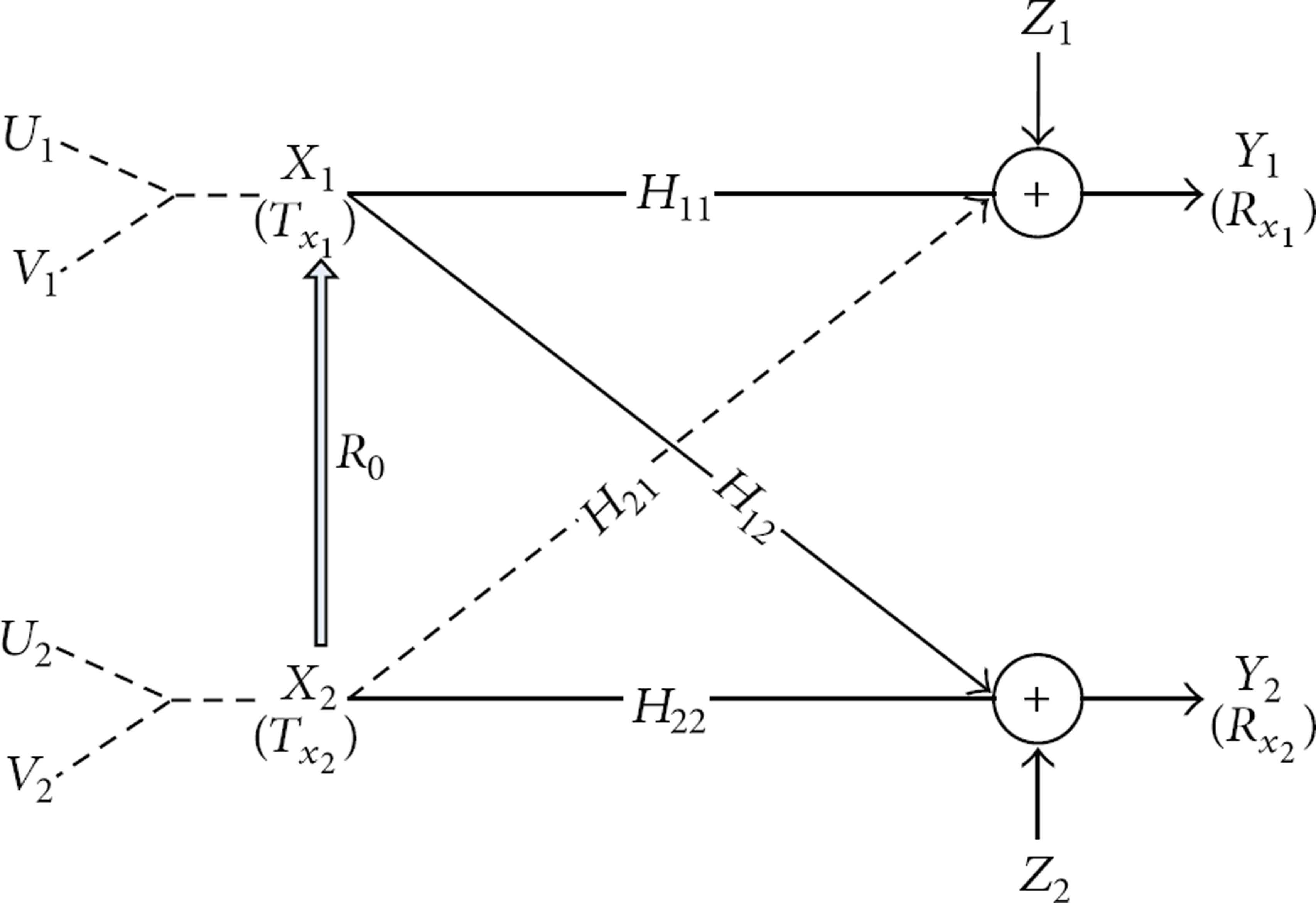
In this section, a two-transmitter two-receiver interference channel with transmitter cooperation is defined in which transmitter has the knowledge of the message to be transmitted by the transmitter . The transmitter could refrain from transmitting its own information and act as a relay for transmitter . Similar to [2], a modified IC with cooperative transmission is introduced and demonstrates an achievable region . After that, a relation between an achievable rate for and an achievable rate for C is used to establish an achievable region for the IC with cooperative transmission. The modified is defined as in Figure 1.
The modified interference channel model with transmitter cooperation.
Let and be the random-variable inputs to the channel. Let and be the random-variable outputs of the channel. The conditional probabilities of the discrete memoryless channel are the same as in [2] and can be fully described by and for all values , , , and .
The modified IC with cooperative transmission introduces two pairs of auxiliary random variables: and . In this work, denote the private message sending to the corresponding receivers. denote the public message sending to the two receivers. The message is generated to send message to receive cooperatively. Define code for the modified IC with cooperative transmission model as a set of codewords , and codewords , , , , such that the average probability of decoding error is less than ϵ.
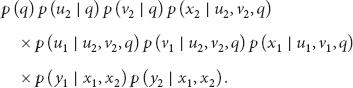
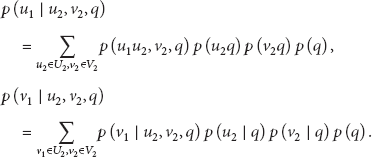
Denote the time-sharing random variable Q as defined in [2]. For notational simplicity, the following notation is used to replace the probability distributions of Q, , , , and
Theorem 1.
Define and let 𝒫 be the set of distribution on Z that can be decomposed into the form
For any , let be the set of all quadruples of nonnegative real numbers such that
Furthermore, let S be the closure of . Then any element of S is achievable for the modified IC with cooperative transmitter .
Proof.
It is sufficient to show the achievability of the interior elements of for each . So, fix and take any satisfying the constraints of the theorem. Given any , define by
Encoding. To generate the codebook, first let be a sequence in chosen randomly according to and known to the transmitters and receivers. Considering the message exchange from to , note that
Then the codebook can be generated according to the distribution
If the probability of error could be arbitrarily small under such a message, the rates achieved will be for the respective transmitter-receiver pairs , , , .
Decoding. and decode independently, based on strong joint typicality. The inputs are received at as according to the conditional distributions
where attempts to recover and attempts to recover based on the received signal . Thus, the decoders at are functions
When receive the and n-sequence , respectively, it looks at the set of all input sequences and , respectively. Thus forms the set with the given as follows:
Valuation of Error Probability. To simplify the error probability calculation, defining each massage emitted to the channel yields the same error probability. First, the decoding error probability for is considered. Suppose that was received by . Let denote the decoding event (18), let define as binary variables indicate the decode function of message , respectively, where equals indicates the decoding successfully, otherwise equals . Then it is easy to have
It is easy to have
Considering the symmetry among the relevant random variables for the second part of (20), it is easy to have
Let us first evaluate . It is easy to have
Using similar techniques for the other terms in (22) and substituting (12) and (13), it is easy to have
Since can be made arbitrarily small by letting n be sufficiently large, (3)–(5) yield
where the parameter . Then, substituting (22), (23), and (24), it is easy to have . For denote the decode error probability. Let denote the decoding event (18). Using similar techniques, it is easy to have the same result. To consider the achievability for the IC with transmitter cooperation channel, it is simply by using lemma 2.1 in [2]. Then it is demonstrated that if the rate pair is achievable in the modified IC with transmitter cooperation channel, then the rate pair is achievable for the IC with transmitter cooperation channel. Furthermore, the convex hull is then achievable by standard time-sharing arguments.
3. The Gaussian Interference Channel with Cooperative Transmission
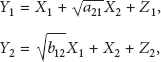
Considering a memoryless Gaussian channel scenario, the received signals in standard form [1] for IC with transmitter cooperation are given by
where are the transmit signals with transmit power constraints and , respectively. and are real numbers, and and are independent AWGN with zero means and variance , respectively.
To simplify the notation, let . Let Q, the time-sharing random variable, be constant. Let define and with . Therefore, independent Gaussian codebooks of sizes , and are generated according to i.i.d. Gaussian distributions , , , and , respectively.
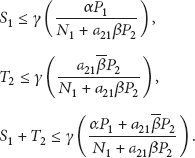
At , are decoded while is treated as noise. Since each mutual-information bound can be expanded in terms of entropies, the set of achievable rates denoted here by is given by
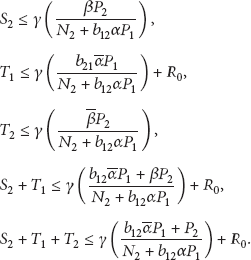
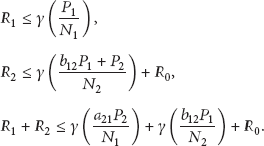
At , are decoded while is treated as noise. This is a multiple access channel with a rate-limited link at transmitter, who has complete knowledge for . This channel is a special case of the multiple access relay channel studied in [15]. The set of achievable rates is denoted by , where
It is possible to use a Fourier-Motzkin elimination to verify the achievable rate region for arbitrary parameter value , and the achievable is formed according to (23)
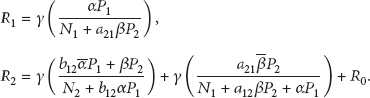
The convex hull of the union of the rate region is over arbitrary and gives the complete achievability region. Since the union of the rate region is convex, the convex hull is not needed. Therefore, the convex hull is not needed. A proof of this fact will be given in the following. Consider the regime where , that is, in weak interference and weak cooperation scenario. In this case, the constraint is ignored. Then the achievable rate region can be represented in a more compact form as follows:
where
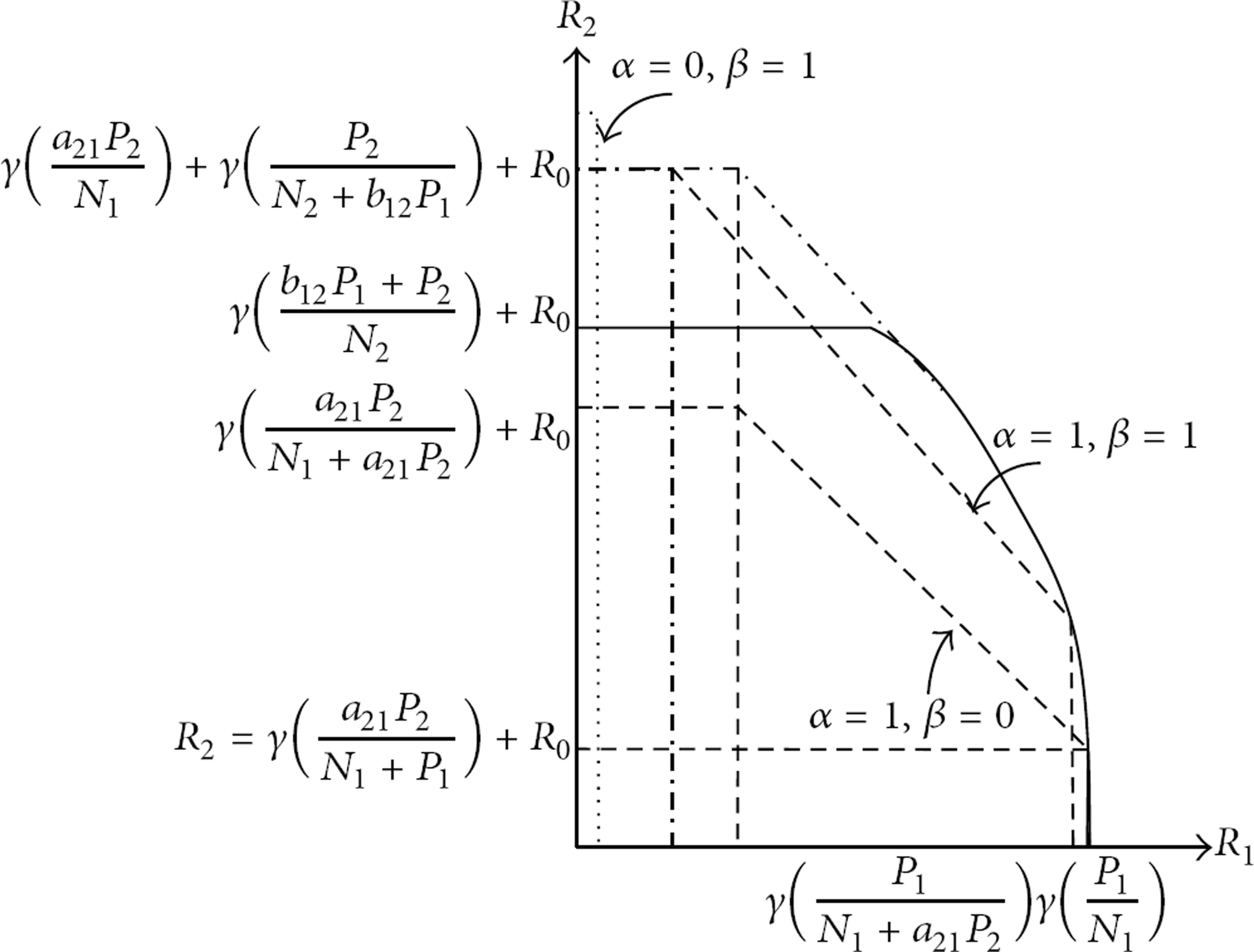
To verify the union of rate region pentagons, it is easy to prove , , and are all continuous functions of , as are from 0 to 1. When α increases from 0 to 1, is monotonically increasing and both and are monotonically decreasing. On the other hand, when β increases from 0 to 1, , are monotonically decreasing, while increasing. Therefore, as shown in Figure 2, the upper left corner point moves downward in the plane as α increases. Therefore, as shown in Figure 2, the upper left corner point moves downward in the plane as increases. Moreover, the lower right corner point moves downward and to the right as α increases and β decreases. Consequently, the union of theses expanded pentagons is defined by , , and the lower right corner points of the pentagons with
The union of rate region pentagons in weak interference scenario.
To prove the convexity of the region, similar to [13], it is easy to have
where , . Since , it has and . As a result, the curve (26) is concave. Therefore, in the weak interference regime where , the rate region is convex. Thus, convex hull is not needed. Thus the achievable rate region simplifies to
Now, consider the strong interference and strong cooperation scenario, where . In this regime, as are increase from 0 to 1, is monotonically increasing and both and are monotonically decreasing. Therefore, using similar techniques, the convex hull is proved to be unnecessary. Thus, the achievable rate region simplifies to
So far, obtained achievable rate regions are obtained for regimes and as in (29) and (30), respectively.
4. Numerical Results
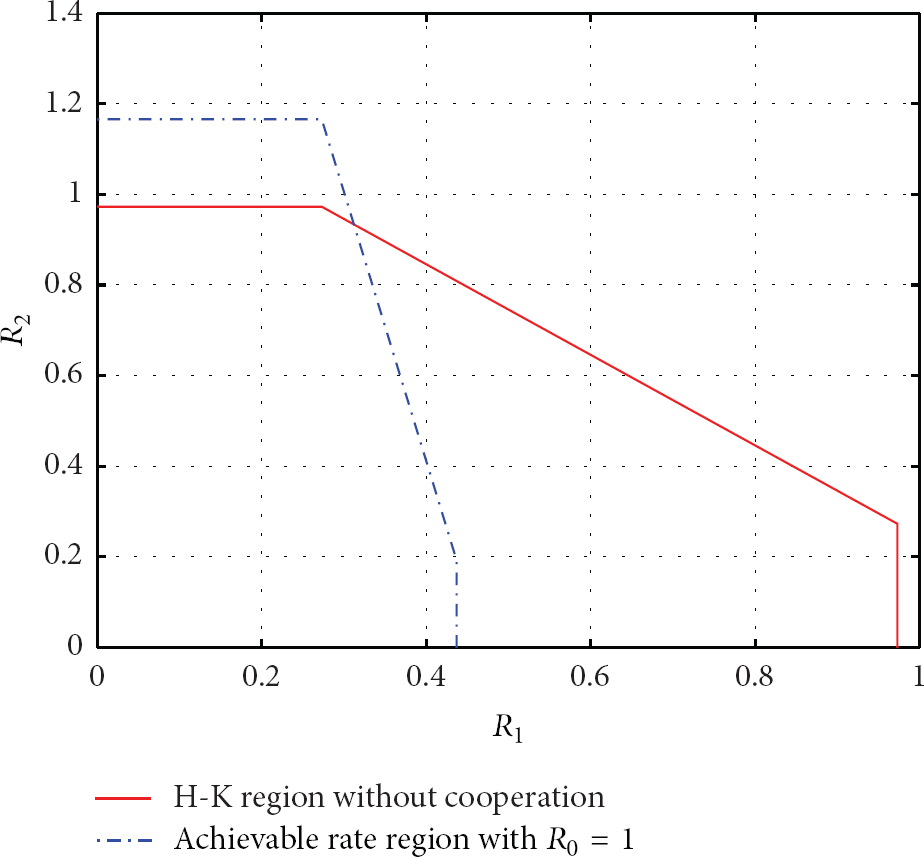
In this section, to evaluate the achievable rate region, the results are illustrated in Figures 3 and 4, respectively. As a numerical example, Figure 3 shows the achievable rate region of a Gaussian IC in the weak interference regime, with , . The red line denotes the classic Han and Kobayashi common-private power splitting scheme [2], and the blue line denotes the IC with transmitter cooperation. The cooperation builds a little contribution for . However, it sacrifices the rate for , because spend more transmit power to the cooperative receiver instead of the direct link receiver . Since the interference link gain is smaller than that of direct link, the cooperation gain of on is tiny as well. This is obviously different in the case of strong interference regime as shown in Figure 4.
The achievable rate region for weak interference with , .
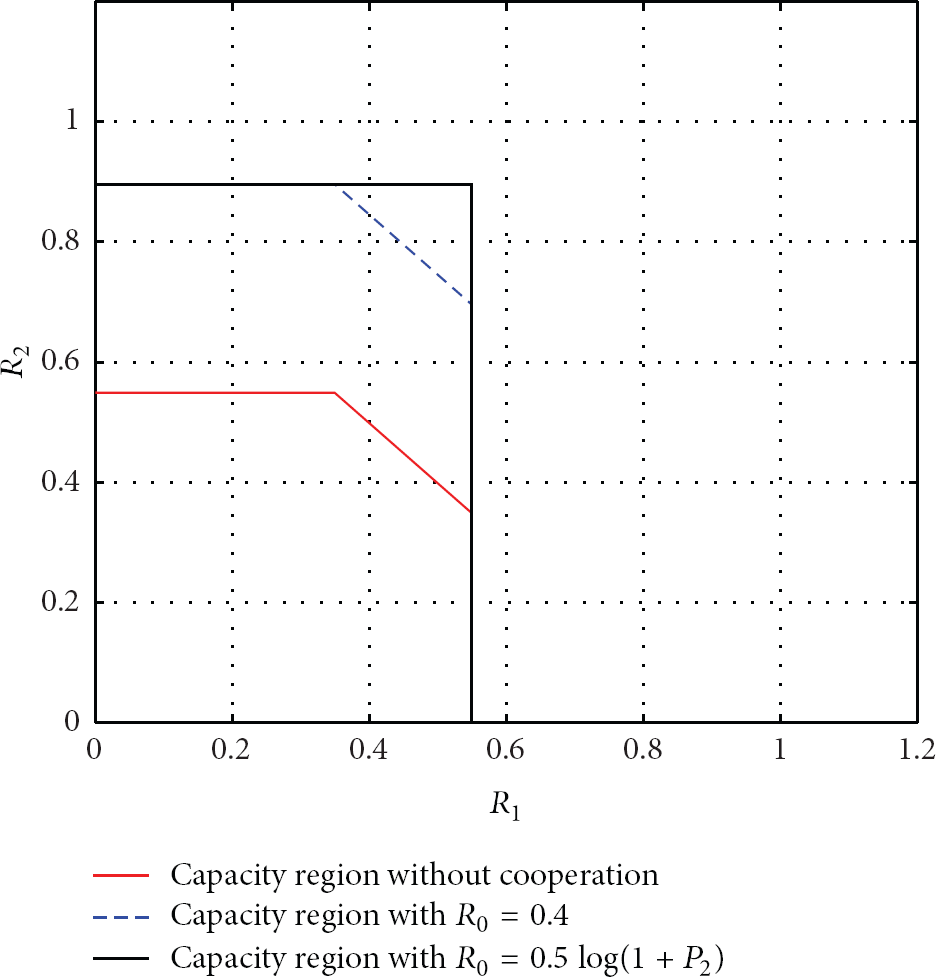
The achievable rate region for weak interference with , .
In the strong interference regime, the capacity region of IC with transmitter cooperation is achieved by transmitting only at the cross-link, that is, the private message from to and the common message from to . In the strong interference scenario, the cooperation link increases the capacity by helping the private information decoding at . In fact, a conferencing link increases the sum capacity by exactly . As a numerical result, Figure 4 illustrates the capacity region of an IC with transmitter cooperation in strong interference regime with and without cooperation. The channel parameters are set to be , . The results indicate that the achievable rate region increases when the increases. The capacity region without cooperation (H-K scheme) is the red pentagon. The capacity expands to the blue pentagon region with cooperation and . If , the can fully cooperative . In this case, the achievable rate region became the black rectangular.
5. Conclusions
In this paper, rate region of the two-user IC with transmitter cooperation is studied and derived into Gaussian channel scenario. A potentially more efficient transmission model is proposed. In the weak interference scenario, a novel achievable rate region is provided to help the cooperative link by splitting the transmit power for the other direct link. In the strong interference scenario, a more flexible rate region is defined and proved. The larger rate region is achievable as the conferencing rate increases, which also improves its sum rate.
Footnotes
Acknowledgments
The authors wish to thank Zhang TianKui. This work was supported by National Natural Science Foundation of China nos. 61250005 and 61340025. JiangXi Natural Science Foundation 20122BAB2111015 and 20132BAB211035, Jiangxi Provincial Department of Education Youth Science Foundation GJJ13007, Jiangxi postdoctoral Merit-funded project funds 2013KY07, and China postdoctoral Science Foundation on the 49th Grant program no. 2013M541875.
References
1.
CarleialA. B.Interference channelsIEEE Transactions on Information Theory197824160702-s2.0-0017918923
2.
HanT. S.KobayashiK.A new achievable rate region for the interference channelIEEE Transactions on Information Theory198127149602-s2.0-0019437605
3.
TiankuiZ.XiaochenS.LaurieC.Vector perturbation based adaptive distributed precoding scheme with limited feedback for CoMP systemsEURASIP Journal on Wireless Communications and Networking20112011article 8
4.
LeeD.SeoH.ClerckxB.HardouinE.MazzareseD.NagataS.SayanaK.Coordinated multipoint transmission and reception in LTE-advanced: deployment scenarios and operational challengesIEEE Communications Magazine20125021481552-s2.0-8485748437410.1109/MCOM.2012.6146494
5.
HuZ.ZhangT.FengC.Study on codeword selection for per-cell code-book with limited feedback in CoMP systemsProceedings of the IEEE Wireless Communications and Networking Conference (WCNC '13)April 2013
6.
DevroyeN.MitranP.TarokhV.Achievable rates in cognitive radio channelsIEEE Transactions on Information Theory2006525181318272-s2.0-3364604586310.1109/TIT.2006.872971
7.
JovicicA.ViswanathP.Cognitive radio: an information theoretic perspectiveProceedings of the IEEE International Symposium on Information Theory (ISIT '06)July 200624132417
8.
Gel'fandS. I.PinskerM. S.Coding for channel with random parametersProblems of control and information theory19809119312-s2.0-0019148101
9.
WuW.VishwanathS.ArapostathisA.Capacity of a class of cognitive radio channels: interference channels with degraded message setsIEEE Transactions on Information Theory20075311439143992-s2.0-3634903471810.1109/TIT.2007.907436
10.
JiangJ.XinY.On the achievable rate regions for interference channels with degraded message setsIEEE Transactions on Information Theory20085410470747122-s2.0-5474911862810.1109/TIT.2008.929026
11.
MarićI.YatesR. D.KramerG.Capacity of interference channels with partial transmitter cooperationIEEE Transactions on Information Theory20075310353635482-s2.0-3514882262510.1109/TIT.2007.904792
12.
SeoD.-W.JeonS.-W.ChungS.-Y.KimJ.Rate enhancement for the Gaussian Z-interference channel with transmitter cooperationIEEE Communications Letters20101498218232-s2.0-7795771454210.1109/LCOMM.2010.072610.100041
13.
ZhouL.YuW.Gaussian Z-interference channel with a relay link: achievable rate region and asymptotic sum capacityProceedings of the International Symposium on Information Theory and its Applications (ISITA '08)December 2008Auckland, New Zealand162-s2.0-7795113873310.1109/ISITA.2008.4895518
14.
ZhaoS.ZhangT.ZengZ.The achievable generalized degrees of freedom of interference channel with orthogonal relayProceedings of the IEEE GLOBECOM Workshops (GC Wkshps)December 2010Miami, Fla, USA7417452-s2.0-7995194106810.1109/GLOCOMW.2010.5700421
15.
SatoD. H.Capacity of the gaussian interference channel under strong interferenceIEEE Transactions on Information Theory198127117867882-s2.0-0019635833