




Abstract
By exploring the idle state of each sensor node, a mixed sleep-cooperative time division multiple access (TDMA) media access control (MAC) protocol (MS-CTDMA) is proposed for the wireless data gathering network in wireless machine-to-machine (M2M) networks. The basic idea is that in the idle state, each sensor node dynamically goes into sleep state or cooperative state to maximize the network lifetime. A single-hop network delay model of MS-CTDMA is established by the
1. Introduction
Machine-to-Machine (M2M) technology is widely used to gather information, and the machines are small and low-power. Cooperative communications enhance the link quality of the wireless network in a distributed fashion. The peer terminals in wireless M2M networks can achieve the diversity gain via mutual cooperation realized by the prevalent cooperative relay protocols, such as amplify-and-forward (AF) and decode-and-forward (DF) in [1]. In fact, the source and the relay form the virtual antenna array which brings benefits of the spatial diversity. For data acquisition system in wireless networks, a node receives transmission signals sent by its neighbors due to the wireless broadcast nature. Reference [2] proposed iterative collaborative relay beamforming strategies based on AF to maximize the received signal-to-interference-and-noise ratio (SINR) in wireless M2M networks. Time division multiple address (TDMA) is adopted to guarantee the quality of service (QoS) of the traffic data. More important, TDMA system can save energy by permitting the nodes to work with sleep mode in wireless data acquisition network [3]. Recently, several cooperative retransmission media access control (MAC) protocols have been investigated for TDMA systems. In [4], a Cooperative TDMA (C-TDMA) protocol was proposed to improve the throughput of the wireless network. Reference [5] extended the previous work to the dynamic slot assignment scheme for TDMA systems.
However, cooperations introduce delay to the system. In order to investigate the delay character of the cooperative relay network, the researchers first established a delay model of the single source and single-relay cooperative automatic-repeat request (ARQ) protocols for failure transmission [6], in which the Poisson arrival model of frames is assumed to estimate the delay caused by the cooperative relay when error frame triggers the retransmission.
For the consideration of saving energy in wireless sensor networks, [7] demonstrated that the network lifetime of wireless sensor network is more important for data collection network. Reference [8] established the energy model of single-hop wireless sensor networks. The transceiver of each sensor node uses energy when sending, receiving, or listening, and the ratio energy consumption is about 1.5 : 1 : 1 [9, 10]. Energy efficiency and power allocation of cooperation transmission in wireless data gathering network were investigated in [11]. Reference [11] adopted the minimum energy consumption (MIE) policy and maximum residual energy (MARE) policy to allocate transmit power between the relay and the source node. Based on the control message of RTS-CTS, the proposed transmission scheme could decrease the signaling overhead. Reference [12] extended MARE policy to pricing strategy to maximize the network lifetime. The proposed energy pricing strategy could balance each node's energy consumption. Besides, [13] proposed the improved power allocation scheme based on communication distance for each group to maximize the lifetime of the whole sensor network. The priority queuing model combined with the vacation queuing model [14] is used to analyze the energy-aware MAC for differentiated services in wireless packet networks.
Only in sleep state, the energy consumption is very low. The microprocessor embedded in sensor node can go to the sleep state automatically when there is no task. So it is essential to introduce sleep mode to wireless sensor MAC protocol to save power [9]. Reference [15] adopted the vacation queue model, depicted extensively in [16], to study the sleep mode in the 802.16e system, which increased the energy efficiency and prolonged the lifetime of the wireless network.
However, it seems that the above cooperative transmission protocols cannot consider the incurred overhead extensively, which includes energy consumption of the relay node, additional delay of the relay traffic, and signaling for cooperating nodes selection [17]. Furthermore, if a terminal is in its idle state (here, we define, idle state is that the incoming buffer length of one node is less than the predefined threshold), it can become a relay node or sleep node according to its residual energy, traffic load, and received signal strength. When the node selects cooperative target during its idle state, many-to-one cooperative communication topology is established, and [18, 19] used game theory to analyze power allocation problem for this topology. When the node selects sleep scheme during its idle state, intuitively it saves power for itself, but if adopting random or independent sleep scheme, the network lifetime of sensor network cannot be maximized, because the network lifetime is attributed to the shortest duration time of the sensor node. Thus, in idle state we combined the sleep mode with the cooperative transmission, which is able to average energy cost over several sensor nodes. Both cooperative scheme and sleep scheme incur the transmit delay.
To deal with both energy and delay challenges, we propose a mixed cooperation MAC protocol with sleep mechanism (MS-CTDMA) for data acquisition system. And a queue model for MS-CTDMA protocol is given to measure the pros and cons of the proposed transmission. The contributions of this research are mainly at the following three points.
MS-CTDMA protocol is introduced by fully utilizing the idle time of each node to save power. During idle state each node can select sleep scheme or cooperative transmission. We establish a Considering many-to-one cooperation communication topology, we give the optimal node selection strategy from the perspective of the relay naming source node selection, which is more efficient to average energy over the whole network.
The rest of the paper is organized as follows. Section 2 describes MS-CTDMA protocol elaborately. In Section 3, we establish the
2. System Model with MS-CTDMA Protocol
2.1. Network Model
The research in this paper considers the wireless data acquisition network with sensor nodes and a sink node. In this network, each node only transfers collected data to the sink node. We focus on single-hop wireless network which means that all nodes are within one-hop transmit range. Moreover, each node can obtain spatial diversity through 2-hop cooperative transmission. This wireless packet system adopts TDMA scheduling protocol. Each node has its own allocated time slot and only has the chance to access the channel in its time slot. All nodes are synchronized and the MAC frames have equal length. Without loss of generality, this study concentrates on single relay cooperative scheme which incurs less overhead. As depicted in Figure 1, this data acquisition system contains M sensor nodes and one sink node. Each node alternatively acts as source node during its busy state or as relay node within its idle state. A frame time is divided into two fields: a control time slot (CT) and a data time slot (DT). CT conveys the scheduling information for each node. DT contains the time slots reserved for data transmission. Each node coordinates the cooperative transmission mechanism through CT.

Typical data acquisition system and time slot assignment.
An Rayleigh fading channel [20] is considered between two nodes, and the reciprocal channel is symmetry.


2.2. MS-CTDMA MAC Protocol
To maximize the sensor network lifetime, which is defined as the network working time until one sensor node uses up its energy, we proposed MS-CTDMA protocol. Introducing sleep mechanism into sensor node's idle state can reach low network energy consumption, but it also prolongs average packet delay. And the cooperative transmission could average power consumption over sensor nodes to lengthen the network lifetime. For example, as shown in Figure 1,
Each node is in one of the following states: init state, busy state, setup state, closedown state, sleep state or cooperation state. The state transition diagram is depicted in Figure 2. A node is said to be in sleep state when it turns off the radio transreceiver to save its battery energy. In a sensor node's cooperation state, the idle node acts as the relay node to save the source node's energy consumption by cooperative transmission based on source node selection, not relay node selection.

State transition diagram of each sensor node.
Initially each node starts out with the initial state. In this state the sensor node completes initialization and waits for the packet arrival. If the sensor has data to transmit, it transfers to the busy state. During the busy state, this node acts as the source terminal S. S is listening to the cooperative relay request (CREQ) from other idle sensor nodes by signaling packet. Then S sends the negotiation (CNEG) message back to the request relay node. Once a request sensor node selects S as its cooperative target and replies to
The criterion to choose optimal source node for R is vital for the mixed transmission strategy. The mixed strategy tries to give a tradeoff between the network lifetime and packet delay determined by considering the multiple important elements: the residual battery energy, the channel state information at the physical layer, the incoming traffic load at the MAC layer, and the packet delay for a different traffic type. During the same constant time interval, if the predefined threshold N is increasing, the number of entering setup state is decreasing. In other words, the overhead for sleep or cooperation is reducing. For the same reason, the long-sleep time
3. Vacation Queue Model for MS-CTDMA
The
Here, we assume that the traffic data buffer size is unlimited, which is reasonable when analyzing the average performance of the MS-CTDMA systems. The incoming traffic of each terminal is assumed to be compound Poisson process. The batch arrival rate is λ, and the number of packet in each batch is denoted by stochastic variable X. Batch Markovian arrival process (BMAP) is suited to the bursty nature of packet traffic for wireless data acquisition scenario [21]. The data acquisition moment is triggered by outside environment changing which coincides with the model of Poisson arrival. At this moment, a new batch of sensor data with random packets is generated into the transmit buffer. In this paper, all sensor nodes are equal and have the same traffic load.
We give some general assumptions first. The packet length keeps constant, that is,

3.1. State Transition for MS-CTDMA Protocol
First, we illustrate the state transition for MS-CTDMA protocol. In proposed MS-CTDMA protocol with

The time distribution with the state transition.
The vacation time in

3.2. The Average Queue Length
We establish the embedded Markov chain to calculate the average queue length in this subsection. The queue length at the packet departure instants can be mapped into the state space of the embedded Markov chain. Let


3.3. The Mean Waiting Time
The mean packet queue waiting time




3.4. The Average Cooperative Probability
Each node selects its working scheme within its vacation time or idle state. So the probability of the event


4. Performance Metric and Optimal Source Selection Strategy
In this section, we first present the total energy consumption during one operation cycle. Then the delay sensitive problem is formulated. The analysis queue model of MS-CTDMA protocol can be extended to the whole network based on energy consumption target. The optimal source node selection strategy is depicted extensively when MS-CTDMA protocol is running on the one-hop network.
4.1. Total Energy Consumption
The energy consumption within one operation cycle

During the vacation time, node i goes into sleep or cooperation state. The transmit power is denoted by

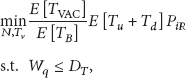
4.2. Delay Tolerant Constraint
In data collection scenarios, the traffic load is always low and nonrealtime. In other words, the collecting data needs to be sent to the sink node more reliably, while the time requirement is relatively relax. However, if the delay is longer than the deadline time
4.3. Extend the Results to the Whole Network
M-node data collection system is an open network, each node has its independent BMAP traffic with the batch arrival rate
According to the Jackson network, an M-node network can be divided into several single nodes to analyze the network performance. For simplicity of deduction, we assume that there are always multiple available relays between the source and the destination, and one source node only chooses one cooperative relay node. Based on the independent characteristic of each node,

4.4. Optimal Source Selection Strategy
In this paper, the cost function [12] is established to evaluate operation mode of each node. At ending instants of the busy period, each node determines whether to sleep or to be as a cooperative relay for one source node. When the node acts as a source node, it also has the opportunity to be selected as the cooperative target by a relay node. During

The first component denotes the cost value during

Compared with (19), we incorporate
4.4.1. The Energy Cost Factor
The energy cost factor is critical for the optimal source node selection. In this paper, we take into account the residual battery energy, the initial battery energy, and the traffic load to calculate the cost factor as follows:

4.4.2. The Optimal Source Selection Strategy
According to (20), the cost value can be decomposed into three independent targets. Within

The first constrained condition is depicted extensively in [24].

Similarly, the problem that each node becomes the optimal target source assisted by other relay nodes can also be formulated as the following linear programming problem:

The energy consumption incurred by state transition is a minimized base on the precondition that the average packet delay must be satisfied. This optimal programming problem is discussed in Section 4.2.
4.4.3. Solutions to Optimal Power Allocation
The linear programming problem (22) can be solved by geometric methods effectively introduced by [12]. From (23), when
As shown in Figure 4,

Geometric solutions for different regions.
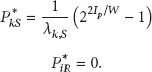
The research in this paper focuses on sleep state,
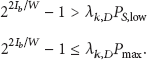
When

When
4.4.4. The Implementation of Optimal Source Selection
The optimal relay selection is the usual way to perform cooperation. But in this paper, we implement the optimal source selection strategy within setup state during the vacation time. Once node i reaches setup state, it transmits CREQ control packet during CT. In the same frame time, when source node k receives CREQ signaling, it responses to node i a CNEG control packet containing the received signal strength indication (RSSI), traffic load, and residual battery energy. When node i gathers all the valid source candidates information, it makes decision whether to sleep or to cooperate during vacation time due to problem (22) and (24) solutions. Then, i sends the CACK packet data in the next frame time.
5. Numerical Results
In order to evaluate the performance of MS-CTDMA, we consider the scenario depicted in Figure 1. The sink node D is in the center of this region. In the research analytical evaluations, the signaling packet length
First, we explore the relationship between average packet delay and average energy consumption. Three different batch arrival rates are assigned to each node, and the node adopts the identical pure sleeping strategy. In this evaluation, the cooperative mechanism is not considered, because it does not affect vacation overhead.
Figure 5 shows a plot of the average packet delay and average energy consumption by varying the vacation time

The average energy consumption and average waiting time by changing vacation time.
Figure 6 shows several curves of the average energy consumption versus delays by varying the predefined threshold N. The increasing line demonstrates that the additional delay of each node introduced by N and the decreasing line demonstrates the average energy consumption of the same node. We clearly concluded that the tradeoff between average energy consumption and average delay can be adjusted by N. Compared to Figure 5, we discover that the average waiting time is insensitive to mean arrival time by changing
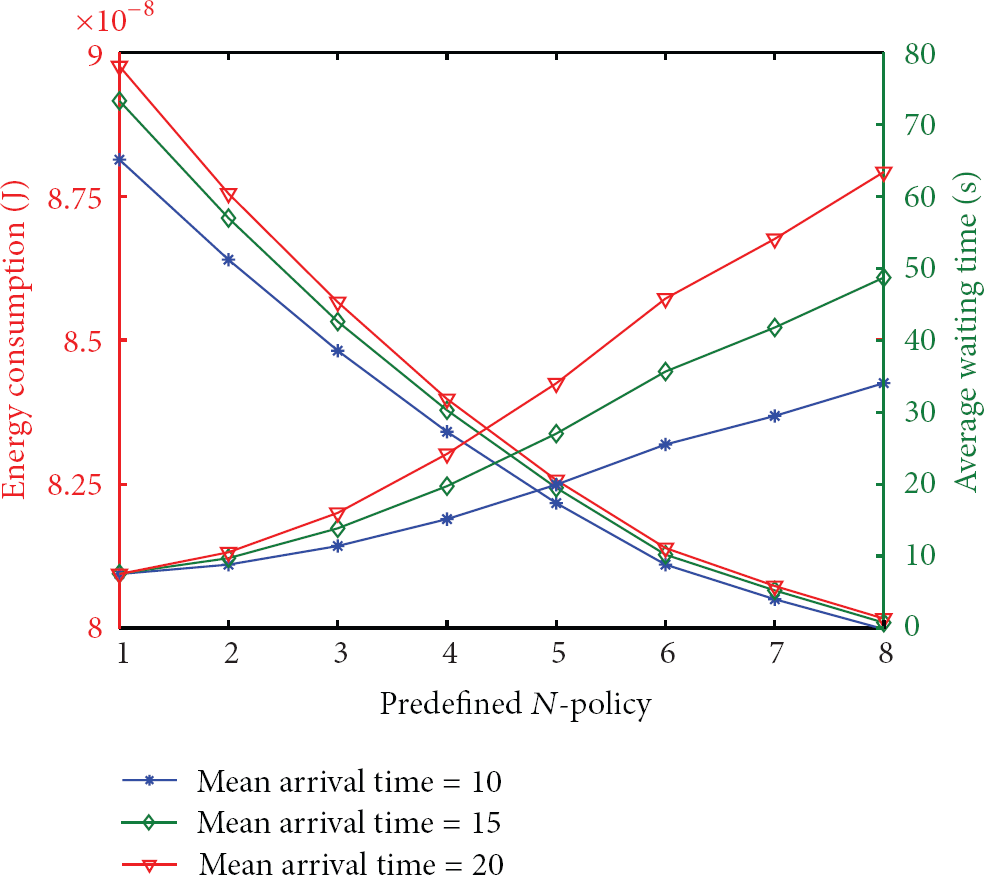
The energy consumption and average waiting time by changing predefined N.
Figure 7 shows the network lifetime of senor network using sleep scheme and our MS-CTDMA protocol by changing the relay node traffic load, when the predefined N has two values. In this simulation, three nodes have the same channel condition to the destination D, such as distance and fading condition. But the traffic load of relay node is lower than the other nodes. From Figure 7, we see that MS-CTDMA protocol considers the impact of different traffic load, and the nodes which have longer idle state are responsible for assisting other heavy traffic nodes to maximize the network lifetime. When the network operates with pure sleep scheme, the network lifetime is up to the shortest lifetime node. But with MS-CTDMA protocol, the node with more idle time or less traffic load can lend its energy to other nodes.
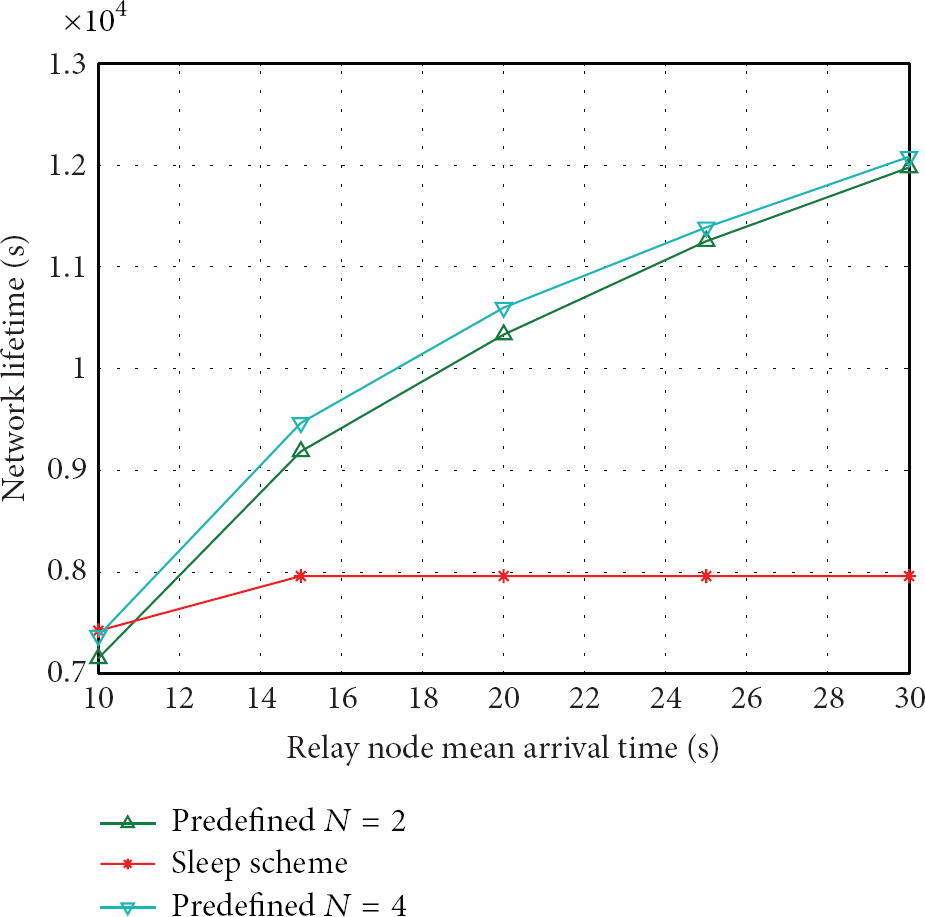
Network lifetime by changing average arrival time.
Figure 8 shows the network lifetime of the senor network by changing distance to sink node. Here, we assume that three nodes have the same traffic load. The relay node is near to the sink node so the channel condition is different. In this condition, the performance of MS-CTDMA is also superior to the pure sleep mode. Comparing Figure 8 with Figure 7, we find that the impact of network lifetime with relay traffic load is more distinct than that with relay distance to sink node by the predefined threshold N.
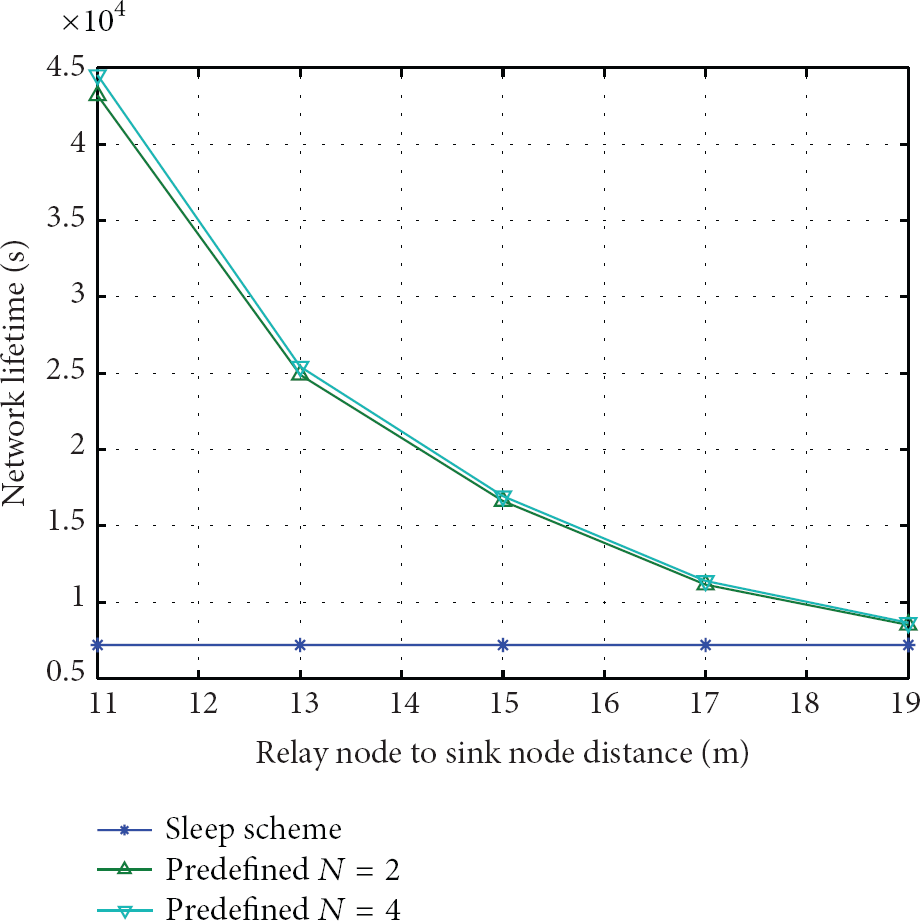
Network lifetime by changing distance to sink node.
In Figure 9, we compare the network lifetime by changing traffic load and distance to sink node simultaneously. It is obvious that the maximization point is reached when the distance is nearest and the mean arrival time is smallest.
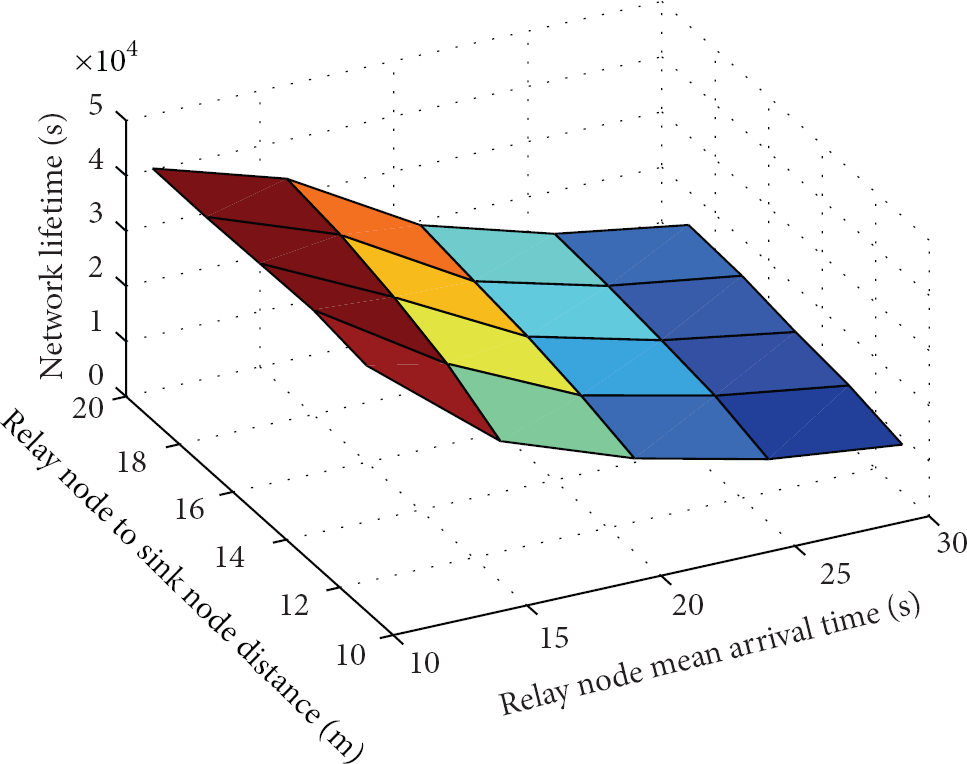
Network lifetime by changing average arrival time and distance.
6. Conclusion
In this paper, we propose a novel mixed cooperative TDMA MAC protocol with sleep mode, namely, MS-CTDMA, for wireless data acquisition networks. When traffic queue length of a terminal is less than the predefined threshold N, it actively devotes itself to be a cooperative relay for its single-hop neighbor or go to the sleep state. And the
As a future work, we would like to investigate the multihop TDMA systems with multiple relays based on dynamic slot assignment scheme.
Footnotes
Conflict of Interests
The authors do not have any conflict of interests with the content of the paper.
Acknowledgments
This research is supported by the National Major Project no. 2011ZX03004-001-01 and National Natural Science Foundation of China no. 61201183 and no. 61132002.