




Abstract
Balanced energy depletion is an important way to prolong network lifetime for wireless sensor networks. Traditional algorithms mainly aim at maximizing network coverage rate with uniform sensor node distribution. However, wireless sensor network is characterized by many-to-one traffic pattern and multihop communication, which usually lead to the energy hole problem in the region around the sink node. In this paper, we investigate the problem of joint placement for both relays and sensors to eliminate energy hole. We first theoretically conclude that balanced energy depletion is achievable with rational designed deployment density for relay nodes. We then propose a novel relay deploying strategy as well as a data routing scheme to eliminate uneven energy depletion. Extensive simulations are presented to verify that our approach outperforms other schemes in terms of both network lifetime and unused energy ratio.
1. Introduction
Recent advancement in large-scale integrated circuits and radio spectrum technology has enabled the development and application of wireless sensor networks. A wireless sensor network usually consists of a large number of tiny sensor nodes with sensing, data processing, and communication components. In general, it is formed by these sensor nodes in a self-organized manner. In recent years, wireless sensor network is playing an increasingly important role in many application fields, such as medical, outer space exploration, volcano surveillance, and intelligence applications [1].
Be aware that whatever happened in the target area timely is one of the most important responsibilities for the wireless sensor network. Sensor nodes are usually able to measure various parameters of the environment and transmit collected data to the sink node through multihop communication. Once the sensor node receives sensed data, it processes and forwards it to the sink node [2]. In order to monitor the interested field preferably and achieve a higher coverage rate, sensors are usually deployed uniformly with a certain density over the target area. However, since the traffic in wireless sensor network follows a many-to-one pattern, the sensors that are nearer to the sink node not only need to send their own data but also to forward data collected by other sensors far away from the sink. As a result, sensors near the sink node will consume more energy and die more quickly. Once those sensors use up their own energy, the whole network would get disconnected and no more data can be transmitted to the sink. This may result in network partitioning and decreasing network lifetime. Consequently, a considerable amount of energy is wasted when the network lifetime ends up [3]. Experimental results in [4] show that up to 93% of the total initial energy is left unused when the network lifetime ends up with uniform sensor distribution. Hence, how to eliminate the uneven energy consumption so as to prolong the network lifetime becomes an urgent issue in wireless sensor network.
In this paper, we try to eliminate uneven energy consumption for wireless sensor network. At first, the relay nodes are introduced into wireless sensor networks. A novel placement scheme for both sensor and relay nodes is proposed to achieve energy balanced depletion. In summary, the main contributions of our work are listed as follows: (1) we theoretically analyze accessibility condition of deploying relay sensors to satisfy that all the working sensors exhaust their energy with the same ratio; (2) we also analyze the extension of network lifetime compared with traditional schemes; (3) we propose a novel relay nodes placement strategy combined with routing schemes to satisfy energy balance depletion condition; and (4) we conduct extensive simulations to verify that by separating the data acquisition and data routing, the full energy balanced depletion among all working sensors is achieved.
2. Related Work
Various approaches have been proposed to prolong the network lifetime for wireless sensor networks and they are mainly classified in two aspects: one is to deploy additional sensors to replace failure sensors, and the other is to relocate sensor nodes in different densities which vary with the distance to the sink.
The problem of unbalanced energy depletion in a wireless sensor network is investigated by Li and Mohapatra for the first time [4, 5]. They first present a mathematical model to analyze the “energy hole” issue in a uniformly distributed wireless sensor networks. And then, they propose several approaches to mitigate this problem. In addition, they point out that simply adding more sensor nodes in the network cannot solve the “energy hole” problem. In [6], the authors investigate the theoretical aspects of the nonuniform node distribution strategy to mitigate the “energy hole” problem in wireless sensor networks. They observe that nearly balanced energy consumption in the network is possible if the number of nodes increases in geometric progression from the outer coronas to the inner ones except the outermost one. And then, they propose a non-uniform node placement strategy and q-switch routing. Though their algorithm can prolong the system lifetime, the balance energy depletion among all the sensors is not achieved. There is still much energy unused in the outermost corona when the network lifetime ends up. In our pervious approach [7], we propose a pixel based sensing mechanism to reduce the sensing redundancy and propose a distributed energy balanced density control algorithm. However, additional energy is consumed in pixel decision process. In [8], the authors propose a balanced energy sleep scheduling scheme in the context of cluster-based sensor networks. They exploit the distance-based scheduling (DS) and the randomized scheduling (BS) algorithms to choose some sensors in each cluster to sleep. However, they only consider the energy consumption in each cluster and ignore the energy depletion of the cluster head. As a result, uneven energy depletion still exists. In [9], the authors propose an adaptive density deployment to mitigate the sink hole problem in wireless sensor networks. It permits a fault tolerant and self-healing deployment. However, their scheme may greatly increase the number of sensor nodes when the network scale increases. In [10], the authors convert balanced energy depletion problem into the expense of gross energy inefficiencies. They investigate the transmission range distribution optimization problem. However, searching the optimal transmission range for sensors is a NP-hard problem. In [11, 12], how to improve network coverage by means of the sensor mobility is studied. In [13, 14], the authors try to separate data collection from communication and investigate the problem of placing sensors, relays, and base station to connect the entire network. Although these algorithms can guarantee the network connectivity and coverage rate, the uneven energy consumption of the entire network is not taken into consideration. In [15], the authors propose a compressive data gathering scheme which can leverage compressive sampling principle to reduce communication cost and prolong network lifetime efficiently. They only focus on how to reduce energy consumption during data transmission, but they do not consider whether the energy consumption of the whole network is even or not.
In this paper, we try to eliminate the “energy hole” for the wireless sensor networks by investigating the optimal placement of relay nodes. The rest of our paper is organized as follows. In Section 3, the accessibility conditions of energy balanced depletion and the extension of network lifetime are analyzed theoretically. In Section 4, on the basis of our network model and assumptions, a novel sensor and relay placement scheme is proposed. In Section 5, a node routing algorithm is proposed for energy balanced depletion. Section 6 presents the simulation results of our proposed algorithm. Finally, the paper is concluded in Section 7.
3. Theoretical Analysis
3.1. Network Model and Assumption
In this section, we will present our network model and make some basic assumptions. Assume that the target area A is a two-dimensional circular surface. There are three kinds of nodes deployed in this region, which are sensor node, relay node, and sink node. Periodical monitoring scheme is applied in our paper, in which each sensor node generates and sends L bits of sensing data per working cycle. In our scheme, a sensor node only needs to sense environmental parameters and forward the sensing data to relay node via one-hop communication. Relay node is responsible for forwarding those sensing data of sensor nodes and does not do any sensing activities. Only sink node works as a terminal data collection station, which is responsible for processing the entire sensed data. We further assume that the energy consumption is only dominated by communication costs, as opposed to the sensing and processing costs. A sensor consumes
We assume that all the sensor nodes are uniformly deployed over a circular area with radius d. The sink node is located in the center of this area. The target area is divided into n

Network model.
3.2. Node Energy Depletion per Working Time T
Define the number of sensor nodes deployed in corona

As sensors will choose relays in their communication range for data forwarding, the relays belonging to corona

Since there are no relays deployed in the outermost corona

3.3. Accessibility Conditions of Balanced Energy Depletion
Ideally, when all the nodes, including sensors and relays, consume their energy with the same ratio, the energy balanced depletion situation can be achieved, and the utilization of network energy can be improved, which can be expressed as

Theorem 1.
Realizing the balanced energy depletion in the whole network is possible when the number of relay nodes in corona
Proof.
Since all the sensors in the network work in the same way and have the same initial energy, the energy consumption of sensors in corona

According to (2), we know that when the number of relays in corona

Combining (5) with (6), we conclude that the condition of energy balanced consumption is accessible, and this completes the proof of Theorem 1.
Lemma 2.
Assume that all the sensors are deployed uniformly with density
Proof.
Denoting the acreage of corona

Assuming the deployed sensors density as

Substituting (8) into the balanced energy depletion condition, the number of relays in corona

This completes the proof of Lemma 2.
Lemma 2 shows that if the sensor nodes are distributed uniformly and the relay node in each corona meets some certain conditions, complete balanced energy depletion is possible in a circular monitor area. Here, we should note that in order to balance energy depletion, the number of relays
3.4. Extension of the Network Lifetime
Further, we will give an analysis on the network lifetime enhancement of our scheme compared with the traditional uniform distribution. Assume that the initial conditions of the network are the same. Sensor nodes in each corona are deployed uniformly with density

Thus, the network lifetime enhancement can be expressed as

Therefore, the network lifetime can be greatly prolonged.
4. Relay Placement
According to the analysis derived in the previous section, we can calculate the ratio of relay angles in adjacent corona

where
The ratio of relay angles of two adjacent coronas

Theorem 3.
Define that the distance between corona
Proof.
As shown in Figure 2, according to the relationship of relay angles within adjacent coronas, the relay angle of corona

where
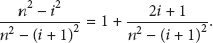
Here, we should notice that (15) is an increasing function with respect to i,

Combining (16) with (14), we can conclude that, to meet the condition of balanced energy depletion among all the nodes, each relay in corona

Owning to triangle conversion relation, when
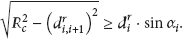
That is to say, when the relay angle in corona

Distance calculation between adjacent coronas.
Consider that the sensor nodes are uniformly deployed in the network, and assume that the distance between the relays and sink node in the first corona

5. Routing Scheme
Assume each sensor is aware of its positions and know the corona ID which it belongs to. The communication model of sensor i is expressed as a circle with radius

If

If

Data forwarding via relays.
According to Theorem 3, when the distance between corona
Step 1. Set Step 2. All the sensor nodes start to collect data Step 3. All the sensor nodes start to send data Sensor Sensor Update the residual energy of sensor
Sensor energy through clockwise from Sensor Update the residual energy of Step 4. All the relays begin to forward data Relay Relay these data; Update the residual energy of
Relay as the data forwarding node; Update the residual energy of
In our algorithm, the time complexity of each sensor is corresponding to the size of its candidate relay set. According to Theorem 1, sensors in corona
6. Simulation
In this section, we present the simulation results to verify the performance of our proposed algorithm. We mainly consider three metrics which are the average residual energy, the residual energy ratio, and the network lifetime.
6.1. Simulation Environment
Assume that the radius of the target region
6.2. Residual Energy
At first, 81 sensors and 255 relays are deployed in a circular area. The whole network is divided into 4 adjacent coronas with the same width. The sink node is located in the center of the target area. Figure 4 shows the residual energy of all the nodes when the network lifetime ends up. A node is said to be dead when it is unable to forward any data or send its own data. The network lifetime is defined as the duration from the beginning of the network operation until the first node dies [6]. As can be seen from Figure 4, almost all the nodes run out of energy at the same time, which verifies the correctness and feasibility of our network model. On the other hand, we can also find that there is a small gap of the residual energy of all the nodes, including relays and sensors. This is mainly because the innermost corona is involved in forwarding all the sensed data, and in the last data transmission cycle, some nodes do not have enough energy to receive data. Even though these nodes receive data successfully, some of them may not be able to forward the data out. As a result, some of the nodes finish sending data while others fail, which leads to a slight difference in node residual energy.
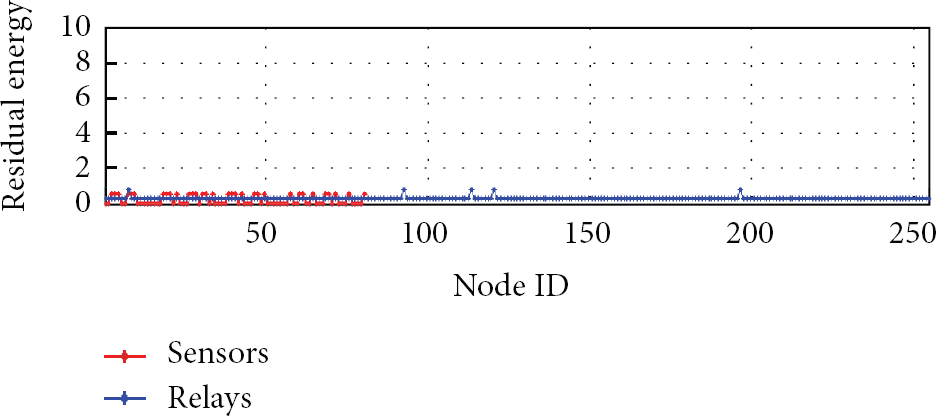
Residual energy of each node.
Figure 5 illustrates the simulation results of average residual energy of sensors and relays in each corona
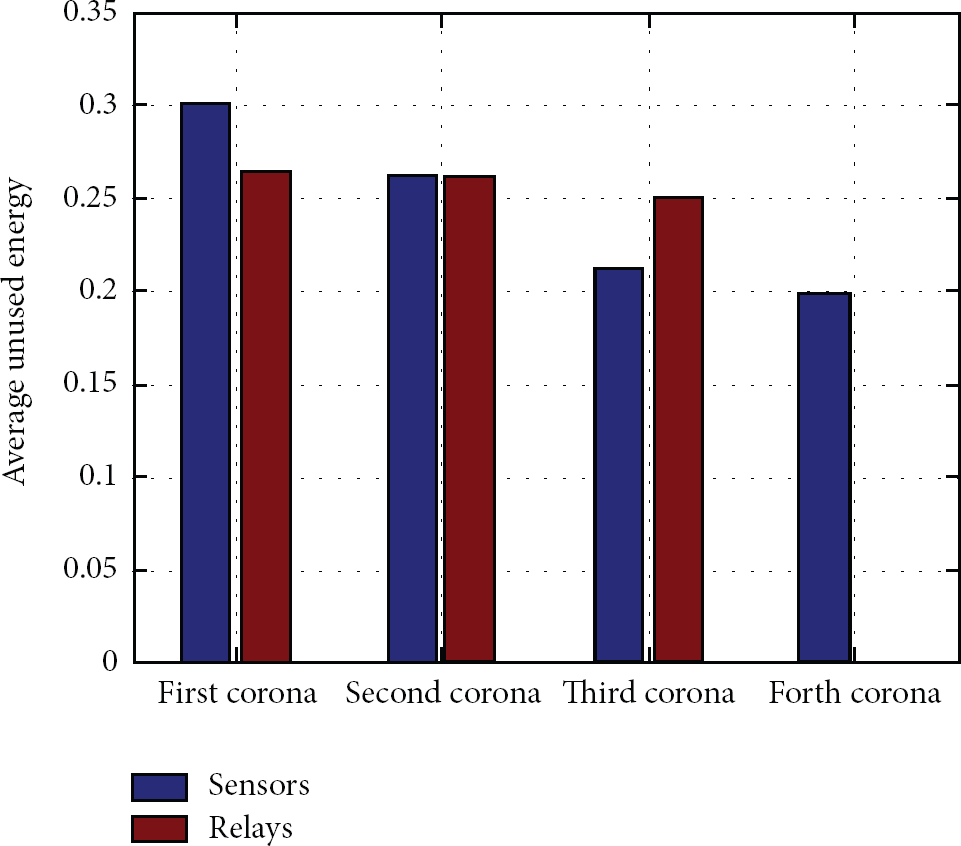
Average residual energy.
6.3. Comparisons with Existed Algorithms
In order to further evaluate the performance of our algorithm, we compare our approach with random node distribution model and uniform node distribution model. Figure 6 shows the unused energy of all nodes after a certain data collection cycle. In Figure 6, sensors with smaller ID numbers are closer to the sink, whereas those with larger ID numbers are far away from the sink node. As shown from Figure 6, we can find that in a random node distribution model, the network connectivity is seriously affected by the sensor distribution over the target area. Almost all the sensors cannot forward their own data to the sink node. For example, the total energy consumption of sensor 10 is almost close to 0 J. In uniform node distribution model, we can see that those sensors with larger ID consume less energy and the unused energy is greater than 60 J. However, those with smaller IDs consume more energy and the residual energy is almost close to 0 J. From the simulation results in Figure 6, we can make a conclusion that although the network connectivity is guaranteed, sensors that are nearer to the sink node carry heavier traffic loads than those farther from the sink node. Thus, unbalanced energy depletion is inevitable. In our model, all the nodes, including both sensors and relays, consume the same energy and have the same energy left, which verify that our algorithm can achieve the balanced energy depletion.

Residual energy of each node after a certain data collection cycle.
Figure 7 shows the comparison of the unused energy ratio after different data collection cycles. In order to facilitate the comparison, we randomly choose parts of the nodes for presenting our algorithm results. As shown in Figure 7, with the increasing data acquisition cycle of, sensor energy consumption becomes more uneven in the network with random and uniform distribution. In uniform node distribution, the heavy load on the inner corona has seriously affected the sensor energy depletion. After 15 times data collections, some sensors use up their energy. Thus, the whole network lifetime is over. As for random sensor deployment, the whole network lifetime is only related to the initial location of each sensor and the energy depletion process is very unstable. In contrast, our algorithm can effectively maintain the stability of energy consumption process. As shown in Figure 7, our algorithm can balance the energy depletion, in which almost all the nodes have the same residual energy after each data collection cycle.

Energy depletion after different data collection cycles.
Figure 8 shows the comparison of network lifetime in different target area sizes. As seen from Figure 8, when the radius of the area
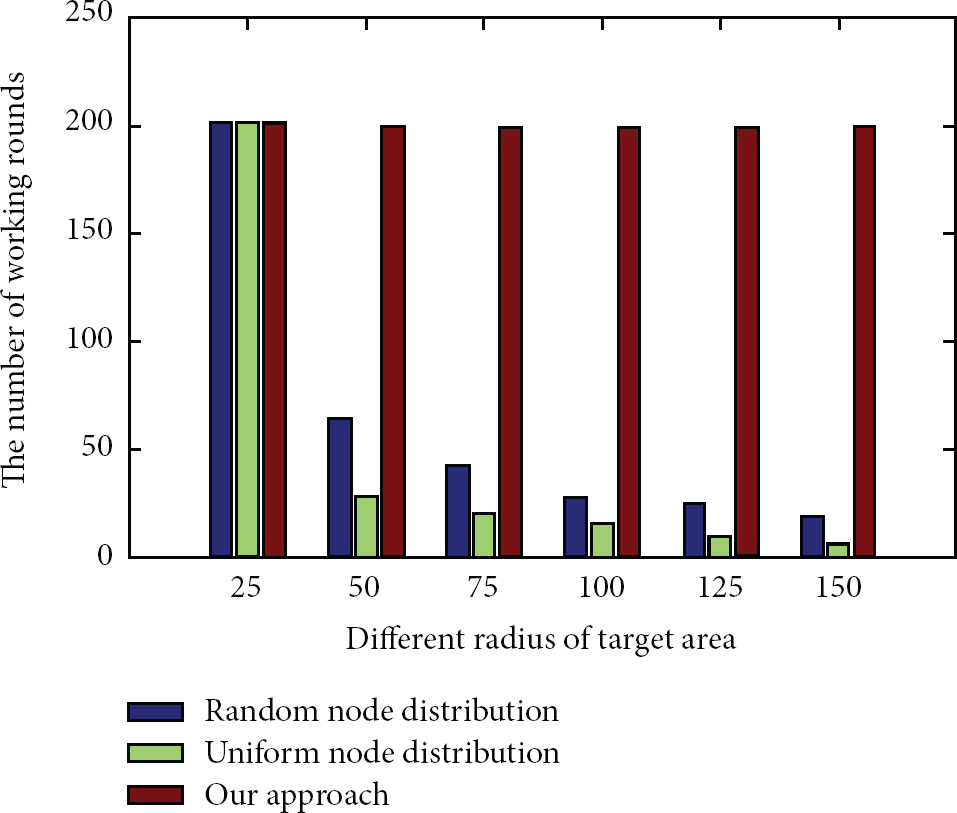
Comparison of network lifetime in different target areas.
7. Conclusion
In wireless sensor networks, traditional deployment approaches mainly focus on maximizing the coverage rate so as to improve the monitoring efficiency, which leads to the creation of “energy hole” near the sink node. In this paper, we theoretically analyze the balanced energy depletion condition by deploying additional relay sensors on the target area. Further, we prove that the network lifetime can be prolonged effectively. Contributively, a novel relay deployment scheme and its corresponding routing scheme are proposed. Extensive simulation results show that our algorithm can achieve complete balanced energy depletion, and outperform other existed algorithms.
Footnotes
Acknowledgments
This work is supported by the National Natural Science Foundation of China under Grant No. 61173153, No. 60903159, No. 61070162 and No. 71071028; the National Science Foundation for Distinguished Young Scholars of China under Grant No. 61225012; the Fundamental Research Funds for the Central Universities under Grant Nos. N110404014, N110318001, N110204003 and N120104001; the China Postdoctoral Science Foundation Funded project under Grant No. 20110491508 and No. 2012T50248; The Specialized Research Fund of the Doctoral Program of Higher Education for the Priority Development Areas under Grant No. 20120042130003.