




Abstract
Particle-laden turbulent flows over a backward-facing step were here numerically studied by means of a large-eddy simulation considering two-way coupling between particle and fluid phases. The modification of turbulence by particles was then analyzed based on the predicted results of mean and fluctuating velocities. The influencing factors of particle size and material density were also evaluated. Turbulence modifications are anisotropic and closely dependent on flow status. Stronger modulations were observed in the up-wall shear flow regions. Fluid laden with smaller size, low-density particles showed enhancement of turbulence in the streamwise direction, but this effect was less pronounced in the case of larger low-density particles. Particle dispersions were also investigated for comparison of particle instantaneous distributions in coherent structures. Particle modulations of turbulence were not found to change particle preferential distributions. The conclusions drawn in the present study were useful for further understanding of a two-phase turbulence physical mechanism and establishment of accurate prediction models for engineering applications.
1. Introduction
Two-phase turbulent flows occur in many technical processes in engineering, such as in chemical processes, pneumatic transport of particulates, air pollution control, circulating fluidized beds, and coal combustion. Turbulence plays a very important role in the transport of mass, momentum, and energy between particles and fluid phases. Studies on particle dispersion by turbulence and particle modulation to turbulence are very important for further understanding physical mechanisms of the interphase interactions between two phases.
The modulation of turbulence by particles has been studied in isotropic turbulence by Boivin et al. [1], Elghobashi and Truesdell [2], Michaelides and Stock [3], and Parthasarthy and Faeth [4, 5]. These teams have reported that dissipation and production of turbulent kinetic energy of the continuous fluid phase are modified by laden particles in homogeneous turbulence scenarios. Experimental investigations regarding the modification of turbulence have also been performed for particle-laden turbulent flows in jets [6–10], vertical pipes [11–14], channels [15] and free shear layers [16, 17] and over a backward-facing step [18–20]. Gore and Crowe proposed a physical model that they used to determine whether particles enhance or attenuate the intensity of fluid turbulence by comparing the scales of particle and local vortices based on the results of previous studies on two-phase flow experiments [21]. Hetsroni summarized that turbulence can be enhanced or attenuated depending on the value of each particle's Reynolds number Rep [22]. In addition, Yarin and Hetsroni proposed a simplified theory for the particles-turbulence interaction taking into account the carrier fluid velocity gradients and turbulent wakes behind coarse particles [23]. Kenning and Crowe developed a model of the modulation of turbulence for gas-particle flows based on previous work on particle drag and on the dissipation based on a length scale corresponding to the interparticle spacing [24]. In brief, particle modulation of turbulence can be affected by particle size and density.
However, the effective viscosity of the fluid phase can change, and turbulent and coherent eddies are generated in different ways, producing different increases in velocity gradients for specific flow configurations. In this way, even if the effects of particles on turbulence have been investigated by many researchers [25–30], modifications of turbulence characteristics by solid particles are not yet clearly understood. Whether particles enhance or attenuate the intensity of fluid-phase turbulence can differ under different study conditions. The influencing factors of particle phase on fluid phase in two-phase turbulent flows can vary considerably. For better application of gas-solid two-phase turbulent flows in industrial applications, more information should be provided to evaluate the factors affecting changes in turbulence.
In this paper, particle-laden two-phase turbulent flows over a backward-facing step were numerically predicted using a two-way coupling large-eddy simulation. Particle size and material density were investigated, and their influence on modulations in turbulence was evaluated. Quantitative comparisons of gas-phase mean and fluctuating velocities were carried out under different sets of flow conditions. Instantaneous large-scale turbulence structures in flows laden with different particles along with particle dispersion distributions in the flow field were also investigated.
2. Physical and Numerical Models
2.1. Flow Configuration
In this paper, the flow configuration was the same as the one used in a previous study [31], as shown in Figure 1. The backward-facing step height H was 0.0267 m, which was used as the reference length scale. The channel height h at inlet section was 0.04 m, representing an expansion ratio of 5: 3. The computational domain was 35 H in the streamwise direction, 2.5 H in the transverse direction, and 10 H in the spanwise direction. The inlet centerline velocity U0 is 10.5 m/s. The Reynolds number, Re = U0H/ν, was 18,400. Here ν was the kinematic viscosity.

Sketch of the flow over a backward-facing step.
2.2. Continuous Phase Equations
Applying the box-filtering operation to the incompressible Navier-Stokes equations, the equations governing the motion of the resolved scales in large-eddy simulation are given as follows:


The unresolved scales are modeled using the subgrid-scale (SGS) stress term τ ij , which is approximated using the eddy viscosity hypothesis:
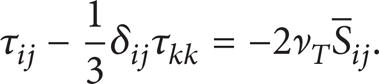
The eddy viscosity ν T and strain rate tensor S ij are defined as follows:

The characteristic filter length is given as follows:

Here Δx i is the computational mesh size in the ith direction corresponding to the streamwise, transverse, and spanwise directions. CSGS is the model coefficient, and it requires specification in order to be close to systems (1) and (2). In the present study, CSGS was calculated using the dynamic approach developed by Germano et al. [32]. This method was calculated using the information from the resolved scales as a function of both time and space during the course of the simulation.
The two-phase two-way coupling is realized by the point-force model. As shown in (2),

where
Equations (1) and (2) can be solved numerically using the fractional step method as described by Kim and Moin and by Wu et al. [33, 34]. A nonsolenoidal velocity field
In order to reduce the aliasing errors and instability, the second-order hybrid scheme developed by Kravchenko and Moin was adopted for the advective term [35]. The central finite difference scheme for ∂ (u i u j )/∂ x j writes as

The forward finite difference scheme for ∂ u i /∂ x j writes as

and the backward one is

In this way, the hybrid scheme for the advective term in the ith direction writes as

The viscous term is discretized using a second-order central difference.
The momentum equations were integrated explicitly using a third-order Runge-Kutta algorithm. The nondimensional calculation time step was taken as Δt = 10−5. Because the time step yields to the stability condition, the numerical results are not affected by different time steps. This includes the statistical mean and fluctuating velocities for both phases.
The inlet flow condition is specified by a velocity distribution of U(y) with a white noise ξ superimposed. U(y) is assumed to obey the 1/7th power law, and the white noise is assumed to have a Gaussian distribution with a mean of zero and a variance of 10−4. Such white noises in the inlet plane are important for the development of unstable disturbances in the transverse and spanwise directions. An improved nonreflective Sommerfeld open boundary condition, as proposed by Dai et al. [36], was used at the exit so that the coherent structures could be transported downstream without any distortion.
The filtered equations were solved on a staggered Cartesian grid with 256 nodes in the streamwise direction. There were 34 nodes in the transverse direction and 35 nodes in the spanwise direction. The independence of grid resolution was examined in a previous study [31]. The consistency of the two-phase statistical velocities with the experimental data shows that the present grid resolution is suitable for an evaluation of flow physics.
2.3. Dispersed Phase Equations
A Lagrangian approach was used to track each particle. This requires the solution of the equation of the motion for each computational particle. Here, all particles were treated as nonevaporating rigid spheres. The particles are assumed to be denser than the fluid. In this way, relative to the viscous drag and lift forces, for high ratios of particle to gas densities, the Basset history term, added mass term, and pressure term are negligible. Particle collisions were not taken into account. The slip-shear lift force and slip-rotational lift force were negligible. With these assumptions, the dominant forces on each particle are the drag force and gravity.
The nondimensional dynamic equations for a particle along its trajectory are as follows:

Here


Re p is the particle Reynolds number defined as follows:
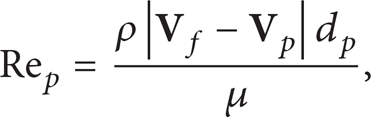
and μ is the fluid viscosity. The Stokes number, which is used to characterize particle motion, is defined as follows:

Here τ p = ρ p d p 2/(18μ) is the particle relaxation or aerodynamic response time scale, and τ = H/U0 is the fluid time scale.
The instantaneous fluid velocity at the location of each particle was determined using the local instantaneous fluid velocity interpolated from the neighboring grid points.
The boundary conditions of particles impacting on walls were here treated as perfectly elastic collisions; particles only changed velocity in the wall normal direction after impacting the wall, but the magnitudes of velocity in the three directions were not changed. The walls were considered smooth. Although both the particle-wall interactions and wall roughness influence particle dispersion, they are out of the scopes of the present work.
The particles are released into the flow fields at the inlet with the same local gas-phase velocities when the gas-phase flow is fully developed. In this way, there is no velocity slip between particles and fluid at the entrance of the flow.
These numerical methods were validated by means of comparing turbulence statistics of both phases with the experimental data collected by Eaton and Johnston [38]. The mean velocities and fluctuations in velocity were found to be closely consistent with experimental measurements. The detailed validations of numerical procedures are described in a previous study [31].
In the present study, particles were released into the flow fields at the same rate, 16,000/s. Three kinds of particles were selected, Lycopodium (700 kg/m3), glass (2500 kg/m3), and copper (8900 kg/m3). They had diameters of 20, 200, and 1000 μm. In this way, the particle-mass-loading ratio was calculated according to the number of particles present. Those parameters are shown in Table 1.
Calculation parameters of particles.

3. Results and Discussion
3.1. Particle Dispersion in Large-Scale Turbulence Structures
The spanwise component of vorticity is used to visualize large-scale structures. The distributions of spanwise vortices in the regions of the shear layer and redevelopment are shown in Figures 2 and 3 for flows laden with particles of different diameters at the same instant. The lines represent the vortices, and the scattered points represent the particles.

Lycopodium particle dispersion in large-scale turbulence structures.

Glass particle dispersion in large-scale turbulence structures.
The shedding vortices from the step develop and impinge onto the lower wall. The vortices that roll up by the upper boundary layer interact with the vortices from the shear layer. All the vortices undergo a process of pairing, merging, and breaking up.
As shown in Figures 2(a) and 3(a), particles preferentially accumulate along the edges of vortices and concentrate in particle clusters. Particle modulations are visible in changes in the vortices and the scattering of particles in the same flow fields. However small particles with smaller Stokes numbers modulate turbulence in such a way that does not change the particle preferential distribution in the vortices.
Particles inertia increases with particle size, weakening their preferential distribution in the vortex edge, as shown in Figures 2(c) and 3(c). For the 20 μm glass and copper particles whose Stokes numbers were around unity, like those in Figures 2(a) and 3(a), preferential distribution is the most significant characteristic of dispersion. However, very large particles with large particle Stokes numbers disperse more uniformly within the flow fields, and they are hardly affected by the vortex structures, as shown in Figures 2(e), 2(f), 3(e), 3(f), 4(e), and 4(f).
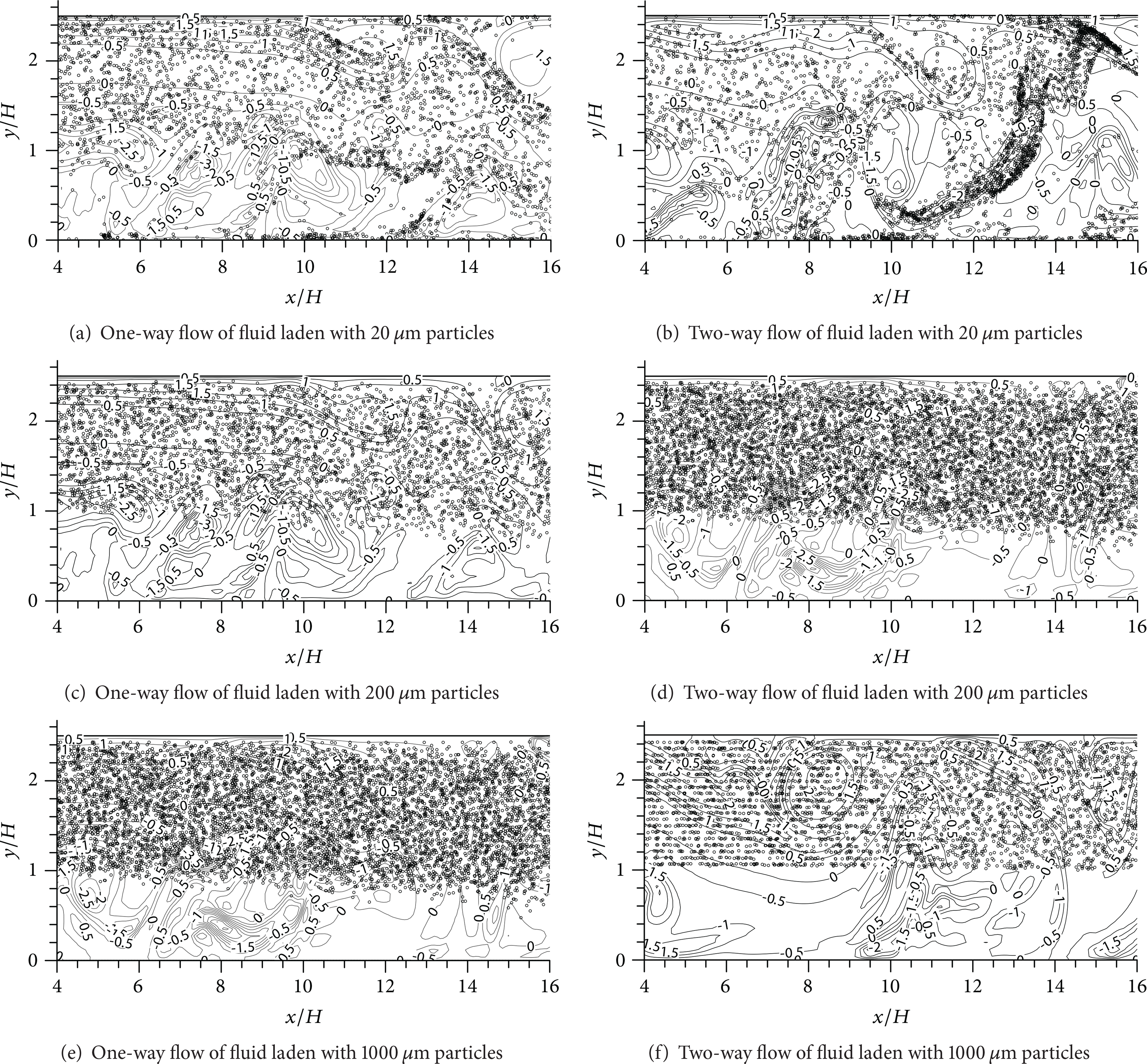
Copper particle dispersion in large-scale turbulence structures.
Particle dispersion behavior changes accordingly. The motion of relatively small particles is mainly ruled by large-scale structures. Large eddies can be destroyed by large particles. This kind of effect is stronger when particles are larger, as shown in Figures 2(e), 3(e), and 4(e). However, even if large particles change more dramatically than smaller ones, the large scale of the vortices in the flow field prevents their motion from being affected by the vortices. As shown in Figures 2(e), 3(e), and 4(e), particles were observed to maintain the directions of their initial velocity.
3.2. Velocity Statistics
The gas-phase velocity statistics, including the mean and root-mean-square (r.m.s.) velocities, were obtained for flows laden with different types of particles in four different areas to assess the modulation of turbulence.
3.2.1. Effects of Particle Size
Glass particles 20, 200, and 1000 μm in diameter were added to the flow at the same particle-mass-loading ratio. The results predicted for flow not laden with particles are also shown (Figure 5).
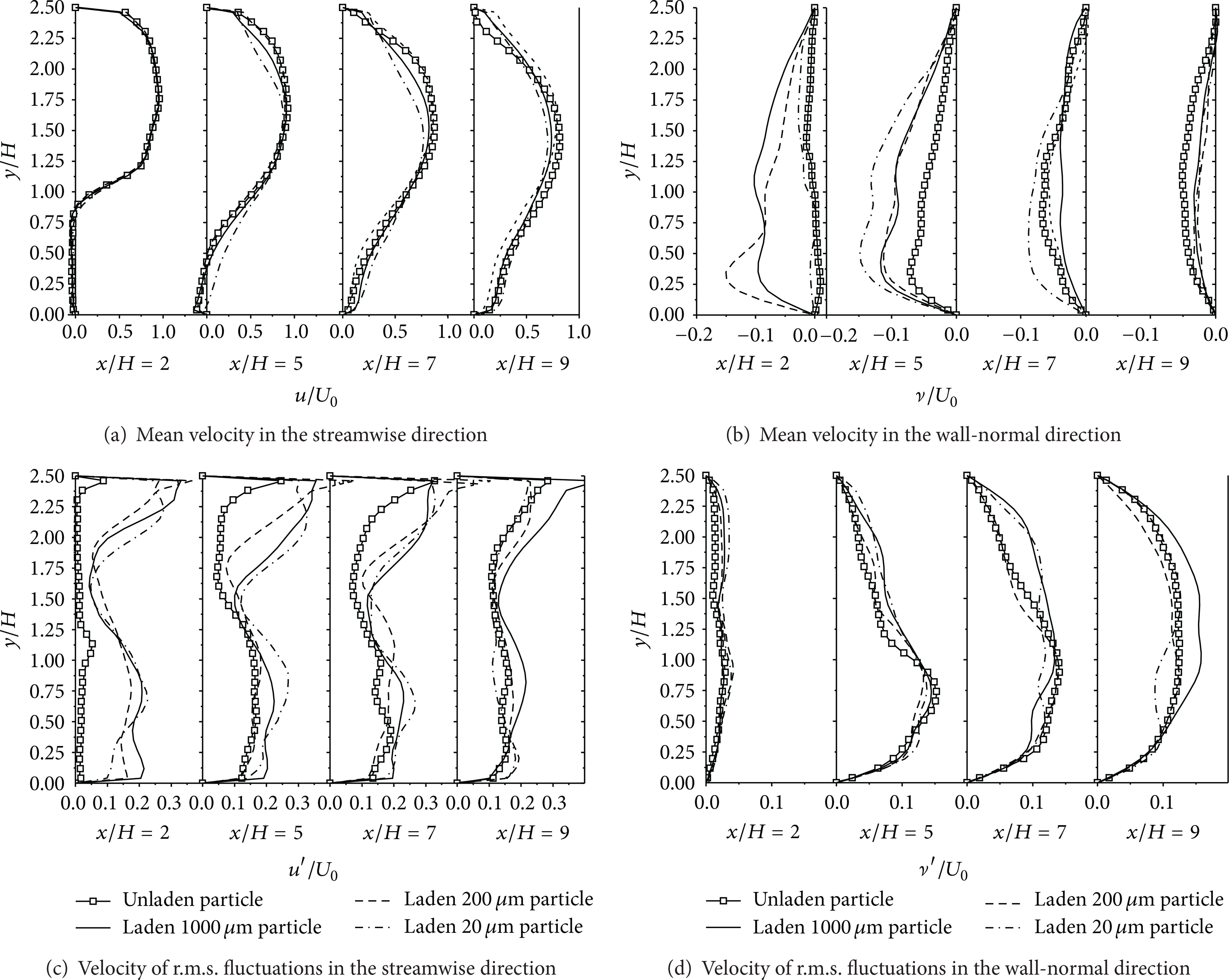
Mean and r.m.s. velocities at different sections laden with particles of different sizes.
The degree to which particles modulate turbulence is shown not only for mean velocities but also for those of r.m.s. fluctuations. Close to the inlet, the effects of particles on mean velocity are negligible, regardless of particle size. However, for the wall-normal component, the mean velocities are modulated to smaller values. The mean velocities of the fluid phase are only slightly changed by particles downstream in the streamwise direction. Particles of 20 μm diameter were found to attenuate the mean velocity close to the upper wall much more than particles of 200 μm. The changes in the wall-normal component of the mean velocity are complicated, depending on the way the flow develops. For example, the locations in the flow field can have a considerable effect. In general, upstream, x/H < 7, due to the presence of particles, the mean velocities in the wall-normal direction increased in modulus, but downsteam they decreased in modulus.
The degree to which a given particle modulates turbulence depends on the flow status. The r.m.s. velocities in the streamwise direction were increased by particles in the regions close to the upper wall. Upstream, x/H < 7, 20 μm particles were found to enhance the degree of fluctuation in turbulence, but, downstream, those particles only modulate fluctuations in turbulence fluctuation very slightly. Unlike that of other particles, the degree to which 1000 μm particles modulated turbulence became stronger along the flow direction.
For the wall-normal component of fluctuating velocities, 1000 μm particles produce the strongest modulation of enhancement at the section of x/H = 9, but the other two kinds of particles almost attenuate turbulence fluctuating levels.
In conclusion, the degree to which a given particle modulates turbulence is strongly dependent on the way the flow develops over the backward-facing step. In downstream regions, smaller particles exert weaker modulation, and larger particles exert stronger modulation.
3.2.2. Effects of Particle Density
At the same particle-mass-loading ratio, different particles with different material densities were loaded into the flows. Then, the effects of particle density on turbulence modulation were investigated. Particles with diameters of 20, 200, and 1000 μm were chosen. Each group contained particles of 700, 2500, and 8900 kg/m3.
Figure 6 shows the mean and fluctuating velocities for the flow laden with 20 μm particles. Low-density particles were found to modulate mean velocities most strongly, and they even changed the velocity distribution profiles. High-density particles were found to produce slighter modifications in the mean velocities.

Modulations in turbulence modulations by particles 20 μm in diameter.
The degree to which particles modulate fluctuations in turbulence depends on the way the flow develops. As a whole, particles enhance fluctuations in turbulence in the streamwise direction, especially near the upper wall. The velocities of the fluctuations in fluid laden with particles approach those of fluid not laden with particles in the wall-normal direction. In this way, denser particles do less to modulate turbulence than smaller particles.
As particles increases to 200 μm, they do less to modulate to the mean velocities in the streamwise direction. Denser particles do less to modulate the fluctuations in turbulence. Those results are shown in Figure 7.

Modulations in turbulence modulations by particles 200 μm in diameter.
Large, low-density particles, as shown in Figure 8, enhance mean velocities close to the upper wall, but they attenuate the mean velocities in the regions close to the bottom wall. However, heavy particles, unlike those shown in Figure 6, change the distribution profiles of the mean velocity in the streamwise direction. As shown in Figures 8(c) and 8(d), large, low-density particles can attenuate the velocity of the turbulence in most parts of the flow fields.
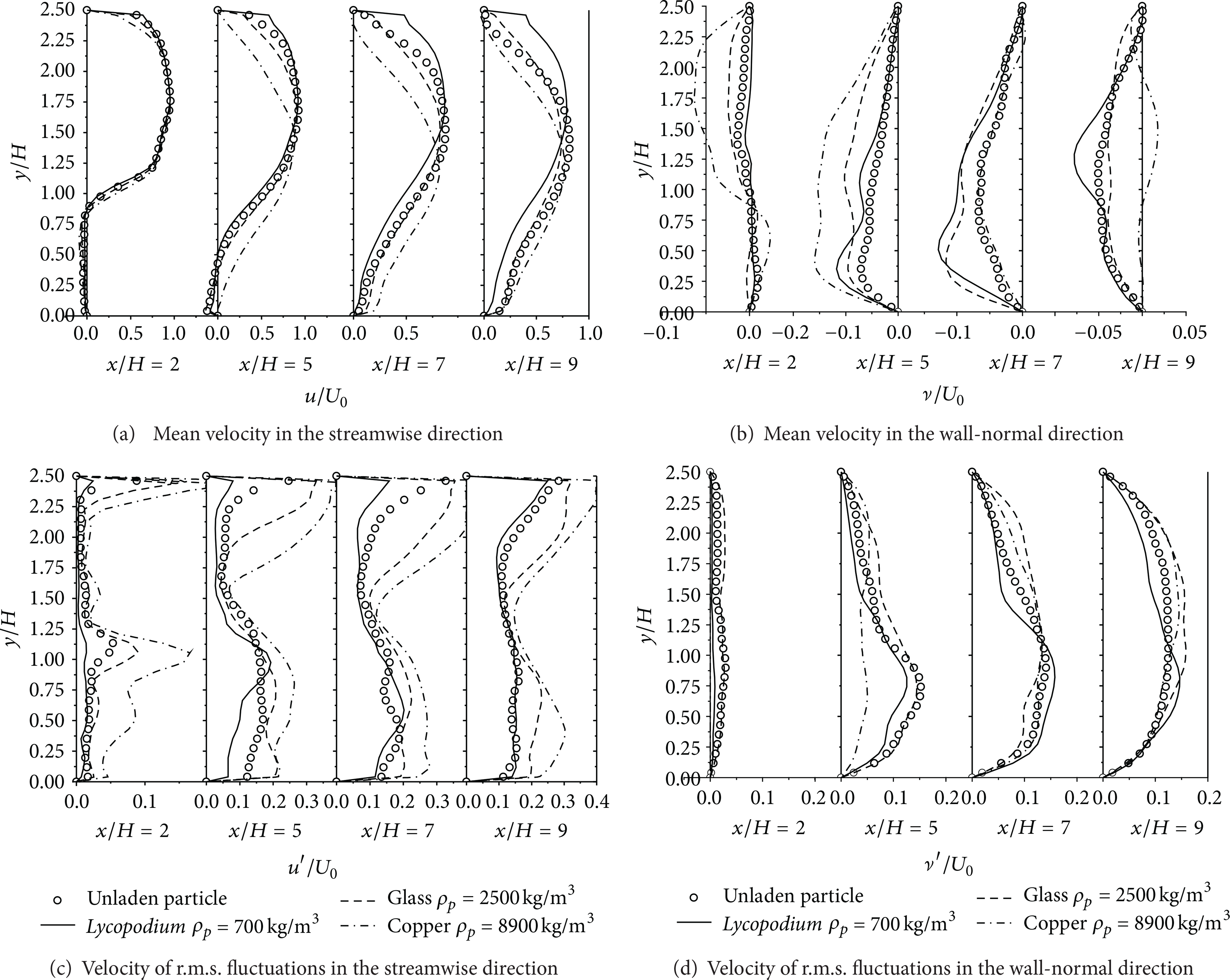
Modulations in turbulence modulations by particles 1000 μm in diameter.
4. Conclusions and Remarks
A two-phase two-way coupling large-eddy simulation was used to numerically obtain particle-laden two-phase turbulent flows over a backward-facing step. Particles released into the flow fields were tracked using a Lagrangian trajectory method. Particle dispersions in large-scale eddy coherent structures and statistical mean and fluctuating velocities were presented to show particle modulations to turbulence. The influences of particle size and material density on changes in turbulence were then analyzed. The main conclusions drawn were as follows.
Particles with smaller Stokes numbers preferentially accumulate in the coherent flow fields. Due to modulations, particles can change the vortices developing but do not change their preferential distribution within the vortices.
Particle modulations to turbulence depend on the flow status in the flow over a backward-facing step. Modifications of turbulence represent the variations of mean and fluctuating velocities. Smaller particles exert a weaker modulation in the downstream flow regions than larger particles do.
Effects of particle density on statistical mean and fluctuating velocities are dependent on particle size. Smaller, less dense particles can enhance the fluctuating velocities in the streamwise direction. Larger particles with lower density can, however, attenuate the fluctuations in turbulence.
Further studies of the effects of particle-mass-loading ratios and two-phase slip velocities on modulations in turbulence must be carried out in the future.