




Abstract
With the development of virtual reality technology, portal slewing crane monitoring system is also gradually moving towards virtualization; virtual simulation laboratory software appeared in large numbers. After a comprehensive analysis of the domestic and foreign construction of virtual reality technology development status, this paper proposes a virtual reality method based on WPF technology. The specific content of this method is summarized as follows. Firstly, the portal slewing crane model was built by 3ds Max, which includes the undercarriage, cab, and main hook. Secondly, the scenes of the port are added, which includes the sea, the sky, and the port. Finally, we use WPF to create the virtual reality module of the portal slewing crane monitoring system. According to a group of performance tests, we can get the performance tests show that the WPF system could improve the CPU utilization and reduce the memory usage during simulating the 3D model of the portal slewing crane.
1. Introduction
With the development of information technology, virtual reality technology becomes more and more widely used on the large port machinery. Many companies have developed lots of the portal slewing crane remote monitoring systems. However, these monitoring systems usual display the operating status of the portal slewing crane by the schematic diagram, legend, and data [1]. The presentation of information is unable to describe the status of the large number of port machinery, and it is lacking in interaction with the user.
Windows Presentation Foundation (WPF) is windows vista-based user interface framework introduced by Microsoft Corporation [2]. WPF applications can also be deployed as standalone desktop programs or hosted as an embedded object in a website. WPF aims to unify a number of common user interface elements, such as 2D/3D rendering, fixed and adaptive documents, typography, vector graphics, runtime animation, and prerendered media. These elements can then be linked and manipulated based on various events, user interactions, and data bindings. Microsoft has released five major WPF versions: WPF3.0 (Nov 2006), WPF3.5 (Nov 2007), WPF3.5sp1 (Aug 2008), WPF4 (April 2010), and WPF4.5 (August 2012).
This paper studies WPF technology and 3D modeling techniques, and on this basis, proposes a kind of the portal slewing crane 3D simulation method based on WPF, establishes a new generation monitoring system based on 3D, immersive, and interactive real-time simulation environment. This system could simulate the real-time 3D virtual scene of the portal slewing crane and real-time 3D analog display port machinery running posture and operating environment. The system users can roam anywhere and adjust any observation point and perspective to achieve the real-time monitoring.
2. Windows Presentation Foundation
For decades, with the growing popularity of the product screen operation, the user interfaces are very popular in our daily work and life. However, Windows developers have been using the interface display technologies that are similar in essence. A well-designed user interface can greatly improve the work efficiency and reduce user inquiries and complaints due to interface problems so as to relieve the pressure of customer service and the cost of after-sales service. Therefore, the design of the user interface is really essential for any products or services [3]. Microsoft proposes to introduce WPF for Windows unified display system in the architecture of .NET Framework 3.0. It is the Microsoft's next-generation graphics system and provides a unified description and operating system of user interface, 2D/3D graphics, documents, and multimedia. WPF unifies the method of the windows creation and display, documents operation and the interaction of user interface, so that the developers and designers can create better visual effects [4]. It provides a richer user experience.
2.1. XAML
Extensible Application Markup Language (XAML) is a declarative XML-based language created by Microsoft that is used for initializing structured values and objects. It is available under Microsoft's Open Specification Promise. The acronym originally stood for extensible avalon markup language-avalon being the code name for WPF. XAML is used extensively in .NET Framework 3.0 & .NET Framework 4.0 technologies, particularly WPF, Silverlight, Windows Workflow Foundation (WF) and Windows Runtime XAML framework. In WPF, XAML forms a user interface markup language to define UI elements, data binding, evening, and other features. In WF, workflows can be defined using XAML. XAML can also be used in Silverlight applications, Windows phone apps, and Windows store apps.
2.2. WPF Application
The workflow of the WPF application is shown in Figure 1. The bottom is display card driver; the up layer of the bottom is DirectX, which is a com component. The presentationcore.dll and milcore.dll are between the presentation framework and DirectX. The milcore.dll is unmanaged and the presentationcore.dll is managed. The WPF application includes controls, data, layout, content, andinteractions with presentation framework.

The workflow of the WPF application.
3. Establish Portal Slewing Crane Model by 3DS Max 2013
3DS MAX 2013 is a PC-based three dimensional animation design and production software developed by the Autodesk Company. As early as the other 3D authoring software is also just large workstation specific software, 3D studio firstly transplanted the previous three-dimensional modeling and animation software to microcomputer hardware platform. The software has become popular among designers and enthusiasts.
The 3D studio is the predecessor version of the 3ds max, which runs on DOS platform. After 3D studio max 1.0 was born, it has excellent performance on the Windows platform. In recent years, with the 3ds max version upgrade, the function of 3ds max is more and more powerful. 3ds max offers compelling new techniques for creating and texturing models, animating characters, and producing high-quality images. 3ds max has thousands of plug-ins to extend the functionality of its various aspects, so that it can play an important role in the construction, the design, and development of computer games.
3.1. Creating Geometry Model
3.1.1. Standard Primitives
Standard primitives can be used to model many objects in the real world; the basic body can also be combined into more extended primitives in 3ds Max. Extended primitives are typically combined of two or more existing standard primitives. It consists of box primitive, cone primitive, sphere primitive, geosphere primitive, cylinder primitive, tube primitive, torus primitive, pyramid primitive, and so on.
3.1.2. Extended Primitives
It consists of morph compound object, scatter compound object, conform compound object, connect compound object, B-mesh compound object, shape merge compound object, and so on. Graphics objects are composed of curves, multiple curves, and straight lines. Most default graphics are composed of the splines. There are linear, rectangular, circular, and so forth in the splines. We can use create panel menu to Create these compound objects. The controls on spline rendering panel are identical in name and operation to those found on the Rendering rollout of editable spline and Edit Spline objects.
3.2. Creating Portal Slewing Crane Model
Graphics are composed by the splines. There are linear, rectangular, circular, and so forth in the splines. We can use Create panel menu to create these compound objects. The controls on Spline Rendering panel are identical in name and operation to those found on the Rendering rollout of editable spline and Edit Spline objects.
We divided the portal slewing crane model into several parts: undercarriage, base, cab, main jib, slewing platform, and hook. After that, we establish every part using creating geometry model method.
The 3ds max models of the undercarriage and base are shown in Figures 2 and 3. Firstly, we create an undercarriage wheel. Secondly, we copy another undercarriage wheel to compose the left undercarriage. After that, we create a base on the top. Finally, we compose the left undercarriage, the right undercarriage and the base.

The 3ds Max model of the undercarriage.

The 3ds Max model of the base.
The 3ds max model of the cab is shown in Figure 4.

The 3ds Max model of the cab.
The cab is composed by cylinders, boxes, and some Boolean operations.
The main jib is created by cylinders. The 3ds max model of the main jib is shown in Figure 5.
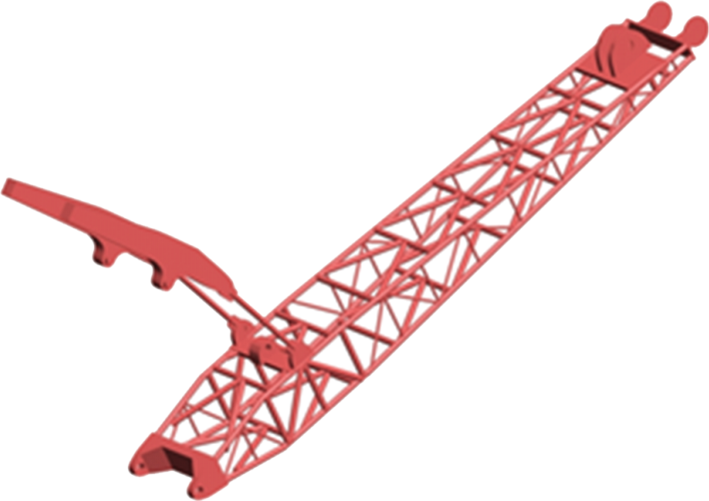
The 3ds Max model of the main jib.
The 3ds max model of the cab and jib is shown in Figure 6. It is composed by cylinders, boxes and some Boolean operations.

The 3ds Max model of the cab and jib.
We compose the undercarriage, base, slewing platform, main jib, and hooks into a whole. The 3ds max model of the portal slewing crane is shown in Figure 7.

The 3ds Max model of the portal slewing crane.
We add the scene of the port into the portal slewing crane. The 3ds max model of the scene is shown in Figures 8, 9, 10, and 11.

The first scene of portal slewing crane.

The second scene of portal slewing crane.
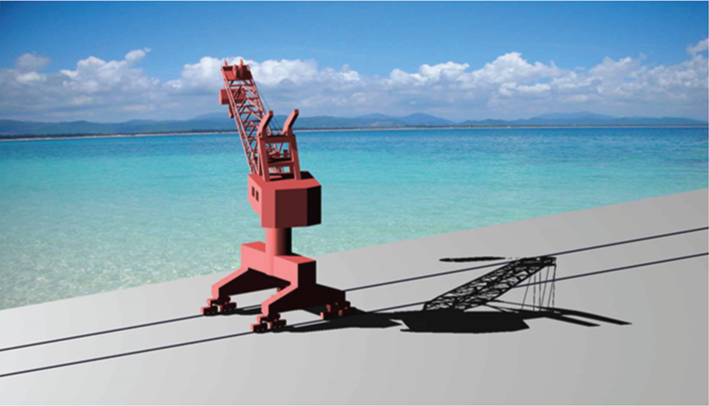
The third scene of portal slewing crane.
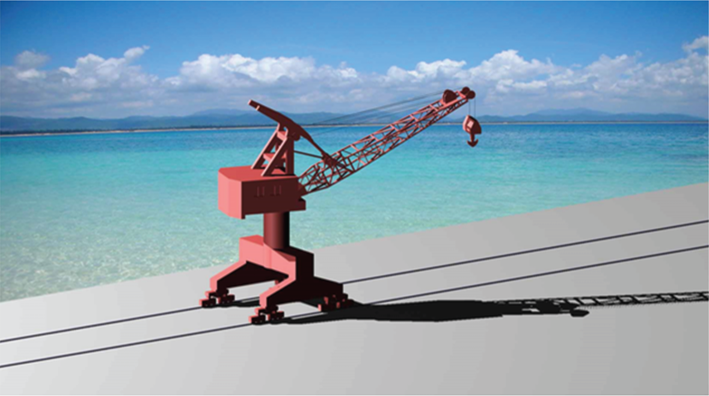
The fourth scene of portal slewing crane.
4. 3D Working Process Simulation System Design
According to the functional requirements for the portal slewing crane monitoring system, we have designed the 3D working process simulation system. There are six functional modules, such as monitor, reports, 3D animation, user settings, system setting, and help module. We have imported the 3ds max model into the system and simulated the working process of the portal slewing crane.
4.1. The Portal Slewing Crane Model Import into the WPF
WPF is essentially a two-dimensional technology. The panel-based layout system is responsible for the 2D elements arranged on a 2D screen. How is the 3D content immerging into 2D world? The Viewport3D elements play a role as a bridge between 2D and 3D, to solve the problem of the conversion. For the WPF layout system, Viewport3D is just a rectangular element it can display moving images.
We save the 3ds max model as .obj file in 3ds max; the 3ds max model can import into WPF by Microsoft Expression Blend 4; after that, we can get the XAML file.
4.2. Working Process Simulate
When the portal slewing gantry crane works, there are many actions, such as the lifting and lowering of load, the up and lower trolley traversing left and right, the hook going up and down. We design a system to simulate the working process of the portal slewing gantry crane.
The slewing of the crane is shown in Figures 12 and 13.

The up trolley lifting of load.
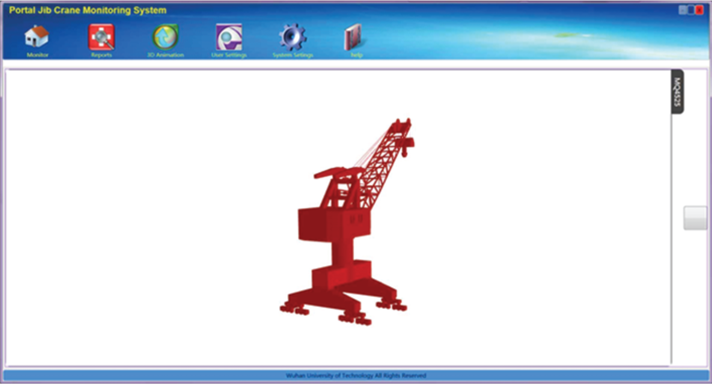
The slewing of the crane.
5. Performance Tests
After finishing the system detail design, the system's performance is important. We have designed a series of experiments to test. All the experiments are implemented in the hardware test environment as follows:
CPU: Intel Core i5-2500@3.30 GHz quad-core,
Motherboard: ASUS P8Z68-V LX (Intel Z68 chipset),
Memory: 4 GB (Kingston DDR3 1333 MHz),
Graphics: NVidia GeForce GTX 550 Ti (1 GB/Colorful),
Hard disk: Seagate ST31000524AS (1 TB/7200 rev/min).
The software test environment is shown as follows:
Windows 7 Ultimate 32-bit SP1 (DirectX 11),
3DSMAX modeling environment: 3DSMAX 2013.
We test the CPU usage rate and memory usage to get the performance. The experiment is divided into three steps.
First, we open the portal slewing gantry crane monitoring system. We record the CPU usage rate (before) and memory usage (before) without any actions.
Second, we give the 3D model some actions, such as transport (road), trolley travelling, lifting, and zoom. We record the CPU usage rate (after) and memory usage (after) with each action.
Finally, we calculate the CPU usage rate of change and Memory usage rate of change. All of the record data is shown in Table 1.
The CPU and memory usage comparison between four kinds of the portal slewing gantry crane's working process.

6. Conclusion
In this paper, we study the WPF technology, the advantage of XAML and the structure of WPF. We introduce the method of creating geometry model by 3ds max. After that, we establish the 3D model of the portal slewing gantry crane by different parts and design a portal slewing gantry crane monitoring system based on WPF. This system has the function of virtual reality and it could simulate some working actions. The performance tests results show that the system performance meets the requirements.
Footnotes
Acknowledgment
This work is supported by the National High Technology Research and Development Program (863 Program) of China under Grant no. 2012AA040106.