




Abstract
This paper presents a dynamic adaptive machine-to-machine (M2M) service rate allocation scheme for optimum traffic distribution in heterogeneous wireless environments (HWEs). According to the M2M service characteristics, it proposes the utility function, which forms a convex optimization problem that maximizes the utility of M2M service and can be solved by the Lagrange multiplier. The simulation results show the proposed method convergence, and it can achieve load balance with maximized throughput and minimized cost.
1. Introduction
Machine-type communication (MTC) is regarded as one of the next frontiers in wireless communications. Recently, there are growing researches about MTC due to the fact it can be widely used in many aspects, such as smart building, smart grid, and environment monitoring.
In 3GPP, it is proposed that each MTC device attaches to the existing cellular infrastructure (e.g., LTE-Advanced) [1, 2], by which higher layers connections between the MTC controller and MTC devices are provided. Thus, the subsequent problems lie in the access management on the air interface [3]. Furthermore, there are also many systems architecture difficulties about MTC [4–6]. Reference [4] identifies potential issues on the air interface. Reference [5] explores systems architecture problems that are associated with the evolving home M2M network. Reference [6] addresses the new requirement to use the M2M equipment with high configuration and flexibility to open up exciting new use cases, services, and applications.
Although MTC has been developed for years, it still faces many challenges due to the differences from the conventional human-type communications, such as low mobility, time controlled [1].
A main MTC characteristic is that there could be a large number of M2M devices existent in the network. It is possible that congestion will happen when massive M2M devices simultaneously connect to the network, as wireless network resources are limited. In order to avoid congestions, some improved measures are proposed. Access class baring [7–9] is effectively to solve plenty of M2M devices access, but the cost is not involved in [7–9]. Meanwhile, because massive M2M devices can produce a great deal of M2M service data, it is necessary to reduce the transmission cost.
The M2M service characteristics are also different for various MTC applications [10]. For example, some applications require hard timing constraints. It will be therefore dangerous when timing constraints of security monitoring are violated. Some applications demand soft timing constraints, such as metering water and gas or electricity. These M2M services can tolerate soft time delay. Therefore, the characteristics of M2M service need to be fully considered in M2M communications.
In addition, it is well known that in the future multiple radio access technologies, such as 3G/4G, WiMax, and WLAN, will coexist and form heterogeneous wireless environments (HWEs), where users have options to access the best wireless network that fits their services requirements, and network operators can increase revenue with a more probability usage of radio resources [11–13]. Reference [11] proposes a rate allocation algorithm over different interfaces with an objective to optimize multiuser performance; the target of this algorithm is to achieve maximum throughput. An explicit adaptive traffic allocation scheme [12] is based on the cooperation of wireless wide area networks and wireless personal area network. This method can achieve internetworking load balance and minimize the whole transmission delay.
For M2M service, it also can be transmitted in HWEs. In this paper, we propose an effective rate allocation scheme for M2M service, which depends on the utility function. The utility function takes both the throughput and the cost into account. It aims to maximize the throughput and minimize the cost according to the characteristics of M2M service.
The rest of this paper is organized as follows. The M2M communications scenario is described in Section 2. Section 3 provides an optimal solution for dynamic traffic allocation and describes our simulation results, and Section 4 concludes the paper.
2. M2M Communications
2.1. M2M Communications Scenario
In a cell, there are massive M2M devices, for example, real-time video surveillance of intelligent transportation M2M systems and video replay transmission of environment monitoring M2M systems. It will result in network congestion when massive M2M devices simultaneously access the same network. If M2M service can be transmitted in multiple networks, it is known then that network congestion will be decreased. However, if an M2M device can access different radio access networks (RANs), its price will be increased, and it will consume more energy for listening to more RANs to access. In fact, it is unnecessary for each M2M device to access different RANs. Meanwhile, M2M devices do not move, move infrequently, or move only within a certain region. For certain management purposes, many M2M devices can be grouped as clusters [2].
Based on the discussion above, it is assumed that different application M2M devices can be divided into different groups, and all of the M2M devices data are sent to the access node. Thus, the access node can operate groups, M2M devices, and there will be large M2M service data on the access node.
Between M2M devices and the access node communications, many kinds of wireless technologies can be involved, such as, Wi-Fi, ZigBee, RFID, and Bluetooth. And many measures can be taken to guarantee the access of these different M2M devices groups. For example, in the back off scheme, different M2M devices groups can take different back off windows, which can effectively decrease congestion [4]. In this paper, the communications from M2M devices to the access node are not considered. And it is assumed that the access node can access different RANs and operate massive M2M devices. This assumption can reduce the M2M device price and access collisions among M2M devices.
In addition, if an M2M device data are large, it also can be viewed as the access node.
In Figure 1, An M2M communication scenario is illustrated. Node A is the access node. It means that other groups of MTC devices transmit data to the node A. Therefore, the data in the noda A are large. And the node A can access multiple RANs.

An M2M communication scenario in HWEs.
For different RANs, some RANs can offer shorter data transmission delay, and some RANs can provide lower service expense. Meanwhile, different M2M services have different requirements, such as delay.
Hence, how to allocate the rate in the different RANs should be solved. For M2M service, two important attributes are observed in this paper, the throughput and the cost.
Firstly, some of variables are explained as follows.
R bps is the total data rate.
N is the number of RANs.
The data transmission through RANs is modeled as
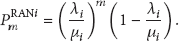
Consequently, the average packets

Hence, the average delay
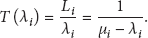
To some extent, minimization of the transmission delay can proportionally maximize the throughput; thus, the total gain function

Additionally, for the ith RAN,
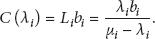
The objective
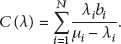
Let

where
Because
2.2. Optimal Solution
When the utility function
2.2.1. Allocation Constraint 1
The delay of M2M service k is determined by the maximum delay
2.2.2. Allocation Constraint 2
The total rate of M2M service distributed in N RANs is calculated by
2.2.3. Allocation Constraint 3
In an
The rate allocation of M2M service k should minimize (7) by satisfying these constraints. Thus, the optimization problem can be modeled as an objective with constraints as follows:
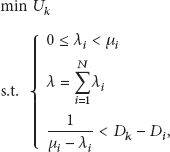
where
To show the concavity of the objective function
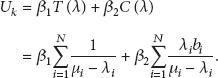
The first derivatives of

The second derivatives of

As long as

According to

In order to deal with the Lagrange function, the Karush-Kuhn-Tucker (KKT) conditions [14] are used. Then, (14), (15), (16), and (17) are obtained as follows:


where

The first derivative of

The second derivative of

Let

The updated
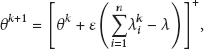
where
The iteration will continue until the difference between
Then, the allocation rate
2.3. Algorithm Flow
In conclusion, we use an iterative algorithm to find the solution of optimization problem, and it is shown in Algorithm 1.
from each RAN. between minimum, such as 0.000001. allocated according to
Algorithm 1
3. Simulation Results
In this section, the performances of the proposed traffic allocation scheme are evaluated. In the numerical simulation, two different M2M services are investigated. One M2M service requires hard timing constraints;
Meanwhile, there are three RANs. It is assumed that the available resources are 4 Mbps for each RAN. For comparison, two different cost combinations are defined for these three RANs. The first cost combination is
In addition, the radio channel environment is good to evaluate the performance of the proposed algorithm.
3.1. Two M2M Services in HWEs
Figures 2 and 3 show two M2M services in the same HWEs, respectively. Figures 4 and 5 show the same M2M service in the different HWEs, respectively. In Figure 2, the allocated rates are almost equal in all RANs because the cost of each RAN is 1. This is also consistent with the actual situation.
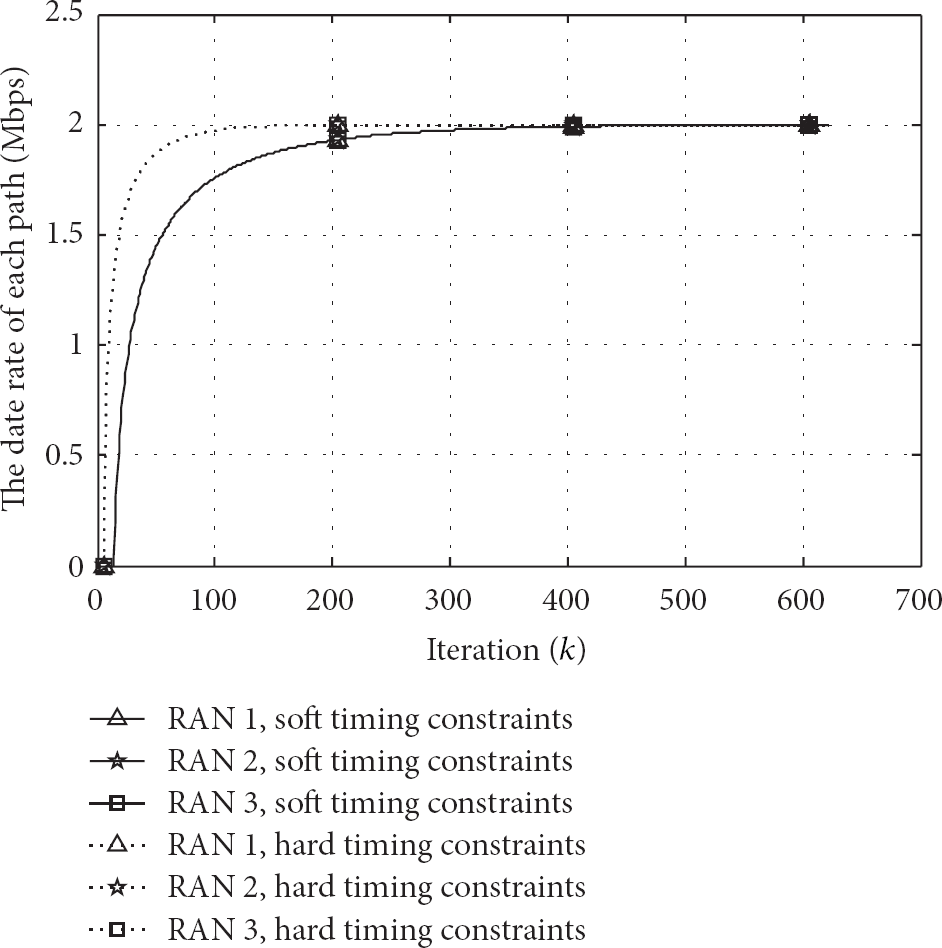
Two M2M services in HWEs with

Two M2M services in HWEs with
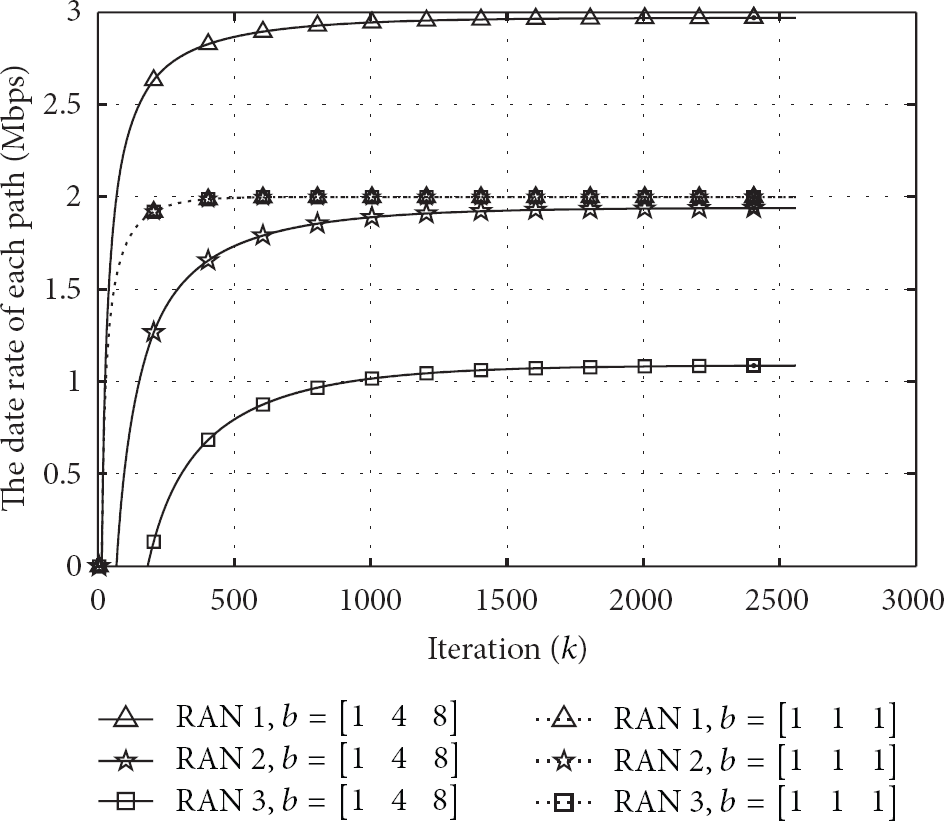
Soft timing constraints in HWEs with

Hard timing constraints in HWEs with
As mentioned above, the hard timing constraints M2M service pays more attention to the delay, and the soft timing constraints M2M service focuses on the cost. Hence, the allocated rates are different when the cost of RANs is charged in Figures 3, 4, and 5. Meanwhile, for the soft timing constraints M2M service, because 1 is the lowest cost of RANs, the allocated rate is the highest in the three RANs.
Based on Figures 2, 3, 4, and 5, because the two different M2M services have different characteristics, the convergence values are different in the three RANs by the Newton method. And these figures indicated that the proposed scheme is effective in rate allocation for M2M service.
3.2. The Cost and Delay Comparison
In Figure 6, the maximum delay of soft timing constraints M2M service is higher than that of hard timing constraints M2M service. For hard timing constraints M2M service, because it pays more attention to the delay, the delays are equal in HWEs with the different cost.

The delay comparison.
In Figure 7, the sum cost of soft timing constraints M2M service is lower than that of hard timing constraints M2M service. Figures 6 and 7 indicate that the hard timing constraints M2M service requires lower delay, while the soft timing constraints M2M service focuses on lower cost. In addition, because

The cost comparison.
3.3. Algorithm Comparison
In order to validate the proposed rate allocation scheme, the commonly used load balancing scheme [12] is briefly given as comparison as shown in Figure 8.
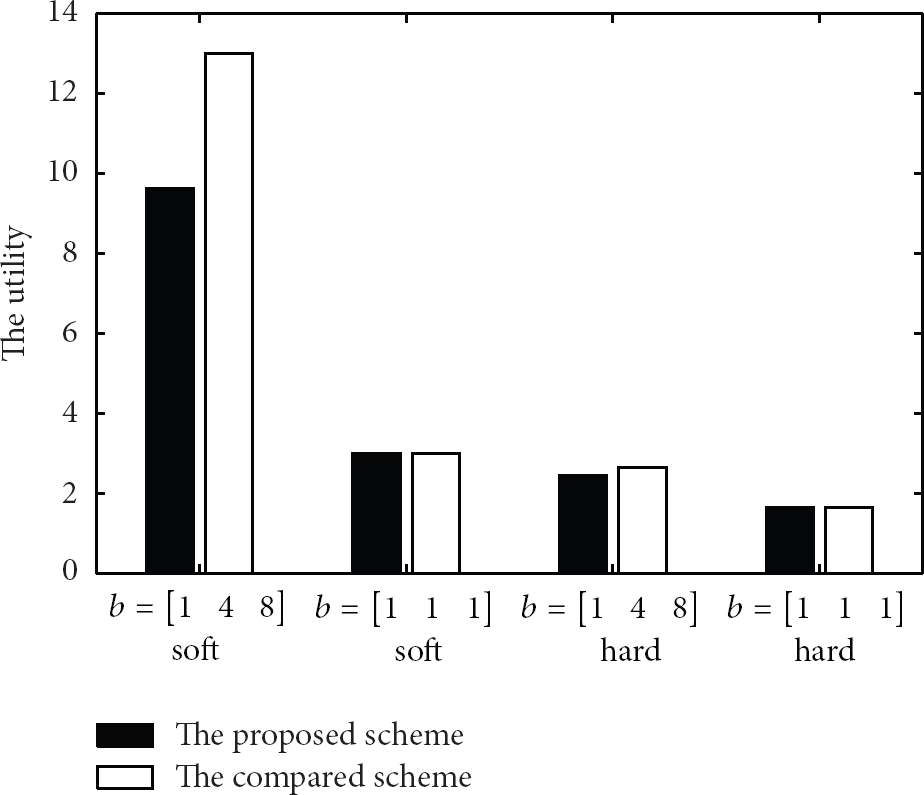
The utility comparison between two schemes.
It should be noted that lower value means better utility. As is shown from Figure 8, the proposed scheme can get better performance than the compared scheme, when the M2M service requires longer delay and lower cost. Meanwhile, the values of the utility are almost equal when
4. Conclusions
In the future M2M communications, M2M service may be transmitted in HWEs. The rate allocation for M2M service among multi-RANs is an important and challenging research. In this paper, an adaptive rate allocation scheme is proposed based on the utility function. According to the characteristics of M2M service, the utility function may be different. And the rate is distributed based on the utility function in HWEs to achieve higher throughput and lower cost. The simulation shows that it is an effective one compared with traditional method.
Footnotes
Acknowledgments
This work was sponsored by the Projects 61121001 and 60971125 supported by the Natural Science Foundation of China, the Project IRT1049 supported by the Program for Changjiang Scholars and Innovative Research Team in University, Chinese Highway Institution Project 2012ZX03005010-003, and China Scholarship Council.