




Abstract
For pumping stations installed blade full-adjustable pumps with frequently varying head in a wide range, adjusting pump blade angles is an effective way to realize optimum operation. Optimal mathematical models were established aiming at the least daily operation cost for pumping station system, which includes main pump units, inlet and outlet passages and their accessories, forebay and outlet pond, auxiliary equipment, power transmission and transformation equipment, other electromechanical equipments and lightings. Also, head varying, time-varying electrical price, and blade adjusting frequency are all taken into account. Meanwhile, the influences of the blade adjusting frequency on operation cost are researched. The results indicate that the operation cost is reduced by 5.64%∼12.13% by the optimal schemes considering time-varying electrical price and adjusting pump blade angles than that of conventional schemes, taking Jiangdu Forth Pumping Station in China as a case. The more the blade adjusting frequency, the less the operation cost. Also, if the blade adjusting frequency exceeds eight times, the optimum operation cost is close to be a const. Therefore, it is advisable to adjust blade angles four to six times a day to save operation cost and guarantee the reliability of pump units.
1. Introduction
For large pumping stations with blade full-adjustable pumps locating tidal river reach, the water level of the forebay is usually varied with tidal water, so the pump assembly head varies frequently in a wide range. In order to save the operation cost of pumping stations, pump blade angles should be adjusted in real time to regulate the operation point of the pump.
If adjusting pump blade angles continuously with varying pump assembly head, the efficiency of pumping station system is the highest, also the operation cost is the least. But, it will result in seal failure of the blade roots and lowering the reliability of blade regulating devices. Furthermore, it is troublesome to manage the blades. Conversely, if the frequency of adjusting pump blade angles is low, the operation duties of the pumps will not be regulated with the varying conditions, and the operation cost will be high. So, it is necessary to determine suitable blade adjusting frequency to guarantee optimizing effect and the reliability of blade regulating devices.
Many researchers have studied the optimal operation theories for water supply pumping station. Nitivattananon et al. [1] propose a dynamic programming model to generate pump schedules in real-time operation for a complex water supply system and determined pump discharges and the number of running pumps. Pulido-Calvo et al. [2] establish a model aiming at the least operation cost for a water distribution system based on demanding water of a day in southern Spain. Moradi-Jalal et al. [3] present a model for the optimal design and operation of water distribution systems. Pump type, capacity, and number of units were determined by SA, and nearly 33% savings in energy cost occurred. In [4, 5], the optimal design and operation of water distribution systems are researched by a hybrid genetic algorithm and two ant colony optimization algorithms, respectively. Xin et al. [6] research an operational optimization problem for the multisource water supply network. The objective is to minimize the operation costs including pumping cost and cost for water purification. A mixed-coding pseudoparallel genetic algorithm is proved to be more efficient and able to find much better solutions. Ostfeld and Tubaltzev [7] research optimal operation for a water transmission system by ant colony algorithm, aiming at the least design and operation cost. Zhuan and Xia [8] research the optimal operation scheduling of a pumping station with multiple pumps by an extended reduced dynamic programming algorithm (RDPA), considering both the energy cost and the maintenance cost. Bagirov et al. [9] propose a novel approach to pump scheduling for minimization of pumping costs in water distribution systems. Selek et al. [10] research the optimal pump schedule detection for water distribution systems by neutral evolutionary search.
However, their researches focus on the analysis of optimizing methods to solve pumping station operation models and have not pointed out suitable blade adjusting frequency for blade adjustable pump units. In this research, we will take Jiangdu Forth Pumping Station System as a case, which is in the Eastern Route of South-to-North Water Transfer Project in China, and establish daily operation models to determine the schemes by different adjusting frequency of pump blade angles. Also, we will analyze the influences on operation schemes and determine the advisable adjusting frequency.
2. Daily Optimal Operation Models
Large pumping station system is mainly constituted by main pump units (including main water pumps, electrical motors, and drive mechanisms), inlet and outlet passages and their accessories, forebay and outlet pond, power transmission and transformation equipment, auxiliary equipment and lighting, and so forth. Therefore, when researching total energy consumption of a pumping station system, other equipment should be included besides the main pump units. The total input power is the addition of input power of main electrical motors, station electrical equipment, losses of power transmission, and transformation, which are relative to the number of running pump units and operation duties, for a pumping station system.
We take into account the varying pump assembly head, the time-varying electrical price, and the blade adjusting frequency, in order to real describe the optimal results for a pumping station system. Assuming pumping volume of water W T , aiming at the least daily operation cost with the constraints of total pumping discharge, the allowed discharge of single pump unit, the ranges of pump blade angles, and the number of operating pump units, the objective function is defined as

where

The constraints are

where F is the total operation cost; i is the sequence number of time period; m is the number of time period divided in a day, or the adjusting frequency of blade angles; p i is the electrical price at time period i; P is the system operation power; ρ is the density of water; g is the acceleration of gravity; Q is the pumping discharge, decided by pump assembly head and pump blade angles; α is the pump blade angles; H z is the pump assembly head, which is the function of time t; n is the number of running pump units in pumping station; η z is the pump assembly efficiency; and η c is the transmission efficiency, η c = 1.0 for driving directly; η d is the efficiency of electrical motor; P zd is the input power of station electrical equipment; ΔP sd is the energy losses of power transmission; ΔP bd is the energy losses of power transformation; W T is the daily pumping volume of water; Qmin and Qmax are allowed minimum and maximum discharge for a pump unit, respectively; αmin and αmax are allowed minimum and maximum pump blade angles, respectively; and M is the number of installing pump units.
3. Solution Method
We had analyzed the performances of genetic algorithm (GA), particle swarm optimization (PSO), and simulated annealing-particle swarm optimization (SA-PSO) [11]. The results indicated that SA-PSO is more suitable for solving optimal operation models for pumping stations, with the characteristics of easy implementation of PSO and good local search ability of SA. Therefore, SA-PSO is used to solve the mathematical models above.
3.1. Theories of SA-PSO
Kennedy and Eberhart [12] proposed the PSO as an intelligent stochastic optimization method in 1995. The idea of PSO is based on simulation of birds flocking, and searching space of the optimizing problem is in analogy with flying space of birds. Each bird is abstracted as a particle without quality and volume. Also, a fitness value, determined by the objective function, evaluates the good or bad particle. The position of the particle is the possible solution, and the velocity of the particle represents the flying direction and the distance. In an n-dimensional searching space, positions and velocities of the particle swarm are initialized firstly. The position and velocity of particle j(j = 1, 2, …, m) are represented as

where w is a parameter called the inertia weight; c1 and c2 are learning factors, which are positive constants referred to as cognitive and social parameters; r1 and r2 are random numbers generated from a uniform distribution in the region of [0, 1].
Personal best position

Simulated annealing (SA) is an algorithm that simulates metal cooling thermodynamics process with the high temperature [13]. If aiming at the minimum of f(x), x is supposed as a current solution and x′ is supposed as a new solution in the neighborhood of x. Given ΔE = f(x′) – f(x), the probability that x′ is substituted for x as a new solution is P a = min{1, exp(−ΔE/θ)}, where θ is a temperature parameter. Obviously, if f(x′) ≤ f(x), P a = 1; namely, the algorithm accepts better solution at the probability of 1. Otherwise, P a is between 0 and 1; that is to say, the algorithm accepts a worse solution at some probability and could escape from the local optimal solution.
SA and PSO are merged together to be a new method called SA-PSO, and SA is applied when updating global optimal position of PSO, so SA-PSO has better global and local searching ability.
3.2. Determination to Variables and Parameters
For pump units with the same types, the assembly performances are regarded as the same, and the operating cost is the least when the same type pumps have the same operation duties, according to differential method. The number of running pumps and pump blade angles are regarded as variables at some time period. If water pump operates at design blade angles, which is fixed, the variable only is the number of running pumps.
Procedures were coded to obtain the minimum value based on SA-PSO, and the objective function is regarded as the fitness function.
The steps for solving fitness function are as follows.
According to daily records of the pump assembly head every two hours, which is varied with the tidal level, we could obtain the head at any time by interpolation or fitting.
Given the relationship among discharge Q, pump assembly head H z , and pump assembly efficiency η z , we could get the performance at any pump blade angles by interpolation or fitting.
Calculating relevant parameters at some time, such as pumping discharge, pump assembly efficiency, and pump assembly head, total cost of pumping station system at this time could be expressed.
Operating cost of pumping station system could be calculated by the time integral at this time.
Summing operating cost of each time period to get total cost during 24 hours and the fitness function are obtained.
Initial population size is chosen as 200, and the maximum iterations are 300–500 based on the number of variables. Learning factors c1 and c2 are defined as follows [14]:

where c1min, c1max, c2min, and c2max are the minimum and maximum of learning factors, given c1max = c2max = 2.5, c1min = c2min = 0.5. And G, Gmax are current and maximum iteration times.
Inertia weight w is introduced by

where wmax and wmin are the maximum and minimum of w, supposing the values are 1.5 and 0.01; F, favg, and fmin are the current fitness value of the particle and average and minimum fitness value of the swarm.
The maximum and minimum positions xmax and xmin of the particle are the upper and lower limit of the variables. And the maximum velocity vmax is 0.1 times of variable range. When searching by SA, initial temperature T(0) = – (fmax – fmin)/ln(0.1), and annealing rate and searching step are 0.92 and 0.01.
4. Results and Discussions
Jiangdu Forth Pumping Station is one of the four pumping stations in Jiangdu pumping stations, which are the source of Eastern Route of South-to-North Water Transfer Project in China. Seven sets of axial-flow pump with 2900ZLQ30-7.8 are installed after renovation. The design discharge is 30 m3/s, the design head is 7.8 m, and the power is 3400 kW, for a single machine. Jiangdu Forth Pumping Station operates together with other three pumping stations, Jiangdu east gate, Jiangdu west gate, Mangdao gate, Yiling gate, and so forth, to control and schedule the water for irrigation, drainage, and diverting Yangtze River by gravity. The design operation time of the pumping station is 5000 to 8000 hours yearly with large installed capacity and high operation cost, so it is important to save cost by optimal operation.
Water level of the forebay in Jiangdu Forth Pumping Station is influenced by tidal level of Sangjiangying water intake of Yangtze River, so the pump assembly head varies frequently in a wide range. According to water level data recorded on February 5 in year 2009, pump assembly head varying at different time is shown in Figure 1.

Pump assembly head varying of Jiangdu Forth Pumping Station on a typical day.
The electrical price is on the rules in Jiangsu Province, China. The peak price is 1.382 RMB/(kW·h) from 08:00 to 11:00 and 17:00 to 22:00, the flat price is 0.829 RMB/(kW·h) from 11:00 to 17:00 and 22:00 to 24:00, and the valley price is 0.356 RMB/(kW·h) from 00:00 to 08:00.
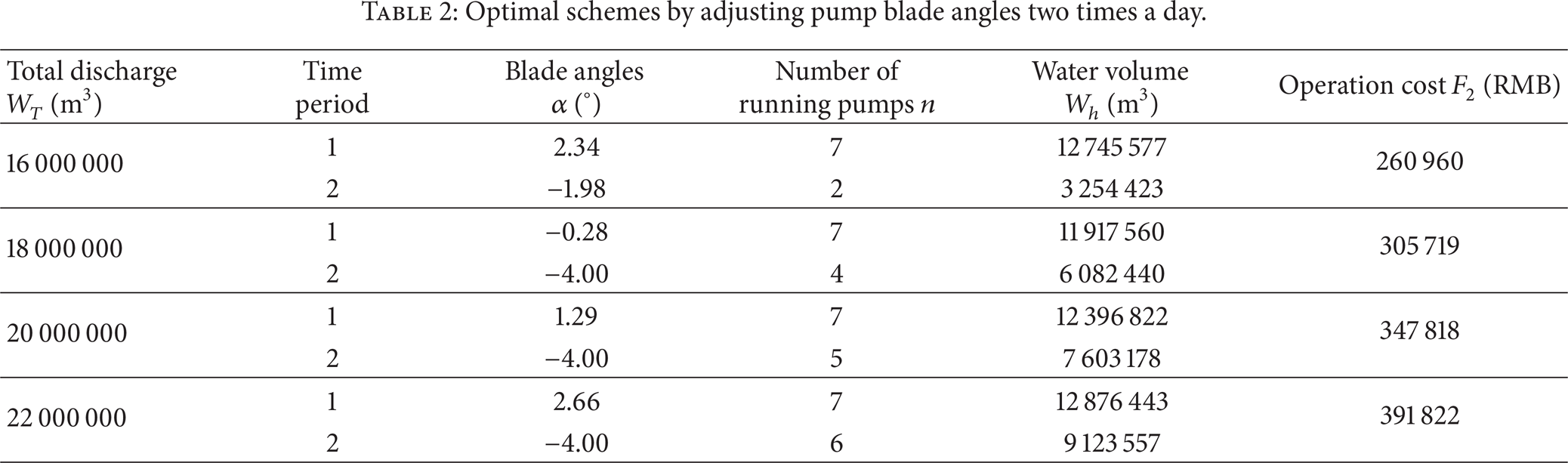
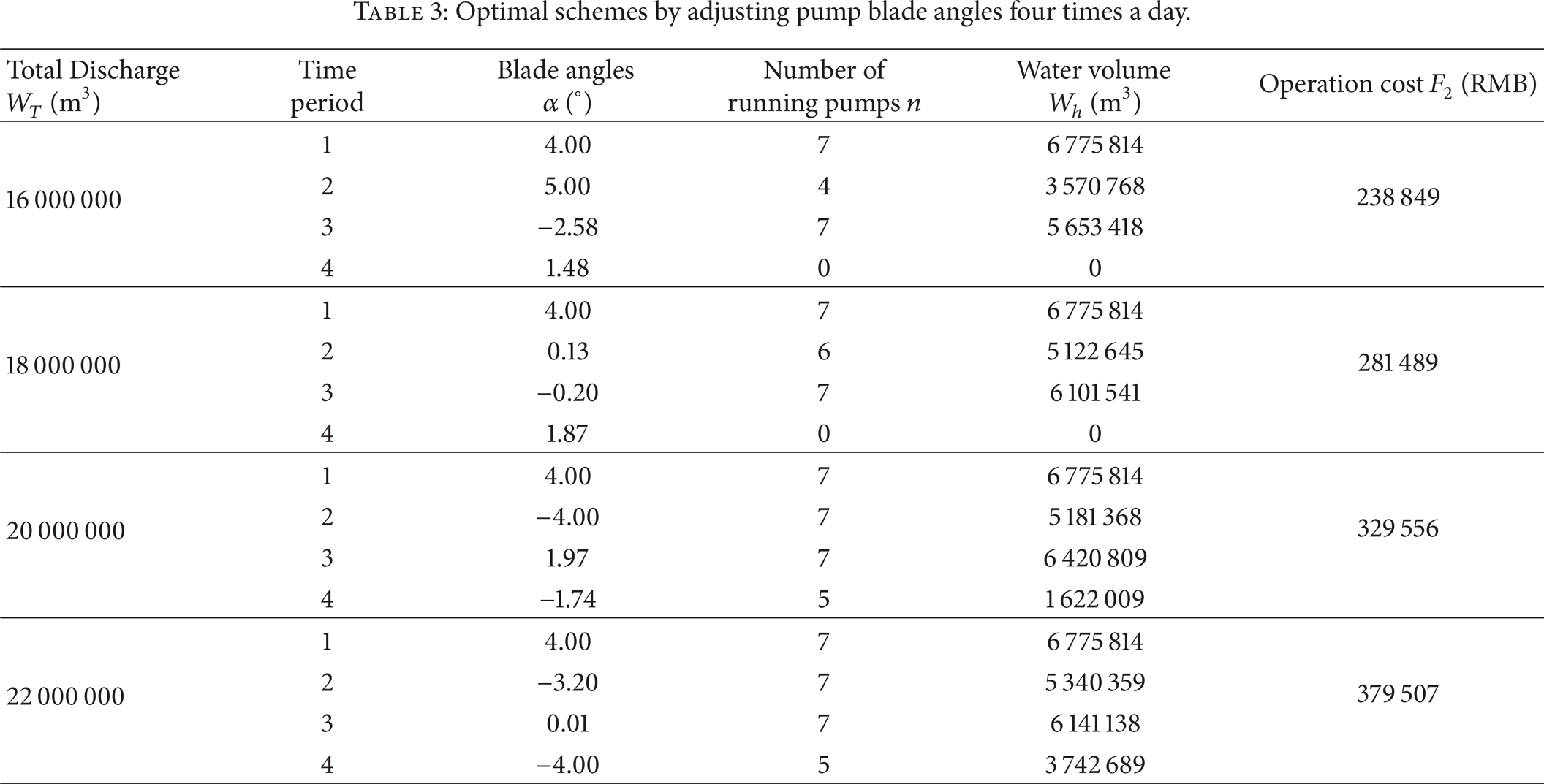
One day is equally divided into one, two, four, and eight time periods, and the blade angles are regulated at the beginning of each time period (namely, adjusting pump blade angles one time, two times, four times, and eight times per day) for Jiangdu Forth Pumping Station. The number of running pump units and optimal pump blade angles in each time period is determined for pumping 16 000 000 m3, 18 000 000 m3, 20 000 000 m3, and 22 000 000 m3. The results by adjusting pump blade angles with considering time-varying electrical price are shown in Tables 1, 2, 3, and 4.
Optimal schemes by adjusting pump blade angles one time a day.

Optimal schemes by adjusting pump blade angles two times a day.
Optimal schemes by adjusting pump blade angles four times a day.
Optimal schemes by adjusting pump blade angles eight times a day.

The operation cost by different adjusting frequency of blade angles is shown in Table 5 and Figure 2. We can see that the operation cost of the schemes by adjusting blade angles two, four, and eight times is reduced by 2.63%∼9.32%, 5.69%∼17.00%, and 5.75%∼17.64% than that by one time.
Comparisons of operation cost by different adjusting frequency of blade angles.

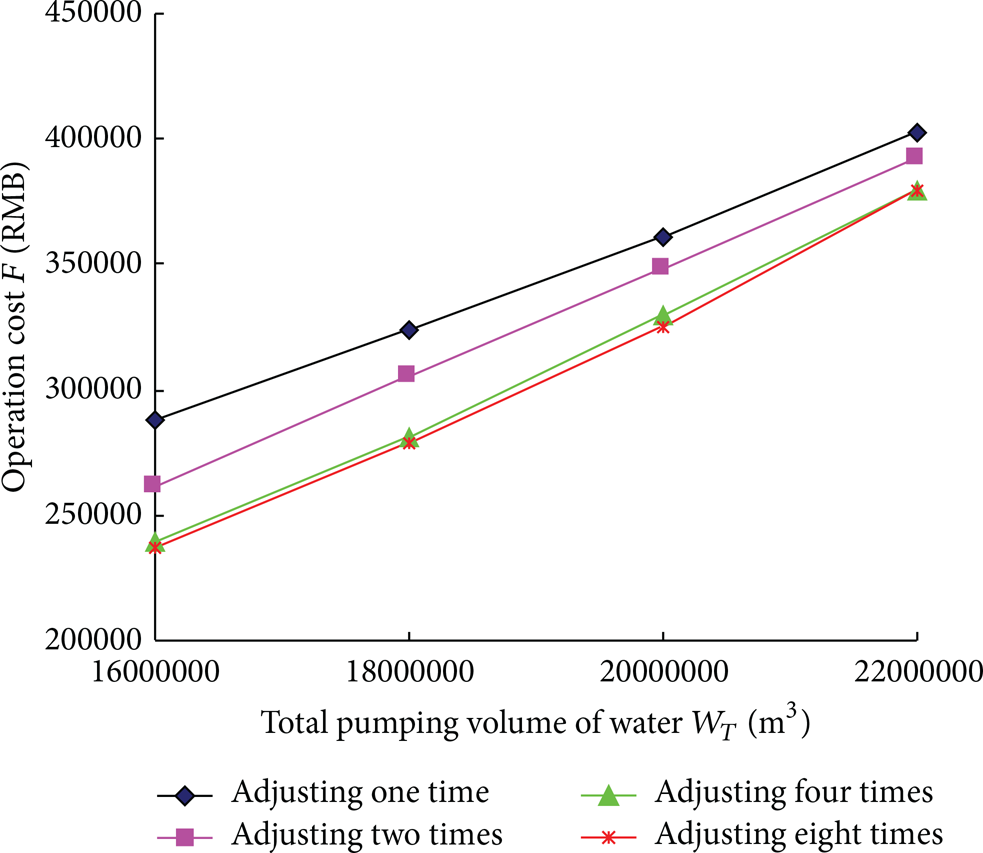
Operation cost based on time-varying electrical price and operating by adjusting pump blade angles.
The saving is more obvious when daily pumping volume of water is less. The blade angles could be regulated to the optimum value, and the required volume of water could be got by adding or reducing the number of running pumps. When the blade angles are at the optimum value, the efficiency of the system is the highest and the cost is the least. For example, in Table 1, when the required water is 16 000 000 m3/s, the blade angles are at optimum value −4.00° and seven pumps operate. And when the required volume of water is increased to 22 000 000 m3/s, all the seven pumps operate, and the blade angles should be increased to −2.86° to reach the required volume. In this case, the efficiency is decreased and the cost is increased.
In Figure 2, the operation cost is lower and tends to a const value, when the frequency of adjusting pump blade angles is higher. The operation cost is reduced by 0.7%∼1.4% by adjusting pump blade angles eight times per day than that by four times. If the frequency of adjusting blade angles continues to increase, the operation cost is decreased a little, and the calculation is complex. Also, the reliability of regulating devices and seals of blade roots would be lowered. Therefore, the number of running pumps and pump blade angles should be regulated to decrease the operation cost, based on the varying head and time-varying electrical price for pumping station system. Meanwhile, it is advisable to regulate blade angles four to six times per day to guarantee the blade reliability. From the figure, we can also see that the operation cost is linearly increased with the increment of total pumping volume of water.
Blade angles and the electrical price are two factors of the operation cost for a pumping station, which usually operates at fixed blade angles and without considering time-varying electrical price. We calculated four operation schemes such as that with adjusting blade angles and considering time-varying electrical price (Scheme A), that with fixed blade angles and considering time-varying electrical price (Scheme B), that with only adjusting blade angles and not considering time-varying electrical price (Scheme C), and that with fixed blade angles and not considering time-varying electrical price (Scheme D). Not considering time-varying electrical price means that the pumping volume of water is not varied with the varying electrical price when calculating.
Taking adjusting blade angles four times a day as a case, the operation cost of the four schemes are shown in Table 6, for Jiangdu Forth Pumping Station. We can see that the operation cost of the optimum schemes with adjusting pump blade angles and considering time-varying electrical price is the least, which is reduced by 3.78%∼12.13% than other schemes.
Comparisons of operation cost of different optimum schemes.

Figure 3 shows the comparisons of pumping volume at each time period between Schemes A and D, taking pumping 22 000 000 m3 water and adjusting blade angles four times a day as an example. Compared with Scheme D, pumping volume is increased the most at time period 1 in Scheme A, because of the low electrical price and head, and is decreased the most at time period 4 in Scheme A because of the high electrical price and head.

Volumes at each time period for pumping station system.
Therefore, in order to save operation cost, we should pump much water when the pump assembly head and the electrical price are low and pump less water or even shut off all the pumps when the pump assembly head and the electrical price are high.
5. Conclusions
When studying optimum operation schemes for a pumping station system, pump assembly head varying, time-varying electrical price, and blade adjusting frequency should be considered comprehensively. The operation cost could be reduced by 3.78%∼12.13% by the schemes of adjusting pump blade angles and considering time-varying electrical price than that of fixed blade angles and not considering time-varying electrical price. The influences of adjusting frequency of blade angles on optimum operation cost are researched for a pumping station system. When the adjusting frequency is higher, the operation cost is lower and tends to be a const value. It is advisable to adjust blade angles four to six times a day, considering the reliability of regulating devices and the seals of blade roots. In order to save operation cost, we should pump much water when the pump assembly head and the electrical price are low and pump less water or even shut off all the pumps when the pump assembly head and the electrical price are high.
Conflict of Interests
All the authors declare that there is no conflict of interests regarding the publication of this paper. All the authors do not have a direct financial relation with the commercial identities mentioned in their paper that might lead to a conflict of interests for any of the authors.
Footnotes
Acknowledgments
The work was supported by National Natural Science Foundation of China (Grant no. 51079125 and Grant no. 51379182), Natural Science Foundation of Jiangsu Province, China (Grant no. BK20130448), and Natural Science Foundation of the Jiangsu Higher Education Institutions of China (Grant no. 13KJB570004).