




Abstract
With the implementation of 4G mobile networks, the number of M2M users will be much large in a cell. When massive M2M users try to randomly access simultaneously, this will impose a great influence on H2H communication. Without effective control, these M2M users will lead to a system breakdown. In this paper, we put forward a model, which allows low delay tolerance of users to have a higher priority for random access, when contending with high delay tolerance of users for limited random access resources. In this model, by controlling access rates of different delay tolerance of users, the random access success probability will be improved efficiently. In the meantime, it will achieve the highest success probability and optimize the system performance by setting optimal access rates for different delay tolerance of users. This will be a practical guide to M2M communication in LTE system.
1. Introduction
3G mobile communication is moving towards 4G with the rapid development of mobile communication technology. An increasing number of mobile and nonmobile users will be a great challenge for 4G communication. It means that the wireless network system should have better performance to support more and more communications. In 2004, the 3GPP and 3GPP2 launched Long Term Evolution (LTE) project, aiming to introduce some key technologies to achieve higher and better system performance. However, LTE system is mainly designed for traditional H2H users. With the tremendous increase of M2M users, it is bound to have a great impact on H2H communications. It can improve the system performance effectively through appropriately controlling M2M users to access. Higher success probability and better system performance can be achieved through setting different access rates for different levels of users. This paper proves that hierarchical control of different users can efficiently improve random access success probability and optimize system performance.
The full paper is organized as follows. In Section 2, we briefly introduce research background and related works. Section 3 analyzes the influence of a large number of M2M users for simultaneous random access in LTE network after studying the LTE random access process. A system model is proposed in Section 4 to improve random access success probability when numerous users access simultaneously. In the next section, we analyze the model and come to a conclusion that setting optimal access rates for different levels of users will achieve the highest success probability. Section 6 builds a simulation to verify the system model. Finally, a brief summary of this paper is presented in Section 7.
2. Research Background and Related Works
2.1. Research Background
2.1.1. LTE
Since traditional 2G/3G network cannot meet the needs of multiple terminals of wireless bandwidth resources, the 3GPP launched LTE/LTE-A. LTE is short for Long Term Evolution (Figure 1). It is not really 4G, and it can be called 3.9G. The real 4G is LTE-advanced. In the fourth-generation broadband wireless multiple access systems data rate will reach probably hundreds of megabits per second [1]. Moreover, downlink data rate target will peak at 100 Mbps and uplink target data rate will peak at 50 Mbps for a bandwidth of 20 MHz in LTE system [2]. However, [3] analyses that downlink peak data rate over 1 Gb/s and uplink peak data rate over 500 Mb/s becomes possible. To meet the need of high data rate, downlink multiple access mechanism utilizes orthogonal frequency division multiplexing (OFDM) and uplink multiple access mechanism utilizes single carrier frequency division multiple access (SC-FDMA) [4].

LTE system architecture diagram.
LTE supports a higher data rate and cell capacity; such a system can be better for meeting the need of IOT for broadband resources. Time delay is 10 times lower than 2G/3G in LTE system, which is better for meeting the high requirements on the system delay of M2M equipment, such as some M2M devices used in monitoring and alarm systems. The number and traffic of wireless network users will grow exponentially [5]. Furthermore, LTE is increasingly seen as a service system for real-time M2M communication [6]. Asynchronous M2M users' accesses utilize access reservation protocol in LTE system. Access reservation protocol is helpful for asynchronous communication or intermittent transmission [7]. The LTE access preambles are selected from the orthogonal preamble set which are obtained from the Zadoff-Chu sequence [8]. LTE access process includes contention phase and data phase; LTE contention phase utilizes time-sharing ALOHA [9]. This ALOHA mechanism proposes a combination model [10]. More information about this combination model is in [11]; earlier research on access reservation protocol is in [12].
2.1.2. M2M
M2M, in a narrow sense, is short for machine to machine. M2M communication is defined as the machine type communication in 3GPP [13]. M2M applies in a very wide range of areas such as industry and agriculture. There are many examples of M2M applications, such as fleet management, smart meters, and goods tracking. We can see that the number of smart meters is far more than 35,000 in New York City with 2 km cell radii [13]. According to the prediction in [14], benefits from M2M communication will greatly improve in the next decade.
2.1.3. ALOHA
The LTE system utilizes slotted ALOHA. ALOHA protocol is divided into two types, one is Pure ALOHA (Figure 2) and the other is Slot ALOHA (Figure 3). Slot ALOHA requires clock synchronization in the whole network. Users can arrive at any time, but they can send data packets until the beginning of the next slot. It may cause part conflict or complete conflict in Pure ALOHA; however, it only causes complete conflict in Slot ALOHA.
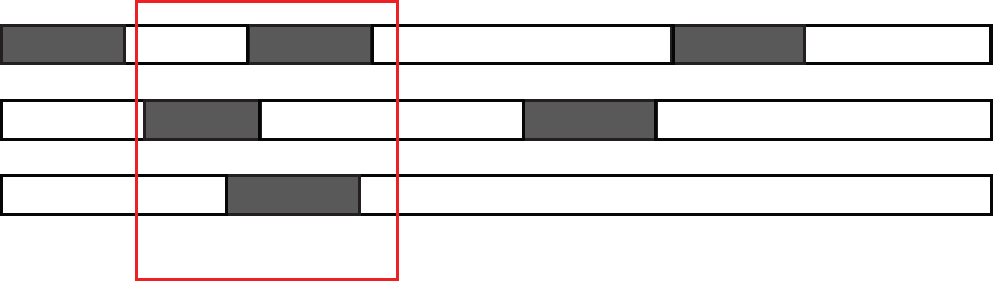
Pure ALOHA.

Slot ALOHA.
2.2. Related Works
It will have a huge impact on the LTE system when multiple M2M users access at the same time. Therefore, aiming to solve the problem of congestion, the 3GPP proposed the following schemes:
introducing new barring factors for M2M equipments to avoid network congestion and control access, classifying RACH resources, setting specific back-off time for M2M equipments, allocating specific slot for M2M equipments to access, and so on.
A fast retrial and dynamic control of random access algorithm in LTE system was proposed [15], and then it got the possible optimal rate of random access when there were some M2M users' packets and retrial packets. However, it just considered M2M users; that is to say, all M2M users were regarded as the same level in [15]. Obviously, it is impractical. In [16], two new dynamic spectrum access schemes for secondary users were proposed which were based on continuous-time Markov chains (CTMC), and then it got the optimal probability of secondary users for random access under the premise of the collision threshold value. In [16], users were divided into two levels. Based on [16, 17], access channel got the optimal probability of secondary users for random access based on Markov in two kinds of channel states.
3. LTE Random Access
3.1. Access Pattern
In a mobile communication network, users need to access if they want to communicate with others. When users synchronized with uplink, they can transmit data packets. In LTE system, there are two kinds of random access patterns, one is based on contention (Figure 4) and the other is based on the noncontention (Figure 5). eNB is evolved node and UE is user equipment in the figure. The main random access pattern is contention-based pattern in LTE system, so we focus on this pattern in this paper. The process of contention-based pattern is as follows:
random access initialization, random access resource selection, random access preambles transmission, random access response and Msg3, contention resolution.

Contention-based.

Noncontention-based.
3.2. Problem Arises
It will lead to a larger chance of choosing the same preamble in the stage of choosing access resources, if numerous users access simultaneously and preambles and time-frequency resources are limited. If many users send preambles with the same time-frequency resources, this will cause the eNB to get the same RA-RNTIs according to the received time-frequency resources and to get the same PDCCHs scrambled with the same RA-RNTIs. The UL grants, preamble indexes, and TC-RNTIs also will be the same. If all of the M2M users can receive PDCCHs, which are scrambled with their own RA-RNTIs, they will send Msg3 according to UL grant's instructions. Moreover, M2M users will send Msg3 in the same position because of the same UL grants. However, the eNB just decodes the first received Msg3. It means other users will fail to access. If none of the users receive RAR or if decoded preamble index is different from their own, they will choose a random value in [0, back-off time]. The number of optional values is far less than the number of users who are choosing the back-off values at the same time, so many users will choose the same values, and these users will collide once again in the next retrial.
4. System Model
In LTE system, due to the high density of M2M users, there may be massive M2M users in a cell. These users may access randomly in a very short period of time in the contention-based pattern. As we know, random access resources are limited, which are less than 64 preambles used in the competition in a cell. When a cell radius is larger, these preambles are more possible to be pairwise orthogonal [18].
Now, we suppose that there are N (N < 64) preamble sequences, and they are orthogonal to each other. We regard the N preamble sequences as N parallel logical channels (hereinafter to be referred to as channels) [1]; that is to say, there are N channels that can be used in a slot. When there is no user in a channel for random access in the current time slot, this indicates that the channel is idle. When there is one and only one user in a channel for random access in the current time slot, this indicates that the user accesses successfully the channel and the channel is successful. When there are more than two users in the channel for random access, the channel is colliding. Figure 6 shows that four preamble sequences are available in a slot; that is, there are four logical channels available. User 1, user 2, and user 3 are accessing the first slot. User 1 chooses channel 1. User 1 accesses successfully as there is only one user in this channel in this slot. User 2 and user 3 choose channel 4 in the meantime, so it causes collision. None of the users choose channel 2 or channel 3, so they are idle.
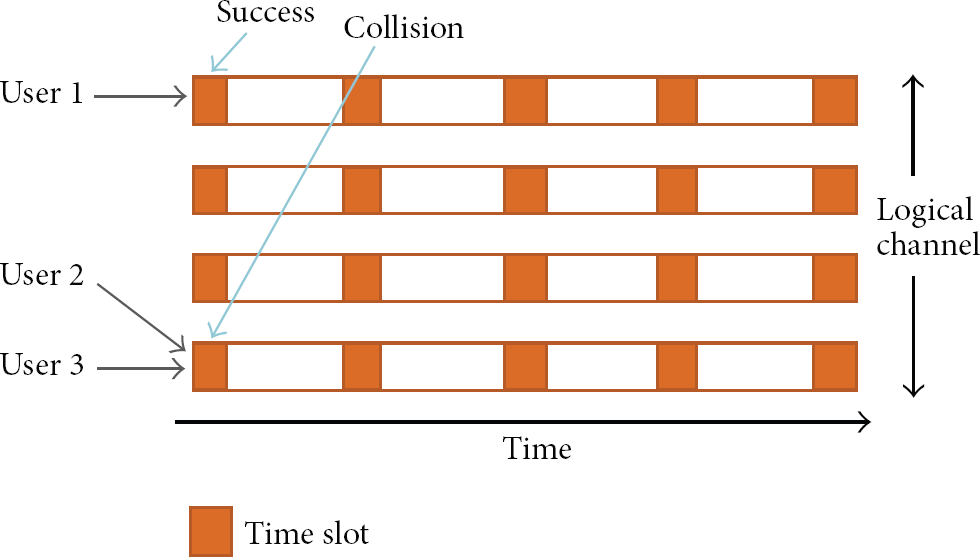
Contention-based random access with 4 logical channels.
Now, we define the following notations:
: number of H2H users for random access in this channel in this slot, α: the rate of M2M users' access,
In LTE system, when users are divided into two levels, we can draw the contention-based random access flowchart as follows (Figure 7).

Contention-based random access flowchart of two levels of users.
When packets arrive in the same channel in the same time slot, the eNB determines the following.
If there are only H2H user's packets, go to step 2; otherwise, go to step 3. If there is only one H2H user's packet, let the H2H user access, and then go to step 6; otherwise, go to step 7. If there are only M2M users' packets, go to step 4; otherwise, go to step 5. If there is only one M2M user's packet, let the M2M user access with rate α, and then go to step 6; otherwise, go to step 7. If there are multiple H2H users and M2M users packets, go to step 2. The channel is successful. The channel is colliding.
All of the colliding packets have to retry until a random time.
5. Analysis
5.1. Two Levels
From the system model in Section 4, we can know that users will choose a channel to access from N logical channels when users want to communicate with others. By controlling the access rate α of M2M users, we want to achieve the highest success probability of random access in a channel. We come to a conclusion that the success probability of random access will achieve the highest value when
The probability of i H2H users for random access in a channel in a current time slot is

The probability of j M2M users for random access in a channel in a current time slot is

Because H2H users' delay tolerance is lower than M2M users', H2H users can access if H2H users' data packets arrive, regardless of whether the M2M users' data packets arrive or not. The premise of access success for H2H users is that there is one and only one H2H user to access the channel in the slot, so the access success probability of H2H users is

M2M users are allowed to access when there are not any H2H users' data packets. The premise of access success for M2M users is that there is one and only one M2M user to access the channel in the slot, so the access success probability of M2M users is

The access success probability of a channel in the slot is

The probability of idle state of a channel in the slot is

The probability of colliding state of a channel in the slot is
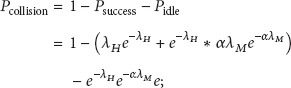

Hypothesis (8) is equal to 0, so we can get

Substitute

so

5.2. Three Levels
We divide random access users into three levels here. The primary users have the lowest delay tolerance, the secondary users have the middle delay tolerance, and the third users have the highest delay tolerance. Three levels of users arrival rates obey the Poisson random processes with parameters
The random access probability of i primary users in a channel in a current time slot is

The random access probability of j secondary users in a channel in a current time slot is

The random access probability of k third users in a channel in a current time slot is

The access success probability of the primary users is

The access success probability of the secondary users is

The access success probability of the third-level users is

The access success probability in a channel in the slot is

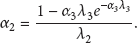
To gain the maximum value of

The first derivative of

The second derivative of

The second derivative of

The second mixed derivative of
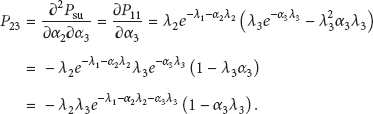




6. Simulation
6.1. Two Levels
If there are only H2H users, we set

The average arrival number of H2H versus access probability.
Figure 8 shows that the random access success probability increases as the number of users increases when the number of H2H users is within a certain range. However, as the number of H2H users increases, the random access success probability will reduce due to collision or other reasons, when the number of users reaches a certain number (the average arrival number of H2H users per second is more than 50 in Figure 8).
When multiple M2M users and H2H users are accessing we meanwhile set the average arrival number of H2H users at 50 per second and set the average arrival number of M2M users at a range from 0 to 5000 per second; that is to say, the average of arrival number of H2H users is 1 per channel per second. When setting different access rates of M2M users, we can get Figure 9.

The average arrival number of M2M versus access probability.
From Figure 9, we can know, setting different access rates for M2M users, that the lower the access rate is, the higher the random access success probability is, when the number of users reaches a certain number (the average arrival number of M2M users is 50 per second in Figure 9); that is, controlling access rate can improve the access success probability in the same number of users.
According to
When multiple M2M users and H2H users are accessing, setting the average arrival number of H2H users at 50 per second, allowing M2M users to access with a certain rate, we can meanwhile get Figure 10.

The average arrival number of M2M versus collision probability.
From Figure 10, we can know that the lower the access rate is, the higher the access success probability is, when the number of M2M users reaches a certain number (the average arrival number of M2M users is 1500 per second in Figure 10); that is to say, controlling the access rate can obviously reduce the collision probability of random access in the same number of users.
6.2. Three Levels
We also suppose that there are 50 logical channels here, the average arrival number of primary users is 50 per second, the average arrival number of secondary users is
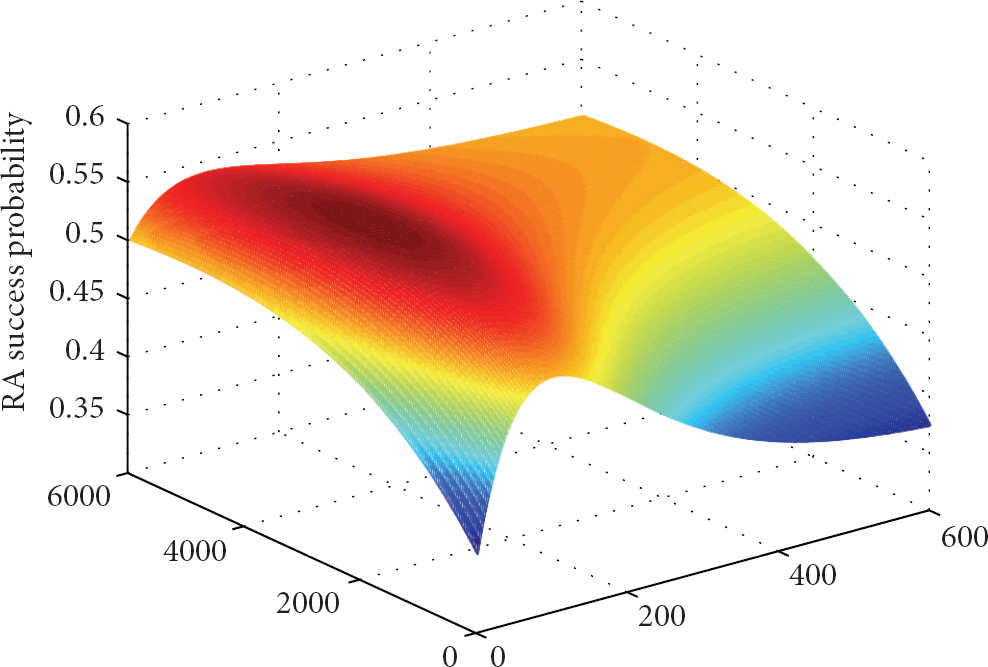
When we do not control the access rate of the secondary and third users, we can get Figure 11. When we properly control the access rate of the secondary and third users (here values of 0.5 and 0.1, resp.), we can get Figure 12. When we control the access rate of the secondary and third users with a smaller value (here values of 0.1 and 0.05, resp.), we can get Figure 13.

Access rate 1.

Access rate of 0.5 and 0.1, respectively.
Access rate of 0.1 and 0.05, respectively.
From Figure 11, we can know that, when we do not control the access rate of the secondary and third users, the success probability of random access increases with the number of users increasing when the number of them is small. When the number of two-level users is larger, channels become colliding due to multiple users accessing simultaneously; moreover, the success probability of random access declines sharply. When the number of the third users is constant (we assume it is 2000), the success probability of random access increases with the number of the secondary users increasing in a small range, and then it is down to a constant value.
The contrast between Figures 11 and 12 tells us, when we control the secondary and third users' access properly, that the success probability of random access can improve obviously.
According to Section 5.2, we can get the theoretical maximum success probability of random access:
The contrast between Figures 11, 12, and 13 tells us that the smaller the access rate of the secondary and third users is, the larger the success probability of random access is in the same number of users.
7. Conclusion
It has become an inevitable trend for M2M accessing the LTE system with the development of the Internet of things technology. This paper first simply introduces the LTE and M2M technologies and the LTE random access process and then analyses the impact of the LTE network when a great number of users are accessing simultaneously. The proposed model can improve the random access success probability efficiently by controlling the access rate of different levels of users. Furthermore, it can optimize the system performance by setting optimal access rates for different levels of users. This will have guiding and practical significance for M2M communication in LTE system.
Footnotes
Conflict of Interests
The authors declare that there is no conflict of interests regarding the publication of this paper.
Acknowledgments
This work was supported by the Natural Science Foundation of Fujian Province (2012J01252), Fujian Province University-Industry Cooperation of Major Science and Technology Project (2011H6008), National Natural Science Foundation (61072080), and the Development Project of Fujian Provincial Strategic Emerging Industries Technologies: Key Technologies in development of Next generation Integrated High Performance Gateway, and Fujian development and reform commission high-technical