




Abstract
To eliminate the location error of MS/AE (microseismic/acoustic emission) monitoring systems caused by the measurement deviations of the wave velocity, a MS/AE source location method using P-wave and S-wave arrivals for unknown velocity system (PSAFUVS) was developed. Arrival times of P-wave and S-wave were used to calculate and fit the MS/AE source location. The proposed method was validated by numerical experimentations. Results show that the proposed method without the need for a premeasured wave velocity has a reasonable and reliable precision. Effects of arrival errors on location accuracy were investigated, and it shows location errors enlarged rapidity with the increase of arrival errors. It is demonstrated the proposed method can not only locate the MS/AE source for unknown velocity system but also determine the real time PS waves velocities for each event in rockmass.
1. Introduction
Geophysical methods, statistical analysis, microseismic monitoring, and in-seam seismic techniques, have shown an increased significance in rock physical mechanics and mining engineering in recent decades [1–21]. In particular, the developments of seismic monitoring provide a scientific basis for controlling the rockburst and seismic hazards.
The seismic location, one of the most important parameters for a seismic monitoring, is very important for rockburst control and warning in a mine through the seismological method of the prediction of the areal rockbursts, which could improve the safety performance of deep geotechnical engineering. Researchers have developed many acoustic emission or seismic source location techniques [1, 2, 7, 22–32]. The problem of locating a signal source using time difference of arrival (TDOA) measurements also has numerous applications in aerospace, surveillance, structural health, navigation, industrial process, speaker location, machine condition, and the monitoring of nuclear explosions [1, 33–45]. And some of which are mature technologies and are widely used in the location of acoustic emission or seismic source.
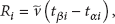
However, for the existing technologies based on AE or seismic source, a given wave velocity or practical pre-measured wave velocity of the propagation medium is required. It is well known that the wave velocity is influenced by the materials, size, and surface conditions of transmission media and other factors. When the input wave velocity is different from the real wave velocity of the measured object, an error would occur in the system [46]. The average wave velocity is different from that of various regions, and the actual location of the occurrence of rockburst is not necessarily in the predetermined wave velocity area. The measured wave velocity is affected significantly by the distance between sensors; the measured P-wave velocity of the general container is between 2800 and 3100 m·s−1 when the distance is large while that is about 5000 to 6000 m·s−1 when the distance is small [41]. The large location errors can be induced by inaccurate average wave velocity. Both of these conditions result in some errors between the pre-measured wave velocity as an input in the positioning system and the actual wave velocity of the area where the rockburst occurs; hence, it would result in a large positional error [41]. To quantitatively study the location errors induced by deviation of sonic speed, the line and plane location tests were carried out in [47], and some interesting conclusions were summarized: the results show that for line positioning, the maximum error of absolute distance is about 0.8 cm. With the speed difference of 200 m/s, the average value of absolute difference from the position error is about 0.4 cm; for the plane positioning, in the case of the sensor array of 30 cm, the absolute positioning distance is up to 8.7 cm. It shows the sonic speed seriously impacts on the plane positioning accuracy; the plane positioning error is larger than the line positioning error, which means that when the line position can satisfy the need in practical engineering, it is better to use the line position instead of the plane location, and the plane positioning error with the diagonal speed is the minimum one. Dong et al. analyzed above the drawbacks systematically in [48]. Velocities of P-wave and S-wave are obtained by blast experiments in existed methodologies. Two clear disadvantages were discussed. Firstly, active times are different because the premeasured velocity is obtained before the real-time seismic event. The fact is that the velocity in rockmass is changing all the time, and the velocity in different time would be not the same. Secondly, propagation traces are different (i.e., the traces of the wave propagation for blast experiments are always different from the wave propagation for real-time events), which would induce a big error because of the different average velocities in different propagation traces. The above drawbacks are further discussed in Figure 1, and the traces between blast source A and sensors were expressed as
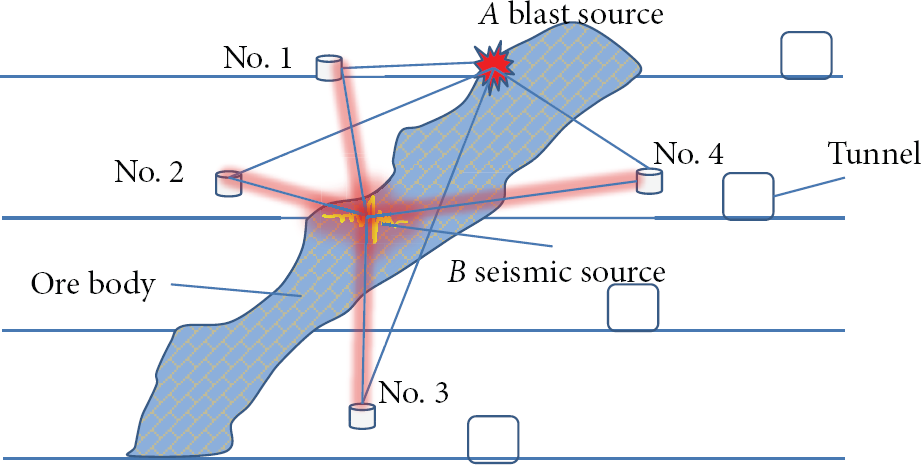
Location schematic diagram for different trace and different time.
In present work, we proposed a an innovative MS/AE source location method without the need for premeasured P-wave and S-wave velocities, which can calculate MS/AE source locations in unknown velocity networks.
2. Methodology
The microseismic n sensors are placed in a location area, and they are not in the same plane. Three-dimensional coordinates of the microseismic sensors are known, which are (
The distance from MS/AE source to sensor i can be expressed as


Supposing an equivalent parameter consider

Equation (2a) and can be rewritten as

Then, the distances between MS/AE source and received stations i, as well as the distance between MS/AE source and received stations j, are obtained as follows:

According to the distance formula of two point in the space, for sensors i and j, (4) and (5) are given as follows



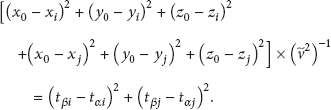

Equation (8) is a nonlinear fitting problem with a single dependent variable. According to all the observed data

Due to



Equations (11a) and

For a simple MS/AE source location problem, only
3. Validation with Numerical Experimentations and Discussion
In numerical experimentations, the location network includes 6 sensors
Arrival times of MS/AE sources.

Location results and error of MS/AE source coordinates under different reading errors of arrivals.

Comparisons between authentic values and fitting results for the E0 condition.

Note: 1, 2, 3, 4, 5, and 6 indicating the values calculated using (8), and i is equal to 1, 2, 3, 4, 5 and 6, while j is equal 1.

Spatial location of sensors and MS/AE sources (unit: meter).
As we all know, it is always difficult to read the accurate arrivals because of limitations of technologies, personal error, or machine error. In present work, the errors are considered as three levels within E1 [0.000001, 0.00001], E2 [0.00001, 0.0001], and E3 [0.0001, 0.001], which are randomly generated by random function of Microsoft Excel. The calculated location results of the three levels were also listed in Table 2. Compared results between authentic values (T) and fitting results of MS/AE sources A, B, C, D, and E for error levels E0, E1, E2 and E3 are shown in Figure 3. From Table 2 and Figure 3, we can conclude that the location errors enlarged rapidity with the increase of arrival errors. The error E1 results in errors within 3 m, and the minimum and maximum are −0.28 and −2.98 m, respectively. The error E2 results in errors within 55 m, and the minimum and maximum are −3.99 and 54.08 m, respectively. The error E3 could induce errors more than 500 m, and the minimum and maximum are −1.62 and 530.39 m, respectively. Figure 3 also shows that the differences between fitted values and authentic values increased with the enlarging of arrival errors. The induced location errors were further investigated by absolute distance errors between real MS/AE sources and fitted MS/AE sources in Figure 4. It also clearly shows the absolute distance errors enlarging exponentially with the increase of arrival errors, and the location errors for A, B, C, D, and E are increased from 0.19, 0.13, 0.28, 0.64, and 0.47 m to 82.49, 331.61, 656.54, 576.49, and 266.39 m, respectively.

Comparisons between authentic values and fitting results: (a) source A, (b) source B, (c) source C, (d) source D, and (e) source E.
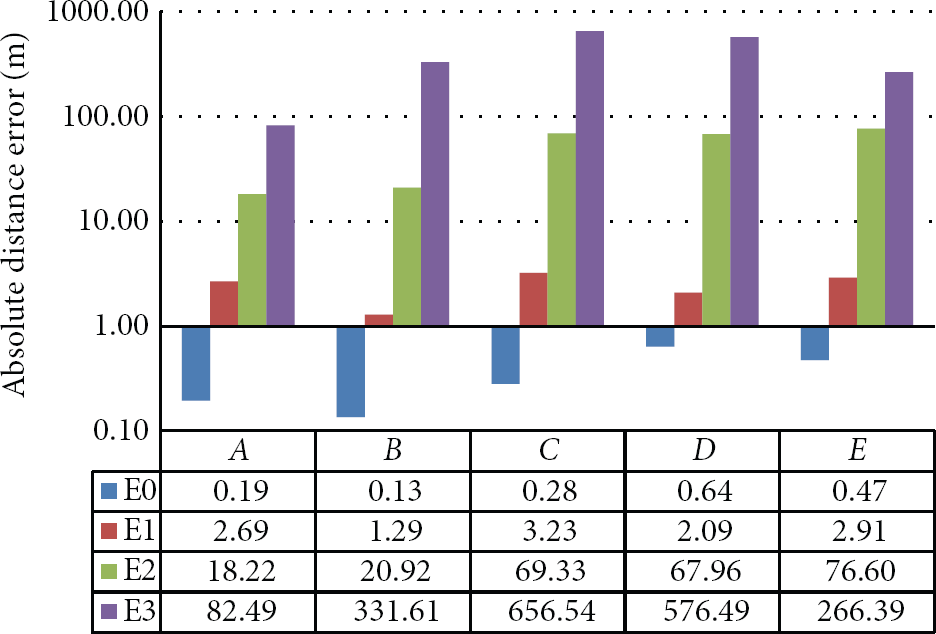
Comparisons of absolute distance error for different arrival errors.
4. Conclusions
A new MS/AE source location method PSAFUVS was developed to address the difficult problem of the location errors for microseismic monitoring system induced by wave velocity measurement deviation. The proposed method was validated by numerical experimentations. Results show that the proposed method without the need for a premeasured wave velocity has a reasonable and reliable precision. It is demonstrated that the proposed method can not only locate the MS/AE source for unknown velocity network but also determine the PS wave real-time velocities for each event. Effects of arrival errors on location accuracy were investigated using PSAFUVS, and it shows location errors enlarged rapidity with the increase of arrival errors. The absolute distance errors between real MS/AE sources and fitted MS/AE sources were further discussed, and results show the absolute distance errors enlarging exponentially with the increase of arrival errors.
Footnotes
Conflict of Interests
The authors declare that there is no conflict of interests regarding the publication of this article.
Acknowledgments
The authors gratefully acknowledge the financial support of National Natural Science Foundation of China (50934006,41272304), National Basic Research (973) Program of China (2010CB732004), China Scholarship Council (CSC), Doctoral Candidate Innovation Research Support Program by Science & Technology Review (kjdb201001-7), Scholarship Award for Excellent Doctoral Student from Ministry of Education of China (105501010), and Support Program for Cultivating Excellent Ph.D. Thesis of Central South University.