




Abstract
We propose an energy-aware dynamic routing strategy in order to provide balanced energy consumption in wireless sensor networks, hence, prolonging the lifetime of the network. The proposed routing algorithm uses local betweenness centrality to estimate the energy consumption of the neighboring nodes around a given local sensor node, without requiring global information about the network topology or energy consumption, and to divert traffic from nodes that are more heavily used. Because nodes with large local betweenness centrality consume energy more quickly, the network lifetime can be prolonged by redistributing energy consumption to nodes with smaller local betweenness centrality. Simulation results showed that the proposed routing strategy has advantages over shortest path routing with respect to extending network lifetime and balancing energy consumption in wireless sensor networks, yet does not introduce significant additional transmission overhead or a longer average path length.
1. Introduction
Wireless sensor networks (WSNs) have many desirable characteristics, including easy deployment and self-organization, and are becoming increasingly important in modern society. The applications of WSNs range from important societal issues such as environmental surveillance, intelligent transportation, disaster relief, and health care to military issues including battlefield biological and nuclear monitoring as well as target tracking [1]. WSNs generally consist of a large number of small, embedded, low-power sensor nodes with sensing, data processing, and wireless communication capabilities [1]. They are deployed in a wide distribution area and collaborate to form an ad hoc network. The sensor nodes are battery-operated, most of which are not rechargeable, and cease to function once the battery expires. Owing to logistical issues such as remoteness or inaccessibility of distribution areas, it is not straightforward to replace sensor nodes with expired batteries. Therefore, balancing the energy consumption of WSNs to prolong the network lifetime is of considerable importance. In WSNs, the energy is consumed in different ways in different nodes; however, the primary energy cost is in data transmission once the networks have been organized.
Experimental measurements have shown that data transmission is generally very expensive in terms of energy consumption, while data processing consumes significantly less energy [2]. Data transmission depends on the routing strategy; therefore, designing a reasonable routing strategy to balance energy consumption has significant potential to prolong the lifetime of WSNs [3].
Along with the discovery of scale-free [4] properties, complex networks have been applied to a wide range of natural and social systems, such as the Internet, social networks, scientific collaboration networks, metabolic networks, and WSNs [5, 6]. Recently, routing in complex networks has attracted considerable interest across many fields of science. Research on routing strategies has overwhelmingly focused on improving transport capacity and controlling congestion, which are crucial problems on many large-scale networks such as the Internet, phone networks, and airport networks [7–14]. WSNs have a low data rate and low energy consumption [6, 15], and so the critical problem in WSNs is the longevity of the network, and the major constraint is energy consumption rather than congestion control.
Much work has been done developing WSN routing (e.g., see [16–27] for extensive reviews). Most existing energy-aware routing algorithms assume that the communication load is evenly distributed; however, this assumption is not consistent with the data usage requirements of individual nodes within many WSNs. Almost no studies have considered energy-aware routing in WSNs from the point of view of the structure and dynamics of large complex networks.
In this paper, we propose an energy-aware routing in WSNs using local betweenness centrality (EAR-LBC). The proposed routing algorithm has two features that differ from those of most current research
It utilizes the basic principles of complex network theory, in particular the concept of betweenness centrality (BC) to estimate the remaining energy of the sensor nodes. Routing in WSNs takes place according to the criterion of the shortest available path from a given source to its destination. The nodes with the largest BC, which are usually called the central nodes of networks and are located in the shortest path, are susceptible to more frequent data transmission due to heavier traffic load [3]. Energy consumption at these central nodes occurs at a greater rate than that of other sensor nodes, leading to unbalanced energy consumption in the network. Once the central node runs out of energy, the WSN will cease to function. Consequently, we propose the EAR-LBC algorithm, which uses local BC (defined in Section 3) to consider the energy cost of forwarding data, and takes both the shortest path and the remaining energy of the sensor node into account, rather than simply employing traditional metrics such as the shortest path. A systematic approach is taken to verify the validity of the EAR-LBC algorithm. Because most network topological structures (including WSN) exhibit scale-free behavior, we designed a simulation model based on Barabasi-Albert (BA) scale-free networks (discussed in Section 4.1). This simulation model is consistent with most WSN topological structures. For definiteness and without loss of generality, we investigated the performance of the EAR-LBC algorithm using three simulation scenarios generated by the model.
The remainder of this paper is organized as follows. Section 2 presents a review of relevant prior work. The proposed routing strategy is described in Section 3. Section 4 discusses the simulation results. Finally, the paper is concluded in Section 5.
2. Related Works
Applying complex network theory to the design of energy-aware routing in WSNs is an interdisciplinary field, which combines WSNs with complex networks. Accordingly, in this sections we describe related research progress in two ways: energy-aware routing in WSNs and routing in scale-free networks.
2.1. Energy-Aware Routing in WSNs
Many energy-aware routing algorithms for WSNs have been presented in recent years. Those routing algorithms can be categorized into two types. One type is the clustering routing algorithms that divide sensor nodes into clusters and balance the energy consumption by cluster head selection to extend network lifetime [19, 23, 24, 26, 27]. Cluster-based routing is an efficient way to reduce energy consumption and extend network lifetime within a cluster. The number of messages transmitted to the base station is reduced by data aggregation and fusion, which reduces the overall energy consumption. Cluster-based routing is mainly implemented as a two-layer strategy: one layer is used to select cluster heads, and the other layer is used for routing. High-energy nodes can be used to process and send information, whereas low-energy nodes can be used to perform sensing in close proximity to the target. The clustering algorithm is based on cluster selecting, which incurs an additional energy cost. The other type is centralized routing, which uses probabilistic forwarding [18] or an optimization strategy, such as ant colony optimization, linear programming, or heuristic approaches, to find an energy-balanced route based on the global information on the network topology and energy consumption [16, 17, 20–22, 25].
However, most existing energy-aware routing algorithms assume that energy consumption in WSNs is evenly distributed or that a WSN is deployed as a specific scenario when analyzing the validity of its routing algorithms, which is not consistent with most WSN topological structures. Almost all studies have failed to consider energy-aware routing from the point of view of the structure and dynamics of large complex networks.
2.2. Routing in Scale-Free Networks
Because of the importance of large complex communication networks in modern society (such as the Internet, which has scale-free properties), the dynamics of the underlying structure (such as traffic congestion) have drawn much attention from both physics and engineering standpoints. Making full use of complex network theory, the routing strategies in scale-free networks overwhelmingly focus on improving transport capacity and congestion control. To avoid congestion and improve the transmission capacity of networks, many routing strategies have been proposed in scale-free networks, including random walk, efficient routing, local routing, optimal routing, and hub avoidance strategies [8–14].
WSNs typically have scale-free properties, and it is necessary to study the routing process according to the particular requirements of these types of networks. Energy awareness is a central design issue for WSNs; to extend network lifetimes, energy-aware routing should be considered in these scale-free networks.
3. Routing Strategy
In this section, we present an overview of the EAR-LBC routing strategy then provide the pseudocode to implement it. Finally, we use a simple routing example to illustrate the proposed algorithm.
3.1. Greedy Forwarding
The proposed routing strategy is a local routing search algorithm based on greedy forwarding. Greedy forwarding aims to bring messages closer to the destination using only local information in each stage of the journey. Thus, each node forwards the message to the neighbor that is most suitable from a local point of view, which can be the one that minimizes the energy cost to the destination in each step.
Because we apply greedy forwarding to find a route from the source to the destination, we must choose a selection function that describes which of the candidates is the most promising. That is, we must identify the optimum next stage of the journey at each sensor node during the process of route finding. Obviously, it is desirable for each sensor node to forward the data packet to a neighboring node that is both close to the destination and has sufficient energy to forward the data packet. This greedy forwarding criterion can be described as a selection function that determines which candidate is nearest to the destination [16]. Suppose that node X has M direct (one-hop) neighbors,

where

where α is an adjustable parameter [9],
3.2. Local Betweenness Centrality
The availability of small, low-power global positioning system (GPS) receivers for calculating relative coordinates makes it possible to obtain the distance from the ith neighbor to the destination. Therefore, in (2), we can readily obtain the value of
Recent studies [7, 10] have reported that BC plays an important role in the traffic on networks. For a given network, the BC of a node is defined as
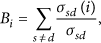
where

Assuming that the sensor node forwarding a data packet consumes energy

where
However, there remains a problem that must be solved. The BC is calculated based on global topology information, which is generally not available in large-scale wireless ad hoc sensor networks. To deal with this problem, we propose an energy-aware routing system based on local BC. We extend the concept of BC from the global topology to a local routing table, which consists of the destination and the next hop information only. Similarly, the local BC of a node for a local routing table is defined as
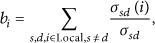
where

3.3. Routing Algorithm
The proposed routing algorithm is a distributed routing algorithm based on local BC. For each sensor node X, which receives a data packet P, the next hop is determined as follows.
For each neighbor Among the neighbors of X, we choose the If there is no routing information about the current data packet P in the routing table, routing paths for P are added. If routing information already exists, we update the next hop information to that determined in step (2).
The pseudocode to implement the algorithm is shown in Algorithm 1.
/⋆ according to (6), computes table of X; computes
/⋆
/⋆ /⋆
/⋆
Initially, the routing table of X will be empty. From (6), the value of
The key to the algorithm is dynamic calculation of cost informed by updating the local routing table. By choosing the optimal next hop by minimizing cost, the data packet can be routed by sensor nodes with more energy. Energy consumption becomes more uniform, and the network lifetime can be prolonged. Obviously, the proposed algorithm is equal to the traditional shortest path routing when
3.4. A Routing Example
Here, we illustrate the algorithm using a simple routing example. Consider a wireless network topology shown in Figure 1. To demonstrate the function of local BC, we consider the distance from one node to another to be the number of hops between them and focus on the change in the local BC. In Figure 1, suppose that the source node S sends several data packets, denoted by

An example of WSN topology.
When S sends

The term

where
Routing table of node S when sending data packet

Node
When S sends 
where
Routing table of node S when sending data packet

In this example, data packets are routed from S to D via
4. Simulation
In this section, we describe simulations that were performed to evaluate the performance of the proposed routing strategy, developed using MATLAB. Our goal was to determine the advantages of the routing strategy in terms of network lifetime, average path length, and residual energy by comparing the performance to that of other routing algorithms. Most routing processes in WSNs take place according to the criterion of the fewest hops from a given source to the destination. This is equivalent to the shortest path routing from a given source to its destination in a graph with the same edge weight on all available wireless links. We compared the performance of the EAR-LBC to that of the shortest path routing (SP).
4.1. Simulation Model
The BA model is one of several proposed models that generates scale-free networks, and the networks studied in our simulation were generated using this model. BA scale-free network incorporates two important general concepts: growth and preferential attachment. Both growth and preferential attachment exist widely in real networks. Growth means that the number of nodes in the network increases over time. Preferential attachment means that the more connected a node is, the more likely it will be to receive new links. Nodes with a higher degree have a greater ability to grab links added to the network.
The generation of networks begins with an initial network of 
where
In our model, the number of sensor nodes in the networks is denoted by N. All nodes are treated as both sensors and routers for generating and transporting data packets, and each link has the same packet-delivery capacity. Consistent with the low data rate in WSNs, we assume that each node has sufficient processing and buffering capacity to deliver and handle all of the data packets it receives in each time step. Transport on the network proceeds in discrete time steps and is driven by inserting R new data packets, with randomly chosen sources and destinations. At each time step, every node delivers the packets toward the neighboring node with the optimum next hop as determined by the routing strategy. For the sake of comparison, the number of new data packets generated by the nodes per time step was fixed at 1 (i.e.,
4.2. Simulation Scenarios
Three simulation scenarios were designed as follows.
The number of nodes was fixed at We fixed the average degree so that We analyzed the distribution of the residual energy in a network using both EAR-LBC and SP routing. The average degree of this network was 12 (
4.3. Simulation Results
Figure 2 shows the simulated network lifetime, and Figure 3 shows the simulated average path length with

The network lifetime, t, as a function of parameter m with

The average path length,
As shown in Figure 3, the average path length of two routing strategies decreased as the average degree increased, which can be explained by considering that there are more links between the sensor nodes, and so more direct routes are likely to be available. It can be seen that, although EAR-LBC enhances the network lifetime, it does not lead to a significant increase in the average path length. Both methods resulted in almost the same average path length. This is a particular useful result because an increase in the number of hops would result in an increased energy consumption for the network as a whole. In fact, EAR-LBC only incurs an additional computational cost in processing the expression in (7) in exchange for an increase in the network lifetime. This additional computational cost is slight because data processing consumes significantly less energy than data transmission in WSNs.
The average degree was fixed at
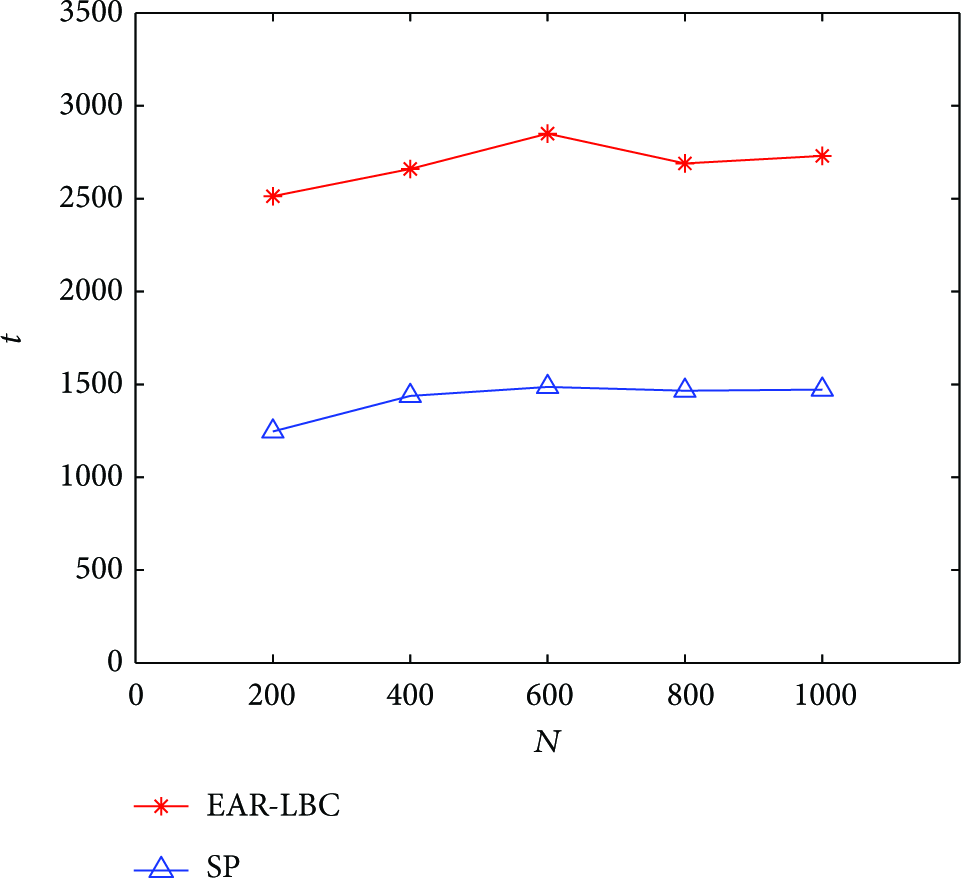
The network lifetime, t, as a function of the network scale, N, with
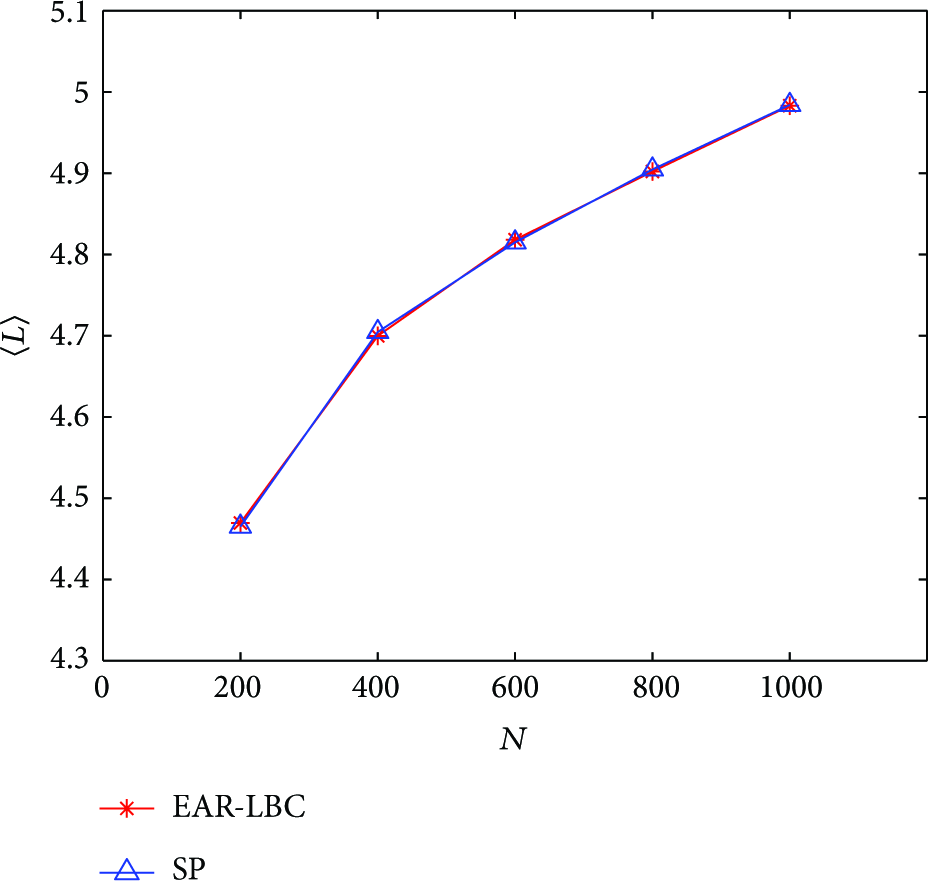
The average path length,
Figure 6 shows the distribution of residual energy plotted against the node index for a network with

The distribution of residual energy plotted as a function of the node index, for a network where
Figure 7 shows a columnar comparison chart for EAR-LBC and SP routing, illustrating the distribution of nodes as a function of the residual energy. We rate the residual energy of each node on a scale of 1 to 4. A residual energy in range of 0 to 200 is level 1. A residual energy in range of 200 to 440 is levels 2. A residual energy in range of 440 to 480 is level 3. A residual energy in range of 480 to 500 is level 4. As shown in the left column, when EAR-LBC and SP routing had the same network data traffic with

Columnar comparison chart for EAR-LBC and SP routing showing the number of nodes in different residual energy levels, for a network with
5. Conclusions and Future Works
We proposed an EAR-LBC for WSNs based on local BC and investigated the network lifetime and the average path length assuming that all nodes had the same initial energy. The proposed routing strategy considers realistic network structures and the dynamic energy consumption of large WSNs.
Our proposed algorithm improves upon the existing methods in two ways regarding the extension of network lifetime. First, our strategy uses greedy forwarding, which takes both the shortest path and the remaining energy at each node into account, rather than simply using traditional metrics such as the shortest path. A tunable weight, α, is used as a parameter to determine the share of path length and remaining energy in route finding. This can be easily adjusted to optimize the routing strategy in line with the particular demands of a given network. Second, the routing strategy introduces the local BC to dynamically estimate the energy consumption of the neighboring nodes. Because of these features, even in the absence of global information on network topology and energy consumption, data packets can be routed to the sensor nodes with more residual energy, which provides a more balanced energy consumption in the network.
Because of these two improvements, EAR-LBC extends network lifetime without introducing additional transmission overhead or a longer average path length. Our results have applications to the design and optimization of routing for WSNs, including environmental monitoring systems, health care systems, and target-tracking systems.
Our future work will aim to improve and extend EAR-LBC algorithms, taking into account many additional characteristics of WSNs. There are a number of directions for future research. First, we will analyze and compare the performance of the EAR-LBC strategy described here and other energy-aware routing algorithms. Based on this comparative research, we will gain insight into which applications are best suited to EAR-LBC algorithms. Second, we will create a physical implementation to evaluate the performance of the EAR-LBC algorithms experimentally and study how to select design parameters according to the WSN application.
Footnotes
Acknowledgment
This work was supported in part by the National Natural Science and Foundation of China under Grants 61105070, 61073025, 61170031, and 61272069.