




Abstract
Machine to machine (M2M) communications, also called machine-type communications (MTC), has widely been utilized in applications such as telemetry, industrial, automation, and SCADA systems. The group-based MTC, especially when MTC devices belong to non-3GPP network, will face new challenge of access authentication. In this paper, we propose a group authentication and key agreement protocol, called EG-AKA, for machine-type communications combining elliptic curve Diffie-Hellman (ECDH) based on EAP framework. Compared with conventional EAP-AKA, our protocol guarantees stronger security and provides better performance. Detailed security analysis has shown that the proposed EG-AKA protocol is secure in terms of user and group identity protection and resistance to several attacks. Furthermore, formal verification implemented in AVISPA proves that the proposed protocol is secure against various malicious attacks. Moreover, performance evaluation demonstrates its efficiency in terms of the signaling overhead, the bandwidth consumption, and the transmission cost.
1. Introduction
Machine to machine (M2M) communications [1], which is also defined as machine-type communications (MTC) [2] in release 10 of the 3rd Generation Partnership Project (3GPP), is one of the hottest issues not only in the standardization but also in the industrial circles. In M2M communications, both wireless and wired systems can communicate with other devices of the same ability. Thanks to MTC, many applications become possible [3, 4]. M2M communications uses a device, such as a sensor or meter, to capture an event (such as temperature and inventory level). Then this event is delivered through a wireless, wired, or hybrid network to an application (software program), which translates the captured event into meaningful information. For example, the event can be translated into what items need to be restocked [5]. Since MTC communications does not need direct human intervention, it is soon becoming a market-changing force for the next-generation intelligent real-time networked applications [6, 7].
Recently, most research on MTC has focused on congestion control, resource management, key management [8, 9], and so forth; however, there are few studies on security aspects. Lu et al. [10] point out that the existing challenges of M2M is energy efficiency (green), reliability, and security (GRS). Taleb and Kunz [11] present some potential challenges and solutions of MTC in 3GPP networks. Some security threats and corresponding solutions of 3GPP are discussed in [12]. Privacy preservation is also an important issue in M2M communications [13–15]. A new group message authentication protocol [16], which utilises only limited authenticated communication, combines short authenticated strings protocol with classical key agreement procedures. This SAS-based group authentication and key agreement protocol is secure against active attacks. If mobile terminals of non-3GPP short-distance wireless communication want to access the 3GPP core network, they must execute access authentication. Most access authentication protocols are based on Extensible Authentication Protocol (EAP), such as EAP-AKA [17], EAP-TTLS [18], EAP-PEAP [19], EAP-LEAP [20], and EAP-SPEKE [21]. However, the existing access authentication protocols cannot provide enough security for MTC [22]; on the other hand, present standard has not considered the group-based access authentication. Recently, several standardization organizations start to present the concept and requirement of group authentication, but the mechanism and procedure have not yet been developed.
To the best of our knowledge, the existing network authentication systems are mainly designed for a single object, and they all need 3 or 4 rounds of interaction to realize the mutual authentication between a user and a server. In practical applications, however, there may be a large number of users with the same properties in a network, such as MTC, and user terminals can form a group when they are in the same region, or belong to the same application, or have the same behavior. In these applications, if substantial numbers of user terminals of a group access the network over a short period of time successively, the available authentication methods may suffer from network congestion by the increasing signal of the network. In order to prevent network from congesting and efficiently authenticate user terminals of a group, the concept of group authentication, which performs authentication for group units, is introduced. As a kind of network authentication technology, group authentication aims to authenticate multiple or all users over a shorter period of time. In this technology, the group is assigned a unique identifier, and user terminals are authenticated together as corporate entities. Group authentication can be fulfilled by utilizing the authentication agency or the gateway. After successful group authentication, user terminals and network side entities can share some keys.
In the current literature, a few authentication protocols of group communication have been proposed. An individual and group authentication model, which uses dynamic key cryptography and group key management for individual and group of users and services, is proposed for wireless network services [23]. Chen et al. propose G-AKA protocol for a group of mobile stations roaming from the same home network to a serving network [24]. Aboudagga et al. propose a group authentication protocol for mobile networks and design a new architecture for authentication management and an associated authentication protocol for mobile groups and individual nodes over heterogeneous domains [25]. However, there are still no appropriate group authentication methods for MTC in 3GPP. On the other hand, EAP-AKA [17] is an important authentication and key agreement protocol between 3G/LTE and non-3GPP, but EAP-AKA does not support group authentication mechanism and cannot be applied to group-based MTC. In addition, there are some vulnerabilities in EAP-AKA, such as disclosure of user identity, man-in-the-middle attack [26].
In this paper, in order to resolve group access authentication for MTC, we propose a novel group authentication and key agreement protocol based on Mun's protocol [26], named EG-AKA. Our protocol guarantees stronger security and provides better performance than the existing protocols. The main idea of our protocol is that the first MTC device of a group, which wants to access to 3GPP core network, performs a full AKA authentication procedure. In this process, the first MTC device obtains group authentication information and group temporary key (GTK) on behalf of other MTC devices of the same group. Then the authentication, authorization, and accounting server (AAA server) is enabled to carry out mutual authentication with remaining MTC devices of the group using obtained group authentication information and GTK without interacting with the home subscriber server (the HSS). The authentication delay can be decreased as a whole and the signaling overhead between the AAA server and the HSS is considerably reduced.
The remainder of this paper is organized as follows. In Section 2, we will introduce relevant background and knowledge. In Section 3, we propose our group authentication protocol. In Section 4, the authentication and other secrecy properties are verified by the model checking tools, and detailed performance evaluations are given in Section 5. Finally, we draw our conclusion and give the future work in Section 6.
2. Background
Before going to the details of the proposed protocol, we first recall the elliptic curve Diffie-Hellman technique [27], Mun's Protocol [26], which serves as the basis of the proposed EG-AKA protocol. Then, we present the abbreviations and network architecture used in this paper.
2.1. Elliptic Curve Diffie-Hellman
Elliptic curve cryptography (ECC), which is based on the algebraic structure of elliptic curves over finite fields, is a famous approach used in public-key cryptography. This cryptography was first proposed in 1985 independently by Koblitz [28] and Miller [29]. The primary advantage of ECC is that the key size is smaller while providing the same level of security, which can reduce storage and transmission requirements; that is, an elliptic curve group could provide the same level of security afforded by an RSA-based system with a large modulus and correspondingly larger key. For example, a 160 bit ECC public key should provide comparable security to a 1024 bit RSA public key. Elliptic curve Diffie-Hellman (ECDH) is an anonymous key agreement protocol that allows two parties, each having an elliptic curve public-private key pair, to establish a shared secret over an insecure channel [30]. This shared secret may be directly used as a key, or better yet, to derive another key which can then be used to encrypt subsequent communications using a symmetric key cipher. It is a variant of the Diffie-Hellman protocol using elliptic curve cryptography.
Key establishment protocol of elliptic curve Diffie-Hellman is described briefly as follows. Suppose Alice wants to establish a shared key with Bob, but the channel available for them is not secure and may be eavesdropped by the others. Initially, the domain parameters (i.e.,
2.2. Mun's Protocol
Mun et al. [26] propose a new authentication and key agreement protocol based on EAP-AKA designed for 3G-WLAN interworking. This protocol combines elliptic curve Diffie-Hellman (ECDH) with symmetric key cryptosystem to overcome several vulnerabilities. In addition, their protocol provides perfect forward secrecy (PFS) to guarantee stronger security, mutual authentication, and resistance to replay attack. The major advantages of their protocol can be summarized as follows:
providing strong user identity protection by encrypted IMSI using shared secret key between user equipment and HSS; using ECDH to provide perfect forward secrecy between the user equipment and the AAA server; resisting against three types of man-in-the middle attack.
Mun's protocol can guarantee stronger security; however, similar to EAP-AKA, the protocol is not suitable for group-based MTC due to lack of specific mechanism. We will modify Mun's protocol to design a novel security enhanced group authentication protocol for MTC.
2.3. Network Architecture
In order to avoid confusing, we list the abbreviations used throughout the rest of this paper in Table 1.
Abbreviation used in the paper.

The network architecture mainly consists of four parts: machine-type communication devices, access point, the authentication, authorization, and accounting server, and the home subscriber server, as shown in Figure 1.

Network architecture of MTC.
Machine-Type Communication (MTC) Devices. An MTC device, which communicates through a public land mobile network (PLMN), is a device equipped for machine-type communications.
Access Point (AP). AP is a device that allows wireless devices to connect to a wired network using Wi-Fi, Bluetooth, or other related standards.
The Authentication, Authorization, and Accounting (AAA) Server. In the LTE network, the authentication, authorization, and accounting (AAA) server provides access authentication services for MTC devices on behalf of the 3GPP core network.
The Home Subscriber Server (HSS). In the LTE network, the home subscriber server (HSS) locates in 3GPP core network and provides authentication and management services for MTC devices on behalf of 3GPP core network.
3. The Proposed Group Authentication Protocol
In this section, we give the details of the group authentication and key agreement protocol for MTC (EG-AKA) to facilitate non-3GPP MTC devices to access to 3GPP core network (CN). In order to achieve this aim, there are three phases in the proposed protocol: group initialization, authentication data distribution, and mutual authentication and key agreement.
3.1. Group Initialization
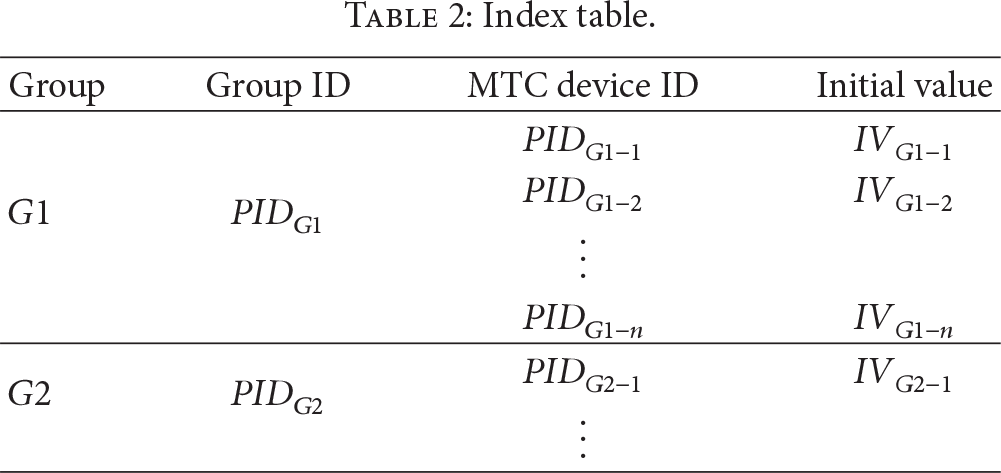
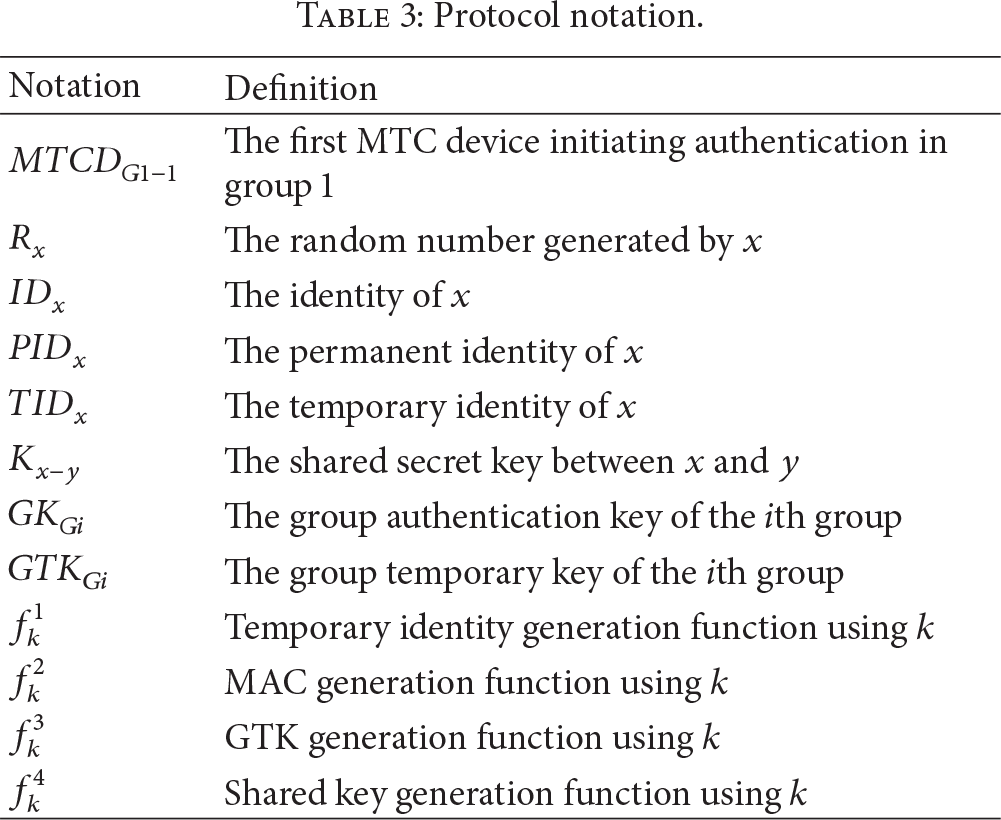
In the group initialization phase, each MTC device has a permanent ID (PID), such as international mobile subscriber identification number (IMSI). This PID is a long-term private identity that identifies MTC device and should be installed in the MTC device by the supplier in order to allow the MTC device to register in a 3GPP network. At the same time, we assume that each MTC device has preshared a secret key with 3GPP CN, and these MTC devices form several groups based on certain principles, and then the supplier provides a group key (GK) to each group for authentication. As shown in Table 2, we create an index table to manage information of MTC devices and group; the index table contains fields of group identity, MTC device identity (PID) for each MTC device, and initial values. Table 3 is the protocol notations used in this paper.
Index table.
Protocol notation.
3.2. Authentication Data Distribution
Let
Step 1.
Step 2.
AP sends an EAP Request/Identity message to require the identity of
Step 3.
Upon receiving the EAP Request/Identity message sent by AP, firstly, the 



Step 4.
Step 5.
When the HSS receives authentication data request message containing
If verification passes, the HSS derives
Step 6.
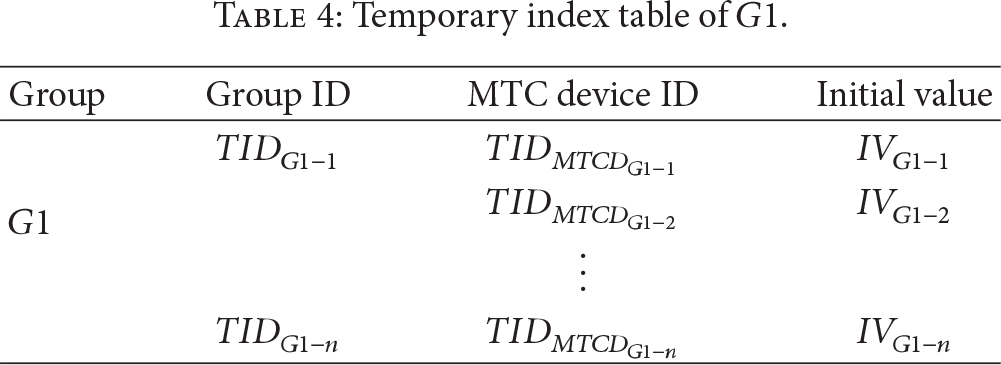
At the moment, the HSS also computes all temporary identities of the devices in group 1 and generates a temporary index table (as shown in Table 4) of group 1; then the HSS sends
Temporary index table of
Step 7.
The AAA server receives and stores
3.3. Mutual Authentication and Key Agreement
Step 8.
The AAA server generates 
Step 9.
The AAA server generates

Step 10.
After receiving Firstly, then,


Step 11.
If verification is successful,
Step 12.
Step 13.
When the AAA server receives
Step 14.
The AAA server sends
Step 15.
The AP verifies whether received
Step 16.
Through decryption,
At this point, the full authentication and key agreement procedure for one MTC device is completed. The procedure is shown in Figure 2.
When other MTC device in the same group want to access the 3GPP CN, the AAA server performs mutual authentication and key agreement with
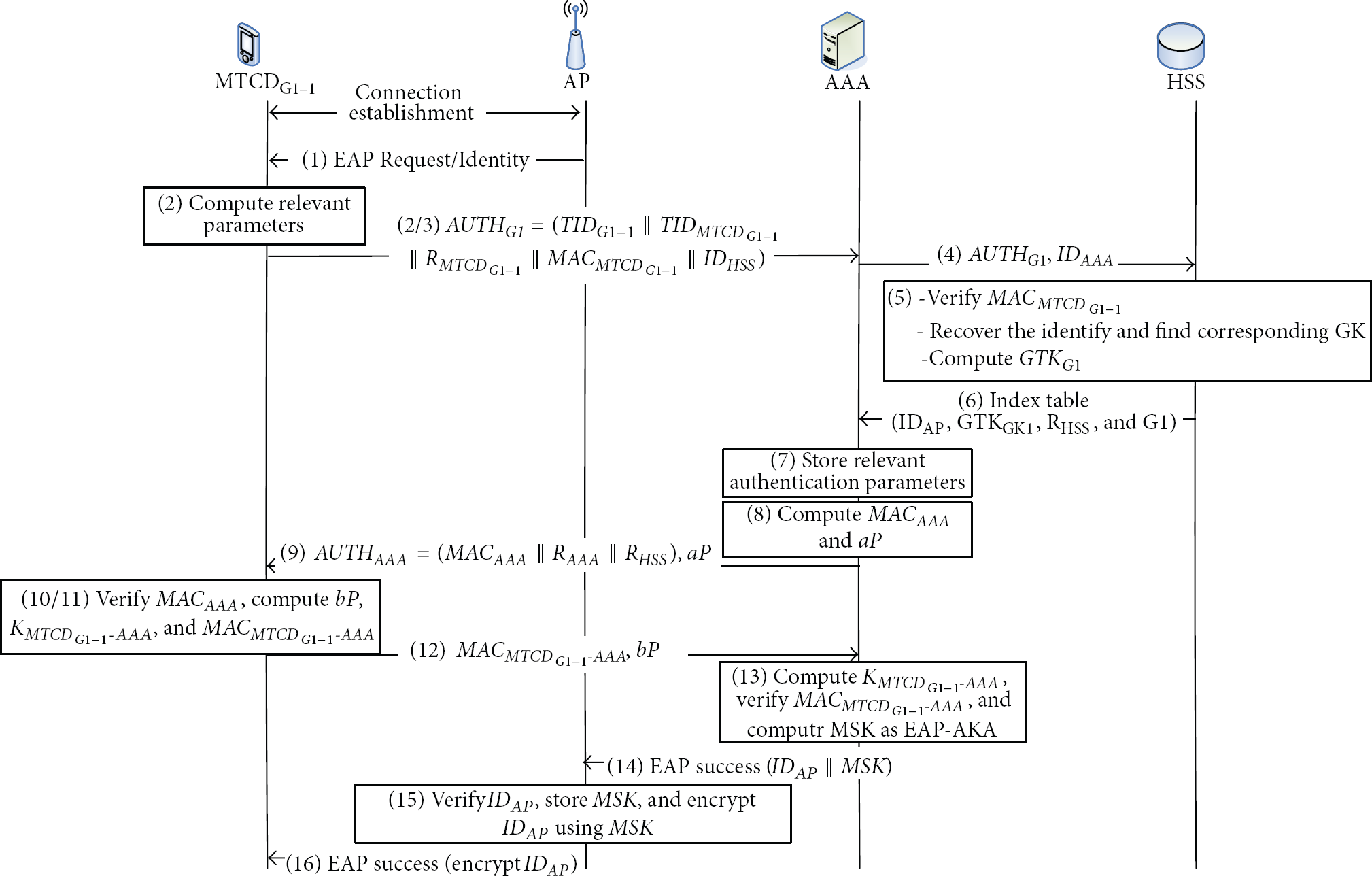
Authentication procedure of the first MTC device in our proposed protocol.
Step 3*. Upon receiving EAP request/identity message by AP, similarly, the 

Step 4*.
Step 5*. The AAA server begins to perform mutual authentication with
The remaining steps are similar to
The other MTC devices perform the authentication and key agreement procedures similar to
4. Security Analysis
In this section, both security analysis and formal verification implemented by the AVISPA tool are conducted to show that the proposed protocol can work correctly to achieve security properties.
4.1. Security Property
In Table 5, we compare our proposed EG-AKA protocol with the other main AKA protocols: Mun's protocol [26], EAP-AKA [17], EAP-TTLS [18], EAP-PEAP [19], EAP-LEAP [20], and EAP-SPEKE [21]. The comparison results demonstrate that our protocol can provide the most comprehensive security performance compared to the other AKA protocols. Providing group access authentication and heterogeneous network access are the two main advantages of our protocol. In particularly, our proposed protocol meets the following security properties.
Comparisons of properties among the EAP-based AKA protocols.

Protect User and Group Permanent Identity. In our protocol, PID cannot be got by attackers. The reason is that the MTC device generates the TID by using the
Secure against Man-in-the Middle Attack. In our proposed protocol, only the MTC devices and HSS can obtain real ID information of the devices and the group from encrypted temporary ID information. An attacker cannot derive and modify this information. The AP receives the EAP Success message with
Secure against Replay Attack. In our protocol, random numbers
Resistance to Impersonate Attack. Note that, in our protocol, all the MTC devices of a group share a common GTK. If an MTC device, without loss of generality, suppose that
Perfect Forward Secrecy (PFS). Our protocol utilizes ECDH to provide PFS between the MTC device and the AAA server. While generating
Provide Mutual Authentication and Key Agreement. We can verify that the proposed protocol can provide a successful mutual authentication between MTC devices and the 3GPP CN by formal verification described in the Section 4.2. Key agreement includes two parts: (a) between the MTC device and the AAA server: the key agreement between the MTC device and the AAA server can achieve through ECDH with symmetric key, and the MTC device and the AAA server can share a secret key
4.2. Formal Verification
The primary goal of our proposed protocol is to provide mutual authentication and key agreement services between MTC devices and the 3GPP CN. We tested our protocol using formal security verification tool known as the “Automated Validation of Internet Security Protocols and Applications” (AVISPA) [31]. The AVISPA project aims at developing a push-button, industrial-strength technology for the analysis of large-scale Internet security-sensitive protocols and applications. This technology will speed up the development of the next generation of network protocols, improve their security, and therefore increase the public acceptance of advanced, distributed IT applications based on them. AVISPA will achieve this by advancing specification and deduction technology to the point where industry protocols can be specified and automatically analyzed. A central aim of the project is then to integrate this technology into a robust automated tool, tuned on practical, large-scale problems, and migrated to standardization bodies, whose protocol designers are in dire need of such tools. In the AVISPA tool, protocols are specified using the High Level Protocol Specification Language (HLPSL for short). Then, the HLPSL specification is translated into an Intermediate Format which is used by the various verification tools embedded in AVISPA. We use On-the-fly-Model-Checker (OFMC) and SAT-based model checker (SATMC) to text our EG-AKA protocol. The authentication goals that we need to verify are shown in Figure 3. The output of the model checking results are shown in Figures 4 and 5. We can conclude that the proposed protocol can accomplish the goal of mutual authentication, and it can resist those malicious attacks such as replay attacks, MitM attacks, and secrecy attacks under the test of AVISPA using the OFMC back-end and SATMC back-end.
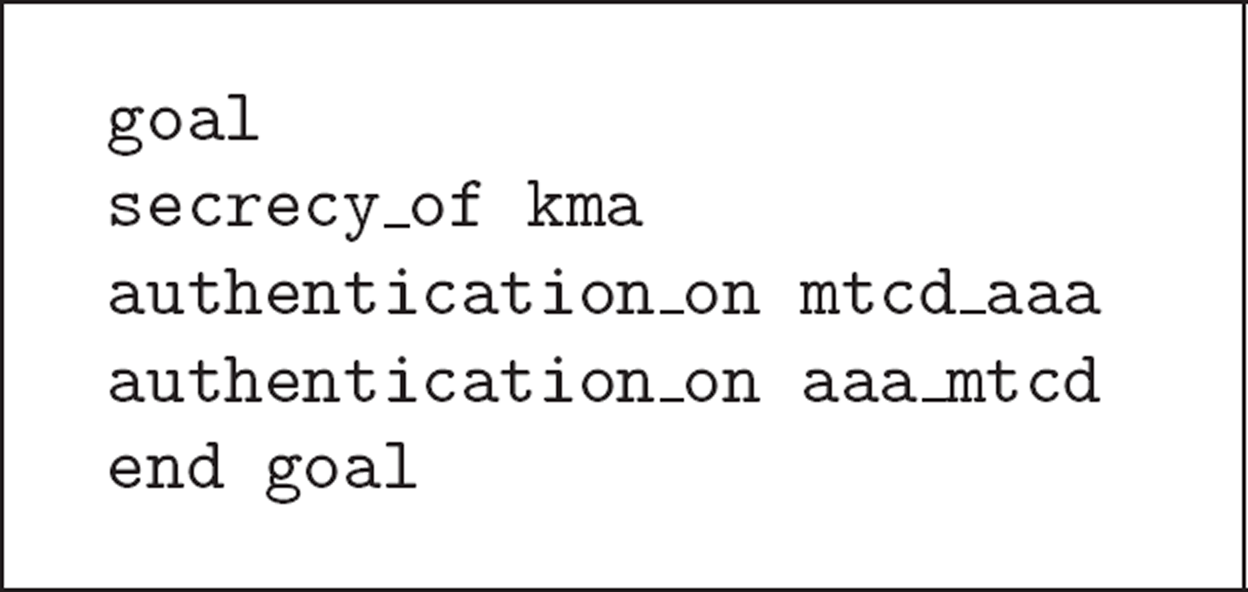
Analysis goals of the model.

Results reported by the OFMC back-end.

Results reported by the SATMC back-end.
5. Performance Evaluation
In this section, we give a detailed performance evaluation of the proposed protocol from the signaling overhead and the transmission cost point of view.
5.1. Signaling Overhead
In order to evaluate the signaling overhead, we consider the following scenario: the number of MTC device is n, and the number of group is m. Suppose that each MTC device launches x (re)authentications. For EAP-AKA, authentication procedures performed by an MTC device require the total number of signaling messages which grows linearly with x. In EAP-AKA protocol, there are 12 signaling messages for one complete authentication procedure. Thus, the number of signaling message of a MTC device is

Comparison of the number of signaling messages of several EAP-based protocols.
5.2. Bandwidth Consumption
In order to analyze the bandwidth consumption, we assume that x AVs are transmitted every time the HSS successfully authenticates one ME, and there are n MTCDs forming m group. Without loss of generality, Table 6 shows the setting of parameters for evaluating bandwidth consumption.
Setting of parameters.

The bandwidth consumption of AKA protocols are as follows, where Bandwidth analysis of EAP-AKA: the sizes of authentication messages are calculated as follows:
The overall bandwidth consumption for n devices is calculated as Bandwidth analysis of Mun's scheme: the sizes of authentication messages are calculated as follows:
The overall bandwidth consumption for n devices is calculated as Bandwidth analysis of EG-AKA: the sizes of authentication messages are calculated as follows:
Consider
where



The overall bandwidth consumption for n devices is calculated as
Figure 7 shows the bandwidth consumption of several AKA protocols, when the number of the MEs is different. From Figures 7(a) to 7(d), we can see that the bandwidth consumption of our EG-AKA protocol is much better than that of EPS-AKA and Mun's scheme. Meanwhile, our EG-AKA protocol can provide much better security compared to the other protocols.
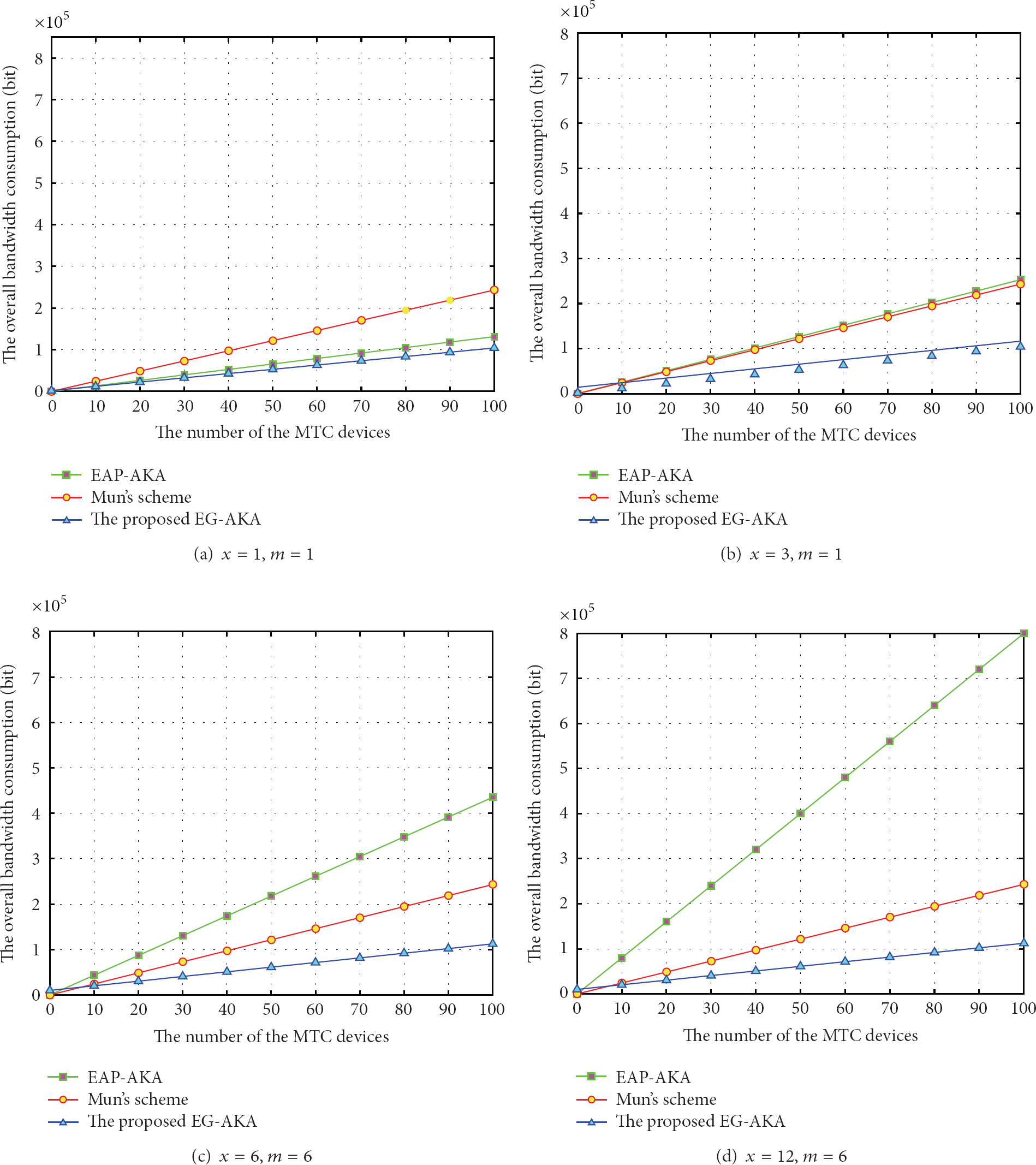
Comparison of the bandwidth consumption of several EAP-based protocols.
5.3. Transmission Cost
In order to evaluate the transmission cost, assume that energy dissipated during 1-message transmission between MTC device and HSS is
Since the other EAP-AKA based protocols only enhance the security aspect and the procedure of signaling mode is the same as the traditional EAP-AKA protocol, we only compare our proposed protocol with the traditional EAP-AKA protocol. We consider the following two case as shown in Figure 2 in our proposed protocol:
the AAA server has to fetch the fresh authentication vector form the HSS; the AAA server already has the fresh authentication vector.
In case (a), there are 4 messages between the MTC device and the AAA server, and there are 2 messages between the AAA server and HSS during one authentication procedure. The communication cost of our proposed protocol in this case is

In case (b), since the AAA server already has the fresh authentication vector, it does not need to communicate with the HSS anymore. Thus, the communication cost of our proposed protocol in this case is

Similarly, in the EAP-AKA protocol, there are 8 messages between the MTC device and the AAA server, and there are 2 messages between the AAA server and HSS during one authentication procedure. Therefore, the communication cost of the EAP-AKA protocol in case (a) is


Suppose that the AAA server fetches n authentication vectors during the authentication procedure. The average communication cost of the proposed protocol is

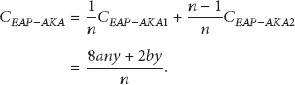


Comparison of the
6. Conclusion and Future Work
In this paper, we propose a group authentication and key agreement protocol for MTC device under the EAP framework, named EG-AKA. To the best of our knowledge, there is no protocol in the current literature that handles specific group access authentication for non-3GPP MTC. The proposed EG-AKA protocol not only enhances security on the basis of Mun's protocol, but also design specific group authentication mechanism for MTC. Formal verification and security analysis show that the proposed protocol is secure and fulfill its design goals. Detailed evaluations of performance illustrate that the proposed protocol achieves better performance in terms of transmission and signaling overhead compared with several existing protocols. In our future work, we will consider more practical group authentication protocol based on symmetric cryptography for resource-constrained devices in heterogeneous networks.
Footnotes
Appendix
For more details see Figure 9.
Acknowledgments
This work is supported by China Scholarship Council and the National Natural Science Foundation of China under Grant no. 61170261.