




Abstract
Most of the traditional wave energy converters are of a single oscillation structure, which leads to difficulties in sealing and installation. Based on the technological status of disc-type permanent magnetic coreless generator (DPMCLG) and long-stroke tape-type spring, a small scale wave energy extracting structure which can be completely sealed and work under the principle of double oscillation is proposed in this paper. By building a double oscillating model of the structure, the time domain differential equations and an equivalent circuit scheme are drawn, from which a phase-space solution by phase method is derived. Based on the solution, the performance of the structure is compared with that of single oscillating structure. The conclusion is that the double oscillating structure has a wider period range and higher power response for wave extraction, as well as the protection of power generator from damage in storm conditions.
1. Introduction
The enthusiasm towards the exploitation of renewable energies has prompted a significant interest in wave power so that various structures have been invented, among which the point absorber is an excellent approach for its simple mechanism, easy fabrication, and point absorption effect. The point absorption method usually aims for large capacity power systems, so such components are adopted as permanent magnets, linear generator, and buoy and anchor [1–8]. Anchored or stationary components work with floating components to extract as much power as possible. However, there are some problems for this type of structure. (1) It is difficult to encapsulate electric devices with relatively moving parts in ocean conditions. (2) Because of a large rating power, conventional linear generators often have considerable cogging force, and thus they are incapable of working in small waves. (3) To meet the requirements of buoy stroke, many permanent magnets should be used in linear generator. (4) Buoy's direct driving generator can enhance wave conversion ability, but it is vulnerable to rough weather conditions. For small-capacity wave power systems, these drawbacks are unacceptable. In this paper, one wave power structure completely encapsulating the relatively moving parts is proposed to overcome these defects. The structure is a vibration pick-up device or double oscillating structure which has been applied in micropower harvesting system. For example, there are vibration generators based on piezoelectric effect and voice coil generators based on Faraday's law [9, 10]. Both generators harvest vibration energy for sensors. There is a similar device used to collect shaking energy of vehicle, which works well in high frequency conditions [11]. For low frequency conditions such as marine gravity waves, particular study is required. Lancaster's project FROG and PS FROG had played a pioneer role here by their two reactionless ocean wave energy converters, along with many materials about the design and performance evaluation [1, 8, 12, 13]. Project called ISWEC from Politecnico di Torino employs gyroscopic principle to achieve the similar goal [14, 15]. Being different, the paper tries to propose another realization and emphasis on performance comparison in various periods for double oscillating and single oscillating structures.
2. Structure
For analysis convenience, stoppers are neglected, though they are indispensable in reality. Therefore, the structure analyzed consists of three major parts (Figure 1).
Outer body: taking a form of vertical cylinder and working as a floater in water.
Inner body: working as oscillator moving vertically within the structure.
Tape spring for generator: tape spring connects outer body and inner body with an appropriate stiffness and concentrically couples a disc-type permanent-magnet coreless generator (DPMCLG) [16]. Both spring and generator rotate synchronously. The tape spring supports the inner body against gravity when the structure is at rest.

Double oscillating structure.
The operation principles of the structure are as follows.
When excited by waves, the outer body moves vertically.
Because of inertia, the inner body lags behind the outer body. Hence there is relative motion.
The relative motion revolves the tape spring, and the energy is absorbed by the coaxial generator.
Advantages of the structure are as follows.
The motion of generator and oscillator is within the chamber, so a totally sealed structure is available.
The tape spring is characterized by long stroke and small elastic coefficient, which enables inner body to work in a state of near weightlessness maximizing the absorption of vibration energy [17].
Compared with most other types of PM generators, DPMCLG suffers little cogging force and is suitable for small wave.
The tape spring with long stroke and small elastic coefficient finds mature application in lifting gear and DPMCLG in wind power generation.
3. Assumptions and Physical Model
For analysis convenience, the following assumptions are made. (1) There is full space for the inner body to move. (2) Friction between mechanical components is small enough. The system can be simplified to a double oscillating model as shown in Figure 2.

Simplified model of double oscillating structure.
4. Mathematical Model
4.1. Differential Equations
The resultant force acting upon the inner body is a summation of spring force, gravity, friction, and electromagnetic force, and that upon outer body is a summation of buoyancy, gravity, spring force, friction, and generator electromagnetic force. According to Newton's second law, the dynamic differential equations for the oscillating model can be written as

where m t = (m1 + m2 + m a ), and fexc is the wave excitation force. In reality, hydrodynamic parameters r1 and m a depend on wave frequency.
4.2. Equivalent Scheme
The dynamic equations of double oscillating system can be expressed in circuit scheme just as Figure 3 demonstrates. To make a comparison, the equivalent scheme for single oscillating structure is shown in Figure 4 [18]. It is clear that both structures have a topology like a band-pass circuit. Compared with single oscillating structure, the double oscillating structure is more complicated; hence there is a wider range for regulation.

Equivalent scheme of dynamic equations for double oscillating system.
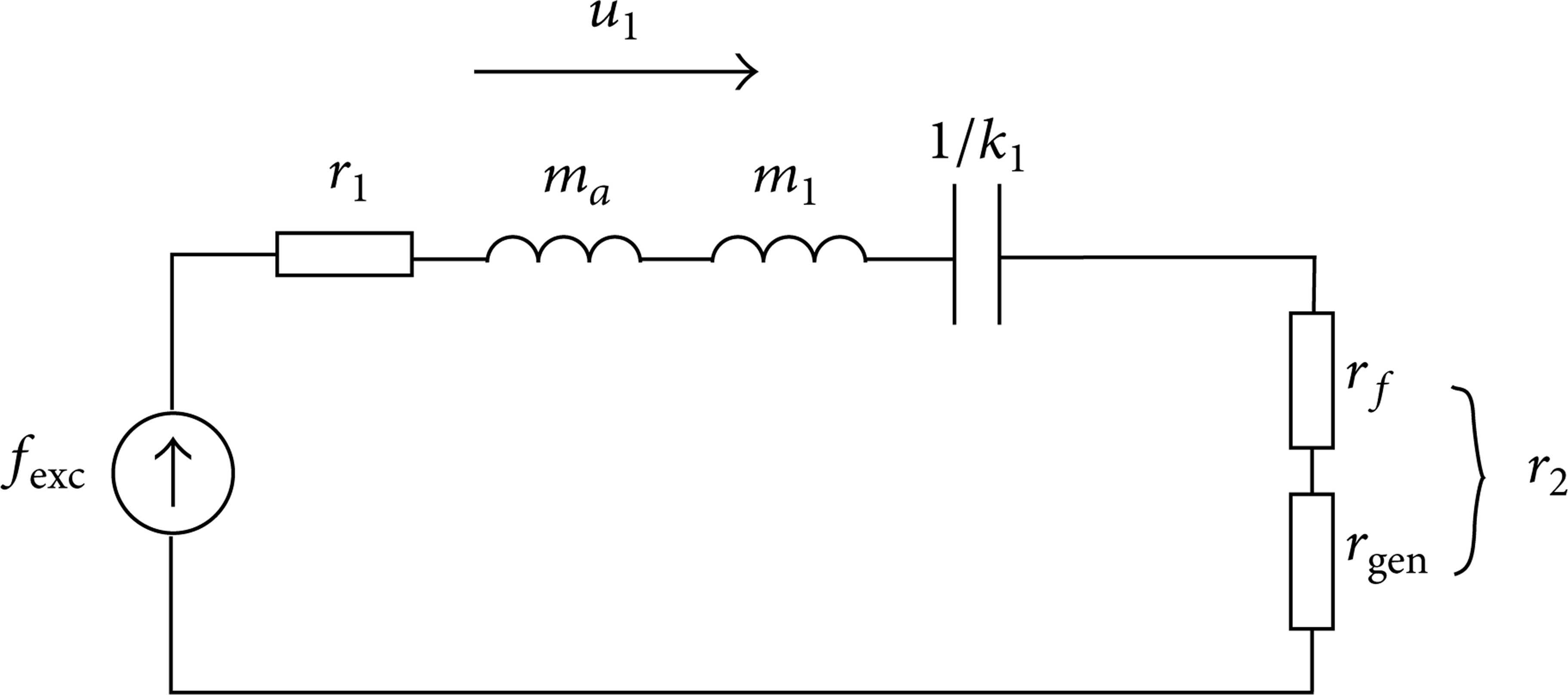
Equivalent circuit of dynamic equations for single oscillating system.
4.3. Phase Equations and Solution
For a monochromatic wave, water surface levitation can be expressed as follows:

When the size of the structure is small enough compared with the wavelength, the wave excitation force fexc can be approximately expressed according to linear wave theory as follows:

The excitation force can be transformed into phase form by adding hat to variables; that is,

Based on research from [18–20], the heave hydrodynamic damping and added mass for vertical cylinder can be expressed as r1 = 2πωρa3∊33/3, m a = 2πρa3μ33/3, where ∊33 and μ33 are corresponding nondimensionalised coefficients, and if concentrating only on difference with single oscillating structure, constant values would bring benefits, so pick values with ∊33 = 0.08, μ33 = 1.125 for both structures. Thus, like the excitation force, the equations for system can be written as phase form accordingly:

where i = SQRT (−1). The solution for the linear phase equations can be easily deduced as follows:

For comparison, the phase solution for single oscillating structure is as follows:

The corresponding displacement and power can be calculated as follows:

5. Computation and Discussion
5.1. Model Parameters
The system is designed under the condition that the resonating period T w = 2 s, wave height H w = 0.4 m, generator power Pgen = 150 W, and damping r2 = 500 kg/s. The radius of the structure a is equal to 0.25 m. The parameters for double and single oscillating structure are listed in Tables 1 and 2, respectively. The k2 and m2 are absent in Table 2, and the m1 equals the total mass of Table 1.
Parameters of double oscillating model.

Parameters of single oscillating model.

5.2. Performance with Different Wave Period
The power absorption, max. velocity amplitude, and max. displacement amplitude of two structures under different wave periods are compared by computation according to expressions (8∼12). The curves are in Figures 5, 6, and 7. First, the max. absorption power is about 150 W which is close to the designation for the single oscillating structure, while the double oscillating structure has a value of 220 W, which is about 1.5 times of the designation. Secondly, the period when max. power absorption happens is about 2 s for single oscillating structure, with a value of 2.4 s for double oscillating structure. Thirdly, suppose that there is a goal of contributing power of at least 100 W; the structure with single oscillation can only work in a range from 1.5 s to 2.6 s, while the double oscillating system can work in a wider range that is from 0.6 s to 2.7 s. All of these illustrate that the double oscillating structure can be smaller, lighter, and easier for control than single oscillating system with the same designing wave period scope and power demand. Finally, the response of the double oscillating system decays more quickly than that of the single one, which is useful in the protection of generator under extreme weather conditions because large wave period means high wave in general.

Generator power-wave period for two systems.

Speed amplitude-wave period for two systems.

Displacement amplitude-wave period for two systems.
5.3. Performance with Different k2
The special performance of double oscillating system derives from the parameter k2. The calculation results concerning performance of the double oscillating system with different value of k2 are shown in Figures 8 and 9. It can be seen that the double oscillating system keeps its band-pass feature well. The period for max. response increases from 1.5 s to 2.3 s as k2 increases from 200 N/m to 2600 N/m. When k2 is larger than 2000 N/m, there is a saddle point at 1.5 s, and the max. response at 2.3 s increases rapidly. As k2 increases, the scope of response narrows and max. value increases sharply.
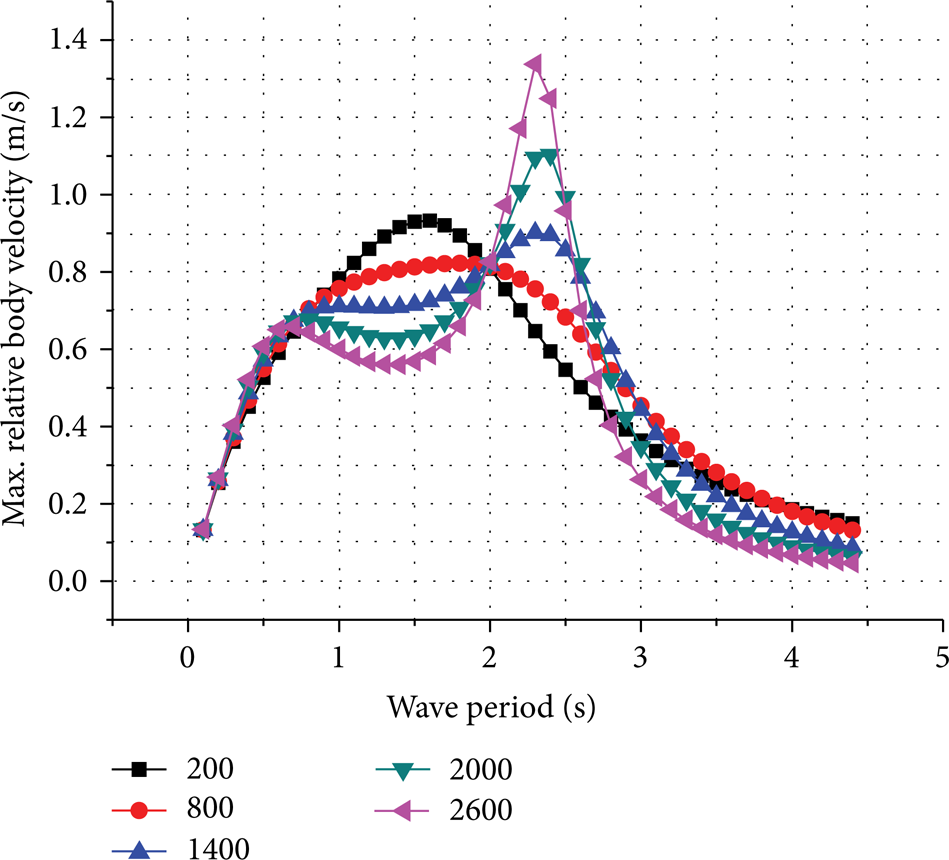
Relative speed amplitude-wave period for double oscillating system with different k2.

Relative displacement amplitude-wave period for double oscillating system with different k2.
6. Conclusions
The double oscillating structure is proposed to solve the main problems of the single oscillating structure. The structure is modeled and analyzed by mathematical equations. According to the case given in the paper, the double oscillating structure has shown an advantage in wider wave range and rougher wave conditions. Furthermore, the double oscillating structure may reduce sealing and installation cost comparing with the single oscillating structure. However, to bring the structure into practice, there are many problems remaining to be solved. Firstly, the structure needs a more accurate model to explore its behavior more exactly by taking into account the nonlinear parameters that were simplified for comparison convenience here. Moreover, the design of the structure needs proper tape spring and generator, and the mechanical support needs further research.