




Abstract
Recently, machine-to-machine (M2M) communication has been studied in the single cell system. However, in themulticell system multiple M2M type devices at the edge of a cell may suffer from the strong interference that consists of the intercell interference from other cells and the intracell interference from other M2M devices in the local cell. In this paper, we study the relay beamforming strategy to guarantee the quality of service (QoS) requirements of the multiple destination devices in multicell systems. We minimize the transmit power of the base stations (BSs) and relays to save the power of M2M devices, while guaranteeing the receive signal-to-interference-and-noise ratio (SINR) of the destination devices. The main contribution of this paper is that we propose an iterative algorithm to jointly optimize the BS and relay beamforming weights with minimizing the BS and relay power under the receive SINR constraints in the perfect channel state information (CSI). Using the semidefinite relaxation (SDR) technology, the optimization problems for the BS and relay beamforming weights can be effectively solved. In addition, we also discuss the issue of imperfect CSI in practice. Simulation results validate our theoretical analysis and demonstrate that our proposed iterative scheme can achieve near-optimal performance within a few iterations.
1. Introduction
Recently, machine-to-machine (M2M) communication has been studied by many standards as the European Telecommunications Standards Institute (ETSI) [1] and 3rd Generation Partnership Project (3GPP) [2, 3]. Machine-type communication devices, such as smart meters, automotive applications, and smart phones, can communicate in M2M systems, which do not necessarily need human intervention [4]. According to the 3GPP standards, the base station (BS) can be used to manage the M2M devices and many BSs can divide the M2M devices into multiple cells [5]. The M2M devices communicate with each other through the BS in the cell system [6].
To offer the high data-rate for the M2M systems, multiple-input multiple-output (MIMO) antenna systems can increase the channel capacity for given transmit power and bandwith in previous studies [7]. However, the performance of MIMO systems may degrade due to correlated signals among antennas and cannot offer high coverage in large areas for M2M devices. Recently, many literatures research on the relay devices to guarantee the quality of service (QoS) requirements of the destination devices [8]. The BS transmit signals to the destination devices with the help of one or more relay devices in wireless M2M networks in Figure 1.
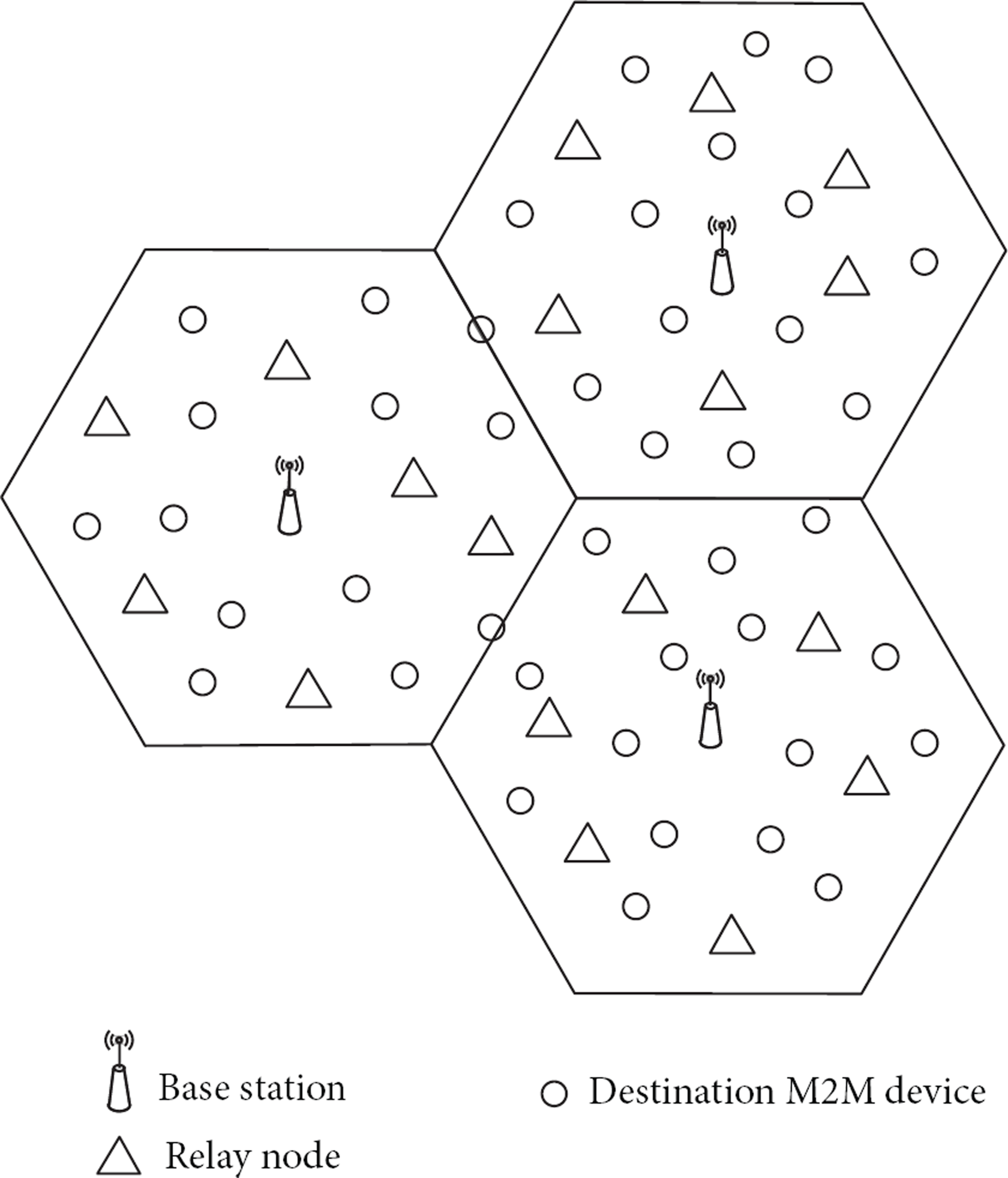
The wireless multicell M2M system.
In general, there are three types of relay schemes, including the amplify-and-forward (AF) [9], decode-and-forward (DF) [10], and compress-and-forward (CF) [11] schemes. In the AF scheme, relay devices receive the signals transmitted from the source and forward the amplified signals to the destinations. In the DF scheme, relay devices decode and reencoded the received signals to the destinations. In the CF scheme, relay devices send quantized and compressed signals to the destinations. Among them the AF scheme is the most attractive for the M2M relay communication due to its low implementation complexity. With the aid of channel state information (CSI), relay devices can be designed to work collaboratively to guarantee the QoS requirements by forming a virtual beamforming system [12, 13].
Most existing contexts have studied relay beamforming strategies in a single cell. Relay strategies in sensor networks with minimum mean square error (MMSE) performance are designed in [8], which is subject to local and global relay power constraints, respectively. Elkheir et al. [14] presented an M2M relay communication scheme, which is subject to the total relay power under specific performance constraints and the individual power of each relay. Wang et al. [15] proposed the iterative strategies to jointly optimize the source antenna selection and the collaborative relay beamforming weights in wireless M2M networks. Li et al. [16] proposed two algorithms with random user scheduling and greedy user scheduling in maximizing the achievable user number by dynamical power assignment in the cellular system. Chen et al. [17] considered signal transmission with the aid of multiple half-duplex single-antenna relay nodes using the AF strategy for a multiuser wireless M2M communication system and proposed two suboptimal relay beamforming schemes that only require local CSI to minimize mean square error (MSE) for all the users with nonorthogonal channels. Zheng et al. proposed the relay beamforming schemes that achieve maximum the received signal-to-noise ratio (SNR) for a single destination under both total and individual power constraints with the aid of perfect CSI [18] and imperfect CSI [19]. In addition, Choi investigated the distributed beamforming for AF relay nodes when a consensus algorithm was employed for cooperative beamforming in [20] and the minimum mean square error (MMSE) criteria were used in [21]. Nguyen et al. studied the relay beamforming schemes to minimize the total relay power in a multiple AF relay network with multiple source-destination pairs under the signal-to-interference-and-noise ratio (SINR) [22] and SNR requirement [23] at each destination, respectively. However, in the multicell system destination devices at the edge of a cell may suffer from the high signal attenuation, as well as the strong interference that consists of the intercell interference from other cells and the intracell interference from other M2M devices in the local cell. In such a case, coordination multicell processing of the BSs and relay devices in adjacent cells is needed to cope with the severe intercell and intracell interference [24, 25].
In this paper, we study the collaborative relay beamforming for multiple M2M destination devices which suffered intercell and intracell interference in the multicell systems. The relay devices can coordinately form virtual beams to transmit beamforming signals from a BS towards multiple destination devices in the AF scheme. Due to the power limitation of the M2M devices, we optimize the BS and relay beamforming weight with minimizing the BS and relay power to guarantee the receive SINR for multiple destination devices with the aid of perfect CSI. We propose an iterative scheme to jointly optimize the BS and relay beamforming weights to deal with the severe intercell and intracell interference for multiple destination devices in the multicell system. Using the semidefinite relaxation (SDR) technique [26], we show that the optimization problems for the BS and relay beamforming weights can be converted into semidefinite programming (SDP) problems, which can be effectively solved by interior-point methods.
The rest of this paper is organized as follows. In Section 2, we describe a multicell system model with multiple destination devices in each cell which suffered from the intercell and intracell interference. Sections 3 and 4 optimize the BS and relay beamforming weights to minimize the BS and relay power under the receive SINR constraints, respectively. Then, we propose an iterative scheme to jointly optimize the BS and relay beamforming weights to deal with the severe intercell and intracell interference for multiple destination devices in Section 5. Simulation results are presented and discussed in Section 6. The issue of imperfect CSI is discussed in Section 7. Finally, conclusions are drawn in Section 8.
Notation.
Vectors are written in boldface lowercase letters, for example,
2. System Model
In this section, we describe a multicell system with L separate cells. In each cell, there are one BS with
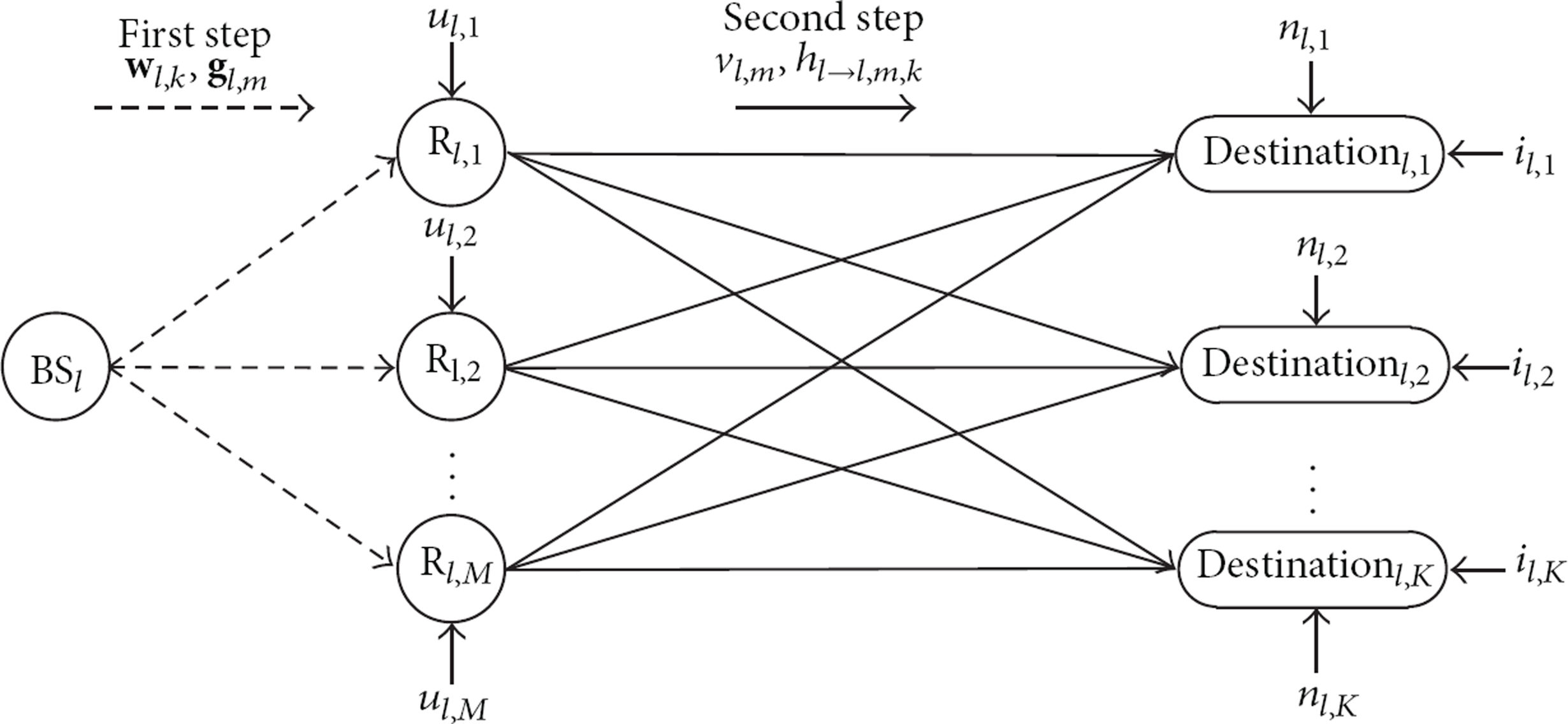
The system model of the lth cell with multiple destinations in multicell systems.
In Figure 2, we consider the two-step AF relay protocol. In the first step, the lth BS broadcasts the K destinations' signal
Thus, during the first step, the relay device m in the lth cell receives the signal

Then, during the second step, the transmitted signal by the mth relay devices is


3. Minimum BS Power with SINR Constraints
In this section, we optimize the BS beamforming vectors to minimize the BS power in the multicell system under the destinations' SINR constraints. The lth BS total transmit power is


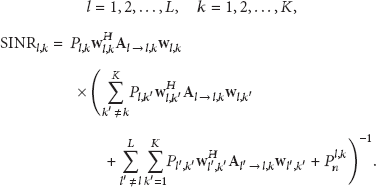
The SINR at the kth destination in (4) can be rewritten as (11), where
Thus, Problem (10) can be formulated as


The SDP problem in (14) can be solved by using interior-point methods. According to [28], the computational complexity of Problem (14) is
The solution of Problem (14) provides a lower bound on the objective function in the original problem (13) due to excluding the rank-one constraint. However, in our extensive simulations, we have never observed that the optimal solution of Problem (14) has a rank higher than one. Thus, the original problem in (13) can be optimally solved. The similar observation was also reported in [29] to design the optimal beamforming schemes. For the cases where the solution of Problem (14) has a rank higher than one, several randomization techniques [30] can be used to provide a good approximate solution
4. Minimum Relay Power with SINR Constraints
In this section, we optimize the relay beamforming weights to minimize the relay power with guaranteeing the receive SINR in the multicell system. Due to the power limitation of the M2M relay devices, the relay power is important to be minimized. The total relay power in the lth cell is given by


Thus, we can formulate the optimization problem as

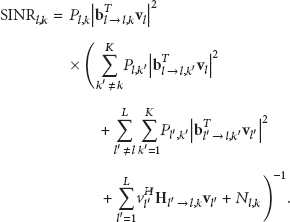
The receive SINR at the kth destination in (4) can be rewritten as (18), where


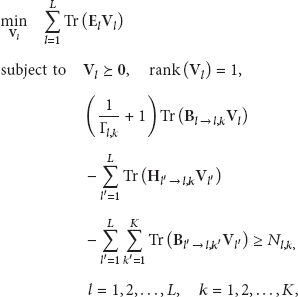

In our extensive simulations, we also have never observed that the optimal solution of Problem (22) has a rank higher than one. This means that the optimal solution of Problem (22) is also optimal for the original problem in (17). If the solution of Problem (22) has a rank higher than one, we can also use the randomization techniques [30] to provide a good approximate solution
5. Iterative Algorithm
Based on the previous results, we propose an iterative scheme (see Algorithm 1) to jointly optimize the BS and relay beamforming weights to minimize the BS and relay power with guaranteeing the receive SINR in the multicell system. This proposed algorithm firstly optimizes the BS beamforming vector according to the current relay beamforming vector. Then the relay beamforming vector is optimized on the basis of the current BS beamforming vector. Circulate the above two steps, until the total relay power is sufficiently close to a fixed point or the iteration number exceeds a predetermined number. The details of Algorithm 1 is in the following.
(1) Initialize the relay beamforming weights (2) Using current relay beamforming weights, optimally solve Problem (14) to get the update BS beamforming weights. (3) If Problem (14) is feasible, then obtain the optimal solution (4) (5) Obtain the BS beamforming vector (6) (7) Obtain the BS beamforming vector (8) (9) Optimally solve Problem (22) with current BS beamforming weights to get the update relay beamforming weights. (10) If Problem (22) is feasible, then obtain the optimal solution (11) (12) Obtain the relay beamforming vector (13) (14) Obtain the relay beamforming vector (15) (16) If the total relay power a predetermined number, then stop the iteration and go to Step 17. Otherwise go back to Step 2. (17)
According to [28], the computational complexity of Algorithm 1 is
6. Simulation Results
In this section, we present simulation results to validate the performance of our proposed iterative scheme for multiple destination M2M devices in a multicell system. It is assumed that the flat-fading channel coefficients
In Figure 3, we show the total relay power
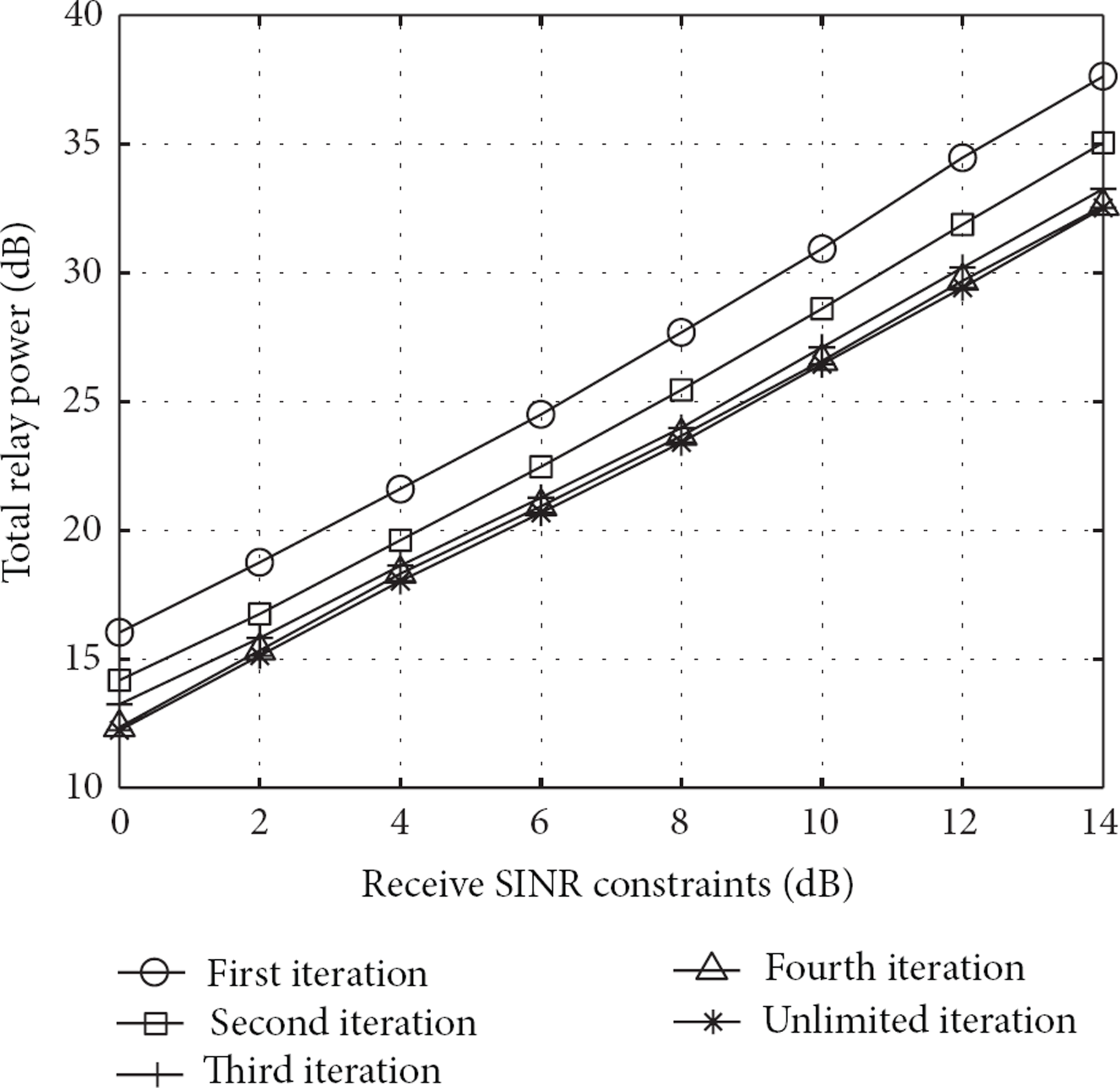
Expected total relay power of our proposed scheme for multiple destinations in the multicell system.
In Figure 4, we compare our proposed algorithm with the relay beamforming algorithm in [32]. Note that Ubaidulla and Chockalingam [32] only consider the single-user case in a single cell system (without considering the intercell interference). The scheme in [32] can be seen as a special case of our proposed scheme. For convenience, we assume that there are
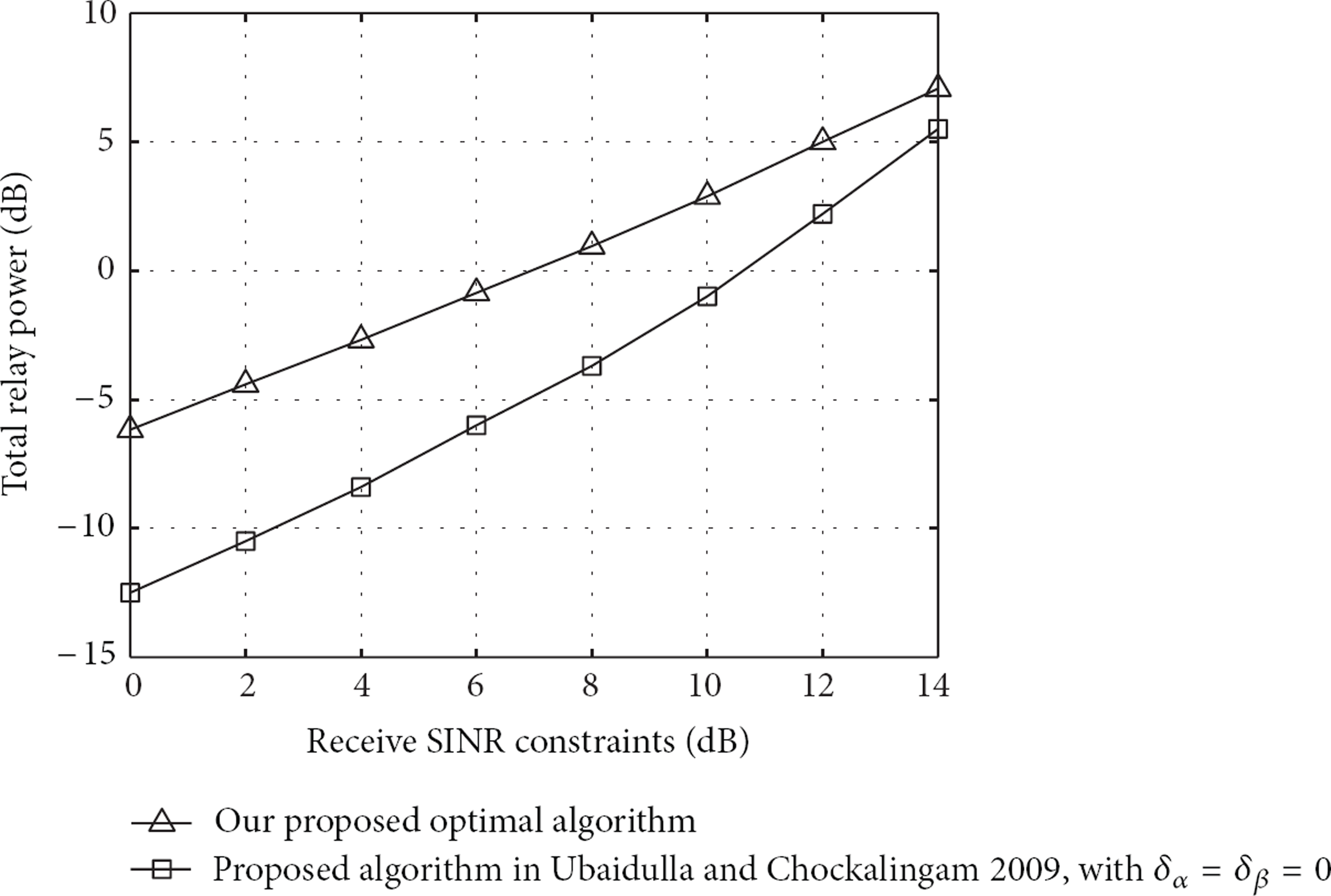
Comparison with one destination in single cell system.
Figure 5 shows the total relay power of our proposed iterative algorithm to jointly optimize the BS and relay beamforming weights for multiple destinations in various scenarios of multicell systems. We simulate three scenarios of multicell systems, where

Expected total relay power of our proposed scheme for various scenarios in multicell systems.
7. Discussion
In the above results, the perfect CSI at relay and destination devices is essential for our proposed iterative algorithm. Thus, the perfect CSI from the BSs to relays and from relays to the destinations needs to feedback to the central processor calculating the BS and relay beamforming weights. This becomes a drawback of the proposed relay-aided transmission schemes in practice wireless M2M networks, which will decrease frequency efficiency and could be costly if the number of relays and users is large. If the channel estimate error exists or the capacity of feedback channel is limited, the central processor only knows the imperfect CSI. In order to overcome this problem in practice, Huang et al. [33] considered the orthogonal beamforming systems with limited feedback under the per user unitary and rate control (PU2RC) technology, where the beamforming weights are selected from a codebook of multiple orthonormal bases in the multiuser system. The concept of the PU2RC technology has been included in the LTE standard. We can use the PU2RC technology to our collaborative relay beamforming algorithm for wireless M2M devices in multicell systems to deal with the problem of the imperfect CSI, where the BS and relay beamforming weights can be selected from a codebook in the central processor.
As the relay devices are distributed, we can use the distributed relay beamforming strategies as in [18, 19] to reduce the CSI feedback to deal with the issue of imperfect CSI in practice. It is assumed that each relay device can learn the local CSI from the source by training and from destinations by feedback, respectively, and measure its noise level. Note that Zheng et al. [18, 19] proposed a distributed implementation algorithm with local CSI under SNR constraints based on the Karush-Kuhn-Tucker (KKT) analysis. Another distributed algorithm was proposed in [21, 34], which used MMSE criterion to construct distributed relay beamforming strategies. However, they focused on the distributed beamforming schemes for the single cell system. Choi [21] investigated the distributed beamforming strategies for the single destination in the multiple relay system and Verdu [34] developed the distributed beamforming strategies into the scenario of multiple destinations. The distributed algorithm for multiple destinations in the multicell system will be investigated in our future work.
8. Conclusion
In this paper, we proposed an iterative scheme to jointly optimize the BS and relay beamforming weights under the receive SINR constraints to cope with the strong inter-cell and intracell interference in the multicell systems. We minimized the BS and relay beamforming power, while guaranteeing the receive SINR for the multiple destination devices by using the SDR technology. We showed that the optimization problems for BS and relay beamforming weights can be converted into SDP problems, which can be effectively solved by interior-point methods. Simulation results demonstrated that our proposed iterative scheme can achieve near-optimal performance with only
Footnotes
Acknowledgments
The authors would like to thank the anonymous reviewers for their valuable comments that have helped improving the overall quality of the paper. This work has been supported by the Specialised Research Fund for the Doctoral Program of the Ministry of Education of China (Grant no. 20120001120125), and the National Natural Science Foundation of China (Grant nos. 61250001, 61231011, and 61231013).