




Abstract
The steady flow of Herschel-Bulkley and Casson fluids for blood flow in tubes filled with homogeneous porous medium with (i) constant and (ii) variable permeability is analyzed. The expression for the shear stress is obtained first by general iteration method and then using numerical integration; the solutions for velocity and flow rate are obtained. It is noticed that the shear stress and plug core radius are considerably higher in the case of variable permeability than those of the constant permeability case. The velocity and flow rate of both the fluids increase considerably with the increase in the permeability factor and they decrease with the increase in the yield stress of the fluids. The velocity and flow rate of Herschel-Bulkley fluid are considerably higher than those of Casson fluid. Aforesaid flow quantities are significantly higher for flow in tubes with variable permeability than for flow in tubes with constant permeability.
1. Introduction
The mathematical analysis of time independent flow of Newtonian and non-Newtonian fluid models has become a topic of increasing interest among the researchers, since it has wide applications in many branches of engineering and medical sciences such as polymer processing industry, environmental science, magnetohydrodynamics, and biofluid dynamics [1]. Blood is the major biofluid which behaves like Newtonian fluid when it flows through larger diameter arteries (arteries with diameter greater than 200 μm) [2, 3]. At low shear rates in small diameter arteries, the apparent viscosity of blood increases markedly and hence it exhibits remarkable non-Newtonian character [4, 5]. Merrill [6] reported that flow may cease in the presence of measurable stress implying that there is yield stress. At low shear rates, red blood cells aggregate in the form of rouleaux which are stacks of 6–10 red blood cells in the shape of roll of coins [7]. At some finite stress which is usually small (of the order
Porous medium is the material volume consisting of solid material with an interconnected void space and is primarily characterized by its porosity which is defined as the ratio between the void space and total volume of the medium [11–13]. The recent past studies on flow through porous medium used Darcy's law (linear relationship between the velocity distribution and pressure gradient across the porous medium) for mathematical modeling [14]. The porous medium is also characterized by its permeability which is the measure of flow conductivity in the porous medium [15]. Several researchers [16–19] analyzed the flow of Newtonian and non-Newtonian fluids in porous medium with application to industrial problems and biodynamics. When blood flows in arteries under some pathological conditions, the fatty plaques of cholesterol and artery-clogging blood clots are formed in the lumen of the coronary artery. The distribution of these fatty cholesterol and artery-clogging blood clots is deemed to be equivalent to a fictitious porous medium [20]. Hence, the segment of the artery which is homogeneously filled with these fatty cholesterol and artery-clogging blood clots is considered as the tube filled with the homogeneous porous medium. Since non-Newtonian behavior of blood in narrow arteries is remarkable and the passage of the artery is considered as homogeneous porous medium, the investigation on the blood flow through narrow arteries filled with the homogeneous porous medium is useful.
From the initial stage of the formation of plaques till it reaches the medium level of plaques (due to the deposit of fatty substances of cholesterol and clogging of blood clots) in the lumen of the coronary artery, the distribution of plaques in the passage of blood in the artery is considered as porous medium with variable permeability (varies in the radial direction). Once these plaques development passed over the medium level, the distribution of the plaques in the passage of blood in the artery is considered as porous medium with constant permeability [21].
The mathematical modeling of blood flow in narrow arteries, treating the narrow arteries as porous medium, was investigated by Song et al. [1] and they reported that the increase in the threshold significantly increases the frictional resistance. Casson fluid model and Herschel-Bulkley (H-B) fluid model are some of the non-Newtonian fluid models with finite yield stress which are widely used to model blood when it flows through narrow diameter arteries at low shear rates [6–8]. Dash et al. [20] studied the flow of Casson fluid in a pipe filled with a homogenous porous medium using the Brinkman's model and mentioned that blood flow in arteries is one of the major application areas to their study. Using the general iteration method, Dash et al. [20] obtained the numerical schemes for shear stress, velocity distribution, and flow rate and used them to plot the graphs for analyzing their results. To study the effects of the different kinds of porous medium, Dash et al. [20] considered two types of permeability in the porous medium such as (i) constant permeability and (ii) variable permeability. In the Dash et al. [20]'s paper, we found that there are significant differences between the data used by them for plotting the graphs and the actual data yielded by their respective expressions for the set of parameters mentioned in their graphs. Hence, we made an attempt to correct the graphs plotted by Dash et al. [20] and revise their analysis section. The steady flow of H-B fluid model in a tube filled with homogeneous porous medium was not studied by any one so far, to the knowledge of the authors. Hence, it is useful to develop mathematical models to study the steady flow of Casson fluid (through the revised solution methodology) and H-B fluid (new fluid model) in a circular tube filled with homogenous porous medium with (i) constant permeability and (ii) variable permeability.
The layout of this paper is as follows. Section 2 mathematically formulates the blood flow in narrow arteries filled with the homogeneous porous medium and obtains the numerical schemes for the flow quantities such as shear stress, velocity distribution, and flow rate. In Section 3, the variation of the aforesaid flow quantities of Casson and H-B fluid models for different values of the parameters are analyzed and compared. The main results are summarized in the concluding Section 4.
2. Mathematical Formulation
Consider an axisymmetric, laminar, steady, fully developed and unidirectional flow (in axial direction) of blood (assumed to be incompressible) in a narrow artery of radius

Geometry of segment of the narrow artery filled with porous medium.
2.1. Momentum Equation
Since the flow is considered as laminar in the axial direction, the radial component of the velocity is negligibly small, and hence, the radial component of the momentum equation is ignored in this study. The simplified form of axial component of the momentum equation governing the steady flow of blood in a narrow artery filled with homogeneous porous medium is given below [20]:

where

where

2.2. Constitutive Equations
The relationship between the shear stress


Equation (5) states the vanishing of velocity gradient in the region where the shear stress


We make use of the following boundary condition to get the expression for the velocity distribution

2.3. Nondimensionalization
Since the dimensions of the coefficient of viscosity of Casson fluid and H-B fluid are different (the dimensions of the coefficient of viscosity of Casson fluid and H-B fluid are M/LT and

The velocity and shear stress of H-B fluid are defined in terms of pressure gradient, viscosity, and radius of the tube as below:

where

Let us introduce the following nondimensional variables:

Using the above nondimensional variables in the simplified momentum equation (3) we obtain

Applying the above nondimensional variables in (4)-(5), one can get the following nondimensional form of the constitutive equations for Casson fluid:


Substituting the nondimensional variables (12) (with the help of (10) and (11)) in (6)-(7), we get the nondimensional form of H-B fluid's constitutive equations as below:

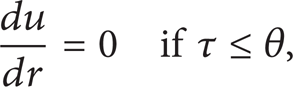
where

2.4. Solution Method
2.4.1. Shear Stress for Variable Permeability
The implicit integral equation (13) is solved for the shear stress distribution τ using the general iteration method. From (13), one can write the general iteration scheme for obtaining the analytical expression for shear stress as below:

As suggested by Dash et al. [20], for the variable permeability of the porous medium, the permeability function is chosen as

where ∊ is the preassigned error tolerance and we keep it as 0.000001. We start the iteration process with the initial guess of

where

Using (22) in (21), shear stress is computed at each nodal point in the radial direction. The plug flow radius r p is estimated approximately by matching the shear stress with the yield stress.
2.4.2. Shear Stress for Constant Permeability
In the case of constant permeability, where K(r) = K0, the integral equation (13) reduces to the following differential equation:

For this case, the appropriate boundary conditions [20] are

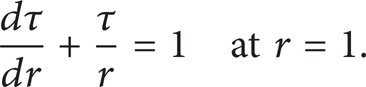
Equation (23) is the modified Bessel's differential equation of order one. On solving (23) together with the boundary conditions (24)-(25), one can obtain the following expression for the shear stress distribution:

where I0 and I1 are modified Bessel functions of first kind of order 0 and 1, respectively. Since the expression obtained for shear stress in the Sections 2.4.1 and 2.4.2 for the cases of variable permeability and constant permeability is independent of the particular non-Newtonian fluid model, both Casson and H-B fluid models utilize the same shear stress expression for finding the velocity distribution and flow rate.
2.4.3. Velocity and Flow Rate of Casson Fluid
Integration of (14) yields the following numerical scheme for the velocity distribution:

Quadrature formula is used to evaluate the integrals in the above equation. The velocity in the plug flow region (plug flow velocity) is given by

The numerical formula for computing the flow rate is given below:
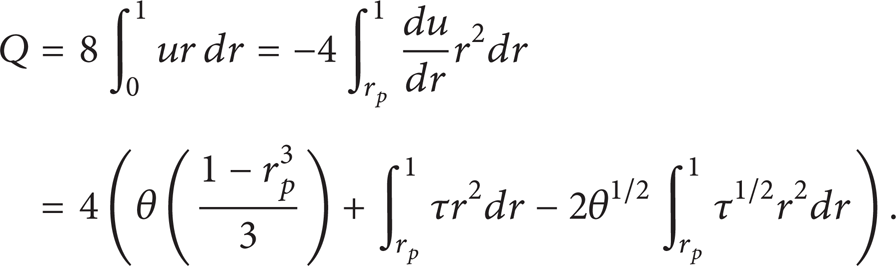
Gauss-Legendre Quadrature formula is applied for evaluating the integrals in (26).
2.4.4. Velocity and Flow Rate of H-B Fluid
Integrating (16), we get the following numerical scheme for the velocity distribution:
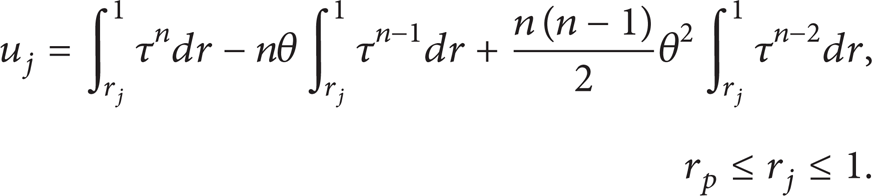
The integrals in (27) are evaluated using the Quadrature formula. The velocity in the plug flow region is given by

The nondimensional flow rate can be computed from the following expression which requires the evaluation of integral involving shear stress using Quadrature formula:

3. Results and Discussion
The aim of this mathematical analysis is to discuss the blood flow characteristics when it flows through narrow arteries filled with homogeneous porous medium, modeling blood as two different non-Newtonian fluid models with yield stress such as Casson and H-B fluids. The homogeneous porous medium present in the blood vessel is mathematically represented as the function K(r). Two types of permeability considered in this study are (i) constant permeability with K(r) = K0, where K0 is a constant (permeability factor) and (ii) variable (in the radial direction) permeability with
3.1. Shear Stress Distribution
Since both H-B and Casson fluid models have the same expression for the shear stress τ, we have the same graphs for analyzing the variation of shear stress with permeability of the porous medium in the radial direction. The shear stress distributions in the radial direction for different values of the permeability factor K0 in the cases of (i) constant permeability and (ii) variable permeability are depicted in Figures 2(a) and 2(b), respectively. In the case of constant permeability with lower values of the permeability factor (K0 = 0.05, 0.1, 0.25), the shear stress increases slowly (linearly) in the radial direction from r = 0 to r = 0.6 and then it increases rapidly (nonlinearly) when r increases further from 0.6 to 1. For higher values of the permeability factor (K0 = 0.5, 1, 15) and in both the cases of constant and variable permeability, the shear stress increases linearly in the radial direction. But the shear stress is considerably higher in the variable permeability case than that of the constant permeability.

Shear stress distribution of H-B and Casson fluid models for different value of K0. (a) Constant permeability. (b) Variable permeability. It is noted that in the case of constant permeability with lower values of the permeability factor (K0 = 0.05, 0.1, 0.25), the shear stress increases slowly in the radial direction when r increases from 0 to 0.6 and then it increases rapidly when r increases further from 0.6 to 1. In both the cases of constant and variable permeability, the shear stress increases linearly in the radial direction when permeability factor takes the larger values (K0 = 0.5, 1, 15). One can also note that the shear stress is considerably higher in the variable permeability case than that of the constant permeability.
It is to be noted that in the case of constant permeability, the values obtained for shear stress distribution in the present study (see Figure 2(a)) are almost half of the corresponding values obtained by Dash et al. in their Figure 2(a) (e.g., when r = 1 and K0 = 15, the value obtained in the present study for shear stress is 0.5 and the corresponding value obtained by Dash et al. [20] is 1.0). But, in the case of variable permeability, there is no notable difference between the shear stress distribution values obtained in present study (see Figure 2(b)) and those obtained by Dash et al. in their Figure 2(b).
3.2. Plug Core Radius
The plug core radius is computed from the expression of shear stress (explained in Section 2.4.1) and thus it is the same for both H-B and Casson fluid models. The variation of plug core radius with yield stress for different values of the permeability factor K0 in the cases of (i) constant permeability and (ii) variable permeability is sketched in Figures 3(a) and 3(b). It is noticed that in the case of constant permeability with permeability factor K0 = 0.05 and 0.1, the plug core radius increases rapidly with the increase in the yield stress from 0 to 0.125 and then it increases slowly with the further increase in the yield stress from 0.125 to 0.4. It is also observed from the constant permeability case that the plug core radius increases linearly with the increase in the yield stress when the permeability factor K0 is 0.5 and 0.15. In the case of variable permeability, the plug core radius increases slowly with the increase in the yield stress for all the values of the permeability factor. It is also seen that the plug core radius increases significantly with the increase in the permeability factor in the constant permeability case and it increases marginally with the increase in the permeability factor in the variable permeability case.

Variation of plug core radius of H-B and Casson fluid models for different values of K0. (a) Constant permeability. (b) Variable permeability. It is seen that in the case of constant permeability, the plug core radius increases linearly with the increase in the yield stress when the permeability factor K0 is 0.5 and 0.15 and when permeability factor K0 = 0.05 and 0.1, it increases rapidly with the increase in the yield stress from 0 to 0.125, and it increases slowly with the further increase in the yield stress from 0.125 to 0.4. In the case of variable permeability, the plug core radius increases slowly with the increase in the yield stress for all the values of the permeability factor.
3.3. Velocity Distribution
The velocity distribution of Casson fluid model for different values of the permeability factor K0 in the cases of constant and variable permeability is shown in Figures 4(a) and 4(b), respectively, for the yield stress (i) θ = 0 and (ii) θ = 0.1. It is noted that in both the types of permeability, the velocity of Casson fluid increases very significantly with the increase in the permeability factor when the yield stress of the fluid holds constant. But, for a given value of the permeability factor K0, the magnitude of the velocity decreases significantly and width of the plug flow region (flatness of the velocity profile) increases significantly when the yield stress of the Casson fluid increases.

Velocity distribution of Casson fluid flow. (a) Constant permeability. (b) Variable permeability. It is clear that in both the types of permeability, the velocity of Casson fluid increases very significantly with the increase in the permeability factor. The velocity of Casson fluid decreases significantly and width of the plug flow region increases significantly when the yield stress increases.
It is observed that in the case of constant permeability with yield stress θ = 0, the values obtained for velocity distribution in the present study (see Figure 4(a) (i)) are almost half of the corresponding values obtained by Dash et al. in their Figure 4(a) (e.g., when K0 = 15, the value obtained in the present study for velocity is approximately 0.25 and the corresponding value obtained by Dash et al. [20] is approximately 0.5). It is to be observed that in the case of constant permeability with yield stress θ = 0.1, the values obtained for velocity distribution in the present study (see Figure 4(a) (ii)) are almost one-third of the corresponding values obtained by Dash et al. in their Figure 5(a). But, in the case of variable permeability, there is no considerable difference between the shear stress distribution values obtained in the present study (see Figure 4(b)) and obtained by Dash et al. in their Figures 4(b) and 5(b).

Velocity distribution of H-B fluid flow. (a) Constant permeability. (b) Variable permeability. The same kind of variations in the velocity profile with respect to both the yield stress and permeability factor that was observed for Casson fluid model in Figures 4(a) and 4(b) is observed for H-B fluid model.
The velocity distribution of H-B fluid model for different values of the permeability factor K0 in the cases of constant and variable permeability are shown in Figures 5(a) and 5(b), respectively (for the yield stress (i) θ = 0 and (ii) θ = 0.1). The same kind of variations in the velocity profile with respect to both the yield stress and permeability factor that were observed for Casson fluid model (in Figures 4(a) and 4(b)), is also found for H-B fluid model. From Figures 4 and 5, it is noticed that for a given set of values of the parameters, the magnitude of the velocity of H-B fluid model is significantly higher than that of the Casson fluid model. The velocity profiles of different fluid models in the cases of constant permeability with K0 = 0.5 and variable permeability with K0 = 15 are depicted in Figures 6(a) and 6(b), respectively. It is noted that in both the cases of permeability, the velocity is maximum for power law fluid model. It is also observed that the velocity of power law fluid model is marginally higher than that of Newtonian fluid model and significantly higher than that of H-B fluid model. It is also seen that the velocity of H-B fluid model is significantly much higher than that of Casson fluid model. It is of interest to note that the plot of Newtonian fluid's velocity in the case of constant permeability (in Figure 6(a) with K0 = 0.5) is in good agreement with the velocity plot of Newtonian fluid obtained by Dash et al. [2] in their Figure 4(c) (k = 0.5 and θ = 0). Figures 4–6 sketch the variations in the velocity profiles of different fluid models with respect to permeability factor and yield stress.

Velocity distribution for different fluid flows. (a) Constant permeability with K0 = 0.5. (b) Variable permeability with K0 = 15. It is observed that in both the cases of permeability, the velocity is maximum for power law fluid model. The velocity of power law fluid model is marginally higher than that of Newtonian fluid model and significantly higher than that of H-B fluid model. It is also noticed that the velocity of H-B fluid model is significantly much higher than that of Casson fluid model.
3.4. Flow Rate
The variation of flow rate of Casson fluid with yield stress for different values of the permeability factor K0 in the cases of constant and variable permeability is illustrated in Figures 7(a) and 7(b). It is clear that in both the cases of permeability, the flow rate decreases rapidly (nonlinearly) with the increase in yield stress from 0 to 0.1 and it decreases very slowly when the yield stress increases further from 0.1 to 0.3. One can also notice that the flow rate increases considerably with the increase in the permeability factor. It is also observed that for a given set of values of the parameters, the flow rate of Casson fluid is higher when it flows in tubes filled with constant porous medium compared to its flow rate when it flows in tubes filled with variable porous medium.

Variation of flow rate with yield stress for Casson fluid flow. (a) Constant permeability. (b) Variable permeability. It is clear that in both the cases of permeability, the flow rate of Casson fluid decrease rapidly with the increase of yield stress from 0 to 0.1 and it decreases very slowly when the yield stress increases further from 0.1 to 0.3. It is noticed that the flow rate increases considerably with the increase of the permeability factor. It is found that the flow rate is higher when it flows in tubes filled with constant porous medium compared to its flow rate when it flows in tubes filled with variable porous medium.
It is observed that in the case of constant permeability, the values obtained for flow rate in the present study (see Figure 7(a)) are almost half of the corresponding values obtained by Dash et al. in their Figure 7(a) (e.g., when K0 = 15, the value obtained in present study for flow rate is 0.5 and the corresponding value obtained by Dash et al. [20] is 1.0). But, in the case of variable permeability, the difference between the flow rate values obtained in the present study (see Figure 7(b)) and those obtained by Dash et al. in their Figure 7(b) is not considerable.
Figures 8(a) and 8(b) show the variation of flow rate of H-B fluid with yield stress for different values of the permeability factor K0 in the cases of constant and variable permeability. In both the cases of permeability, the flow rate of H-B fluid decreases almost linearly with the increase in the yield stress. For H-B fluid model also, the flow rate increases significantly with the increase in the permeability factor K0. Figures 9(a) and 9(b) compare the variations in the flow rate of H-B and Casson fluid flows in tubes with constant and variable permeability with K0 = 15, respectively. It is seen that in both the cases of permeability, the flow rate of Casson fluid decreases rapidly when the yield stress increases from 0 to 0.125 and then it decreases very slowly when the yield stress increases from 0.125 to 0.4. But, the flow rate of H-B fluid decreases linearly with the increase in the yield stress from 0 to 0.4. One can note that the flow rate of H-B fluid increases with the increase in the power law index n. The flow rate of both the fluids is higher when they flow in tubes filled with variable porous medium compared to their flow rate when they flow in tubes filled with constant porous medium. It is also observed that the flow rate of H-B fluid is significantly higher than that of Casson fluid.
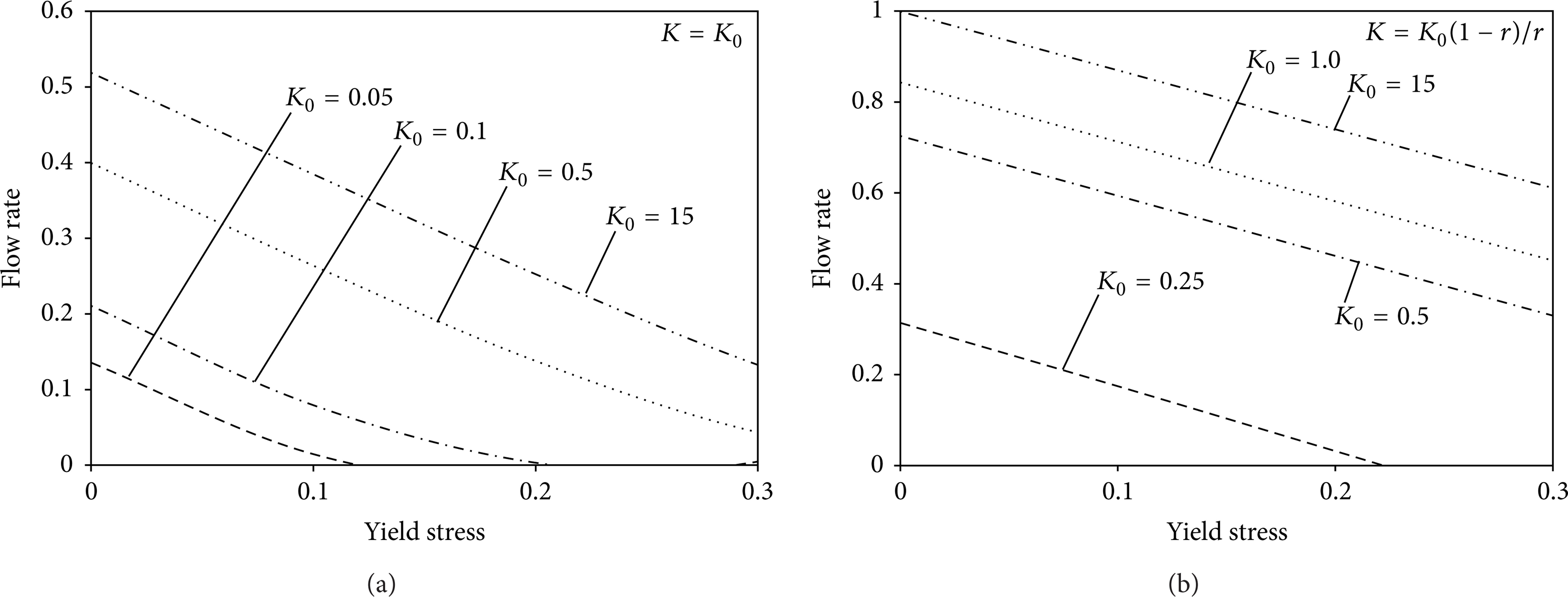
Variation of flow rate with yield stress for H-B fluid flow. (a) Constant permeability. (b) Variable permeability. It is observed that in both the cases of permeability, the flow rate of H-B fluid decreases almost linearly with the increase in the yield stress and increases significantly with the increase in the permeability factor K0.
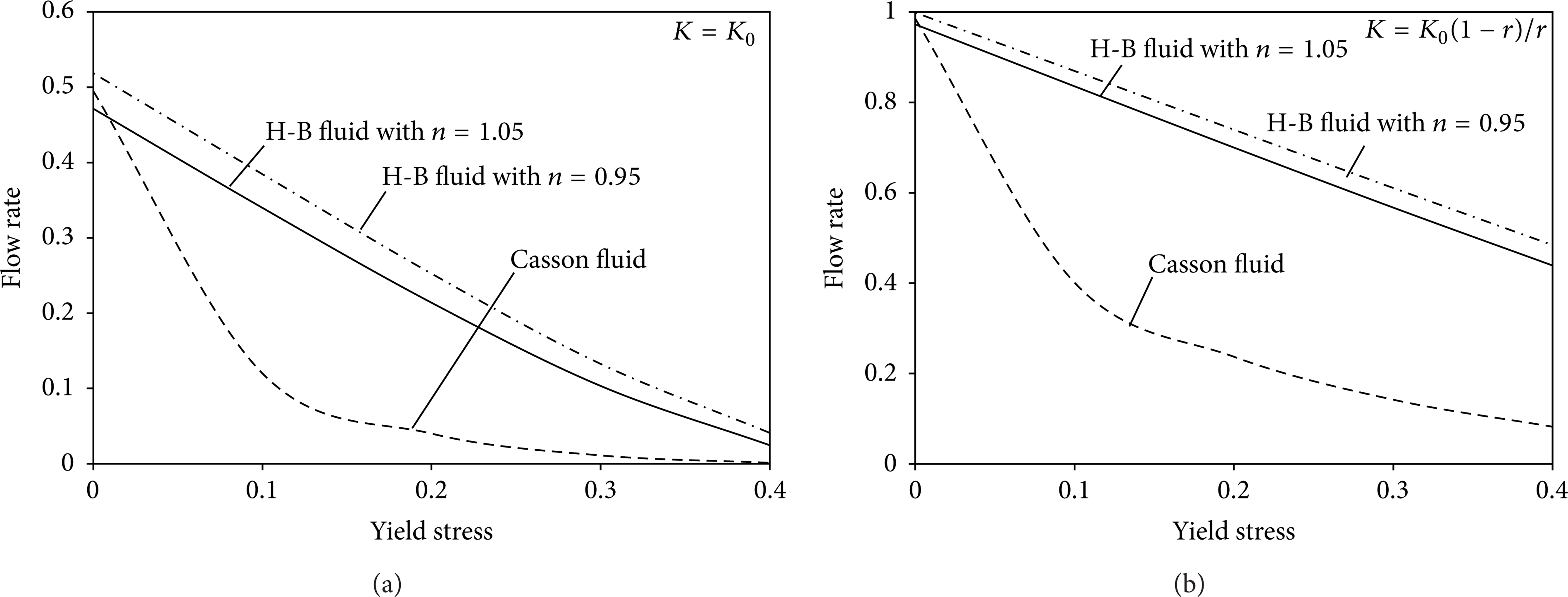
Variation of flow rate with yield stress for different fluid flows and K0 = 15. (a) Constant permeability. (b) Variable permeability. It is seen that in both the cases of permeability, the flow rate of Casson fluid decreases rapidly when the yield stress increases from 0 to 0.125 and then it decreases very slowly when the yield stress increases from 0.125 to 0.4. But the flow rate of H-B fluid decreases linearly with the increase in the yield stress from 0 to 0.4. It is seen that the flow rate of H-B fluid increases with the increase in the power law index n. The flow rate of both the fluids is higher when they flow in tubes is filled with variable porous medium compared to their flow rate when they flow in tubes filled with constant porous medium.
4. Conclusion
The flow characteristics of blood in a homogeneous porous medium with (i) constant permeability and (ii) variable permeability are analyzed in this study. Blood is modeled as two different non-Newtonian fluids with yield stress such as Casson fluid and Herschel-Bulkley fluid. The main results of the present mathematical analysis are summarized below.
In both the cases of constant and variable permeability, the shear stress increases with the increase in the radial distance as well as permeability factor.
The shear stress and plug core radius are considerably higher in the variable permeability case than those of the constant permeability.
The velocity and flow rate of both the fluids are significantly higher when they flow in tubes with variable permeability compared to the corresponding flow quantities of these fluids when they flow through tubes with constant permeability.
The plug core radius increases with the increase in the yield stress of the fluid and decreases with the increase in the permeability factor.
The velocity and flow rate of both the fluids increase considerably with the increase in the permeability factor and decrease with the increase in the yield stress of the fluids.
The velocity and flow rate of H-B fluid are considerably higher than those of the Casson fluid model.
Hence, it is concluded that the present study can be considered as an improvement in the mathematical modeling of blood flow in narrow arteries filled with homogenous porous medium.
Footnotes
Nomenclature
Acknowledgment
The authors would like to express sincere thanks to referees for providing valuable suggestions to improve the quality of the paper.