




Abstract
A reliable transport protocol with prediction mechanism for urgent information (PMUI) in WSNs is proposed. With PMUI, which is based on RTP-UI, the congestion control mechanism is improved, and the priority control and prediction mechanisms are adopted by taking the current queue length with change rate and expected queue length with remaining length together into consideration. The congestion status of current queue is analyzed and the changing trend of the next cycle of the queue is predicted as well. In order to evaluate the degree of congestion, state machine is adopted. Working states of WSNs are classified into eight states in accordance with different degrees of congestion. According to the change rate of a queue and the expected change rate of a queue, different rate adjustment mechanisms and bandwidth allocation schemes based on different working states are developed. Simulation results show that PMUI is lower than RTP-UI in both packet loss rate and the average delay for reliable transmission of urgent information.
1. Introduction
A wireless sensor network (WSN) consists of numerous sensor nodes. These sensor nodes are self-organized by wireless communication and transfer surrounding environmental data to observers. Due to characteristics including low cost, robustness, and survivability, sensor nodes can be deployed densely in large-scale areas [1, 2]. Although a WSN is designed to collect data when an emergency occurs within the monitoring region, sensor nodes may still suffer from some problems incited by the rapid increase of data throughout. The problems include congestion, increase of network transmission delay, and decrease of network throughput, which are not conducive to transfer data timely and reliably [3]. Thus, congestion control mechanism is also in great need to ensure timely and reliable data transmission in WSNs.
Currently, there are mainly two issues dealing with congestion detection and rate adjustment in congestion control mechanisms [4, 5]. Channel load [6, 7], length of buffer queue [8], the ratio of node service rate and arrival rate [9], and so forth, are adopted as criterion of congestion detection in most research studies. Such detection mechanisms not only fail to reflect the possibility of overflow of the node queue length timely and accurately but also ignore that the occurrence of congestion is a continuous gradual process. In addition, in rate adjustment phase, mostly the original rate [10, 11] is adjusted to defer or reduce the amount of data flow into the network, so as to achieve the purpose of reducing congestion in traditional congestion control mechanisms. As these congestion control mechanisms cannot model the process of event that occurs realistically, they cannot guarantee timely and reliable transmission of emergency information.
PCCP [6] is a typical protocol based on priority control. In this protocol, each node is assigned with a priority, and arrival time of interactive packet in a queue is calculated to detect congestion. Rate adjustment is conducted according to the priority of each node. The deficiency of PCCP is that diverse needs of reliable data are not taken into account although the priority mechanism is adopted [12].
In RTP-UI [13], the priority queue mechanism and the state machine model are introduced into the protocol. In congestion detection mechanism, the congestion level of each node is evaluated by combining the length of buffer queue with change rate of the queue length. Working states of nodes are divided into six states. Different rate adjustment mechanisms are adopted depending on different states. Compared with traditional congestion control mechanisms, the advantage of RTP-UI is that it reflects the real situation of emergencies by taking the gradual process of node congestion and the diversity of data transmission into account. The disadvantage of RTP-UI is that the analysis on gradual process of congestion of the node itself is not comprehensive, which cannot indicate the current congestion state of the network timely and accurately.
In this paper, emergency that occurred within wireless monitoring region is studied intensively. According to three characteristics including suddenness [14], timeliness [15], and the diversity for reliability in emergency data, a reliable transport protocol (PMUI) with prediction mechanism for WSN to deliver urgent information is designed and analyzed. The congestion control mechanism of RTP-UI is improved in PMUI. It not only combines the prediction mechanism with the priority control mechanism but also obtains eight different node working states through the comprehensive analysis of joint change rate of queue, joint queue length, expected queue length, and expected joint change rate of queue. It also adopts different rate adjustments depending on their different states. Compared with RTP-UI, PMUI is able to accurately determine the current network congestion and timely adjusts node transmission rate by the way of analyzing probability of congestion in future by prediction mechanism.
2. Improvement of RTP-UI Congestion Control Mechanism
2.1. Queue Model
Each node has three priority queues, that is, high, medium and low priority queue, denoted as HP, MP, and LP. These three priority queues are assigned with different weights, denoted as
2.2. Congestion Evaluation Mechanism
In PMUI, queue length changes are considered on the current and previous cycles, and the expected queue length
Definition 1.
Joint change rate of queue is defined as follows:

Definition 2.
Joint queue length is defined as follows:

Definition 3.
Expected queue length is defined as follows:

Definition 4.
Expected change rate of a queue is defined as follows:

Working conditions are divided into eight by comprehensive analysis of joint queue length
State 1. When a node satisfies Condition 1, the joint queue length
Condition 1.

State 2. When a node satisfies Condition 2, the node will enter State 2. At this time,
Condition 2.

State 3. When a node satisfies Condition 3, the joint change rate of the queue is less than or equal to 0, indicating that the queue length of the node is gradually decreasing. At this time, the node will enter State 3, and it is in normal working condition.
Condition 3.

State 4. When a node satisfies Condition 4,
Condition 4.

State 5. When there are one or more queues in the node priority queue, of which the remaining length is between
Condition 5.

State 6. When a node satisfies Condition 6,
Condition 6.
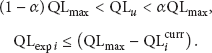
State 7. When
Condition 7.

State 8. When a node satisfies Condition 8, it indicates that the probability of queue overflow is increasing in a node. At this time,
Condition 8.

The improved node state transition diagram is shown in Figure 1. As shown in the figure, we can figure out the transformational relation of each state, where S1 to S8 in the figure represent State 1 to State 8.
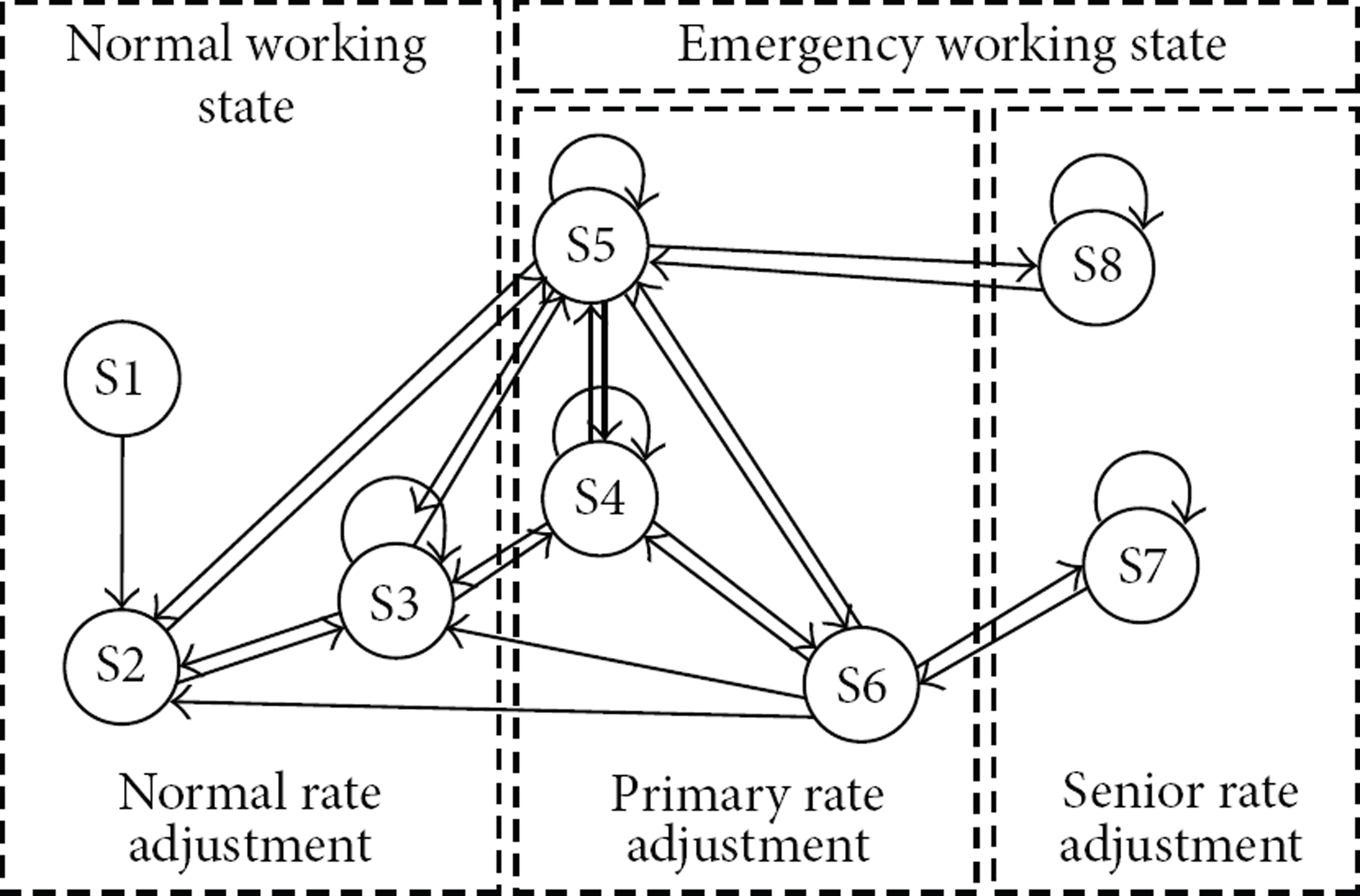
Improved node state transition diagram.
2.3. Rate Adjustment Mechanism
Node states of rate adjustment are divided into normal rate adjustment, primary rate adjustment, and senior rate adjustment in PMUI. The normal rate adjustment mechanism adopts the rate adjustment mechanism utilized in reference [13]. In order to perform a comprehensive analysis in the primary rate adjustment and senior rate adjustment mechanism in PMUI, the joint change rate of queue is combined with the expected change rate of queue. It is more flexible to adjust the transmission rate of a node and more reliable to transfer data.
2.3.1. Normal Rate Adjustment Mechanism
When a node is in State 2 or State 3, the node is in normal working condition. At this time, normal rate adjustment mechanism is used. According to the rate adjustment mechanism in reference [13], we can obtain the average service rate of the sink node, as shown in the following formula:
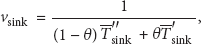
Starting from the sink node, each node i in the network is evaluated in turn by formula (14) and broadcasts initial maximum service rate of its child node j, where

After each dispatching cycle of node, the rate of each child node j is readjusted by formula (15), where

2.3.2. Primary Rate Adjustment Mechanism
As we can see from the improved node state transition diagram, we draw that when a node is in State 4, 5, or 6, the possibility of overflow is increasing in the congestion queue because of the increase of node's data flow. It will result in the increasing probability of node's packet loss. Therefore, the node needs to improve its service rate to cancel out the increase of queue length by the primary rate adjustment mechanism.
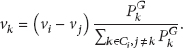
Primary rate of node j is calculated by formula (16), where

2.3.3. Senior Rate Adjustment Mechanism
When a node is shifted to State 7 or 8, the node queue length is greater than

It means that low level rate adjustment mechanism cannot work well even the node gets all of its parent node's bandwidth, and high level rate adjustment mechanism is adopted. Then in order to reduce congestion, bandwidth of its parent node and its sibling node is reallocated.
3. Design and Analysis of Simulation Experiments
In order to verify performance of PMUI, we use two performance indicators, including delay and packet loss rate, as the evaluation criterion. We also compare the performances of PMUI with RTP-UI and PCCP protocols. We use the same topology model used in RTP-UI for simulation and only consider the node queue overflow congestion. The topology model for simulation is shown in Figure 2. It is assumed that the node c is off during 10–40 s, indicating that the rate of node c becomes 0 and assumed that node c detects emergencies during 60–90 s, which will result in huge bunch of persistent data suddenly.

Simulation topology.
Simulation parameter settings are shown in Table 1.
Simulation parameters.

As shown in Figure 3(a), the packet loss rates of HP approach zero in PMUI and RTP-UI. From Figures 3(b) and 3(c), we can see that the packet loss rates of MP and LP are much smaller than those in PCCP. Compared with RTP-UI, the average packet loss rate of PMUI is lower. PMUI has higher reliability for emergency information transmission.

Comparison of packet loss rate.
Comparison results of delay of these three kinds of data flows are shown in Figure 4. The average delay of HP, MP, and LP in PMUI is less than that in RTP-UI and PCCP, and the delay of HP is less than the delay of MP and LP. The average delay of LP has the largest gap. In the event of an emergency, PMUI is more effective to reduce transmission delay of emergency information.

Comparison of delay.
From Figures 3 and 4, both packet loss rate and delay fluctuate at 10 s because of the closedown of node c. But they all recover soon. Although emergencies occur during 60–90 s, RTP-UI and PMUI both work well since the continuous variation of congestion is considered in both of them. RTP-UI and PMUI both perform better in higher priority queues due to their priority control mechanism. With prediction mechanism, PMUI performs better than RTP-UI when emergencies occur.
4. Conclusions
In this paper, a reliable transport protocol with prediction mechanism for urgent information (PMUI) is proposed. Considering the characteristics of emergency information comprehensively, prediction mechanism and priority control mechanism are utilized in PMUI. We design a congestion detection method based on queue priority, change rate of queue length, expected queue length, and expected change rate of queue length. According to the degree of current congestion and the queue tendency in next cycle with prediction mechanism, node working states are divided into eight different ones, so as to adopt a different rate control mechanism. Compared with RTP-UI, PMUI is better in ensuring reliable transmission of emergency information in WSNs.
Footnotes
Acknowledgments
The author would like to acknowledge the financial support of the Special Fund Project of the National Natural Science Foundation of China (no. 61370088), National IOT Development (no. MOIIT (2012)583), Doctoral Fund of Ministry of Education of China (no. 20100111110004 and no. 20120111110001), Natural Science Foundation of Jiangsu Province (no. BK2011236), Natural Science Foundation of Anhui Province (no. 1208085QF113), and S&T Cooperation Program of Anhui Province of China (no. 1303063009).