




Abstract
Fossil-fired thermal power plants (TPP) produce a significant part of electricity in the world. Because of the aging TPPs and so their equipment (especially boiler), thermal power plants also produce less power than their installed capacities, and there has been power loss in time. This situation affects the supply and demand balance of countries. For this reason, aging equipments such as pulverized coal-fired boiler (PCB) must be renewed and power loss must be recovered, instead of building new TPPs. In this study, economic analysis of rebuilding an aged pulverized coal-fired boiler with a new pulverized coal-fired boiler including flue gas desulfurization (FGD) unit and a circulating fluidized bed boiler (FBB) are investigated in an existing old TPP. Emission costs are also added to model, and the developed model is applied to a 200 MWe pulverized coal-fired thermal power plant in Turkey. As a result, the payback period and the net present value are calculated for different technical and economic parameters such as power loss, load factor, electricity price, discount rate, and escalation rate by using the annual value method. The outcomes of this study show that rebuilding of a pulverized coal-fired boiler with a new one is amortized itself in a very short time.
1. Introduction
Population increment, industrializing, and technologic development result directly in increasing energy consumption. This rapid growing trend brings approximately the very important environmental problems such as air pollution and greenhouse effect. Nowadays, about 80% of electricity in the world is produced from fossil fuel-fired thermal power plants [1–3].
Coal is the most abundant fossil energy resource in the world and exists in almost every major region of the world, but its quality varies greatly from region to region. Coal-fired thermal power plants (TPPs) are the most widely used plants worldwide. Actual electricity production of coal-fired TPPs is 41% of annual world electricity generation, and by 2030 this percentage is expected to rise to 44%. However, many countries use aged pulverized coal-fired boilers (PCBs) (25–40 years) for electricity generation. Moreover, coal (especially poor quality) used in these TPPs for electricity generation causes crucial environmental problems, such as global warming and acid rain, because the poor quality coal cannot be burned cleanly and efficiently in these boilers and their performance deteriorates. Hence, the thermal efficiency of TPPs is to be lower [1, 4–13].
Although the share of TPPs generating electricity is about 64% within the total installed power in Turkey; its ratio at the compensation of electricity demand is about 75% in 2012. Nowadays, more than 50% of the amount of electricity generated from TPPs is dependent on imported fuel sources, especially natural gas. It is obvious that the main solution of problems like these is efficient utilization of the domestic fuel sources. Therefore, enhancing the performance of the aged coal-fired TPPs is a necessity in terms of energy policy, national security, fuel reserve, and environmental concerns [1, 2, 14–16].
In the present work, firstly, economic analysis of rebuilding an aged pulverized coal-fired boiler (PCB) with a new pulverized coal-fired boiler including flue gas desulfurization system (FGD) and a circulating fluidized bed boiler (FBB) are examined in an existing old thermal power plant. Secondly, emission costs are added to model, and the developed model is applied to a 200 MWe pulverized coal-fired thermal power plant in Turkey. Thirdly, the payback period and the net present value are calculated for different technical and economic parameters such as power loss, load factor, electricity price, discount rate, and escalation rate by using the annual value method. As a result, the outcomes of this study show that rebuilding of aged pulverized coal-fired boiler is a necessity for aging thermal power plants.
2. The Importance of Rebuilding
Because of the aging thermal power plants (TPPs) and so their equipment, thermal power plants also produce less power than their installed capacities, and there has been power loss in time. For example, boiler is one of the most important equipment in TPPs. Due to the aging of boilers, the problems such as slag and degradation of heat transfer increase and boilers produce less steam than their design values. As a result, TPPs also produce less power than their design values. Developing countries need more power and must build new plants to meet increasing demand. So, countries must recover power loss in aging TPPs, instead of making new investments. Moreover, chronic power shortages and scarcity of capital funds have led many countries to apply them to rebuilding of aging thermal power plants, instead of building new ones, because new power projects go through long environmental assessments and approval processes. Development of infrastructure for these projects, following the approval, also takes considerable time and entails high capital costs, whereas rebuilding of aging TPPs can be done in a relatively short time at a much lower cost. Therefore, TPPs can add more power to grid and benefit from recovering capacity through upgrades of old equipment such as aging boiler. In this connection, upgrading of aged pulverized coal-fired boilers (PCBs) can be one of the urgent needs for many countries because of the economic and environmental pressures [1, 6, 9, 14, 15].
In addition, aged PCBs must deal with both the decreasing quality of fuel and strict environmental standards. Moreover, the performance of these boilers is very bad, and emissions are very high. It is a vital issue to meet the increasing electricity demand and decrease emissions for many countries. Therefore, the rebuilding of aged PCBs with new one can be very important for adding more power to the grid and decreasing emissions.
3. Methodology
In this study, all costs and benefits during the economic lifespan of the system are expressed annually. Then, the payback period and the net present value are calculated for rebuilding of aged pulverized coal boiler (PCB) with a new PCB including flue gas desulfurization (FGD) unit and circulating fluidized bed boiler (FBB).
The rebuilding of aged PCB with a new PCB including flue gas desulfurization unit or a circulating FBB requires some changes, such as need for more area for FGD unit or replacement of super heaters. In addition, operation and maintenance costs will be different by rebuilding. Also, the thermal power plant is not operated throughout the rebuilding. Therefore, electricity is not sold during the rebuilding. Moreover, the results will change by adding FGD unit, because emissions will decrease. So, emission taxes will decrease. All these factors have been considered in the study. Because the proportion of auxiliary power consumption within total expenditure is very low, it is not taken into consideration in the analysis. Moreover, a similar methodology has been used, and assumptions have been taken as the same for two different technologies except for specific costs. Accordingly, total expenditure (E) and gain (G) can be calculated from (1) and (2), respectively [17–23].
Consider the following:






where E is the total cost, C I ($/kWe) is the specific investment cost for new PCB with FGD, FBB, and auxiliary equipment, C D ($/kWe) is the specific cost of dismantling, erection, and commissioning, C O ($/kWe) is the specific constant operation and maintenance cost such as employees' salary, R L is the revenue lost for the downtime period, G is the annual total gain, G E is the annual additional electricity gain obtained from incremental power production, G F is the annual additional gain because of fuel savings, GEM is the annual gain due to the decrease in emissions after rebuilding, DP (h) is the downtime period, P e ($/kWeh) is the unit electricity price, P f ($/kg) is the unit fuel price, LHV (kcal/kg) is the low heat value of fuel, H (h) is the annual average operation duration of the plant, ηtho is the thermal efficiency of TPP before rebuilding, ηth is the thermal efficiency of TPP after rebuilding, N (kWe) is the installed power of the plant, N o (kWe) is the operating power before revamping, and LF (%) is the annual average load factor of plant.
Unit emission cost is taken as $0, 22/kgCO2, $11/kgSO2, and $5, 7/kgNO x for CO2, SO2, and NO x , respectively [17, 19, 20, 22, 23]. Then, annual emission costs are found and added to total gain.
Total expenditure (E) can be converted to annual constant expenditure (E y ) by using amortization factor (AF). Then, payback period (PBP) can be calculated (9). The payback period is the time of equality of the cost and benefit. Therefore, it is calculated with the rate of total annual constant expenditure (E y ) to total annual gain (G). Net present value (NPV) which includes escalation rates for electricity price and fuel price and discount rate can be determined from (10).
Consider the following:



where n (year) is the economic life span, t is the period, and r (%) is the discount rate.
4. Case Study and Discussion
The prior aim of this study is to present a general economic model to evaluate quickly the rebuilding of aged pulverized coal-fired boiler (PCB) with a new one in existing thermal power plants (TPPs). Hence, it can be an important study for the evaluation of aging TPPs for researchers and operators of TPPs. Specific costs such as C I , C D , and C O and technical data for case study have been taken from the literature ([1, 6, 15, 21]), authorities of Turkish Electricity Generation Co., Inc. (EUAS; http://www.euas.gov.tr/), and operators of Soma Thermal Power Plant (an institution of EUAS) in Manisa in Turkey. EUAS produces about half of Turkish electricity production, and it is a very important official institution of Turkey. Therefore, they are approximate values for case study. Conclusions of case study depend on these values. Moreover, auxiliary power consumption and boiler efficiency for two firing system are important parameters. Because the proportion of auxiliary power consumption within total expenditures is low and boiler efficiency for two firing system is very close to each other [6, 12], they are not taken into consideration in the analysis, but more accurate and sensitive solutions can be obtained from the development model by considering real cost values, auxiliary power consumption, and combustion efficiency.
Coal (especially lignite) is an important fuel source for Turkey and it is used mostly for electricity generation. On the basis of the latest estimates, the total lignite reserves of Turkey have reached approximately 11.5 billion ton. However, poor quality lignite (below 2000 kcal/kg) accounts for about 70% of these reserves. Share of better quality lignite (over 3000 kcal/kg) is very low (6%). The other lignite reserve (between 2001 and 3000 kcal/kg) accounts for about 24% [7, 16]. The developed model is applied to a 200 MWe pulverized coal-fired TPP in Turkey. Then, the payback period (PBP) and net present value (NPV) are computed. Coal quality effects PBP and NPV. Coal quality is directly related to lower heating value. The coal used in a 200 MWe thermal power plant example is poor quality coal (lower heating value is 1800 kcal/kg). Therefore, PBP decreases and NPV rises if the coal quality increases. Table 1 taken from the literature shows the technical and economic values for the case study [1, 6, 15, 16].
Technical and economic parameters for the case study.

PBP and net present value NPV can change from country to country. Therefore, the effects of almost all technical and economic parameters, such as power loss, downtime period, escalation rate, and discount rate on PBP and NPV are investigated. As a result, it is seen that power loss has a significant effect on the NPV and PBP. When the power loss increases in the aged pulverized coal-fired TPP, the PBP decreases, and the NPV rises. So, the rebuilding is indispensable if power loss is high in aged pulverized coal-fired TPPs, especially after 30 MWe. NPV and PBP values are closer to each other for FBB and new PCB with FGD system when emission costs are not included (Figures 1 and 2), because TPPs can add more power to grid and benefit from recovering capacity through upgrades of aging equipment. The other parameters are also investigated in this study. However, their effects are less than power loss effects, so there is no place in this paper.
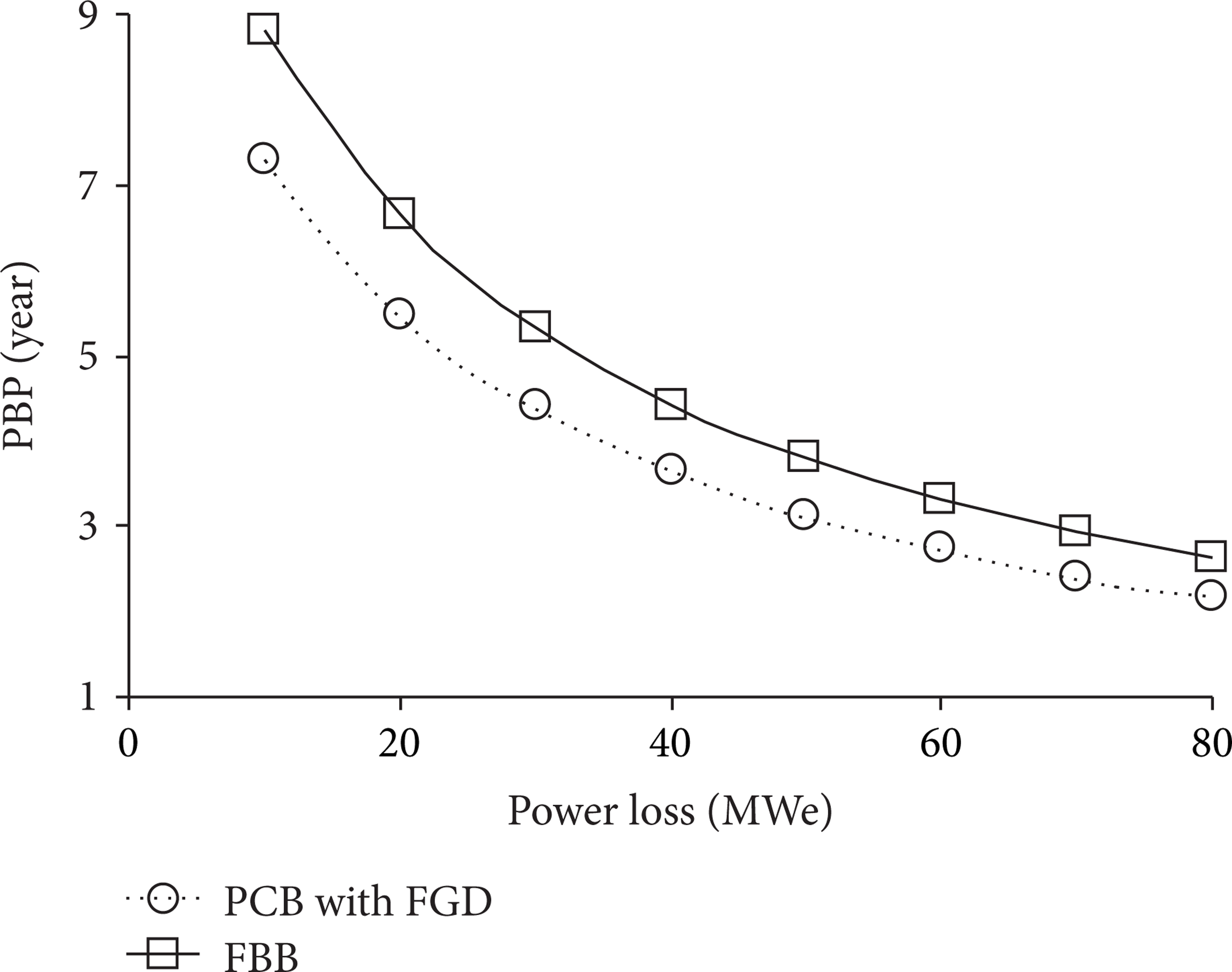
The variation of payback period (PBP) with power loss at PCB with FGD and FBB without emission costs.

The variation of net present value (NPV) with power loss at PCB with FGD and FBB without emission costs.
When the emission costs are added to FBB system, rebuilding is more advantageous (Figures 3 and 4). The results show the necessity of rebuilding with FBB in many countries when the taxes for emissions are engaged in the future. Besides, the results with emission taxes present the necessity of adding an eliminating system, because the PBP is decreasing and the NPV is increasing too much when the emission costs are eliminated. The difference between results includes and excludes emission taxes which are clearly seen from Figures 3 and 4.

The variation of payback period (PBP) with power loss at FBB.

The variation of net present value (NPV) with power loss at FBB.
Figures 5 and 6 show the variation of the payback period with downtime period and load factor at new PCB with FGD without emission costs, respectively. When the downtime period is decreased and the load factor is increased, payback period is diminished, because after rebuilding, income increases.

The variation of payback period with downtime period at new PCB with FGD without emission costs.
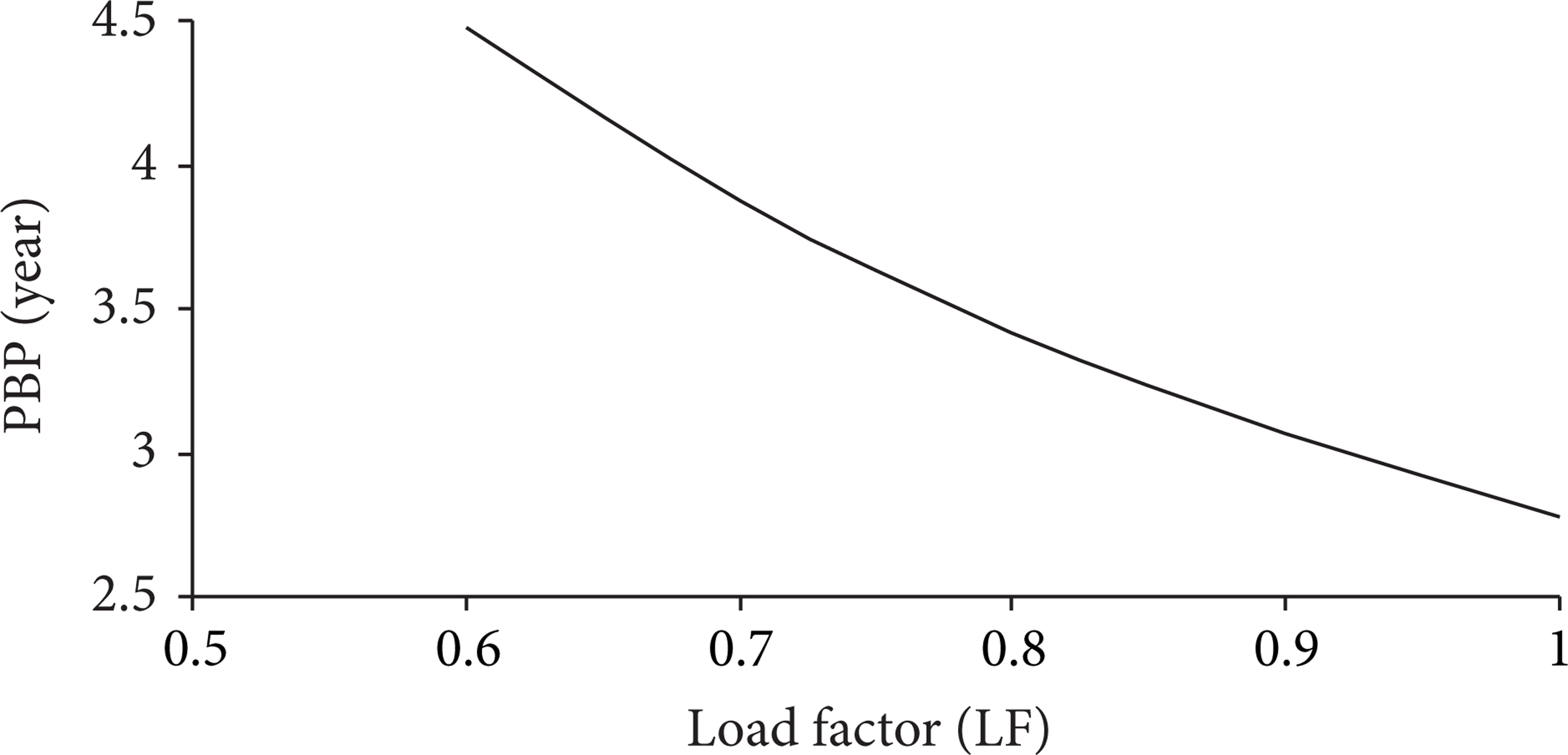
The variation of payback period with load factor at new PCB with FGD without emission costs.
5. Conclusions and Suggestions
This study firstly presents a general economic model for the rebuilding of a pulverized coal boiler (PCB) with a new PCB including flue gas desulfurization (FGD) unit and circulating fluidized bed boiler (FBB). Secondly, a case study is performed for a 200 MWe aging pulverized coal-fired thermal power plant (TPP). Finally, the emission taxes are added to the model, and analysis is repeated.
Payback period (PBP) and net present value (NPV) are closer to each other for FBB and new PCB including FGD when emission costs are not included. Of the investigated parameters, power loss has the greatest effect on PBP and NPV. Therefore, if power loss is very high in the existing TPP, the rebuilding will be very convenient. The more the increase of power loss at the old thermal power plant is, the more advantageous the rebuilding gets, especially after 30 MWe. The results show that the rebuilding of PCB with a new PCB with FGD unit system or FBB system is a cost-effective method, since it is amortized in a very short time.
Moreover, the results show the necessity of rebuilding when the taxes for emissions are engaged in a lot of countries in the future. When the emission costs are added to the model, rebuilding is more advantageous. When the emission taxes are added to the costs, the results are changing very much, the PBP is decreasing and the NPV is increasing too.
The prior aim of this study is to present a general economic model to evaluate quickly rebuilding of aged PCB with a new one in TPPs and to show that rebuilding of a PCB with a new one is a necessity. Technical and economic data in the case study are approximate values. Conclusions of the case study depend on these values. Therefore, more accurate and sensitive solutions can be obtained from the development model by considering real cost values, auxiliary power consumption, and combustion efficiency.