




Abstract
Dynamic spectrum management is a key technology in cognitive wireless sensor network (C-WSN), in which spectrum sensing plays an important role. In this paper, we propose an improved approach as sparse learning via iterative minimization based on compressive sampling (CS-SLIM) for wideband spectrum detection. CS-SLIM can provide wideband spectrum detection with almost the same accuracy but a lower computational burden than that of SLIM. The measurement matrix and the computational complexity for CS-SLIM are discussed. Mean squared errors (MSEs) at various measurement samples are provided to demonstrate the performance of the proposed approach in sparse scenes. It is also proved that the algorithm is suitable for sparse signal reconstruction and wideband spectrum sensing in C-WSN.
1. Introduction
Dynamic spectrum management is a key technology in cognitive radio. In cognitive wireless sensor network (C-WSN), the first step of dynamic spectrum management is spectrum sensing, which is a task for obtaining awareness about the spectrum usage and existence of primary users (PUs) that contains a large amount of sensors, which have cognition functions [1]. Cognitive WSN sensors use the spectrum holes of PUs to transmit their local sensing information, which gathers the local results in order to realize data fusion and reconstruct the sensing information collected by all sensors [2]. One way of doing spectrum sensing is energy detection [3]. However, traditional energy detection consumes a lot of resources and for cognitive sensor networks, sensing may be applied to the local results to save resource and to improve efficiency [4, 5]. Nevertheless, spectrum sensing in C-WSN could be regarded as a challenging task due to the wide frequency bandwidth.
Compressed sampling (CS) theory provides an efficient way to sense sparse or compressible signals. The characteristics of discrete-time sparse signal can be completely captured and represented by a number of projections over a random basis and reconstructed perfectly from these random projections. An intriguing aspect of the theory is the central role played by randomization that preserves the structure of the signal and the original signal reconstruction is conducted using an optimization algorithm from these projections, while reconstruction algorithm design with low mean-square errors (MSE) is regarded as the key issue for practical application of CS theory in large-scale distributed WSN. CS can be implemented as a framework to reduce the spectrum sensing rate in C-WSN. For sparse input signals, analog-to-information conversion (AIC) promises greatly reduced digital data rates (matching the information rate of the signal), and it offers the ability to focus only on the relevant information.
In this paper, after compressive sampling, signals can be exactly recovered with high probability by using effective sparse signal reconstruction algorithms. The present sparse signal reconstruction algorithms can be divided into two categories. One is convex optimization algorithm such as basis pursuit (BP) [6]. The other is greedy algorithm including Matching Pursuit (MP) [7], Orthogonal Matching Pursuit (OMP) [8], and Compressive Sampling Matching Pursuit (CoSaMP) [9]. Compared with greedy algorithm, convex optimization algorithm has higher estimation accuracy while the former has lower computational burden. In particular, sparse learning via iterative minimization (SLIM) [10] algorithm follows an
Cooperative wideband spectrum sensing in C-WSN has high requirements for the accuracy of spectrum reconstruction, the algorithm complexity of the system, and the corresponding computing time. However, the present sparse signal reconstruction algorithms cannot meet all of the requirements. This paper put forward a cooperative spectrum sensing algorithm that identified sparse learning via iterative minimization based on compressive sampling (CS-SLIM). The algorithm combines SLIM and compressive sampling theory together. With the guarantee of an accurate reconstruction of sparse signal frequency spectrum, it also reduces signal sampling frequency and decreases data size to the greatest degree. Therefore, it reduces the complexity of the system, saves computing time, and realizes dynamic allocation of the idle channels with the premise of not interfering in the communication among PUs. Compared with cooperative spectrum sensing algorithm based on
2. System Model
Suppose that an authorized user (also known as PU) and many unauthorized users (also known as cognitive radio user, CR) distribute in a certain area. In this paper, we use 4 CR users to do cooperative spectrum sensing, as shown in Figure 1. The communication between PUs only occupies a small part of the authorized spectrum, while most of the authorized spectrum is idle. In other words, the occupied spectrum is sparse compared with the authorized spectrum. So CR users use sparse signal reconstruction algorithm to reconstruct the spectrum; then they do the spectrum sensing. The result is sent to the data fusion center to do cooperative spectrum sensing. Date fusion center will feed back the result that whether the subchannel is idle to CR users to manage dynamic spectrum for the communication among CR users.
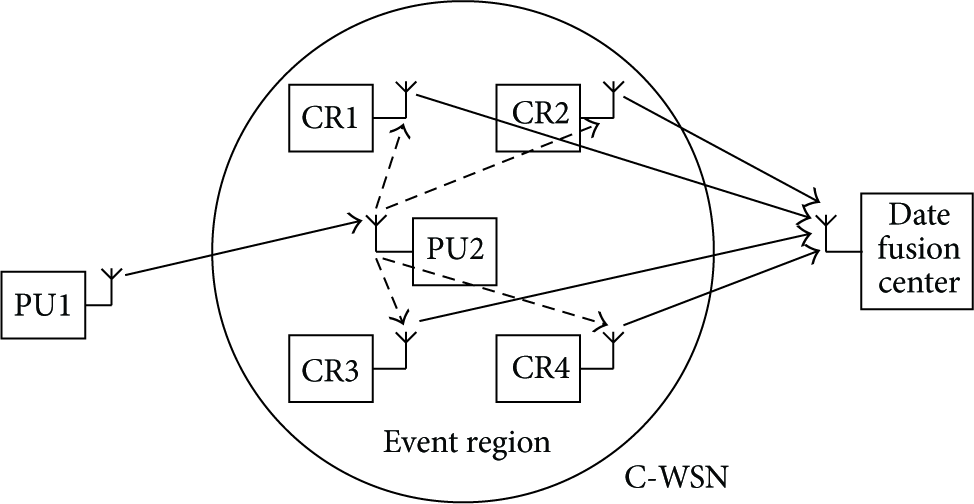
Sketch of C-WSN.
Figure 2 describes the compression spectrum sensing system scheme for a CR user. The broadband analog signal received by CR users is compressively sampled through analog-to-information conversion (AIC) system. The compressed spectrum signal is exactly reconstructed by sparse signal reconstruction algorithm to do the spectrum sensing using energy detection (ED) for one CR user.

Compression spectrum sensing system scheme for one CR user.
The output signal of AIC is

In [11],

The bandwidth of

3. Compressed Sampling Model
The compressible or sparse signal is compressed and sampled using the theory of CS, based on which the signal is recovered with high probability by sparse signal reconstruction algorithms. This approach is proved to be feasible. In [9], a K-sparse signal
We assume that


The received signal

4. Cooperative Spectrum Sensing Based on CS-SLIM
4.1. Sparse Reconstruction Algorithm Based on CS-SLIM
SLIM is a regularized minimization approach with an
Consider the regularized minimization algorithm for sparse signal recovery as



We assume that initial estimation of

We can stop SLIM after 15 iterations or when the stop criterion is satisfied.
In this paper, we combine CS with SLIM to occupy high reconstruction probability and low computational complexity so as to ensure the communication among PUs without interference and idle subchannels can be real-time allocation.
On the basis of CS, measurement signal Design transmitted signals We offer the standard received signal model for sparse signal recovery algorithm based on the MIMO signal model that has been provided in this paper. Choose optimal measurement matrix by the simulation of MSE and compress received signal Initialize the parameters of SLIM with Assume that
where

4.2. Cooperative Spectrum Sensing
Because there is instability in spectrum sensing of a CR user, this paper conducts cooperative spectrum sensing aiming at several CR users. Presume that the observation conditions of several CR users are independent identically distributed with the same SNR. Each CR user carries out independent detection for the first subchannel and gets jth independent sensing result
Each CR user uses energy detection (ED) method when detecting independently a certain subchannel. So the decision of the lth sunchannel is defined as


We can use detection probability

There are two kinds of decision rules of the data fusion center: hard decision and soft decision. Hard decision includes “and” decision, “or” decision, and “K” decision, while soft decision includes maximum ratio combining decision, equal gain combining decision, and selection combining decision. In order to make sure that the communication among PUs is not interfered with greatest degree, we choose “or” decision and also equal gain combining decision to simplify models.
(
1) “Or” Decision. “Or” decision means that as one CR user believes this subchannel is occupied by PUs, it is judged that this channel is occupied. Therefore, it can be guaranteed to the greatest degree that the communication among PUs, in other words, maximizes the cooperative detection probability
(
2) Equal Gain Combining Decision. Equal gain combining decision means the fusion center receives the detection information from Jth CR users, so the new fusion detection measurement
5. Numerical Results and Analysis
It is the presence of a PU and several CR users in a certain area which shares a broadband with a total bandwidth of 128 MHz, and this broadband is divided into 16 subchannels with equiband. Suppose that the PU occupies some of the subchannels randomly and continuously with an average subchannel occupation rate of 25%. We choose 4 CR users to conduct cooperative spectrum sensing, and all of the 4 users keep silence during the monitor period. Suppose that the SNR of the 4 cooperative CR users in the simulation condition varies from 10 dB to 30 dB.
One sees that the signal frequency spectrum can be reconstructed with high probability, while NMSE drops gradually with the increase of the compression rate and the SNR. Meanwhile, as the sampling number increases, the detection probability increases rapidly until up to one. However, the computing time also increases which is smaller compared with the other algorithm.
Figure 3 shows the reconstruction signal frequency spectrum figure when the received signal is polluted by white Gaussian noise, with an SNR of 20 dB and a compression ratio of 0.5. It can be seen from the figure that when there is white Gaussian noise, CS-SLIM can still reconstruct the signal spectrum with high precision.

Reconstruction signal spectrum.
To detect the performance of CS-SLIM more accurately, we introduce NMSE, which is

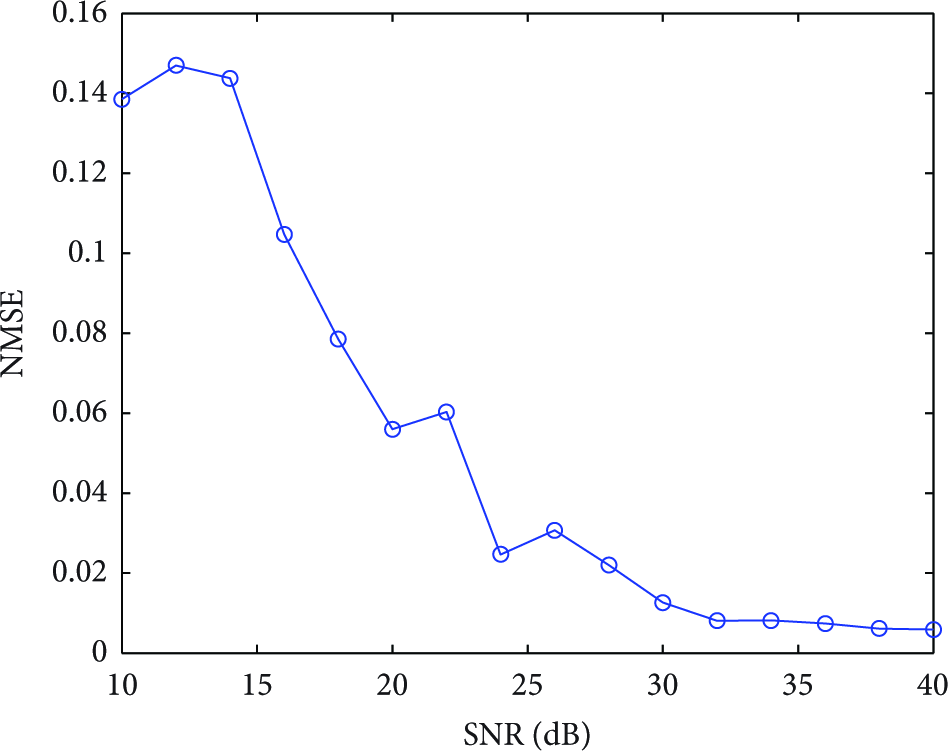
Relationship of reconstruction NMSE and SNR (dB).

Relationship of reconstruction NMSE and compression rate.
Figure 6 shows the variation tendency with the change of compression rate of the detection probability of the cooperative spectrum sensing algorithms which are based on CS-SLIM, and this probability is adjudged, respectively, by “or” principle and equal gain combining decision. One sees that when the sampling number increases, the detection probability increases too. When the compression rate is larger than 0.35, the detection probability of the cooperative spectrum sensing algorithms based on CS-SLIM which are adjudged by “or” principle is 1. When the compression rate is larger than 0.6, the detection probability of the cooperative spectrum sensing algorithms based on CS-SLIM which are adjudged by “equal gain combining decision” principle is 1. It means that when compression rate is larger than 0.6, the cooperative spectrum sensing algorithms based on CS-SLIM which are adjudged by “or” principle and “equal gain combining decision” can both differentiate between idle subchannels and busy subchannels. The performance of the two different cooperative spectrum sensing methods which use “or” principle is better than that when using “equal gain combining decision” principle but the detection probability can both reach 1 when there is smaller compression rate.

Wideband spectrum sensing performance versus compression rate.
We could know that the algorithm proposed in [14] has better performing and also more time consuming while its computing time is four times that of the standard
6. Conclusions
This paper introduces the cooperative spectrum sensing and compression sensing theory in the broadband cognitive wireless sensor network. A novel cooperative spectrum sensing algorithm is proposed in this paper which is cooperative spectrum sensing algorithm using sparse learning via iterative minimization based on compressive sampling. In cooperative spectrum sensing, the key role is sparse signal spectrum reconstruction algorithm. The simulation experiment result shows that as the cooperative spectrum sensing algorithm introduced in this paper precisely reconstructs the signal spectrum, reduces the complexity of the system greatly, and saves a lot of computing time. Therefore, it can better allocate the idle subchannels dynamically with the premise of not interfering in the communication among the PUs and improving spectrum utilization. From the numerical results it can be seen that the cooperative spectrum sensing algorithm based on CS-SLIM achieves the expected result and proves its relatively high spectrum reconstruction precision and low computing complexity.