




Abstract
To solve the product data consistency problem which is caused by the portable system that cannot conduct real-time update of product data in mobile environment under the mass customization production mode, a new product data optimistic replication method based on log is presented. This paper focuses on the design thinking provider, probing into a manufacturing resource design thinking cloud platform based on manufacturing resource-locating technologies, and also discuss several application scenarios of cloud locating technologies in the manufacturing environment. The actual demand of manufacturing creates a new mode which is service-oriented and has high efficiency and low consumption. Finally, they are different from the crowd-sourcing application model of Local-Motors. The sharing platform operator is responsible for a master plan for the platform, proposing a open interface standard and establishing a service operation mode.
1. Introduction
The working environment of representative of enterprises implementing the “gotten out” strategy is changeable and unpredictable. If adopting the B/S structural system, a lot of limitations would be brought to the work of enterprise representative because of the network; even effective information service cannot be provided to the customer [1]. The repetitive construction of the manufacturing capacity as well as the imbalance widely exists in the manufacturing industries of China, leading to the problem of resource idle and resource bottleneck.
The enterprise representative needs to update local product data in no time when data update requirements are qualified, so that the enterprises can obtain the customer information in the shortest time and the enterprise representative can obtain the latest product information to promote customer trust degree [2] of service-oriented technology, virtualizing technology, cloud computing technology, a networking technology, and so forth; the actual demand of manufacturing creates a new mode which is service-oriented, has high efficiency and low consumption, and is based on the knowledge networking intelligent manufacturing, that is, a cloud manufacturing service mode [3]. In fact, this mode has started to be accepted and attempted by some domestic and foreign enterprises. The USA Local-Motors.com adopts a bran-new operation mode, which only spends less than 20 months manufacturing a distinctive Rally Fighter concept car in a microfactory with a size of dry cleaner. The problem associated with it is how to control the product data consistency between duplicate database and primary database and duplicate database and duplicate database. Thus, it can be seen that the product data consistency control is one of the key factors for successful mass customization production.
To realize a business function decoupling among each participator and promote the optimized distribution of resource, a new kind of cloud manufacturing service mode is presented. Firstly, the paper briefly analyzes distributions and relationships of several roles in the cloud manufacturing service mode. The enterprises implement “gotten out” strategy and provide the customer with comprehensive product information initiatively. To win the customer's trust and quickly obtain customer order, it has been inevitable to make full use of computer technology and network technology. The enterprises are developing portable system to obtain customer order and provide customer with product information.
2. Distributions in the Cloud Manufacturing Service
Most of enterprises still choose to employ the C/S structural system and adopt the primary copy's data storage method: the enterprise database is the primary database, and the portable system takes possession of duplicate database [4], and the roles involved include a manufacturing service demander, a manufacturing service provider, a manufacturing application provider, and a sharing platform operator, as shown in Figure 1.

Cloud manufacturing service mode distributed storage supporting mobile environment.
The manufacturing application provider is subdivided into a solution integrator, an application tool developer, a design thinking provider, and so forth as required. The design thinking, such as equipment, cutter, tool, and locating, in the application service are provided by the specialized design thinking provider, and the specific fine-grained service tools are provided by the application tool developer, so the integration of the application service is completed by the solution integrator. For example, for the application in the production management of the cloud manufacturing, the constitutions of its manufacturing application in the C/S are as shown in Figure 2.
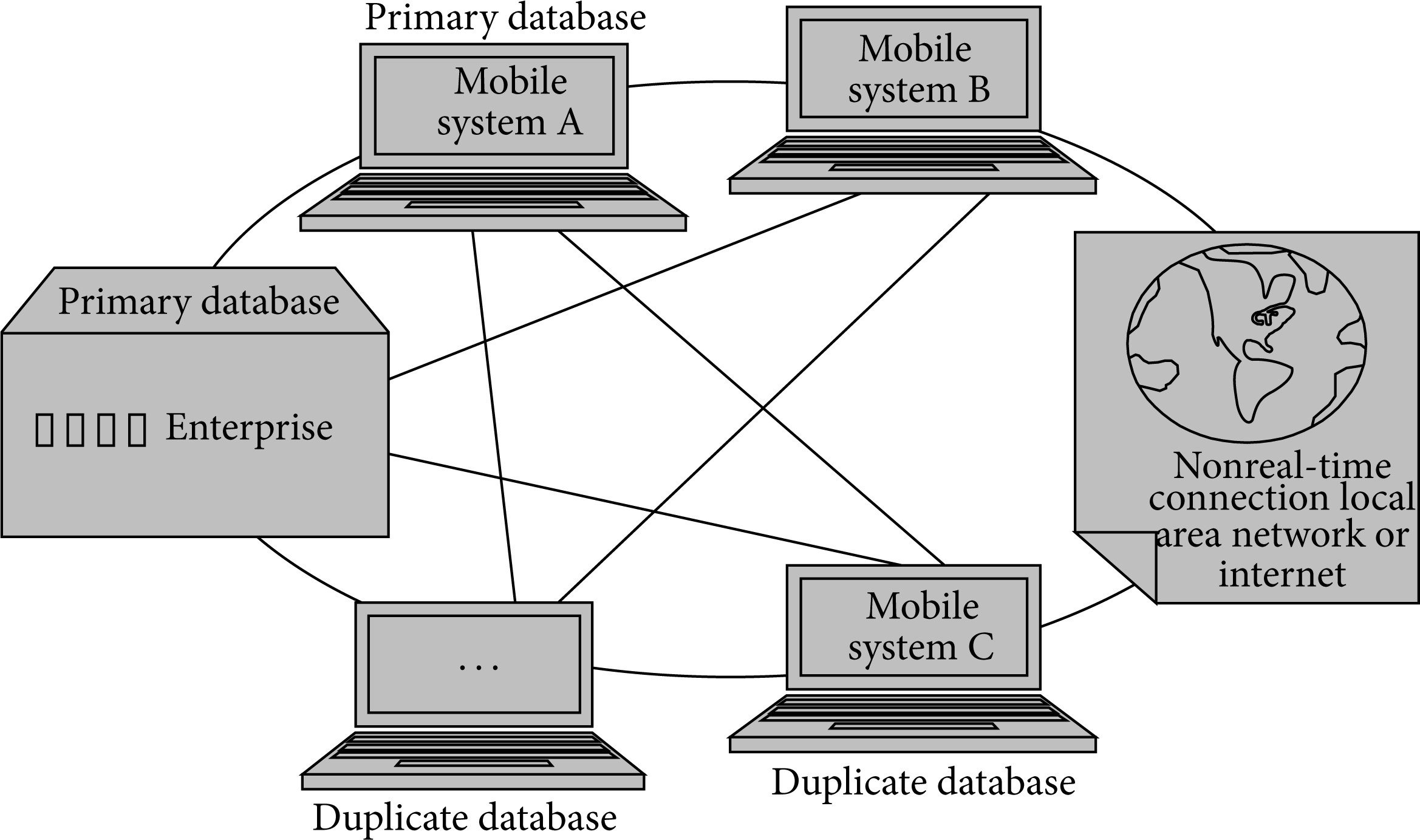
The schematic plot of optimistic replication method in the C/S structural system in mobile environment.
The integration among the cloud manufacturing sharing platforms mainly reflects the integration among the manufacturing application providers. In the design thinking layer, the integration usually adopts the data share mode or the realized public design thinking mode; in the application tool layer, generally, the reuse of the service tool is achieved via the design of the open interface; and, in the application service layer, the complementation and integration of the cloud manufacturing platform are achieved by mutually invoking among the services. The manufacturing resource/manufacturing capacity, the manufacturing cloud, and the manufacturing whole-life cycle application in the cloud manufacturing system [4] can, respectively, provide supports by the above-mentioned design thinking layer, the application tool layer, and the application service layer. Adopting the cloud manufacturing service mode shown in Figure 2, the design thinking layer exists independent of the application layer to form a specialized data cloud service. This data cloud is voluntarily provided by relevant enterprises and is realized by means of the public design thinking service.
3. The Cloud Manufacturing Service System Based on Log
3.1. Manufacturing Process of Manufacturing Resource Location Data
In optimistic duplication, product data consistency control based on log suggested in this article is achieved via exchanging the modified log record of the data among nodes of different primary copy. A unified log record structure is adopted for the modification of all data in this method. The overhead recording data change only depends on the modification frequency of product data, and the frequency of data synchronization is irrelevant of the size of individual product data item and the quantity of data item and primary copy. Therefore, a large number of storage and network transmission overhead will be saved. Furthermore, the log organization mode provided in this article will save space consumed by log effectively, which makes the consistency control of product data more flexible and much easier to be realized [5]. In the process of repair and maintenance of the equipment, the scheduling for a maintenance personnel usually is unable to be near response, and so forth, because of not controlling the location information of the faulty equipment and the maintenance personnel having qualifications. Applying the locating technology to the manufacturing field can help to locate and monitor the manufacturing resource and to control locations and states of all kinds of manufacturing resources in real time, thereby promoting the refinement, transparency, and just in time (JIT) to achieve the purpose of improving the production efficiency and economizing the production cost. As it were, the location data of manufacturing resources have important implications for improving the management refinement in each manufacturing process.
The rapid development of locating technology makes it possible to do the fine-grained locating, tracking, and managing of all kinds of manufacturing resources in the manufacturing field. The location information of the manufacturing resources, such as WIP, materials, personnel, and products, is integrated to establish a manufacturing resource location database, thus providing a powerful support for the transparency of workshop WIP and materials and the quick-response of personnel as well as the agility of the product services.
To support product data consistency control based on log effectively, product data model is designed as a two-tuple (Key, Value). At present, it is a common data model, which is the prerequisite that the method can be widely applied. For a single enterprise, establishing an enormous location database give rise to heavy maintenance cost and inefficient data utilizing for the lack of location information from external manufacturing resources.
3.2. Product Data Model and Data Operation
To support product data consistency control based on log effectively, product data model is designed as a two-tuple (Key, Value). At present, it is a common data model, which is the prerequisite that the method can be widely applied. “Key” is the unique identification of a set of data in product database, and the data could be a single data item as well as multiple data item jointly constructed; “Value” is the data corresponding to “Key”. A “Key” corresponds to one or a plurality of different “Value.”
Product data operation is defined as the following three kinds.
ADD (Key, Value), adding a “Value” to the data item corresponding to “Key” in data.
DELETE (Key, Value), deleting a “Value” in the data item corresponding to “Key” in data.
CHANGE (Key, Value), firstly deleting all the values corresponding to “Key” and adding to a given “Value”.
Meanwhile, it is set that if we repeatedly implement the same ADD, DELETE, or CHANGE operations on the same data item, then, the later operations after the first time make no difference to the product data.
3.3. The Log Record Method of Product Data Modification
Both the primary database and duplicate database can independently operate the present node in distributed product data storage manner. The unified data modification log record method must be adopted to make the log become the basis of the data consistency control. LOG could be composed of two single LOG items in the following formats.
(A, KEY, and VALUE): used for recording the operation of adding the “Value” to the “Key”.
(D, KEY, and VALUE): used for recording the operation of deleting the “Value” from the “Key”.
The LOG only records the operation that makes the product data change. If and only if the modification of product data has already been submitted and completed, this operation could be recorded in LOG record. For example, a value is add to a data item corresponding to a “Key” as the value already exists in this data item, or deleting a data value that does not exist. No change occurs to the product data. Thus, such operation will not be recorded in LOG and LOG storage overhead could be saved. There is no CHANGE operation in LOG item, because it can be realized via first DELETE operation and later ADD operation.
The whole LOG is divided into a number of LOG domains after product data consistency control. In the same primary or duplicate database, a LOG domain includes the LOG items of all data update in the intervals of twice data consistency control. (ID, CRE-TIME) is identified as a mark of all the LOG domains within a same node. ID is the identification number of the node, and CRI-TIME is timestamps for identifying the creation time of LOG domain.
LOG domain is built in local node database. Once the domain begins to conduct data consistency with other nodes, the current LOG domain should be closed before transmitted to other node database. A new LOG domain identification will be created when the data consistency is completed.
Because different node databases often make product data consistency with other node databases, different LOG domains are made as smallest data unit to conduct transmission and exchange. Therefore, in fact, LOG is a mixture of the LOG domains created locally and those created on other nodes.
The positioning conditions of the manufacturing resources are recorded from the manufacturing, logistics, and sales to the product maintenance by combining all kinds of positioning technologies in order to form the rich location design thinking. These location data can be distributed on different resource clouds, and the manufacturing resource locating clouds (as shown in Figure 3) are formed by the data share and integration, and the manufacturing resource locating clouds will provide supports for the upper cloud manufacturing services.

The basic mapping relationship of log and data operation.
4. The Implementation Process of the Product Data Consistency Control of Cloud Locating Supports
4.1. Support for WIP and Material Locating of a Transparent Workshop Service
Under the support of the cloud locating platform, an enterprise can obtain the position information of WIP and material in the workshop during a certain period. The enterprise can understand current circulation and consumption conditions of WIP and material by querying position information of WIP and material and can also grasp the circulation and use conditions of WIP and material in the past certain time, thereby achieving the vitrification of WIP and material in the workshop. The positions of WIP and material are important production information, which can reflect the production line status, the material consumption condition, the inventory situation, and other production conditions. Grasping the positions of WIP and material can provide a direct basis for the control of the production rhythm and the material scheduling and also provide a basis for the production improvement, thereby reducing waste and speeding up decision making and production efficiency.
4.2. Support for Personnel Locating of an Agile Supply Chain Service
Essentially, the product data consistency control based on log is achieved through synchronizing the log data stored in different primary duplicate database. The obtained difference log is mapped to data operation modification language through local system to modify local database to achieve data consistency. The supply chain helps the enterprise to ship and also helps the enterprise to obtain the material, and the quick and smooth supply chain can help the enterprise to reduce the inventory, at the same time, to reduce the material shortage, thus saving costs for the enterprise and keeping a fluency of production.
It is included as an example of descripting the following process that database A asks database B to conduct data consistency control. The upstream and downstream enterprises can reasonably arrange the production, the material delivery, and other activities in accordance with the query results of the manufacturing resource information.
Under the support of the cloud locating platform, the enterprise provides the query permissions of this enterprise's material condition for the upstream supplier, and the supplier draws up a reasonable production plan and a material delivery plan depending on the queried material condition and in accordance with the materiel condition and the supplier condition. At the same time, the enterprise also provides the position information of product transportation vehicles, and the downstream enterprise arranges the storage and production plan in accordance with this information.
4.3. Quick-Response Service for Product Positioning
The state vector of A includes the state of other primary duplicate databases B and C that the current A has known. Meanwhile, the state vector is also reflected in the LOG of A. The transmission overhead required in the process is very small.
The product positioning provides location information of products for enterprises, when the products break down or are stolen, the nearby person who can deal with it will be sent to conduct the maintenance, in accordance with current positions of products, thereby achieving the service agility.
Under the support of the cloud locating platform, when the products appear failures, the enterprise can query faulty product locations for the cloud locating database, at the same time query the locations, qualifications, and states of maintenance personnel around the faulty products. The enterprise timely sends the maintenance personnel who are nearest to the failure locations, have maintenance qualifications, and have free time to conduct the maintenance according to the queried product and maintenance personnel information.
4.4. Support for the Cloud Locating Platform
With the continuous modification and consistency control of product data, the log increases continuously. Thus, the efficiency of the system will be reduced in a period of time. Therefore, the maintenance for the log should be made to guarantee the working efficiency of the system. The cloud locating platform will integrate position information of all kinds of manufacturing resources in each enterprise to provide a convenient and efficient positioning service for the manufacturing enterprises and to provide a bridge for communicating among each enterprise, in order to promote the coordination among enterprises.
In order to contact each enterprise in the industry chain to communicate, the enterprise can open the query permission of this enterprise's manufacturing resource for the industry chain or other relevant enterprises in the area and at the same time can obtain the query permissions of other enterprises' manufacturing resources. The enterprises which obtain permissions can query relevant manufacturing resources information based on permissions and conduct the design, production plan arrangement, materiel delivery, after-sales service, and so forth of products according to these information. Each enterprise conducts a coordination operation for the design, production, logistics, after-sales service, and so forth, which ties the cloud locating platform.
5. Cloud Manufacturing Service Framework in Which the Design Thinking Cloud
For any one of database, when the LOG domains included in this node have already been copied to all the databases in the system, then the LOG domains could be deleted from the node. Because it will never be requested by other databases. As well, for the LOG item, if the LOG item no longer made any difference to the data in the system, it can be deleted from LOG either.
The copy will ultimately be made to conduct consistency control with primary database in product data primary copy distributed storage mechanism. Therefore, creating a log maintenance system in primary database is feasible. The maintenance system judges which logs have been useless for the system. Instructions are issued to delete the spam logs when the copy conducts consistency with the primary database. Generally, the ADD and DELETE items adopted in this article may be removed from the system. In the cloud manufacturing service mode shown in Figure 2, a manufacturing resource design thinking cloud service can serve as a kind of public infrastructure, independent of the cloud manufacturing sharing platform. The cloud manufacturing sharing platform provides application tools and application clouds and other different levels of services as well as the whole service plan integrated by them in order to provide a support platform for the cooperation between the manufacturing service demander and the manufacturing capacity provider.
In that framework, the manufacturing resource design thinking itself is a kind of cloud service. Different operators can establish private or public manufacturing resource design thinking clouds through relevant infrastructures. On this basis, they can integrate existing standards, resource parameters, and other public database. These design thinking clouds and public database form a powerful design thinking cloud by the share and integration.
The cloud manufacturing service is realized through the cooperation between the design thinking cloud and the application cloud. But for users, the design thinking cloud is not visible, and it exists as a kind of common resource. Users can indirectly use public manufacturing resource data provided by the design thinking cloud as long as they access the cloud manufacturing sharing platform.
The product data consistency control method based on log is practically applied in the “sale management subsystem” of the “HTMC Product Data Management System” software in a large-scale injection molding machine enterprise.
Because the sales forces in the large injection molding machine enterprise are usually on business in other places, the data in the duplicate database of C/S structural “sale management subsystem” cannot guarantee the real time consistency with the data in the primary database in the enterprise, mainly reflected in two aspects: (1) the data are not consistent with the latest product information in the primary database of the enterprise; (2) the users' order information collected by the sales representative is not consistent with that in the primary database of the enterprise. However, the sales representative needs to timely obtain the latest product information and provide it to users, and the enterprise needs to timely obtain the order information that the sale representative gets. Then, data consistency control is required.
Under the nonreal-time linkage situation, the consistency control is achieved between the data of the portable “sale management subsystem” and that of the primary database in the enterprise and other duplicated portable “sale management subsystem”, so that the enterprise could obtain the customer order collected by the moving “sale management subsystem” within a short time and win time to configure the product by order. Simultaneously, the “sale management subsystem” obtains the latest order information and product information to help the customer understand the enterprise and the product and increase the customer's trust degree on the enterprise. Due to limitation of pages, we take just the example of the related software interface of the consistency control of customer order data in the sale management subsystem to describe the application of the method in practical software.
Before data consistency control, the customer order data in a certain “sale management subsystem” include not only the just collected customer order, but also the order information obtained after conducting data consistency with the customer order of other primary copy databases. The data need to be provided to the customer regularly to win their trust. After data consistency, the customer order data in the primary database of the enterprise can be ensured integrity. The data consistency control interface can determine which primary copy database in the system is chosen to make data consistency control and determine what information can be conduct consistency. Synchronization process is displayed on the interface, and consistency control result is timely provided.
According to the statistics of the example, the data volume required to be transmitted is 82 KB when adopting the method in this article while the data volume is 367 KB when adopting the traditional data consistency control method. The reason that the data volume is reduced lies in what need to be transmitted in the network is just the state vector and the inconsistent log item when adopting the new method mentioned in this article while all the data in the database need to be transmitted in traditional method. The reduction of data volume will be more outstanding for the larger database. At present, for the general Internet network environment, the reduction of data volume mentioned enables the data consistency control of larger database in mobile environment to be realized. And the communication time and expenses of data are reduced. Meanwhile, the efficiency of data consistency control is increased.
6. Conclusion
The difference between the product data consistency control method adopted in this article and the existing data consistency control method is mainly reflected in the architecture and data replication method adopted.
Compared with the architecture adopting the metadata record, the architecture based on log record suggested in this article is used for recording the overhead of product data change. And the overhead depends on the modification frequency of data item, the frequency of data consistency control and has nothing to do with the size of individual data item and the quantity of data item, and the number of the copy in the system. The efficiency in consistency control is much higher and a large number of storage overhead will be saved.
Compared with the traditional data consistency control replication method, the optimistic replication method adopted in this article is conducting the update propagation after transaction, and all the information is written in the updating transaction. Then, the network communication overhead could be effectively reduced. Meanwhile, the cost caused by the error is low. What we need to do is just abandon local data update. The error has nothing to do with other nodes in the system.
In the rapid development of network technology today, although the pattern of “fat” server and “thin” client has been developed and promoted step by step, the disconnected C/S system pattern will still continue to survive because of the factors such as the complexity of the mobile environment and the distribution of geography position.
Conflict of Interests
There is no conflict of interests between State Key Laboratory of CAD&CG and SANYHE International Holdings Co., Ltd., such as financial gain. All of the results of this paper are shared.
Footnotes
Acknowledgments
This work was supported by the Science Fund for Creative Research Groups of the National Natural Science Foundation of China (Grant no. 51221004), the National Natural Science Foundation of China (Grant nos. 51005202, 51175456, and 70902061), and the Zhejiang Provincial Natural Science Foundation of China (Grant no. LY13G020003). Sincere appreciation is extended to the reviewers of this paper for their helpful comments. And sincere appreciation is also extended to Yixiong Feng who is the corresponding author.