




Abstract
The objective of this paper is numerically to study the heat and flow characteristics of temperature-sensitive ferrofluid in the square cavity with and without the magnetic intensity. The numerical model was developed to predict the behavior of the ferrofluid using finite element method (FEM) and showed good agreement with the existing data within 5% at all Rayleigh number ranges from 103 to 106. Natural convection and heat transfer characteristics of the ferrofluids within the tested cavity were found to depend on both magnetic intensity and magnetic volume fractions of magnetite. In addition, the mean Nusselt numbers and mean velocity of the ferrofluid in a square cavity were increased with the rise of the magnetic intensities and increased by 23.2% and 143.7%, respectively, at both magnetic intensity of H = 10000 A/m and the elapsed time of t = 30000 seconds.
1. Introduction
The ferrofluid, which means novel functional fluids using functional materials, has both characteristics of metals and fluids. The ferrofluid generally consisted of magnetite nanosized particle of around 1 to 100 nm and carrier liquid such as water, oils, and hydrocarbons with the aid of surfactants in a continuous carrier phase. It can be controlled by both magnitude and direction of an external magnetic field and temperature [1–12]. In addition, because of the nanosized magnetic particles consisting of the ferrofluids and the surfactant attached to magnetic particles, the ferrofluid could be prevented from particles sticking to each other or precipitate with Brownian motion [2]. Therefore, the ferrofluid could be applied for various industrial fields: enhancement and depression of the heat transfer of the thermal devices, magnetic sealing, damping and bearing of machines, energy conversion system, drug delivery for disease curing, optical devices, micro-/nanofluidic devices, and so forth [3–5].
Numerous numerical and experimental studies have been widely investigated scientifically for various scopes of application. Horng et al. [3] reported the structural pattern formation of the magnetic columns in the ferrofluid thin film under magnetic fields and framework of the application of the ferrofluid based on the remarkable optical properties caused by these magnetically induced structures. Wang et al. [6] studied the effects of magnetic force on the natural convection in porous enclosure under magnetic field. They explained the heat and flow characteristics on the effect of the inclination angle, Darcy number, and magnetic force parameter. Basak et al. [7] analyzed the heat flow due to natural convection within porous trapezoidal enclosures with hot bottom wall and cold side walls in presence of insulated top walls. They examined the thermal mixing within the cavity for various material processing applications and suggested the generalized non-Darcy model, neglecting the Forchheimer inertia term, to predict the flow in porous medium. Zhao et al. [8] introduced the novel optical devices based on the tunable refractive index of ferrofluid and their characteristics. They reported that the developed new method would play an important role in the fields of optical information communication and sensing technology. Wang et al. [9] investigated synthesis of Fe3O4 ferrofluid used for magnetic resonance imaging and hyperthermia, which was to obtain a stable water based ferrofluid with fast magnetotemperature response for using itboth in magnetic resonance imaging (MRI) and ferrofluid hyperthermia (MFH) with protecting magnetic precipitates from oxidation. Jin et al. [10] simulated a porous cavity filled with thermosensitive ferrofluids using the lattice Boltzmann method (LBM). They showed the magnetization, heat, and flow characteristics of ferrofluids on the effect of the Rayleigh number and the magnetic Rayleigh number. However, concise and precise studies on the thermal and its flow control of the ferrofluid in a cavity are few in open literature.
The objective of this study is to numerically investigate the heat and flow characteristics including the control of the heat transfer of the ferrofluid in the square cavity with variations of the magnetic intensity and temperature difference between heated and cooled walls. In addition, the mean Nusselt numbers on heated and cooled walls were calculated with boundary conditions.
2. Numerical Method
2.1. Physical Model
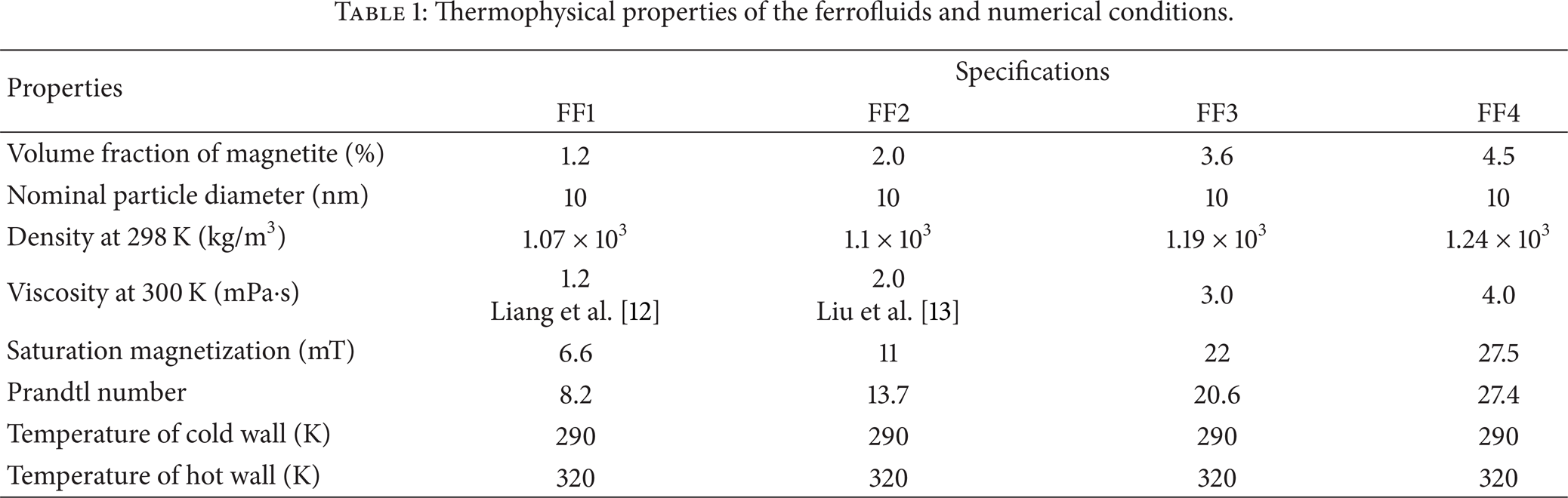
Figure 1 shows the physical model of the square cavity filled with temperature-sensitive ferrofluid. Because the magnetic force was caused by the interactions between the external magnetic field and magnetization [11], in order to observe the effects on the temperature of walls and magnetic intensity of the ferrofluid at the square cavity, temperatures of the left and right walls were maintained to be 290 K and temperatures of the bottom and top walls were 320 K and 290 K, respectively. Magnetic intensities ranged from 0 to 15000 A/m with the interval of 1000 A/m and wereapplied uniformly along y-direction at bottom wall, respectively. Velocities of x- and y-directions at initial conditions were assumed to be 0 and with no-slip boundary conditions at all walls. Table 1 showed the thermophysical properties of the ferrofluids used in the numerical model. The thermophysical properties of the ferrofluids supplied by ferrofluid manufacturing company were used. The nominal diameter of magnetite particles was 10 nm and the base solution of the used ferrofluids was water. The volume fractions of magnetite of the ferrofluid were varied from 1.2% (FF1) to 4.5% (FF4).
Thermophysical properties of the ferrofluids and numerical conditions.

Schematic diagram of the physical model for ferrofluid in the square cavity.
2.2. Governing Equations
The conservation equations for mass, momentum, and energy are expressed using Equations from (1) to (3) as transport equations of a natural convection problem and the governing equations for magnetization and Maxwell are expressed using (4) and (5) suggested by Sawada et al. [16]:





where magnetic induction vector (
Several physical assumptions as well as the well-known Boussinesq approximation are used to solve the above equations [18]. The thermophysical properties of ferrofluid are only function of the temperature and there is no internal heat generation by chemical reaction (ρR = 0). Also, density difference is the only function of temperature difference. Then, the density difference in the mass conservation could be negligible. The particles in the momentum conservation do not have the couple of volumes (ρ

That is, the governing equations describing a natural convection of a ferrofluid are rearranged as adding the magnetic term to the momentum equation, where ρ r is the representative density of ferrofluids, p is the pressure, η is the dynamic viscosity, η1 is the eddyviscosity, M0 is the equilibrium magnetization strength, β is the cubical expansion coefficient, T is the fluid temperature, T r is the representative temperature, g is the gravitational acceleration vector, C p is the specific heat at constant pressure, k is the thermal conductivity, and ω is the rotational angular velocity vector of fluid.
The above governing equations could be rearranged as dimensionless forms like (8) using the dimensionless analysis technique [20]:
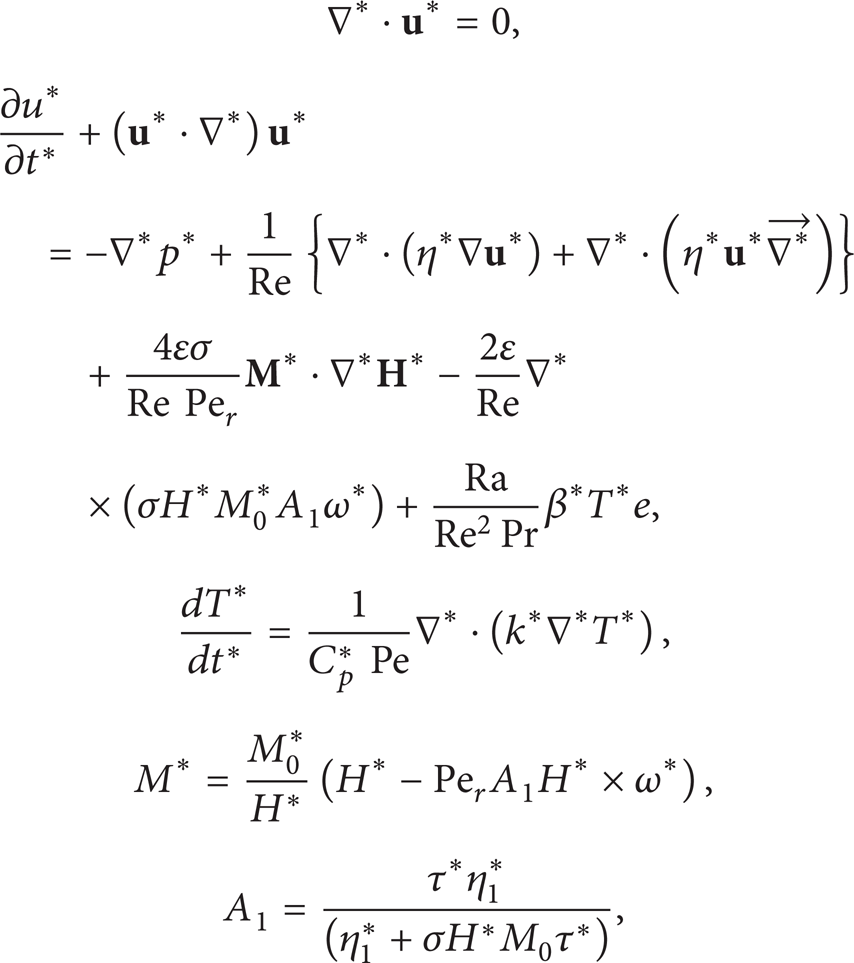
where Re is the Reynolds number, ∊ is the polarity effect parameter, σ is the magnetic effect parameter, Pe r is the rotational Peclet number, Ra is the Rayleigh number, Pr is the Prandtl number, and e is the unit vector of direction of the gravitational acceleration [21, 22]. Dimensionless parameters are expressed as follows:
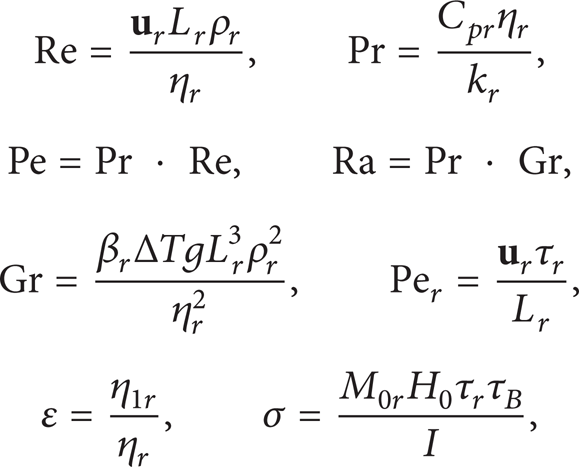
where H0 is the intensity of applied magnetic field,τ
B
is the relaxation time of a Brown motion, and subscript r is the representative value of each parameter in the dimensionless process. Also, the representative velocity, u
r
, was calculated using
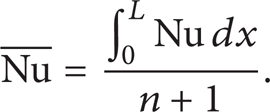
The local Nusselt numbers on the heated wall were defined as (10) and the mean Nusselt numbers on the heated wall were calculated using local Nusselt numbers like the following:

2.3. Algorithm
The governing equations were calculated using generalized simplified maker and cell method (GSMAC) suggested by Kawai et al. [24] and the finite element method (FEM) suggested by Vinogradova and Zarubin[25]. And they were finally expressed as forms of the discretization equations from (12) to (13)
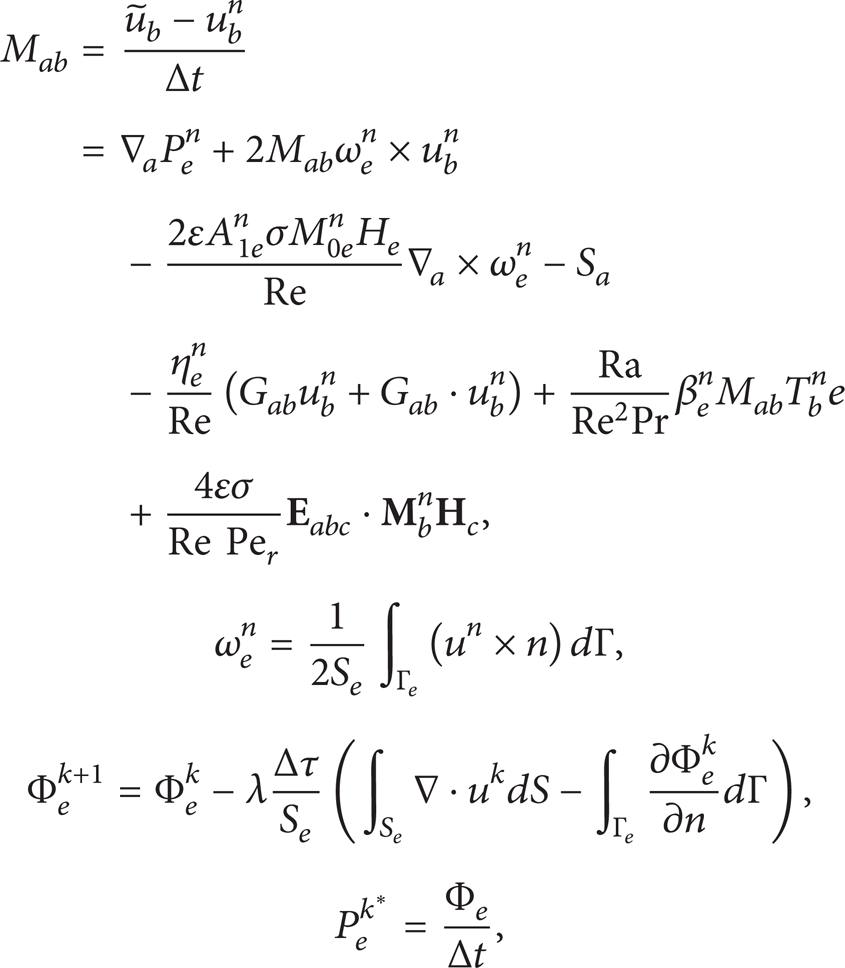
where

Based on the research of Seo [26], the numerical analysis was iteratively calculated until the tolerance is converged. In order to decide the proper grid size and number, mesh sensitivity analysis with different numbers of mesh size (20 × 20, 30 × 30, and 40 × 40) was performed under Ra = 103, H = 0 A/m, aspect ratio = 1, cold wall temperature of 300 K (left, top, and bottom walls), and hot wall temperature of 320 K (Right wall), as shown in Figure 2. Reasonably good agreement of 3.32% deviation was found between the 20 × 20 and 40 × 40 grids at the value of maximum velocity and therefore the grid used was 40 × 40 for considering a proper iteration time and the accuracy of the results. In other words, the case with 40 × 40 grids was used for deciding both the accuracy and convergence rate taken into account. Figure 2 shows the comparison of the velocity distributions of the ferrofluid in the square cavity at different number of grids. In addition, the steady state of the ferrofluid in the square cavity was decided at temperature difference of 10−5 K between the initial state and final state during 0.5 second. The interval of isotherms was 0.05.

Comparison of the velocity distributions with the number of grids: 20 × 20, 30 × 30, and 40 × 40.
3. Results and Discussion
3.1. Validation
Validation of numerical solution was carried out and compared with that of Barakos at al. [14] and that of Markatos and Pericleous [15]. Temperatures of both top and bottom walls of the cavity maintain adiabatic state. Temperature of the left wall maintains hot state and temperature of the right wall maintains cold state. All conditions except the above-mentioned conditions were similarly maintained with conditions considered in the previous researches. Table 2 shows the comparison of the mean Nusselt numbers with the existing data. The predictions of the present model showed good agreement within 5% of the data of other researchers. The mean and average deviations between the present data and the existingdata were 1.0% and −0.77%, respectively, for Barakos at al. [14], 2.0% and −2.0%, respectively, for Markatos and Pericleous [15], at all Rayleigh numbers ranges from 103 to 106, as shown in Figure 3.
Comparisons of the mean Nusselt numbers.


Comparison of the present data of the developed model with the data by existing numerical models.
Comparisons were performed keeping a temperature difference of 20 K between the vertical walls of the square cavity and establishing the reference temperature at 293 K. Therefore, from Figure 3, we could be confident that the present analysis and model used are correct.
3.2. Nature of Isotherms
We present the numerical results for isotherms. The isotherm characteristics of the ferrofluids were analyzed under both nonmagnetic and magnetic intensities and also compared with the data of the Newtonian fluid. Newtonian fluid used in this study was water. And numerical analysis was conducted at Ra = 105 and took 7 minutes at each condition.
Figure 4 shows the isotherm characteristics of the Newtonian fluid and ferrofluid with the magnetic volume fractions of 2.0% (FF2) and 4.5% (FF4), respectively, of the square cavity under nonmagnetic intensity (H = 0 A/m) and the elapsed time of 10000 seconds. Heat transfer of the Newtonian fluid in the tested cavity was slightly activated more than that of the ferrofluid because the magnetite of the ferrofluid could not increase the heat transfer under nonmagnetic intensity. In addition, the heat transfer decreased with the rise of the magnetic volume fractions from 2.0% (FF2) to 4.5% (FF4). This is because the number of particles of magnetite per unit volume increased by 118.2%. It could not be helpful to activate the heat transfer of the ferrofluid in the tested cavity under nonmagnetic intensity.

Comparisons of the isotherms at t = 10000 seconds under nonmagnetic intensity (H = 0 A/m).
Figure 5 shows the isotherm characteristics of ferrofluids under magnetic intensity (H = 15000 A/m) with the variation of the magnetic volume fractions from 1.2% (FF1) to 4.5% (FF4) of the square cavity after the elapsed time of 10000 seconds. As shown in Figures 4 and 5, isotherms of the ferrofluid under the magnetic intensity (H = 15000 A/m) expanded more rapidly than that of ferrofluid under the nonmagnetic intensity (H = 0 A/m) at the same time due to the increased magnetic volume force at the given magnetic intensity. In addition, the heat transfer of the ferrofluid in the tested cavity under magnetic intensity (H = 15000 A/m) increased greatly with the rise of the magnetic volume fractions from 1.2% (FF1) to 4.5% (FF4) due to the increased heat transfer. Namely, this is because the diffusive concentration gradients lead to the coupling effect between heat and mass transport as mentioned in Rinaldi et al. [2] Also, the presence of the magnetic intensity tends to accelerate the fluid motion inside the tested cavity as mentioned in Grosan et al. [27].
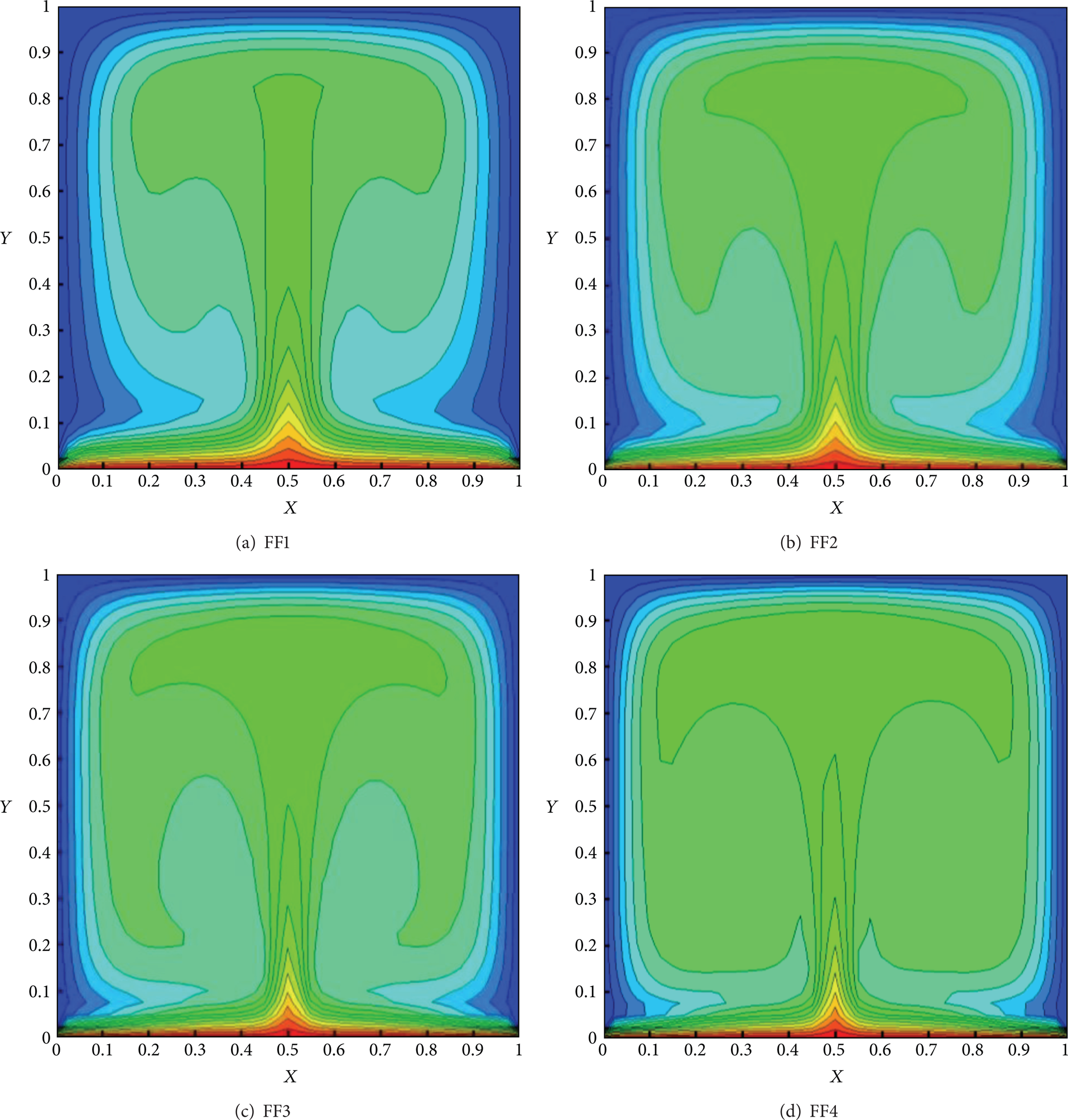
Comparisons of the isotherms at t = 10000 seconds under magnetic intensity (H = 15000 A/m).
Figure 6 shows the effect of the isotherms and mean Nusselt numbers on the temperature difference between top and bottom walls of the tested cavity under the elapsed time of t = 10000 seconds, magnetic intensity of H = 15000 A/m, and magnetic volume fractions of 2.0% (FF2). Temperature difference in the tested cavity was changed with 30°C to 50°C. The expansion speed of the isotherms counter of the ferrofluid in the tested cavity increased with the rise of the temperature differencebetween top and bottom walls because it caused an increased heat flow by natural convection with the rise of the density difference, as shown in Figure 6(a). Namely, increased temperature difference between top and bottom walls of the square cavity means the increased superficial magnetic volume force of the ferrofluid at the given magnetic intensity. In addition, the mean Nusselt number was increased from 12.70 to 12.84 with the rise of the temperature difference from 30°C to 50°C due to the increased superficial magnetic volume force, as shown in Figure 6(b). Also, increased temperature gradient causes a concentration gradient of magnetic particles and leads to diffusive concentration gradients known as Soret effect by Lange [28].

Effect of the isotherms andmean Nusselt numbers on the temperature difference between top and bottom walls at t = 10000 seconds, H = 15000 A/m, and magnetic volume fractions of 2.0% (FF2).
3.3. Nusselt Numbers
Figure 7 shows the mean Nusselt numbers and velocity vectors in the square cavity with the volume fractions of the magnetite and magnetic intensities at the elapsed time of t = 30000 seconds at Ra = 105. And it took 21 minutes at each condition. Figure 7(a) shows the mean Nusselt numbers of the present model. The mean Nusselt numbers of the ferrofluid under magnetic intensities of H = 5000 A/m and H = 10000 A/m, respectively, increased by 9.6% and 23.2%, respectively, with the rise of the volume fraction of magnetite from 1.2% (FF1) to 4.5% (FF4) due to the increased heat transfer with the rise of the magnetic intensities. The increased heat transfer means the increased isotherms expansion speed of ferrofluids in the tested cavity with the rise of the mean velocities as shown in Figure 7(b). The mean velocity increased with the rise of the volume fraction of magnetite and magnetic intensities. Figure 7(b) shows the mean velocity of the present model. The mean velocity increased by 49.4% and 143.7%, respectively, at the magnetic intensities of H = 5000 A/m and H = 10000 A/m, respectively.
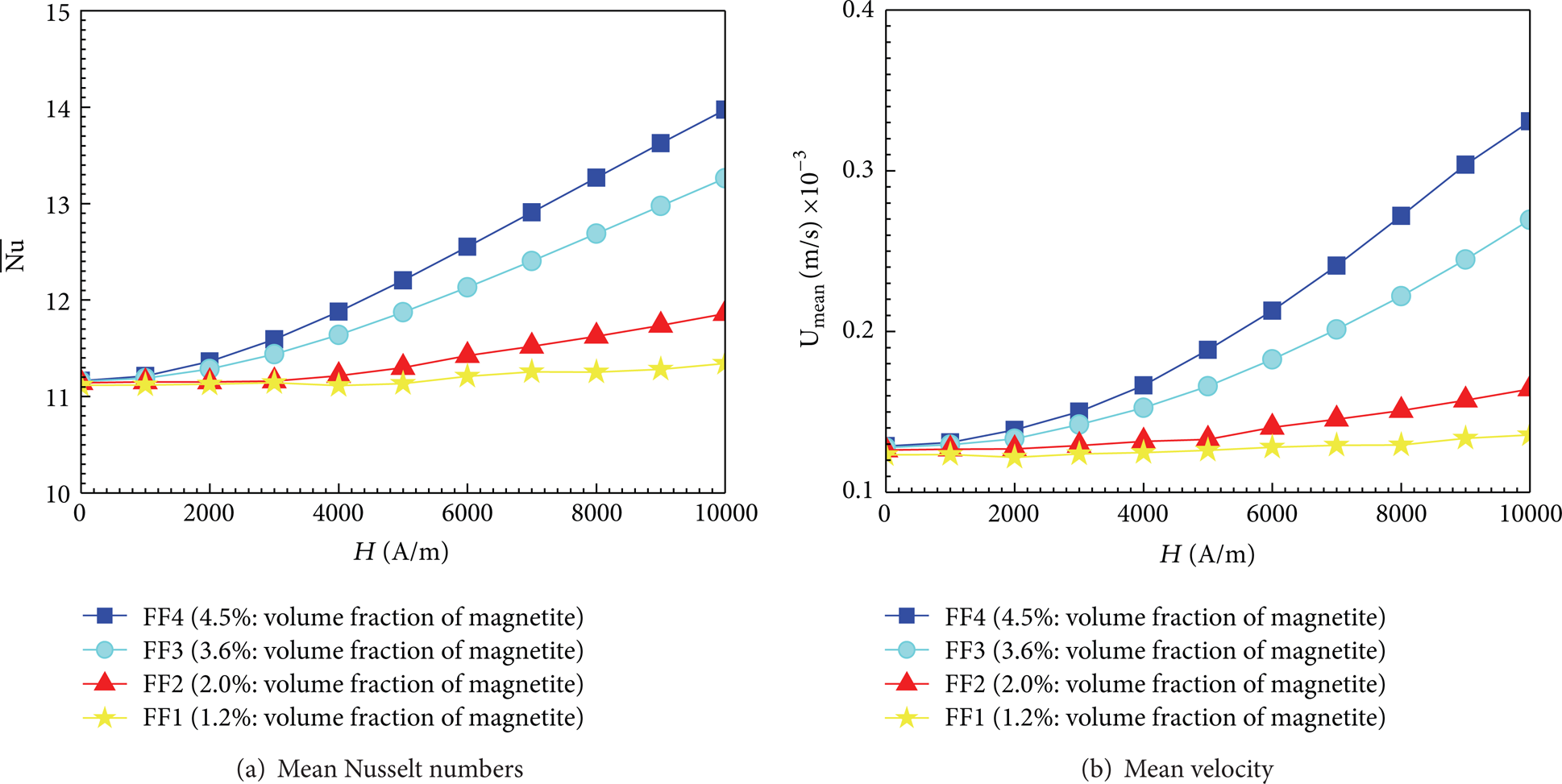
Mean Nusselt numbers and mean velocity with various magnetic intensities at t = 30000 seconds.
4. Conclusions
This study investigated numerically the heat and flow characteristics including the control of both suppression and enhancement of the heat transfer of the ferrofluid in the square cavity with variations of the magnetic intensity and temperature difference between heated and cooled walls. The mean and average deviations between the predicted data by developed model and the existing data were 1.0% and −0.77%, respectively, for Barakos at al. [14], 2.0% and −2.0%, respectively, for Markatos and Pericleous [15], at all Rayleigh number ranges from 103 to 106. Heat and flow characteristics of the ferrofluids within the tested cavity were found to depend on both magnetic intensity and magnetic volume fractions of magnetite. Isotherms of the ferrofluid under the magnetic intensity of H = 15000 A/m expanded more rapidly than those of the ferrofluid under the nonmagnetic intensity (H = 0 A/m) at the same time due to the increased magnetic volume force. And the mean Nusselt number and the expansion speed of the isotherm contours of the ferrofluid increased with the rise of the temperature difference between top and bottom walls in the tested cavity. In addition, the mean Nusselt numbers and mean velocity of the ferrofluid were increased with the rise of the magnetic intensities and increased by 23.2% and 143.7%, respectively, at both magnetic intensity of H = 10000 A/m and the elapsed time of t = 30000 seconds.
Footnotes
Acknowledgment
This research was supported by Basic Science Research Program through the National Research Foundation of Korea (NRF) funded by the Ministry of Science, ICT & Future Planning (no. 2013R1A1A1062152), and Business for Cooperative R&D between Industry, Academy, and Research Institute funded Korea Small and Medium Business Administration in 2013 (Grant no. C0102915).