




Abstract
Dual-cycle cognitive model (DCCM) is an effective means to develop the future large-scale cognitive wireless networks. In this paper, the DCCM is considered to construct cognitive wireless netwroks, in which the structure and implementation of service-oriented radio architecture (SORA) are expounded. Using SORA, a DCCM-based wireless resource management is considered in design and implementation of cognitive wireless networks. It shows that our proposed DCCM-based SORA is able to provide loosely coupled, reusable, and scalable implementations in machine-to-machine (M2M) heteogeneous wireless networking environment, while the intelligence of network can be improved.
1. Introduction
Cognitive radio technology has been developed during the last decade and played a crucial role in wireless communications. However, large-scale and heterogeneous wireless network environments have posed us big challenges with respect to the design and implementation of cognitive wireless networks. Since the cognitive wireless networks with various air interfaces require a great deal of sensors to monitor the surrounding environment, the interactions between these sensors and heterogeneous wireless networks may cause troubles in the process of system integration. Moreover, multiple hierarchies drive the design and management of cognitive wireless networks to be even more complex. Accordingly, a series of schemes have been considered in design and implementation of cognitive wireless networks.
Mitola proposed the observe-orient-plan-decide-act-learn (OOPDAL) loop to support the concept and architecture of cognitive radio in 1999 [1]. The OOPDAL loop is an abstract model to describe the operation process of a cognitive radio system, which is also known as the extension of Boyd's observe-orient-decide-act (OODA) [2]. In addition, Thomas designed his cognitive model based on the OODA loop [3]; Balamuralidhar divided the communication process into five phases to build the sense-analyze-decide-reconfigure-communicate (SADRC) loop [4]; Fortuna modified the OOPDAL loop and proposed the sense-plan-decide-act-learn-policy (SPDALP) loop [5]. All these loops above provide the basic models in order to construct cognitive radio systems. Nevertheless, they may not be able to describe the whole operation process of cognitive wireless networks. Therefore, an alternative model has to be considered before we make a further discussion on the implementation of cognitive wireless networks.
As a key component of cognitive radio system, the software-defined radio (SDR) platform has been well studied. The SDRs are usually implemented with tightly coupled software communication architectures (SCA) [6], which lack flexibility and compatibility in the integration of heterogeneous components. On the other hand, since a variety of cognitive radio systems were developed on different software and hardware development platforms, the integration of heterogeneous cognitive systems is drawing wide attentions [7]. Particularly, building a large-scale and multinode test bed over wide areas becomes an urgent need for the research on future cognitive wireless networks and has already been concerned by the Europeans [8]. Fortunately, the machine-to-machine (M2 M) technology provides us with an efficient method to solve these problems. In [9], using the idea of service-oriented architecture (SOA) [10], a novel M2 M architecture named service-oriented radio architecture (SORA) has been developed to design and construct cognitive radio systems. In this respect, Virginia Tech has also built a cognitive radio open-source system (CROSS) to integrate cognitive engines based on different intelligent algorithms [11].
Although the SORA has provided us with a new way to implement the cognitive wireless networks, it may not be practical since only simple scenarios are considered on the application of SORA [10]. Thus, it is desired to consider the design and implementation of SORA in more realistic and complicated network scenarios. In this paper, using dual-cycle cognitive model (DCCM), a general structure of complex cognitive wireless networks is constructed with SORA. It shows that our proposed DCCM-based SORA is able to provide loose-coupling, reusability, and scalability implementations, especially in M2M heterogeneous wireless networking environments.
The rest of this paper is organized as follows. In Section 2, we will propose a generic model for multiple-hierarchies cognitive wireless networks named DCCM. In Section 3, the SORA will be introduced in detail. In Section 4, an intelligent wireless resource management system will be designed by the DCCM and implemented by the SORA. Finally, in Section 5, we conclude the paper.
2. Dual-Cycle Cognitive Model
2.1. Hierarchy of Cognitive Wireless Networks
In the long-term development on networking techniques, different types of networks come forth. They may adopt different access technologies, different hardware, and different network operators and lead to heterogeneous architectures. Fortunately, cognitive radio technologies provide compelling solutions, with which the networks could connect to each other. Therefore, the cognitive wireless networks, including the technology and architecture, have become popular research topics.
Among the researches of cognitive wireless network architecture, E2R is famous for its end-to-end reconfigurability [12]. Its aim is to design, develop, and test the configurable terminal and their suspending system structures, furthermore, to provide a systemic network solution for users, service providers, and the network providers. In order to implement these goals, the E2R proposes reconfiguration management plane (RMP). The RMP includes three fundamental function entities, that is, the reconfiguration manager (RCM), radio reconfiguration support function (R-RSF), and user equipment reconfiguration support function (U-RSF). These entities are located distributedly in different hierarchies of the network management field.
In order to combine the heterogeneous networks, IEEE 1900.4 has been developed [13], where the distributed decision-making architecture is used to optimize the resource utilization in a “network-terminal” format. With the spectrum management system, two dominating entities are defined within the standard: network reconfiguration manager (NRM) and terminal reconfiguration manager (TRM), both of which are components of the composite wireless network (CWN) that cooperate with each other to manage the network.
In addition, there exist other different cognitive wireless network architectures, including the dynamic intelligent management of spectrum for ubiquitous mobile network (DIMSUMNet) [14], and the OverDRiVE designed by the European Union [15], and the cognitive wireless cloud (CWC) proposed by NICT [16].
Through the investigation of various cognitive wireless network architectures mentioned above, several common characteristics can be concluded as follows.
The cognitive wireless networks all work in a hierarchical structure, which are abstracted as the following layers: core networks, access networks, and terminals. Function entities on different layers are considered with different operation characteristics: the management and control between the core networks and the access networks are coarse grained, of large time scale, and intelligent, while those between the access networks and the terminals are fine grained, of small time scale, and adaptive. Although the heterogeneity exists among different cognitive wireless networks, their cognition actions are almost similar and can be generally concluded to three phases, that is, sensing, decision, and action, which are regarded as the basic cycle behind all the cognitive wireless networks.
2.2. Dual-Cycle Cognitive Model
Obviously, according to the above analysis, OOPDAL loop or OODA loop cannot completely describe the behaviors of cognitive wireless networks. However, considering the structure of both loops, it is possible to combine them into a dual-cycle cognitive model (DCCM) that corresponds to the multiple-hierarchies structure of cognitive wireless networks.
Dual-cycle consists of the decision loop and the execution loop, where the former and latter loops are located on the up-level and the down-level of the cognitive wireless network, respectively. As shown in Figure 1, the dual-cycle cognition runs at the hierarchical network, while the core network is managed by the core level functional entity (C-FE), the access networks are managed by the radio access level functional entities (R-FE), and the terminals perform with the terminal level functional entities (T-FE).

Illustration of the double-cycle mode.
The decision loop is responsible for global network management and control, aiming at the global target. Figure 2 illustrates the detailed phases of the decision loop, including observe, orient, plan, decide, and act components. Note that the learn component is different from that in Mitola's OOPDAL, due to its operation in an offline manner in a loose-coupling way. Thus, we name it OOPDAL loop.
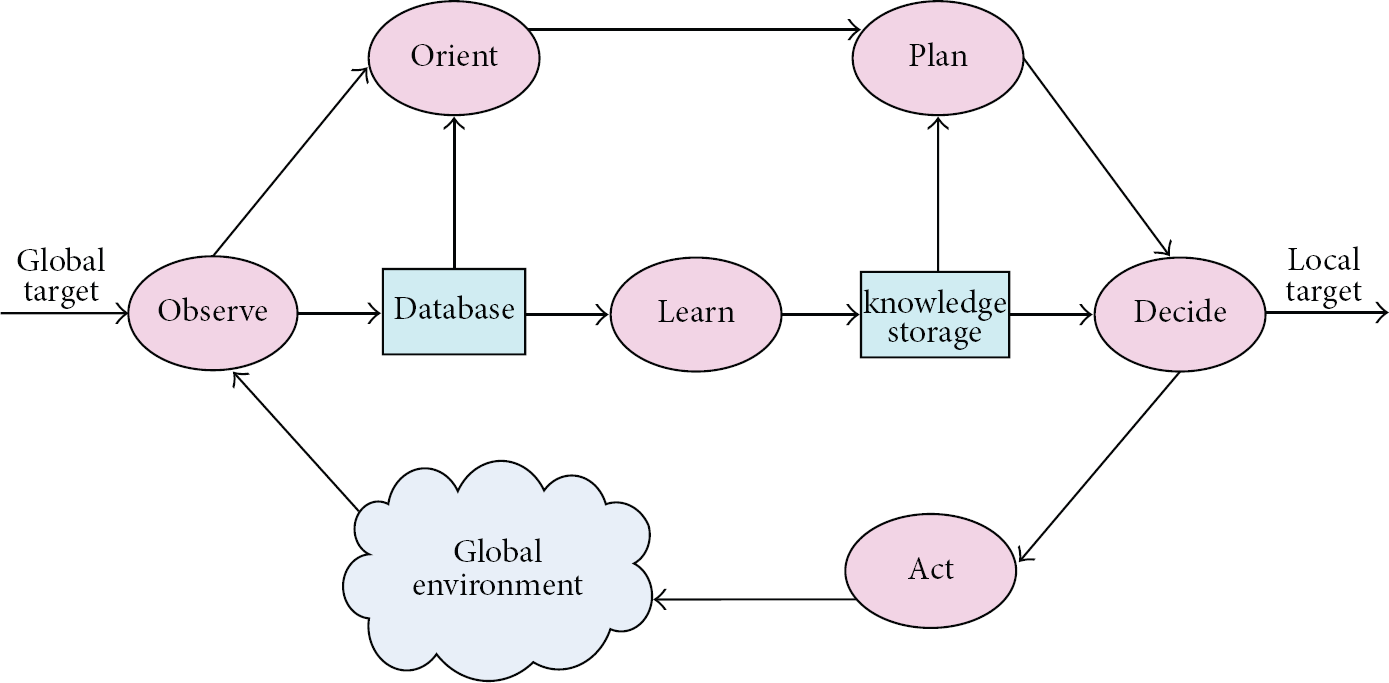
Illustration of the decision loop.
Using the database, the decision loop is able to gain information of global environment under the constraint of the global target to make orientations and plans. The plans are accordant to the whole variation and global change to form an optimal strategy. The strategy provides the up-layered adjustment and down-layered adjustment, while the upper-layered one is sent to the act component in this loop and the other is sent to the execution loop. As the background component, using the continuously updated database, the learn function renews the knowledge storage regularly.
The execution loop is responsible for local network management and control, aiming at the local target. Figure 3 illustrates the detailed phases of the execution loop, including observe, orient, decide, and act components. It receives the delivered policy as the local target and then makes the local plan with the observation of the local environment. Note that the execution loop is only performed within the local networks. After the loop operation is terminated, the local information is then sent to the upper decision loop.

Illustration of the execution loop.
The dual-cycle (decision and execution loops) configuration is tightly coupled, as shown in Figure 4. Since two loops manage different network parameters, take different network responsibility, and aim at different adjustment targets, from which we could consider them independent. In the other prospect, the execution loop sends local information to the decision loop, while the decision loop sends policy to the execution loop, and thus they are connected to shape a whole cognition process.

Illustration of the double-cycle relation.
3. Service-Oriented Radio Architecture
Our proposed SORA is an open architecture, where the principles and methodologies of service orientation are considered to design and integrate radio communication systems. Using SORA, different radio function modules are encapsulated into the network-base components (namely, services). Since radio services are published and discovered over networks, users are able to invoke and orchestrate different required services to implement various radio communication applications.
Two key issues are considered to define the SORA. Firstly, SORA is a distributed and modular system architecture, where the radio function modules can be deployed as services over networks. Secondly, SORA provides an open architecture, where the radio services adopt open and standardized interface descriptions and interoperation contracts. Overall, SORA is able to provide radio systems a number of advantages, such as loose-coupling, reusability, scalability, reconfigurability, and the capability of cooperative development.
All these characteristics of SORA lead to the significant improvement of flexibility and compatibility during the processes of radio system design, development, and implementation, especially for cooperative research, test, and exploitation.
3.1. Framework
The framework of our proposed SORA has been expounded in [9], where three terms are considered, namely, radio infrastructures, services, and applications. Specifically, radio infrastructures provide the basic function of radios (e.g., encoder, modulator-demodulator (MODEM), RF module, antenna, etc.), services act the infrastructure functionalities (i.e., blocks of the radio system that can be assembled), and radio communication applications are implemented through design and integration of various services. The three terms of the framework are specified as follows.
Radio infrastructures: it is known that different wireless networks (e.g., 2G/3G, Wi-Fi, and WiMAX) exist in the current wireless environment, simultaneously. In such an environment, the radio infrastructures can be characterized by the heterogeneity, as they could be based on different development platforms and may belong to different operators and networks. Three components are considered as the infrastructures, including antennas, RF modules, and multiple programmable processors. Services: using functionality description, different radio infrastructures are encapsulated and abstracted from the corresponding software/hardware platforms. The abstracted infrastructure is regarded as a service to be published, discovered, and invoked over networks. In our proposed architecture, the services are classified into four different categories, namely, waveform services, information security services, sensing services, and cognition services. Applications: through the service integration, a virtual radio is constructed to execute the different applications of radio communication.
According to the framework of our proposed SORA systems, we can show that the service layer plays a crucial role, since different radio infrastructures are encapsulated and abstracted as services to support the heterogeneity of underlying development platforms. Comparing to the traditional radio architectures, the services are deployed distributedly over different networks with our proposed SORA configuration, while a virtual radio system is constructed through integration of appropriate services to meet the requirements of different users. From this perspective, SORA is regarded as an agile virtualization method to assemble radio function modules in a network-based concept.
The implementation of SORA is based on a series of web service standards, including the web service description language (WSDL) for service description, the simple object access protocol (SOAP) for service interaction, and the universal description, discovery, and integration (UDDI) for service registration, publishing, discovery, and integration, respectively. The functions of these standards will not be introduced for simplicity, which have already been specified in [9].
3.2. Application Method
Three components are considered for SORA to construct the wireless communication systems, which are client, service provider, and registry. The client is regarded as a user who employs one or more services to implement a certain communication task according to its requirement. The service provider publishes various services into the registry in order to be discovered by the client. The registry acts as a public server for service publication and discovery. Through interactions among the above three components, an SORA-based wireless communication system can be constructed. The process of the construction is usually divided into four steps, including the service encapsulation, publication, discovery, and orchestration.
Service encapsulation: all the service providers need to encapsulate their radio function modules as the invokable web services. Then, the WSDL documents need to be generated to define relevant service functionalities. Service publication: the WSDL documents are published in a UDDI service registry over the IP core network, where the registry is developed by a third party for public service publication and discovery. Service discovery: the client accesses to the service registry by utilizing the SOAP messages to find out the required services in the service list. Correspondingly, the locations, interfaces, and operations of different services are discovered using the WSDL documents. Service orchestration: according to the order of the signal processing in the communication system, different discovered services are orchestrated by the client. Then, the services are invoked through the SOAP messages, where a virtual SORA-based CR access network is finally constructed.
4. Intelligent Wireless Resource Management
Complicated heterogeneous wireless networks have posed big challenges to wireless resource management. Firstly, dynamic wireless environment requires the wireless communication systems possess intelligence, where the capabilities of sensing, reconfiguration, and learning are taken into account. Secondly, multiple-hierarchies-based structure leads the management process to be even more complex, where a suitable model is desired to guide the system design. Moreover, a flexible implementation architecture is needed to integrate different components of heterogeneous systems with insurable interactions. Considering the above problems, the proposed DCCM and SORA are carried out to design and implement the wireless resource management systems in heterogeneous environments.
4.1. DCCM-Based System Design
Note that the DCCM has been proposed in Section 2. In this section, it is used to design an intelligent wireless resource management system. According to the DCCM, the intelligent wireless resource management system could also be divided into three layers corresponding to the three hierarchies of cognitive wireless networks, that is, core layer, access layer, and terminal layer. The core layer includes two entities: advanced radio resource management (ARRM) and cognitive engine (CE). The access layer includes the local radio resource management (LRRM) entity, while the terminal layer includes the terminal decision management (TDM) entity. In Figure 5, the dash line represents data information flow, while the full line denotes the management and control flow.

Illustration of cognitive network architecture.
Using the knowledge obtained from the CE, the ARRM provides different access strategies for all the managed access networks. These strategies are then sent to the LRRM and TDM in the form of advice. LRRM mainly allocates the spatial, the temporal, and spectral resources based on the received strategies. In addition, TDM performs the decision and reconfiguration based on the LRRM and ARRM.
The cognitive loop in the scenario acts as a regular and steady manner. The corresponding working flow is shown in Figure 6. In the figure, steps 1 to 14 are explained as follows.
LRRM1 reports the load info to the CE. LRRM2 reports the load info to the CE. LRRM1 reports the load info to the ARRM and submit handover request. ARRM requests for other RANs' load info from CE. CE replies for the request. ARRM requests for the user's preference info from CE. CE replies for the request. ARRM requests for policy info from CE. CE replies for the request. ARRM delivers the handover message to LRRM1. ARRM delivers the handover message to LRRM2. ARRM delivers the handover message to TDM. TDM replies with the channel info and user info to LRRM2. TDM replies with QoE to CE.

DCCM working flow.
And the seven operations are explained as follows.
Establish the RAN2 and 3 as the target switch network. Some users in RAN1 are switched to RAN2. Permit the handover from the RAN1 to RAN2, and generate the handover strategy. Permit to access. Channel allocation. Waveform reconfiguration. Learn.
4.2. SORA-Based Implementation
Next, with an example provided, we illustrate how to use SORA to implement the intelligent wireless resource management system. The scenario of the example is shown in Figure 7. In this scenario, the whole network consists of five parts, including two operators, a research institute, a service provider, and a service registry, which are deployed over wide areas. It shows that each part is considered with an individual network connected to an IP core network. Two radio access networks (RANs), that is, RAN1 and RAN2, are carried out with Operator A, while another radio access network RAN3 is carried out with Operator B. Note that each of the RAN includes the relevant LRRM entities. It is also known that the service provider is used to provide ARRM service, while the CE services (including learning service, data base, and knowledge base) are provided by the research institute. As a result, the three RANs form a heterogeneous wireless network, where the various services are integrated to manage the wireless resources by SORA. Using the above architecture, the heterogeneity of the network is able to be overcome, where the management information can be interacted without any compilation. Thus, the flexibility and reusability of the system can be greatly improved.

Illustration of SORA-based implementation method.
The corresponding process of service integration can be divided into three steps, including service publication, service discovery, and service invocation, which are summarized as follows.
Service publication: at first, the service provider and research institute encapsulate their entities, including the ARRM and CE, as web services. Then, the WSDL documents of each service are generated and published in the service registry for discovery. Service discovery: the LRRMs in different RANs as clients access to the service registry to find out the needed services in the service list. Correspondingly, the locations, interfaces, and operations of different services are discovered using the WSDL documents. Service invocation: according to the order of the working flow mentioned above, different discovered services are orchestrated by the clients. Then, the services are invoked through the SOAP messages, where a virtual SORA-based wireless resource management system is finally constructed.
4.3. Simulation
In this subsection, the quality of experience- (QoE-) [17] based simulation is carried out to demonstrate the advantages of the proposed DCCM and SORA in wireless resource management. It shows that the QoE can be significantly improved by using our proposed architecture. Note that three heterogeneous wireless access networks (i.e., RAN1, RAN2, and RAN3) are considered in the proposed structure, where multiple terminals with cognitive ability can access to different wireless access networks due to networks' dynamic change and the needs of users, as shown in Figure 8.
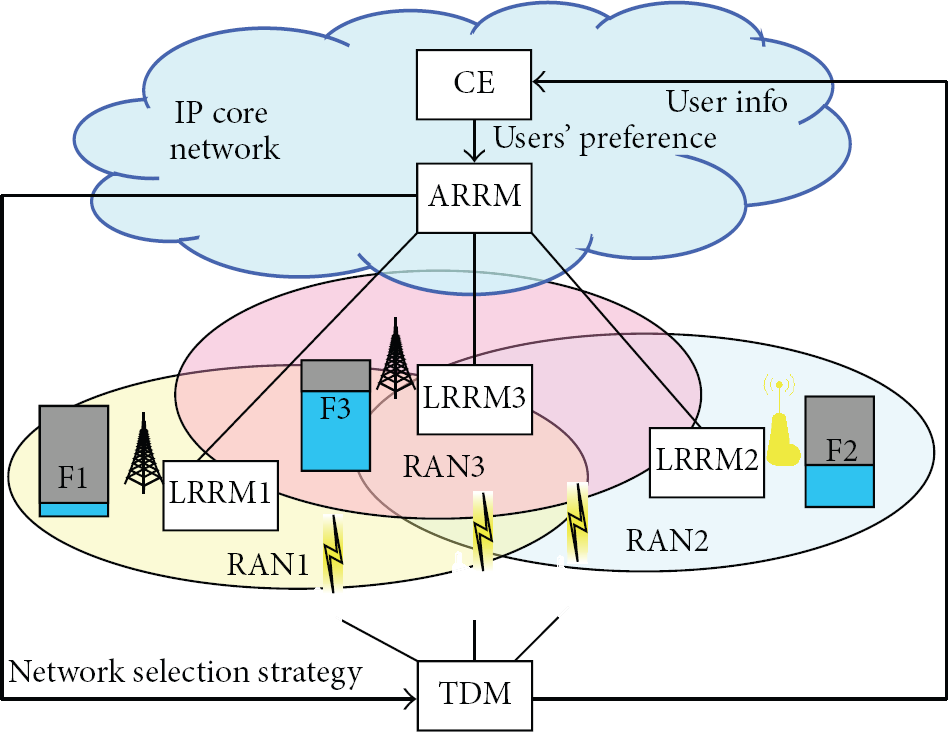
Simulation scenario.
As indicated in Figure 8, different wireless resources are assigned to different RANs, while the spectrum utilization efficiency of a certain RAN is considerably high (i.e., F3 for RAN3), while that of others is low (i.e., F1 and F2 for RAN1 and RAN2, resp.). Therefore, in this scenario, the main goal of wireless resources management is to balance the load of the wireless access network, where the spectrum utilization can be improved to ensure good QoE for users. According to the goal, a load balancing algorithm is considered to guarantee the QoE for different users.
QoE refers to the users' comprehensive feeling with respect to the equipments, networks, and systems. For heterogeneous wireless networks, users may present different preferences for different network. For example, some users target on security mobile networks, while other users prefer low cost of broadband access networks. If the system has been developed with the cognitive structure, it could be able to adopt the method of artificial intelligence to predict subjective preference of the users with different strategies.
According to the above scenario, we assume that the heterogeneous wireless network environment contains I wireless access networks with different air interface technologies. The wireless resources of downlink and uplink for each RAN are limited to the upper bounds (
The QoE guaranteeing load balancing algorithm includes two aspects: (1) the requirements of QoS, where the minimum average data rates (
The algorithm is carried out to perform the network throughput optimization, which is presented as follows:
Ω is the network throughput; Formulas (5) and (6) represent the resource limits in downlink and uplink, respectively. Formulas (7) and (8) represent the guarantee of QoS requirements. Formulas (9) and (10) represent the satisfaction of users' preferences for networks.









Note that the proposed load balancing algorithm is used to optimize the network throughput by selecting the access networks for different users. Since the user preferences are considered in the network optimization, the QoE of users can be improved. Using the above algorithm, we compare our proposed QoE-based load balancing strategy to the conventional SNR-based switching strategy and the QoS-based load balancing strategy [8] in terms of the overall performance.
In Figure 9, simulation results show the network throughput versus the number of users using different strategies. It can be observed that the QoE- and QoS-based strategies outperform the SNR-based ones in terms of the network throughput. Under the condition that the number of users is small, QoE- and QoS-based strategies provide similar performance. Note that when a large number of users are considered (e.g., 60–100), comparing to the performance of the QoS-based strategy, the throughput of our proposed QoE-based one is slightly lower because one has to sacrifice the network performance to meet proper QoEs for different users. However, it will be shown in Figure 10 that our proposed strategy is able to provide strongly improved performance to users in terms of the QoE comparing to that of the QoS-based strategy.
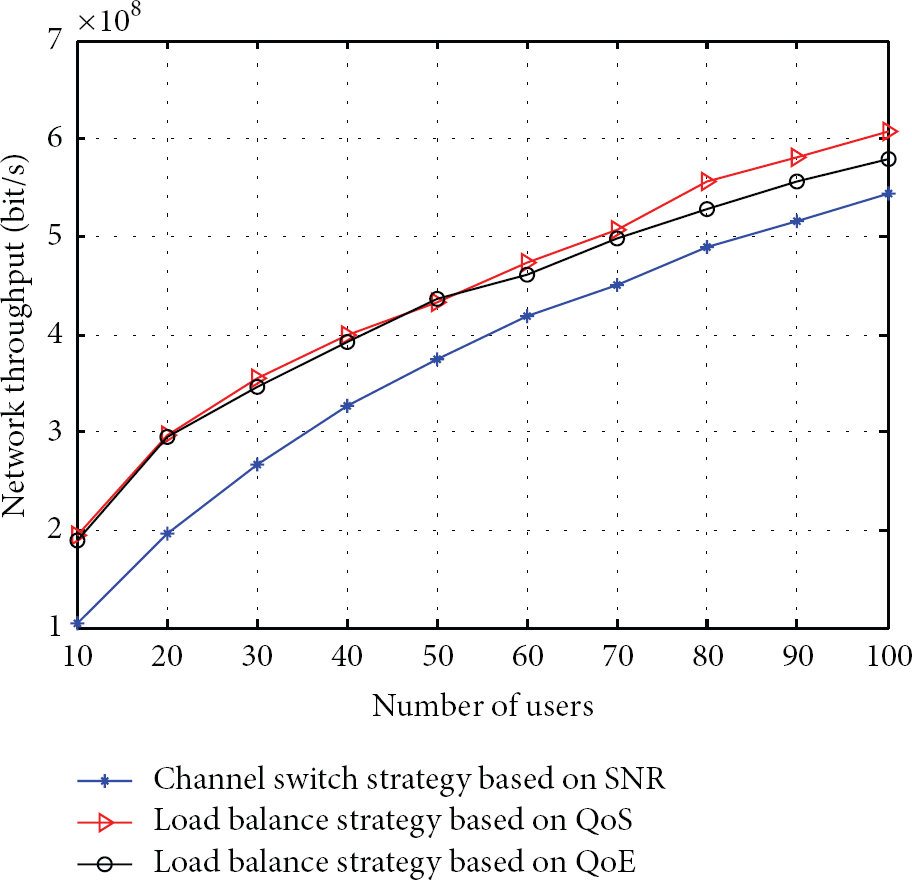
Network throughput changes with number of users.

The average users' QoE scores change with the number of users.
In Figure 10, the simulation results show the average users' QoE scores versus the number of users with the employments of different strategies. It can be demonstrated that the average QoE of our proposed scheme becomes much higher than that of the other two strategies. In addition, we can show that neither the SNR nor QoS strategies is able to provide reasonably good QoE performance to users. Consequently, in order to make users more satisfactory, our proposed QoE-based load balancing strategy is more desirable. In this simulation, all the strategies adopt the same network deployment and user preference knowledge. Therefore, when we average the QoE scores through many simulations, the simulation results without consideration of users' preferences are almost the same.
5. Conclusion
In this paper, we have proposed the double-cycle cognitive model and the service-oriented radio architecture for designing and implementing the cognitive wireless networks. We have first proposed the DCCM through analysis of cognitive wireless network architecture. Then, we have introduced the framework and application method of our SORA. Finally, we have employed the DCCM to design an intelligent wireless resource management system, used the SORA to implement this system for higher flexibility, and improved the QoE based on the proposed architecture.
In conclusion, using the idea of M2M technology, our proposed strategy could make the heterogeneous components of cognitive wireless network loosely coupled with each other. Thus, the whole network can be integrated and implemented more compatibly and become more intelligent.
Footnotes
Acknowledgments
The authors would like to thank the anonymous reviewers for their valuable comments that have helped improving the overall quality of the paper. This work has been supported by the National Natural Science Foundation of China (Grants nos. 61231011 and 61250001) and the China National 973 project (Grant no. 2009CB320403).