




Abstract
Wireless machine-to-machine (M2M) networks enable ubiquitous sensing and controlling via sensors, vehicles, and other types of wireless nodes. Capacity scaling law is one of the fundamental properties for high mobility M2M networks. As for high mobility M2M networks, vehicular ad hoc networks (VANETs) are a typical case. Since vehicles have social property, their moving trajectory is according to the fixed community. With the purpose of transmitting packets to different communities of VANETs and further improving the network capacity, we study the multicast capacity of bus-assisted VANETs in two scenarios: forwarding scenario and routing scenario. All the ordinary vehicles obey the restricted mobility model. Thus, the spatial stationary distribution decays as power law with the distance from the center spot of a restrict region of each vehicle. In forwarding scenario, all the buses deployed in all roads as intermediate nodes are used to forward packets for ordinary vehicles. In routing scenario, buses and ordinary cars construct a highway path supported by percolation theory to transmit urgent packets. Each ordinary vehicle randomly chooses
1. Introduction
In recent years, M2M networks have been a subject of intense interests due to the rapid evolution of wireless communication systems. M2M networks can be used to enable a wide variety of automated complex operations, which include advanced sensing, remote control, and monitoring technologies. M2M networks have many differences compared with conventional wireless networks because M2M is a machine-oriented networking technology. First of all, M2M networks commonly need to support a large number of devices. Second, power consumption of M2M devices is very important due to the limited battery capacity. Third, various data transfer delay requirements may exist depending on the M2M application being executed [1, 2]. Examples of M2M communications networks include vehicular ad hoc networks (VANETs) [3], underwater sensor networks (UWSNs) [4], wireless body area networks (WBANs) [5], and wireless mobile social networks [6–8].
Capacity scaling laws of wireless networks have attracted a lot of attention. Since Gupta and Kumar initiated the study of capacity scaling laws of ad hoc networks [9], the capacity of different types of wireless networks has been widely studied, such as sensor networks, ad hoc networks, cellular networks, vehicular networks, and so forth. Grossglauser and Tse showed how the mobility increases the capacity of ad hoc wireless network in 2002 [10], Li proposed a new method to calculate the multicast capacity of wireless ad hoc networks in 2009 [11], Garetto and Leonardi proved restricted mobility improves delay-throughput tradeoffs in mobile ad hoc networks [12], and Mao et al. calculated the multicast capacity for hybrid wireless networks [13] in 2012. There are also some people who work on the capacity of energy-constrained networks [14]; some people study the capacity of arbitrary networks [15] and inhomogeneous networks [16], some people let nodes cooperate with a hierarchical MIMO network [17], and some people use network coding [18] to improve the network capacity.
The capacity of vehicular ad hoc networks was first studied in 2007 by Pishro-Nik et al. [19]. They proposed a grid-like framework as shown in Figure 1 to demonstrate the streets of urban region. We have abstracted one real construction from the real urban map. However, we realized we also have to use statistic methods to calculate the capacity of high mobility social M2M networks. If the statistic methods were applied in the calculation, the detail of the real construction will be neglected in the calculation. Thus, there is no difference between real construction and grid-like construction. Furthermore, grid-like construction is easy to understand and convenient to be used in calculation. As a result, we choose the grid-like construction to be the geometrical construction in our calculation. Lu et al. extended their work and obtained the per-vehicle throughput

The real map of urban area.
Assume that n ordinary vehicles and
In the forwarding scenario, all the buses deployed in all roads as intermediate nodes are used to forward packets for ordinary vehicles. The buses of each road were considered as one bus trajectory. The bus forward scheme was proposed in [21]. Each transmission flow transmits packets via two-hop relay scheme proposed in [22]. All the forward processes of buses are considered as one-hop. The packets could be transmitted directly from source to destination or be transmitted to an intermediate vehicle or bus, then be forwarded to the destination. In the routing scenario, we use buses and ordinary cars to construct the highway system. We use percolation theory to prove that there are highway path clusters that cross through the network vertically and horizontally. Thus, based on a simple routing protocol, the highway system can ensure the packets can be transmitted to destination located in any place of VANET. Simultaneously, the urgent TTL requirement can be satisfied.
To schedule the interference in MAC layer of wireless transmission, we use the protocol model [6] as our interference model in this paper. We assume the bandwidth of wireless transmission is
Our Main Contributions. With the purpose of transmitting packets to different communities of VANETs and further improving the network capacity, in this paper we derive the upper and lower bound of the multicast capacity for bus-assisted VANET in two kinds of scenarios.
In the forwarding scenario, the per vehicle capacity of bus-assisted VANET is as follows:

In the routing scenario, we construct the highway system to transmit the urgent packets. We also derive the capacity of per vehicle via bus‐assisted mode, it can achieve at most
The rest of the paper is organized as follows. In Section 2 we represent the network model in detail. The upper and lower bounds of multicast capacity by ad hoc forwarding are derived in Section 3. In Section 4 we calculate the upper and lower bounds of multicast capacity by bus forwarding. We combine the results of Sections 3 and 4 and obtain the multicast capacity for bus-assisted forwarding in Section 5. Section 6 constructs the highway path and derives the capacity of bus-assisted VANET in routing scenario. Section 7 discusses the results and the remaining challenges. Section 8 concludes this paper and reviews the results on multicast capacity for bus-assisted VANETs.
2. Network Model
2.1. Network Geometry
We use the grid-like construction (as shown in Figure 1) to represent the urban region. The construction comprises m parallel streets intersected with other m parallel streets. Each street considers a bus line. Let s denote the total number of road segments (street section between any two street lines) and let c denote the number of squares in the grid-like construction. Thus,
2.2. Mobility Model
Vehicles always move in a localized area centered at the driver's home or work space and seldom move out. Thus, we let all the ordinary vehicles obey the restricted mobility model. Each vehicle randomly selects one square as its home-point (as Tier
2.3. Communication and Interference Model
For simplicity, we assume that there is only one wireless channel in the bus-assisted forwarding and during a time slot t the wireless channel can only transmit
At each time slot, a transmission from vehicle i to vehicle j is successful only if the following inequality stands:


2.4. Traffic Model and Relay Scheme
We consider n multicast flows existing in the network concurrently. Each packet is transmitted to
2.5. Definitions of Capacity
In this paper, capacity denotes the feasible throughput. The capacity of VANETs is defined as follows.
Definition 1 (feasible throughput).
A throughput of
Definition 2 (capacity of vehicle network).
The average capacity of vehicular network is of order

Definition 3 (throughput capacity).
Let

3. Bounds in Multicast Capacity by Ad Hoc Forwarding
Forwarding scenario has two parts: ad hoc forwarding parts and bus forwarding parts. In this section, we discuss the bounds of capacity for pure ad hoc forwarding for the forwarding scenario. All the packets are transmitted to destination directly or via an ordinary vehicle. Since source vehicle and destination vehicle have the same home-point, k is less than or equal to the number of vehicles that have the same home-point. Broadcast cannot be achieved only with this forwarding method.
3.1. Upper Bound in Multicast Throughput Capacity by Ad Hoc Forwarding
We first calculate the upper bound of multicast throughput capacity by ad hoc forwarding. The following lemma is used in the calculation of upper bound of throughput capacity of ad hoc forwarding. This lemma was proved in [17].
Lemma 4.
Let

According to Lemma 4, we first derive the upper bound in multicast throughput capacity by ad hoc forwarding.
Theorem 5.
For the social proximity VANETs, with two-hop scheme, the average per-multicast throughput capacity by ad hoc forwarding cannot be better than
Proof.
Let







3.2. Lower Bound in Multicast Throughput Capacity by Ad Hoc Forwarding
To obtain the lower bound of average multicast throughput capacity, we introduce the following lemma which was proved in [17].
Lemma 6.
The number of vehicles whose mobility region contains road segment i is denoted by N. Thus, N scales as
With the two-hop relay scheme, a packet can be successfully transmitted only if there exists at least one source-destination pair or source-intermediate pair when the road segment is active. Since sources and destinations have the same home-point, there is one source-destination pair or source-intermediate pair with probability
Theorem 7.
The throughput capacity of average per-multicast flow can be scaled at least
4. Bounds in Multicast Capacity by Bus Forwarding
In this section, we calculate the bounds of multicast capacity by bus forwarding for the forwarding scenario. All the packets are relayed by bus, and all the ordinary vehicles can be the destinations of any source vehicle. With the bus forwarding, k can be equal to n to achieve broadcast in the network.
4.1. Upper Bound in Multicast Throughput Capacity by Bus Forwarding
We first calculate the upper bound in multicast throughput capacity by bus-to-bus transmissions. We introduce the Euclidean tree to demonstrate the bus transmission process of multicast flows and each segment of the bus transmission process used is one edge of a multicast tree. Let
Lemma 8.
Given n nodes randomly and uniformly distributed in a 2-dimensional cube, divide the cube into c cells as Voronoi diagrams with the same side length. Each node transmits packets to k destination concurrent via base-station. The base-station forwarding of a transmission is considered as a Euclidean tree. When
Different from the base-station connected by fiber, the ones connected by bus carry packets and move to the destination along roads represented by segments in the grid construction. However, if we consider the intersections of road segments as the vertex of Euclidean tree and each intersection belonging to a unique square, we can obtain the same conditions with Lemma 8. Thus, the results are suitable for the Euclidean tree of bus-to-bus transmissions. According to the above analysis, we derive the following corollary.
Corollary 9.
In the grid-like construction, if one uses Euclidean tree which represents the bus-to-bus transmissions, one can have the following results. When
Recall that there are s segments in the construction. Then according to Pigeonhole principle, when
Theorem 10.
When
Theorem 10 is the capacity of bus-to-bus transmissions; buses have to transmit packets to ordinary vehicles at last. Then we calculate the up bound of the transmission between buses and ordinary vehicles for bus forwarding method. Recall that the active probability of one segment is
Theorem 11.
The upper bound of the throughput capacity between bus and ordinary vehicles for bus forwarding is
Obviously, the minimum throughput of bus forwarding process and bus-to-vehicle process determines the throughput of whole bus forwarding. By summarizing Theorems 10 and 11, we derive the upper bound of multicast throughput capacity for bus forwarding.
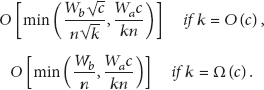
Theorem 12.
The upper bound of the multicast capacity for bus forwarding is as follows:
4.2. Lower Bound in Multicast Throughput Capacity by Bus Forwarding
By using the bus forwarding method, a packet can be successfully transmitted by bus only if there exists at least one bus-destination vehicle when the road segment is active. Reference to the proof of Lemma 6, we can easily prove the following lemma.
Lemma 13.
The number of vehicles whose mobility region contains bus line i is denoted by
According to Lemma 13, we know that in any segment there is one bus-destination vehicle pair with probability
Theorem 14.
The throughput capacity of average per-multicast flow can be scales at least
5. Capacity Bounds for Bus-Assisted Forwarding
In this section, we will analyze the throughput capacity for bus-assisted forwarding. The analysis is based on the results of ad hoc forwarding and bus forwarding derived above. With the purpose of transmitting packets to other communities that have different home-point and further improving the network capacity, both ad hoc forwarding and bus forwarding are used in bus-assisted forwarding. In particular, bus forwarding is the only way to transmit packets to other communities. According to the destination of packets, bus-assisted forwarding adaptively selects a better forwarding method. Therefore, the throughput capacity of bus-assisted forwarding cannot surpass the maximum capacity of ad hoc forwarding and bus forwarding. The maximum capacity of ad hoc forwarding and bus forwarding is optimum for bus-assisted forwarding. Similarly, bus-assisted forwarding has the same lower bound with ad hoc forwarding and bus forwarding. According to the analysis above, we can obtain the bounds of multicast capacity for bus-assisted forwarding as the following theorem.
Theorem 15.
The upper bound of the multicast capacity for bus-assisted VANET is as follows:

6. Capacity of Highway Routing
The forwarding protocol can transmit packets with tiny delivery cost. However, the delay cannot be diminished by the protocol because it mainly depends on the velocity of the bus. For the urgent packets, the forward scenario cannot match the requirement. Thus, the capacity of forward scenario cannot satisfy the transmission of urgent packets. For the purpose of calculating the capacity of urgent packets transmissions in the bus-assisted VANET, we designed a basic routing protocol for the bus-assisted VANET. We call it the highway routing. Then we calculate the capacity with the highway routing.
6.1. Introduction of Percolation Theory
The highway system is constructed based on the percolation model on square lattice. Before we construct the highway, we first introduce the bond percolation of percolation theory.
Assume that some packets are generated on top of the network region. Will the packets be able to make their way from edge to edge and reach the bottom? This question is modeled mathematically as a two-dimensional network of
The open probability p of the edge is independent. The probability of an open path existing is determined by p. The single open path is not enough to ensure the all over network transmissions. As the number of vehicles increases to infinity, the network construction increases to infinity. Thus, there must be infinite open path clusters to ensure all over network transmissions.
By Kolmogorov's zero-one law, in the regular square lattice, for any given p the probability that an infinite open path cluster exists is either zero or one. The probability of p is an increasing function that was proved in [19]. It increases sharply from approach zero to one in a short span of P. Therefore, there must be a critical p (denoted by
6.2. The Construction of Highway
As in Figure 2, we assume that the intersection is the center of a virtual square. The road between two intersections is one edge. The virtual square lattice is denoted by red dotted lines. The black lines denote the open paths. To calculate the

Construction of highway path.
Packets are forwarded by intermediate vehicles. In the network, each edge between two squares is open if the road between the two squares has at least one vehicle. Thus, the probability of each road having at least one vehicle must be larger than

6.3. Highway Routing Protocol
Based on the open edge cluster derivation above, we use basic routing protocol to transmit packets in VANETs. Following the protocol, all source vehicles upload packets to the highway path and then packets are transmitted through the highway path until they approach the destinations. Destination vehicles will download packets from highway path. Time slots will be well arranged to ensure the highway path has priority to occupy transmit opportunity.
Upload. Source vehicles upload the packets to highway path when there are some transmission opportunities. Otherwise, the source vehicle can add the packets to highway transmission flow when it is chosen as the intermediate vehicle of the highway path.
Routing. Packets are forwarded along the shortest highway path to the destination or the intermediate vehicle besides the destination. If the shortest bus path has a closed edge, then highway path will detour to avoid the closed path.
Download. Packets are forwarded to the destination vehicle through the highway path. The destination vehicle downloads the packet from the highway path when it has opportunity to access the link. Otherwise, the destination vehicle can get the packets from highway transmission flow when it is chosen as the intermediate vehicle of the highway path.
Figure 3 is used to show a simple routing process. Source vehicle S can be assumed as the highway path and transmit packets to destination vehicle D. When road a has no vehicle, the highway path detours to avoid road a. Then, packets will achieve the destination vehicle or the neighbor of destination D. Destination vehicle will get the packets or download them from its neighbor which is in the highway path.

Construction of highway path.
6.4. Calculation of Capacity
When vehicle upload or download packet from the highway path, one packet occupies one transmission opportunity. That process is equivalent to transmit one packet through one edge. Thus, the upload and download process can be assumed as the first edge and the last edge of the highway path. The transmission opportunities are arranged by protocol, and thus an interference group can fully use the transmission opportunities. Each packet will cost one transmit opportunity to pass through one edge. The network has total
Lemma 16.
Given a square b in the lattice, the probability that a random highway path will be routed via the square s is at most
Therefore, a square b can be used by at most

Theorem 17.
With the application of highway protocol, the per-vehicle capacity of VANET can be achieved at most
7. Discussion
Notice that
To calculate the bounds of multicast for the bus-assisted VANET, we assume that the TTL (time to live) of packets is infinite. However, in the realistic VANET, TTL is one of the most important characteristics of the packets in any kind of ad hoc network. Therefore, if we can tolerate the delay of transmission, the study of achievable capacity is also essential for the bus-assisted VANET. We will focus on the tradeoff between capacity and delay in the future work. Similarly, applying more real interference model is also essential such as physical interference model and Gaussian interference model. All of our results are derived under grid-like construction. A more realistic framework may close the gap of capacity between theoretic results and real value. We will consider all the remaining challenges in the future work.
We calculate the achievement per-vehicle capacity for the forwarding scenario and routing scenario of bus-assisted VANETs. The forwarding scenario can save lots of energy and transmission coasts to diminish the overhead of bus-assisted VANETs. The routing scenario can transmit packets within very little time to satisfy the urgent packets by sacrificing the overhead of the network. We just derive the performance. The selection of transmission scenario needs an additional protocol.
8. Conclusion
The capacity scaling law of high mobility M2M networks has been considered as one of the most fundamental issues. In this paper, we derive the upper and lower bounds of multicast capacity for high mobility social proximity M2M networks via bus-assisted forwarding method. In the routing scenario, we use buses and ordinary cars to construct the highway system for VANETs, which is a typical case of high mobility M2M networks. We use percolation theory to prove that there is a highway path cluster cross through the network vertically and horizontally. Therefore, the highway system can ensure the packets can be transmitted to destination located anywhere in VANETs. The per-vehicle capacity of routing scenario is also derived. At last we discussed how the different forwarding processes influence the results of capacity scaling law for high mobility M2M networks. Our work provides new insights for the design of bus-assisted VANETs as intermediate vehicle to relay packets.
Footnotes
Acknowledgment
This work is supported by Heilongjiang Province Education Department Foundation 12531Z007.