




Abstract
In smart grid, smart meters are deployed to collect power consumption data periodically, and the data are analyzed to improve the efficiency of power transmission and distribution. The collected consumption data may leak the usage patterns of domestic appliances, so that it may damage the behavior privacy of customers. Most related work to protect data privacy in smart grid relies on cryptographic primitives, for example, encryption, which induces a large amount of power consumption overhead. In this paper, we make the first attempt to propose solutions without any cryptographic computation to protect user privacy. The privacy in smart grid is formally defined in the paper. Three schemes are proposed: random perturbation scheme (RPS), random walk scheme (RWS), and distance-bounded random walk with perturbation scheme (DBS). Three algorithms are also proposed in each scheme, respectively. All schemes are ultra-lightweight in terms of computation without relying any cryptographic primitive. The privacy, soundness, and accuracy of proposed schemes are guaranteed and justified by strict analysis.
1. Introduction
Smart grid is a typical application of Internet of Things, M2M, or IP-based sensor networks. It has been envisioned as a key method to reduce the emission of carbon dioxide and retard climate changes, by improving the efficiency of power distribution and transmission.
Smart grid relies on smart meters to collect power consumption data at user ends instantly. Smart meters report the power consumption data periodically to smart grid control center (SGCC). SGCC thus can allocate necessary power distribution and schedule required power transmission. In addition, the SGCC can relocate the power requirements at user ends by delivering power price to users. Users thus can schedule the usage of their household appliances according to the forthcoming price.
As smart meters report the power consumption data periodically, the data may leak user privacy in daily life. For example, the data may be used for deducing user behavior patterns, such as when she gets up according to the data of using microwave oven or toaster in the morning, when she goes back home according to the data of using electric stove for cooking at afternoon, or when she takes bath or goes to bed at night according to the data of using water heater or lamps. Such privacy concerns have already been acknowledged and reported by NIST [1] and significantly affect the deployment of smart meters.
Although there exist several privacy protection or security improvement for smart grid currently [2–6], most of them rely on cryptographic primitives, for example, encrypting the uploading data at smart meters. Cryptographic operations are usually not lightweight, so that they will induce extra power consumption at smart meters. In addition, the data uploading may occur frequently and periodically, so the computation for data encryption occurs extensively. For example, data are uploaded to SGCC once in 10 minutes. The encryption for the data has to be 144 times a day. Thus, the energy consumption for encryption computation would be large for a month even at single smart meter. Moreover, the extra power consumption will be accumulated to an unsatisfactory waste, because the number of smart meters in smart grid is huge. Furthermore, the decryption computation at SGCC has to be conducted if the uploading data are encrypted at smart meters. The energy consumption of decryption at SGCC will thus extremely increase. Last but not least, the smart meters usually have resource and power constraints, like traditional sensors. As the privacy protection must be conducted at smart meters, any computation for privacy protection should cost low energy to tackle these constraints. The frequent encryption operations are undesirable. Even though the encryption is lightweight in certain situations, the key management for encryption is also a difficult issue for deployment. Therefore, privacy protection by encryption unfortunately contradicts the intention of smart grid for saving energy; an ultra-lightweight method without any cryptographic computation for privacy protection is mandatory for a long run and a large scale.
In this paper, we propose perturbation-based schemes with ultra-lightweight computation without any cryptographic computation. Besides, we strictly and formally define and proof its privacy protection strength. We adapt a rigorous method to state, present, and analyze the privacy protection achievements. All our presentations strictly follow the formal expressions for better clarity and generality.
The contributions of the paper are listed as follows: (i) we propose ultra-lightweight privacy-protection schemes in terms of computation (and thus energy consumption) without any cryptographic computation; (ii) we strictly define the requirements on privacy, soundness, and accuracy in smart grid and proof the guarantee of those requirements.
The rest of the paper is organized as follows. In Section 2 we discuss the basic assumption and models used throughout the paper. Section 3 provides the detailed description of our proposed models and analysis. Section 4 gives an overview on relevant prior work. Finally, Section 5 concludes the paper.
2. Problem Formulation
2.1. Network Model
Two major entities exist in smart grid: smart meter (denoted by SM hereafter) and SGCC.
SM computes power consumption data and uploads them to SGCC periodically. The period for computing power consumption data at SM is called sensing period. The period for uploading power consumption data to SGCC is called uploading period. Without loss of generality, suppose the sensing period and uploading period are both t minutes. The sensing times and uploading times in a day will thus be
In smart grid, utility price may vary in different time slots. The price information is delivered by SGCC in advance. Users use such information to guide the power consumption. SM receives such information to calculate utility charge in a month for users. Suppose the prices for n uploading periods in a day are denoted as a set
2.2. Attack Model and Trust Model
Only adversaries who attack user privacy are considered in this paper. Adversaries can eavesdrop the channels between SM and SGCC; those are denoted as
SGCC is untrustworthy, as we assume adversaries at SGCC are interested in user privacy. SM should be trustworthy. It is a prerequisite for any further discussion, sensing data are at SM, and all possible solutions are conducted at SM. Besides, if SM is untrustworthy, users will not choose them. SM can be easily evaluated and authorized by a Trusted Third Party (TTP).
2.3. Security Definition and Design Goal
Informally speaking, the privacy is guaranteed if the adversaries (not only at SGCC but also at channels between SGCC and SM) cannot deduce the user activities in a day. More specifically, we formally state the privacy requirement definition as follows.
Definition 1.
User activities. They are the activities that damage user privacy and are related to using one or multiple household appliances in a daily life. They are denoted as a set
Definition 2.
Deduce. It means an activity in
Definition 3.
Perfect full privacy (denoted as

Definition 4.
Computational full privacy (denoted as

Claim 1.
Perfect (computational) full privacy can protect user privacy on all user activities in a day, as no activity can be deduced from data in
In previous claim the content in “()” is corresponded with each other. Similarly, the perfect (computational) partial privacy can be defined in the following.
Definition 5.
Perfect (computational) partial privacy, denoted as

Claim 2.
Perfect (computational) partial privacy can protect certain privacy-sensitive activities, as these activities cannot be deduced by
Claim 3.
Full privacy has stronger strength than partial privacy in terms of the number of deducible data in

Roughly speaking, full privacy protects all activities; partial privacy protects partial activities. Perfect privacy defends against any adversary; computational privacy defends against any PPTM adversary. As perfect full privacy has the strongest privacy strength, we thus concentrate on the perfect full privacy protection in the following.
Definition 6.
Full privacy attacking experiment on the scheme Π defending against any adversary 𝒜- the scheme Π is executed in the presence of any adversary 𝒜; 𝒜 fully accesses if and only if 𝒜 outputs 1, the experiment outputs 1.
Definition 7.
The scheme Π that can guarantee the perfect full privacy in presence of any adversary 𝒜 (denoted as
For any adversary 𝒜 that the scheme Π defends against, the probability that the output of the full privacy attacking experiment equals one is 0. That is, if and only if

Therefore, the design goal is to propose a scheme Π satisfying
3. Proposed Schemes
3.1. Problem Reduction
To protect the privacy of sensing data
As SM is trustworthy, SM is proposed to equip a trusted mixing layer between sensing layer and communication layer. That is, SM is modeled as three tuples:

Definition 8.
“Bad” data set (
The characteristics of Without loss of generality, Any Any Similarly, any Any Different
In summary, the deduction relationship set

In other words, mapping
Definition 9.
After transformation F, the privacy of

Definition 10.
After transformation F, the soundness of

Due to the concentration in the rest of the paper, the research problem is reduced to as follows: given
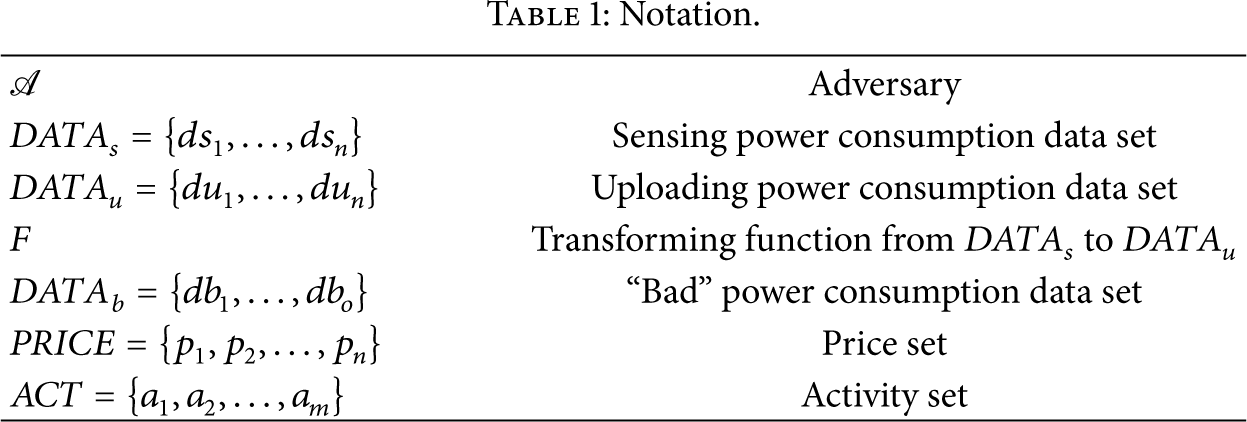
Next, we propose a family of schemes to solve the problem. We list all major notations used in the remainder of the paper in Table 1.
Notation.
3.2. Random Perturbation Scheme (RPS)
We firstly propose a basic scheme-random perturbation scheme (RPS) to illustrate our motivations. In RPS, any
3.2.1. Analysis of Algorithm 1
Proposition 11.
After the transformation of algorithm RPA, the soundness of
Proof.
The biases of
Proposition 12.
The scheme RPS is ultra-lightweight.
Proof.
As algorithm RPA is ultra-lightweight, the number of loops is
Proposition 13.
The scheme RPS can guarantee the perfect full privacy. (
Proof.
It is clear that
3.3. Random Walk Scheme (RWS)
If the gap between
Claim 4.
If the gap between
Proof.
Suppose
If the perturbation is small, adversaries may guess the
Definition 14.
After transformation F, the privacy of 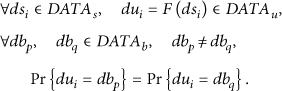
The definition for privacy is thus extended to include the definition here and Definition 9.
In RWS, any
3.3.1. Analysis of Algorithm 2
Proposition 15.
After the transformation of algorithm RWA, the soundness of
Proof.
The proof is similar to the proof of Proposition 11. As
Proposition 16.
The scheme RWS is ultra-lightweight.
Proof.
The number of loops is
Proposition 17.
The scheme RWS can guarantee the perfect full privacy. (
Proof.
According to the algorithm, for for all
3.4. Distance-Bounded Random Walk with Perturbation Scheme (DBS)
In smart grid, the uploading data will be used as a feedback for future scheduling of distribution and transmission. It thus requires the uploading data can accurately present the power consumption (namely, sensing data). However, thanks to the power distribution and transmission serve not for a single SM, but a large number of SMs (e.g., a campus, a community, or a county scale), only the accuracy for a scale of SMs is sufficient for scheduling.
In RPS and RWS, although the bias exists (that is, uploading data is not equal to sensing data) at single SM, the uploading data for a large number of SMs can still represent power consumption in a scale. More specifically, the deviation between the summation of uploading data and the summation of sensing data is randomly positive or negative in one SM, thus the overall summation remains almost unchanged in expectation in a large scale. It is explained as follows.
Definition 18.
After the transformation F, the accuracy of
Proposition 19.
After the transformation
Proof.
In each sensing (uploading) period,
To further guarantee the scheduling accuracy, we propose a distance-bounded scheme, in which the perturbation value (i.e., δ) is bounded. The accuracy is thus guaranteed within a threshold value. It takes the advantages of former two algorithms RPA and RWA. A distance-bounded algorithm (DBA) for the transformation F is proposed as follows.
3.4.1. Analysis of Algorithm 3
WHILE (1) { EXIT; CONTINUE; }
Proposition 20.
After the transformation of algorithm DBA, the soundness of
Proof.
The proof is similar to the proof of Propositions 11 and 15.
Proposition 21.
The scheme DBS is ultra-lightweight.
Proof.
The proof can be reduced to the proof of Propositions 12 and 16.
Proposition 22.
The scheme DBS can guarantee the perfect full privacy. (
Proof.
The proof is similar to the proof of Propositions 13 and 17.
Proposition 23.
After the transformation
Proof.
The proof is reduced to the proof of Proposition 19.
Proposition 24.
The summation of uploading data equals the summation of the sensing data with deviation bounded by
Proof.
The schedule accuracy is the deviation between the summation of uploading data and the summation of sensing data. As it is proofed in Proposition 19, it depends on the number of SMs in the schedule area and the number of sensing (uploading) period in the schedule period. The expectation value is proofed to be 0, as the expectation of δ is 0. Concerning the accuracy of one schedule period, the maximal bias between the summation of uploading data and the summation of sensing data is bounded by
4. Related Work
The security architectures and overall security requirements in smart grid were discussed in the recent years [3, 7]. Currently, the privacy issue in smart grid starts to attract more attentions. The requirements of privacy were explored in some previous works [8–11]. They pointed out the importance and urgency of privacy issues. Efthymiou and Kalogridis proposed a privacy protection scheme via anonymization of data [12]. Their work relied on Escrow and Public Key Infrastructure (PKI); thus the flexibility and scalability may be tampered. Tomosada and Sinohara proposed to use virtual energy demand to estimate the energy load and protecting consumer privacy [13], but the estimation may take much computation overhead, and accuracy may be damaged. Lu et al. [10] proposed an efficient and privacy-preserving aggregation scheme (EPPA). Their scheme relied on homomorphic Paillier cryptosystem and induces much computation overhead. Cheung et al. [14] proposed a credential-based privacy-preserving power request scheme for smart grid, which relied on an advanced cryptographic primitive-blind signature. He et al. [15] proposed to use homomorphic encryption for smart grid communications. Comparing with all aforementioned related work, our final scheme does not rely on any cryptographic primitive but fulfils provable privacy and restrains ultra-lightweight in computation.
5. Conclusions
In this paper, we proposed three schemes to protect user privacy in smart grid without any cryptographic primitive and with ultra-lightweight computation. They are random perturbation scheme (RPS), random walk scheme (RWS), and distance-bounded random walk with perturbation scheme (DBS). We also proposed three algorithms for three schemes, respectively. Our schemes do not rely on any cryptographic computations, are sound in terms of maintaining the correct utility charge, can guarantee the privacy that were strictly proofed, and can ensure the scheduling accuracy in power transmission and distribution. All proposed schemes and algorithms were extensively analyzed, which justified their applicability.
Footnotes
Acknowledgments
W. Ren's research was financially supported by National Natural Science Foundation of China (61170217), the Open Research Fund from Shandong provincial Key Laboratory of Computer Network (SDKLCN-2011-01), and Fundamental Research Funds for the Central Universities (CUG110109). Y. Ren's research was sponsored in part by the “Aim for the Top University Project” of the National Chiao Tung University and the Ministry of Education, Taiwan.