




Abstract
We propose the low overhead media access control protocol (LO-MAC), a new low latency, energy efficient MAC protocol for low data rate wireless sensor networks. LO-MAC uses both duty cycling and multihop forwarding from the routing-enhanced MAC protocol (RMAC) to reduce idle listening and sleep latency, respectively. Besides that, LO-MAC introduces a traffic-adaptive mechanism, which is based on the fact that a node can sense a busy channel within its carrier sensing range. This mechanism uses carrier sensing as a binary signal, and effectively notifies nodes of the existence of a data packet. The nodes then either keep their radios on to take part in multihop data forwarding or turn them off to save energy. Moreover, LO-MAC takes full advantage of the broadcast nature of wireless communication and lets a packet have different meanings when it is in transmission range of different nodes. In LO-MAC, not only is a request-to-send/clear-to-send pair replaced with a Pioneer (PION) packet, as in RMAC, but also a data packet can play both data and acknowledgement functions. Therefore, control overhead and overhearing energy are significantly reduced. Our simulation results show that LO-MAC outperforms RMAC in terms of energy efficiency while achieving comparable end-to-end latency.
1. Introduction
Wireless sensor networks (WSNs) usually contain a large number of wireless battery-attached sensor nodes capable of sensing the environment and communicating in ad-hoc or structure fashion. However, replacing or recharging the batteries used in WSNs is often difficult, so network lifetime may be bound by limited battery capacity [1]. Reducing energy consumption is thus a challenge when designing a media access control (MAC) protocol for WSNs. A major source of energy consumption in a WSN is the idle listening mode in which a node remains awake for a long time when no actual data transmission is required by the network. Several MAC protocol design approaches have been proposed to reduce idle listening energy, the most successful one being MAC in which a duty cycling scheme is applied [2, 3]. In this type of MAC protocol, the nodes periodically alternate between active and sleep states in operational cycles. When being in the active state, the nodes can transmit and receive packets; otherwise, each node turns off its radio.
The original duty cycling scheme, however, adds significant latency in multi-hop packet delivery, since it supports only single hop transmissions. Consequently, a packet that is received at an intermediate node must wait until the upcoming cycle to be forwarded to a neighbor node; the packet hence incurs the so-called sleep latency. The best way to shorten the latency is to increase the number of hops through which the packet can pass in a single cycle. The routing-enhanced MAC protocol (RMAC) [4] introduces a typical solution to reduce excessive end-to-end latency and commences a new class of MAC called multi-hop MAC. The multi-hop MAC preserves the energy-efficient advantage of duty cycling. Moreover, the MAC exploits cross-layer information to relay a data packet via multiple hops in an operational cycle, which contains Sync, Data, and Sleep periods. During the Sync period, the nodes are synchronized their clocks in order to together wake up at the beginning of next cycle. The Data period can be used to schedule multi-hop data transmissions in the subsequent Sleep period. The number of hops a packet can traverse in a cycle mainly depends on the length of the Data period. The more hops the packet can pass, the longer the required Data period is. By using that long Data period, nodes likely waste energy by keeping their radios on, that is, the long Listening period problem when there is no data transmission in the network.
On the other hand, wireless MAC protocols often use control packets in order to achieve reliability and avoid the well-known hidden/terminal problems, for example, the request-to-send (RTS)/clear-to-send (CTS)/DATA/acknowledge (ACK) handshake in [2, 5]. However, the control overhead, which is the energy consumed to transmit control packets, has been investigated as another large source of energy wastage in WSNs. For example, control packets induces high overheads in the range of 40 to 75% of the channel capacity [6]. Therefore, it is necessary to reduce the control overhead, and intuitively decreasing the number of packets transmitted is only one possible approach. Fortunately, wireless networks are substantially characterized by the broadcast nature, meaning that active nodes usually “overhear” packet content not intended for them when neighboring nodes participate in communication. By exploiting the nature, we can force a packet to play more than one role, as a result both the control overhead and packet overhearing overhead decrease. RMAC also follows this approach and replaces an RTS/CTS pair with a pioneer (PION) packet; however, the protocol still incurs large overhead in data packet transmissions.
We propose the low overhead MAC protocol (LO-MAC), a new duty cycling MAC protocol, which can solve the above-mentioned problems. LO-MAC uses carrier sensing techniques to bypass the long Listening period problem, which occurs very frequently under low traffic load environments. After the Sync period, a short period called the carrier sensing period is introduced. In this period, we use the advantage of the carrier sensing technique to inform the nodes of the status of the network traffic. The nodes then decide to turn their radios off or keep them on to involve in a possible data transmission. LO-MAC is also able to transmit data packets over multiple hops in a single cycle and thoroughly use the broadcast nature to minimize the control overhead. In LO-MAC, not only a control packet replaces an RTS/CTS pair in the Data period, but also a data packet plays both acknowledge and data roles in the Sleep period.
The rest of this paper is organized as follows. Section 2 discusses related work regarding reduced energy consumption and latency MAC protocols. Section 3 gives a detailed description of LO-MAC. Section 4 presents results from the evaluation of LO-MAC. Finally, Section 5 concludes the paper.
2. Related Work
Due to the limitation in battery capacity, energy efficiency is the primary goal in MAC protocol design for WSNs. Initially, many proposed protocols focus on the energy efficiency at the expense of other parameters (e.g., throughput, latency, fairness). Ye et al. [2] have reported that the main source of energy wastage is idle listening energy and propose the sensor-MAC protocol (S-MAC). S-MAC contains the original duty cycling concept to reduce the overhead of idle listening. S-MAC is more energy efficient than the full wake IEEE 802.11 MAC protocol, but it introduces a very large end-to-end latency. Asynchronous MAC protocols such as B-MAC [7], X-MAC [8], RI-MAC [9], A-MAC [10], PW-MAC [11], and CyMAC [12] can free the synchronous overhead but still have the large latency. That is because a WSN is basically multi-hop, and a data packet needs several cycle to reach a multi-hop destination.
Several modified versions of S-MAC have been developed to shorten the latency. One is S-MAC with adaptive listening [3]. In this protocol, a node that “overhears” the control packet (e.g., RTS or CTS) of another node's transmission is going to wake up for a short time when the transmission finishes. If the waken node is the next-hop along a multi-hop path, it and its neighbor immediately receive/transmit the data packet rather than waiting until the next operational cycle. This protocol not only can deliver a packet at up to two hops per operational cycle, but can also significantly increase energy consumption when many neighboring nodes can “overhear” RTS or CTS and wake up, although only one is chosen as the next hop node. Another development is timeout MAC (T-MAC) [13]. T-MAC reduces latency by adaptively changing the ending time of an Active period when there is no traffic transmission near the node. T-MAC can conserve energy better than S-MAC and S-MAC with adaptive listening and can also deliver a packet at most two hops within an operational cycle. In T-MAC, when downstream nodes are unlikely to “overhear” upstream communication two hops away, they are not going to remain awake to receive a forwarded packet. Moreover, T-MAC may also increase energy consumption, since many nodes other than the intended next-hop node are going to remain awake.
Different to the previous approaches, Shu et al. [4] propose RMAC that can forward a data packet via multiple (more than two) hops in a cycle. To enable multi-hop data forwarding, RMAC's nodes relay a cross-layer control packet (i.e., PION) during a Data period in order to schedule a transmission in the subsequent Sleep period. By conveying the cross-layer information, a PION can replace a traditional RTS/CTS pair, hence reducing control overhead. The number of hops over which RMAC can forward a data packet during an operational cycle is limited by the duration of the Data period. That long Data period becomes a source of energy wastage in low data rate environments, that is, the long Listening period problem. Several improvements of RMAC have been introduced [14, 15], but these protocols focused on supporting more data or more hops in a cycle rather than solving the problem. Another development of RMAC is demand wakeup MAC (DW-MAC) [16], which is designed to support dynamic traffic loads. Comparing to RMAC, DW-MAC outperforms RMAC under high traffic loads, but DW-MAC consumes same overhead and achieves higher latency under low traffic loads. That is because in DW-MAC a data transmission starts at a subsequent duration after the beginning of Sleep period which is the starting point of RMAC's data transmission. However, the two protocols share the manner of relaying control packet during the Data period; hence the problem still remains in DW-MAC.
In our previous work, we have proposed two traffic-adaptive mechanisms to solve the long Listening problem. The first mechanism, which is adopted by
3. LO-MAC Descriptions
3.1. Overview
LO-MAC is a duty cycling contention-based MAC protocol, which employs carrier sense multiple access with collision avoidance (CSMA/CA) for accessing channel task. In LO-MAC, the packet structure, short interframe space (SIFS) and distributed interframe space (DIFS) are inherited from IEEE 802.11 [5]. The protocol supports multi-hop transmissions in an operational cycle, which is divided into four periods: Sync, carrier sensing, Data, and Sleep. LO-MAC's nodes wake up together at the beginning of the Sync period, during which they exchange SYNC packets to synchronize their local clocks. In the carrier sensing period, an adaptive mechanism, which exploits the carrier sensing technique, is introduced. The mechanism notifies the nodes of the existence of traffic in the network and lets them keep the radios on or turn them off at the beginning of Data period. In the former case the nodes follow an idle cycle, and in the later case they involve in a busy cycle. In the busy cycle, the nodes may exchange cross-layer control packets during the Data period to schedule multi-hop data transmissions in the subsequent Sleep period.
3.2. Adaptive Mechanism Using Carrier Sensing
As previously explained, the Data period is a key parameter of multi-hop MAC, since it is necessary to initialize multi-hop transmission to achieve a balance between energy efficiency and delivery latency. However, in low data rate environments, nodes may not have packets to be transmitted in most cycles. In this case, nodes needlessly waste energy during the Data period, that is, the long Listening problem. Multi-hop MAC is more efficient if it can let the nodes go to sleep when there is no data in the network; otherwise, it maintains multi-hop flow transmission. To accomplish this, we add a short period called carrier sensing (length
The benefit of the carrier sensing period is that the total length of the carrier sensing process, even in multiple hops, is negligible if compared with the length of the Data period. This is possible when the CCA time for compliant radio is reported less than 15
Figure 1 illustrates two types of operational cycles in LO-MAC. Two nodes I1 and I2 exchange SYNC packets during the Sync period. If these two nodes sense the channel as idle during the carrier sensing period, they follow an idle cycle. Otherwise, they follow a busy cycle and take part in a multi-hop forwarding flow in the upcoming Sleep and Data periods.

Adaptive mechanism in carrier sensing period.
3.3. Multihop Data Transmission in a Busy Cycle
In wireless networks, an inherent characteristic is the broadcast nature, meaning that an active node usually “hears” a packet when it is within transmission range of nodes participating in a transmission. Depending on the content of the packet and the process of handling the received packet at the node, the broadcast nature may be advantageous or become a source of overhearing overhead (i.e., the node has to receive useless packets). We use this characteristic to enable multi-hop transmission and conserve energy in designing LO-MAC.
Figure 2 gives an overview of multi-hop transmission in a LO-MAC's busy cycle. The scenario includes four nodes: source S, intermediate nodes (I1 and I2), and destination D. All nodes wake up together at the beginning of the Sync period. They keep their radios on at least until the beginning of the Data period, since the traffic-adaptive mechanism allows them to detect the existence of pending data at S. During the Data period, a multi-hop transmission is initiated as follows. S starts to transmit the first cross-layer control packet to I1, and I1 stores the cross-layer information then modifies and relays the control packet to I2. The process is repeated at I2, and the control packet reaches D. The cross-layer information is used to schedule the wake up time in the subsequent Sleep period. The nodes are woken up at the scheduled time and implement the multi-hop data packet transmission similar to relaying control packet.

LO-MAC in a busy cycle.
3.3.1. Initiating Multihop Transmission
Multi-hop transmission is initiated during the Data period by exchanging the PION packets. In LO-MAC, the construction of a PION packet and the exchange process are inherited from RMAC [4]. The PION packet is constructed by adding cross-layer fields to the original IEEE 802.11 RTS packet. The additional fields, which come from the routing layer, are hop count (the number of hops the PION has traveled) and the final destination. Hence, the new packet PION can play both RTS/CTS roles as well as provide a scheduling function.
A PION is initiated by S and relayed by I1 and I2 during the Data period. During its entire life cycle, a PION packet plays the RTS role regarding a downstream node and the CTS role regarding an upstream node. We describe the PION exchange progress for a 4-node scenario in the Data period shown in Figure 2. The source node has a data packet and starts its PION after a contention window (CW). Intermediate node 1 (I1) receives and relays the PION to its downstream node I2. The PION from I1 serves as both CTS to S and RTS to I2. However, in contrast to the traditional RTS/CTS exchange, the node has to wait at least until the subsequent Sleep period to implement actual data transmission after sending a PION packet. Upon receiving I1's PION, I2 performs the same steps as I1. This process of receiving a PION and immediately transmitting another PION continues until either the final destination has received the PION, or the end of the current Data period has been reached.
On the other hand, the PION packet also provides scheduling information for all nodes in its relay path. The hop count field of a PION packet is used to schedule the wake-up time of nodes in the Sleep period. Unlike in RMAC, the LO-MAC scheduling function works as follows. Suppose that a node is the

Here,
3.3.2. Multihop Data Transmission
Similar to RMAC and other multi-hop MAC protocols, LO-MAC's multi-hop data transmission is also implemented in the Sleep period. A source node immediately generates a data packet for a downstream node at the beginning of the Sleep period, and it stays awake for at least the SIFS period plus a small period to receive an acknowledge signal from its neighbor. The data packet needs the SIFS period for packet processing in each node. It is then relayed to a downstream node in the same way as for the PION packet. When the data packet is relayed by each intermediate node, it also plays the role of an ACK packet for the upstream node. If a downstream node fully receives the data packet, it may waste more energy than receiving an ACK. The reason is that the size of data packet is bigger than the size of ACK, for example, four times bigger in RMAC. Therefore the ack function of the data packet is achieved in a different way, as follows.
The node stays in the awake state for a short period ((
In the above-mentioned scenario, as soon as the Sleep period starts S and I1 immediately start sending/receiving their data packet. Other nodes in a multi-hop path, which successfully transmits PION in the Data period, go to sleep to save energy. Each node later wakes up at the scheduled time to receive the data packet from the upstream node and relays the packet to the downstream node. For example, node I2 goes to sleep when the Sleep period begins, but it wakes up at the scheduled time when I1 is ready to forward the data packet to I2. This process is described in the Sleep period of Figure 2.
In LO-MAC, we also keep the network allocation vector and frame loss handling as in RMAC.
4. Performance Evaluation
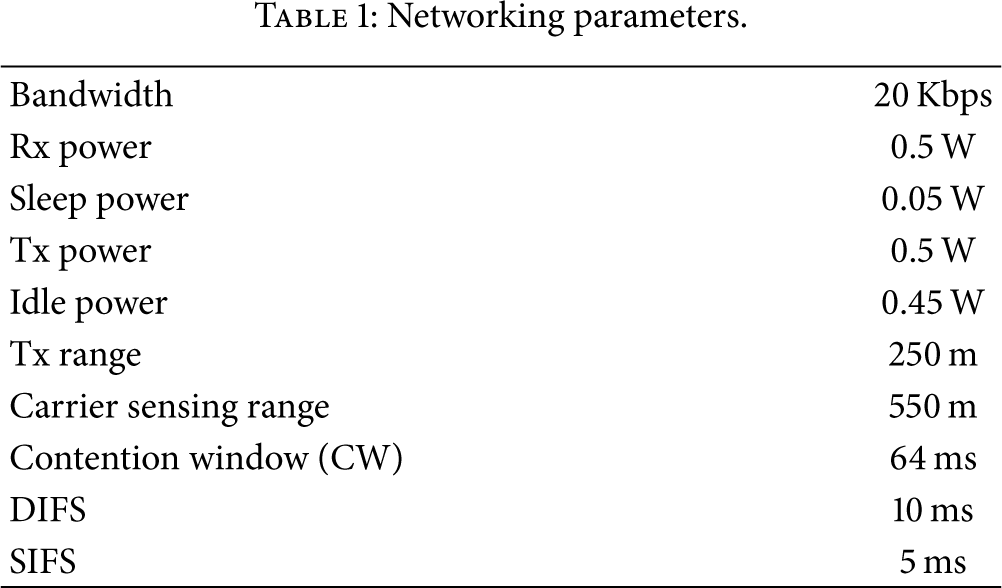
We use the network simulator ns-2 [21] to evaluate LO-MAC's performance. Each sensor node has a single omni-directional antenna through which the combined free space and two-ray ground reflection radio propagation models are employed. Key networking parameters are shown in Table 1, where power consumption parameters are set to typical values for a Mica2 radio (CC1000) [22]. The 250 m transmission range and the 550 m carrier sensing range are modeled after the 914-MHz Lucent WaveLAN DSSS radio interface; although not typical for a sensor node, we use these parameters to make our results comparable to RMAC. In our evaluation of power efficiency, we focus on the energy consumed by radios but ignore the energy consumed by other components such as CPU and memory [23]. The transmission time and size of packets are listed in Table 2. All the duration parameters of an operational cycle of RMAC are presented in Table 3. We denote the length of a cycle and the durations for Sync, Data, and Sleep periods as
Networking parameters.
Packet parameters.

Time duration parameters.

To simplify our evaluations, we ensure that networks that we use are connected networks. In addition, we do not include routing traffic in the simulations. We also assume that there is a routing protocol deployed to provide the shortest path between any two nodes. We simulate two scenarios: a multi-hop chain and a network scenario. In the chain scenario, the nodes are arranged in a straight line, and their neighbors are placed 200 meters apart, as shown in Figure 3. In the network scenario, 200 sensor nodes are uniformly in a random pattern within a

Chain scenario.
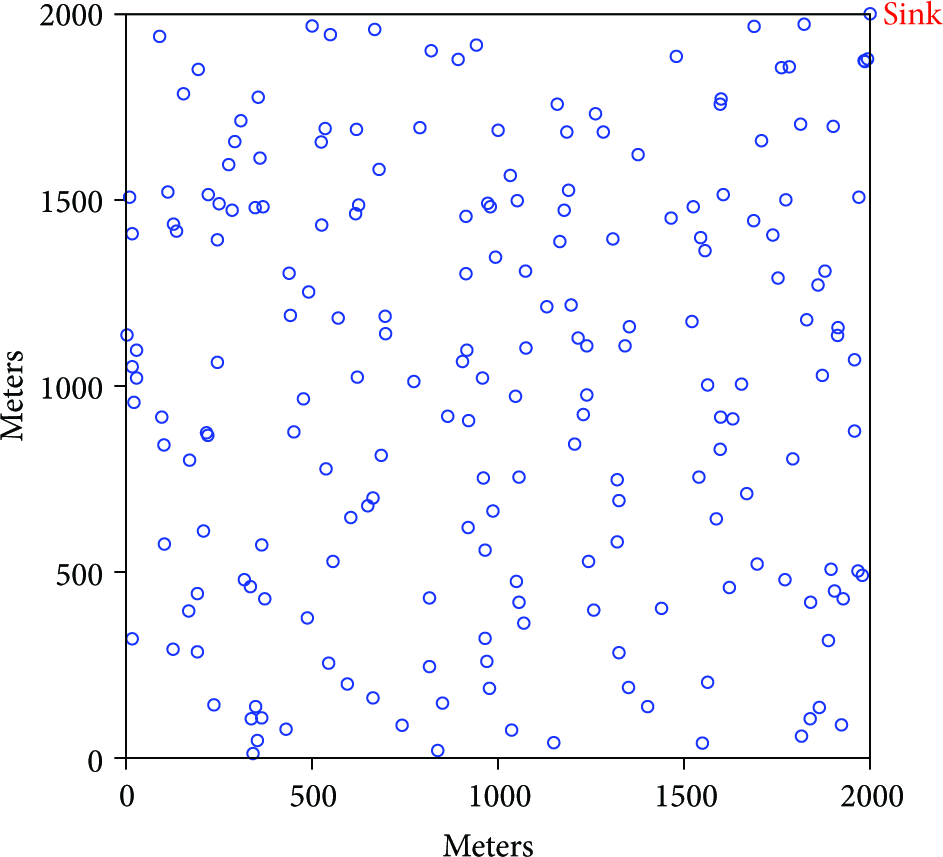
Network scenario: 200 nodes in
4.1. Multihop Chain Scenario
We first evaluate LO-MAC in an 11-node chain scenario. In this evaluation, we use a single flow to send packets at a constant rate from node 0 at the beginning of the chain to the destination node 10, which is farthest node from the source. We vary the interval between two consecutive packets from 10 to 60 seconds. Each simulation lasts for a total of 3600 seconds, and the duty cycle is kept to 5% in all nodes. We compare the performance between LO-MAC and RMAC.
Figure 5 shows the average energy consumption over all the sensors in the chain. The average energy consumption is calculated by dividing the total energy consumed in the simulation by the total number of sensors. The error bars show the minimum and maximum values for a single sensor's energy consumption. When the traffic load increases; that is, the packet interval decreases, the nodes in RMAC and LO-MAC increase their energy consumption, but the LO-MAC's nodes consume less energy than RMAC's nodes. Specifically, when the packet interval is 60 seconds, the average energy consumption in LO-MAC is approximately 75.1% of that of in RMAC, and this value approximates to 59.4% when the packet interval is 10 seconds. We can conclude that LO-MAC outperforms RMAC in terms of energy efficiency. There are two reasons for this. The first one is LO-MAC has the adaptive mechanism; the nodes save power by turning the radio off when no data packet exists in the idle cycles. The second is that during the busy cycles in LO-MAC, the nodes transmit fewer packets than in RMAC. For example, for an N-hop transmission in a cycle, the RMAC's nodes transmit

Energy consumption in chain scenario.
Figure 6 shows the average delivery latency in the multi-hop chain scenario. The error bars show the minimum and maximum values of delivery latency. Using an additional period (
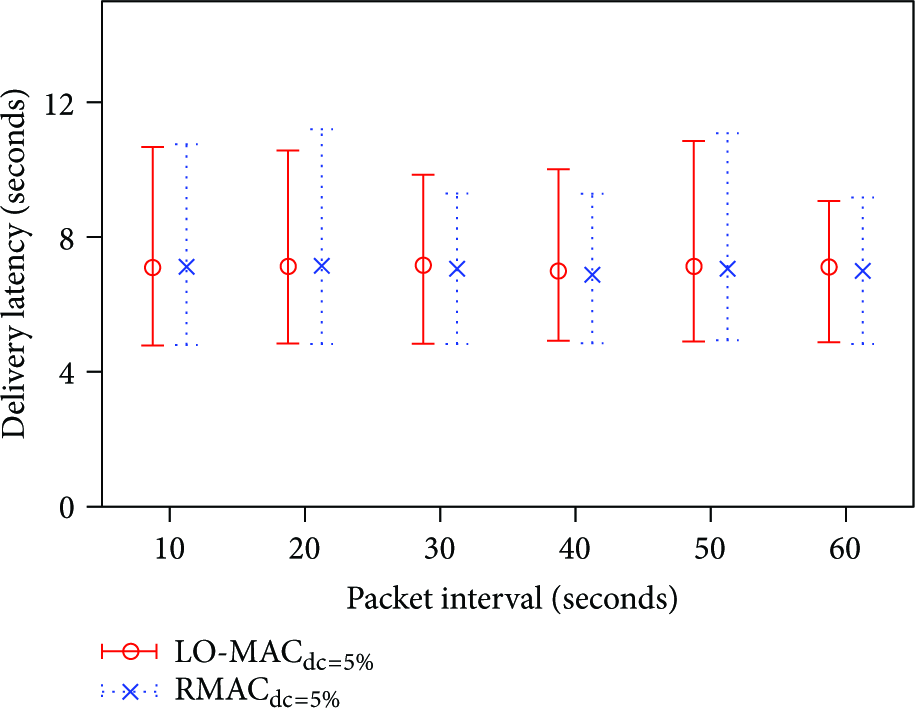
Average latency in chain scenario.
4.2. Random Network Scenario
In the evaluation of the network scenario, we adopt the same traffic generation method that is introduced in the original RMAC's paper. The traffic load is generated as follows. At a periodic interval of 50 seconds, a sensor node is randomly selected to send one data packet to the sink at the top-right corner. If a node is selected to send a packet, it is taken out of the selection pool. The selecting order is similar in both LO-MAC and RMAC's evaluations. The number of packets is varied from 0 to 100; and the total time of each simulation is 5300 seconds. In this evaluation, we use two values of the duty cycle 5% and 10% to investigate the effect of duty cycle to the performance. We denote LO-

Average energy consumption in network scenario.

Average latency in network scenario.
In Figure 7, the middle point is the average value of energy consumption. The average energy consumption value is calculated by dividing the total energy consumption by the total number of nodes. The error bars express the maximum and minimum values of a node's energy consumption during the simulation time. When there is no traffic in the network, the nodes in LO-
Figure 8 shows the average value of delivery latency, and the error bar shows the maximum and minimum values. We have the same conclusion as in the chain scenario in the case of 5% duty cycle, since the difference between the average latency in
To furthermore investigate the performance of the protocols, we simulate in the same network scenario with the same traffic model, but the total number of generated packet is 200. The total simulation time is 10300 seconds. We measure the energy consumption of each node and track the delivery latency of all packets. The cumulative distribution function (CDF) of the energy consumption and the delivery latency is shown in Figures 9 and 10, respectively. The results in Figure 9 indicate that even with 5% duty cycle, LO-MAC outperforms the two cases of RMAC, and LO-

CDF of energy consumption in network scenario.
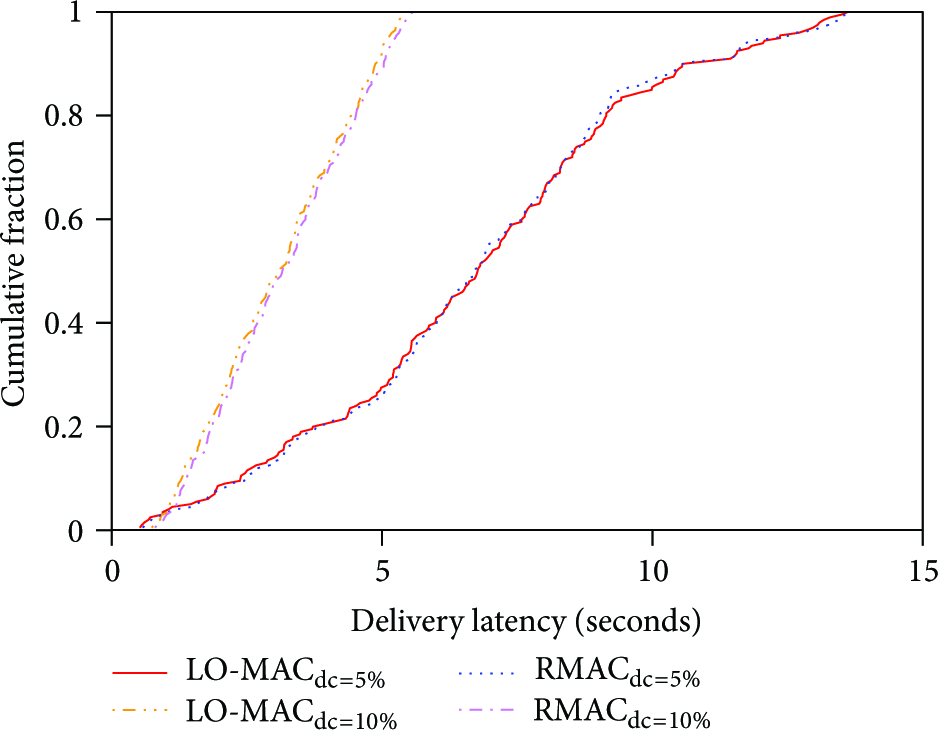
CDF of latency in network scenario.
5. Conclusion
We propose LO-MAC, which is an energy efficient, multi-hop MAC protocol for low data rate sensor networks. LO-MAC exploits the characteristics of wireless communication to achieve energy efficiency and low delivery latency. The traffic-adaptive mechanism based on carrier sensing effectively controls the period of keeping the nodes' radios on in a cycle, hence, preventing the long Listening period problem. Moreover, LO-MAC relays a packet via multiple hops to reduce end-to-end latency. During the relaying path, a packet from one node often plays two roles to its upstream and downstream neighbors by exploiting the broadcast nature of wireless communication. By doing so, the number of transmissions is significantly reduced; therefore, the protocol can effectively prevent overhearing and control overhead. Our simulation results show that LO-MAC outperforms RMAC in terms of energy efficiency and achieves comparable delivery latency.