




Abstract
In wireless distributed sensor networks, one open problem is how to guarantee the reliable relay selection based on the quality of services diversity. To address this problem, we focus on the reliable adaptive relay selection approach and adaptive QoS supported algorithm,
based on which we present a Markov chain model, in consideration of different packet states and error control algorithm assignment. The mathematical analyses and NS-2 simulation results show that the proposed relay selection approach could perform better in terms of saturation throughput, reliability, and energy efficiency, compared with the traditional approaches. More importantly, the quality of real-time multimedia streaming is improved significantly, in terms of decodable frame ratio and delay.
1. Introduction
It is well known that delivering and transmitting various data over wireless distributed and dynamic networks is a very challenging task. Wireless communication link is a dynamic environment. Data transmission over wireless channel suffers from the limited bandwidth, high packet loss rate, dynamic changes of channel state, sensor nodes mobility, channel competition, and so forth [1]. These constraints and challenges, in combination with the delay and loss of sensitive nature of multimedia applications [2], make QoS provisioning over wireless sensor networks a challenging proposition.
The data delivery of different applications inherently has different QoS requirements [3, 4] such as throughput, real time performance, playable frame rate, reliability and energy efficiency, and so forth. There is an open problem in the relay selection approach design: how to take advantage of the requirements information of QoS diversity in the wireless distributed sensor networks to find out the optimal relay for forwarding data packets from the potential relays.
In this paper, we investigate how to select the optimal relay nodes to provide the reliable and effective QoS provision and satisfy the diversity requirements of application services.
The rest of the paper is organized as follows. The related work and our work are elaborated in Section 2. Section 3 describes the system models and problem description. In Section 4, we design a Markov chain model to describe process of data communication in wireless distributed sensor network and give the theoretical analysis model to show the achieved performance. The supported scheme of QoS diversity is used to realize reliable, efficient, and robust communication in wireless distributed sensor network, which is shown in Section 5. Section 6 proposes the QoS supported adaptive relay selection (ECA-Q-RS) approach, followed by the details of implementation. Simulation and mathematics results are given in Section 7. Finally, we conclude the paper in Section 8.
2. Related Work
Recent research shows that the traditional cooperative strategies, such as amplify-and-forward (AF), decode-and-forward (DF), or estimate-and-forward (EF), work well in networks of static channel state information (CSI) but have scalability limitations that degrade performance in larger or rapidly moving networks. So, research on AF and DF has drawn researchers’ attention which focuses on outdated channel estimates [5], outdated CSI [6], outage probability and bit error probability [7], and mobile relays [8], in order to reduce the complexity in management about mobile sensor nodes and simplify some essential procedures such as reliability guarantee and wireless resource allocation. In additon, error control scheme is usually used to improve the reliability for wireless distributed sensor networks, which can be realized by automatic repeat request (ARQ) [9], forward error correction (FEC) [10], or hybrid ARQ (HARQ) [11, 12].
How to combine error control protocol and cooperative technology in wireless distributed sensor networks has been fairly studied in the literature [13–15]. Lo et al. [13] present a decentralized relay selection protocol, which supports HARQ transmission where relay nodes forward parity information to the destination node in the event of a decoding error. A high energy efficiency adaptive cooperative error control mechanism was proposed in [14], which predicts frame loss rate using the model of GM (1,1) and adjusts the FEC parameter according to the energy efficiency of the sensor nodes. In addition, Wang et al. [15] designed a deterministic linear network coding scheme for reliable communication against multiple failures in wireless sensor networks. Moreover, the energy of sensors depends on the battery mainly, which is limited and difficult to replace or recharge. Therefore, a data forwarding scheme termed dynamic energy-based relaying proposed in [16] tries to forward data packets toward these sensor nodes which are closer to the data sink with optimal distance.
Besides, QoS requirements [17] play a major part in relay selection mechanism for real-time multimedia applications since they can be applied to find relay nodes under application's diversity requirements.
As we know, the static scheme has several drawbacks. That means that the data packets will be treated with the same way, which may introduce a great inefficiency due to the characteristics of ARQ, FEC, and HARQ. Hence, an adaptive error control mechanism was proposed in [18], which can improve the performance of wireless sensor network by scheduling the optimal error control protocols according to the feature of distance between sending node and next-hop receiving node with the energy efficiency.
Existing relay selection protocols do not have explicit consideration of cross-layer design and interactions, as well as combination of adaptive error control schemes and QoS diversity guarantees for different application services. This paper proposes an efficient and robust QoS supported adaptive relay selection protocol (ECA-Q-RS) for service diversity in wireless distributed sensor networks. The purpose is to explore a relay selection protocol with satisfying QoS diversity. The proposed ECA-Q-RS introduces a series of improved error control mechanisms. First, we present a Markov chain model based on three different states of the wireless data packets and two different error control algorithms. Second, a reliability aware QoS analysis model to detect the performance is suggested. The aim is to estimate whether we should update the error control scheme by the threshold of distance or signal-to-noise ratio (SNR) or not. Finally, considering the characteristics of QoS diversity requirement, we introduce an adaptive QoS supported strategy into relay selection protocol, based on cross-layer design, to alleviate the congestion and optimize the limited resource allocation.
3. System Model
In this section we present the wireless distributed sensor network model which is composed of Mica2 sensor nodes, which are comprised of ATmega128L processor and CC1000 radio module. In order to analyze the variation characteristics of SNR between hops, the log-distance path loss model is used, which is able to approximate the effects of the signal propagating through the wireless channel. In this model, d denotes the distance between the sending node and receiving node. The received power of transmitter node with d is given by

Here, let β denote the path loss exponent, and assume that it is set to 3. The close-in reference distance

where
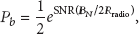
where
In this network model, HARQ or ARQ scheme is applied in sending nodes, receiving nodes, and relay nodes. Let

where the sum of data link layer frame header length and frame check sequence size is α and the packet length of ACK is
Furthermore, let

4. Reliability Aware QoS Analysis Model
4.1. Markov Chain Model
When the packet has been sent into the wireless channel, it may be in three states: (1) received state, (2) drop state, or (3) aware state. Let

Markov chain model for the error control scheme.
In this Markov chain, the nonnull one-step transition probabilities from aware state into received state are listed as follows:


The probability of packet retransmitted by the relay nodes is given by following formula:

For the transition probabilities from other states into drop state, we have

When the physical characteristics, distance, and the value of
4.2. QoS Analysis Model
Let
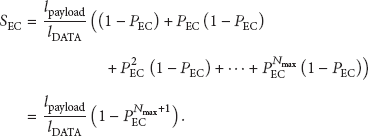
Here,

The average retransmission time

According to (11), we can obtain the solution of average delay, which is shown as (12):
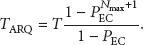
Here, let T denote the round trip time of one packet. The energy efficiency η is defined as (14), which is a suitable metric that could capture the energy and reliability constraints:

η means the ratio of the energy of payload

4.3. Results and Discussion
In our previous research achievements [18], the performance of ARQ or HARQ scheme has a close relationship with distance and
On the one hand, Figure 2 shows four performance metrics as a function of distance. We only consider two different
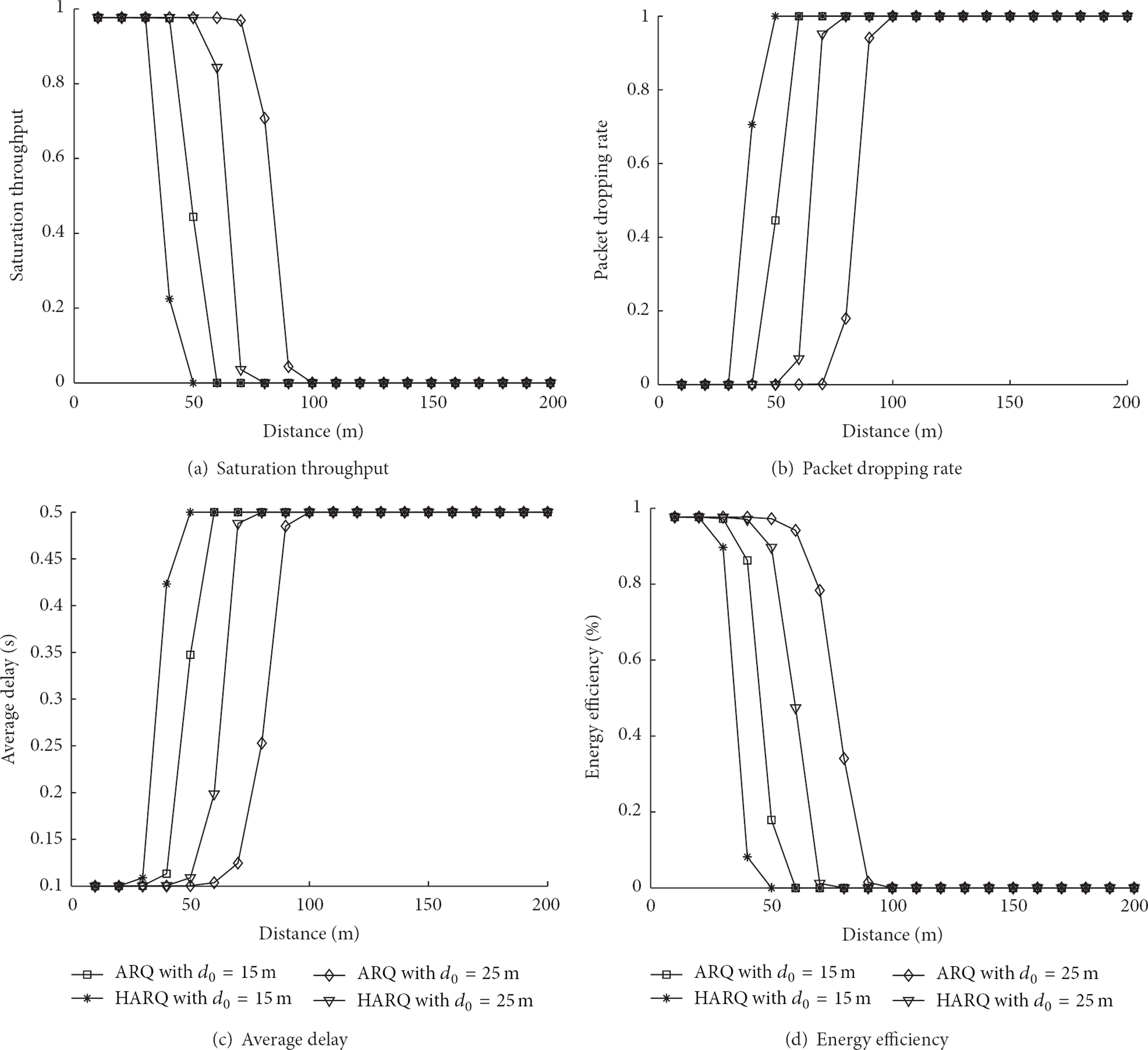
Performance analyses of ARQ and HARQ with different distances and
On the other hand, the change trend of four performance metrics as a function of SNR is shown in Figure 3. It was obvious that the performance of ARQ is maintained gradually perfect with increasing of SNR. Specially, the saturation throughput and energy efficiency of ARQ increase to 1 rapidly; meanwhile, the packet dropping rate and average delay of this scheme decrease fast when the SNR between sender node and next-hop receiver node is greater than 16 dB. Hence, SNR between sender node and next-hop receiver node has a constant value, which is 16 dB for this scheme. There is apparently a SNR threshold value of ARQ scheme. Likewise, the SNR threshold value is 20 dB for HARQ. Therefore, different error control mechanisms have always one constant SNR threshold value. We can choose the best relay node as the next-hop receiving node according to this conclusion.
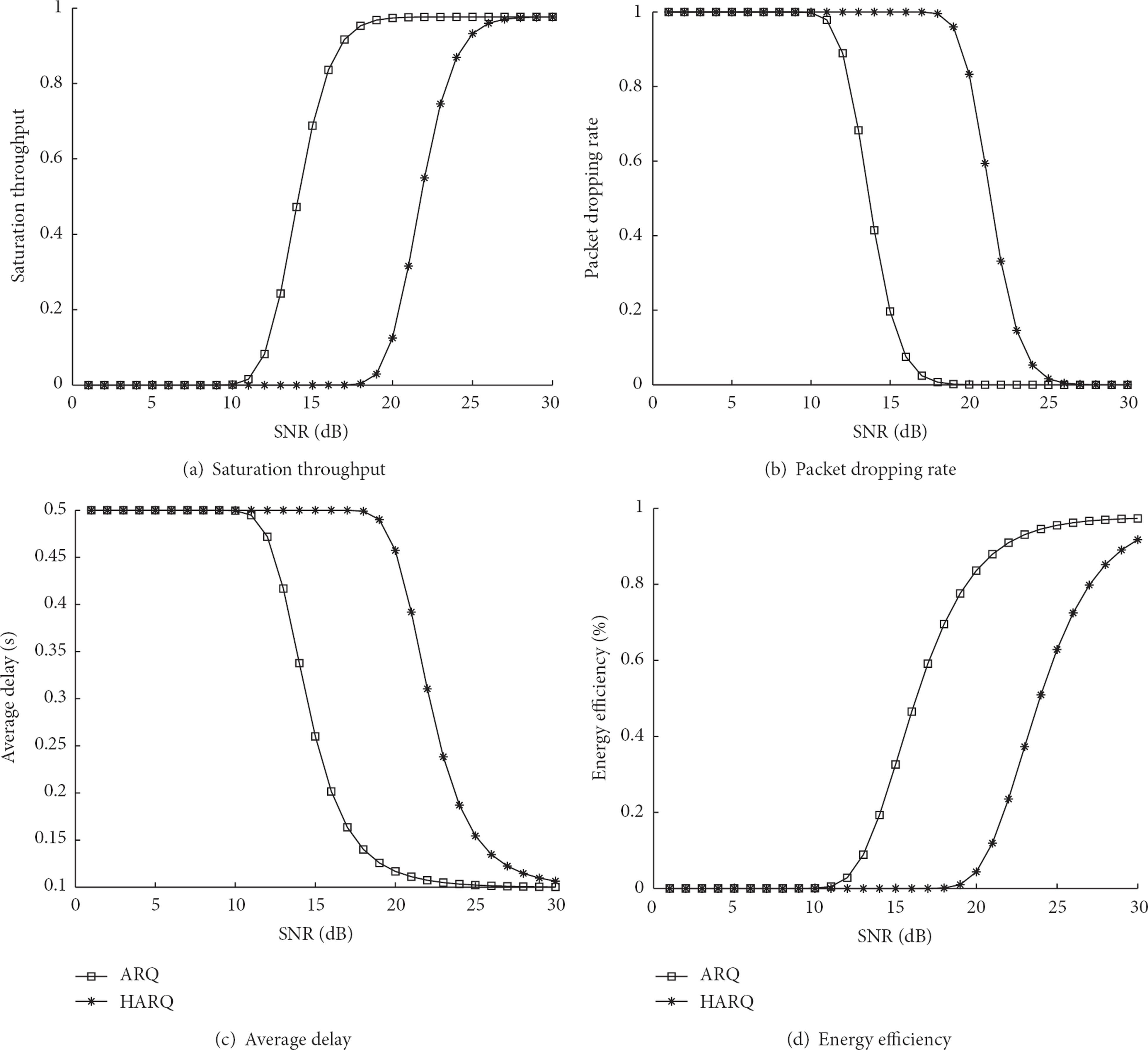
Performance analyses of ARQ and HARQ with SNR.
5. Diversity of QoS Supported Scheme
In this section, we define six error control schemes: (1) ARQ with distance (

Analytical research of four performance metrics between six different error control schemes.
From Figure 4, we discover the relationship of QoS supported capacity with the above error control scheme, which is listed as follows.
Energy efficiency: ARQ with SNR > HARQ with SNR > ARQ with distance (
Average delay: HARQ with distance (
Packet dropping rate: ARQ with SNR > HARQ with SNR > ARQ with distance (
Saturation throughput: ARQ with SNR > HARQ with SNR > ARQ with distance (
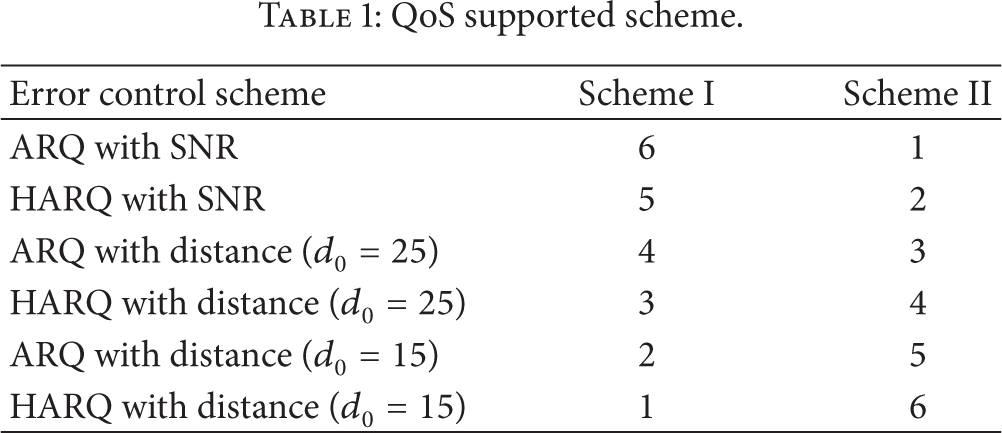
We found out that the trend of saturation throughput, packet dropping rate, and energy efficiency is quite opposite to the one of average delay. Therefore, the application service could select the optimal QoS supported scheme to satisfy the diversity requirement from Table 1. Here, QoS scheme I is composed of the guarantee ability of saturation throughput, packet dropping rate, and energy efficiency. In addition, QoS scheme II is comprised of real-time guarantee ability. Particularly, the more the digit of the error control scheme in Table 1, the better its guarantee capacity.
QoS supported scheme.
6. High Reliable Relay Selection Approach
6.1. Relay Selection Algorithm
If we can obtain the end to end distance d, the optimal relay node should be selected according to distance threshold, and also the number of relay nodes is given, which are as shown in the following equations:

where
In a word, the work flow of relay selection based on distance is as follows.
To obtain the value of
Calculate
Get
If the distance is less than or equal to
If we can obtain the SNR of wireless channel, the optimal relay node should be chosen according to SNR threshold. The process of relay selection based on SNR is as follows.
The SNR of the wireless channel is acquired with real-time detection.
Acquire the SNR threshold SNRTE based on the QoS analytical model.
If the SNR of one sensor node is less than or equal to SNRTE, it would be selected as the relay node.
Particularly, relay selection based on SNR should be used first when the wireless channel is stable and perfect; otherwise, relay selection based on distance has to be employed promptly.
6.2. Implementation of Adaptive Relay Selection
In this subsection, the reliability aware and diversity of QoS supported adaptive relay selection mechanism (ECA-Q-RS) is proposed, which is implemented in wireless distributed sensor network. Because the relay node is selected based on characteristic of error control in ECA-Q-RS, the performance of the proposed mechanism can be evaluated by the following formula:
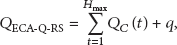
where
Afterwards, we present the basic idea of the ECA-Q-RS and its implementation at sender node, receiver node, and relay nodes in detail, which is illustrated as follows.
Sender Node
Carry out the QoS supported scheme. The guarantee priority of saturation throughput, packet error rate, and energy efficiency, or average delay is appointed according to the requirement of application service.
At the data link layer, the optimal error control and QoS supported scheme are chosen on the basis of Table 1. Moreover, the value of
Relay selection mechanism based on distance is implemented when d and
Starting to send data packets. If ACK packet is received, new data packets are sent, and retransmission time-out is used for each packet at the same time.
When the timer matures, or NACK packet is received, the optimal error control scheme is started according to the QoS scheme.
Relay Node
Select the optimal relay node from candidate nodes based on distance or SNR threshold.
Steps (3), (4), and (5) are implemented repeatedly in proper order until the data packet is received successfully or discarded actively.
Receiver Node
If ARQ scheme is used, checksum is calculated and tested. If HARQ scheme is used, checksum testing and FEC encoding are implemented.
If the result obtained is right, the data packet is accepted, and ACK packet is sent simultaneously; otherwise, it is rejected, and NACK packet is sent at the same time.
Deliver the correct data packet to the upper layer.
7. Performance Evaluation
In this work, we use NS-2 and VC++6.0 to simulate, analyze and evaluate the performance of ordinary data transmission and multimedia streaming using ECA-Q-RS, compared with max SNR relay selection and distance aware relay selection through two group experiments. The experimental data is the average value after 100-time simulation and mathematical analysis.
7.1. Simulation Parameters
In experiment 1, 50 sensor nodes move in an 800 m × 800 m rectangular region. α is 11 bytes.
For multimedia traffic of experiment 2, we use a medium quality MPEG4 video clip from the movie forman_qcif.yuv, which consists of 400 video frames. The structure of the group of pictures is IBBPBBPBBPBB (
7.2. Simulation Results
Two case studies are designed and conducted, with the variation of bit error rate
Decodable frames rate: it considers the dependency between different MPEG4 video frames.
Average delay: we only calculate the end to end delay of the decodable frames.
Throughput: the total size of data packets received successfully by the receiver node.
Energy efficiency: the number of obtained decodable video frames per unit of energy consumption.
7.2.1. Experimental Results with Channel State
Figure 5 shows three performance metrics as a function of

Performance with varying channel state (
7.2.2. Experimental Results with QoS Supported Capacity
Figure 6 shows the five performance metrics as a function of different relay selection schemes in experiment 2.

Performance with multimedia communication.
Figure 6(a) shows the result of the decodable frame rate. As the transmission rate of multimedia data increases, the collision probability of data packets transmission increases significantly, leading to an unstable and dynamic decreasing tendency of decodable frame rate. The result demonstrates tremendous improvement of decodable frames rate with ECA-Q-RS as compared with other mechanisms. On this basis, we determine that ECA-Q-RS can prime accommodate the poor and dynamic wireless network environment. This obvious improvement depends on their stable relay selection scheme based on QoS diversity supported mechanism and adaptive error control strategy.
The real-time performance is shown in Figure 6(b). The average delay using ECA-Q-RS achieves a tremendous improvement. The main reason is that the error control aware adaptive relay selection strategy enhances the bandwidth and frequency spectrum utilization, as well as propagation path. As shown in Figure 6(c), the ECA-Q-RS always performs better than the other two mechanisms. The throughput gain we have is in the improvement of hop-by-hop throughput and reduction in bandwidth consumption.
Figure 6(d) provides packet error rate for each video frame in different mechanisms. When using ECA-Q-RS, the packet error rate fluctuates a little, and the average is the lowest. These adaptive schemes in ECA-Q-RS are not only able to achieve higher decodable frame rate and network throughput but also improve the stability of the video transmission. Figure 6(e) shows the energy utilization efficiency of different mechanisms. The enhancement of data exchange gain and adaptive error control can greatly reduce energy consumption for data transmission. Comparing with the other two schemes, ECA-Q-RS achieves significant improvement in energy utilization efficiency.
8. Conclusions and Future Work
There is a great potential for relay selection and error control to enhance the performance of QoS diversity services and resource utilization. The purpose of this work is to overcome all kinds of limitations; we propose a reliability aware and QoS supported relay selection (ECA-Q-RS).
The main contributions in our work are as follows. First, considering the characteristics of different error control schemes, we introduce the Markov chain model based on ARQ and HARQ to study the characteristics of QoS. Second, a QoS supported strategy with dynamic priority is designed to ensure that packets have a better chance to be forwarded. Finally, we present adaptive relay selection algorithm, working together with the above QoS supported mechanism, in order to reduce the ratio of potential damaged or lost opportunities.
The mathematics and simulation results demonstrate that, compared with the existing typical relay selection mechanisms, ECA-Q-RS greatly improves the data transmission quality and achieves significant gains in terms of throughput and energy efficiency. As a result, we determine that the proposed mechanism is feasible for data diversity communication in wireless distributed sensor network.
Our future work focuses on the implementation and validation of the proposed adaptive relay selection algorithms on the prototype system. Besides, one possible future direction is to study the channel prediction approach and the tradeoff between performance and complexity.
Footnotes
Conflict of Interests
The authers declare that they have no financial and personal relationships with other people or organizations that can inappropriately influence their work; there is no professional or other personal interest of any nature or kind in any product, service, and/or company that could be construed as influencing the position presented in, or the review of the paper.