




Abstract
Diesel engine is a complex electromechanical system which must operate reliably in harsh working environments. Reliability analysis and prediction play an important role during the design and development of diesel engines. However, in the traditional reliability methods, the analytical result obtained from the conventional failure mode, effects, and criticality analysis (FMECA) is not sufficient, which not only increases the workload of designers in charge of reliability, but also prolongs the product delivery time. This paper performs an in-depth reliability analysis with an emphasis on predicting the lifetime of diesel engine's turbocharger, in which the failure mode and the information of criticality provided by FMECA are fully utilized to carry out the reliability predictions. Meanwhile, to ensure the reliability prediction quality, this paper takes into account the expert knowledge and provides a possibility-based prediction model, in which the fuzzy analytic hierarchy process and the fuzzy comprehensive evaluation are combined to assess the criticality of the FMECA.
1. Introduction
Reliability prediction becomes a necessary step for designing any technical products today, which is defined as a process to evaluate the reliability target of the product in the context of specified goals under certain working environments. The process begins at the design stage, where prediction of the product reliability is made based on the initial information at that point. The prediction is further refined through the development, testing, production, and operational stages of the life cycles.
At the initial design stage, various factors affecting the product reliability must be considered. Since these factors are complex, it is difficult to assess their weights and importance to the product reliability. In other words, many uncertainties exist in the initial reliability prediction. Therefore, the conventional reliability prediction models may not be suited for dealing with products involving a large amount of uncertainties, particularly at early design stages. To solve the problem, some alternatives are often adopted.
Design similarity method which analyzes the similar products currently in operation and uses the results to predict the reliability of a new design.
Expert assessment method which is based on the scores is marked by the experts to predict the product reliability.
Fuzzy comprehensive evaluation method which utilizes the experts' experiences and fuzzy inference mechanisms to estimate the reliability.
Nowadays, the widely used risk analysis methods are the phenomena identification and ranking table (PIRT) process [1] and FMECA. PIRT process has shown additional utility as a robust means to establish safety analysis while the focus of this paper is mainly on the FMECA. As one of the fundamental techniques for handling diesel engine reliability analysis, FMECA can be applied across the entire life cycles from design, development, manufacturing, field operation, and so forth. However, in the reliability prediction mentioned above, the analytical results obtained from FMECA are not sufficient and fully exploited. In order to obtain a more accurate reliability prediction, we have to collect relevant lifetime data adequately. This will increase the workload of the design team which reduces the working efficiency hugely. Even if this process can be repeatedly applied, the reliability prediction still may not be able to achieve the satisfactory results. Yang et al. [2] proposed a risk evaluation method in failure mode and effects analysis of aircraft turbine rotor blades using Dempster-Shafer evidence theory under uncertainty. Xiao et al. [3] proposed a multiple failure modes analysis and weighted risk priority number evaluation method in FMEA. To obtain a more accurate and realistic prediction, this paper proposes a new prediction model by combining the failure mode with the critical information derived from FMECA. Targeting at the characteristics of diesel engine design, expert weight method in the fuzzy analytic hierarchy process and the fuzzy comprehensive evaluation are combined to assess the criticality of FMECA.
2. Traditional FMECA
FMECA is known be to a systematic method to identify the potential failure modes, determine the root causes, and evaluate the effects on system reliability. The study is performed preferably in the early development phases while removal or mitigation of the failure mode is the most cost effective. In performing FMECA, the system behavior is evaluated per individual potential failure mode of individual component. A critical part of the analysis prioritizes the failures for correction action based on the risk priority number (RPN).
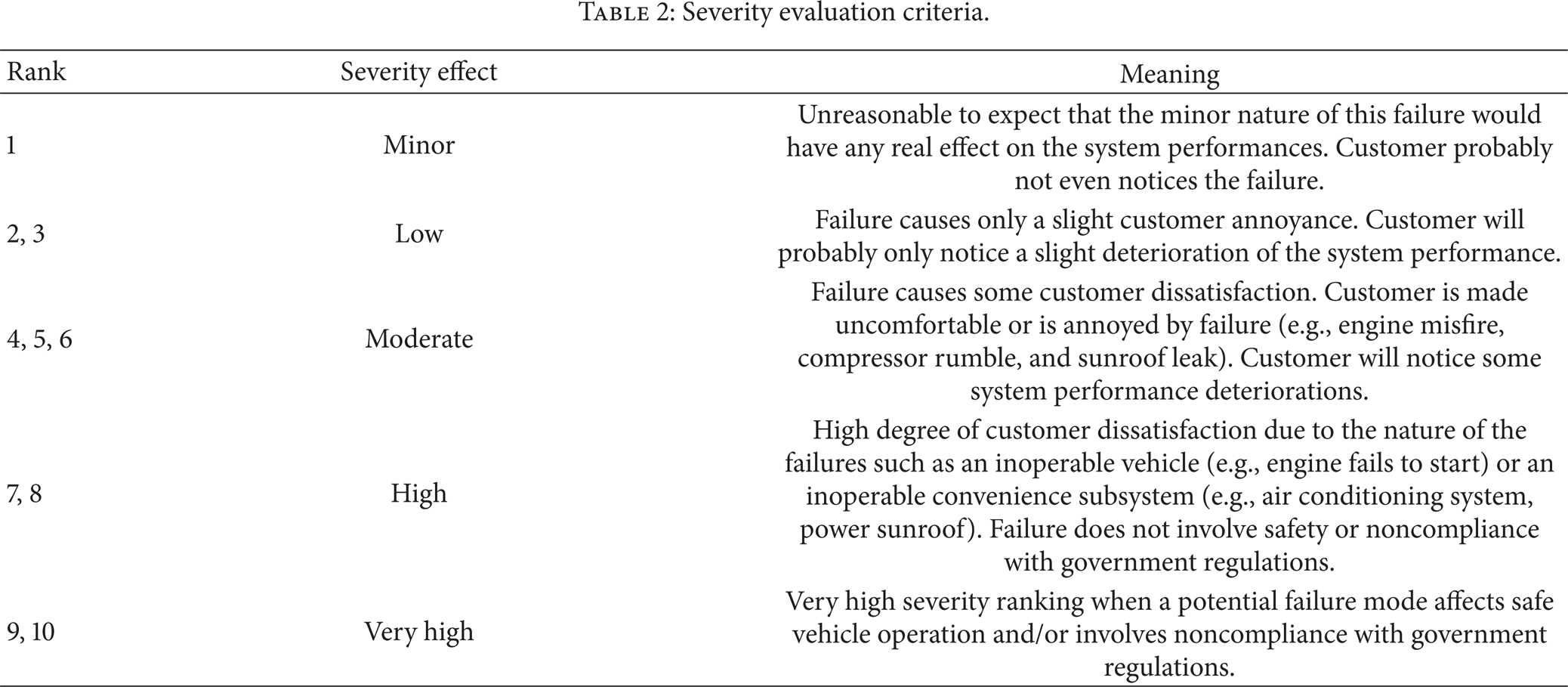
The RPN method is widely used in the automotive industry. It uses linguistic terms to rank the probability of the failure mode occurrence as well as the severity of its failure effect and the probability of the failure. All of these are scored from 1 to 10. These rankings are then multiplied to generate an RPN value. Failure modes with a higher RPN are assumed to be more significant than those with a lower RPN. The parameters are described by the linguistic variables shown in Tables 1, 2, and 3, respectively. The ranks and meanings given in the tables are based on the definitions used in the RPN analysis.
Frequency of occurrence evaluation criteria.

Severity evaluation criteria.
Detectability evaluation criteria.

3. FMECA Analysis for the Turbocharger of Yu-Chai YC6108ZQ Diesel
When designing the turbocharger of Yu-Chai YC6108ZQ, our first job is to perform FMECA analysis. Assume that experts can score the occurrence, the severity, and the detectability of every failure mode. The criteria for the occurrence, severity, and detectability and the corresponding descriptions are, respectively, given in Tables 1, 2, and 3. According to the criteria in the Tables 1, 2, and 3, the scores are shown in Table 4.
The RPN of the turbocharger for Yu-Chai YC6108ZQ.

The traditional approach to criticality assessment is widely used, but it has some disadvantages. For example, in the study of the turbocharger, it is difficult for an expert to assign the exact scores for all failure modes because of the lack of information as well as the ambiguous criteria in the early design stage. Therefore, the scores usually cannot be determined precisely which were often influenced by the subjective judgment of the experts. Meanwhile, the scores for the same failure mode assigned by the different experts may be quite different due to the different experiences and knowledge, and how to eliminate the score gaps is very important. Most importantly, the way of RPN calculation is also not quite reasonable. For instance, there are two different failure modes. For the first failure mode, the occurrence is 2, the severity is 9, and the detectability is 3, in the traditional method, the RPN is 54. For the second failure mode, the scores are 5, 5, and 5, respectively, so the RPN is 125. However, it is obvious that the first failure mode is more significant than the second one because its severity is 9. In order to solve the aforementioned problems perfectly, the expert weight and the fuzzy analytic hierarchy process as well as fuzzy comprehensive evaluation are employed in this paper.
4. Fuzzy Analytic Hierarchy Process (AHP)
The game model based on the triangular fuzzy number is used to calculate the weights of experts in this paper. u1, u2, …, u n represent n teams in the game model [4–6]; every two teams have one game, and the total score of the game equals 1. u i plays a game with u j (i ≠ j). The score got by u i and u j are μ ij = (l ij , m ij , u ij ) and μ ji = (l ji , m ji , u ji ), where μ ij (μ ji ) denote the triangular fuzzy number. l ij (l ji ), m ij (m ji ), and u ij (u ji ) denote the lower bound, the point with membership degree equals to 1 and upper bound for the triangular fuzzy number μ ij (μ ji ), respectively.
From the aforementioned discusses, we know that l ij ≥ 0, m ij ≥ 0, u ij ≥ 0, l ji ≥ 0, m ji ≥ 0, u ji ≥ 0, and


Equation (2) means that the team u i cannot play game with itself; the value of the μ ij can be taken arbitrary value in interval [0, 1]. μ ij which satisfies (1) and (2) is called opposite fuzzy property measure, matrix (μ ij ) is called fuzzy property assessment matrix. If μ ij > μ ji , we have that u i is more important than u j ; that is, u i > u j . If fuzzy property assessment matrix (μ ij ) satisfies u i > u j , u j > u k , and u i > u k , then we call μ ij as consistency.
The total score obtained by the team u i can be calculated by
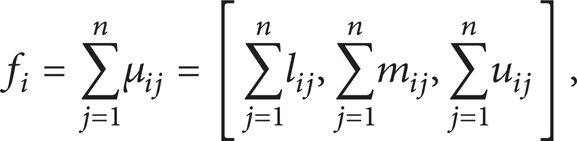
where f i denotes the total score obtained by the team u i , and it is a triangular fuzzy number.
From (1) and (2), the total score obtained by all the teams and the opposite property weight of each team can be, respectively, calculated by

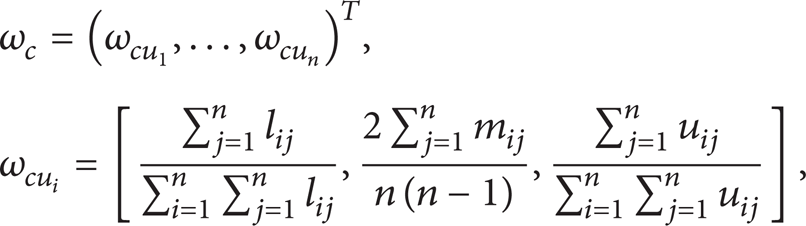
where ω c is called opposite property weight vector [7] and ω cu j is the opposite property weight for the team u j (j = 1, 2, …, n). The score between arbitrary two teams u i and u j and the opposite property weight ω cu j for the arbitrary team u j (j = 1, 2, …, n) are shown in Table 5.
Fuzzy property assessment μ ij and opposite property weight vector ω c .

5. Fuzzy Criticality Analysis
5.1. Fuzzy Linguistic Variable
The natural language which is used to describe the criticality of the failure modes can be divided into five different states based on the fuzzy linguistic variables (see Table 6). The corresponding fuzzy numbers to represent these five states are shown in Figure 1.
Linguistic variables and their triangular fuzzy numbers.


States of fuzzy linguistic variables.
From Figure 1, we know that it is not necessary to adopt a deterministic score for analyzing a failure mode. Instead, it is assigned with a fuzzy number to represent the state. As shown in Figure 1(a), the assessment of the occurrence is 2–6, which could be described by a triangular function. The membership of occurrence moderate for the interval is 0.82. In other words, we could assume that the median value has the largest probability. The fuzzy number stands for the fuzzy information of the occurrence. We could get a fuzzy set X, which is composed by the intersection points of the fuzzy number and the fuzzy linguistic variables such as

Equation (6) represents the possibility distribution of the occurrence scores. Similarly, the severity and the undetectability could be handled using the same way.
5.2. Fuzzy Comprehensive Evaluation Model
5.2.1. Factor Set
The factor set with elements that are a variety of factors affecting criticality assessment is a conventional set. It can be defined as follows:

where
5.2.2. Factor Weight Set A
Because of the different contributions to the criticality, the factors may have the different weights. Mathematically, these weights can be simply represented by the following set:

where a1 is the weight of occurrence, a2 is the weight of severity, and a3 is the weight of undetectability,
5.2.3. Fuzzy Matrix X
In Figure 1, the factors have been represented by five different linguistic variables. When a failure mode is analyzed, the fuzzification process can be used to convert the occurrence, severity, and undetectability into three fuzzy sets which constitute a fuzzy matrix. After the normalization from (6), the fuzzy matrix could be converted into the following matrix X:

where X1, X2, and X3 denote the values of the occurrence, severity, and undetectability after normalization.
5.2.4. Assessment Set
An assessment set consists of all the possible assessed results which are scored by assessors in the intervals. The levels for criticality can be defined as

where V denotes the criticality level, and v1 = remote, v2 = low, v3 = moderate, v4 = high, v5 = very high.
5.2.5. Single Factor Assessment Matrix
For only single factor assessment, there exists a fuzzy mapping f from X to V. According to the fuzzy mapping principle, the fuzzy relation R, which is defined as a fuzzy subset on product X × V, can be determined by f [8]. When a fuzzy subset is expressed as a membership function, the fuzzy relation can be described as follows [9–11]:

where r ijk denotes the membership grade of the binary (x ij , v k ) and 0 ≤ r ijk ≤ 1.
The single factor assessment matrix B is defined as

where
The comprehensive evaluation matrix D [11–13] is defined as

where
6. Criticality Number
6.1. Weight Average Principle
Proper weights for the linguistic variables of the assessment set are chosen, and the weights set could be defined as follows:


where E denotes the weight set and C m denotes criticality.
6.2. Reliability Prediction Based on the Failure Modes
The traditional similar product method can be used to predict the reliability of new products by using the failure data of the old products. It is defined as

where
R0 = reliability of old product,
R n = reliability of new product,
d0 = number of defects of old product,
d i = number of the added defects of new product,
d e = number of the solved defects of old product.
The criticality number of failure modes obtained from FMECA is used to predict the reliability of the new product rather than counting the number of defects.
The new reliability prediction model can be defined as

where
R0 = reliability of old product,
R n = reliability of new product,
Cm0k = criticality number of failure modes of old product,
C mik = criticality number of the added failure modes of new product,
C mek = criticality number of the solved failure modes of old product.
7. FMECA Analysis for the New Type Turbocharger of Yu-Chai YC6108ZQ Diesel
Assume that the reliability of a new type turbocharger needs to be predicted. The failure modes of the new type turbocharger are shown in Table 7. Four experts are available, and the occurrence, severity, and undetectability of every failure mode are scored independently. Different experts may use the different weights because of the difference in product domain knowledge. Therefore, the fuzzy AHP method is employed to calculate the weights of the available experts.
Failure modes of the new type turbocharger.

According to (1) and (2), the fuzzy numbers in Table 5 can be acquired easily.
The weight matrixes of the available experts could be obtained by the questionnaires, which is given by

According to (5) and Table 5, the opposite property weight can be given by

The algorithm of defuzzification is used for the opposite property weight; we have S1 = 0.248, S2 = 0.098, S3 = 0.41, and S4 = 0.248.
After the normalization for the S i (i = 1, 2, 3, 4), the weights of the available experts can be given by

Four key failure modes for the turbocharger are listed in Table 6.
As shown in Figure 1, the fuzzy matrix X of the fracture scored by expert 1 is given by

In this example, the factor weight set A = (0.3, 0.5, 0.2) is defined. According to the experts knowledge and some related studies, the following single factor assessment matrixes R1, R2, and R3 are obtained, which can be, respectively, expressed as

Therefore, the comprehensive evaluation matrix D1 of fracture is obtained from the proposed method, and it is given by

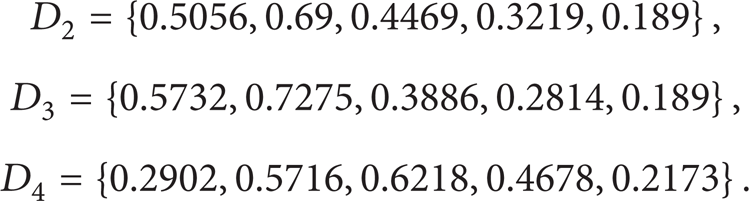
The comprehensive evaluation matrixes scored by expert 2, expert 3, and expert 4 are, respectively, acquired, which can be expressed as
The final comprehensive evaluation matrix can be obtained by combining the weights of the available experts; that is,

Assuming that E = {1, 3, 5,7, 9}, according to (15), the criticality number of fracture Cm03 is

By the same way, the criticality numbers of the failure modes can be calculated. The criticality numbers of the failure modes for the old turbocharger are

The criticality number of the solved failure modes of the old turbocharger is

The criticality number of the added failure mode of the new turbocharger is

According to the statistical calculation of the maintenance data, the reliability of the old turbocharger is R0 = 0.9602. It is easy to calculate the reliability of the new turbocharger R n ; by using the prediction model in (17), we have

8. Conclusion
Through a comprehensive and in-depth study on the diesel engine turbocharger's reliability analysis, this paper makes full use of failure modes and the criticality information from FMECA to carry out the reliability prediction of new design. It not only reduces the workload of the design team significantly, but also improves the working efficiency and the compressing of the time-to-market cycles. Meanwhile, according to the characteristics of diesel engine turbocharger design, this paper proposed a new reliability prediction model by synthesizing experts' weights with conventional RPN technique. The fuzzy analytic hierarchy process and the fuzzy comprehensive evaluation procedure are combined to assess the criticality of FMECA. Therefore, the prediction result is more accurate and realistic than the traditional methods.
Footnotes
Acknowledgment
This research was partially supported by the National Natural Science Foundation of China under the contract no. 51075061.