




Abstract
Designing wireless sensor networks (WSNs) that can work reliably in the presence of inside packet drop attackers is very challenging. Current trust mechanisms and avoidance approaches are promising but have their limitations. Avoidance approaches transmit multiple copies of the packets to avoid attackers and cause high overhead. In trust mechanisms, each sensor monitors it neighbors, evaluates their trustworthiness, classifies them as either trustworthy or untrustworthy, and then discards untrustworthy sensors from the network. However, malicious insiders, which are legitimate members of the network and know exactly what their monitoring nodes know, can launch attacks carefully to avoid being detected and discarded from the network. In this paper, we first show that this is possible by introducing a selective forwarding-based denial-of-service (DoS) attack. We then propose an enhanced trust mechanism to detect such attackers and identify their victims. Furthermore, we design two attacker-aware protocols to reroute victim nodes' packets by avoiding the attackers. We conduct extensive OPNET simulations to validate our claims and demonstrate the advantages of our proposed approaches. Finally, as a complementary defensive method to our detection and avoidance approaches, we introduce a prevention routing algorithm that proactively prevents the attack and provide our preliminary results to evaluate its performance.
1. Introduction
In wireless sensor networks (WSNs), sensor nodes will generate data packets and send them to the base station (BS) in a multihop collaborative fashion due to their limited energy and transmission range. While being routed to the BS, data packets may be lost from collision, congestion, noise, or other network problems. The so-called insider packet drop attacks refer to a set of attacks where compromised nodes intentionally drop packets [1]. Such attackers disguise their malicious behavior behind the aforementioned natural packet loss phenomenon. This type of attack has become a serious security threat in WSNs [1–3]. A well-positioned malicious insider can be on the routing path of many sensor nodes and thus receive many data packets. It can simply drop them to cause damage to the network.
Selective forwarding attack, where the attacker drops only some packets and at some arbitrary time, is the most difficult insider packet drop attack to defend against [2]. Normally such an attacker seeks to achieve one of the following two goals. First, degrade the performance of the network in terms of packet loss rate. Second, prevent data collected by certain sensor nodes from reaching the BS. In the second case, the victim node will not be able to talk to the BS, and we name this attack selective forwarding-based denial-of-service (DoS) attack. Most reported studies on selective forwarding attacks focus on the detection of the attacker with the first goal [4–7]. As we will discuss later, these approaches are not effective against selective forwarding-based DoS attacks.
As a motivation for the importance of studying selective forwarding-based DoS attacks, we consider a WSN deployed in a territory for intruder detection. With the help of insiders that perform the selective forwarding-based DoS attack, an intruder will be able to enter the territory from the area monitored by victim nodes (to the selective forwarding-based DoS attacks) without being noticed by the BS. When the intruder can communicate with the inside attackers, they can launch the synchronized insider-outsider colluding DoS attack so the insider attackers can target different victims at different times, and the intruder can explore the territory covered by the victim nodes only.
Trust mechanism has been proven as a promising approach to identify inside packet drop attackers [3, 8–12]. In such approach, each node will monitor its neighbor's packet forwarding behavior and use this observation to measure the trustworthiness of its neighbors. Once a neighbor's trust value falls below a predetermined threshold, the monitoring node will consider this neighbor as an inside attacker and eliminate it from the routing table.
Another conceptually different approach to defend against insider packet drop attacks is avoidance [2, 13], where multiple copies of the packets are sent to the BS through multiple disjoint paths. As long as there is a path that does not contain any attackers, the packets will be delivered to the BS successfully. However, this approach has a very high cost in terms of network traffic, transmission energy, and so forth [2, 7].
In this paper, we study the selective forwarding-based DoS attacks and propose effective detection and avoidance mechanisms as well as a prevention routing algorithm to defend against such attacks. Specifically,
we first describe a simple selective forwarding-based DoS attack and show that the popular trust-based approaches (such as beta [14] and entropy [10] trust mechanisms) for inside attacker detection fail to detect such attack. We also analyze the potential damage this attack can cause to the network,
we then propose a source-level trust evaluation scheme to enhance the beta and entropy trust mechanisms for effective detection of the selective forwarding-based DoS attackers. Once the attacker is identified, we propose two avoidance strategies to reroute the victim's packets so they can reach the BS,
we validate our claims and evaluate the performance of our detection and avoidance mechanisms with extensive OPNET simulations,
as a complementary defensive mechanism to our detection and avoidance methods, we also introduce a prevention routing algorithm to proactively prevent the selective forwarding-based DoS attacks and show our preliminary results to evaluate its performance.
For simplicity, during the discussion of the threats and detection of insider packet drop attacks, we do not consider natural packet drops caused by network problems. However, our simulation settings include lossy networks and the natural packet drops due to that network problems will be reported.
The rest of this paper is organized as follows. Section 2 covers related work on insider packet drop attacks and the current countermeasures. Then in Section 3, we describe a selective forwarding-based DoS attack that none of the current defending approaches can detect to motivate our work. We propose our detection and avoidance approaches in Section 4 and evaluate their performance in the packet routing domain in Section 5. In Section 6, as a complementary defensive mechanism to our detection and avoidance methods, we introduce a prevention routing algorithm where an attacker has to choose between “not attacking” and “attacking and being caught.” We conclude this paper in Section 7.
2. Related Work
Attackers to a network can be insiders, outsiders, or both. WSNs deployed for security applications (such as monitoring in the battlefield) are normally equipped with cryptography-based authentication and authorization mechanisms to prevent outside attackers from launching eavesdropping or packet modification. Thus outsider attacks are limited to direct physical damage of sensors or jamming the communication channel [15]. However, inside attackers have many advantages [2, 12, 15]. First, they are legitimate members of the network and will not be caught by authentication or authorization. Second, inside attackers can disrupt network operations by modifying packet information or dropping critical packets. Finally, inside attackers can collude with outside attackers to cause more severe damage to the network as we have described in the introduction [16].
Inside attackers can launch various types of attacks actively (such as modification, packet drop, or misrouting) or passively (such as eavesdropping). Among these, packet drop attacks not only can cause significant network performance degradation, but also cannot be prevented by authentication and authorization [2]. Below are three representative types of insider packet drop attacks [2, 8, 10].
Blackhole Attacks. The blackhole attacker drops all received packets. It will cause the most serious damage to the network among all types of packet drop attacks during the same amount of time. However, it can be easily captured by the monitoring neighbors as it consistently drops all their packets.
On-Off Attack. When attack is on, the attacker drops all received packets, then forwards all received packets when attack is off, and repeats this drop-forward pattern periodically. This attacker can appear suspicious to its neighbor during its attack period when it acts like blackhole attacks and can also be detected easily when the attack on period is long or the on-off pattern is discovered.
Selective Forwarding Attacks. As we described in the introduction, such attackers can either drop packets randomly or selectively. It is much more challenging to defend these attacks than blackhole and on-off attacks.
Current defending approaches against selective forwarding attacks are either detection approach or avoidance approach. The detection approaches will fail to detect the attacker and victims in our proposed selective forwarding-based DoS attack. The avoidance approaches will solve the problem, but it is very expensive and may not suit for WSN applications where each sensor has limited resource.
Most of the reported efforts focused on random selective forwarding attacks [4–7]. For example, Hai and Huh [4] presented a neighbor-based monitoring and detection mechanism using two-hop neighbor knowledge where each exchanges its one-hop neighbors’ packet forwarding behavior periodically. However, this approach introduces network overhead due to periodic information exchange between nodes and is vulnerable to false information provided by malicious neighbors. In the multihop acknowledgement scheme [7], each node in the forwarding path is responsible for detecting attackers. Specifically, some randomly chosen nodes (called ACK nodes) will report ACKs back to the source node (hop by hop) using the same but reversed routing path when they receive a packet. However, this approach has several problems. First, it is unclear how to locate the exact attacker. Second, their detection scheme depends on other nodes’ observations, and thus their scheme is vulnerable to false accusation from malicious neighbors. The trust mechanisms with watchdog, as we have discussed earlier, solve these problems by monitoring whether the next node in the routing path forwards the packets or not [3, 9–11, 17]. Despite its many known limitations, the trust mechanism has been a promising solution to defend against insider packet drop attacks.
Instead of detecting the attackers, the avoidance approaches focus on how to deliver the packets successfully with the existence of the attackers. A popular way to achieve this is to use multipath routing paths [2, 13, 18, 19]. In [2], the authors pointed out that k disjoint multipath routing can completely defend against selective forwarding attacks with no more than
3. A Selective Forwarding-Based DoS Attack
In this section, we first describe the current trust mechanisms and trust-based routing approaches to avoid inside attackers. Then we introduce a selective forwarding-based DoS attack and show that the current trust mechanisms fails to detect such attack.
3.1. Trust Mechanism
A trust mechanism defines a trust value (or trustworthiness) for each sensor node, and how each node measures the trustworthiness of its neighbors. It detects insider packet drop attacks in the following three stages.
Neighbor Behavior Monitoring. Each node monitors and records its neighbors’ behavior such as packet forwarding. Watchdog [3] is a popular monitoring mechanism used in this stage. Each node M records all of its recently forwarded packets in a buffer. When M sends a packet to its neighbor node A, M monitors whether A forwards the packet toward the BS by overhearing A's packet transmission. Then, each overheard packet will be compared with the packet sent to A. When a match is found, M records that A has forwarded the packet and removes it from the buffer. If a packet remains in the buffer for a period longer than a predetermined time, the watchdog considers that A failed to forward the packet. In this paper, we use this watchdog mechanism in the OPNET network simulator [20].
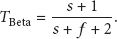
Trust Measurement. Based on the data collected in the previous stage, a trust model will measure the trustworthiness of the node being monitored [8, 10, 14]. For example, when a node is observed to have forwarded the packet s times and dropped the packet f times, the beta trust model [14] will assign this node a trust value using the following formula:
The entropy trust model [10] uses entropy function:

where p is the trust value in beta trust model, and define the trust value by

Note that in (1), the trust value is between 0 and 1. But the trust value in (3) is between −1 and 1. To have a nonnegative trust value between 0 and 1, we define

Detection. By comparing the measured trust value with a predetermined threshold
3.2. Trust-Based Routing
We use the popular greedy perimeter stateless routing (GPSR) [21] as an example to show how a trust mechanism can help to detect and avoid inside attackers.
Consider the WSN with 20 nodes shown in Figure 1. Node 3 relays the packets from nodes 4, 5, 9, 10, 15, and its own packets to node 2 which will then send them to the BS based on GPSR (depicted by solid lines with arrowhead). In a trust mechanism, node 3 will use its watchdog to monitor node 2.
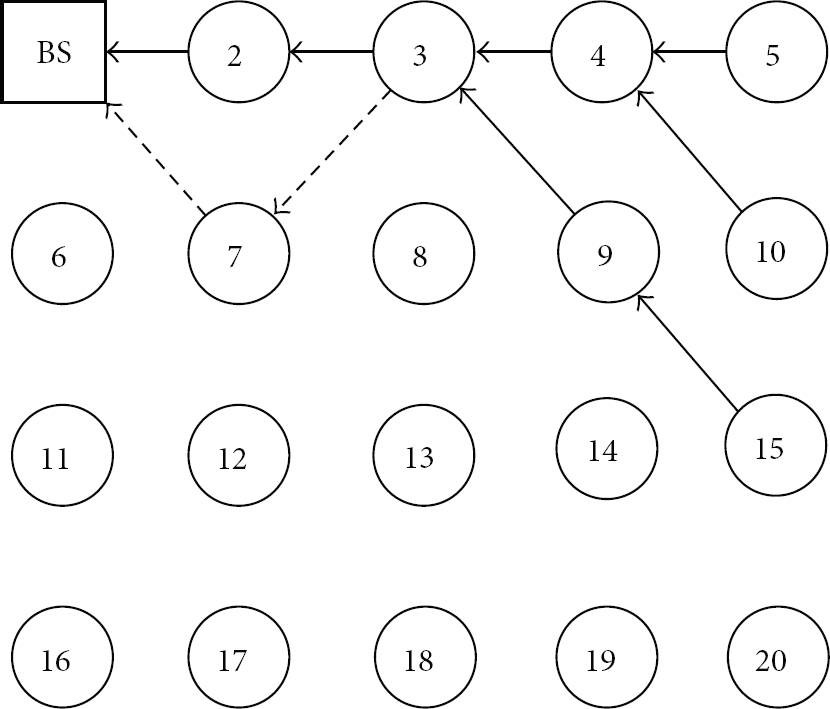
GPSR (solid lines) and trust-based GPSR (dotted lines).
When node 2 drops packets from node 3, node 3 will reevaluate the trust value of node 2. If the trust value falls below the threshold value, node 3 will treat node 2 as an inside attacker. A trust-based routing algorithm will then find a new routing path to avoid node 2. In this case, node 3 will forward the packets to node 7, hoping that node 7 will deliver the packets to the BS (the dotted lines with arrowheads in Figure 1).
Many researchers [9, 10, 17, 22–24] have shown that trust-based routing approaches can gracefully mitigate insider packet drop attacks by building trusted paths to the destination. Moreover, they showed that trust-based routing improves the packet's successful delivery under insider packet drop attacks over routing algorithms that do not consider trust. Clearly, the effectiveness of these trust-based routing algorithms is based on their underlying trust models. A good trust model will help the routing algorithm to quickly and accurately identify inside packet drop attackers and find alternate routes to avoid them.
3.3. A Selective Forwarding-Based DoS Attack and Its Analysis
3.3.1. Motivation
the current trust mechanisms and trust-based routing cannot detect all known insider packet drop attacks. For instance, an intelligent attacker who can keep its trust value above the threshold value
To attack victims and avoid being identified, the attacker node A will have to disguise itself by forwarding packets for some nodes. When a node M sends only its own packets to the attacker A and uses its watchdog to monitor A, apparently A cannot drop all the packets without being detected. However, if M also forwards packets from other nodes to A, then A may be able to drop all the packets from one or multiple victim nodes.
For example, in the WSN shown in Figure 1 where all the nodes generate packets with the same frequency and send them to the BS, node 2 can pick node 10 as its victim and drops all the packets from node 10. Therefore the BS can never hear messages from node 10 and hence comes the name “denial of service” for this attack. However, if node 2 forwards all the packets from nodes 3, 4, 5, 9, and 15 to the BS, when Beta trust model is used with
It is not hard to see that once an attacker positions itself on the routing path of many nodes, it can select multiple victim nodes and launch the denial of service attack without being noticed. This can easily cause a lot of damage to the network and so we need to find countermeasures to defeat such attack.
3.3.2. Protocol of the Attack
Steps shown in Algorithm 1 define the protocol for an inside attacker A to launch the selective forwarding-based DoS attacks against multiple victim nodes.
On each received packet (step 3), the attacker A first determines the direct sender of the message (node M) and original source node S that generates the packet (steps 4 and 5). If A has received packets from S before (i.e., S is not a new source node), A will either drop or forward the packet based on whether S is a victim or not (steps 6 and 7). If S is a new source node, A will update the number of nodes whose packets are routed to A through M by
3.3.3. Analysis of the Attack
For an inside attacker to launch the selective forwarding-based DoS attack against the victim nodes, the attacker needs to (i) be able to tell whether a received packet is from the victim nodes, and (ii) ensure that, after dropping all the packets from the victim nodes, the attacker will not be detected by the monitoring nodes.
We first show that assumption (i) is valid. In a geographic routing employed WSN, the receiver of a packet can obtain the source node (the node that creates the packet) information from the packet because the receiver is a legitimate relay node that can access the packet's header where the source identification is stored [21, 25]. Even when the source node is protected by methods such as authorization, it is still possible for a malicious receiver to figure out the source node information by breaking the authorization mechanism or analyzing network traffics [26, 27].
Second, we will show that requirement (ii) can be satisfied. Because the inside attacker is a legitimate member of the WSN, it knows the trust model and the threshold value
We define
In the beta trust model, if attacker A attacks

To keep this trust value higher or equal to the trust threshold

For the entropy trust models, there is no closed formula for
Values of

The small values of
One can also see that
4. The Proposed Defensive Mechanism
In this section, we propose and analyze our defensive mechanism, which is an enhancement of the beta and entropy trust mechanisms, against the above selective forwarding-based DoS attack. This defensive mechanism consists of two phrases: attacker detection and attacker-aware rerouting, which will be elaborated in Subsections 4.1 and 4.2 of this section, respectively. We analyze our approach and compare with existing methods in Subsection 4.3.
4.1. Source-Level Trust Evaluation and Attacker Detection
As depicted in Figure 2(a), in the existing trust mechanism [3, 9, 10, 14, 17, 22, 23, 28], a monitoring node M counts the number of successes s and failures f that the next node A forwards packets from M. It then evaluates the trust value

We can see that the current trust mechanism fails because the attacker can hide its malicious behavior behind its good behavior. As an attacker can identify the source node of a packet to launch the selective forwarding-based DoS attack, a monitoring node can also utilize the source node information to defend against such attack. This leads us to the following idea. If M uses separate counters to track not only A's overall packet forwarding behavior, but also how it delivers packets from each individual source node, then M will be able to tell whether A has launched the DoS attack against any node. This is shown in Figure 2(b) where M also evaluates A's trust value
Neighbor Behavior Monitoring. In addition to recording A's overall behavior s and f, for each packet that M overhears A is forwarding, M checks the source node information and updates a pair of separate counters,
Trust Measurement. Based on the data collected in the first stage, M evaluates not only A's overall trust value

When the entropy trust model is used, A's source-level trust value for source node i,

where

Detection. If any trust value
Theorem 1.
The proposed source-level trust evaluation approach can successfully detect selective forwarding-based DoS attacks against any source node.
Proof.
By the definition of the selective forwarding-based DoS attack, if A launches attack against node i, it will behave like a blackhole attacker and drop all packets originated from node i. Hence, after the attack is launched,
Formally, let

Because all the
Our approach requires the number of delivery successes and failures for packets from each source node. This will introduce storage overhead. Fortunately, such overhead is negligible. Even in the case when a node is receiving packets from 100 different source nodes and wants to track the status of the last 1 million packets from each node, the memory requirements will only be 0.25 KB (= 100 × log2220 bits/8). This overhead is low for current sensors such as TelosB (10 KB RAM, 48 KB Flash, and 1 MB EEPROM) and Mica2/MicaZ (4 KB RAM, 128 KB Flash, and 512 KB EEPROM) [29].
4.2. Attacker-Aware Avoidance Routing Strategies
Once the attacker and a victim of the selective forwarding-based DoS attack are detected, approaches to reroute the victim's packet to the BS should be developed. In this section, we propose two attacker-aware rerouting algorithms, which we refer to as avoidance strategies.
When the value of a
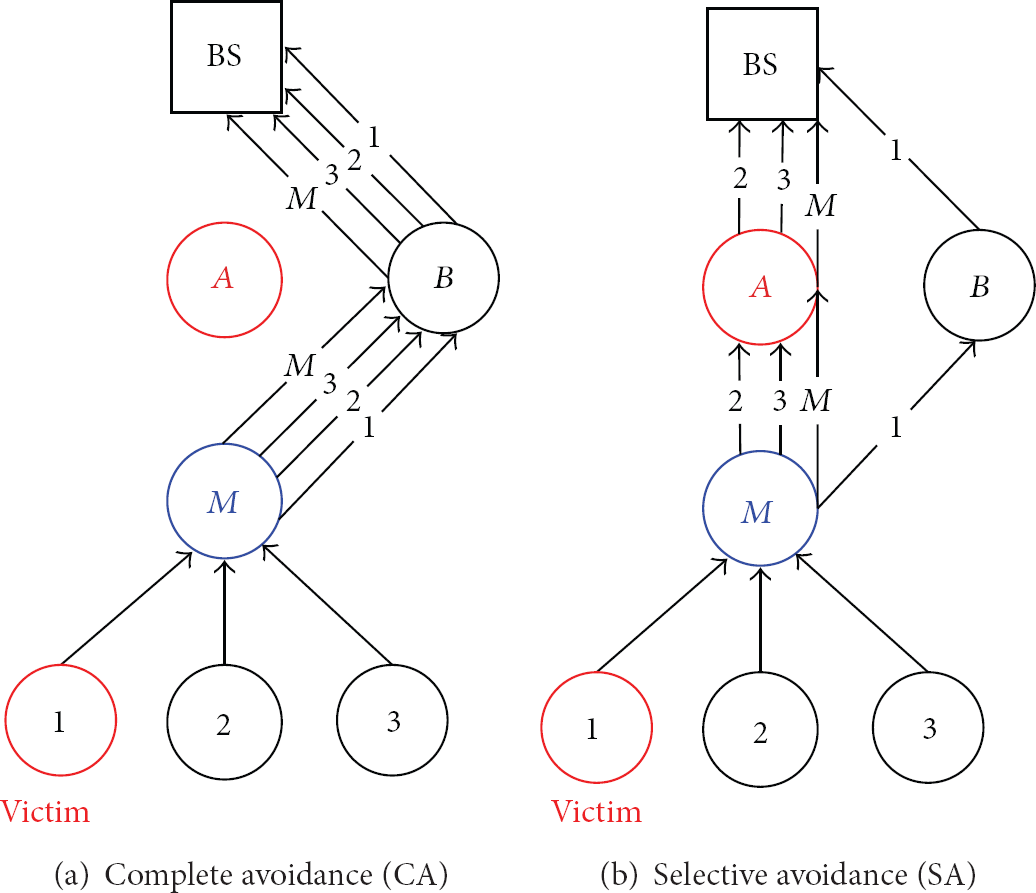
Two avoidance strategies to reroute the victim's packets to BS.
In light of the fact that a selective forwarding-based DoS attacker (node A in this case) has targeted victims, the selective avoidance (SA) strategy will only reroute the discovered victim's packets to avoid the attacker A and keep the other packets running through node A (see Figure 3(b)). The monitoring node M will continue updating the trust values (
We summarize the features of the two proposed attacker-aware rerouting algorithms in Table 2.
Comparison of the complete avoidance strategy (CA) and the selective avoidance strategy (SA).

4.3. Analysis of the Proposed Defensive Mechanism
The proposed defensive mechanism follows the 2-phase detection-avoidance framework. In the first phase, the source-level trust evaluation approach will detect victims of the selective forwarding-based DoS attack. In the second phase, the attacker-aware rerouting strategy will find a different path to deliver victim's packets to the BS.
4.3.1. Comparison with the Existing Trust Mechanisms
Our source-level trust evaluation is an enhancement of the existing trust-based mechanisms for inside attacker detection [10, 14]. The difference is that existing approaches do not consider the packet forwarding behavior of the receiving node (the node being monitored) for each individual source node. Therefore, it can detect whether the node is an inside packet drop attacker, but it will fail to detect the proposed selective forwarding-based DoS attack. In our proposed method, the monitoring node will evaluate the trust value with respect to each source node. As stated in Theorem 1, this enhancement enables us to identify not only the attacker, but also all the victims. The cost of our approach, compared with existing mechanisms, is the storage requirement to keep the delivery information for each source node, which we have analyzed after the proof of Theorem 1.
Now we compare the false alarm rate (FAR) of our approach with existing mechanisms. FAR measures how likely a good node will be tagged as an inside attacker. Let
Theorem 2.
Proof.
Recall that the trust value
When we use CA strategy in the second phase, the first detected victim node j is the one that has the largest packet drop rate that results in the smallest

However, when our approach claims an attacker,
On the other hand, when SA strategy is applied, our approach will identify the DoS victims one by one and reroute the packets from these victims to nodes other than the attacker A. Note that victim nodes always have large packet drop rate; when their packets are rerouted, the trust value of A evaluated by our approach will be higher than that in the existing approach. This is because the existing approach will count the
4.3.2. Comparison with the Avoidance Approaches
As we have mentioned in the introduction, the idea behind current avoidance approaches is to send packets from multiple disjoint paths in order to avoid inside packet drop attackers [2, 13, 18, 19]. These approaches cannot and are not intended to detect the attackers. We have also discussed in Section 2 that the overhead of such avoidance approaches can be prohibitively high. For example, when each packet is sent through multiple different paths, the transmission energy, the network traffic, and collision will all increase dramatically.
Despite the same name, the avoidance strategy in the second phase of our defensive mechanism is conceptually different from the above avoidance approaches. In our approach, the avoidance strategy is applied after both the victims and the attacker in the insider packet drop attack have been identified. Therefore we can efficiently find a path that does not involve the attacker to deliver victim's packets to the BS. Although the new path may not be as good as the initial path (where the attacker sits on) in terms of energy, delay, or channel quality, neither CA nor SA uses multiple paths. Hence, the large overhead problem in the conventional avoidance approaches does not exist in our defensive mechanism.
5. Simulation and Results Analysis
5.1. Simulation Goals, Setups, and Evaluation Metrics
There are two main goals of the simulation: validating that the current trust mechanisms fail to detect the proposed DoS attack and evaluating the performance of our defensive approach.
The parameters in Table 3 are used in our simulations. We conduct simulations with the commercial network simulator OPNET Wireless Modeler v.17.1. 100 sensors are deployed in a 2 km × 2 km area randomly in one setting (Figure 4(a)) and in a 10 × 10 grid in another setting (Figure 4(b)). Each node except the BS generates packets randomly in each 10-second period. The packets are sent to the BS. We use some of the default settings in OPNET such as 1024 bit data packet and geographic routing protocol (GRP) with a maximum of 7 retransmissions before a packet is dropped. We set each node's initial trust value to be 0.99. We consider the cases of both single and multiple selective forwarding-based DoS attackers. The simulation time is set to be 30 minutes in the case of single attacker and 40 minutes for multiple attackers. We simulate the attacker(s) launch the proposed selective forwarding-based DoS attack to various numbers of victims. Both beta and entropy trust models (defined in (1) and (4)) as well as our enhanced trust mechanism (defined in (7) and (9)) with two avoidance strategies (CA and SA) are implemented in the OPNET Modeler for comparison purposes.
OPNET simulation setup parameters for the validation of our detection mechanisms.


Two WSN topologies in our simulations.
The main performance evaluation metrics are as follows.
Avoidance completion time (ACT): this is the time when all the victims have been rerouted to avoid the attacker.
False alarm rate (FAR): as discussed in the previous section, this is the probability that a good node is being considered as a selective forwarding-based DoS attacker.
Energy per packet (EPP): this is the average energy consumption to deliver a data packet, regardless of whether the packet reaches the BS or not. EPP is obtained by the total energy consumed for data packet transmissions divided by the total number of data packets generated by all source nodes.
5.2. Simulation Results and Analysis of Single Attacker
ACT is the most important metric as it indicates the ability of each approach in identifying the attacker and rerouting the victim's packets.
The simulation results on ACT in Table 4 reveal the following.
Avoidance completion time (in seconds) for the Beta and Entropy trust model without any avoidance strategy (Pure), with the complete avoidance strategy (CA), and with the selective avoidance strategy (SA) when the attacker targets J victim nodes.

Beta or Entropy Trust Models Alone Fail to Detect the Attacker. In the grid topology, there are 21 source nodes that send packets to the monitoring node and then to the attacker. From Table 1, when the selective forwarding-based DoS attacker targets 6 victims or less, the beta trust model will not detect it; when it targets 3 victims or less, the entropy trust model cannot detect it. The results in Table 4 confirm this. This is also true for the random topology where the monitoring node forwards packets from 16 source nodes (including itself) to the attacker.
Our Defensive Mechanisms Successfully Detect the Victims. Even when the attacker targets only one victim (the case of
Optimality of the Proposed Selective Forwarding-Based DoS Attack. We already discussed in the first item that our proposed selective forwarding-based DoS attack cannot be detected by the current trust model. Table 4 also shows that if the attacker becomes aggressive and targets more victims than the
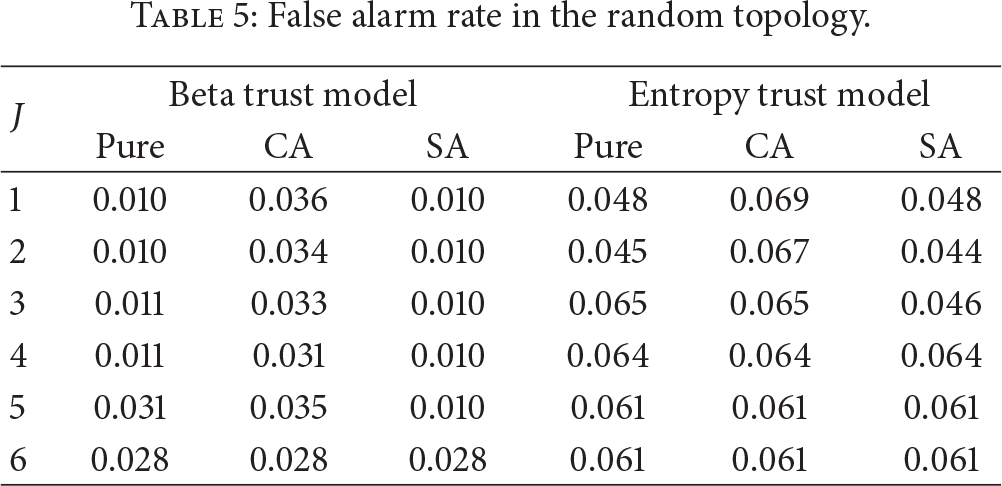
FAR measures the likelihood an approach will mistakenly treat an honest node as attacker. In the grid topology, there are very few collisions and there is no false alarm. The FAR values for different approaches in the random topology are shown in Table 5. This result confirms the claim of
False alarm rate in the random topology.
Finally, we report EPP. From Table 6, we can see that our proposed enhancement incurs very little energy overhead. In the avoidance approach where multiple paths are used, for a single attacker, two disjoint paths will guarantee the successful avoidance of the attacker. However, the energy consumption will be doubled. From energy perspective, our approach is much better than the current avoidance approach.
Energy per packet (mJ) for the Beta and Entropy trust model without any avoidance strategy (Pure), with the complete avoidance strategy (CA), and with the selective avoidance strategy (SA) when the attacker targets J victim nodes.
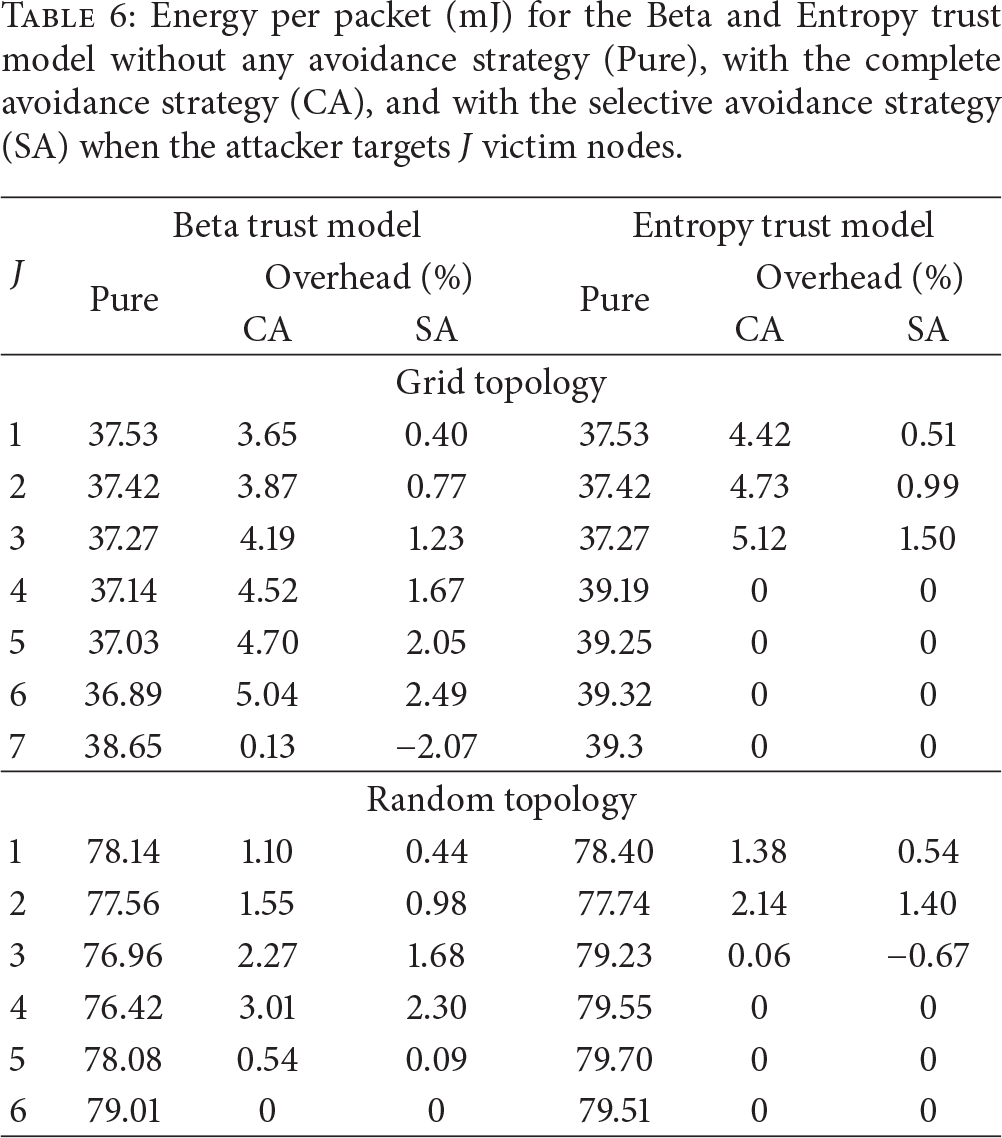
In a couple of cases, when SA strategy is used, there is actually a small amount of energy savings. This is possible because the original geographical routing protocol does not guarantee energy efficiency. Moreover, as we have analyzed, SA strategy uses less energy than CA strategy because in SA strategy, only packets from detected victims will be rerouted.
5.3. Simulation of Multiple Attackers
For simplicity, we report the case of two attackers. When the two attackers are far away from each other, launching attacks to victim nodes independently, the result for each attack is almost identical to the single attacker case. Here we discuss the more interesting case when the two attackers are physically close to each other, for example, when the node to the right of the attacker in Figure 4(b) is also an attacker and they both target the same set of victims.
As one can imagine, when a victim node is identified, either the CA or the SA strategy will try to reroute packets to avoid the attacker. However, because the attacker's neighbor is also an attacker, if the monitoring node happens to choose the second attacker to forward packets to, both ACT and EPP will increase. In particular, the ACT will be around doubled because it will take about the same amount of time for the monitoring node to recognize the second attacker and reroute again. We now study the simulation results below.
First, we see that the two attackers together can target more victims without being detected. For example, in Table 4, we know that a single attacker will be detected by the beta trust model if it attempts to attack 7 or more victims. However, Table 7 shows that the beta trust model can find the two attackers only when they are trying to attack 9 or more victims, which apparently indicates the improvement of attacking power.
Avoidance completion time (seconds) in the case of multiple attackers in the grid topology.

Second, we see that the ACT is about tripled, instead of doubled, of the ACT in the single attack model. This is a little unexpected. However, the topology of the network and the position of the attackers are the main reason for this. In our case, when the monitoring node finds the second attacker, it will reroute the packets to a new node. The new node happens to forward the packets to the second attacker again; thus, it will take again time for the new node to identify the second attacker. This results in the ACT in the 2-adjacent attackers case is about three times of the ACT for single attacker.
6. Prevention Routing Algorithm
6.1. Motivation and Key Idea
As we have discussed earlier, when an inside attacker relays packets for many sensor nodes in the network, it can pick one or more victims to launch the selective forwarding-based DoS attack. This is because it can hide its malicious behavior by forwarding packets from other nodes and maintaining a high trust value. If an attacker is on the routing path of only one or two nodes and it attacks a victim, the chance that the attacker will be detected quickly is high. In such situation, the attacker may not take the risk to launch any attack. Based on this observation, we propose a prevention routing algorithm where an attacker has to choose between “not attacking” and “attacking and being caught.” This is complementary to the detection and avoidance approach we described earlier. They can be used together as a more effective defensive mechanism.
The key idea of our prevention method is to limit the number of source nodes
Figure 5 shows how our prevention method successfully defends against a selective forwarding-based DoS attacker
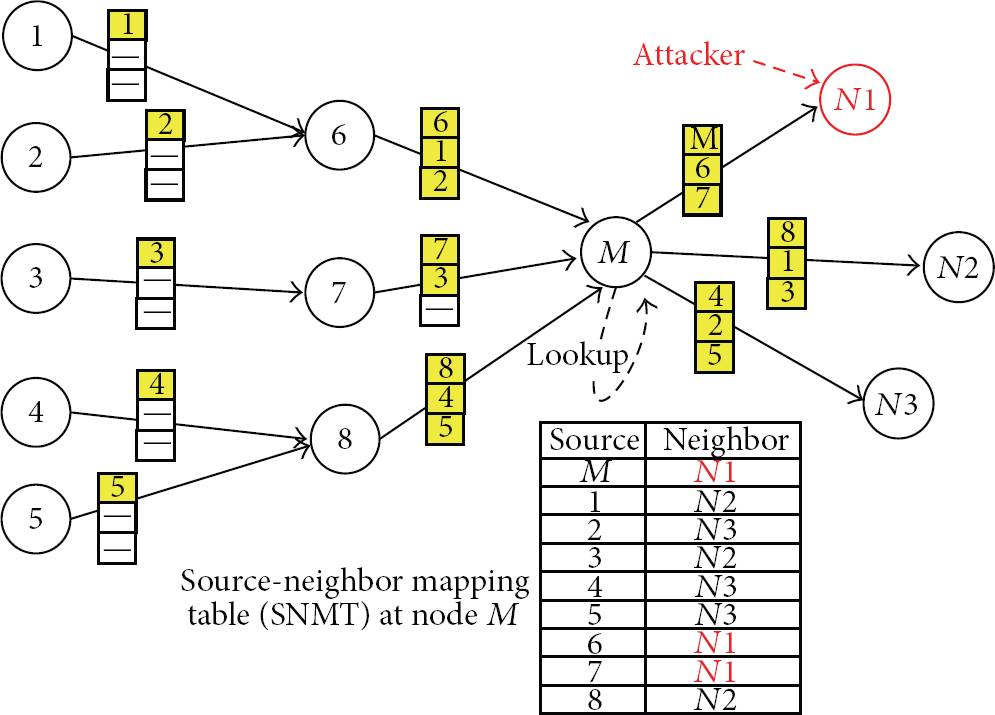
Our prevention routing algorithm against a selective forwarding-based DoS attacker (
We know that
6.2. Proposed Prevention Routing Algorithm
Our prevention method can be easily integrated into any existing trust-based routing algorithm. Figure 6 shows the flow chart of a trust-based routing algorithm with our prevention method. Each time node M wants to forward a data packet toward the BS (regardless of its own packet or packets it receives from other nodes), M first checks the source node of the data packet and then finds a neighbor node A at M's source-neighbor mapping table (SNMT). SNMT is a look-up table that tells M which of M's neighbors will receive a certain source node's data packet to forward the packet toward the BS. If such node A is found at the SNMT for the source node, M will forward the packet to A. Otherwise, M will find a new neighbor node B such that the number of source nodes assigned to B is less than

The flow chart of a trust-based routing algorithm with our prevention method to prevent the selective forwarding-based DoS attack.
We explain how a relay node M assigns source nodes to its neighbor nodes as shown in Figure 5. Assuming that every source's data packet is equally important, we use the (First Come First Serve) FCFS manner for this source-neighbor assignment process. For example, in Figure 5, assume that M received the first data packets of its eight source nodes in the following order: M, 6, 7, 8, 1, 3, 4, 2, and 5. Then, M assigns firstly arrived three source nodes (M, 6, 7) to its best neighbor
6.3. Simulation Setups and Preliminary Simulation Results
We use the simulation parameters described in Table 8. 100 sensors are deployed in a 2 km × 2 km area randomly as shown in Figure 7. Each node except the BS generates packets randomly in each 10-second period. The packets are sent to the BS. We use some of the default settings in OPNET such as 1024 bit data packet and geographic routing protocol (GRP) with a maximum of 7 retransmissions. We set each node's initial trust value to be 0.99. We choose one node near the BS as the selective forwarding DoS attacker. The simulation time is set to be 60 minutes. The attacker targets various numbers of victims. We implement two trust-based routing algorithms: trust-based GRP based on the beta trust model (Beta GRP) and our prevention routing algorithm combining the Beta GRP and our prevention method (Beta GRP-P). For our prevention method,
OPNET simulation setup parameters for the validation of the our prevention routing algorithm.


A WSN topology in our simulations. One hundred sensors are deployed in a 2 km × 2 km area randomly.
In addition to the three performance metrics (ACT, FAR, and EPP) used in Section 5, we use the following two performance metrics.
Number of source nodes whose data packets route to the attacker through the same monitoring node (
Packet delivery rate (PDR): this is the probability that a data packet is delivered to the BS. PDR is obtained by the total number of data packets delivered to the BS divided by the total number of data packets generated by all source nodes.
We first show how many source nodes’ data packets can route through the inside attacker (located near the BS) in the simulation network topology. To see routing paths from source nodes to the BS via the attacker, we simulate the attacker forwarding packets normally toward the BS without attacking any source (attack off). Figures 8 and 9 show source nodes whose data packets route through the attacker and their routing paths to the BS when the beta GRP and our prevention routing algorithm (Beta GRP-P) are used, respectively. We can see that when beta GRP is used, the attacker receives data packets from many more source nodes as compared to our approach used.

30 potential victim source nodes and their routing paths to the BS when Beta GRP is used.

8 potential victim source nodes and their routing paths to the BS when our prevention routing algorithm (Beta GRP-P) is used.
Specifically, Table 9 shows
The number of source nodes whose data packets route through the attacker (

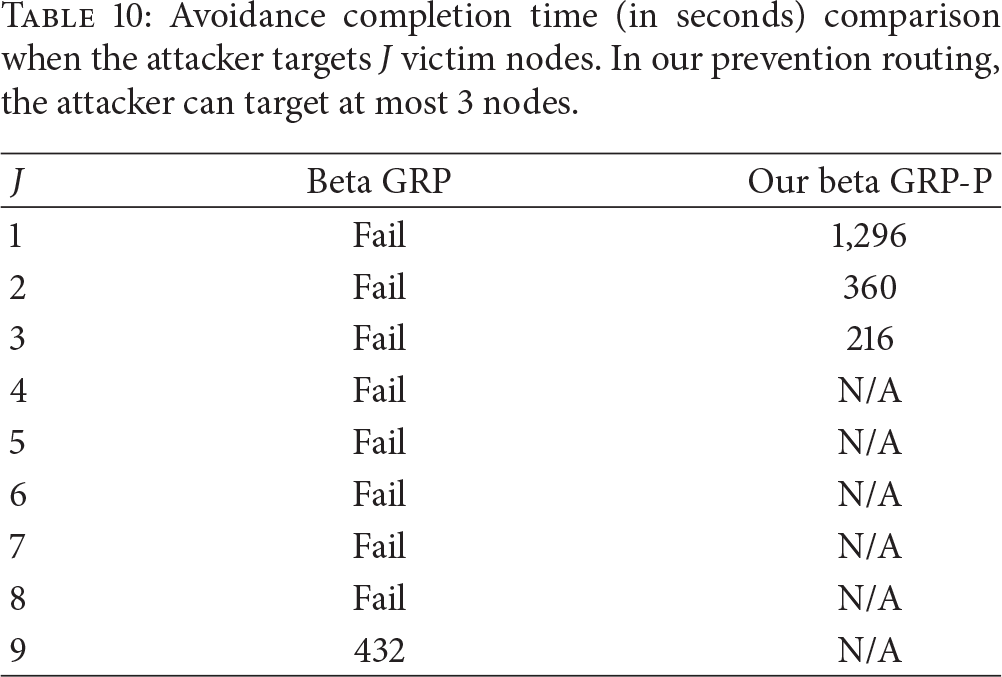
Second, we examine ACT that indicates the ability of each approach in identifying the attacker and rerouting the victim's packets. We simulate the attacker launching the selective forwarding-based DoS attack by increasing the number of victims (J). We assume that the attacker intentionally targets source nodes from node 70 because it can have the largest number of victim source nodes. The simulation results on ACT in Table 10 reveal the following.
Beta trust model alone fails to detect the attacker. As shown in Table 10, the attacker can attack up to 8 sources without being caught by node 70's beta trust model. As shown in Figure 8, the entire area monitored by the 8 victims (circled area) can be influenced by the DoS attack, and thus outside intruders can stay in or move around the area stealthily.
Our approach successfully defends against the attacker. The proposed outsider-insider colluding attack is not effective when our prevention approach is used because the number of victims is very small. That is, since the attacker cannot target more than 3 source nodes when our approach is used, the victim area is significantly reduced compared to when the Beta GRP is used. As a result, outside intruders’ movement will be limited by the small area monitored by victim nodes. In addition, if the attacker insists to attack any victim (the case of
Avoidance completion time (in seconds) comparison when the attacker targets J victim nodes. In our prevention routing, the attacker can target at most 3 nodes.
Third, FAR measures the likelihood an approach will mistakenly treat an honest node as attacker. Both approaches have almost similar FARs that range from 0.03 to 0.04. Thus, we consider that our approach does not increase FAR compared with the Beta GRP.
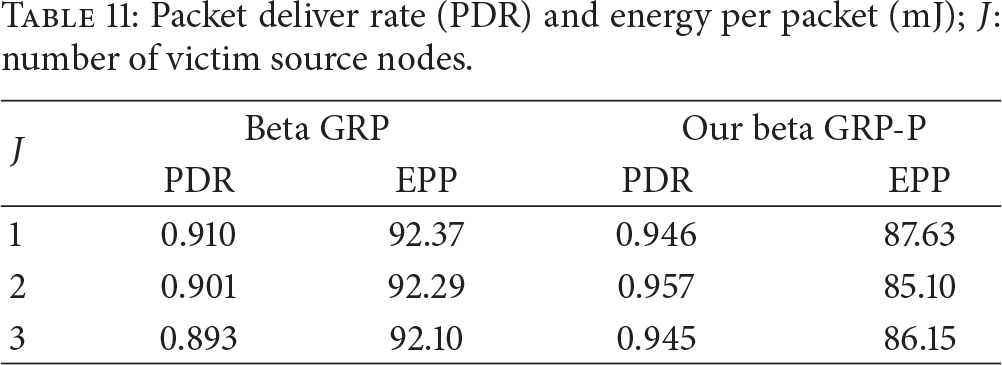
Finally, we report PDR and EPP. We show results when the number of victims (J) is less than 4 for comparison purposes. As shown in Table 11, our approach has a higher packet delivery performance than the beta GRP. This is because our approach can detect and avoid the attacker while the Beta GRP cannot defend against the attacker. In addition, from energy perspective, we can see that our approach is better than the Beta GRP.
Packet deliver rate (PDR) and energy per packet (mJ); J: number of victim source nodes.
7. Conclusions
In this paper, we first present a simple selective forwarding-based DoS attack and show that two representative trust mechanisms (namely, the beta trust model and the entropy trust model) fail to detect such attack. We also show the potential damage this attack could cause to the network. Second, we propose a source-level trust evaluation scheme to enhance the beta and entropy trust mechanisms to effectively detect the selective forwarding-based DoS attack. In addition, we propose two avoidance strategies to reroute the victim's packets so they can reach the BS and validate our claims and evaluate the performance of our detection and avoidance mechanisms with extensive OPNET simulations.
Finally, we introduce a prevention-routing algorithm to proactively prevent the selective forwarding-based DoS attack as a complementary defensive mechanism to our detection and avoidance methods and provide preliminary results to evaluate its performance.
There are also several directions for future work. First, how to further reduce ACT to minimize the attacker's damage to the network. Second, our preliminary results on network with lossy network show fairly large FAR. How to improve the accuracy of the proposed approach in such network is still a challenge. Finally, after the inside attackers become aware of our defensive mechanism, how they can respond to the challenge and launch more sophisticated attacks.
Footnotes
Acknowledgments
This material is based upon work supported in part by the Air Force Office of Scientific Research (AFOSR/RSL) under Award no. #FA95501010140 and a University Partnership with the Laboratory of Telecommunications Sciences, Contract no. H9823013D00560002. The authors would like to thank OPNET Technologies, Inc., for providing us with OPNET Wireless Modeler to validate our approaches. There is no conflict of interests.