




Abstract
Laminar two-dimensional natural convection boundary-layer flow of non-Newtonian fluids along a horizontal circular cylinder with uniform surface heat flux has been studied using a modified power-law viscosity model. In this model, there are no unrealistic limits of zero or infinite viscosity; consequently, no irremovable singularities are introduced into boundary-layer formulation for such fluids. Therefore, the boundary-layer equations can be solved numerically by using marching order implicit finite difference method with double sweep technique. Numerical results are presented for the case of shear thinning as well as shear thickening fluids in terms of the fluid velocity and temperature distributions, shear stresses, and rate of heat transfer in terms of the local skin friction coefficient and local Nusselt number, respectively.
1. Introduction
Natural convection laminar flow of non-Newtonian power-law fluids from a horizontal circular cylinder with uniform heat flux presents an important role in numerous engineering applications that are related to pseudoplastic fluids. The pseudoplastic fluid is characterized by a constant viscosity at very low shear rates, a viscosity which decreases with shear rate at intermediate shear rates and an apparently constant viscosity at very high shear rate. The interest in skin friction and heat transfer problems involving power-law non-Newtonian fluids has grown in the past half-century. An excellent research on non-Newtonian fluids was given by Boger [1]. Acrivos [2] was the first to consider boundary-layer flows for such non-Newtonian fluids. Since then, a large number of papers have been published, due to their wide relevance in pseudoplastic fluids like chemicals, foods, polymers, molten plastics, petroleum production, and various natural phenomena.
An entire assessment of these literatures was impractical; however, selected papers are listed here to provide starting points for a broader literature search [3–15]. In the boundary-layer study, they used the traditional power-law viscosity correlation in which viscosity becomes infinite for small shear rates or vanishes for the limits of large shear rates, which are giving the unrealistic physical results. Because an infinite viscosity corresponds to solids and no frictionless fluid has ever been found, a partial set of measured viscosity shear relations is not sufficient for a boundary-layer study.
In recent times, proposed modified power-law correlation is sketched for various values of power index n in Figure 2, and this model is formulated based on the available experimental data for the non-Newtonian fluids (see Boger [1]). It is clear that the new correlation does not contain the physically unrealistic limits of zero and infinite viscosity displayed by traditional power-law correlations [2]. The modified power-law, in fact, fits measured viscosity data well. The constants in the proposed model can be fixed with available measurements and are described in detail in Yao and Molla [16]. The boundary-layer formulation on a flat plate is described and numerically solved for non-Newtonian fluid in Yao and Molla [16, 17], and the associated heat transfer for two different heating conditions is reported in Molla and Yao [18, 19] for shear thinning fluid. The boundary-layer formulation along with an isothermal horizontal circular cylinder is also described and numerically solved for non-Newtonian fluid in Bhowmick et al. [20] for the case of shear-thinning as well as shear thickening fluids. In this investigation, the behavior of both shear-thinning and shear thickening fluids on the natural convection laminar flow with uniform heat flux along a horizontal circular cylinder is studied by choosing the power-law index as (n = 0.6, 0.8, 1.0, 1.2, 1.4) to fully demonstrate the performance of various non-Newtonian fluids.
It is precious to message that the soundness of the laminar boundary-layer theory has been well established for nearly a century. Power-law correlations have also been used for almost half a century. It is well known that they can correlate a major part of the available data. The recently proposed modified power-law simply modifies the power-law to fit available data better at its two ends, because a power-law model is an undeviating model, that is, used to fit experimental data. The results of our parametric study in the paper can provide the necessary database that a simple interpolation can be used to find approximate heat transfer rates and wall shear stresses for any non-Newtonian fluid from our tables.
2. Formulation of the Problem
A two-dimensional steady laminar natural convection boundary-layer of a non-Newtonian fluid over a horizontal circular cylinder of radius “a” with uniform surface heat flux has been considered. The viscosity depends on shear rate and is correlated by a modified power-law. We consider shear-thinning and shear thickening situations of non-Newtonian fluids. It is assumed that a surface heat flux q w is applied to the cylinder; T∞ is the ambient temperature of the fluid and T is the temperature of the fluid. The configuration considered is as shown in Figure 1.

Physical model and coordinate system.

Modified power-law correlation for the power-law index
Under the previous assumptions, the boundary-layer equations governing the flow and heat transfer are
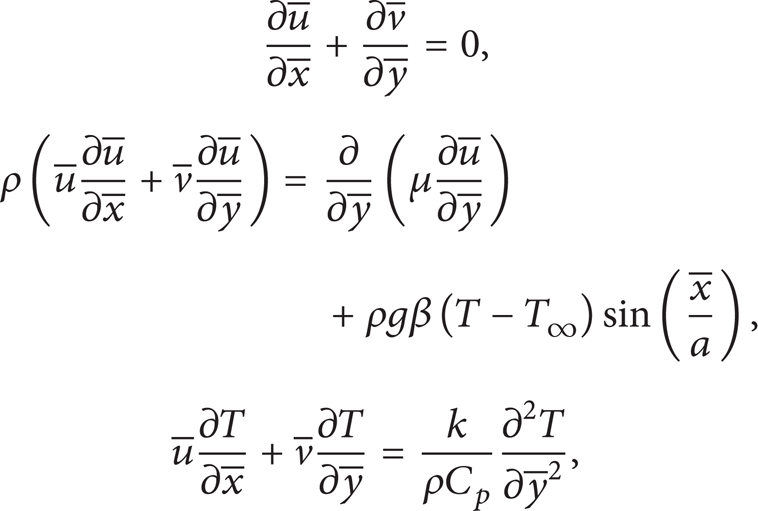
where

The constants
The boundary conditions for the present problems are


We introduce nondimensional dependent and independent variables according to

where ν1 is the reference viscosity at

The length scale associated with the non-Newtonian power-law is

The corresponding boundary conditions are


Now, we introduce the parabolic transformation:

Substituting variable (8) into (5) leads to the following equations:


The correlation (10) is a modified power-law correlation first presented by Yao and Molla [16]. This correlation describes that if the shear rate |γ| lies between the threshold shear rates γ1 and γ2, then the non-Newtonian viscosity, D, varies with the power-law of γ. On the other hand, if the shear rate |γ| does not lie within this range, then the non-Newtonian viscosities are different constants, as shown in Figure 2. This is a property of many measured viscosities.
Equation (9) can be solved by marching downstream with the leading edge condition satisfying the following differential equations, which are the limits of (9) as X→0:
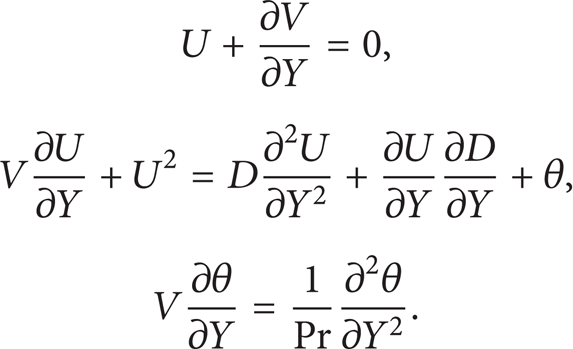
The corresponding boundary conditions are


Equations (9) and (11) are discretized by a central difference scheme for the diffusion term and a backward difference scheme for the convection terms. Finally, we get an implicit tridiagonal algebraic system of equations, which can be solved by a double sweep technique. The normal velocity is directly solved from the continuity equation. The computation is started at X = 0 and marches to downstream to X = π. After several test runs, converged results are obtained by using ΔX = 0.0025 and ΔY = 0.005.
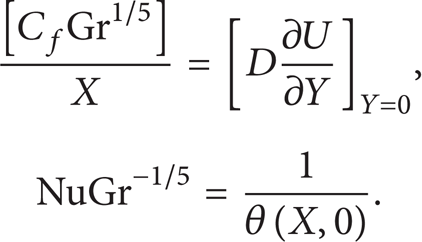
In practical applications, the physical quantities of principle interest are the local skin-friction coefficients C f and the local Nusselt number Nu, which are
3. Result and Discussion
The numerical results are presented for the non-Newtonian power-law of shear-thinning fluids (n = 0.6 and 0.8) and the shear thickening fluids (n = 1.2 and 1.4) as well as the Newtonian case (n = 1), while Prandtl number, Pr = 10 and 50. Based on the experimental data of Boger [1] the thresholds shears γ1 and γ2 have been chosen as 0.1 and 105, respectively. The obtained results include the viscosity, velocity and temperature distribution, and the wall shear stress in terms of the local skin-friction coefficient,
Figures 3(a)–3(d) show the viscosity distribution, D as a function of Y at selected (X = 1, 2, 3) locations for Pr = 10 and 50 at n = 0.6 and 0.8. From Figures 3(a)–3(b), it is found for Pr = 10 that there is one region of variable viscosity at X = 1 and 3, but at n = 0.6 in Figure 3(a), there are two regions at X = 2; the primary region lies from Y ≈ 0.0 to 1.3 and the secondary variable viscosity region lies between Y ≈ 1.3 and 2.2 and at n = 0.8 in Figure 3(b), the primary region lies from Y ≈ 0.0 to 1.7 and the secondary variable viscosity region lies between Y ≈ 1.7 and 2.15. On the other hand, only one variable viscosity region was found in the case of Pr = 50 for both n = 0.6 and 0.8 which is shown in Figures 3(c)–3(d), respectively.

Viscosity distribution, D, for different values of X for (a) n = 0.6, (b) n = 0.8 at Pr = 10 and (c) n = 0.6, (d) n = 0.8 at Pr = 50.
The velocity distribution as a function of Y at the selected locations (X = 1, 2, 3) for the different power-law indices (n = 0.6, 0.8, 1.0, 1.2, and 1.4) is presented in Figures 4(a)–4(c) for Pr = 10 and Figures 4(d)–4(f) for Pr = 50, respectively. Figure 4 shows that for shear-thinning fluids (n = 0.6 and 0.8), the velocity increases due to the decrease of viscosities at the downstream region; consequently, the boundary-layer thickness decreases. On the other hand, for shear thickening fluids (n = 1.2 and 1.4), the velocity decreases slowly and the boundary-layer is thickened as the fluid becomes more viscous. We may conclude that for Pr = 50, the fluid velocity is smaller than that of Pr = 10 and the boundary-layer thickness is larger for Pr = 50 than that of Pr = 10.

Velocity distribution for different n at (a) X = 1, (b) X = 2, and (c) X = 3 at Pr = 10 and (d) X = 1, (e) X = 2, and (f) X = 3 at Pr = 50.
The corresponding temperature distribution is plotted for Pr = 10 and 50 in Figures 5(a)–5(f), respectively. The temperature of shear thickening fluids is higher than shear-thinning fluids for both Pr. For the shear-thinning fluids, the temperature distribution is smaller and for shear thickening fluidsis always higher than the temperature of fluid with the Newtonian viscosity. At the downstream region, in the case of shear-thinning fluids, the variation of temperature in the boundary-layer is smaller than that of the shear thickening non-Newtonian fluids which is expected, and the thermal boundary-layer is thinner for larger Prandtl numbers.
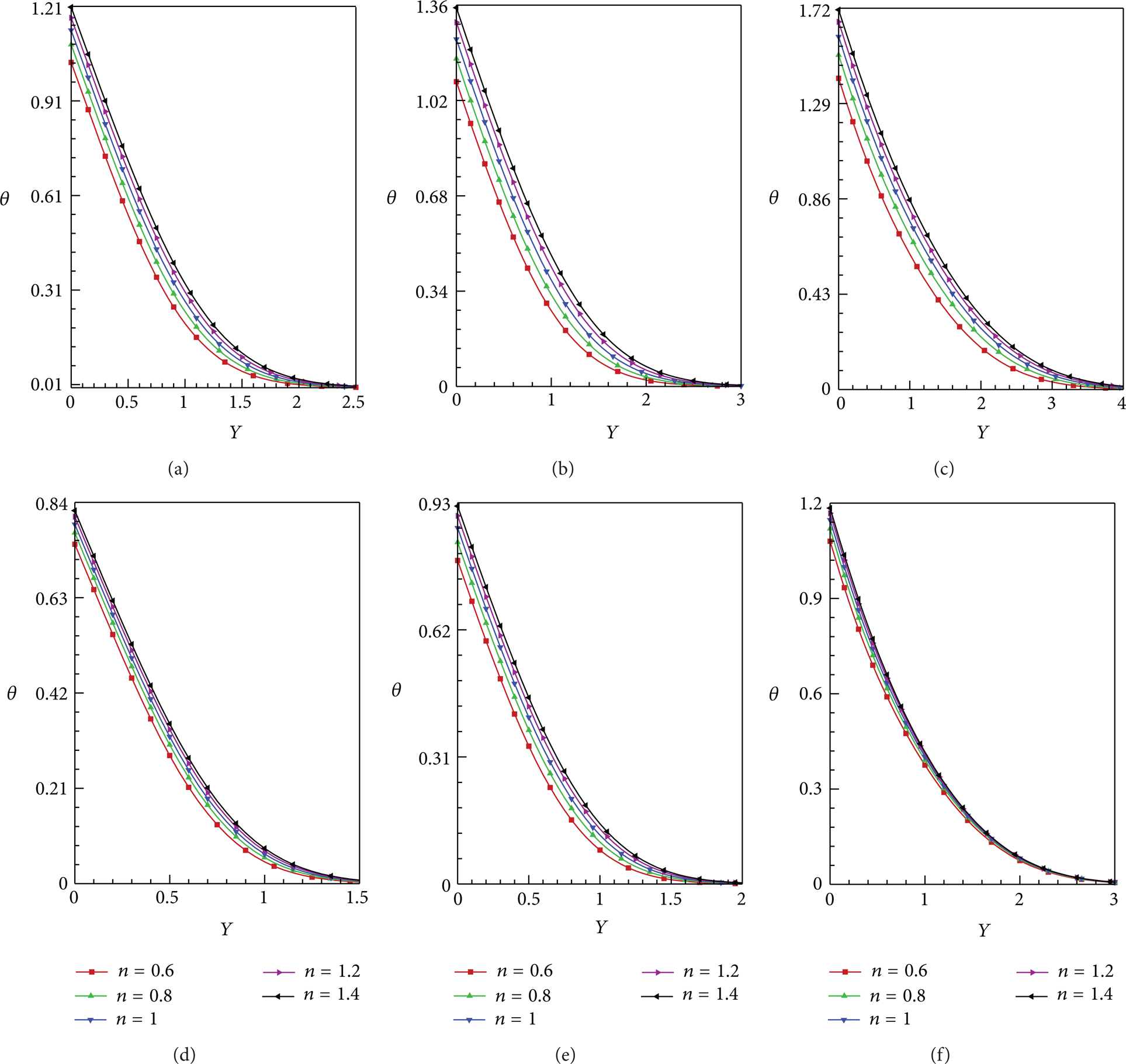
Temperature distribution for different n at (a) X = 1, (b) X = 2, and (c) X = 3, Pr = 10 and (d) X = 1, and (e) X = 2, (f) X = 3, Pr = 50.
The effects of the non-Newtonian power-law index (n = 0.6, 0.8, 1.0, 1.2, 1.4) on the variation of the wall shear stress in terms of the local skin-friction coefficient

Wall shear stress, C f Gr1/5/X, for the different values of n: (a) Pr = 10, (b) Pr = 50.

Local Nusselt number, NuGr−1/5, for different values of n: (a) Pr = 10, (b) Pr = 50.
4. Conclusions
The proposed modified power-law correlation agrees well with the actual measurements for non-Newtonian fluids; consequently, it is a physically realistic model. The problem associated with the nonremoval singularity introduced by the traditional power-law correlations does not exist for the modified power-law correlation proposed in this paper. Therefore, the modified power-law correlations can be used to investigate other heat transfer problems for shear-thinning as well as shear thickening non-Newtonian fluids in boundary-layers. The fundamental mechanism is that the effect of non-Newtonian fluids eventually becomes dominant when shear rate increases within the threshold shear limits. We may summarize our obtained results as follows.
The velocity increases due to the decrease of viscosities at the downstream region for shear-thinning fluids. However, the velocity decreases slowly as the fluid becomes more viscous for the case of shear thickening fluids.
At the downstream region of the boundary-layer, the variation of the temperature inside the boundary-layer is smaller for the case of shear-thinning fluids than that of the shear thickening non-Newtonian fluids for all Prandtl numbers considered here.
The boundary-layer thickness decreases more at the downstream region for the shear-thinning fluids than that for the shear thickening fluids. It is revealed that the boundary-layer thickness for Pr = 50 is almost half of the boundary-layer for Pr = 10.
It is observed that the local Nusselt number increases for shear-thinning and decreasesshear thickening fluids for both Prandtl numbers considered here.
Footnotes
Acknowledgments
The first author wants to acknowledge the funding body of the Jagannath University, Bangladesh. The authors would also like to thank Professor L. S. Yao for the valuable idea about the modified power-law viscosity model.