




Abstract
In wireless sensor networks (WSN) systems, various indoor environmental parameters can be monitored in real time by an RF wireless sensor module. A wireless sensor module with several sensors is developed for an indoor environment monitoring system. ZigBee is a wireless standard for personal area network (PAN) sensor monitoring and control, also known as IEEE 802.15.4. In this paper, we designed a wireless sensor module that had a ZigBee communication module and a sensor module for monitoring a room or an office environment using WSN. The sensor module has various enlargements for various types of sensors, for example, a humidity sensor, temperature sensor, and O2 and CO2 sensors. Using ZigBee technology of 2.4 GHz Industrial, Scientific, and Medical (ISM) band, we could monitor the information from terminal PC modules that are attached to the wall of an office or a room. A wireless sensor device was developed to circuit schematic using PowerPCB tool PADS and made it a printed circuit board (PCB). From the results of our tests, we confirmed that the designed wireless sensor module and room monitoring system can supply a comfortable environment for people by monitoring the indoor environment.
1. Introduction
In the near future, all electronic appliances at home will be networked: PCs, telephones, stereos, refrigerators, and even washing machines. Heating and air conditioning, previously controlled by a single, fixed, manual thermostat, can now be managed by an intelligent controller with remote access capabilities [1, 2]. Recently, the use of residential air conditioning has become widespread owing to increasing living standards and expectations for comfort. The control and monitoring of indoor atmospheric conditions represents an important task with the aim of ensuring suitable working and living spaces for people. However, comprehensive air quality monitoring, which includes monitoring humidity, temperature, O2, CO2, and flying dust particle density, is not easily monitored and controlled [3, 4]. In addition, several difficulties due to air pollution from industrial development, new house syndrome, atopic diseases, and swine flu complicate air quality monitoring [4]. In particular, humans require comfortable environments because the necessity of domestic air administration is enlarged [5]. Recent progress in wireless technologies has led to a renovation in home automation which makes it possible to upgrade environmental controls in rooms. One of the popular examples is the practical application of wireless sensor networks (WSN), which is now used in many areas, such as environmental monitoring, healthcare, home automation, and intelligent transportation systems. In particular, there are more opportunities to build wireless monitoring systems using ZigBee with the number of wireless sensor networks available. ZigBee is a wireless standard for personal area network (PAN) sensor monitoring and control, also known as IEEE 802.15.4 which is a communications standard designed for low-power short-range communications between wireless devices [6]. Many prototypes for home monitoring systems have been proposed [7–17].
In this study, we design a room monitoring system. A wireless sensor module with optimal communication conditions is designed, and it has a ZigBee communication module and a sensor module. A sensor module has various sensors that monitor temperature, humidity, O2, CO2, and atmospheric pressure. Indoor air quality in a room or an office can be monitored and efficiently controlled by a ZigBee module. We can monitor sensing information from terminal PC modules that are attached to the wall of an office or a room. A wireless sensor device is developed to circuit schematic using PowerPCB tool and PADS and make it a printed circuit board (PCB). From the results of our tests, we confirm that the designed wireless sensor module and room monitoring system can supply a comfortable environment for people by the monitoring indoor environment.
2. Room Environmental Monitoring Systems
The concept for the room environmental monitoring system is shown in Figure 1. Several sensors such as a temperature sensor, humidity sensor, CO2 sensor, and an atmospheric pressure sensor were built on an RF transmitter board for monitoring the indoor environmental conditions. These input sensors were chosen in consideration of the parameters that maintain comfort for a human being.

Concept for the indoor environmental system.
The feasibility of the wireless sensor module application as a room monitoring system was tested. The wireless sensor module has only one transmitter and receiver; however, multiple sensors can be attached to the module. To simplify the system, the transmitter and receiver were separately designed and fabricated using a ZigBee chip. In the transmitter sensor module, most of analog sensors were added, so that typical commercialized sensors can be used conveniently. The sensor module, which transfers the sensor data to the receiver by an RF signal, has a very simple structure that includes a ZigBee chip, a commercial 2.4 GHz RF transmitter chip, and several normal analog or digital sensors on a PCB board. Thus, we can easily attach the wireless transmitter module to the wall of a room or at a convenient place. Figure 1 shows the system configuration used in this study. The environment of a room or an office was monitored.
Commercial discrete sensor devices can be built in a socket module for analog and digital sensors. The digital sensor data were converted to data packets before transmission to the receiver by the RF signal. The designed data format of the packet is shown in Figure 2. The packet was composed of an ms preamble, 3-bit sensor address, and 8-bit sensor data. In the designed system, a maximum of eight sensors were used because we limited the address length in the data packet.

Packet. (i) Length (1 byte): packet, (ii) data seq-no (1 byte): packet number, (iii) dest (2 byte): destination address, (iv) src (2 byte): source address, and (v) location value (1 byte): receive signal value.
The continuous data packet stream of the receiver that was transferred from the transmitter was filtered to recover the original sensor data and then transmitted to an 8051 microcontroller board through an RS-232 serial communication method.
2.1. ZigBee Communication Module
In this study, we designed and fabricated a ZigBee system as a communication module to form the USN environment. The ZigBee communication module is a Texas Instruments (TI), CC2431 2.4 GHz IEEE 802.15.4 RF chip. The CC2431 has 128 Kb of system flash memory on-chip and an internal 8051 core [19]. Figure 2 shows the ZigBee communication module.
The size of the ZigBee communication module is 38 mm × 38 mm, with an average output of 27 mA (RX) and 25 mA (TX) at 32 MHz and a receive range of 100 m ± 20 m. The Titanis 2.4 GHz Swivel SMA antenna is used [20].
The ZigBee communication module is composed by low electric power. Further, the module is designed efficiently to present the remaining battery life, internal temperature, and location with the contained battery monitor, temperature sensor, and internal location engine (see Figure 3).

ZigBee communication module (38 mm × 40 mm).
2.2. Sensor Module
In Figure 4, the integrated sensor module for efficient maintenance of comfortable indoor environment consisted of humidity, temperature, O2, CO2, and atmospheric pressure sensors. Table 1 shows the sensor range.
Sensor range.


Sensor module.
3. Developed Module Test
The test devices include a power supply, an oscilloscope, a spectrum analyzer, and a PC. Sensor data from each sensor are monitored from the client PC.
3.1. ZigBee Communication Module Operating Frequency Test
The IEEE 802.15.4 standard which is shown in Table 2 for wireless personal area networks (WPANs) specifies the physical (PHY) at the 868 MHz, 915 MHz, and 2.4 GHz Industrial, Scientific, and Medical (ISM) band. We selected the 2.4 GHz Industrial, Scientific, and Medical (ISM) band (see Figure 6) [6].
IEEE 802.15.4 PHY.

In Figure 5, we found that the number of channels is 16, the channel interval is 5 MHz, and the channel output power is not the same. In Table 3, we find that 2425 MHz was the best operating frequency.
Test results for the ZigBee Gain.


ZigBee 2.4 GHz band.

ZigBee operating frequency range test.
3.2. ZigBee Communication Module Distance Test
ZigBee communication module distance test was used as a path loss. Path Loss is equation (1), and Table 4 is path loss exponents for indoor environments:

Path loss exponents for indoor environments [18].

The PT is transmission power; SR is receiver sensitivity. The log-distance path loss model is another site general model and it is given by [21]

The n is path loss exponent, d is distance, and
According to (1) and Table 2, we find

2.4 GHz distance with
In Figure 7, we find that distance is 11 m at
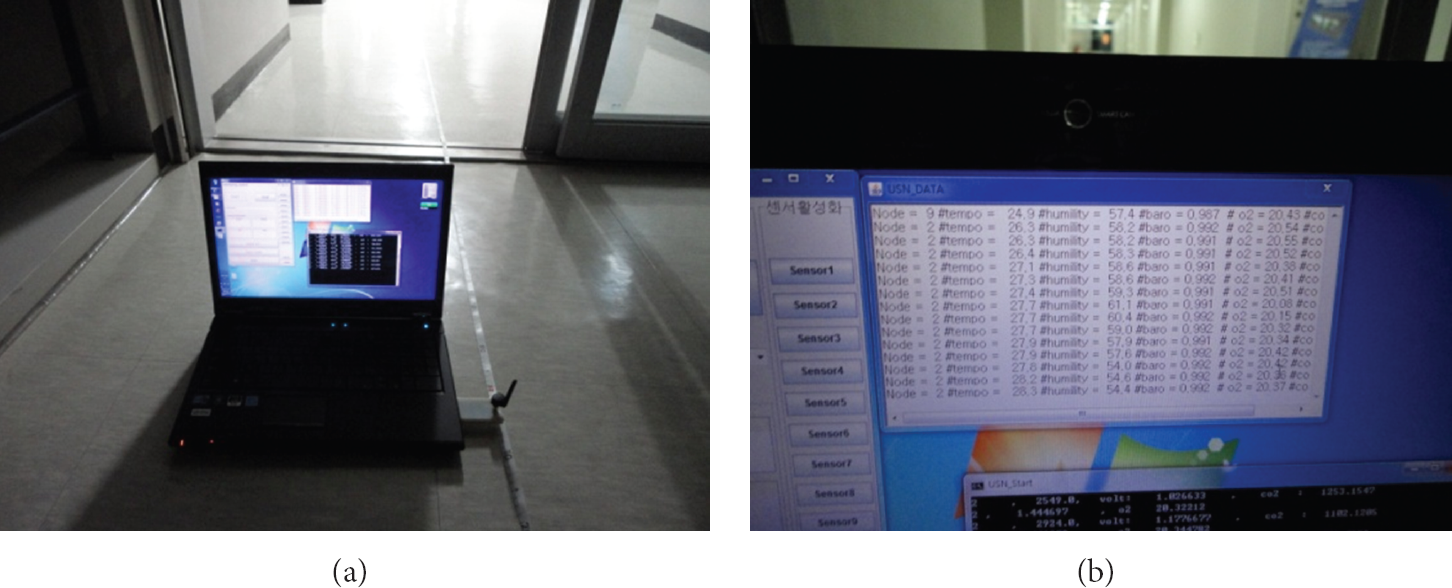
The measurement of distance at our office.
In Figure 9, measurement result is closed to

2.4 GHz path loss in our office.
3.3. Experimental Results
Figure 10 shows a test the monitoring system using the designed wireless sensor module.
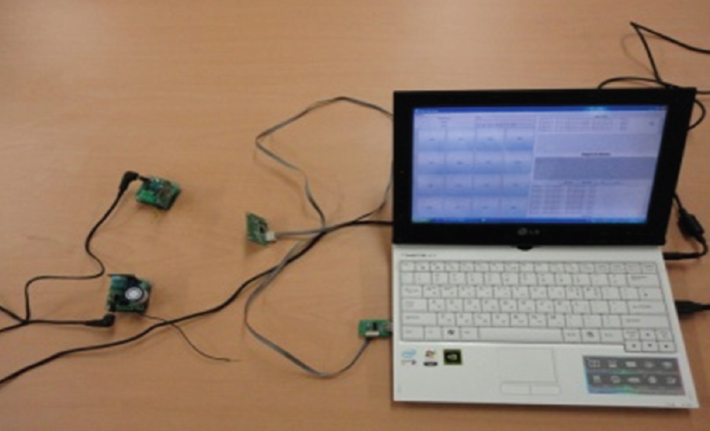
Test of monitoring system of the designed wireless sensor module.
Figure 11 shows the monitored values of the sensor from an actual experiment using the designed sensor module in laboratory. X-axis is second time.

Experimental sensor data.
Figure 12 shows the designed wireless senor module and the designed room monitoring system.

A designed room monitoring system.
4. Conclusions
In the past, only toxic gases were monitored for the safety of humans in a house; however, the monitoring of various room conditions allows for a comfortable life with modern technology. Comfort can be attained by complex monitoring and controlling of many parameters, including temperature, humidity, CO2 concentration, O2 concentration, and the density of fine particle dust. Thus, a wireless multisensor module for the monitoring of indoor room conditions is a very important home networking technology.
In this study, we designed a wireless sensor module that had a designed ZigBee communication module and a sensor module that uses WSN for monitoring a room environment. Most of the system components were designed and fabricated for system optimization. We utilized an integrated sensor module consisting of sensors that are used in industry to check the atmospheric pressure, O2, CO2 concentration, and an imported ZigBee communication system. Using ZigBee technology of 2.4 GHz Industrial, Scientific, and Medical (ISM) band in the IEEE 802.15.4 standard, we could monitored the information from terminal PC modules that are attached to the wall of an office or a room. A wireless sensor device was developed to circuit schematic using PowerPCB tool and PADS and made it a printed circuit board (PCB). From the results of our tests, we confirmed that the designed wireless sensor module and room monitoring system can supply a comfortable environment for people by monitoring indoor environment. Hereafter, we are going to study about the power consumption of this designed WSN monitoring system.