




Abstract
The effect of magnetic field on double-diffusive natural convection in a square cavity filled with a fluid-saturated porous medium is studied numerically. The bottom wall is fully heated at a constant temperature, and the top wall is maintained at a constant cold temperature. The right wall is fully salted to a high concentration, while the left wall is fully salted at a lower concentration than the right one. A magnetic force is applied on the cavity along the gravity force direction. The Darcy model is used for the mathematical formulation of the fluid flow through porous media. The governing equations for heat and mass transfer are solved using the finite volume method. The governing parameters of the present study are Rayleigh number (Ra), Lewis number (Le), buoyancy ratio (N), and Hartmann number (Ha). The numerical solutions were studied in the range of −10 ≤ N ≤ 10, 0 ≤ Ha ≤ 10, 50 ≤ Ra ≤ 500, and 10−4 ≤ Le ≤ 10. The results were discussed considering the effect of these parameters on the heat and mass transfer processes. The results were presented in terms of streamlines, isotherms, isoconcentration, average Nusselt number, and average Sherwood number for different values of the governing parameters. In general, it has been found that the increase of magnetic force has an effect to retard the strength of the flow inside the cavity and reduce the heat and mass transfer processes. For high Hartmann number, the flow is almost suppressed.
1. Introduction
Double-diffusion natural convection inside cavities filled with a fluid-saturated porous medium has received considerable attention in recent years, on account of its wide applications in natural systems and industries, for example, the effect of contaminants on lakes and underground water, atmospheric pollution, chemical processes, food processing, energy storage, and materials processing, to name but a few. The study of double-diffusive convection in a fluid-saturated porous medium under the influence of magnetic field has importance in many fields of science, engineering, and technology. It is useful in commercial production of the magnetic fluids, in chemical engineering and in the performance of petroleum reservoirs, where the geothermal areas are influenced by the magnetic field of the earth. The investigation is also useful in geophysics, to study the earth's core, where the molting fluid is conducting, which can become convectively unstable as a result of differential diffusion. The process of manufacturing materials in industrial problems and microelectronic heat transfer devices involves an electrically conducting fluid subjected to a magnetic field. In that case the fluid experiences a Lorentz force, and its effect is to reduce the flow velocities [1]. This in turn affects the rate of heat and mass transfer. It is, therefore, important to study the detailed characteristics of transport phenomena in such a process so that good quality product can be developed with improved design in the manufacturing processes.
In double diffusion, the buoyancy force is affected not only by the difference of temperature, but also by the difference of concentration of the fluid. A detailed discussion on double diffusion natural convection can be found in the books by Nield and Bejan [2], Ingham and Pop [3], and Vafai [4]. Magneto-hydrodynamics (MHD) is the science of the motion of electrically conducting fluids under the influence of applied magnetic forces. The symbiotic interaction between the fluid velocity field and the electromagnetic forces gives rise to flow scenarios; the magnetic field affects the motion. Electromagnetic field has an important influence on the hydrodynamics. One of the main purposes of the electromagnetic control is to stabilize the flow and suppress oscillatory instabilities [5].
The phenomenon of double-diffusive natural convection in pure fluids and fluid-saturated porous media has received more attention in the literature due its important applications as mentioned before. For some related problems with just a heat effect (pure convection) from below, see, for example, Elder [6], Robillard et al. [7], Sezai and Mohamad [8], and Calcagni et al. [9], and for heat and mass transfer effect see, for example, Bejan and Khair [10]. The review of the literature on double-diffusive natural convection in fluids filled with a porous medium shows that most of studies focus on the thermosolutal effect inside cavities or enclosures where different boundary conditions apply. Studies by Bahloul et al. [11], Zhao et al. [12], Liu et al. [13], Zhao et al. [14], and Mamou et al. [15], for example, used boundary conditions of heating and salting from side. Other studies by Bourich et al. [16] and Mansour et al. [17] investigated heating from below and salting from sides. Some studies, for example, Zhao et al. [18] and Alloui et al. [19], looked at double-diffusive natural convection in boundary conditions of heating and salting from below. Many studies used a Darcy model to formulate the momentum equation; see for example, Liu et al. [13] Zhao et al. [14], Mamou et al. [15], Alloui et al. [19], Trevisan and Bejan [20], Mamou et al. [21], Bourich et al. [22], Saeid and Pop [23], Saleh and Hashim [24], and Akbal and Baytaş[25]. For non-Darcy, see for instance, Zhao et al. [12], Zhao et al. [18], and Goyeau et al. [26]. For an analytical study, see, for example, Bahloul et al. [11], Trevisan and Bejan [27], Amahmid et al. [28], and Bhadauria and Srivastava [29].
In the present work, the effect of magnetic field on the heat and mass transfer in a square porous cavity heated from below and salted from side is considered. Related studies can be found in, for example, Mahmud and Fraser [1], Revnic et al. [5], Garandet et al. [30], Alchaar et al. [31], Chamkha and Al-Naser [32], Ece and Buyuk [33], Saleh and Hashim [24], Teamah et al. [34], and Grosan et al. [35]. Mahmud and Fraser [1] studied magnetohydrodynamic-free convection and entropy generation in a square porous cavity with heating from side and adiabatic horizontal walls. They found that increases in the value of magnetic force have a tendency to retard the fluid motion inside the cavity, and the entropy generation rate is decreased in magnitude as the magnetic force is introduced and strengthened. Teamah et al. [34] discussed double-diffusive natural convection in an inclined rectangular enclosure in the presence of magnetic field with heating and salting from side. Grosan et al. [35] discussed the steady magnetohydrodynamics-free convection in a fluid-saturated porous medium with internal heat generation with an inclined magnetic field. They found that the convection modes within the cavity were found to depend upon both the strength and the inclination of the magnetic field. In addition, the applied magnetic field in the horizontal direction was found to be most effective in suppressing the convection flow for a stronger magnetic field in comparison with the vertical direction. Revnic et al. [5] studied the effect of an inclined magnetic field and heat generation on unsteady natural convection in a square cavity filled with a fluid-saturated porous medium with heating from side. They found that, for a fixed value of the Rayleigh number, the average Nusselt number decreases to the steady case when the Hartmannn number is increased. In addition, for all values of the governing parameters considered, the average Nusselt number reaches the steady-case faster when the magnetic field is parallel to the vertical walls of the cavity.
Most of those related papers discussed natural convection with heating the vertical walls and without salting source. The aim of this work is to study the effect of a magnetic field on double-diffusive natural convection in a square cavity filled with a fluid-saturated porous medium with heating from below and salting from side. Parametric study is carried out to study the effect of the following parameters: Hartmann number (Ha), buoyancy ratio (N), Lewis number (Le), and Rayleigh number (Ra) on the heat and mass transfer processes. The results were presented in terms of streamlines, isotherms, iso-concentration, average Nusselt number, and average Sherwood number for different cases in the parametric study.
2. Mathematical Formulation
The physical model under consideration is a square cavity of length L filled with an electrically conducting fluid-saturated porous medium as shown in Figure 1. The bottom and the right walls are fully heated and fully salted, respectively, while the top and the left walls are cooled and salted to a constant temperature and concentration, respectively. The two vertical walls are adiabatic and impermeable. A magnetic force affects the fluid in the cavity along the gravity force direction. The third dimension is assumed to be large enough to consider a two-dimensional simplification. The full elliptic equations are considered, while, the simplified boundary layer (parabolic) equations are not considered. The porous medium is assumed to be in local thermal equilibrium. In addition, the properties of the fluid and the porous medium are assumed to be constants. To simplify the problem, the Soret and Duffour effects are neglected. The Darcy model is employed, which is valid for the low values of Rayleigh number, and the Boussinesq approximation for the relationship of the density and the temperature and concentration is adopted:

There are many industrial applications of the electrically conducting fluids in double diffusion of cross-thermosolute gradients in the presence of a magnetic forces, for example, crystal growth, electronic packages, metallurgical applications involving continuous casting, and solidification of metal alloys and others.

Physical model with coordinate system.
The mathematical model can be derived based on the following dimensionless variables:

The dimensionless conservation equations for mass, momentum, energy, and concentration for the two-dimensional flow are
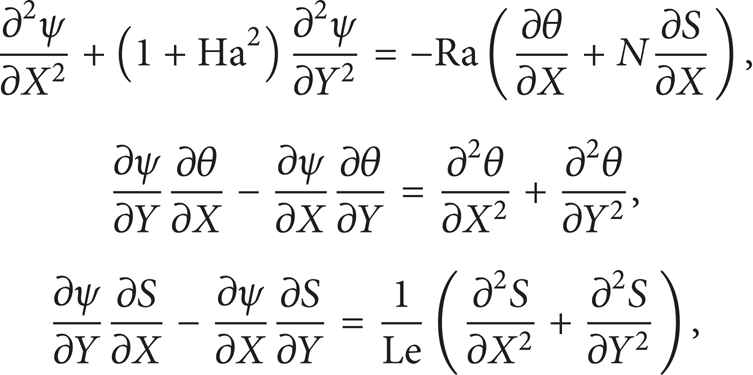
where
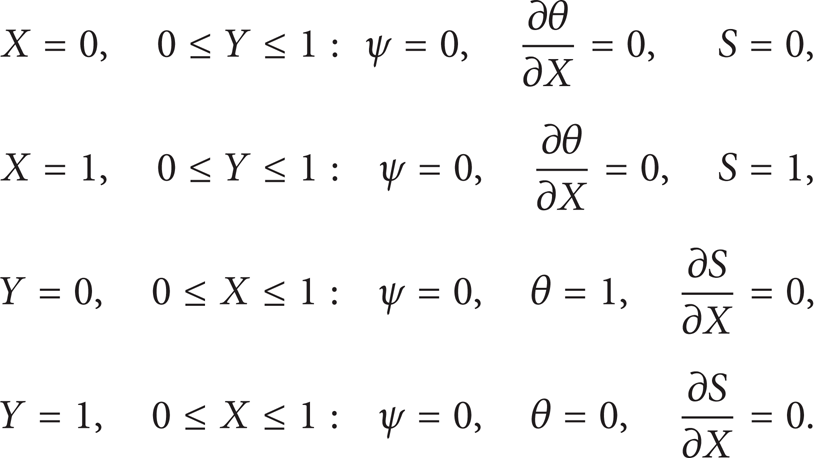
The average Nusselt number
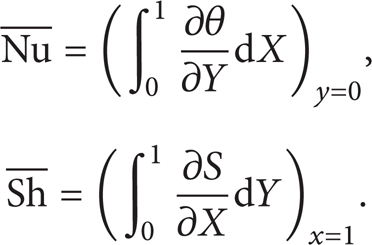
3. Numerical Method and Validation
The finite volume method (FVM) was used to solve the governing equations (3) subjected to the boundary conditions (4). The power law scheme is applied for convection-diffusion formulation. The details of this method can be found in the books by Patankar [36] and Versteeg and Malalasekera [37]. The solution is initialized by assuming stagnant fluid in the cavity with S = θ = 0. The line-by-line iteration using the tri diagonal matrix algorithm (TDMA) was used to solve the discretized equations. The iterations are continued until the following condition is satisfied:

where ϕ refers to ψ, θ, or S and m denotes the iteration step. The effect of the grid size was tested in terms of the average Nusselt number and average Sherwood number with Ra = 100 and Lewis number Le = 1, with two values of buoyancy ratio (N = 0, and 1) as shown in Table 1. It is found that 80 × 80 is an appropriate size for most calculations in the present problem. A good agreement was found between the present results and the results presented in the literature as shown in Table 2. The average Nusselt number (
Grid size test for Ra = 100, Le = 1 with two values of N.

Comparison of

Code validation in the case of pure convection (N = 0) and Ha = 0 with the heating from below.

Comparison of

4. Results and Discussion
The mathematical formulation shows that there are four parameters affecting the heat and mass transfer process when a magnetic field is applied on the fluid in a square cavity filled with a porous medium. These parameters are Ra, N, Le, and Ha. The numerical simulation was conducted and limited under different ranges of these parameters: 50 ≤ Ra ≤ 500, 0.0001 ≤ Le ≤ 10, – 10 ≤ N ≤ 10, and 0 ≤ Ha ≤ 10. The results were presented in terms of streamlines, isotherms, iso-concentration, average Nusselt number, and average Sherwood number.
4.1. Effect of the Buoyancy Ratio Parameter (N)
In this section the effect of buoyancy ratio parameter (N) in double-diffusive natural convection is considered. The numerical simulation was conducted using the following buoyancy ratio N = 0, 1, – 1, and 5, with different values of Hartmann number Ha = 0, 1, and 5. The values of Rayleigh number and Lewis number were fixed with Ra = 200 and Le = 1.
Streamlines, isotherms, and iso-concentration inside the cavity shown in Figure 2 are for different values of Hartmann number, Ha = 0 and Ha = 1 with N = 0. Figure 2(a) shows the case without any effect of magnetic field Ha = 0. Isotherms spread wide inside the cavity. The buoyancy force enhances the fluid to flow rising up along the right wall until the top wall, then circulating and going down along the left wall making a circulation with counterclockwise direction as shown in the streamlines with |ψ|max = 8.938. Since N = 0, iso-concentration spreads under the effect of thermal buoyancy force and follow the same direction. At Ha = 1 the flow became slower and |ψ|max = 2.923 as shown in Figure 2(b). The spread of isotherms is not wide and the high temperatures are still in the bottom half of the cavity. The shape of isotherms is different from the previous case, which change the type of solution from one-circulation cell in the previous case to a triple-circulation cell in this case, with two circulations in counterclockwise direction and one circulation in the middle in clockwise direction. It is noticeable that a big difference occurred between the previous values of
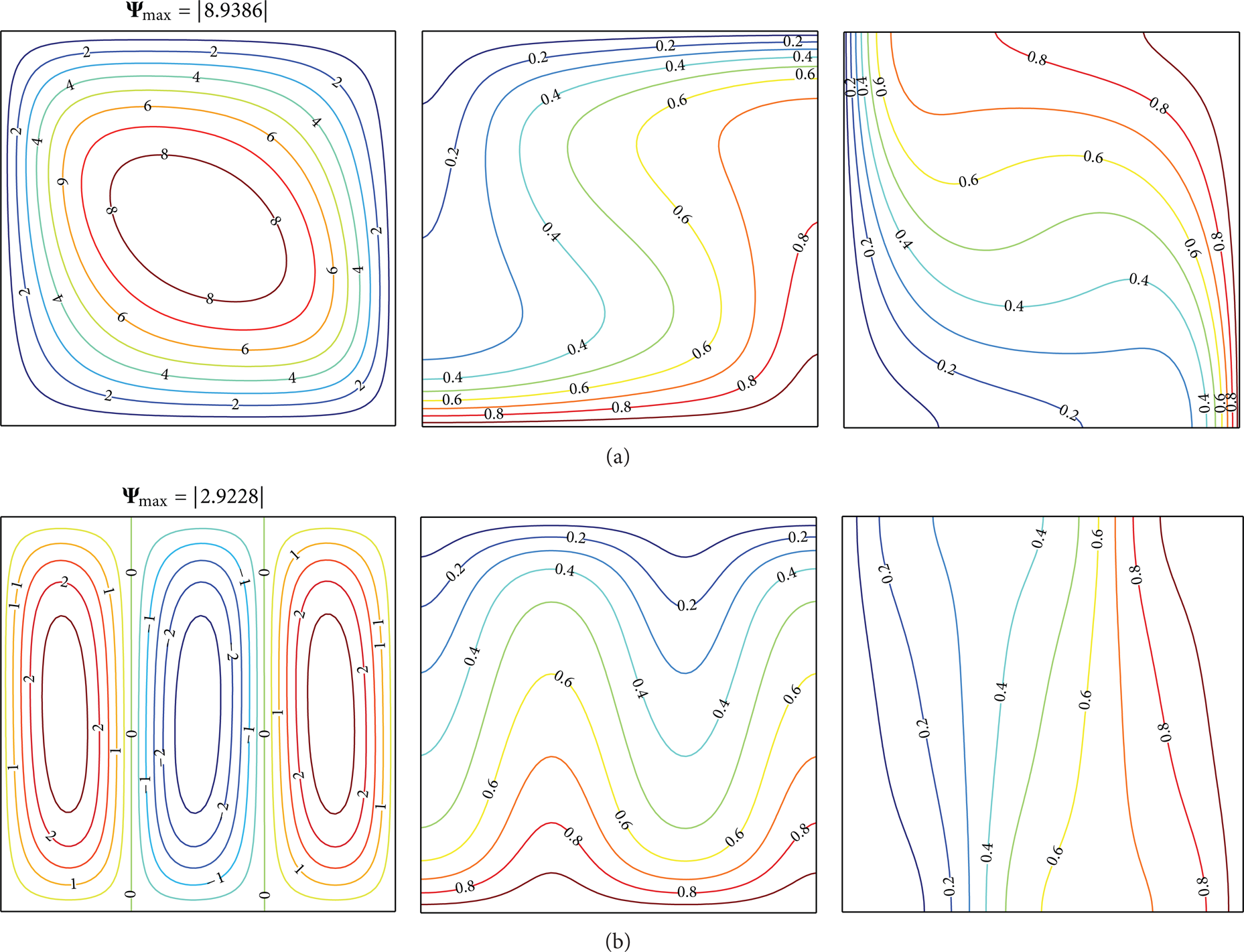
(left) Streamlines, (middle) isotherms, and (right) iso-concentration in the case of N = 0, Ra = 200, Le = 1. (a) Ha = 0, ψmax = 8.938,
Figure 3 shows the streamlines, isotherms, and iso-concentration for N = 1 with different values of Hartmann number (Ha = 0, 1, and 5). When Ha = 0 (see Figure 3(a)), both isotherms and iso-concentration spread inside the cavity and cooperating together to make a circulation with counterclockwise direction with |ψ|max = 11.488,
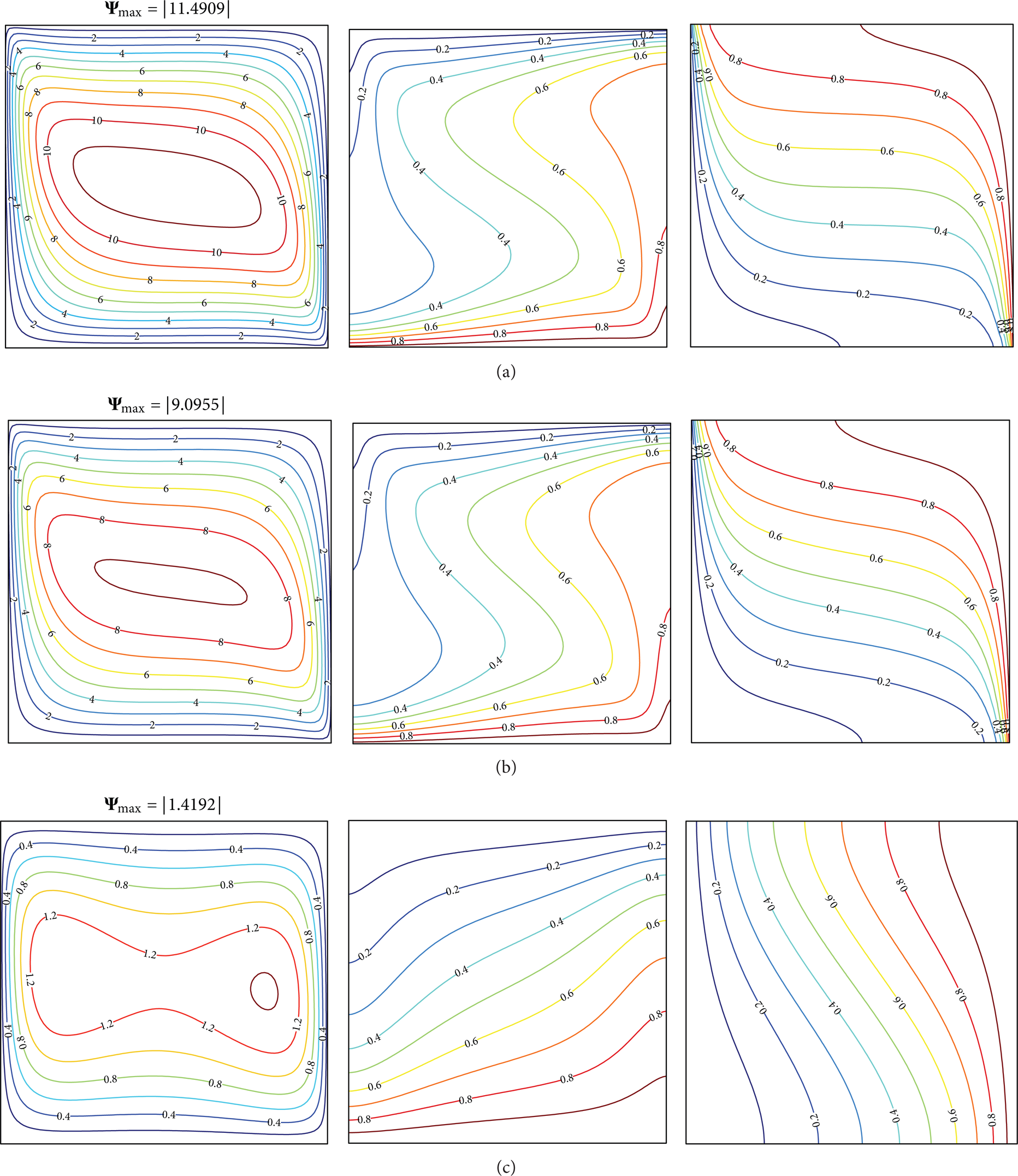
(left) Streamlines, (middle) isotherms, and (right) iso-concentration in the case of N = 1, Ra = 200, Le = 1. (a) Ha = 0, ψmax = 11.488,
Streamlines, isotherms, and iso-concentration shown in Figure 4 are for N = – 1 and for different values of Hartmann number Ha = 0, 1, and 5. The buoyancy ratio has the same value as the previous case but in the opposite direction. It is noticeable from Figures 4(a)–4(c) that the flow has the same behavior as the previous case but in the opposite direction, and this is due to the opposite direction of buoyancy ratio. The strength of the flow, heat transfer, and mass transfer have almost the same values with the previous case as shown in Figures 4(a)–4(c). The circulations in all cases reverse their directions to clockwise direction, where the thermal and solutal buoyancy forces cooperate together to enhance the fluid to rise up along the left wall and then circulating and going down along the right wall making a circulation with clockwise direction with small skewness to the top right corner and the bottom left corner.

(left) Streamlines, (middle) isotherms, and (right) iso-concentration in the case of N = – 1, Ra = 200, Le = 1. (a) Ha = 0, ψmax = 11.488,
The streamlines, isotherms, and iso-concentration are shown in Figures 5(a), 5(b), and 5(c) for N = 5 and Ha = 0, 1, and 5, respectively. When Ha = 0, both isotherms and iso-concentration spread inside the cavity as shown in Figure 5(a). Both buoyancy forces are working together to rise the fluid up along the right wall and then circulating and going down along the left wall making a circulation with counterclockwise direction with

(left) Streamlines, (middle) isotherms, and (right) iso-concentration in the case of N = 5, Ra = 200, Le = 1. (a) Ha = 0, |ψ|max = 22.079,
4.2. Effect of Lewis Number (Le )
In this section the effect of Lewis number Le on double-diffusive natural convection is considered. The numerical simulation was conducted under different values of Lewis number (Le = 0.1 and 10), with different values of Hartmann number (Ha = 0, 1 and 5). The values of Rayleigh number and buoyancy ratio were fixed with Ra = 200 and N = 1.
Figure 6 presents the streamlines, isotherms, and iso-concentration for Le = 0.1 and different values of Hartmann number Ha = 0, 1 and 5. For the case without the effect of magnetic force Ha = 0 (see Figure 6(a)), isotherms and iso-concentration are cooperating together to rise the fluid up along the right wall to the top wall an then circulating and going down along the left wall making a circulation with counterclockwise direction. The strength of the circulation is relatively high with |ψ|max = 18.06. Distortion and spread of isotherms are clear and wide in comparison with iso-concentration where
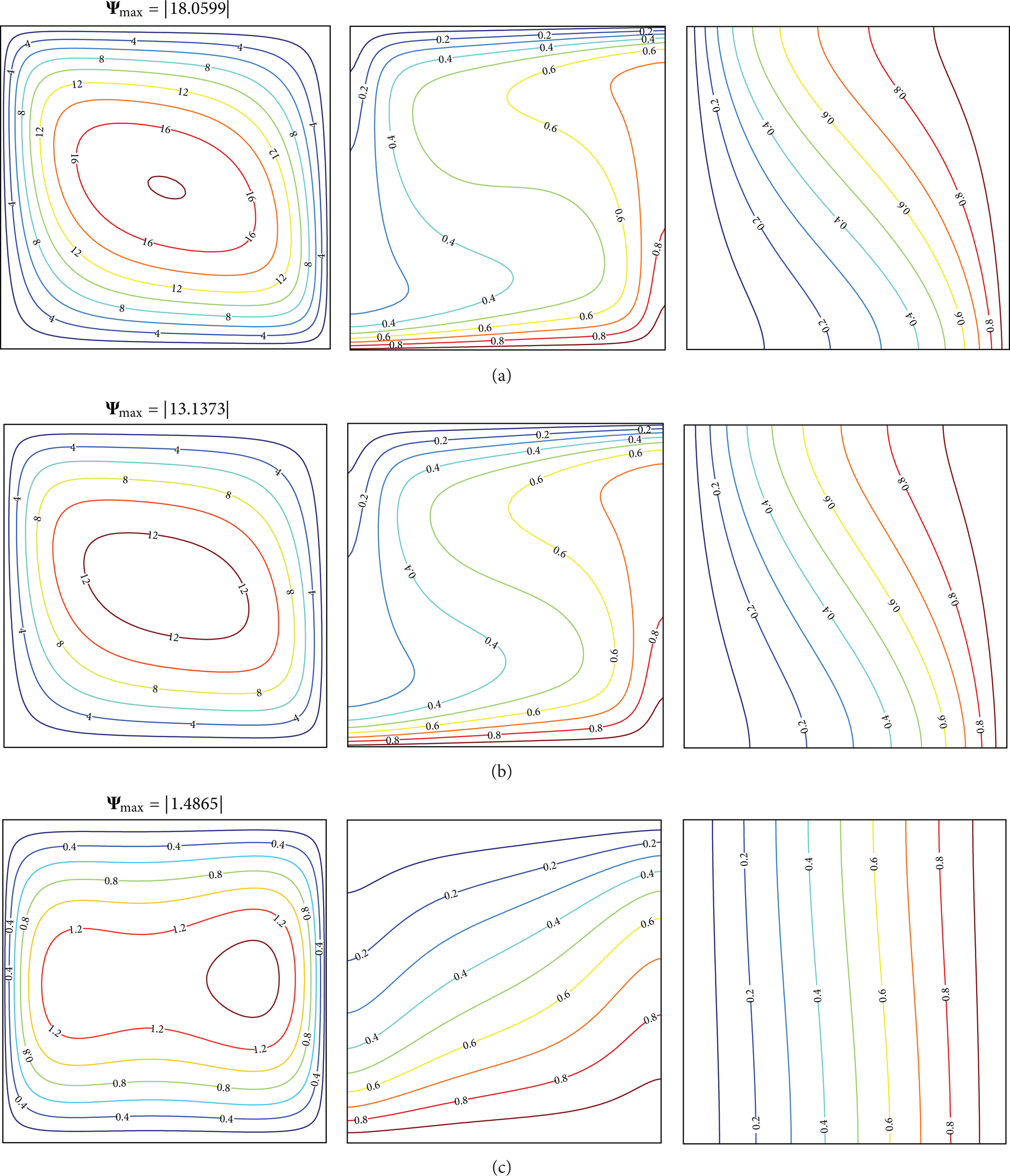
(left) Streamlines, (middle) isotherms, and (right) iso-concentration in the case of N = 1, Ra = 200, Le = 0.1. (a) Ha = 0, |ψ|max = 18.06,
Streamlines, isotherms, and iso-concentration are presented in Figure 7 for Le = 10 with different values of Hartmann number (Ha = 0, 1 and 5). For Ha = 0, both isotherms and iso-concentration are spread widely inside the cavity, and cooperating together to enhance the fluid to rise up along the right wall to the top wall and then circulating and going down along the left wall making a circulation with counterclockwise direction. The strength of the circulation is relatively high with |ψ|max = 8.564. Figures 7(b) and 7(c) illustrate the flow under the effect of magnetic force (Ha = 1 and 5). The flow is progressively inhibited due to retarding effect of magnetic force on the fluid flow. Distortion of isotherms and iso-concentration is a start to disappear with increasing Hartmann number. As Hartmann number increases, isotherms and iso-concentration lines inside the cavity approache more and more towards the conduction-like distribution pattern as shown in Figure 7(c). A sharp decreasing of circulation strength where the |ψ|max becomes 1.2 for Ha = 5. In addition, a two egg-shaped cores appeared as shown in Figure 7(c).

(left) Streamlines, (middle) isotherms, and (right) iso-concentration in the case of N = 1, Ra = 200, Le = 10. (a) Ha = 0, |ψ|max = 8.564,
4.3. Heat and Mass Transfer
In this section the heat and mass transfer processes are discussed and presented in terms of average Nusselt number (
Figure 8 illustrates the relation between buoyancy ratio (N) and average Nusselt number (
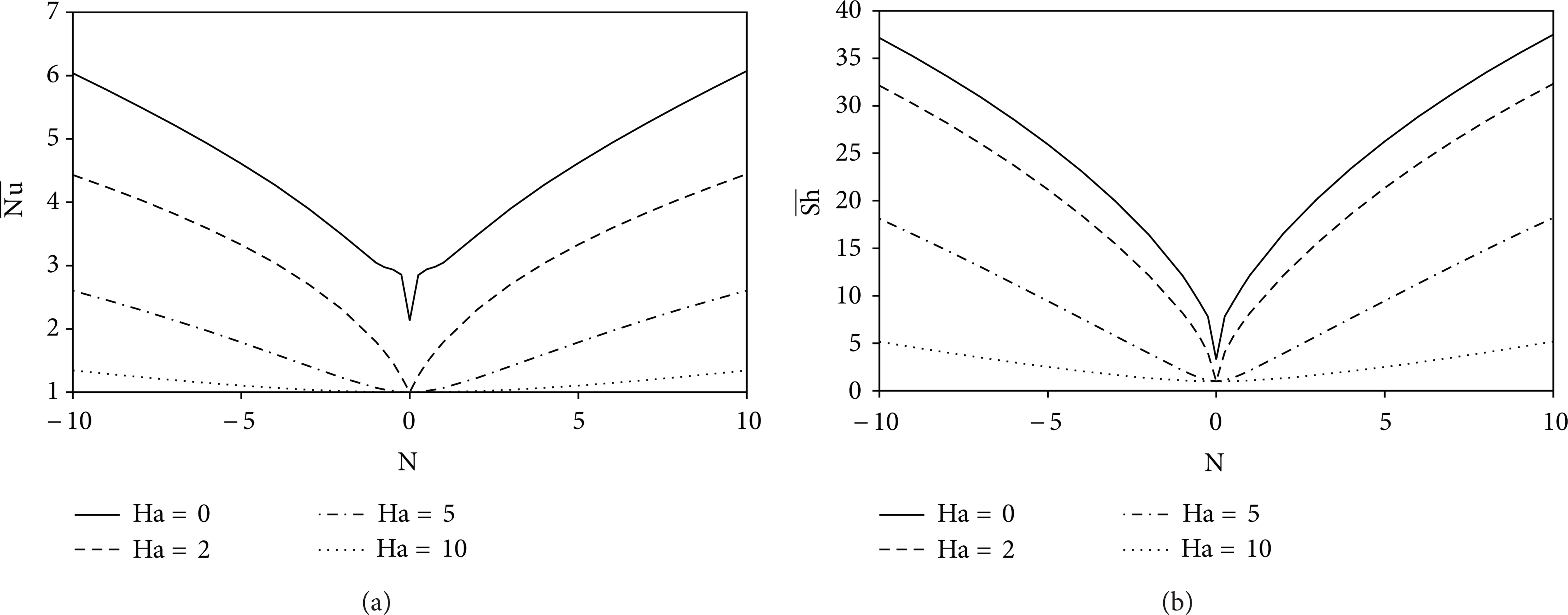
The effect of buoyancy ratio (N) on (a) the average Nusselt number
Figure 9 illustrates the relation between average Nusselt number (

The effect of Lewis number (Le) on (a) the average Nusselt number
The relation between
The relation between
Figure 10 illustrates the relation between average Nusselt number and average Sherwood number with Rayleigh number, under the variation of Hartmann number. The Rayleigh number and Hartmann number vary: 50 ≤ Ra ≤ 500 and Ha = 0, 2, 5, and 10. The buoyancy ratio and Lewis number were fixed at N = 1 and Le = 5 in the results presented in Figure 10. A direct relation is observed from Figure 10 between

The effect of Rayleigh number (Ra) on (a) the average Nusselt number
As a result, as the Hartmann number increases, the values of the average Nusselt number and average Sherwood number decrease for each value of the buoyancy ratio, Lewis number, and Rayleigh number. In some cases as discussed before with high Hartmann number Ha ≥ 5, they become close to 1 and approach to the pure diffusion case.
5. Conclusion
The double-diffusive natural convection in a square cavity filled with a porous medium is studied numerically. The bottom and right walls are fully heated and fully salted, respectively. The top and left walls are heated and salted, respectively, with high temperature and high concentration on the bottom and right walls, respectively. The magnetic field affects the fluid flow in the cavity on the direction of gravity acceleration. The results are generated and presented in terms of the average Nusselt number and average Sherwood number for different values of buoyancy ratio, Lewis number, and Rayleigh number with a combined effect of Hartmann number. Streamlines, isotherms, and iso-concentrations are also presented for some cases. In general, it is found that the increase of magnetic force has an effect to retard the strength of the flow inside the cavity. In addition, the distribution of isotherms and iso-concentration becomes less intensive and for some cases close to parallel lines. As the Hartmann number increases the heat, mass transfer processes are decreased, where the values of the average Nusselt number and average Sherwood number decreased to small values. For high values of Hartmann number, the heat and mass transfer are suppressed, and the values of average Nusselt number and average Sherwood number approach their asymptotic values. For any fixed value of the Hartmann number, an increasing of buoyancy ratio and Rayleigh number will enhance the heat and mass transfer processes, while increasing the Lewis number will decrease heat transfer and enhance mass transfer for any fixed value of the Hartmann number.