




Abstract
Mobile cloud computing (MCC) enables mobile devices to outsource their computing, storage and other tasks onto the cloud to achieve more capacities and higher performance. One of the most critical research issues is how the cloud can efficiently handle the possible overwhelming requests from mobile users when the cloud resource is limited. In this paper, a novel MCC adaptive resource allocation model is proposed to achieve the optimal resource allocation in terms of the maximal overall system reward by considering both cloud and mobile devices. To achieve this goal, we model the adaptive resource allocation as a semi-Markov decision process (SMDP) to capture the dynamic arrivals and departures of resource requests. Extensive simulations are conducted to demonstrate that our proposed model can achieve higher system reward and lower service blocking probability compared to traditional approaches based on greedy resource allocation algorithm. Performance comparisons with various MCC resource allocation schemes are also provided.
1. Introduction
Cloud computing is a new computing service model with characteristics such as resource on demand, pay as you go, and utility computing [1]. It provides new computing models for both service providers and individual customers, which can be broadly classified into infrastructure as a service (IaaS), platform as a service (PaaS), and software as a service (SaaS). Furthermore, smart phones are expected to overtake PCs and become the most common web access entities worldwide by 2013 as predicted by Gartner [2]. Since mobile devices (MDs) have more advantages such as mobility, flexibility, and sensing capabilities over fixed terminals, integrating mobile computing and cloud computing techniques is a natural and predictable approach to build new mobile applications, which has attracted a lot of attention in both academia and industry community. As a result, a new research field, called mobile cloud computing (MCC), is emerging.
In [3], Huang et al. presented a new MCC infrastructure, called MobiCloud, where dedicated virtual machines (VMs) are assigned to mobile users to improve the security and privacy capability. In such an MCC environment, the system computational resources, such as CPU, storage, and memory, are partitioned into several service provisioning domains based on the cluster geographical distribution. Each domain consists of multiple VMs, and each VM handles parts of cloud computing resource (i.e., CPU, storage and memory, etc.). When the MCC service provisioning domain receives a service request from a mobile device, it needs to make a decision on (1) whether to accept the request; and (2) how much Cloud resources should be allocated if the request is accepted. Although the Cloud resource can be considered as unlimited compared with the computing resource in a single mobile device, in practice, a geographically distributed cloud system usually contains limited resource at a local service provisioning domain. When all the Cloud resources are occupied within the local service provisioning domain, the service request from mobile device will be rejected (or migrated to a nonlocal service provisioning domain) due to the resource unavailability. The rejection of a service request not only degrades the user satisfaction level (i.e., resulting in a long service delay due to the nonlocal service provisioning or service migration to other remote domain), but also reduces the system reward which is usually defined as a metric that includes the system net income and cost.
In general, the Cloud income increases with the number of the accepted services. However, it is definitely not true that cloud service provider (CSP) would like to acccept service requests as many as possible, since more accepted services occupy more cloud resources, and more likely a new request will be rejected when the network resource is limited, which degrades the QoS level of users. The rewards of the most existing Cloud resource allocation methods only consider the income on behalf of the CSP. To obtain a comprehensive system reward of MCC, the customer QoS and user satisfaction level should be taken into account in the system reward as well. Therefore, our research goal is to address the following questions: how to obtain the maximal overall system rewards by taking into account from both the service provider side and the customer side while satisfying a certain QoS level.
In this paper, we present an adaptive MCC resource allocation model based on semi-Markov decision process (SMDP) to achieve the objective mentioned above. Our proposed MCC model considers not only the incomes of accepting services, but also the cost resulted from VM occupation in the Cloud. Moreover, other factors including service precessing time of both Cloud and MD battery consumption of mobile device are also taken into account. Thus, the overall economic gain is determined by a comprehensive approach which considers all the factors mentioned above.
The contributions and essence of this proposed model are listed as follows.
Semi-Markov decision process (SMDP) is applied to derive the optimal resource allocation policy for MCC. The proposed model allows adaptive resource allocations, that is, multiple Cloud resources (i.e., the number of VMs) can be allocated to a service request based on the available Cloud resource in the service domain in order to maximize the resource utilization and enhance the user experience. The maximal system rewards of Cloud can be achieved by using the proposed model and by taking into the considerations the expenses and incomes of both Cloud and mobile devices.
The rest of this paper is organized as follows. We present the related work in Section 2. In Section 3, the basic system model is described. The semi-Markov decision process model for MCC system is presented in Section 4. Based on our proposed model, we analyze the probabilities for each adaptive allocation scheme and rejection probability in Section 5. We evaluate the performance of the proposed economic model in Section 6 and conclude this paper and discuss the future work in Section 7.
2. Related Work
Recent research work for Cloud computing has shifted its focus from the Cloud for fixed user to Cloud for mobile devices [4], which enables a new model of running applications between resource-constrained devices and Internet-based Cloud. Moreover, resource-constrained mobile devices can outsource computation/communication/storage intensive tasks onto the Cloud. CloneCloud [5] focuses on execution augmentation with less consideration on user preference or device status. Elastic applications for mobile devices via Cloud computing were studied in [6]. In [3], Huang et al. presented an MCC model that allows the mobile device related operations residing either on mobile devices or dedicated VMs in the Cloud. [7] proposes a way using traffic-aware virtual machine (VM) placement to improve the network scalability by optimizing the placement of VMs on host machines.
Although resource management in wireless networks has been extensively studied [8–10], there are few previous works focusing on resource management of Cloud computing and especially mobile cloud computing. In [11], an economic mobile cloud computing model is presented to decide how to manage the computing tasks with a given configuration of the Cloud system. That is, the computing tasks can be migrated between the mobile devices and the Cloud servers. A game theory-based resource allocation model to allocate the Cloud resources according to users' QoS requirements is proposed in [12]. In the past few years, some research work focused on application of specific resource management in Cloud computing using virtual machines or end servers in data center. In [13], authors propose a new operating system which enables resource-aware programming while permitting high-level reusable resource management policies for context-aware applications in Cloud computing. Lorincz et al. [14] address the problem of resource management in semantic event processing applications in Cloud computing. Tesauro et al. [15] propose a reinforcement learning based management system for dynamic allocation of servers trying to maximize the profit of the host data center in Cloud computing. In [16], Boloor et al. propose a generic request allocation and scheduling scheme to achieve desired percentile service level agreements (SLA) goals of consumers and to increase the profits to the cloud provider.
The works discussed above target to achieve a higher Cloud system profit and/or to meet a better service level agreement (SLA). However, they model the problem from service provider's perspective without considering the costs and profits of mobile devices. Therefore, the overall system rewards derived in previous works are sufficient. Generally, a Cloud-based application can be assigned with multiple resources in terms of VMs (can be in different domains/clusters) to obtain more computation/storage and other capacities. However, to our best knowledge, in the previous literature, none of them addresses the following emerging research problems: (1) how to construct a reward model of MCC system for resources allocation purpose by considering the rewards from both Cloud system and mobile users; (2) how to allocate system resources to service requests to maximize the user satisfaction level of mobile users while obtaining the maximal overall system and user rewards under a given QoS level.
3. System Model
A major benefit of MCC over the traditional client-server mode is that MDs can have more capabilities and better performance (i.e., less processing time, energy saving, etc.) when they outsource their tasks onto the Cloud. The outsourcing procedure can be implemented by using weblets (application components) to link the services between the Cloud and the mobile devices. A weblet can be platform independent such as using Java or .Net bytecode or Python script or platform dependent, using a native code. Some research work [5] focuses on the algorithm to decide whether to offload the weblet from MD to the Cloud (i.e., run on one or more virtual nodes offered by an IaaS provider) or run the weblet on the MD itself. In this way, a mobile device can dynamically expand its capabilities, including computation power, storage capacity, and network bandwidth, by offloading an elastic application service to the Cloud. The choice made by mobile device on whether to offload the task onto the Cloud can refer to the mobile device's status such as CPU processing capability, battery power level, and network connection quality and security. In this paper, the service scenario of the proposed model is the task offloading from MD onto the Cloud. Also, the task offloading procedure can be done in a way that MD sends a service request to the Cloud firstly, then the task is further offloaded to the Cloud once the service request is accepted by the Cloud.
As shown in Figure 1, a VM is responsible for managing the weblet's loading, unloading, and processing in the mobile Cloud. Each VM has the capacity to hold one weblet at a time for handling migrated weblet request, and two types of service requests are defined to be handled by a VM: (i) paid: a paid weblet service request is sent to the service provisioning domain from a mobile device; (ii) free: a free weblet service request is sent to the service provisioning domain from a mobile device. Figure 1 demonstrates the relationship between the paid/free service requests and the VMs of the service provisioning domain.

Reference model of mobile cloud computing.
In this paper, the MCC service architecture is based on the MobiCloud framework presented in [3], in which a VM can handle a portion of Cloud system resources (CPU, memory and storage, etc.) that can satisfy the minimal resource requirement to process an application offloading service in the MCC system. Within the local MobiCloud service provisioning domain, the resource capacity, in terms of the number of VMs, is limited. Thus, if the demands of the arriving service requests exceed the number of available VM resources in a certain service domain, the following service requests will be rejected (or migrated to a remote service provisioning domain). On the other hand, if the demands of the arriving service requests are lower than the number of the available VMs, more VMs can be assigned to one service request to maximally utilize the Cloud resource and achieve a better performance and QoS. Our analytical model is based on a single local service domain. The analysis of local service migrations to remote service domains is regarded as the future study.
3.1. System Description
An MCC system mainly consists of two entities, VM and physical MD. A VM is the minimum set of resources that can be allocated to an MD upon receiving its service request. Since an MD is a wireless node with limited computing capability and energy supply, it can outsource its mobile codes (i.e., weblet) of an application service to the Cloud. Then, the Cloud will decide a number of VMs to be allocated to the arriving service request if the decision for the service request made by the Cloud is accepted.
In this paper, we consider a service provisioning domain with K VMs. The maximum number of VMs that can be allocated to a Cloud service is c VMs (we denote as c allocation scheme), where
It can be more complicated when we consider both the rewards and costs of mobile devices. Cost involved in the MD side should not be neglected, which means that the whole system reward should consider not only the rewards of the mobile Cloud itself, but also the incomes and the costs of MD, such as the saved battery energy if the service is processed in the mobile Cloud and the expense of the battery energy and the processing time of MD if the application service is processed on the MD locally.
To model this complex dynamic MCC resource allocation process, without loss of generality, we assume that the arrival rates of both paid and free service requests follow Poisson distributions with mean rate of
Since the decision making epoch is randomly generated in the system, we use semi-Markov decision process (SMDP) to model the dynamic MCC resource allocation process based on the system description we presented above. SMDP is a stochastic dynamic programming method, which can be used to model and solve optimal dynamic decision making problems. There are six following elements in the SMDP model: (a) system states; (b) action sets; (c) the events that cause the decisions; (d) decision epoches; (e) transition probabilities; and (f) reward. In the following, we first present the system states, the actions, the events, and the reward model for the MCC system.
3.2. System States
According to the assumption, there are total K VMs in one service provisioning domain, and c VM can be allocated to the service request, which is from 1 to C, where
In the MCC system model, we can define two types of service events: (1) a paid or free service request arrives from an MD, denoted by

3.3. Actions
For a system state of the service provisioning domain with an incoming service request from an MD (i.e.,
And for the departure of a finished service in the service provisioning domain (i.e.,

3.4. Reward Model
Based on the system state and its corresponding action, we can evaluate the whole mobile Cloud system reward (denoted by

The net lump sum income should consider the payment from MD to the mobile Cloud, the saved battery energy of MD, and the consumed time of mobile Cloud to process the service if the service is run in the mobile Cloud, the consumed battery energy, and the consumed time of MD if the service is run on MD locally.
Thus, the net lump sum income

In (3),


4. SMDP-Based Mobile Computing Model
Based on the SMDP model, we have already defined the system states, action sets, the events, and reward for the MCC system in the last section, then we need to define the decision epoches and obtain the transition probabilities to calculate the maximum long-term whole system reward.
There are three types of events in the MCC system (i.e., an arrival of a paid service request, an arrival of a free service request, and a departure of a finished service). The next decision epoch occurs when any of the three types of events takes place. Based on our assumption, the arrival of service request follows Poisson distribution and the departure of finished service follows exponential distribution. Thus, the expected time duration between two decision epoches (i.e.,

Thus, the expected discounted reward (denoted as

Then the only element left to be calculated is the transition probabilities. To calculate the transition probabilities, we show an example in Figure 2.
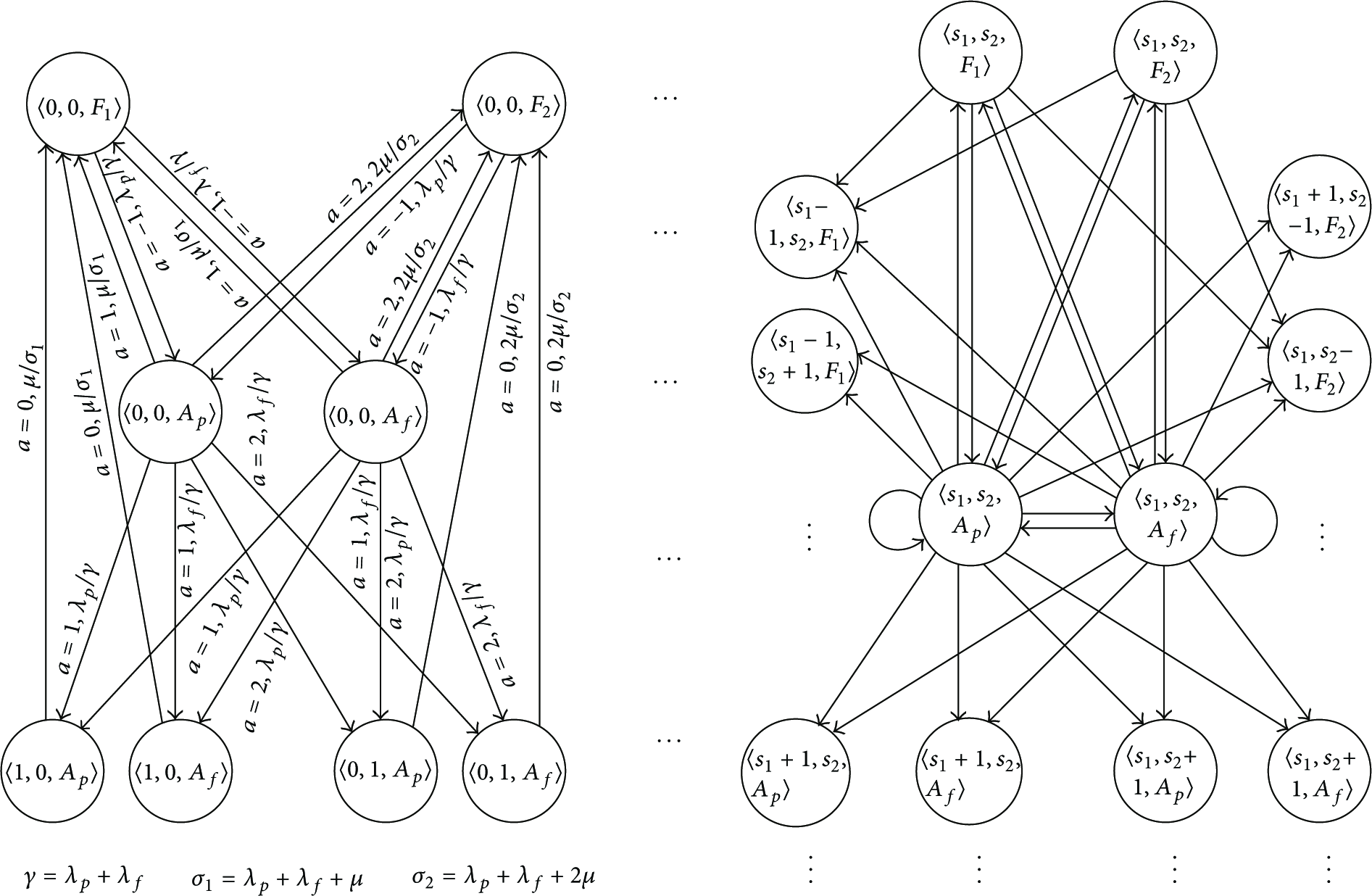
An example of state transition probabilities for two allocation schemes. The first item represents the action and the second item represents the state transition probability.
In this example, without loss of generality, we assume that there are only two allocation schemes, which means
States transition probabilities of system model at

From the example, the transition probabilities of C allocation schemes can be deduced. Let
For the state 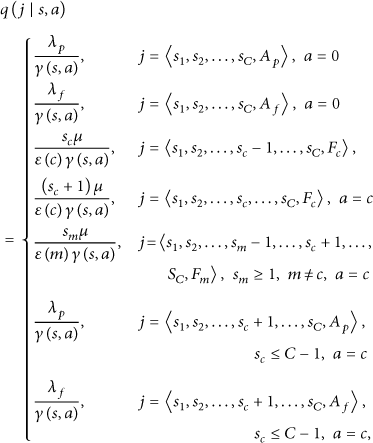
For the states 
For the states 
Then, the maximal long-term discounted reward is obtained based on the discounted reward model defined in [18, 19] and can be denoted as

In the reward equation (8), the first part is that the revenue is a lump earnings of the reward and the second part is that the cost is a continuous-time payment of the reward. Thus, the reward function needs to be uniformized to obtain the uniformized long-term reward, then the discrete-time discounted Markov decision process can be used in this model. Based on the assumption 11.5.1 in [19], we need to find a constant ω satisfying
Thus, the transition probability can be uniformized as

For the state 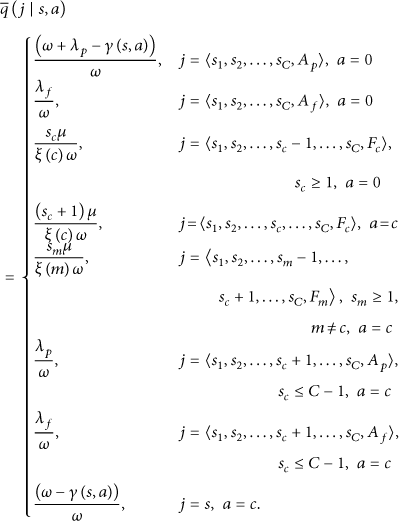
Similarly, for the state 
And for the state s
Using the uniformization equations presented above, then the expected maximal long-term reward in (12) can be uniformized as

Thus, according to the uniformization equations (14), (15), (16), and (17), the uniformized maximal long-term expected reward is obtained as

5. Performance Analysis
The probability of allocation scheme c, which is defined as the probability that c VMs are allocated for a cloud service, is an important performance metric for ensuring the user satisfaction level and the Cloud resource utilization ratio. It is very useful for the operator to manage the system capacity/utilization status based on the system parameters of the service provisioning domain (such as arrival rate, departure rate, and the VM number of Cloud resource). Meanwhile, blocking service request does not only mean the loss of whole system reward, but also means the degradation of users' satisfaction level. Then, the blocking probability, which is the probability that blocking the cloud service requests from mobile device, is another important performance metrics for the service provisioning domain. In this section, we analytically derive the probabilities of each allocation scheme and blocking probability for the proposed economic mobile computing model based on SMDP.
From the reward function (18) and probability equations (14), (15), and (16), the expected total discounted reward
Let 


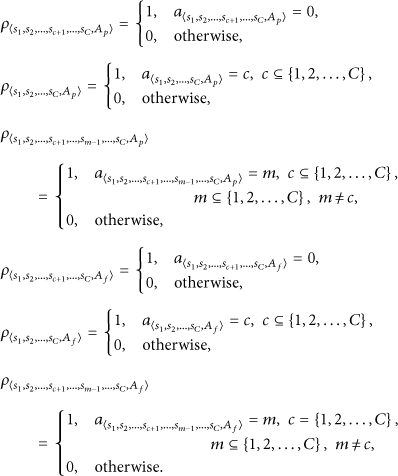
Since the sum of the steady-state probabilities for all states equals to 1, we have

Therefore, the steady-state probability of each state in an MCC service provisioning domain can be obtained by solving (19), (20), (22), and (24). Thus, as a result, for the service request arrival states (i.e., 

Based on (26) and (25), the blocking probability for the service request arrival states (i.e,
The high values of
6. Performance Evaluation
In this section, we evaluate the performance of the proposed economic MCC model based on SMDP by using an event driven simulator compiled by Matlab [20] and compare our proposed model with the traditional greedy algorithm. Since the paid service demands a higher QoS level compared with other free services, thus our simulation mainly focuses on the performance of paid service.
In our simulation, the maximal number of VMs is
Simulation parameters.

6.1. Optimal Actions
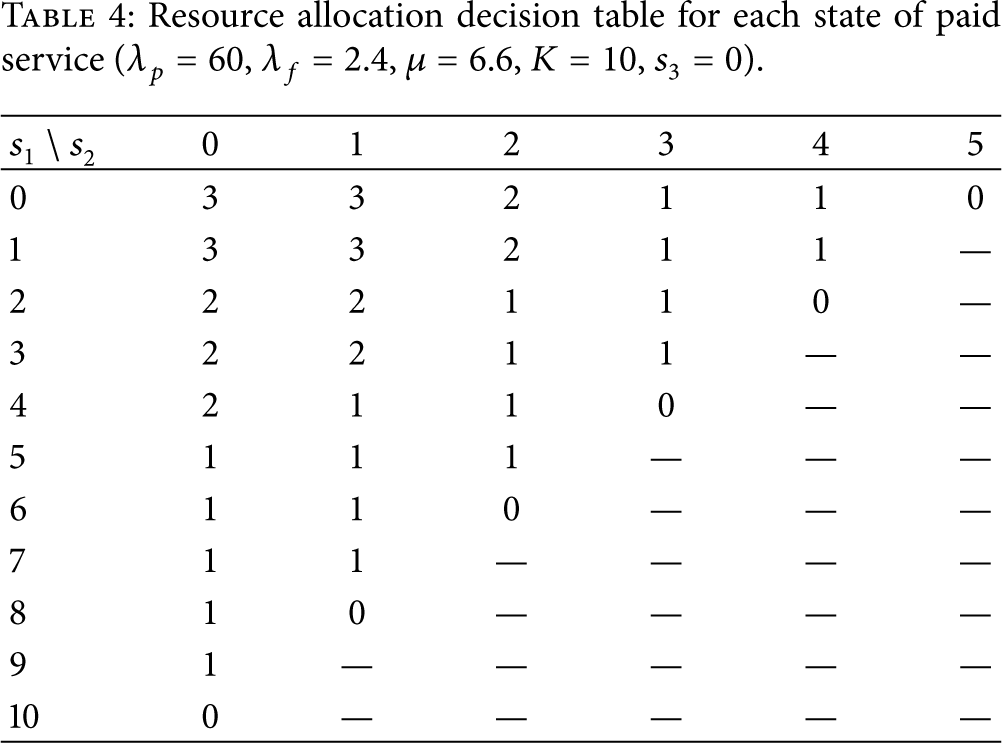
Tables 3 and 4 illustrate the actions of optimal resource allocation at each system state with different arrival rates of the paid service
Resource allocation decision table for each state of paid service (

Resource allocation decision table for each state of paid service (
6.2. System Rewards and Blocking Probability
To evaluate the performance of the proposed dynamic resource allocation model, we compare the long-term reward and blocking probability of the paid service between our model and greedy method in Figures 3, 4, and 5. In Figure 3, the reward of paid service of our model increases at the beginning, then falls down with the increase of the arrival rate of paid service requests

System reward of paid service compared between SMDP model and greedy method, varying with the arrival rate of paid service requests (

Probabilities for each action of paid service using SMDP model, varying with the arrival rate of paid service requests (

Dropping probability of paid service compared between SMDP model and greedy method, varying with the arrival rate of paid service requests (
To further illustrate the performance of our model, we compare the reward of paid service and the blocking probability with the greedy method under the scenario of different number of VMs (K). In Figure 6, the rewards of both our model and greedy method increase with the increase of the number of total VMs in the service provisioning domain.

System reward of paid service compared between SMDP model and greedy method, varying with the number of VMs (K) (
When the number of VMs (K) is less than
When the number of total VMs in the service provisioning domain is low (

Probabilities for each action of paid service using SMDP model, varying with the number of VMs (K) (

Dropping probability of paid service compared between SMDP model and greedy method, varying with the number of VMs (K) (
The reason is that our model does not only consider the instant and future long-term income but also the cost of resource occupation of all running services in the service provisioning domain when deciding to allocate the Cloud resources to the paid service request, while the greedy method only considers the current income of paid service of the service provisioning domain. Then, when the Cloud resource of the service provisioning domain is less than
In Figure 6, we can also see that when the number of VMs (K) is less than
Figure 9 shows the total rewards (rewards of paid service plus free service) of different arrival rates of free service requests of our proposed model, varying with the increase of arrival rate of paid service requests in the service provisioning domain. It can be seen that when the values of the arrival rates between paid service request and free service request are comparable, the total reward of our model increases with the increase of arrival rate of free service requests. On the other hand, when the arrival rate of free service requests is much larger than that of paid service requests, the total reward decreases rapidly, which results from the large increase of the arrival rate of free service requests which may cause more rejections for the following service requests.

Total system reward with different arrival rate of free service requests using SMDP model, varying with the arrival rate of paid service requests (
7. Conclusion
In this paper, we propose an SMDP-based model to adaptively allocate Cloud resources in terms of VMs based on requests from mobile users. By considering the benefits and expenses of both Cloud and mobile devices, the proposed model is able to dynamically allocate different numbers of VMs to mobile applications based on the Cloud resource status and system performance, thus to obtain the maximal system rewards and to achieve various QoS levels for mobile users. We further derive the Cloud service blocking probability and the probabilities of different Cloud resource allocation schemes in our proposed model. Simulation results show that the proposed model can achieve a higher system reward and a lower service blocking probability compared with the traditional greedy resource allocation algorithm. In the future, we will study a more complex decision making model with different types of mobile application services, for example, the mobile application services which require different serving priorities. We will also investigate the optimal Cloud resource planning by determining the minimal Cloud network resources to achieve the maximal system rewards under given QoS constraints.
Footnotes
Acknowledgments
This work was supported in part by the State Key Development Program for Basic Research of China (Grant no. 2011CB302902), the “Strategic Priority Research Program” of the Chinese Academy of Sciences (Grant no. XDA06040100), the National Key Technology R&D Program (Grant no. 2012BAH20B03), US NSF Grants CNS-1029546, and the Office of Naval Research's (ONR) Young Investigator Program (YIP).