




Abstract
In engineering field, analytical methods can only be applied to classic heat transfer problems with regular geometric boundaries. It is difficult to apply analytical methods in solving the mathematical and physical equations in nonorthogonal boundary of irregular domains. In this paper, we presented a method by conformal mapping from the solution for heat conduction problems in regular domains to solve problems in irregular domains.
1. Introduction
In engineering field, all two-dimensional heat conduction problems can be solved by the partial differential equations in the initial and boundary conditions in mathematics. For problems in regular domains, the analytical methods can be applied, including the variable separation method, the integral transformation method, Green's function method, and the conformal mapping method. However, it is hard to apply those analytical methods to solve problems in irregular domains. Therefore, numerical methods were extensively used to solve the practical problems. In fact, analytical methods have advantages in illustrating the basics of physical concepts, giving the concise conclusions, by which it is easier to analyze a different physical phenomenon. Besides, it is less time consuming compared with the numerical method.
Jiji introduced the method of singular perturbation to Slovenia two-dimensional heat conduction in irregular domains which retains the two-dimensional nature and gives accurate estimates of the heat flux in the boundary-layer region [1]. A simple finite-difference technique using the generalized finite-difference (GFD) discretization was presented by Chung for two-dimensional heat transfer problems of irregular geometry [2]. McCorquodale et al. presented an algorithm for solving the heat equation on irregular time-dependent domains. This leaded to a method that was second-order accurate in space and time [3]. Lately researchers also developed Weighted Least-Squares Collocation Method (WLSCM) and smoothed particle hydrodynamics method for Heat Conduction Problems in Irregular Domains [4, 5]. In general, the partial differential equations for heat conduction problems can be solved by the variable separation method, in which the infinite series solution can be constructed in the orthogonal curvilinear coordinate system with the corresponding functions. And the coefficients in the above infinite series can be determined by the Fourier-Liouville series expansion. Different coordinate systems can be chosen for different problems, according to the specific boundaries. For example, using spherical coordinates or cylindrical coordinates to separate the variables in the Laplace equations, wave equations, or transport equations, an associated Legendre equation, Bessel equation or Spherical Bessel equation will appear, respectively. The image method and conformal mapping technique are well known in solving two-dimensional problems [6]. For heat conduction problems with irregular domains, we can map these irregular domains to regular domains which are called the image spaces. The solutions of the problems in the image spaces are easy to be obtained. Then by mapping the solutions back to the initial space, we can get the solutions of the initial problems [7–11].
2. Analytical Method
2.1. Dirichlet Problem in the Eccentric Domain
For steady heat conduction issues with internal heat source in irregular domains, analytical methods solve the initial state and boundary condition of the Poisson equation. The fundamental equations and boundary conditions are
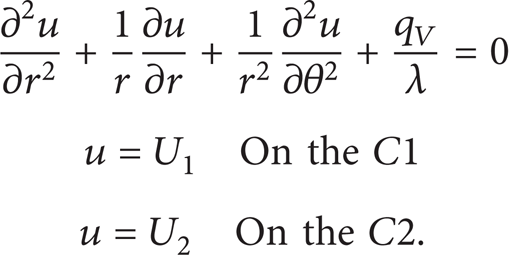
In the equation, u is temperature distribution, q V is heat flux, and λ is thermal conductivity.
Boundary description is shown in Figure 1. In the Z-plane domain, R1 and R2 are the outer and inner radius of the eccentric ring, and the boundary conditions are known.
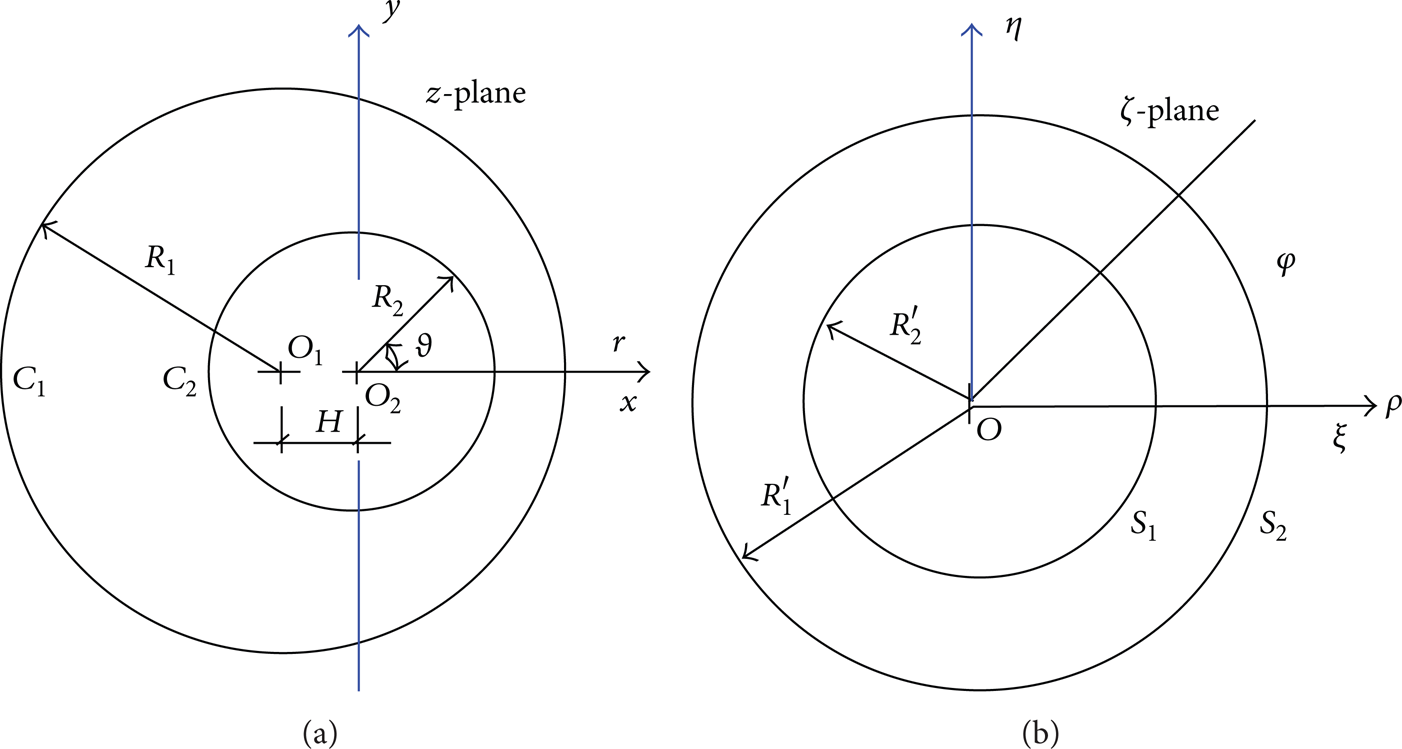
Boundary of two numeration fields.
2.2. Conformal Mapping Method
The traditional solution has been to map eccentric circles in the physical space z-plane with nonorthogonal boundary to concentric circles in the ζ-plane with orthogonal boundary using conformal mapping. Solving the problem in the ζ-plane and inverse transformation to the z-plane give the final analytical solution.
Then, using linear conformal mapping, we obtained
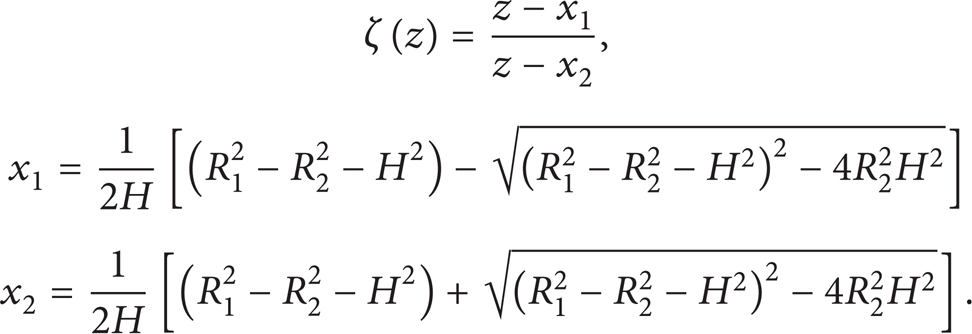
Thus, the transformation of Z-plane eccentric circles to ζ-plane concentric circles can be realized. Through conformal mapping, the equations and boundary conditions of the concentric ring in the ζ-plane are
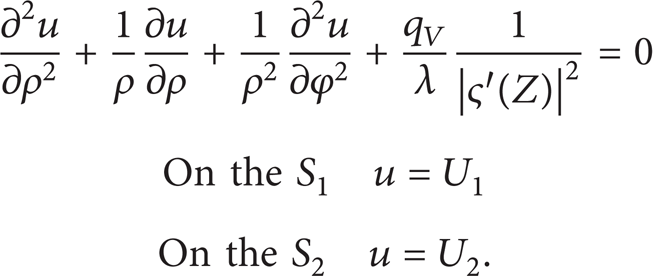
R1′ and R2′ are the outer and inner radius of the concentric ring in the ζ-plane after transformation:

Obviously, the fundamental equation is still a Poisson equation in the ζ-plane, but the strength of the “source” becomes
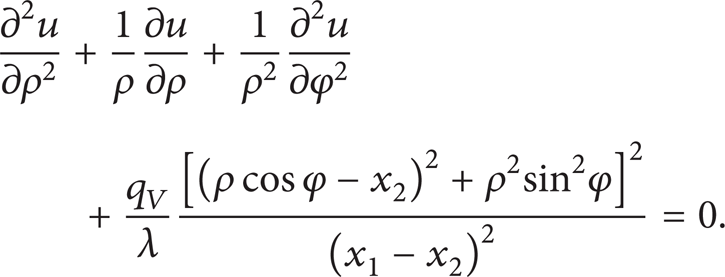
Through conformal mapping, the equation is transferred into Poisson equation with a concentric circles boundary. In polar coordinates, the equation can be described as (5). In the equation, ρ is the polar radius, and φ is the polar angle:
2.3. Particular Solution of the Poisson Equation in the Domain of Concentric Rings
Solving the Poisson equation in the concentric rings domain (5), we assumed the form of the solution to be

where V is the particular solution and W is the general solution of the Laplace equation:

In order to get a particular solution, a coordinate transformation is introduced:
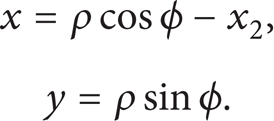
Then, the Poisson equation can be rewritten as

Thus, we can construct

Then
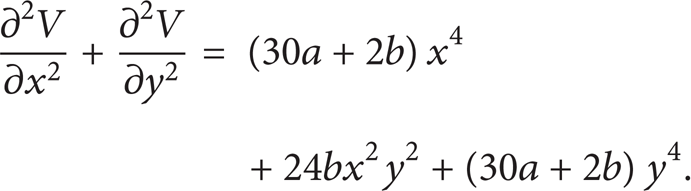
Taking it into the equation above
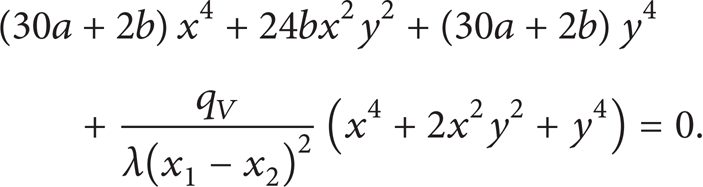
Undetermined coefficients a and b can be calculated

Thus, the particular solution is

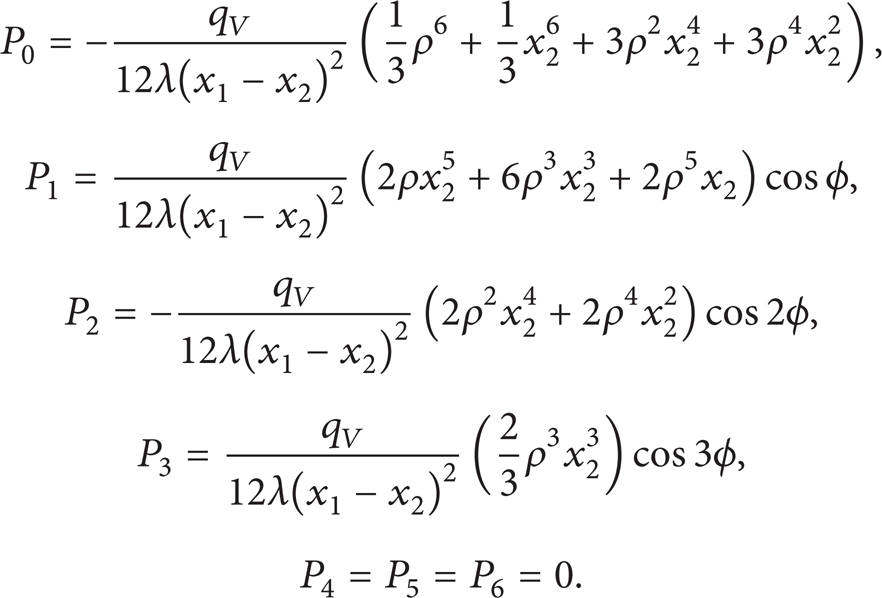
According to the form of the particular solution V, by trigonometric function V can be expressed as

Thus, the particular solution is
2.4. General Solution of the Poisson Equation in the Domain of Concentric Rings
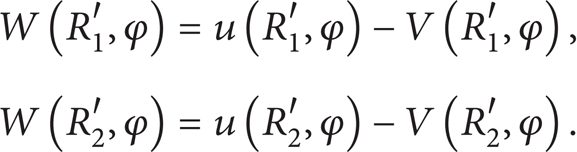
On the inner boundary S1 and the outer boundary S2 of the concentric rings, we get
The theoretical solution of the Dirichlet problem in the Laplace equation of the concentric rings is

According to the form of the boundary conditions, we can assume that

By substitution of the boundary conditions on the inner boundary S1 into (19) and the outer boundary S2 into (15), then A0, A1, A2, A3, B0, B1, B2, and B3 can be determined by comparing the factors of the two sides in (15) and (19), and we can obtain the analytical solution (6) of the Poisson equation (5):

2.5. Calculations with Typical Positions of the Eccentric Rings with Different Radii
In this paper, for the Dirichlet problem, S1 = 100°C and S2 = 0°C. Further, the outer radius was set at R1 = 0.5 m, the inner radius R2 = 0.3 m, distance of the two centers H = 0.1, heat flux q V = 1.5 kW/m3, and thermal conductivity of the pipe wall λ = 1.5 W/(m·°C), and we determined the distribution of temperature in the eccentric circles with different radii.
We selected points of different radii on the typical position in the z-plane and then conducted coordinate transformation and solved the Poisson equation of the concentric ring in the ζ-plane, thus obtaining the solution to the original problem with nonorthogonal boundary. Table 1 lists the calculations of the typical position of three eccentric circles with different radii.
Calculation and simulation results of three typical positions.
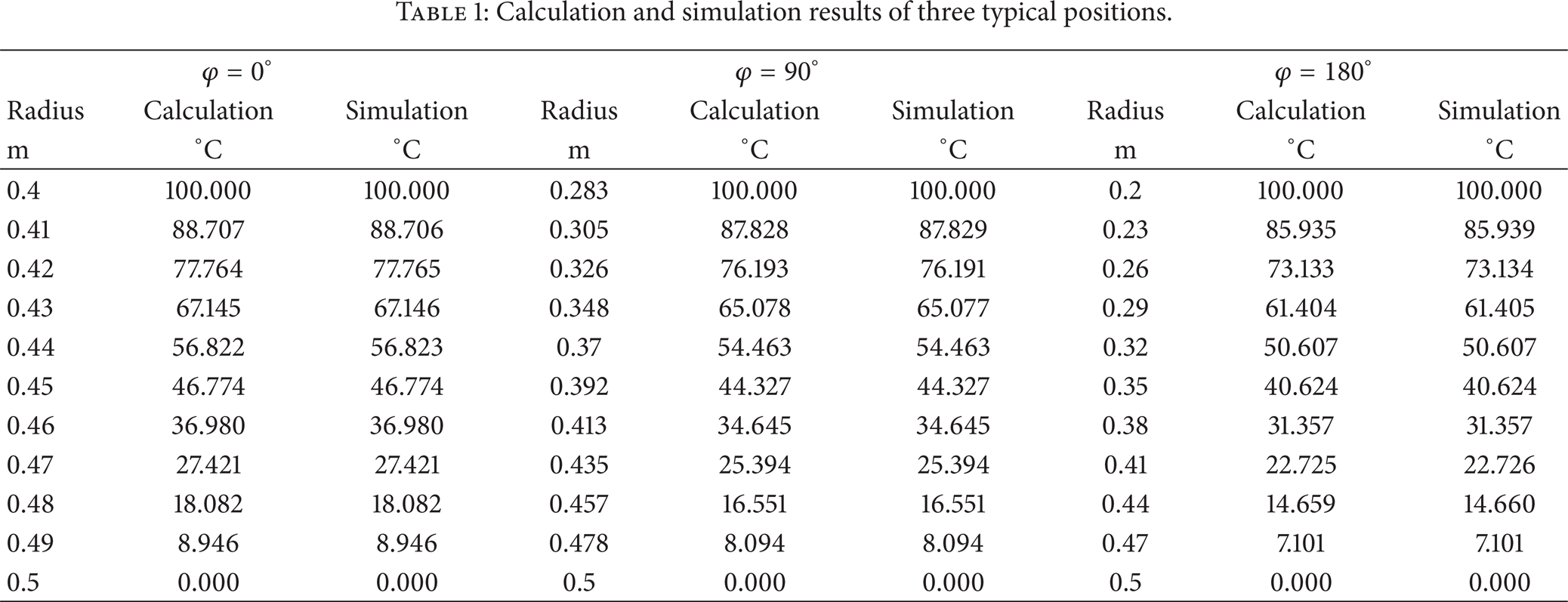
As seen from Table 1, the temperature distribution trend of the typical positions in the z-plane was substantially the same; the temperature gradually reduced as the radius increased. When θ = 0°, the temperature along the x-axis direction gradually reduced as the radius increased. When θ = 90°, the temperature along the y-axis gradually reduced as the radius increased. When θ = 180°, the temperature along the negative x-axis also had a downward trend as the radius increased. Comparing θ = 180° with θ = 0°, the temperature downtrend of the former was slower; the temperature gradient along the negative x-axis was larger than the one along the x-axis. Compared with the temperature distribution simulated by ANSYS, the analytical solution derived in the article is correct.
3. Conclusions
Steady heat conduction issues with internal heat sources in irregular domains can be resolved by solving the Poisson equation with the initial and boundary conditions. In this study, the conformal mapping method is presented to solve this equation. Firstly, the eccentric rings in the physical space z-plane with nonorthogonal boundary was mapped to the concentric rings with orthogonal boundary. And then the solution in the ζ-plane is inverse transformed to the z-plane. Finally we obtained the analytical solution to the initial problems. Also, the temperature field was analyzed to obtain the temperature distribution of typical eccentric ring positions. And the result is verified by the simulation.