




Abstract
WirelessHART is an emerging wireless sensor network protocol. In this paper, a joint graph routing algorithm for maximizing the network lifetime (JRMNL) in WirelessHART is proposed. Node communication load factor is approximately estimated by matrix operations for the first time. Then node communication load, the residual energy, and the link transmission power are integrated as a link cost function that is accurately measured in this algorithm. A node chooses the optimal next hop by comparing the link cost function of all its neighbor nodes, which guarantees the energy balancing of the whole network. Simulation results show that the proposed algorithm can extend network lifetime by a factor of 2 relative to the maximum residual energy selection algorithm and prolong the network lifetime by a factor of 7 relative to the minimum transmission power routing algorithm, but the average energy consumption per route will increase by 2 dBm compared with the minimum transmission power routing algorithm.
1. Introduction
WirelessHART is the first international protocol aiming for industrial automation and process control. Since it was announced in 2007, many scholars have carried out deep exploration into the application, the key technologies, and the protocol stack design of WirelessHART [1–9]. Despite that, the limit of energy and the transmission requirement for high reliability in WirelessHART have not been well solved yet. The brand-new graph routing defined in WirelessHART protocol can guarantee high transmission reliability, but the protocol gives out only the operation mechanism while ignoring the concrete implementation algorithm based on it. Moreover, the harsh working conditions and the small sharpness of its field devices as well as the arbitrariness of deployment together make it unable to use the wired power supply. That is to say, WirelessHART field devices are battery powered; once exhausted, they will soon break away from the network, leading to a rapid network paralysis. Therefore, high reliable communication and the ability to work for long duration are, so to speak, the prerequisites for wireless sensor devices to handle industrial control tasks.
Different from the star network or the tree network in which data focuses on some fixed nodes, the topology of WirelessHART is a mesh network, in which data can be transmitted on different paths. In WirelessHART network, every sensor node is a router, and WirelessHART defines two kinds of routing named graph routing and source routing, respectively. The source routing is used for path detection, while the graph routing can provide abundant redundant path to improve the reliability of the wireless communication.
It is tested that most of a node's energy is used for wireless data transmission, so how to choose the appropriate route to make the maximum numbers of transmission when uploading data to the gateway is a meaningful topic. In recent years, [10, 11] gave a detailed and deep discussion of the state of the art about the latest wireless sensor network routing algorithm and pointed out the difference of their application scope. Among the latest achievements of wireless routing algorithm, [12, 13] proposed a dynamic adjustment mechanism to adjust the transmission radius based on the heterogeneous connection between nodes during the constructing and operating phase. The transmission power can be reduced, and the network lifetime can be prolonged with the help of an excellent routing algorithm. In [14, 15], a new clustering algorithm based on time delay and energy awareness was proposed for distributed wireless sensor network. Reference [16] considered the robustness of the path connection, and an energy-efficient opportunistic routing strategy EFFORT was brought forward, while [17] proposed a routing algorithm based on the link quality judgment, prolonging the network lifetime. In addition, a routing algorithm based on relative position identification and direction sensing was proposed in [18, 19], which ensures the shortest path routing and small energy consumption. Reference [20] proposed a FANC routing algorithm based on network coding. Energy minimized one-hop network coding is carried out inside the sensor so that the algorithm complexity is very high. As we can see, most of these new algorithms are applied to distributed wireless sensor network, and they have certain requirements for the computing power and storage capacity of the sensors. Although they have obtained the certain energy-saving effect, the network lifetime is not maximized at all. In WirelessHART, we are seeking a kind of energy-balanced routing strategy to make the maximum network lifetime so as to meet the strict requirements in industrial application. Therefore, [21, 22] proposed the Minimum Transmission Power Cooperative Routing algorithm (MPCR), reducing the energy consumption of a single route while guaranteeing certain throughput. However, the algorithm ignores the neighbor nodes' residual energy and communication load, which will give rise to the fast running out of energy of some fixed nodes due to the frequent communications. Based on the above consideration, [23, 24] proposed a routing algorithm based on Maximum Residual Signal Level (RSL) called ELHFR, by which a node chooses the optimal next hop through comparing the residual energy of neighbor nodes. ELHFR can prolong the network lifetime to a certain extent, but it also brings about the shortcoming that the transmission in every chosen route is accompanied by large energy consumption. In addition, in [25], a load-balanced routing algorithm based on communication frequency proposed that a node always chooses the next-hop node by comparing the neighbor communication load, but the computational complexity of the communication load in the sensors is very high. It follows that the existing routing algorithms for WirelessHART are unable to maximize the network lifetime.
Based on the graph routing network topology in WirelessHART, this paper proposes a Joint Routing Algorithm for Maximizing Network Lifetime (JRMNL) by taking into account the remaining energy and communication load of neighbor nodes as well as the transmission power of the route. This paper has proven that JRMNL can effectively reduce the energy consumption of a single route and maximize the network lifetime at the same time.
The rest of this paper is organized as follows. Section 2 introduces the system model of WirelessHART network, and JRMNL algorithm is given in detail in Section 3. In Section 4, MATLAB simulation is carried out for parameter testing and performance analysis. Finally, Section 5 gives the conclusion.
2. System Model
2.1. Network Model and Channel
WirelessHART network is composed of a lot of stationary and randomly distributed sensor nodes in a certain range, and the gateway serves as the sole root node for data aggregation and divergence. In order to achieve the high reliability in data transmission, this paper adopts the graph routing, by which each node has two or more neighbors so that redundant paths are provided to improve the reliability of communication.
In graph routing, the next-hop destination address is referred to as the father nodes or the neighbor nodes who serve as the relays, and data should be delivered to the gateway through a lot of relays. The establishment of the network topology is shown in Figure 1. Set the degree of the gateway to be 0 then its child node degree will be 1, and so on, for each of the nodes. If a node whose degree is i has multiple parent nodes with different degrees, then it will choose the one with minimum degree as the parent node and set up its degree to be

Graph routing topology structure.
In this paper, the quasistatic flat fading channel is considered for wireless communication between nodes, so the channel parameters remain unchanged over a given super frame transmission. Nevertheless, over the different super frame transmissions, channel parameters are variable and are independent complex Gaussian random variables with zero mean and unit variance. In addition, the noise terms are also set to be complex zero mean Gaussian random variables with the variance
Assume a WirelessHART network with N nodes that have the same initial energy, and each node knows very well about all its neighbors' location and residual energy. Link
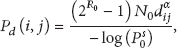
WirelessHART is considered to be the most promising industrial wireless sensor network protocol due to its safety and easier controlling. According to the information such as the location of nodes, the network manager can easily calculate the energy consumption for transmission between hops through the software tools, and then guides the WirelessHART system to find the optimal route based on it.
2.2. Network Topology and Routing
Based on the proposed graph routing topology structure, we consider several kinds of existing routing algorithms. Assume that node i needs to deliver data to the gateway and Ω denotes the possible set of routes; for a given route

In addition, the ELHFR algorithm proposed in [23] is committed to finding the next hop with the largest residual energy, which can balance the energy in the network. The cost function for node i can be given by

The link connectivity is forwarded to network manager regularly, and the link cost function is computed periodically according to the previous formulas. The calculation results will be broadcasted to all nodes in network updating. The focus of this paper is to find the best link cost function for choosing the next-hop node under the graph routing topology. So this strategy must make the maximum numbers of wireless data transmission, namely, the maximum network lifetime. In our study, the best link cost function can and only can be achieved when some important elements that will be introduced in the next part are specially considered.
3. JRMNL Algorithm
Since WirelessHART network adopts the hierarchical topology, the number of hops for a node to reach the gateway is the degree of the node, which is a fixed number. It is on this premise that studying the path selection criterion in each jump becomes very meaningful. Without considering the energy consumption for data processing and information broadcasting, the network lifetime can be expressed as the number of data forwarding to the gateway. For the path selection criterion, the residual energy and the energy consumption for transmission are clearly two determinants, but it is not enough. In the actual WirelessHART network, according to formula (1), the value of the minimum transmission power is fixed. If we only consider this factor, the best route will remain unchangeable; however, this is impossible and unreasonable.
WirelessHART network is a changing one, the harsh environment will lead to node failure at any time, and the node's remaining energy also changes all the way. Therefore, the best routing should also be changed all the way. In order to solve the load balancing problem in the changing network, we introduce the concept of the node communication load. Communication load refers to the communication frequency of nodes in a certain period of time, and it indicates the node's intensity of wireless communication. Obviously, nodes with the lower communication load should be preferentially selected. Therefore, we need to analyze the residual energy, the transmission power, and the node communication load and then enable them to be nonlinear combined into a composite cost function. The power exponents of three factors as well as their respective representative algorithms are as shown in Table 1.
Determinant features.

The joint routing algorithm for maximizing network lifetime JRMNL coalesces the node communication load, the residual energy, and the link transmission power together as a whole and chooses the optimal next hop by comparing the link cost function. The formation of the link cost function is divided into two steps, which are the calculation of node communication load factor and the nonlinear combination of the factor, the residual energy and the transmission power consumption.
3.1. Node Communication Load Factor
As the name implies, the node communication load factor reflects the communication frequency of nodes. The greater the load factor is, the higher the communication frequency is and the faster the energy consumption is. When the graph routing topology structure is established, the network manager will soon label all the nodes and links. The calculation process for load factor is as follows.
(1) Scan the topology step by step, and establish the link connection matrix
(2) Network manager regularly collects communication cycle 
(3) Calculate the link communication frequency matrix 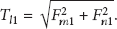
(4) Calculate the node communication load factor matrix 
3.2. Link Cost Function
(1) In this section, we will get the final link cost function by a nonlinear combination of the node communication load factor, the residual energy, and the transmitted power. In order to exactly reflect the importance of each part in the link cost function, on the basis of [21, 22, 26], this paper constructs the link cost function as follows:

(2) In actual WirelessHART network, when choosing the next hop a node could not ensure that all the three parameters of neighbors satisfy the above extreme at the same time, but the nonlinear combination of the three parameters can well balance their importance in routing. This setting can be confirmed by experimental verification in Section 4.2.
4. Simulation and Performance Evaluation
4.1. Simulation Parameters
Without considering retransmission and the energy consumption for data processing, we use MATLAB software to simulate JRMNL, ELHFR, and MPCR under the same conditions. According to the system and channel model built in Section 2, the detailed simulation parameters are listed in Table 2.
Simulation parameters.

4.2. Power Exponent Determination
(1) In our JRMNL routing algorithm, the link cost function plays a key role while the value of the power exponent is uncertain. In order to ensure the accuracy of the cost function in actual application, we should consider all of the energy loss, such as the energy wastage of the time synchronization, the data retransmission, information broadcasting, and the interference from the hostile environmental. However, as WirelessHART is commonly used in industrial automation field, it is difficult to form such a large network experimental platform. Therefore, simulation experiment can be carried out to replace the actual testing, as long as the measured parameters in the configuration can achieve the maximum consistency with our simulation platform.
According to Table 1, we assume that the value of
To simplify the experiment, we can fix the value of
Determinant definitional domain.

(2) Separately considering the residual energy or the power consumption as a cost function, some ready-made algorithms are available, such as ELHFR and MPCR. In order to further simplify the experiments, we can compare the network lifetime of ELHFR and MPCR algorithm under the same conditions. Specific experimental operation is as follows.
After building the layered graph routing topology, we randomly select the source nodes that need to find a path to the gateway and then use three kinds of routing algorithms for routing until all nodes in the network are running out of energy. In the actual WirelessHART network, due to the limited bandwidth resource and the real-time demand of data transmission, the number of sensor nodes is limited. Generally speaking, in the light of the perishing industrial application environment, the network permits 50 to 100 devices. Therefore, in our experiment, we choose up to 100 nodes [4]. Simulation is carried out based on 10 different network topologies with the same number of nodes, and the network lifetime is averaged over them, as is shown in Figure 2.

Network lifetime versus the number of nodes based on ELHFR and MPCR.
As can be seen from the figure, when the number of nodes is larger than 40, MPCR algorithm can extend the network lifetime by a factor of 2 relative to ELHFR algorithm. It shows that the energy consumption for transmission plays a more important role than the residual energy in the routing selection process. Therefore, in the link cost function, the value of
(3) Under the same simulation environment, we compare the simulation cases

Network lifetime versus the number of nodes based on JRMNL when
We can see from the figure that the difference between their network lifetimes is very small. When the number of nodes is larger than 50, the network lifetime when in case
4.3. Simulation Analysis
In the above experiments, a measure of the cost function in JRMNL is verified by the experiments on the accuracy of the values of the power exponents, and it is verified that JRMNL can maximize the network lifetime. Now, we will further study the advantages of JRMNL compared with other routing algorithms and the optimization between the network lifetime and the power consumption.
Finally, under the same simulation environment, we get the average energy consumption per route and the average network lifetime based on different N; in addition, we also get the average network lifetime of three algorithms under different throughput requirements, as shown in Figures 4, 5, and 6, respectively.
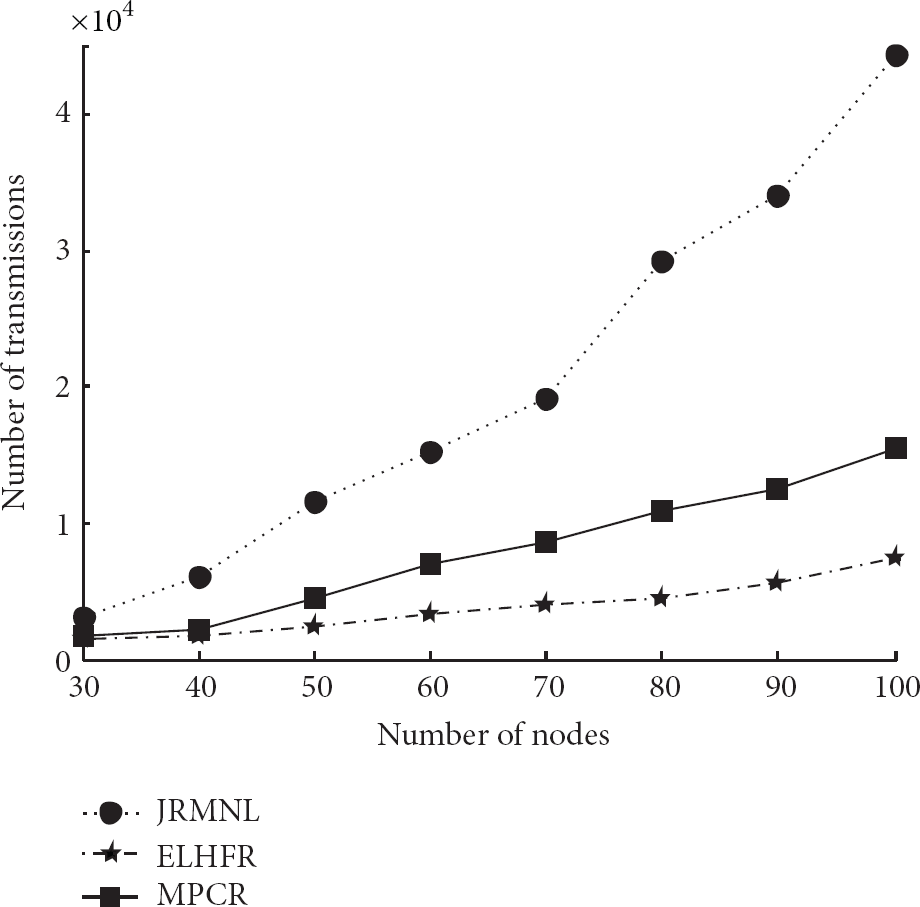
Network lifetime versus the number of nodes based on three routing algorithms.

Average transmission power per route versus the number of nodes based on three routing algorithms.

Network lifetime versus different desired throughputs based on three routing algorithms when
As can be seen from Figure 4, the network lifetimes all increase with the number of nodes. The proposed algorithm JRMNL can extend the network lifetime by a factor of 7 relative to ELHFR and prolong the network lifetime by a factor of 2 relative to MPCR. So MPCR algorithm has a greater impact on network lifetime than ELHFR, which also verifies the rationality of power exponent settings for the link cost function. Judging from the shape of the curve, with the further increase of network nodes, JRMNL will show a stronger advantage in the network lifetime.
Figure 5 depicts how the average energy consumption per route changes with the number of nodes. We can see that the average energy consumption per route decreases with the number of nodes in all the three algorithms. For JRMNL algorithm, the average energy consumption per route will increase by 2 dBm compared with MPCR and will decrease by 4 dBm compared with ELHFR. This implies that JRMNL algorithm is used to balance the residual energy and communication load at the expense of the minimum energy consumption. The maximum network lifetime and the minimum average transmit power per route are a pair of contradiction, so we cannot get the maximum network lifetime under the premise of the minimum energy consumption per route. When we focus on the improvement of the network lifetime, the best cost function is obtained at the expense of the energy consumption. However, from a global perspective, JRMNL can greatly improve the network lifetime and meet the practical WirelessHART application requirements.
Figure 6 depicts how the network lifetime changes with the desired throughputs based on three routing algorithms when
5. Conclusion
Aiming at the highly reliable WirelessHART protocol, this paper proposes a joint routing algorithm for maximizing network lifetime JRMNL. Based on the graph routing topology structure with high reliability, the algorithm builds a unique link cost function by a nonlinear combination of several parameters including the transmission power, communication load factor, and the residual energy of nodes. A node will select the optimal next hop by comparing the link cost function of all the possible links. JRMNL can greatly increase the network lifetime by 7 times and 2 times compared with ELHFR and MPCR, respectively. When the throughput is small the algorithm can also have a relatively longer network lifetime. In addition, since JRMNL takes into account a variety of important determiners, the average energy consumption per route is about 2 dBm larger than MPCR but is nearly 4 dBm smaller than ELHFR. Due to the particularity of the WirelessHART protocol, the combination of the optimal routing and the link scheduling will be an interesting issue and is worthy of further study.
Footnotes
Acknowledgments
This research was supported by the National Science and Technology Major Project of the Ministry of Science and Technology of China (2011ZX03004-001-01) and was under the Modern Communication Team support program supervised by Shenzhen Key Laboratory for Information Science and Technology in Tsinghua University.