




Abstract
Application of the technology systems is growing in various fields and the agriculture is not an exception. Agriculture is also reaping the benefits of technological innovation which helps in quantitative and qualitative food production. Vertical farm, one of the agricultural practices, is considered to be the future of agriculture with the rate of population migrating into urban areas. Ubiquitous computing in agriculture is emerging remarkably in this fast processing pervasive environment, owing to wireless sensor network (WSN). Building a context aware system for the vertical farm is complex without the semantic interoperability between the Internet of things (IOT). In this paper, we propose a vertical farm ontology (VFO), an OWL based ontology model which helps in more understanding of the relationship between the domain factors. With the proposed model, the information from the Internet of things is recomposed as context information and made understandable for the other systems. For the sake of agriculture, we hope that our proposed model will pave great path for the development of smart and intelligent agricultural services.
1. Introduction
Recently, ubiquitous computing technology has been flourishing widely in agricultural field [1]. Some of the progresses in this area include automation process on the u-agriculture and smart services to control the activities. Such advancement in the ubiquitous computing encourages the agricultural researchers and even farmers to apply automation in the process.
Agriculture is a fundamental human activity and also inseparable from human life. As per the history, human started cultivating crop around 10,000 years ago, also referred as the Neolithic Age [2]. Starting from using simple tools such as stick and stones to advanced wireless computing technology, the development agricultural technology has major contribution [3]. Agriculture technique takes different form of advancement through centuries according to the lifestyle of the people. It is also estimated that 80% of the world population is expected to live in the urban areas by 2050. Also the rapid increase in population may be a threat to farmland [4]. For the future agriculture, existing indoor cultivation method is improved with the expert engineering and termed as vertical farming. Vertical farming is already in practice in many countries. Currently, vertical farms are rapidly evolving in the large-scale production of variety of crops in the urban centres [5].
Vertical farming is a fully automated system without any human intervention, which is also considered as the new agricultural evolution. To serve as ubiquitous computing infrastructure, it needs to be aware of the context and provide appropriate data and services. Considering the situation of the large-scale farming system like vertical farming in real time, the system is independent of each other. Context-aware service is being realized between the system by using the set of common ontology that supports the communication and the relationship.
In this paper, we propose an OWL based ontology model for the vertical farming environment. The suggested model concentrates more on the controlling and monitoring services of the environment. An upper-class ontology model is designed by identifying the important concepts in the vertical farm environment that focuses majorly on the services. The model is designed in a way that can be improvised further according to the needs and requirements without starting from scratch.
2. Background Study
This section represents the background work of the proposed ontology. First, we have discussed about the vertical farming which has both technological and expert engineering that makes a perfect combination for the ubiquitous computing environment. Next, OWL based ontology model is briefly discussed which is considered to be well suited for the development of semantic interoperability and finally the related works that helped in the development of context model.
2.1. Ubiquitous in Vertical Farming Overview
Vertical farming is considered as one of the modern agricultural technique in the future urban area, in where most of the people are expected to live [5]. Agricultural farming took different forms over the millennium since the invention of agriculture in stone ages to which it finally reached the vertical farming. And it may take different dimensions in the future, as the technologies are evolving nonstop. Computer technology during the last decade has numerous changes in the many fields. Looking back the evolution of the computer, in the early ages, the mainframe era was made a big evolution in which only expert accessed the computer. But today, the popular devices as laptops, tablets and Smartphone are owned and accessed by all ages. The third wave of computing (ubiquitous computing) is already upon us, leading to the departure of mainframe and personal computer [6].
As per the recent study [7], the paradigm shift is evidently occurring from personal to ubiquitous computing in which the evolution of the data-centric application encapsulates the data environment to ontology based application with automated reasoning capabilities [8]. Weiser [9] articulated the term “ubiquitous” which meant “everywhere” and defined many of its attributes. One of the goals of ubiquitous computing is to enable devices to sense changes in their environment and to automatically adapt and act based on these changes and preferences.
2.2. OWL
OWL is the ontology representation language which helps in the process of context information instead of presenting the information. Basic OWL ontology concept include classes representing domain concepts, properties of classes, and individual instances specified from classes. Ontology is referred to as the shared understanding of some domains, which is often conceived as a set of entities, relations, functions, axioms, and instances.
The reason for choosing OWL is to realize our context model and define our context model as follows. It is much expressive compared to other ontology languages. It has the capability of supporting semantic interoperability to exchange and share context knowledge between different systems. The context can be exchanged and understood between the systems in various domains.
2.3. Related Work
The gust of third wave computing has made a great evolution of computer in the past few years. Since the introduction of first context aware application “Active Badge Location System” by Want et al., [10] that used an infrared based system to determine a user's current location that helped to forward phone call to the close user. Many such research focused on finding the user's location and identifying the current situation [11–13]. Although many definitions were proposed for the term “context,” the most appropriate definition was given by Dey and Abowd [14].
Prekop and Burnett [15] proposed two dimensions of contexts such as external and internal context. The external context is the context that is measured by hardware sensors that is, location, temperature, or light. The internal context refers to the user's goal, task, or work. In this modern world, the sensors have become a part of human life. To add value to the day today life, the sensors along wireless sensor network have made human life easier. The interest in wireless sensor network has increased considerably. Although the wireless sensor network was used in the military purpose, recently it is used in various fields such as health monitoring, transportation, smart home, habitat monitoring and agriculture [16].
Extensive usage of WSN has developed the interest in routing protocols. WSN is available everywhere, but it is impossible that there is a common routing protocol for all the application. Many survey has been undergone in the routing technique of wireless sensor network and classified according to Location-based, Data-centric based, Hierarchical based, Multipath based and QoS-based protocols [17]. With many kinds of routing protocol in practice, the recent researches [18, 19] have been focused on the major concern, which is the energy awareness.
The u-agriculture or intelligent agriculture is one of the applications of Internet of things (WSN). Zigbee standards in the wireless sensor network are recognised as the authoritative standards of agricultural environment [20]. Zigbee uses wireless mesh protocol for wireless control and monitoring, and is well known for long-lived battery and high reliability with a low cost and low power. Many studies have been undergone in the u-agriculture focusing mainly on the monitoring and automatic process controlling. Cho et al. [21] explain the service based system workflow model of agriculture with a situation context information. Hwang et al. [22] depict the monitoring service of the greenhouse through the wireless sensor network. Similarly, a real-time “field area” monitoring service in agricultural field was successfully created by Mizoguchi et al. [23]. In [24], Hwang and Yoe focuse one the importance of wireless sensor network in the context aware middleware of the greenhouse environment. Many real-time and prototypic implementations have been performed on ubiquitous agriculture [25–27].
Most of the researches in ubiquitous agriculture are service based automation. In the large-scale environment like vertical farming, the common understanding of the structure of information among the system is more important for a flawless automation. The context model which helps to fulfill such need is ontology which is termed as “formal, explicit specification of a shared conceptualisation” [28]. Ontology is a widely accepted tool for the modelling of context information in pervasive computing and also considered to be advantages over the other modelling techniques [29]. The OWL is part of the growing stack of W3C recommendation related to the semantic web. As semantic web is considered to be the future of web, OWL based ontology is widely used in the applications.
Many researches have been undergone in the vertical farm context modelling based on the OWL Ontology, in which Kim et al. [30] explains the situation categorization and its services relationship through OWL based on RDF. As it is in the beginning stage, many such research and development are expected.
3. Vertical Farm Ontology
Vertical farm ontology (VFO) is designed focusing on the service based vertical farm without any human intervention. The ontology model is designed using OWL based on RDF and implemented in Protégé 4.2.
In this fast evolving world of technologies, the model needs to be developed considering the future evolution. In our paper, we built a domain-specific model which is extensible. The first step handled in designing the model is by identifying the concepts of the environment. The concepts are physical or conceptual objects in the domain. For example, let us consider the vertical farm environment. As vertical farm is a large-scale production environment with optimal growth condition regardless of time and season. Although there are many designs available in vertical famring, we have used one of Bluke Kurasek design [31] for better understanding. As shown in Figure 1, we are left with many question.

Vertical farm environment.
By answering each question and analyzing the common dependency among the domain, the major classes are identified and structured as set of concepts. The concepts are context, devices, service, environment, network, location, and user. Figure 2 shows the upper ontology of the VFO which can be extended according to the domain of interest.
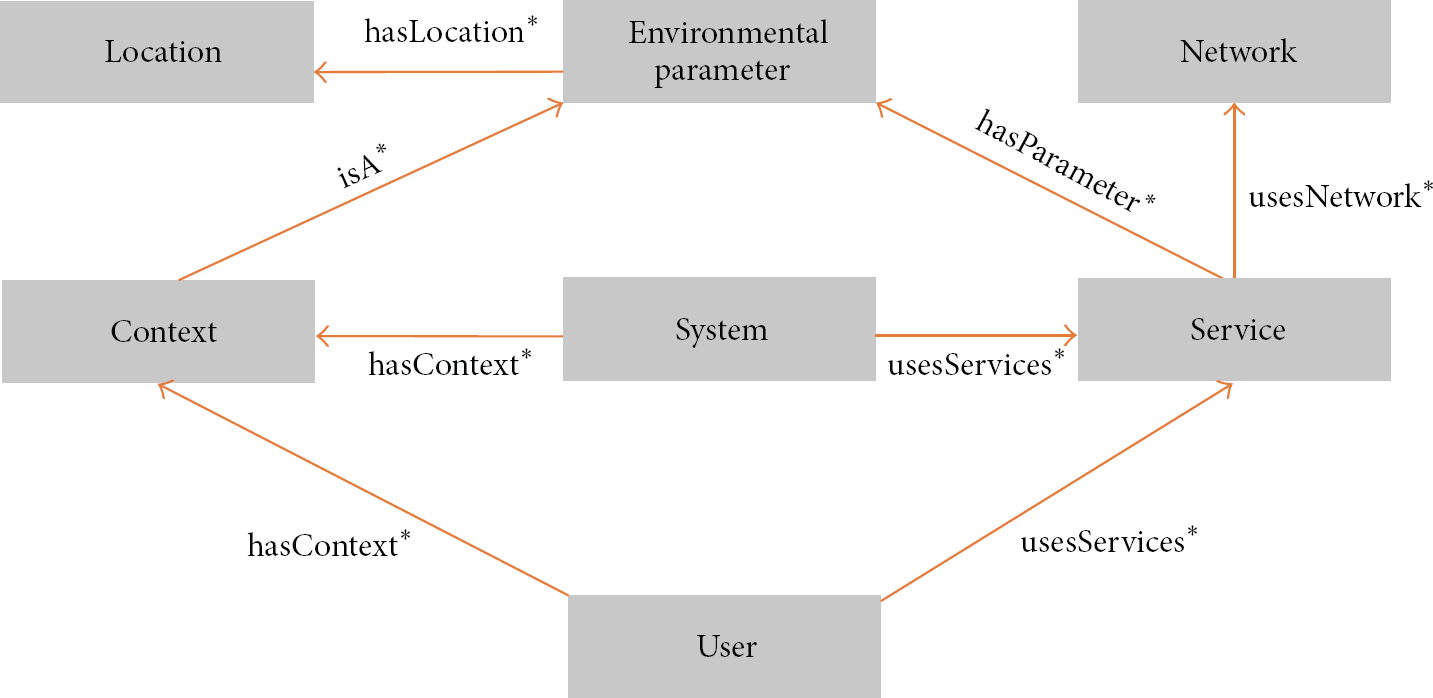
Upper-level model of VFO.
In the next subsections, each of the concepts is distinctly presented and explained.
3.1. Context Concept
Context is an often noted notion in the ubiquitous environment. Although context has various definitions, Dey and Abowd [14] definition was considered to be more accurate. Context awareness adds much to the dynamicity of the systems as their behavior varies depending on circumstances. Context aware systems are well known for their adaptability to the current context without any human intervention. The context information is mostly derived from sensors through a proper channel wireless sensor network. In VFO model, the context holds the set environmental parameter of a single location with a scheduled interval time. Also, an instance of the context class can be associated with a user in a time. The environmental parameter such as temperature, humidity, CO2, and light as a context element, associated with appropriate control equipment, can range from specific sector, floor, or building. Thus, the location is interrelated with the context related concepts.
3.2. User Concept
Vertical farm environment is entirely automated environment with intelligent services such as monitoring and controlling services. The user concept makes use of such smart services. The context information obtained from time to time are monitored by the User. Although the control services are automatic, in case of emergency or necessity, the user can manually access the control services. Figure 3 depicts the user concept on VFO. In the vertical farm environment, the user can also be represented as person who has access to the services such as administrator, researcher, and system manager.

User concept.
3.3. Environmental Parameter Concept
For a healthy crop growth, an optimal environmental condition is needed. The environmental condition information is very important to control the most appropriate devices. The parameters are useful to express the functionality of both devices and services. Internet of things acts as the bridge between the physical objects such as place, person, or device which is known as “things”. IOT consist of set of heterogeneous set of devices which are uniformly discoverable, closely integrated with the Internet infrastructure and service, regardless of the devices (RFID, sensor, or embedded devices). Presently, IOT is considered as the ideal emerging technology to influence the domain by providing new evolving data and the required computational resources for creating revolutionary apps [32]. In VFO, the autonomous services are achieved through the sensors and actuators. Sensors are directly related to the environmental parameter, from which the values are sent to the server via Wireless communication protocol (Zigbee). The actuators are indirectly linked to the parameter. Actuator controls the control equipment such as air conditioner, heater, window, humidifier, and light. The result in the variation of environmental parameter affects the actuator to maintain the optimal condition through controlling the equipment.
As we mention environmental parameter, it includes both the indoor and outdoor environmental conditions. Although the indoor factor plays major role, the outdoor factors are not to be omitted. According to the daily weather condition, the environment parameter needs to be manipulated and processed. Factors such as season, daily weather, and day-night atmospheric differences are also taken into account for the more appropriate growth condition. As for the indoor parameter, the atmospheric condition and the soil condition (can also referred as soil nutrient) are given major concern. Figure 4 represents the overview of the environmental parameter concept.

Environmental Parameter Concept.
3.4. Service Concept
VFO model is designed focusing on the service based environment. The two main services that revolve around the vertical farm automation monitoring and controlling services. The controlling service helps the control equipment to be controlled through the actuator node. Figure 5 shows the service concept and its relation with the other concepts.

Service concept.
3.5. Network Concept
In this pervasive environment, the communication is most important factor that cannot be ignored. Not to mention, the WSN is overwhelming all over the world. The sensor uses the wireless communication protocol to deliver the parameter to the server. The wireless technology used in the vertical farm environment is Zigbee technique, which uses the frequency of 2.4 GHz. The programmable logic controller (PLC) which is the wired communication protocol helps in controlling the control equipment. Figure 6 depicts the network concept used in the VFO model.

Network Concept.
3.6. Location Concept
The main concept of vertical farm is to produce maximum amount of crop production with optimal condition, even in the middle of the urban area. Hence the skyscrapers have much number of floors with variety of crops in it. As each crop is distinct, each needs a different environmental condition. Therefore, keeping a track of the crop and its location is much more important. The environmental parameter of the corresponding sector should be maintained properly so as to control the equipment of the above required sector. Figure 7 shows the overlook of location concept.
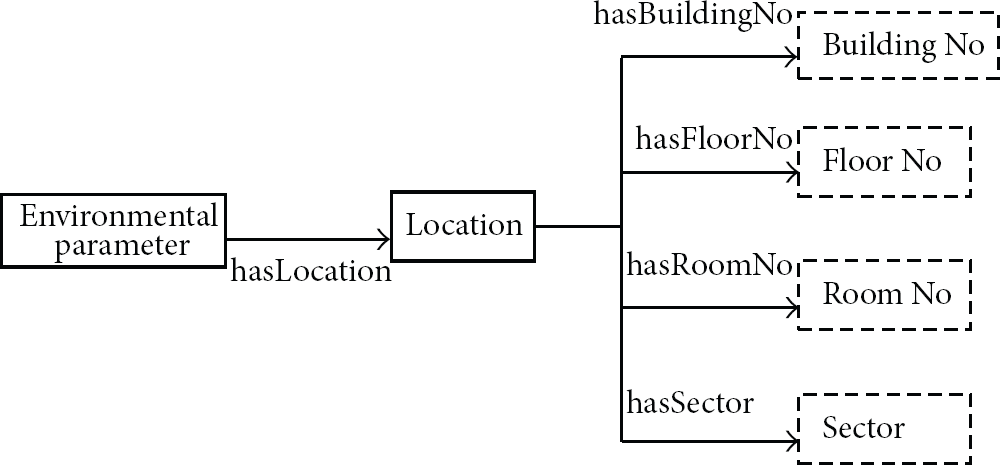
Location concept.
3.7. System Concept
The system concept is commonly divided into devices and control Equipment. The concept is classified on the basis of their services. The devices that are categorized in the VFO model are computer and the so called smart devices which are sensors and actuators. As discussed in the environmental parameter concept, the sensor returns certain parameters and actuator performs the control actions. The sensed data from the each sensor are transferred to the sink node through the wireless sensor network. The control equipment are air conditioner, humidifier, CO2 generator, light, irrigator, and window. Figure 8 shows the underlying relationship of the system concept.

System Concept.
4. Experiment and Results
In this section, we present the implemented part of our VFO model. According to Hendrickson and Indulska, efficient use of context model needs careful planning; therefore, careful planning was done before the implementation. In our model, we have domain named class context where all the context information is gathered. In vertical farm environment, the set of environmental parameter and the location of the particular factor is considered to be more important. Figure 9 shows the high level context information and the relationship of the particular scenario. It indicates that the temperature in the sector B12 is 22 degree Celsius. As we know the OWL based ontology is interrelated. The location of the sector B12 is in Building no. A01, Floor no. 3, and Room no. 302. The relationships between the type of crop, location of the crop, and the temperature of the environment are all well defined to form an appropriate context.
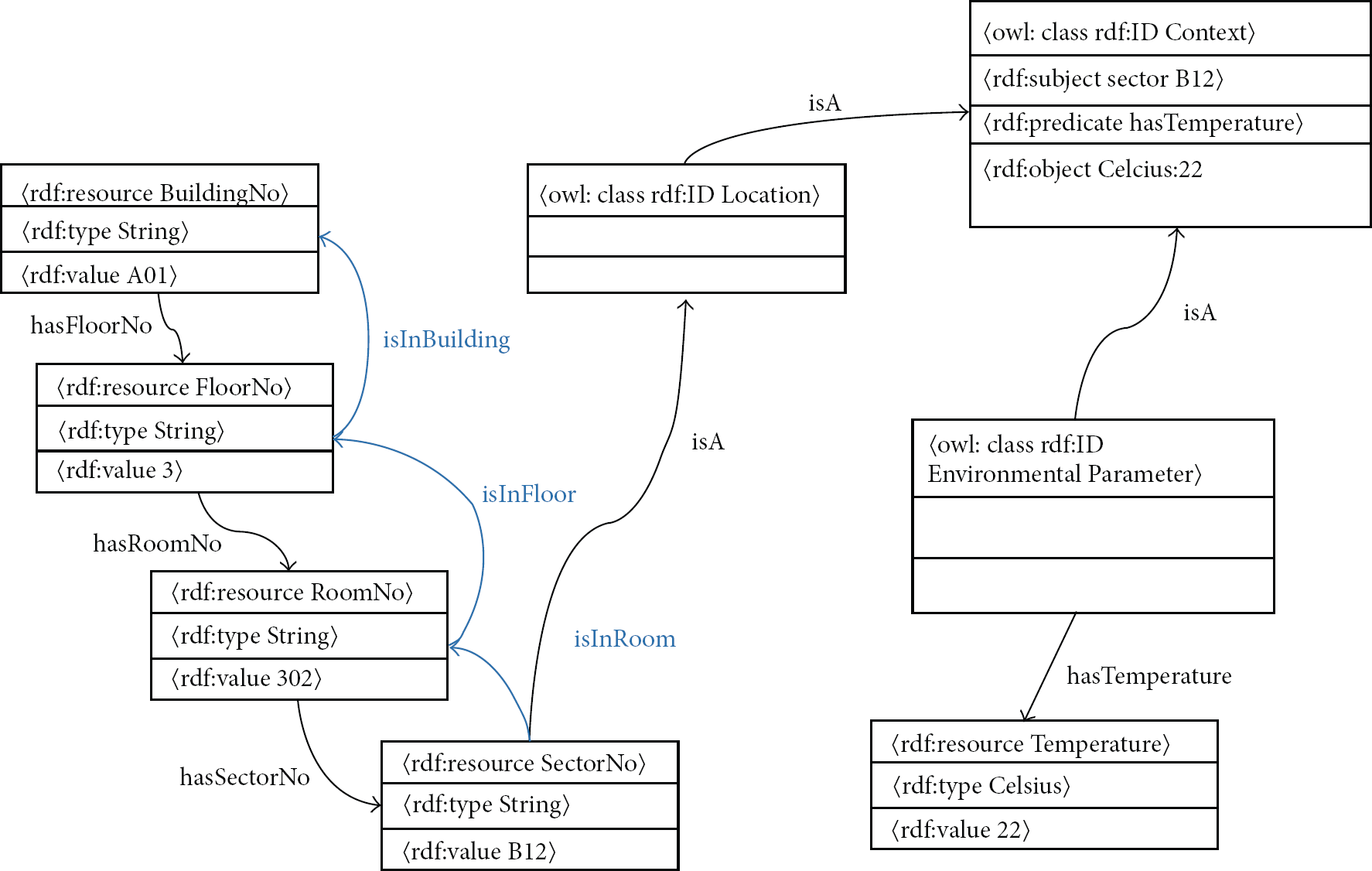
High level context information.
Various devices such as sensor, actuator, and control equipment were installed in the vertical farming prototype to examine the monitoring and control services. Figure 10 shows GUI application of the monitoring service where the context information is gathered and displayed.
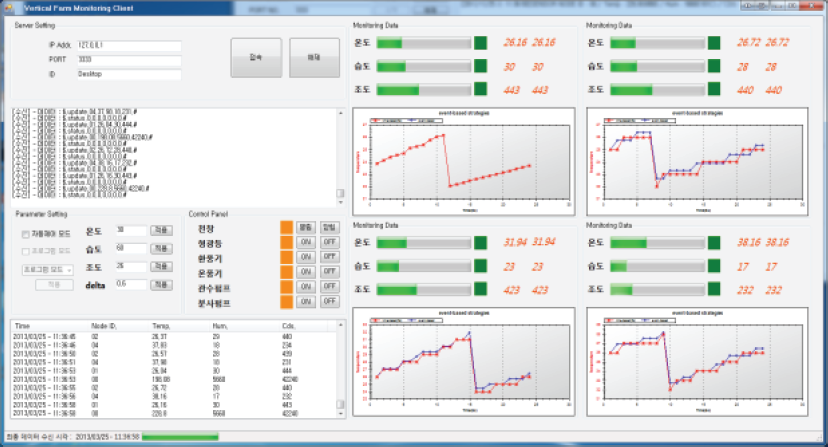
Vertical farm monitoring client.
The sensed data are updated in the monitoring client on a regular time interval. Both the time-based and event-based readings are graphed for the comparison. The readings are taken from a single port ID, in other words, from a particular sector of the vertical farm. Each sector has different crop, which is mapped well to compare and monitor the crop's optimal growth environment.
A detailed middleware response of sensed data is presented in Figure 11. As the wireless sensor network has number of sensors, each node of sensor with a unique node value sends the sensed value to the sink, where the mapped devices are found.

Vertical farm middleware.
The entire controlling service is performed automatically without any human intervention. The process is based on the following step.
The sensed data from the sensor such as temperature sensor, humidity sensor or light sensor are sent to the sink (wireless sensor node) through the wireless communication protocol. The sensed values are stored in the server database. The values are then sent to the actuator through the wired communication protocol. PLC decides on the action after analyzing the values for the corresponding crop. The control action is performed on the corresponding control equipment to maintain the optimal condition in the environment.
5. Conclusion and Future Works
Recently, researchers are willing to make computing services smarter [33–35]. In this paper, we presented vertical farm ontology (VFO) for the future agriculture evolutionary environment. The suggested context model uses OWL based ontology to define common understanding and relationship between the system and services. The upper level ontology is analyzed and derived with the set of concepts such as location, user, system, context, environmental parameter, user, and Network. The basic concepts proposed can be reused and extended for the agricultural based smart environments.
With the gained experience from the prototype implementation, our VFO model and the concept will be more refined according to the domain-specific environment. By doing this, it may serve as a very helpful to develop agricultural service automation and smart service application in the agricultural environment.
Footnotes
Conflict of Interests
The authors declare that there is no conflict of interests regarding the publication of this paper.
Acknowledgment
This research was supported by the Ministry of Science, ICT and Future Planning (MSIP), Korea, under the Convergence Information Technology Research Center (CITRC) support program (NIPA-2013-H0401-13-2008) supervised by the National IT Industry Promotion Agency (NIPA).