




Abstract
This paper formulates an analytical model of energy dissipation in cluster-based wireless sensor networks for network connectivity. The proposed model constructs the analytic expression for the optimal cluster size for minimum energy dissipation. The same model is then applied to control the cluster size which is defined as number of nodes connected to a node (node degree) through transmission power control. The proposed approach constrains the cluster size through node's degree so that all cluster heads maintain a minimum node degree for network connectivity. The simulation results show the total energy dissipation in the network with respect to node's degree, and when cluster heads' degree is above a certain value (threshold), the network remains connected at many more rounds during the network operation.
1. Introduction
One of the main design considerations in cluster-based wireless sensor networks is cluster head election and cluster formation. A cluster size with a large number of member nodes leads to a small number of clusters in the network improving the efficiency of intercluster communication. On the other hand, cluster size with a small number of member nodes leads to increased number of clusters in the network which requires a backbone with a large number of cluster heads and gateways (cluster member linking two different cluster heads) to route the packet for inter-cluster communications [1]. Energy efficiency of clustering protocols can be considered through two different approaches which are the number of clusters formed or the number of members per clusters (cluster size). In context of cluster-based topology, cluster size is related to number of neighbours connected to a cluster head which is defined as node degree and can be referred to as the number of member nodes per cluster. Most of the existing methods control the cluster size with admission or rejection policies during the cluster formation which can be based on the strongest received signal strength [2]. Our proposed method of controlling the number of members per cluster is through transmission power control algorithm [3].
This paper considers the fundamental question of what is the cluster size that gives minimum energy dissipation while maintaining network connectivity. Connectivity can be determined by number of neighbours a node has (node degree) [4]. Node degree is a local property that can be checked by each node to achieve global network property such as connectivity [5]. Connectivity is an important property in wireless sensor networks that enables data to be forwarded or exchanged between nodes in the network. Nodes can cooperate among themselves to route each others' data packets if there exists a path between any two pairs of nodes. Connectivity depends on the number of nodes per unit area and their transmission range. The correct setting of nodes' transmission range is an important consideration for network lifetime [6]. By increasing the transmission power of a node, more nodes can be reached via direct link. Increasing the transmission range can improve connectivity but on the other hand can lead to higher interference, more data collision, and higher energy consumption [7]. Reducing to low transmission power may result in some nodes getting isolated without having any link to other nodes. Connectivity in terms of node degree has been studied by [4, 8, 9]. Node degree is also regarded as one of the important and convenient metrics to measure connectivity of wireless ad hoc networks [10, 11]. It has been shown that the average node degree for an almost fully connected random network of node located randomly using uniform distribution is in the range of 6 to 10 [8]. The results have also been derived to show that to obtain a connected network it is only necessary to keep the average node degree to a certain value [8]. It has been further shown that, for increasing number of nodes in the network, it is essential to have node degree of
In this paper we work on the fundamental questions of the cluster size that gives minimum energy dissipation while maintaining network connectivity. Cluster size can be the basis for connectivity by implementing minimum constraint to node degree. First we propose to formulate an analytical model of energy dissipation in the network for different cluster sizes. Then we make use of the result from [4] where we take a node degree threshold of
The remainder of the paper is organized as follows: Section 2 describes the related works on clustering process. Section 3 describes the analytical formulation of energy dissipation for connected sensor networks. The simulation results are presented in Sections 4 and 5 concludes the paper.
2. Related Works
The aim of cluster formation in LEACH is to have k number of clusters per round. The LEACH protocol determines the optimal value of k, which is a system parameter, using the communication energy model based on radio energy dissipation model as in [12]. The research work derived the total energy consumption for transmitting l-bit message at a distance d for a frame and is given by the following:


Average energy dissipated per round in LEACH as the number of clusters is varied between 1 and 11. This graph shows that LEACH is the most energy efficient when there are between 3 and 5 clusters in the 100-node network, as predicted by the analysis [12].
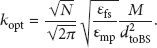
The number of neighbors connected to a node or a cluster head (node degree) can be obtained during the clustering process. A fix transmission power or dynamic controlled power levels can associate cluster heads with a number of fully connected nodes. As stated earlier, node degree can be considered as an essential criterion for obtaining connectivity in the network. From this standpoint, we proposed to formulate an analytical model for node degree (Q) to show the energy dissipation as a function of node degree using the same radio energy dissipation model as illustrated in [12].
In wireless sensor networks, adaptive clustering for data routing is well explored as they have been shown to improve network lifetime [13]. Nodes are grouped into clusters with a probability that some nodes become cluster heads and the rest becomes member of clusters. The role of the cluster heads is rotated among the nodes in the network to balance the energy consumption [14]. The aim of clustering in multihop is to have balanced workload among all the nodes in the network by having different cluster sizes [15–17]. However, the effect of different cluster sizes to connectivity is yet to be explored as an important consideration for an efficient intercluster communication. In most recent clustering algorithms the connectivity is usually measured through nodes transmission range and not in terms of node degree [18, 19]. In HEED [18], to ensure multi-hop communications among cluster heads, the selected transmission range among cluster heads varies to ensure connectivity. A sufficiently large network is divided into cells, where each cell is of size
The results in EECS [15] propose clustering with reduced transmission range and try to balance the energy of cluster heads by justifying the cluster size. Since the energy consumed by cluster heads is dependent on the distances between cluster heads and the base station, cluster heads located farther from the base station have smaller cluster size compared to cluster heads located closer to the base station. The cluster head election phase has no iteration and is different from HEED. During the election phase candidate nodes broadcast their candidacy using a reduced transmission range where they need to adjust their transmission range to
3. Energy Dissipation for Connected Sensor Networks
In the network model assumed in recent literature, nodes can join a cluster after the cluster heads election based on strongest signal strength, node degree, or distance of cluster heads to base station [12, 16–18]. During cluster formation if the cluster heads do not maintain a certain cluster head degree, the connectivity of the network may be lost. The connectivity depends mainly on the number of nodes per unit area and their radio transmission range. Our goals in this paper are that (1) small node degree will result in reduced average distance between cluster members to cluster heads and vice versa, (2) connectivity can be conserved by maintaining cluster head degree to certain value, (3) controlling the node degree we can create both equal and unequal cluster sizes, and (4) addressing the question of whether or not the network connectivity can be achieved at minimum energy dissipation.
3.1. Energy Dissipation Model with respect to Node Degree
The simplified radio model is used from [12]. Both energies dissipated in cluster heads in a single frame is related to energy spent receiving from members, that is, cluster head degree (Q), aggregating data and sending the aggregated data to base station [12, 22]. We define Q as the number of neighbours connected a node (node degree), so in a cluster there will be
The area occupied by each cluster is





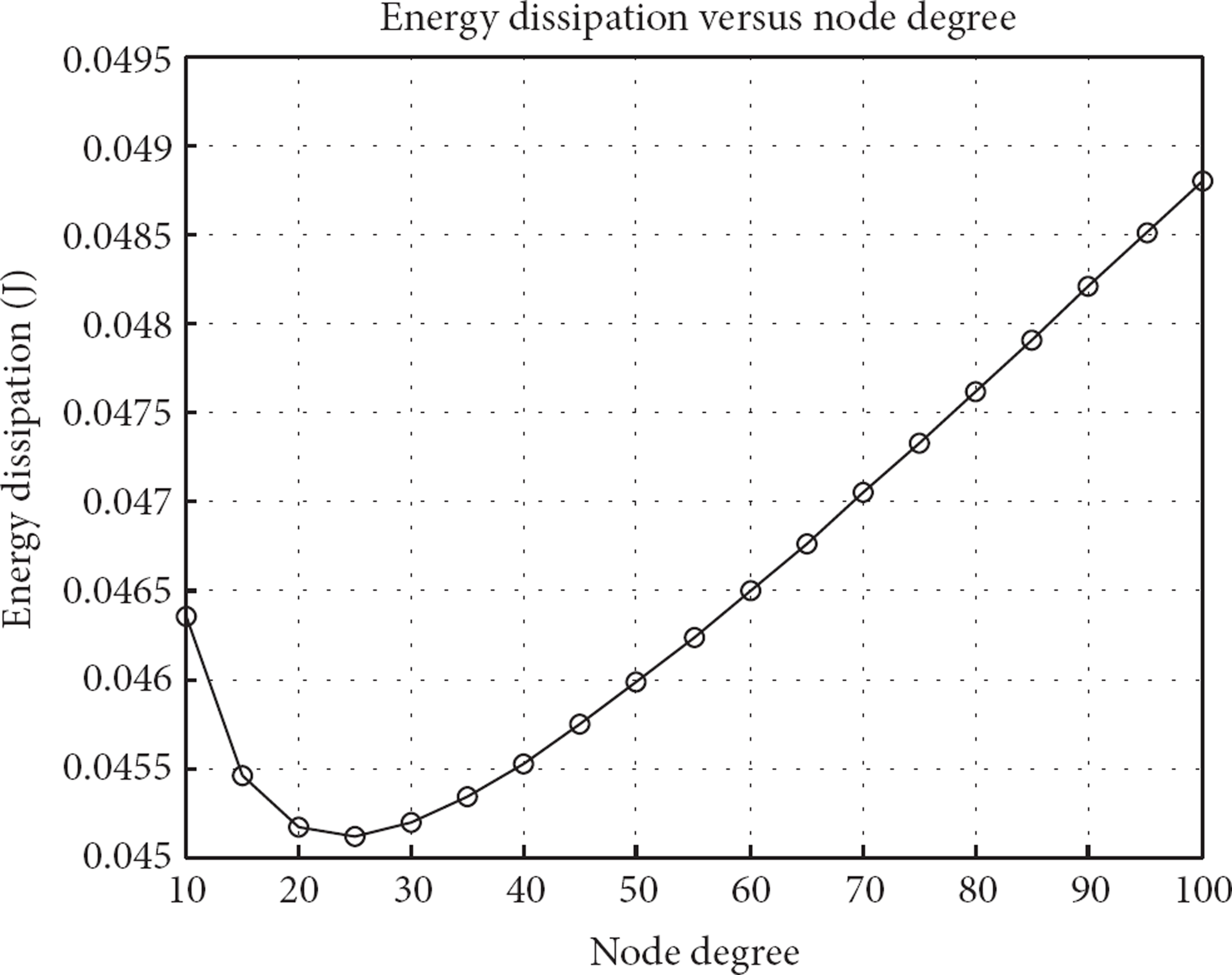
Energy dissipation per round with different node degrees for 100-node network.
We further simulate the energy dissipation for 200 nodes in the network as in Figure 3. It shows that minimum energy dissipation occurs when node degree is between 30 and 40.

Energy dissipation per round with different node degrees for 200-node network.
We developed here an analytical formulation to show energy efficiency of our previously proposed algorithm (TCAC) [3] which constructs cluster within the minimum cluster size to ensure network connectivity. TCAC clustering algorithm consists of three phases: a Periodical Update, Cluster Head Election, and Cluster Formation as shown in Figure 4.

Periodical Update, Cluster Head Election, and Cluster Formation phases.
The pseudocode of the algorithm is as shown in Pseudocode 1.
Pseudocode 1
3.1.1. Description of Cluster Heads Election
The cluster heads election is an important process for any clustering algorithms because it determines how the overall energy is dissipated in the network. A node calculates its probability


3.1.2. Description of Cluster Formation
Once cluster heads are elected, membership association takes place for noncluster heads nodes. The cluster formation is described as follows: once nodes are elected as cluster heads they send cluster head messages, CHMSG. The noncluster head nodes receiving the message will acknowledge a CHMSG message by sending a request message, REQMSG, containing its ID to the cluster heads. Noncluster heads nodes that do not receive any cluster head message will send request message across the network after timeout expires. A cluster head can receive multiple requests. Once the cluster head receives the requests it will rank the requests based on received signal strengths and store them in a priority list with the following priority structure (ID, Rank). The node with strongest signal strength is ranked with the highest priority. The cluster head then broadcasts the priority list to all nodes requesting to join its cluster. The priority mechanism indicates two important features: (1) nodes know how close they are to the cluster head relative to all the nodes requesting to join the same cluster, (2) the importance of a node to a cluster head which does not necessarily implies that it is the closest to cluster head, but a node may join a cluster to fulfill the degree threshold of the cluster heads. From the list, noncluster head nodes calculate the degree of each cluster head. Nodes join a cluster to achieve the
4. Simulation Results
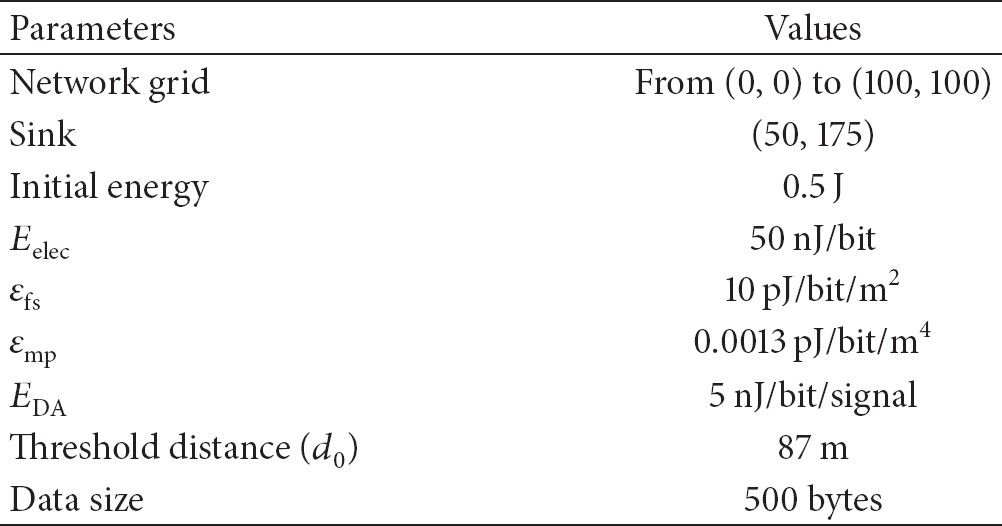
Simulations are carried out to evaluate the proposed algorithm for its energy efficiency. The nodes are placed according to uniform distribution in an area of dimension
Simulation parameters.
In the simulation we measure lifetime in terms of number of rounds when the first node dies. We set the optimal number of cluster head
4.1. Network Connectivity Performance Comparison
We conducted experiments comparing HEED, EECS, and TCAC algorithm. We set

The average rounds when cluster heads maintain degree above
4.2. Network Lifetime
We have conducted simulation experiments to compare the network lifetime of TCAC algorithm with LEACH, EECS, and HEED where network lifetime is measured as the time elapsed until the first node dies. In this simulation the network lifetime is expressed as number of rounds until the death of first node. It can be observed from the results in Figure 6 that the TCAC algorithm runs for more rounds than the other three algorithms. The energy loss per round in the TCAC algorithm is less than others causing network to run for a longer time. The energy consumption is dependent on how many nodes are connected to cluster heads. The TCAC algorithm ensures there are cluster heads elected at every round covering all nodes, and there will not be any single-node clusters. The simulation results also show a small variation in the number of cluster heads elected per round which is in contrast with other algorithm. The TCAC algorithm also allows dynamically the control of node degree to ensure connectivity.

The network lifetime for HEED, LEACH, EECS, and TCAC.
5. Conclusion
This paper has presented an analytical model of energy dissipation with respect to cluster size. The proposed model considers the number of nodes connected neighbors to a cluster head to form a connected network while extending the network lifetime. When each cluster maintains a degree above certain value, the network remains connected on every round of the operation. We have shown analytically and through simulation that the lowest energy dissipation takes place when the node degree is in the range of 20 to 30 for 100 nodes in the network. The optimal degree ensures network connectivity as well as prolonging lifetime which are important design considerations in wireless sensor networks.
Footnotes
Acknowledgment
This work is financially sponsored by Yayasan Khazanah a foundation established by Khazanah National Berhad.