




Abstract
This paper proposes a noncoherent spectrum sensing scheme for the cognitive coexistent heterogeneous networks with the assistance of geolocation information of primary and secondary nodes. Different from the conventional networks with single secondary network, the spectrum sensing scheme in the coexistence scenario should not only detect the primary signal but also detect the secondary signals to avoid the interference with both the primary network and the operating coexistent secondary networks. Therefore, the sensing scheme in this case should be able to differentiate the primary signal from each kind of the secondary signals. However, in the coexistent heterogeneous scenarios, the secondary signals may exploit different PHY modes (some of them may be the same as the primary PHY mode), which imposes difficulties in the coherent signal detection schemes. Aiming to tackle this problem, the parallel detection of both primary signal and each kind of secondary signals is implemented through a proposed noncoherent power decomposition scheme. In this scheme, the power decomposition is formulated into a problem of solving a nonhomogeneous linear equation matrix. During the signal detection, the characteristics of both primary and secondary signals are not required. Both the analysis and the simulation results show the feasibility and efficiency of the proposed scheme.
1. Introduction
With the rapid growth of the wireless applications, more and more wireless spectrum bands are demanded. However, the wireless spectrum resources have almost been allocated to special applications. This results in the problem between the growing demand and the limited supply of the spectrum. On the other hand, measurements on different cities all over the world show that most of the allocated spectra are significantly underutilized for different locations and times [1, 2]. Cognitive radio is considered as one of the most promising techniques to provide the dynamic spectrum access for the unlicensed users, that is, secondary users (SUs), on the under-utilized licensed frequency bands when the licensed users, that is, the primary users (PUs), are not using them at a specific location and a specific time period [3].
One can envision that multiple heterogeneous secondary networks will try to utilize the same spectrum holes in the licensed frequency band due to the lack of coordination. In this case, packets collision and the interference cannot be avoided. Therefore, in addition to the coexistence between the primary network and the secondary networks, the coexistence mechanism among the secondary networks should also be considered in order to prevent the performance degradation due to the harmful interference. A lot of effort has been put into the creation of such a coexistence mechanism. For example, the IEEE 802.19.1 Task Group (TG) has been created to develop high level radio-technology-independent standard for coexistence in the TV white spaces (TVWS) [4]. The open access of TVWS has motivated several standardization efforts such as IEEE 802.22, IEEE 802.11af, the European Computer Manufacturers Association (ECMA) Technical Committee 48 Task Group 1 (TC48-TG1), to develop the PHY and MAC standards to support the operation in this band. Obviously, such coexistent different standard-compliant devices lead to the heterogeneity. Heterogeneity and coexistence are the characteristics of all the open access frequency bands not unique to the TVWS. The coexistence of heterogeneous secondary networks coupled with the PUs protection poses new and subtle challenges to the cognitive coexistent heterogeneous networks.
We can mainly classify the coexistence issues into two categories: (1) detection of available spectrum bands to protect the PUs and mitigate the interference among SUs and (2) spectrum sharing among the overlapped secondary networks to achieve better Quality of Service (QoS). The former one can be implemented by spectrum sensing or database indicating the availability of each channel. The latter one can be implemented by many coexistent mechanisms such as the Transmission Power Control (TPC) [5], Dynamic Frequency Selection (DFS) [6], Time-Division Multiple Access (TDMA), and Code-Division Multiple Access (CDMA).
The objective of this paper is to present a spectrum sensing scheme for the cognitive coexistent heterogeneous networks. Different from the traditional spectrum sensing schemes which only detect the primary signal, the proposed sensing scheme with the assistance of geolocation information is able to detect both the primary signal and the coexistent secondary signals simultaneously. The detection of primary signal refers to identifying the available spectrum to prevent causing interference to the licensed PUs. The detection of secondary signals can be used to enable optimized decisions for spectrum sharing, especially for TPC and DFS. Specifically, the proposed scheme has the following features.
It can differentiate the primary signal and each kind of secondary signals individually. Therefore, such signals can be detected simultaneously. The strength of the secondary signals operating in the adjacent channels can be obtained so that they can be subtracted from the total collected energy when constructing the test statistic at each sensor. As a result, the noise uncertainty range can be narrowed down. The proposed scheme avoids the widely used quiet periods in traditional energy detection schemes. This can lower the synchronization requirement in the coexistent networks and improve the QoS of the secondary networks. It is a noncoherent scheme and does not require any prior knowledge of both primary and secondary signals.
The reminder of this paper is organized as follows. In Section 2, we will analyze the problem of spectrum availability detection. In Section 3, we will present the system model. In Section 4, we will analyze the noise uncertainty problem in the cognitive coexistent networks. In Section 5, we will describe the proposed spectrum sensing scheme for cognitive coexistent heterogeneous networks. The simulation-based performance evaluation will be illustrated in Section 6. We conclude this paper in Section 7.
2. Spectrum Availability Detection
In the cognitive coexistent heterogeneous networks (a typical coexistent scenario, considering multiple secondary networks, is shown in Figure 1), the spectrum availability detection is twofold: first, the primary signals should be detected to protect the incumbent Pus; second, the secondary signals on the primary band should also be detected in order to enable optimized decisions when selecting operating channels, for example, using DFS to avoid operating in the same channel in the interference range or using the TPC to restrain the transmission power to decrease the interference when operating in the same channel.

A typical cognitive coexistent heterogeneous scenario.
2.1. Primary Signal Detection
Since the precondition of using dynamic spectrum access is to protect licensed PUs from interference, the detection of primary signals should be a very strict requirement. This can be seen from an example of the FCC rule. According to the rule, the Advanced Television Standard Committee (ATSC) signal higher than −114 dBm over a 6 MHz frequency band should be detected with a probability of detection (
Both of these two approaches have their pros and cons. Compared with the geolocation-based database which is more reliable but sometimes cannot be reachable, the spectrum sensing is more flexible but faces difficulties in detecting signals in such a low level mentioned above. Sensing techniques of primary signals to date can mainly be classified into noncoherent detection and coherent detection. Compared with the former one, coherent detection, for example, matched filter detection [7] and cyclostationarity detection [8], requires the prior knowledge of the primary signals such as the operating frequency, pulse shape, bandwidth, and modulation type and order. Energy detection is a kind of noncoherent detection. It detects a signal by collecting the power samples in an observing period and compares it with a predefined threshold based on the noise floor. Energy detection is widely used, especially in cooperative spectrum sensing, because of its simplicity and no requirement of any prior knowledge of the primary signal. However, the performance of the energy detection is significantly compromised by the noise uncertainty including the device noise uncertainty and the environmental interference uncertainty. As it is pointed out in [9], the environmental interference dominates the noise uncertainty. Therefore, when performing the energy detection, the environmental interference should be deducted from the test statistic so as to greatly narrow down the uncertainty range.
2.2. Secondary Signal Detection
In the scenario of multiple secondary networks coexisting together (see Figure 1), secondary signals operating in the cochannel and adjacent channels should also be detected. While detection of cochannel secondary signals can be used for DFS and TPC, detection of the signals operating in adjacent channels can be exploited to narrow down the noise uncertainty range, which significantly affects the sensing performance. Similar to the case of primary signal detection, the detection of secondary signals can also be implemented by either the database or the spectrum sensing. However, since the white spaces of the primary band are opened to access, it is almost impossible to use the centralized database to control all the accesses of the secondary networks. For example, it is difficult to control the noncompliant networks (e.g., the peer-to-peer network) because they do not obey a standard access mechanism. In this case, the spectrum sensing becomes necessary no matter whether the secondary database exists or not.
Due to the heterogeneity of the secondary networks, the transmission power, signal characteristics, and the used protocols may be different. For example, the transmission Equivalent Isotropically Radiated Power (EIRP) of the fixed and the mode II devices in the TVWS can be as high as 36 dBm, while the maximum transmission EIRP of the mode I devices is 20 dBm. Owing to the difference of the air interfaces and protocols, it is difficult to use the coherent detection to differentiate the primary signals and each kind of secondary signals. Another challenging issue in cognitive heterogeneous networks is the synchronization. It is the precondition of the traditional sensing schemes using quiet periods during which all the SUs should stop data transmission to decrease the interference. Therefore, the detection of both primary signal and secondary signals simultaneously is much more challenging than solely detecting the primary signal. On the other hand, failure to detect or ineffectively detecting the secondary signals may lead to the following problems: (1) performance degradation may be resulted from the interference within the overlapping regions; (2) missed detection may lead to packet loss and impact the communication effectiveness among the secondary networks: for example, the loss of Coexistence Beacon Protocol (CBP) due to the packet collision will prevent the convergence of the self-coexistent IEEE 802.22 networks [10]; (3) loss of synchronization beacons will cause difficulties in scheduling quiet periods, which then leads to performance degradation of traditional sensing schemes.
Analyses above show that spectrum sensing for coexistent heterogeneous networks has to solve two challenging tasks at the same time: primary signal detection and secondary signal detection. Most of proposed spectrum sensing techniques in the literature so far focus only on the primary signal detection exploiting the quiet period; that is, all the coexistent secondary networks should stop data transmission in this period [10–12]. In such techniques, the scheduling of quiet period requires tight synchronization of the secondary networks, which can be easily implemented by coordination within the identical type of secondary network. However, it will become much challenging when different types of secondary networks coexist together. In addition, the previously proposed coherent spectrum sensing techniques cannot work well when the primary network takes the same PHY mode as one or more secondary networks. Aiming at such challenges and characteristics of the cognitive coexistent heterogeneous networks, this paper proposes an energy detection scheme to detect the primary signal and each kind of secondary signals simultaneously. In addition, we try to narrow down the noise uncertainty range by mitigating the environmental interference to improve the sensing performance.
3. System Model
In this section, we will create a model to describe the cognitive coexistent heterogeneous networks. To simplify the description, as it is shown in Figure 1, we consider a coexistent network that consists of a primary transmitter and multiple secondary networks such as the IEEE 802.22 network, IEEE 802.11af network, and ECMA TC48 network. The primary spectrum band is divided into M channels. We assume that the primary transmitter, the fusion center (FC), and the K sensors
The detection of primary signal and each kind of secondary signals can be formulated into binary hypothesis testing problems. For each kind of signal, we use
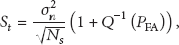

The process of data exchanging in the proposed sensing scheme can be described as follows.
Each sensor performs local energy collection and reports the collected energy to the FC. The FC decomposes the total received power into the primary signal power, each kind of secondary signal powers, and the device noise power. According to either decision fusion or data fusion [14], the FC exploits the decomposed primary signal power and the secondary signal powers to make final decision whether the primary signal and each kind of secondary signals are present or not. In addition, the received power at each SU, produced by each of other SUs, can also be computed by the FC for network optimization. The detailed scheme of this step will be described in Section 5. The FC distributes the computed secondary signal powers and the decisions on the primary signal and secondary signals to the related SUs.
4. Noise Uncertainty Problem
Many energy detection schemes assume the noise power is known a priori in order to form the test statistic and/or the decision threshold [14]. In fact, its power level varies over time and is very difficult to be exactly measured, which yields the noise uncertainty problem. Mathematically, if we use

Energy detection employs the summation of the received target signal and the actual noise to construct the test statistic to compare with a given threshold. Obviously, if the target signal is so weak that the test statistic falls into the noise uncertainty zone, it is impossible to infer the presence or absence of the signal. The wider the noise uncertainty zone is, the worse the detection performance is. Therefore, in order to improve the performance of energy detection, we can try to narrow down the noise uncertainty zone. Generally, the noise consists of the device noise and the interference including CCI and ACI. According to [9], the device noise uncertainty is generally less than 2 dB, while the uncertainty of ACI can be as wide as 58 dB. Obviously, the uncertainty of CCI would be much wider than ACI when the transmission power is the same. Therefore, it is considerably important to differentiate the primary signal, each kind of secondary signal in the sensing channel, the ACI from the SUs in the adjacent channels, and the device noise from total received energy. When constructing the test statistic for the detection of primary and secondary signals, the interference and the device noise should be cancelled so as to improve the energy detection performance.
5. Parallel Detection of Primary and Secondary Signals
In this section, we present how to detect the primary signal and secondary signals in parallel. Then, the presence or absence of the primary signal and secondary signals as well as the power level of the secondary signals at each SU can be determined. In addition, the ACI can also be mitigated in signal detection after the power decomposition.
According to [15], when the two-ray ground propagation model is used, the interference power with the receiver

Equation (4) illustrates that each primary and secondary transmitter contributes a part of power to the energy collecting sensor. As a result, the received power at each sensor is a composite power consisting of several parts: the primary signal power, the cochannel secondary signal powers, and the adjacent channel secondary signal powers. From the perspective of primary signal detection, both cochannel and adjacent channel secondary power are interference and should be removed when constructing the test statistic of energy detection. When the primary signal is detected, all the secondary networks should vacate the sensing channel and switch to other backup channels or terminate the data transmission when there are no available backup channels to protect the PUs. When the primary signal is not detected, the sensed channel can be utilized by the secondary networks. In this case, the coexistence mechanism becomes greatly important to avoid performance degradation because of the interference. To enhance the interference management, it is important to detect secondary signal and to determine the power level of each kind of secondary signals.
Obviously, the composite received power of a sensor


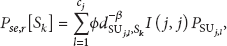

In (6)–(8),
Let



For all the other sensors, we can obtain the same results as the sensor


Obviously, D is a
By finely adjusting the geolocations of the sensors, the rank of coefficient matrix D can always satisfy
The solved vector P can be used to obtain the received primary signal power, each kind of secondary signal powers in the sensing channel, and the ACI. The received primary signal power at the sensor



Next, we should consider the secondary signals. If we assume there are


Up to now, we have obtained the device noise power
In coexistent heterogeneous networks, the detection of the secondary signals is not enough. In some cases, the signal power level is also necessary in order to optimize the spectrum sharing, for example, TPC. In the proposed scheme, the caused CCI power to each SU by other SUs sharing the same channel can also be achieved. For example, the CCI power at the

Such information is beneficial for the SUs with given tolerant interference. When the total interference exceeds the tolerant value, the coexistent SUs can be requested to decrease their transmission power to achieve better coexistent performance.
As we can see, the proposed parallel detection scheme is actually a real-time spectrum sensing scheme. Since the received signal power varies with the variation of the transmission power of both PU and SUs, the proposed scheme is applicable in the adaptive transmission power control. Moreover, it can be used in the scenario with ON/OFF status of the secondary signals, in which the OFF status is treated as the absence of this secondary signal by noticing the fact that the actual received power at each sensor does not contain the resulted part from this secondary signal.
Due to the successful avoidance of the widely used quiet periods in the conventional energy detections, the proposed parallel sensing scheme has at least two advantages. First, it lowers the synchronization requirement, which is difficult to be implemented in the coexistent heterogeneous networks. Second, it can improve the QoS (e.g., the capacity and the packet delay) of the secondary networks because the secondary transmissions do not need to stop during the spectrum sensing. In addition, no prior knowledge of both primary signal and the different kinds of secondary signals is required, which avoids the difficulties in acquiring such information due to the heterogeneity.
6. Performance Evaluation
6.1. Simulation Results
After the power decomposition, as we can see from Section 5, the detection processes of primary signal and secondary signals are essentially the same except using different
In the simulation, the primary spectrum band is divided into 3 consecutive channels (i.e., ch1, ch2, ch3) with 6 MHz bandwidth, which is the TV channel bandwidth in US and many other countries [18]. The average power spectral density (PSD) of the device noise is set to be −174 dBm/Hz, and no noise figure is considered for each sensor. In each channel, we deploy 2 SUs. The primary transmitter, the FC, and the sensors are deployed in ch2. As it is analyzed in Section 5, the number of deployed sensors should equal the sum of the SUs and PU; that is, 7 sensors are deployed in ch2. The geographic locations of all the nodes including PU, SUs, and sensors are randomly generated so as to average the achieved results. The path loss exponent β is set to be 3. In order to effectively show the role of the proposed scheme, we do not consider the diversity gain in the simulation. The or rule is used for decision fusion in the FC.
Figure 2 shows the achieved

Probability of missed detection for different ACI.
Figure 3 indicates the sensing performance for different sensing durations. The

Probability of missed detection for different number of samples (sensing times). Sixty samples correspond to 10
Figure 4 evaluates the detection performance with different device noise uncertainties.

Probability of missed detection for different device noise uncertainties. No ACI is used.
6.2. Sensitivity Evaluation
As it is shown in Section 5, the performance of the proposed scheme depends on the accuracy of the path loss exponent and the distances among the primary transmitter, SUs, and sensors. It also shows that the distance errors result in the similar impact on the performance and that the sensing performance is determined by the accuracy of the solved transmission power of each node. Therefore, to simplify the analysis, let us take a case study on the geolocation error of the primary transmitter, which leads to the distance errors between the primary transmitter and other nodes. We use the inaccuracy of the solved transmission power of the primary transmitter to measure the sensing performance and define it as

Inaccuracy (defined by
In the proposed scheme and the previous simulations, we assume the channels are additive white Gaussian noise (AWGN) channels and consider the large scale path loss for cochannel and interchannels by using the interference model. Next, let us evaluate the impact of Rayleigh fading channels.
Figure 6 illustrates the achieved average

Impact on the performance of the proposed sensing scheme by Rayleigh fading. No device noise uncertainty is considered.
7. Conclusion
In this paper, we proposed a geolocation assisted spectrum sensing scheme for cognitive coexistent heterogeneous networks. The proposed scheme is able to detect the primary signals and each kind of secondary signals simultaneously. With the assistance of the geographic locations of the PUs, SUs, and the sensors, the detection of primary and secondary signals is formulated into a problem of solving a homogeneously linear equation matrix, the coefficient matrix of which depends only on the distances among the PUs, SUs, and sensors. The proposed scheme is a noncoherent spectrum sensing scheme, which avoids the difficulties in acquiring the characteristics of primary and secondary signals in the heterogeneous networks. In addition, the proposed scheme does not exploit the quiet periods, which not only greatly relaxes the requirement on the network synchronization but also improves the QoS of the secondary networks. Simulation results verify the feasibility and the efficiency of the proposed scheme and show that it can satisfy the sensing requirement of FCC. We also pointed out that the proposed scheme is sensitive to fading and the parameter errors of the employed interference model.
Footnotes
Acknowledgment
This work was conducted under a contract of R&D on intelligent resource utilization technology for future broadband access systems in whitespace with the Ministry of Internal Affairs and Communications, Japan.