




Abstract
We presented an iterative turbo equalization to cope with intersymbol interference induced by reflection of sea level and sea bottom for underwater sensor communication channel. Iterative turbo equalizer consists of inner codes and outer codes; we employ decision feedback equalizer as an outer code and turbo codes as an inner code. Equalizer and decoder are connected through the interleaving and deinterleaving that update each other's information repeatedly. At the receiver side, we resort to powerful turbo equalization algorithms that iteratively exchange probabilistic information between inner decoder and outer decoder, thereby reducing the error rates significantly. Furthermore, we expand iterative turbo equalizer techniques for single-input-single-output (SISO) system to multiple-input-multiple-output (MIMO) system in order to increase data rates for underwater sensor communication channel. Based on experimental channel response, we confirmed that the performance is improved as iteration number is increased. The performance is improved by 3.5 [dB] compared to noniteration for SISO channel and by 1 [dB] for MIMO channel, respectively. We also decided that optimal iterations are 3. Very important for a successful decoding is the channel estimation, which is also discussed.
1. Introduction
The excessive multipath encountered in underwater sensor communication (USC) channel is creating intersymbol interference (ISI), which is limiting factor to achieve a high data rate and bit error rate (BER) performance. Various different methods to cope with multipath situation have been developed. In addition to ISI, cochannel interference (CoI) is also occurred resulting from the use of multiple transmitters in UW communication. Removal of both CoI and ISI is a challenging problem in view of difficult channel conditions. The optimal detector is a maximum likelihood detector (MLD), which can be realized, for example, by the soft Viterbi algorithm. Due to the length of the impulse response in the UW channel, the number of states in the decoder will be increased. One well-proven method to counteract ISI is the decision feedback equalized (DFE), which has been used in many UW communication links [1, 2]. However, the use of DFE has difficulties when a multipath with a number of arrivals has equal strength or low SNR [3]. The other way to cope with ISI, iterative equalizer which constitutes an outer loop is used in the receiver. An inner loop consists of iterative decoder. The assembly utilizes the error correcting power of the iterative codes to get an efficient equalizer [4, 5]. Based on iterative turbo equalization technique for single-input-single-output (SISO) channel, this paper expands it to the multiple-input-multiple-output (MIMO) channel for increasing data rates and capacity gains [6].
In this paper, we study iterative coding-based equalization for single-carrier USC channel. Among the iterative coding schemes, turbo codes and LDPC codes are dominant channel coding schemes in recent studies [7–9]. This paper decides that turbo coding scheme is optimal for underwater communications system in aspect to performance, packet size, and underwater environments. As an outer code, DFE is used in the paper. As an inner code, the turbo codes are used. In MIMO system, space-time trellis codes (STTCs) were employed as an inner code. In receiver side, BCJR algorithm is used for STTC decoding in order to improve BER performance by increasing iterations. This paper gives basic theory of iterative turbo equalization for SISO and MIMO systems; a description of our system and the result of some sea trials were conducted in the East Sea with an iterative turbo equalizer.
2. Iterative Turbo Equalizer for USC Channel in the SISO System
Iterative turbo equalizer has better performance than the general equalizer. However, because of using a MAP (maximum a posteriori) algorithm, it has the disadvantage of complexity by increasing exponentially as the length of the channel impulse response [7]. For this reason, a low-complexity linear equalizer or DFE is used in order to reduce the complexity. In this paper, we consider turbo equalizer with DFE. The baseband model of turbo equalizer is shown in Figure 1.

Model of the turbo equalization in baseband.
Figure 1 shows iterative linear equalizer; that is, decision feedback equalizer is used, which constitutes an outer code of the receiver. An inner code consists of the turbo codes. The information to be transmitted was encoded by a rate of 1/3 turbo code with identical recursive encoders having the duobinary generator polynomial with 16 states [8]. The interleavers are designed for good properties in a turbo code and were taken from [10]. The receiver of turbo equalizer consists of equalizer and decoder. Equalizer and decoder are connected through the interleaving and deinterleaving that update each other's information repeatedly. The inner coded bits are then subtracted from the input and interleaved. The interleaved output is canceled a posteriori from the proceeding received signal. Interleaving helps receiver convergence.
The






2.1. Experimental Result of USC Channel
We evaluate the performance of the proposed method in real underwater environments. The experiment was conducted off the coast of Donghae city, Korea, during June 2011. The sound speed profiles were measured periodically by XBT (eXpendable BathyThermograph) instrument and are plotted in Figure 2(a). The water depth was approximately 200 [m]. An acoustic transducer was towed at 100 [m] below the ocean. The source signal has 3.8 [kHz] to 8 [kHz] band. The hydrophone was equipped at 200 [m] sea bottom and the horizontal range from transducer is 3 [km]. The received signal is sampled at 60 [kHz] sampling frequency. In Figure 2(b), underwater channel response is shown during 5 minutes. This response was measured by using LFM (linear frequency modulated) signal with bandwidth of 4 [kHz]. We observe that the main arrival paths appear on around delay of 40 [ms]. The channel gains for the secondary/third arrivals fluctuate more rapidly. This sparse channel is affected by multipath propagation by reflection from surface and bottom. In order to perform periodic channel estimation and synchronization, the packet consisted of a LFM probe signal for both synchronization and channel estimation, silence interval, PN code of 128 symbol, timing sequence, preamble data, and transmission data symbol which are added lastly. Experiment parameters are listed in Table 1.
Parameters of UWA channel experiment.


Characteristic of underwater sensor communication channel.
Figure 3 shows BER curves of iterative turbo equalization. We confirmed that the performance is the best as iteration numbers are increased. If the range of iteration number is three or four, we can achieve BER performance enhancement by 3.5 [dB] compared to noniteration. However, we cannot achieve the performance gain after third iterations, and we conclude that the optimal iteration numbers are three.

BER Performance of iterative turbo equalizer for USC channel for SISO system.
3. Application to MIMO Underwater Communication
MIMO technique is being studied in underwater communications because of increasing the data rates. MIMO communication systems employ multiple sensors at the transmitter and receiver sides. They can yield significantly increased data rates and improved link reliability without additional bandwidth. Representative method is space-time trellis codes (STTCs). In this paper, we propose turbo equalization models for MIMO system in the USC channel employing STTC and turbo codes. We will show how much coding gain can be achieved for increasing number of iterations.
3.1. System Model for MIMO Underwater Communication
Consider an

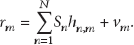
The source bits are encoded by STTC encoder and interleaved then mapped to QPSK symbols. After the signals have been received by the receive array, the process consists of estimating the channel impulse response in training or decision mode and detecting the symbols by using the estimated channel impulse response. For increasing data rate and diversity gain according to using MIMO technique in underwater channel environment, exact channel estimation is necessarily. After channel estimation and symbol detection have been done, significant performance improvement iterative turbo equalization BCJR algorithm [11] for STTC decoding, deinterleaving, and turbo decoding is performed. As shown in Figure 1, the baseband equivalent signal received at the mth hydrophone can be expressed in the discrete-time domain form as




The channel estimation problem is to estimate 

3.2. MIMO Turbo Equalization and Results
In MIMO turbo equalization, two codes are concatenated in the serial fashion. The inner codes are turbo codes with 16 states described in Section 2, and outer codes are STTCs with optimal generator polynomial described in [13]. Normally, the candidates of outer codes are space-time block codes (STBCs) and STTCs. Representative method of STBCs is V-BLAST (Vertical-Bell Labs lAyered Space-Time) [14, 15]. This system obtained diversity or spatial multiplexing effect. The MLD is optimal and fully exploits the available diversity. However, STBCs for MIMO turbo equalization cannot obtain coding gain even if increasing number of iteration. This is the reason that the outputs of STBCs are not soft type symbols. The types of input symbols and output symbols must be soft symbols in order to improve performance by increasing number of iterations [16]. At the receiver, we resort to powerful turbo equalization algorithms that iteratively exchange probabilistic information between inner decoder and outer decoder, thereby reducing the error rates significantly. Therefore, we adopt STTCs which are introduced by Roy et al. in 2007 [17]. These codes are described by a trellis structured. We used BCJR algorithm which is soft-based Viterbi algorithm as a STTC decoder. The symbols of outer decoder are then subtracted from the input and interleaved. The interleaved symbols are canceled a posteriori from the proceeding received symbol. Interleaving helps receiver convergence. To confirm the performance improvement of the iterative turbo equalization for MIMO system, the simulation was conducted. Underwater communication is difficult to maintain the reliability because it is affected by temperature, depth, and geometry. The channels for simulation were generated by Bellhop model, and the sound speed profile that was measured via sea trials was used. We considered

Channel impulse responses for measured

Performance of MIMO system.
The same as SISO system, we also confirmed that the coding gain of 1 dB can be achieved compared to noniteration.
4. Conclusions
In this paper, we proposed receiver structure based on an iterative turbo equalization to cope with intersymbol interference and multipath errors underwater sensor communication channel. Iterative turbo equalizer consists of inner codes and outer codes; we employ decision feedback equalizer as an outer code and turbo codes as an inner code.
We simulated the performance of the iterative turbo equalizer using the channel response data with distance of 5 Km and data rate of 1 Kbps which are obtained by experimentation in the Eastern coast of Korea. In simulation results, we confirmed that the performance is the best as iteration number is increased. The BER performance is improved by 3.5 dB compared to noniteration. We also decided that optimal iteration numbers are three. We expand iterative turbo equalizer technique to MIMO system in order to increase data rates for underwater sensor communication channel. We also confirmed that the coding gain of 1 dB can be achieved compared to noniteration.
Footnotes
Acknowledgments
This work was supported by Defense Acquisition Program Administration and Agency for Defense Development under the Contract UD110101DD and was financially supported by the Ministry of Education, Science Technology (MEST) and National research Foundation of Korea (NRF) through the Human Resource Training Project for Regional Innovation.