




Abstract
In this study a partially open enclosure with two heat sources is examined to determine the Nusselt number along the hot wall. The first part of the study examines the effect of the Rayleigh number ratio on the Nusselt number. The largest Rayleigh number ratio results in the highest magnitude of the Nusselt number. The second part of the study examines what happens to the Nusselt number along the hot wall as the Rayleigh number ratio for the two blocks is different. This situation can arise when the two blocks have unequal heat source values. The largest Nusselt numbers correspond to the situation when the block along the top wall has a Rayleigh number ratio that is ten times higher than the Rayleigh number ratio for the block along the hot wall. The largest Nusselt number magnitudes can be attributed to the strong vortex in the corner near the hot wall.
1. Introduction
Natural convection plays an important role in many applications where heat must be removed from objects that generate heat. Often, these objects are inside of an enclosure that is partially open. The practical applications for this situation have been well documented by previous researchers [1] and include nuclear reactors, solar energy collectors, electronic equipment, and the design of indoor environments.
Several studies have been conducted regarding natural convection in partially open enclosures. Angirasa et al. [2] examined transient natural convection in an enclosure with three heated walls and one open wall. Other studies involving open enclosures were performed with large domains outside of the enclosure [3–5]. All of these studies did not involve heated objects in the enclosure.
Xia and Zhou [6] explored a partially open enclosure interacting with an external heat generating source. Mariani and Da Silva [1] examined the local and average Nusselt number along a hot and cold wall for a single internal heat source inside a partially open enclosure. They varied the position of the heat source along the insulated bottom and hot side wall. In addition, they varied the ratio of the Rayleigh number for the internal heat source (internal Rayleigh number) and the Rayleigh number based on the temperature difference between the hot and cold wall (external Rayleigh number).
Recently, a new study examined natural convection in vented cavities using a restricted domain approach [7]. In addition, Muftuoglu and Bilgen [8] and Muftuoglu and Bilgen [9] studied a single heat source in an open enclosure to determine the optimal heat source location. Liu and Phan-Thien determined the optimal spacing for three chips mounted on a vertical substrate in an enclosure [10]. Also, Da Silva et al. found the optimal position on a wall and a plate undergoing natural convection [11, 12]. Other studies have examined heat sources in vertical channels and L-shaped channels [13, 14].
All of the above studies examined enclosures that contained a single heat source or multiple heat sources along a plate or an open channel. This study will examine multiple heat sources in a partially open enclosure. This study will characterize the Nusselt number along the hot wall as a function of the external Rayleigh number for various ratios between the internal Rayleigh number, Ra i , and the external Rayleigh number, Ra e . In addition, this study will examine the Nusselt number along the hot wall as a function of the external Rayleigh number for various ratios of the internal Rayleigh numbers for the two heat sources. Streamlines and isotherms will be presented for the two cases listed above.
2. Mathematical Model
The geometry for the model consists of a partially open enclosure with two heated blocks inside of the enclosure, Figure 1. The enclosure is a square with a length of L1 and an opening of one half of L1. The left side of the enclosure is at a constant high temperature, T h , and the right wall of the enclosure is held at a lower temperature, T c . The upper and the lower walls of the enclosure are adiabatic. The two heat sources are located in the middle of the left and upper walls. Both heat sources are square and have a length L2 that is one tenth of L1. The heat sources produce an amount of heat equal to q1 and q2, respectively.

The geometry for the problem.
A computational mesh is constructed for the geometry with a high density of elements placed near the walls where the gradients are the largest. A grid refinement study is performed at a Rayleigh number of 5,000, and the results can be seen in Table 1. The optimal number of elements is found to be 40,000 across all Rayleigh numbers examined. In addition to the grid refinement study, our model is compared to Mariani and Da Silva for two different external Rayleigh numbers, Figure 2. Figure 2 shows excellent agreement between the two models.
The results from the grid refinement study.

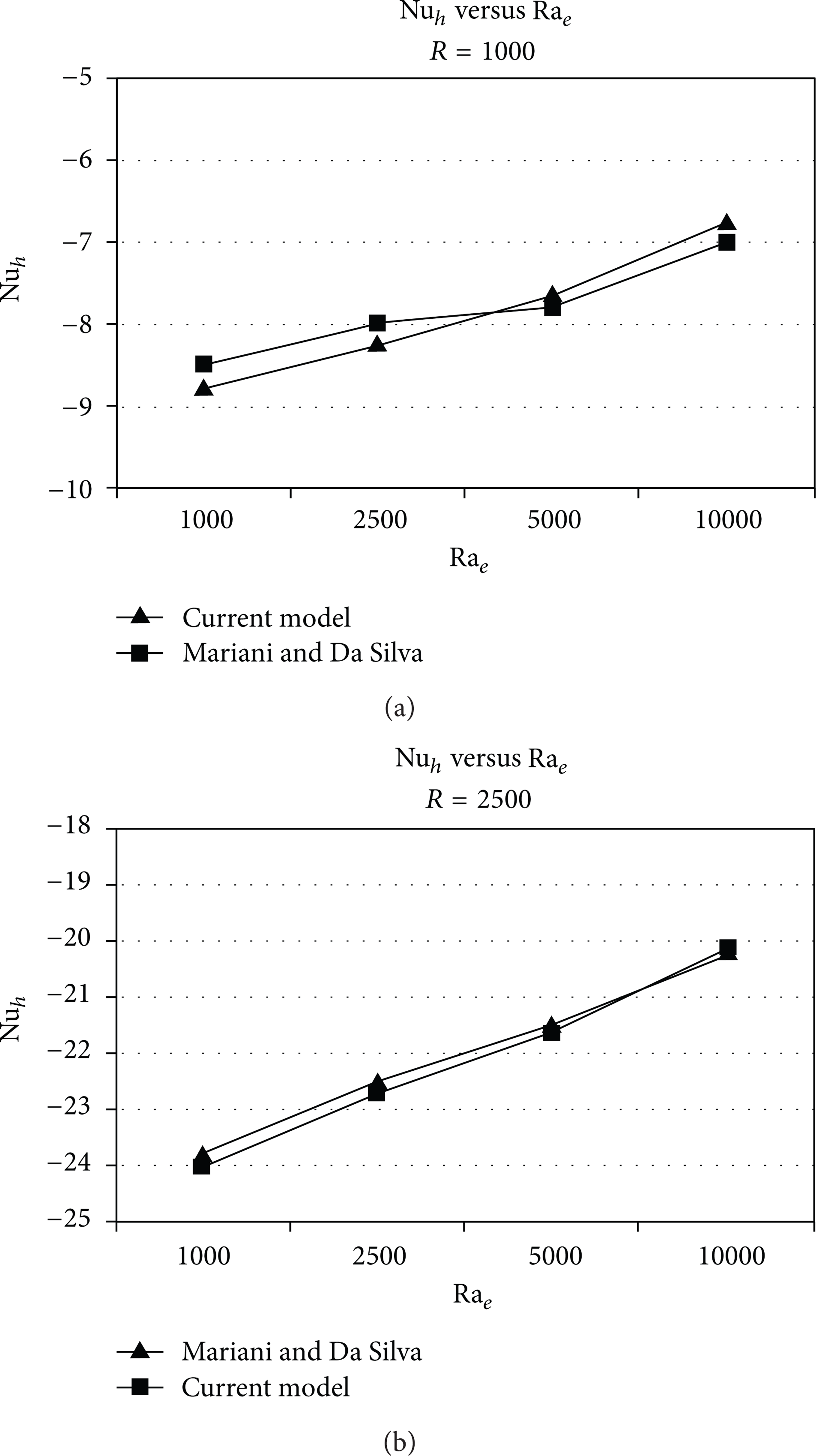
The comparison between Mariani and Da Silva and our model for the external Rayleigh number of (a) 1000 and (b) 2500.
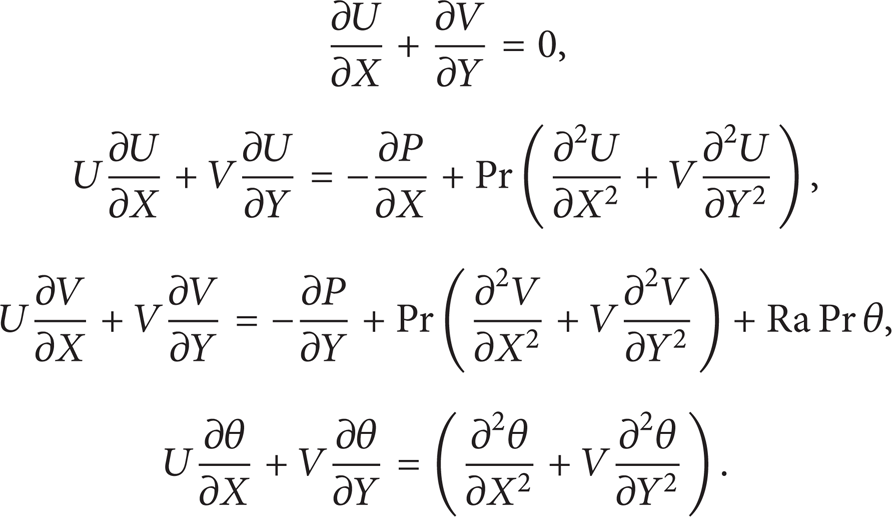
The dimensionless form of the steady mass, momentum, and energy equations in the fluid region for the problem is defined as follows:
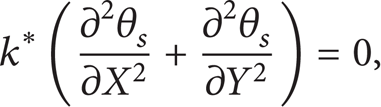
In the solid conducting block, the dimensionless energy equation is
where the nondimensional variables used in (1) and (2) are defined as
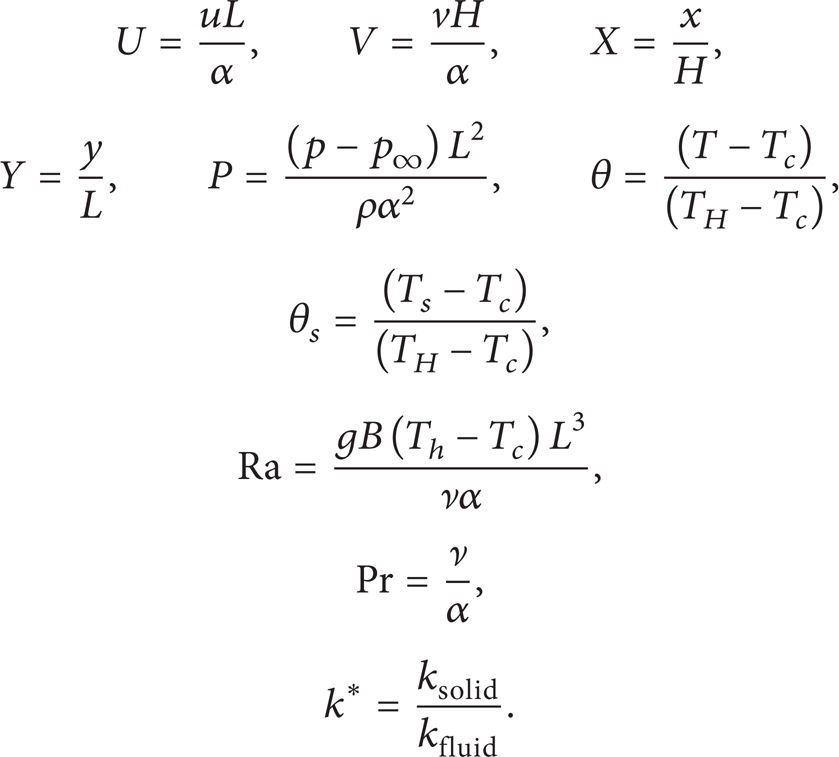
u and v are the fluid velocity in the x and y directions, α the thermal diffusivity, ρ the fluid density, k the thermal conductivity, T the temperature, ν the kinematic viscosity, p∞ the reference pressure, p the static pressure, and B the thermal expansion coefficient.
The boundary conditions in the fluid domain are as follows:

At the surface of the conducting block, the boundary conditions are
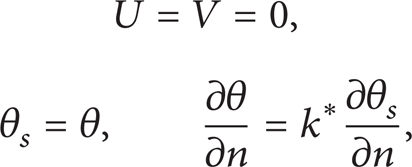
where n is the normal direction to the surface. The solid block and fluid were initialized to have the median temperature between the hot and cold walls for all the simulations. The equations above were solved using the finite volume software FLUENT. The pressure-velocity coupling was accomplished by the SIMPLE algorithm, and a power law representation was used for the convective flux terms. The Boussinesq approximation was used to model the buoyancy effects.
The key dimensionless groups that characterize the problem are developed by Mariani and Da Silva and are the average Nusselt number, Nu, the external Rayleigh number, Ra e , the internal Rayleigh number, Ra i , and the ratio between the internal and external Rayleigh number, R. In addition to the above parameters, this study will examine the effect of different R values for each of the heat sources, R*. The dimensionless groups are defined below

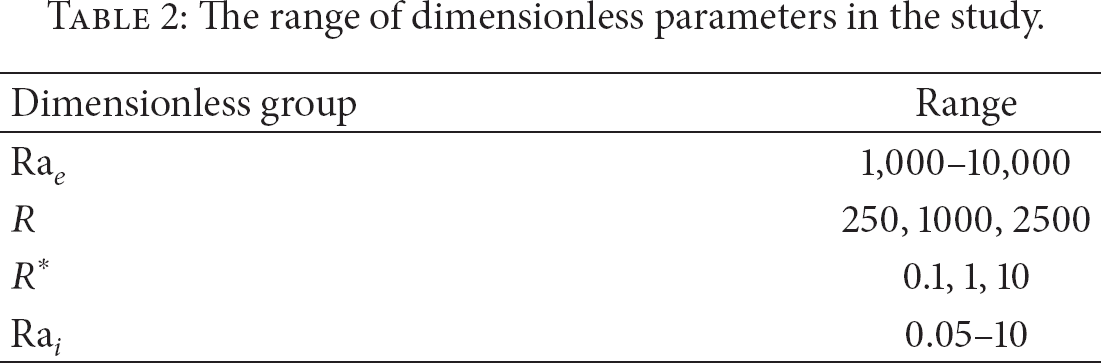
To explore how the average and local Nusselt numbers are affected by these dimensionless groups, simulations are performed by varying the external Rayleigh number, which is consistent with the method by Mariani and da Silva. Table 2 displays the range of the dimensionless groups used. The subsequent sections detail the results of how the Nusselt number is affected by each group.
The range of dimensionless parameters in the study.
3. Effect of the Rayleigh Number Ratio
To determine the effect of the Rayleigh number ratio, R, on the local and average Nusselt numbers, Figure 3 is created. In Figure 3, the average Nusselt number along the hot wall is plotted versus the external Rayleigh number for three different Rayleigh number ratios, 250, 1000, and 2500. From the figure, one can see that the most negative Nusselt numbers correspond to the largest Rayleigh number ratio of 2500. Also, as the external Rayleigh number is increased, the average Nusselt number increases for all Rayleigh number ratios, and the rate of change decreases. The negative Nusselt numbers are due to the direction of heat flow from the air inside the enclosure to the wall. These trends are consistent with the works by Mariana and Da Silva. However, the average Nusselt number for our Rayleigh number ratios is much larger in magnitude compared to the average Nusselt number from Mariana and Da Silva at the same Rayleigh number ratios. Table 3 shows the maximum magnitude of the average Nusselt number along the hot wall for each Rayleigh number ratio for the current study compared with the one by Mariana and Da Silva. From Table 3, one can see that the addition of the second heat source results in higher Nusselt numbers.
The comparison between the average Nusselt number along the hot wall for three Rayleigh number ratios.


The average Nusselt number along the hot wall versus the external Rayleigh number for a Rayleigh number ratio of 250, 1000, and 2500.
The reason for this increase in the magnitude of the Nusselt number along the hot wall can be seen with the aid of Figure 4. Figure 4 shows the isotherms for an external Rayleigh number of 6000 for the three Rayleigh number ratios. Notice the large gradient in the isotherms along the upper part of the hot wall and the left side of the heated block along the insulated wall for the Rayleigh number ratio of 2500. In addition to the large gradients, the temperature of the air in that corner is higher for this Rayleigh number ratio than the other two Rayleigh number ratios. These large gradients affect the flow patterns.

Isotherms for an external Rayleigh number ratio of 6000 for a Rayleigh number ratio of (a) 250, (b) 1000, and (c) 2500.
Figure 5 shows the streamlines for an external Rayleigh number of 6000 for the three Rayleigh number ratios. The streamlines indicate two distinct vortices in the flow. The main vortex is centered near the middle of the enclosure, and the second vortex is located in the corner of the enclosure between the two heat sources. The second vortex increases in strength as the Rayleigh number ratio is increased. This can be seen by the increased gradient in the streamlines as the Rayleigh number ratio is increased. This large temperature gradient causes a strong vortex to form in this corner associated with this Rayleigh number ratio. Mariani and Da Silva also reported a second vortex near the heat source; however, the size of the vortex is larger in the current study. This increase in the isotherm gradients and the resulting vortex size contribute to the larger Nusselt numbers in the current study.
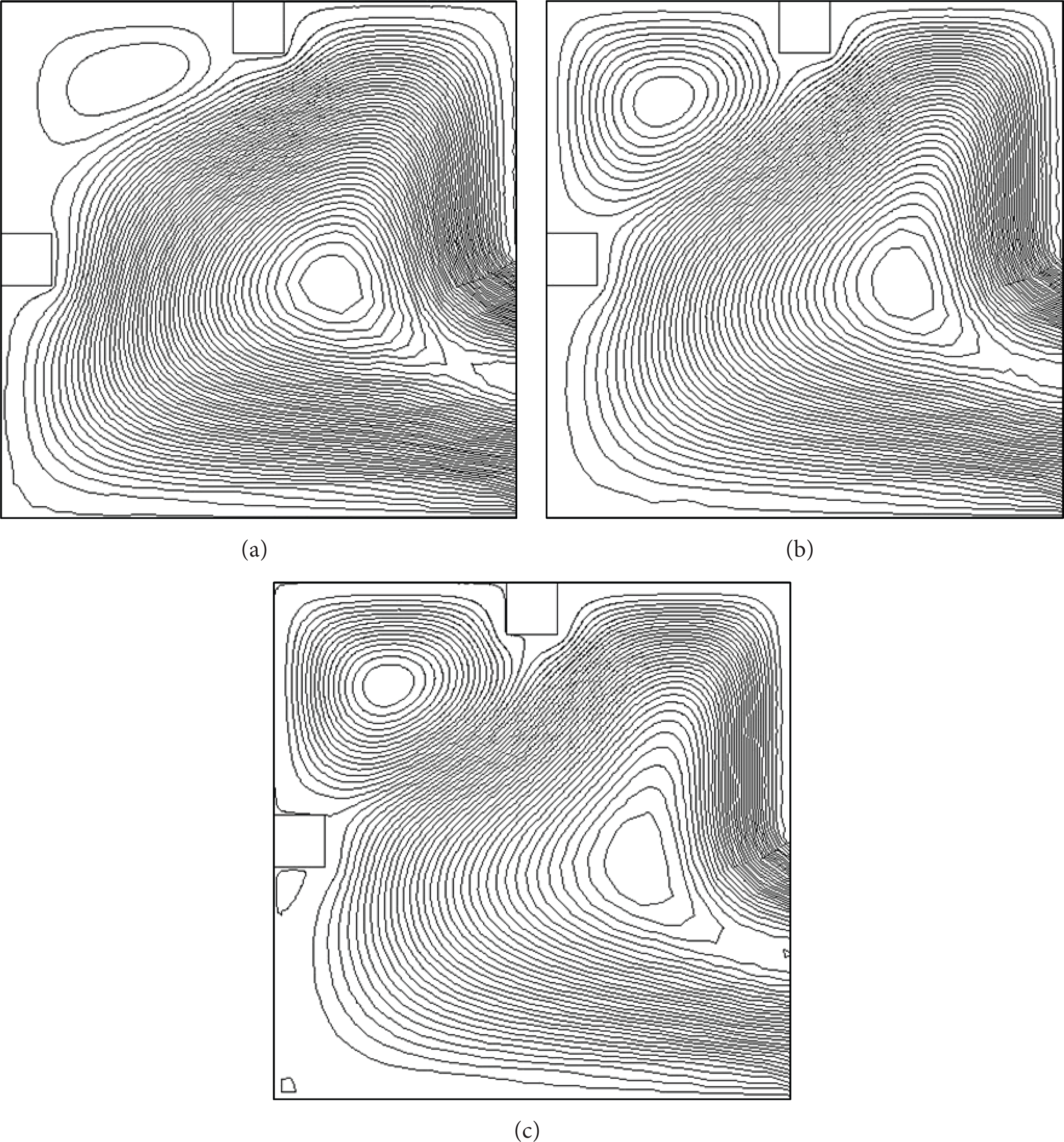
Streamlines for an external Rayleigh number ratio of 6000 for a Rayleigh number ratio of (a) 250, (b) 1000, and (c) 2500.
4. Effect of Unequal Rayleigh Number Ratios for the Heated Blocks
In order to determine the effect of different heat generation rates for the two blocks, the Rayleigh number ratio for each block is set to a different value. The ratio between the Rayleigh number ratios for each block is defined as the parameter R*. The block on the left-hand hot wall is designated block one with a Rayleigh number ratio of R1, and the block along the top wall is called block two with a Rayleigh number ratio of R2. Figure 6 shows how the Nusselt number along the hot wall is affected by the external Rayleigh number for three different R* values, 0.1, 1, and 10.0. The R* value of 1.0 corresponds to the two blocks having equal Rayleigh ratios and is the value in the previous section. From Figure 6, one can see that the magnitude of the Nusselt number is the largest for the value of R* equal to 0.1, and the magnitude of the Nusselt numbers for the other two R values, 1.0 and 10.0, are close to each other. The Nusselt numbers for the R* value of 10.0 are slightly less than the Nusselt numbers for R* value of 1.0.

The average Nusselt number along the hot wall versus the external Rayleigh number for an R* ratio of 0.1, 1.0, and 10.0.
The larger magnitude of the Nusselt numbers for the R* value of 0.1 can be explained with the aid of Figure 7. Figure 7 shows the resulting isotherms for the three R* values for an external Rayleigh number of 6000. Notice the large gradient in the isotherms associated with the R* value of 0.1. In contrast, the isotherms for the R* value of 10.0 are spaced relatively wide apart. The resulting streamlines for the three R* values can be seen in Figure 8. One can see that a vortex exists in the upper corner near the hot wall for the case where R* equals 0.1. In comparison, no vortex appears in that same corner for the R* value of 10.0. The strong vortex in the corner of the hot wall for the R* value of 0.1 is associated with large gradients in the isotherms. A vortex does exist in the upper corner for the case where R* equals 1.0. However, the strength of this vortex is much smaller than the vortex associated with the R* value of 0.1. This can be seen by the gradient between the streamlines for these two cases. In addition to the vortex in the upper corner near the hot wall, a second vortex appears in the upper corner near the cold wall for the case where R* equals 0.1.

Isotherms for an external Rayleigh number ratio of 6000 for a Rayleigh number ratio of (a) 250, (b) 1000, and (c) 2500.

Isotherms for an external Rayleigh number ratio of 6000 for a Rayleigh number ratio of (a) 250, (b) 1000, and (c) 2500.
5. Conclusions
In this study, a partially open enclosure with two heat sources is examined to determine the Nusselt number along the hot wall. The study is divided into two parts. The first part examines the effect of the Rayleigh number ratio on the Nusselt number. The largest Rayleigh number ratio results in the highest magnitude of the Nusselt number. When compared to the study by Mariani and Da Silva, the current study shows much larger magnitudes for the Nusselt number for the same Rayleigh number ratios. This increase is attributed to the large vortex that forms of the corner near the hot wall. The strength and size of this vortex are due to the large gradient in the isotherms with higher Rayleigh number ratios.
The second part of the study examines what happens to the Nusselt number along the hot wall as the Rayleigh number ratio for the two blocks is different. This situation can arise when the two blocks have unequal heat source values. The largest Nusselt number magnitudes are associated with the R* value of 0.1. This corresponds to the situation when the block along the top wall has a Rayleigh number ratio that is ten times higher than the Rayleigh number ratio for the block along the hot wall. The larger Nusselt number magnitudes can be attributed to the strong vortex in the corner near the hot wall. In contrast, there is no vortex in the same corner for an R* value of 10.0. A second vortex also exists in the corner near the cold wall for the R* value of 0.1.