




Abstract
A multicriteria decision-making model was proposed in order to acquire the optimum one among different product design schemes. VIKOR method was introduced to compute the ranking value of each scheme. A multiobjective optimization model for criteria weight was established. In this model, projection pursuit method was employed to identify a criteria weight set which could keep classification information of original schemes to the greatest extent, while PROMETHEE II was adopted to keep sorting information. Dominance based multiobjective simulated annealing algorithm (D-MOSA) was introduced to solve the optimization model. Finally, an example was taken to demonstrate the feasibility and efficiency of this model.
1. Introduction
Generally, designers tend to get more than two schemes in product conceptual design because multiple alternatives can make the design more innovative. After different schemes are obtained, the designers should further decide which one is the best. This is exactly a multicriteria decision making problem. Many researches have been conducted on multi-criteria decision making in different application fields. Gu and Wu [1] introduced fuzzy set theory and analytic hierarchy process into the evaluation process to determinate the weights of evaluation factors. Kaya and Kahraman [2] proposed integrated VIKOR-AHP methodology to the selection of the best energy policy and production site. Kong et al. [3] construct the comprehensive evaluation model of enterprise's technological innovation abilities and evaluate technological innovation abilities of four enterprises based on VIKOR method. Macharis et al. [4] discussed the strengths and weaknesses of the Preference Ranking Organization Method for Enrichment Evaluations (PROMETHEE) and analytic hierarchy process (AHP) methods. Opricovic and Tzeng [5, 6] illustrated a comparative analysis of two multiple criteria decision-making methods VIKOR and TOPSIS. Sayadi et al. [7] extended the VIKOR method for decision-making problems with interval number. Lin et al. [8] presented a framework that integrates the analytic hierarchy process (AHP) and the technique for order preference by similarity to ideal solution (TOPSIS) to assist designers in identifying customer requirements and design characteristics and achieving an effective evaluation of the final design solution. Shih et al. [9] proposed a multiattribute decision-making model based on TOPSIS, which is indeed a unified process and it will be readily applicable to many real-world decision-making situations without increasing the computational burden.
In these researches, criteria weight should be given at the beginning in order to calculate the ranking value. It is inevitable to bring subjective factors into criteria weight by these methods. In order to reduce subjective uncertainty in weight calculation to the greatest extent, we put forward a multicriteria decision-making method for product design schemes. In our method, a multiobjective optimization model for criteria weight was established, by which classification and sorting information of original schemes are kept in the final priority sequence.
In Section 2, VIKOR method is explained in detail. VIKOR method is the basis of the proposed model because the optimized criteria weight by the model will eventually be substituted into this method. In Section 3, a multiobjective optimization model for criteria weight is established, respectively, based on projection pursuit method and PROMETHEE II. In Section 4, a new multi-objective optimization algorithm D-MOSA is introduced to optimize the proposed multi-objective optimization model for criteria weight. In Section 5, a mechanism example is taken to demonstrate the efficiency and feasibility of our model.
2. VIKOR Method
VIKOR was proposed by Opricovic to deal with discrete multicriteria decision-making problem [10]. It uses different aggregation function and normalization method from TOPSIS and calculates ranking value of each scheme with maximum group utility and minimum individual regret. Given a scheme set A = {x ij | i = 1 ∼ m, j = 1 ∼ n}, in which x ij denotes the rating of scheme a i with respect to criteria S j , we perform multicriteria decision making using VIKOR method as follows.
Step 1. Normalize the rating x ij in set A. We assume that all the criteria are benefit-type, and then the following equation can be used to normalize the scheme set A:

where f ij is the rating after normalization and xmax(j) is the maximum rating of all the schemes with respect to criteria S j . Through normalization, the rating value with respect to each criterion could be restricted within the closed interval [0, 1].
Step 2. Determine the positive ideal value f j * and negative ideal value f j −. f j * is the maximum rating value with respect to criteria S j in all schemes, while f j − is the minimum with respect to criteria S j in all schemes. We evaluate the distance between each scheme and positive ideal value or negative ideal value and select the optimum scheme which is closest to the positive idea value but farthest from the negative ideal value.
Step 3. Calculate group utility S i and individual regret R i :

where w j is the weight of each criterion.
Step 4. Compute the ranking value Q i . The schemes are sorted according to their ranking values Q i , and it can be calculated as follows:

where

v is introduced as strategy weight. It determines whether to consider maximum group utility more or minimum individual regret more in ranking value. When it is set to 0.5, they are considered equally.
According to VIKOR method, the final ranking value Q i should satisfy two conditions: the acceptable advantage and the acceptable stability in decision making. However, it is very difficult to satisfy them at the same time, because the schemes usually vary slightly from each other, and thus it is difficult to get a complete order using these two conditions. In this paper, the authors sort the schemes directly according to their ranking value Q i . It can be known that the less the ranking value Q i is, the better its corresponding scheme is.
3. Multiobjective Optimization Model for Criteria Weight
Multicriteria decision making is required to reflect both classification and sorting information in original schemes [11]. In this paper, projection pursuit [12] is employed to guarantee that the obtained criteria weight could keep the classification feature of schemes. It can make the ranking value scatter on the whole scale but at the same time aggregate on the local scale through maximizing the standard deviation of projecting value and local density. Besides, sorting information can be guaranteed by PROMETHEE method.
3.1. Projection Pursuit Based Scheme Classification Optimization Model
Multi-criteria decision making is actually a projecting process from multidimensional criteria to one-dimensional ranking value. Therefore, the criteria weight set W = {w j | j = 1 ∼ n} can be regarded as the projection direction. If we choose different weight set W, or in other words, we project criteria from different directions, criteria will be understood at different angles. The projection could be expressed by the following formula:

where P(·) is the projection function.
In formula (5), vector F is known at the beginning of evaluation. There are mainly two methods to determine weight set W, namely, subjective weighting and objective weighting [13]. But these methods are deficient in determining weight accurately due to the limited knowledge and experience of decision maker. In projection pursuit, standard deviation S(Q) and local density D(Q) of the ranking value are calculated firstly based on the result of formula (3):

where


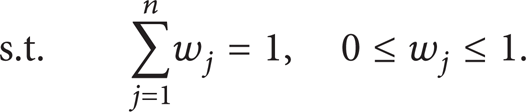
According to the literature [14], the final ranking values, respectively, evaluated by formula, (7) and (8) are similar. In this paper, the authors use formula (8) as the objective function.
3.2. PROMETHEE II Based Sorting Optimization Model
Scheme sorting can be easily affected by criteria weight set. The slight change of criteria weight may even lead to drastic change in sorting. In order to make the sorting stable enough, the most efficient way is to maximize the difference of ranking values between each scheme [15]. PROMETHEE method adopts preference function to establish the priority relation between every two schemes [16, 17]. Preference degree of any scheme versus the whole scheme set is defined, combining with criteria weight, further to determine the priority order of all schemes. For the scheme set A = {x ij | i = 1 ∼ m, j = 1 ∼ n} given in last section, its criteria weight set is W = {w j | j = 1 ∼ n}.
Preference function is given as P k (a i , a j ) ∊ [0, 1], which denotes the priority degree of scheme a i under criteria k relative to scheme a j . The different values of P k (a i , a j ) are as follows:

a i has no priority over a j ;

a i is prior to a j under criteria k, and the priority degree is ρ;

a i is absolutely prior to a j under criteria k.
The priority degree of a i versus a j can be calculated as follows:
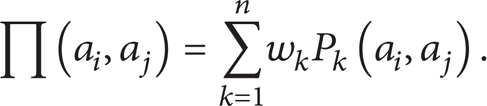
The outgoing flow, incoming flow, and net flow of a i can be obtained using the following equation:

The scheme set A is sorted according to net-flow Φ(a i ). When ϕ+(a i ) ≥ ϕ+(a j ), ϕ−(a i ) ≤ ϕ−(a j ), it can be denoted as

When ϕ+(a i ) = ϕ+(a j ), ϕ−(a i ) = ϕ−(a j ), it can be denoted as

Given x ij , y ij ≥ 0, for any a i and a j , we have


specifically, when a i Pa j , x ij = y ij = 0.
The difference index Z [9] in formula (20) is calculated through summing x ij , y ij of all priority relations in scheme set and can reflect the difference between ranking values. In order to make the scheme sorting stable, this equation can be taken as the maximizing optimization objective:

In this equation, α = min{x ij , y ij | A i PA j }, it is the minimum x ij or y ij of all scheme relation pair. ∊ is a small positive number.
3.3. Multiobjective Optimization Model of Criteria Weight
Criteria weight is mainly to measure the policymakers' preference degree for product attributes [18]. Multi-objective optimization model of criteria weight is established as follows:

4. Dominance Based Multiobjective Simulated Annealing Algorithm (D-MOSA)
Simulated annealing (SA) is an ideal algorithm to deal with single-objective optimization problem. When optimization parameter is chosen properly and temperature is reduced slowly enough, the result by SA can be very close to global optimum solution. Smith et al. [14] proposed a new simulated annealing algorithm oriented to multiobjective optimization problem, namely, dominance based multiobjective simulated annealing algorithm (D-MOSA). It overcomes the shortcoming of SA in optimizing single objective. This paper introduced this algorithm to optimize the multi-objective model of criteria weight.
4.1. Dominance Based Energy Function
In simulated annealing algorithm, energy function is used to compare the new solution and current solution as the objective function of optimization and determine whether the new proposal should be accepted. In multi-objective optimization, we can use dominance relation between solutions to determine the priority of proposal versus current solution.
In Figure 1, sample 1 is dominated by more points on Pareto front than sample 2, so we could think that sample 1 has higher energy than sample 2. When the sample point is on the Pareto front, the sample is dominated by no points, and accordingly its energy is 0. Pareto front is denoted by set P, and the part in set P which dominates sample

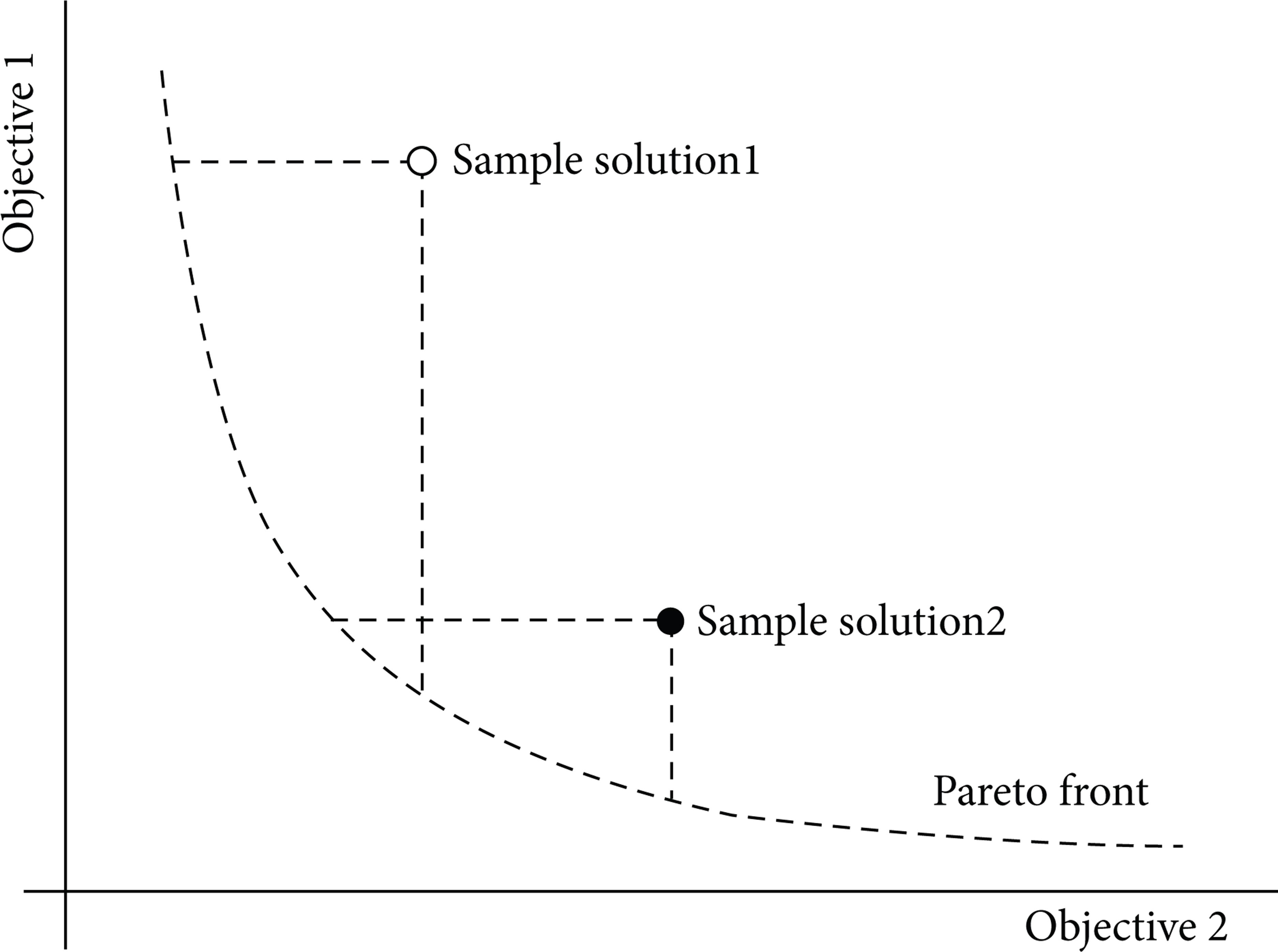
Different samples are dominated by different number of points on Pareto front.
Energy function is defined as E(
In practical application, Pareto front is unknown, so an estimated Pareto front should be used in energy function instead. Set F is constituted by all mutually nondominating solutions so far and can be used to estimate the true Pareto front. Based on set F, set

Hence, the energy difference between the new proposal and current solution is
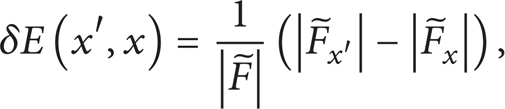
where
Using the previous energy function, we do not need to be given the weight of every objective function; meanwhile, it encourages the exploration of sparsely populated region of the front because, in this region, the energy of new solution is relatively lower (they are dominated by fewer points), and they can be accepted more easily.
4.2. Attainment Surface Sampling
Though using the estimated Pareto front F provides an estimate of solution energy, the resolution in the energies can be very coarse [14] if F is small. The acceptance probabilities will also become lower and convergence to global optimum will be prevented. In this algorithm, attainment surface sampling (ASS) is used to augment points on estimated Pareto front F.
Firstly, attainment surface S F of F is determined. As a matter of fact, S F is the boundary of the region in objective space dominated by elements in F. If

where

H F is the minimum hyperrectangle containing F, and

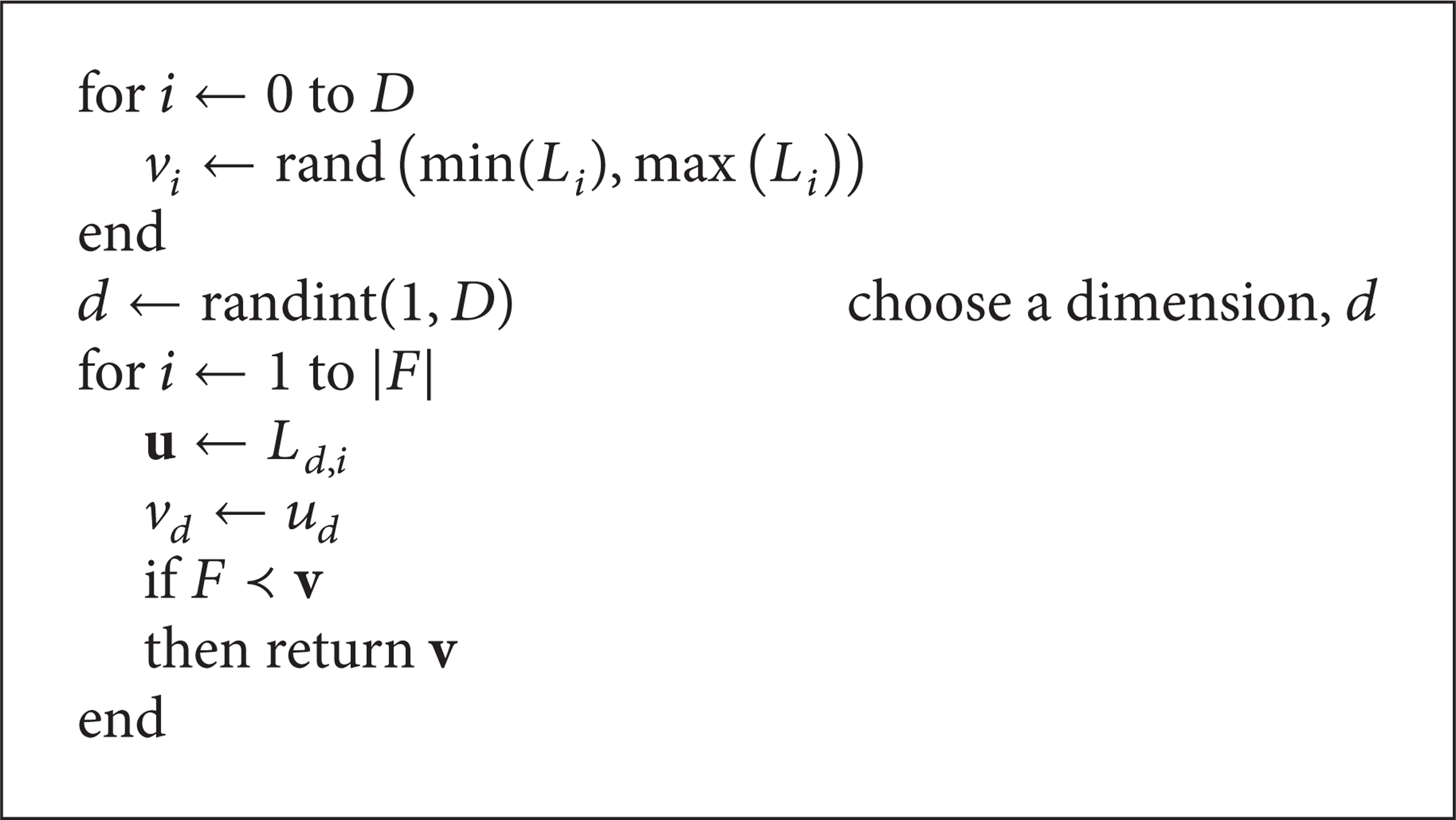
After the attainment surface S F of set F is obtained, uniformly sampling from S F ∩ H F is performed using Algorithm 1. In the following pseudocode, L d (d = 1, 2, …, D) is the element sequence of F sorted by increasing coordinate d.
4.3. Algorithm Procedure
The flow chart of dominance based multi-objective simulated annealing algorithm is depicted in Figure 2. The detailed process is explained as follows.

The flow chart of dominance based multiobjective simulated annealing algorithm.
Step 1. Initialization. The initial feasible point
Step 2. Form the proposed solution using perturbation function. Perturb each element of
Step 3. If there are fewer than S solutions in F, ASS interpolation is performed. One hundred samples are drawn from S
F
, and they make up the set S
F
′,
Step 4. Consider
Step 5. Determine whether to accept the proposed solution or not. The proposal is accepted with the probability P:

Step 6. Delete solutions in F dominated by
Step 7. If the iteration times under current temperature come to the maximum, then go to Step 8 and reduce annealing temperature; otherwise, return to Step 2.
Step 8. If current temperature gets the lowest, then optimization is over; otherwise, return to Step 2.
5. Instance
In this section, we will evaluate three schemes for the paper feeding mechanism in card punching machine [19]: cam-rocker-slider mechanism, shaper mechanism, and Stephenson mechanism, as depicted in Figure 3. We regard product's properties like reliability, maintainability, and green attributes as evaluation parameters, which is shown in Table 1. The rating of each scheme based on 1–9 level is given in Table 2. It can be seen in Table 1 that three schemes are equivalent with respect to criteria S2 and S14. Therefore, S2 and S14 will not be considered in the following evaluation. The rating values after normalization are shown in Table 3. In PROMETHEE method, preference function was given as

where
Evaluation index.

Rating of each scheme with respect to different criteria.

Rating of each scheme with respect to different criteria.


Scheme model. (a) Cam-rocker-slider mechanism. (b) Shaper mechanism. (c) Stephenson mechanism.
Through performing D-MOSA, we get the estimated Pareto front. Weight set w = (0.0292, 0.0666, 0.0082, 0.0967, 0.0169, 0.0356, 0.1246, 0.0171, 0.0338, 0.1561, 0.0057, 0.0128, 0.0503, 0.1274, and 0.2190) was chosen from the Pareto front to calculate ranking values of these three schemes, I = 7.908 × 10⁻⁹, Z = 1.1584 × 10⁻⁶. After substituting weight set W into VIKOR method, we get the ranking values of Schemes 1, 2, and 3 and get the result as is shown in Table 4. From the ranking value sequence, we know that Scheme 1 is the best one and Scheme 3 is the worst one. This conclusion is the same as that in the literature [19].
Evaluation result of each scheme.

6. Conclusion
The proposed multi-criteria decision-making model provides designers with an evaluation result objectively. Criteria weight was optimized through the multi-objective optimization model, to maximize the standard deviation and local density of ranking value sequence, as well as the difference index between every two schemes. All of these can guarantee the classification and sorting information of original schemes kept in final ranking value sequence. Meanwhile, the more schemes there are, the closer the result will be to the true Pareto front. During product designing, there is a large quantity of decision makings with fuzzy and uncertain information. This is the field calls for more researches and investigations. Through evaluating and decision of fuzzy information, a knowledge system of artificial intelligence evaluation can be developed to promote the intelligent designing of products.
Footnotes
Acknowledgments
This work was supported by the Science Fund for Creative Research Groups of the National Natural Science Foundation of China (Grant no. 51221004), the National Natural Science Foundation of China (Grant no. 51175456, 51205347).