




Abstract
We present the numerical investigation of the steady mixed convection boundary layer flow over a vertical surface embedded in a thermally stratified porous medium saturated by a nanofluid. The governing partial differential equations are reduced to the ordinary differential equations, using the similarity transformations. The similarity equations are solved numerically for three types of metallic or nonmetallic nanoparticles, namely, copper (Cu), alumina (Al2O3), and titania (TiO2), in a water-based fluid to investigate the effect of the solid volume fraction or nanoparticle volume fraction parameter φ of the nanofluid on the flow and heat transfer characteristics. The skin friction coefficient and the velocity and temperature profiles are presented and discussed.
1. Introduction
The problem of convective flow in a porous medium provides one of the basic scenarios for heat transfer theory, and thus, it is of considerable theoretical and practical interest and has been extensively studied. Excellent reviews of the topic can be found in the books by Nield and Bejan [1], Pop and Ingham [2], Ingham and Pop [3], Vafai [4, 5], and Vadasz [6]. The most basic and classical problem for natural convection in a porous medium is that of free convection past a vertical flat plate, which was first studied by Cheng and Minkowycz [7]. There are several numerical studies on the mixed convection flow in a porous medium, and we mention here those by Merkin [8, 9], Harris et al. [10, 11], Nazar et al. [12, 13], Ping and I-Dee [14], and Ping [15].
The problem of convection flow in a thermally stratified fluid is also an important problem, and this type of flow arises in many contexts, ranging from industrial and technological settings to the oceanic and atmospheric environments. Stratification is due to the difference in water density like warm water is less than cool water and therefore tends to float on top of the cooler heavier water so that the thermal stratification refers to a temperature layering effect that occurs in water and so forth. Thermal stratification is a characteristic of all fluid bodies surrounded by differentially heated side walls. Hence, the dynamics of flows in thermally stratified fluid is gaining attention amongst researchers of both theoretical and applied fields in the last few decades. In the case of vertical consideration, thermal stratification arises mainly because of temperature variations, concentration difference, or presence of different fluids of different density (Moorthy and Senthilvadivu [16]). Thakar and Pop [17] analysed the free convection from a vertical plate immersed in a thermally stratified porous medium under the boundary layer assumptions. Natural convection in a thermally stratified fluid saturated porous medium has been studied by Tiwari and Singh [18]. On the other hand, Ishak et al. [19] considered the steady mixed convection boundary layer flow through a stable stratified porous medium bounded by a vertical surface. They found that the thermal stratification significantly affects the surface shear stress as well as the surface heat transfer, besides delays the boundary layer separation. Further, in the following papers, numerical solutions on convection in a thermally stratified fluid saturated porous medium in various geometries were discovered and discussed, for instance, in the papers by Angirasa et al. [20], Kumar and Shalini [21], Neog and Deka [22], and Bansod and Jadhaf [23].
Nanofluids are engineered by suspending nanoparticles with average size below 100 nm in traditional heat transfer fluids such as water, oil, and ethylene glycol. Fluids such as water, oil, and ethylene glycol are poor heat transfer fluids, since the thermal conductivity of these fluids plays an important role in the heat transfer coefficient between the heat transfer medium and the heat transfer surface. Choi [24] showed that the addition of small amount (less than 1% by volume) of nanoparticles to conventional heat transfer liquids increased the thermal conductivity of the fluids up to approximately two times. Therefore, the effective thermal conductivity of nanofluids is expected to enhance heat transfer compared to the conventional heat transfer liquids. Nield and Kuznetsov [25] studied natural convective boundary layer flow in a porous medium saturated by a nanofluid taking into account the combined effects of heat and mass transfer in the presence of Brownian motion and thermophoresis as proposed by Buongiorno [26]. Later, Kuznetsov and Nield [27] examined the natural convective heat transfer in the boundary layer flow of a nanofluid past a vertical flat plate embedded in a viscous fluid. Ahmad and Pop [28] have considered the steady mixed convection boundary layer flow over a vertical flat plate embedded in a porous medium filled with a nanofluid using the nanofluid model proposed by Tiwari and Das [29], where this nanofluid model analyzes the behaviour of nanofluids taking into account the solid volume fraction. It should be also mentioned the mathematical nanofluid model proposed by Khanafer et al. [30]. There are several published papers on convective heat transfer using the nanofluid equation model proposed by Tiwari and Das [29], and we mention here those by Bachok et al. [31], Arifin et al. [32], Tham and Nazar [33], and Rohni et al. [34]. Very recently, Chamkha et al. [35] have examined the effect of thermal radiation on mixed convection boundary layer flow over an isothermal vertical cone embedded in a porous medium saturated by a nanofluid. These authors [35] used the model for the nanofluid which incorporates the effects of the Brownian motion and thermophoresis (Buongiorno [26]) with Rosseland diffusion approximation (Rosseland [36]).
Therefore, the present investigation deals with the mixed convection boundary layer flow embedded in a thermally stratified porous medium saturated by a nanofluid using the nanofluid model proposed by Tiwari and Das [29]. It extends, in fact, the papers by Ishak et al. [19] to the case of nanofluid. Numerical results are compared with those of Ishak et al. [19] and Ahmad and Pop [28] for special cases and are presented in tables and graphs.
2. Problem Formulation
We consider the steady mixed convection flow over an impermeable heated semi-infinite vertical flat plate, which is embedded in a thermally stratified fluid saturated porous medium filled with nanofluids. It is assumed that the free stream velocity and the ambient temperature (far flow from the plate) are U(x) and T∞(x), respectively. It is also assumed that the temperature of the plate is T w (x), where T w (x) > T∞(x) corresponds to a heated plate (assisting flow) and T w (x) < T∞(x) corresponds to a cooling plate (opposing flow). It is also assumed that the convecting fluid and the porous medium are in local thermodynamic equilibrium, the viscous dissipation is neglected, and the physical properties of the fluid except the density are constant and that the Boussinesq approximation holds. Following the nanofluid model proposed by Tiwari and Das [29], along with the Boussinesq and boundary layer approximations, the steady boundary layer equations of the present problem are (see Ahmad and Pop [28]),
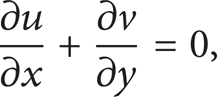


subject to the boundary conditions

where the “+” and “−” signs in (2) correspond to the assisting and opposing flows, respectively. The physical quantities, namely, the viscosity μ nf and the thermal diffusivity α nf of the nanofluid, are defined as (see Oztop and Abu-Nada [37])
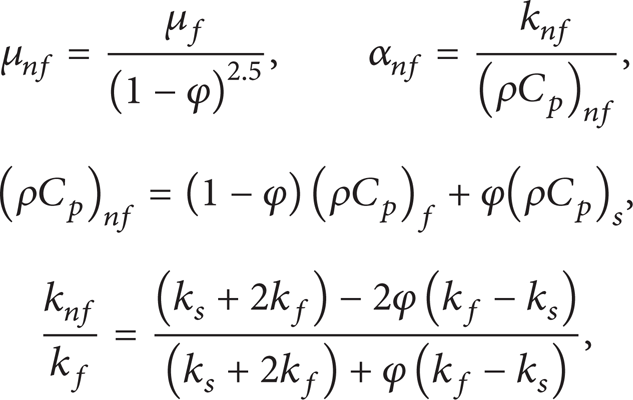
where k nf is the thermal conductivity of the nanofluid, φ is the nanoparticle volume fraction parameter, (ρC p ) nf is the heat capacity of the nanofluid, (ρC p ) f is the heat capacity of the fluid, and (ρC p ) s is the heat capacity of the solid. It should be stated that the expression of μ nf has been proposed by Brinkman [38]. On the other hand, it is worth mentioning that the expressions (5) are restricted to spherical nanoparticles where it does not account for other shapes of nanoparticles. Other models for the effective thermal conductivity of the nanofluid, k nf , can be found, for example, in the papers by Ding et al. [39]. The thermophysical properties of the base fluid (water) and nanoparticles are given in Table 1 (Oztop and Abu-Nada [37]).
Thermophysical properties of fluid and nanoparticles (Oztop and Abu-Nada [37]).

Given that (1)–(3) possess similarity solutions, we assume

where a, b, and c are positive constants, m is a parameter, and T0 is the ambient temperature at the leading edge. We notice that the stratified porous medium is stable when dT∞/dx > 0. Thus, we assume the following similarity variables (see Ishak et al. [19]):
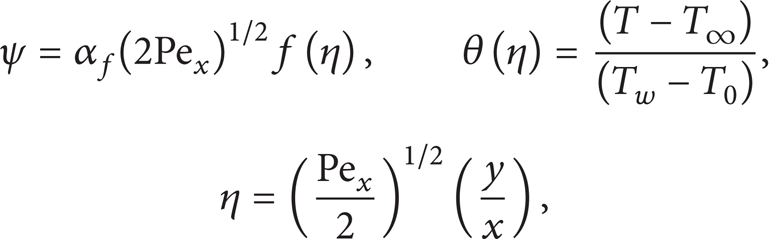
where Pe x = U(x)x/α f is the local Péclet number. Substituting (7) into (2) and (3), we obtain the following system of coupled ordinary differential equations:

subject to the boundary conditions

Here, λ = ± Ra x /Pe x is the constant mixed convection parameter with Ra x = ρ f gKβ f (T w – T∞)x/μ f α f being the local Rayleigh number for a porous medium, the “±” sign has the same meaning as in (2), and S = c/b is the constant stratification parameter. Further, from (8), we get
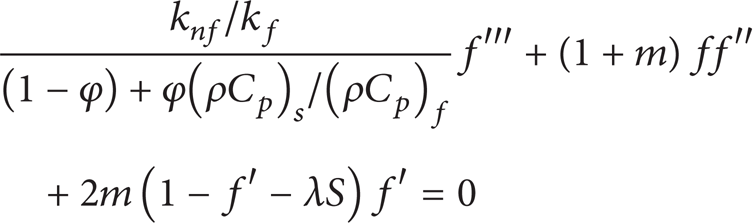
subject to the boundary conditions

It is worth mentioning that λ > 0 corresponds to an assisting flow (heated plate), λ < 0 corresponds to opposing flow (cooled plate), and λ = 0 corresponds to the forced convection flow. We also noticed that since the plate is heated, it implies that for 0 < S < 1, the porous medium is stable stratified and for S = 0, the porous medium is unstratified. The case of m = 1 corresponds to the steady mixed convection boundary layer flow near the stagnation point on the vertical surface embedded in a porous medium. It is worth mentioning that when φ = 0 (regular Newtonian fluid), (10) subjects to boundary conditions (11) reduces to that derived by Ishak et al. [19] and when m = 0, (10) subjects to (11) reduces to that derived by Ahmad and Pop [28].
The quantity of physical interest is the skin friction coefficient C f , which is easily shown to be given by

where Pr = v f /α f is the Prandtl number. Thus, our task is to study the variation of the skin friction coefficient (Pe x 1/2/2Pr)C f with φ, λ, m, and S.
3. Results and Discussion
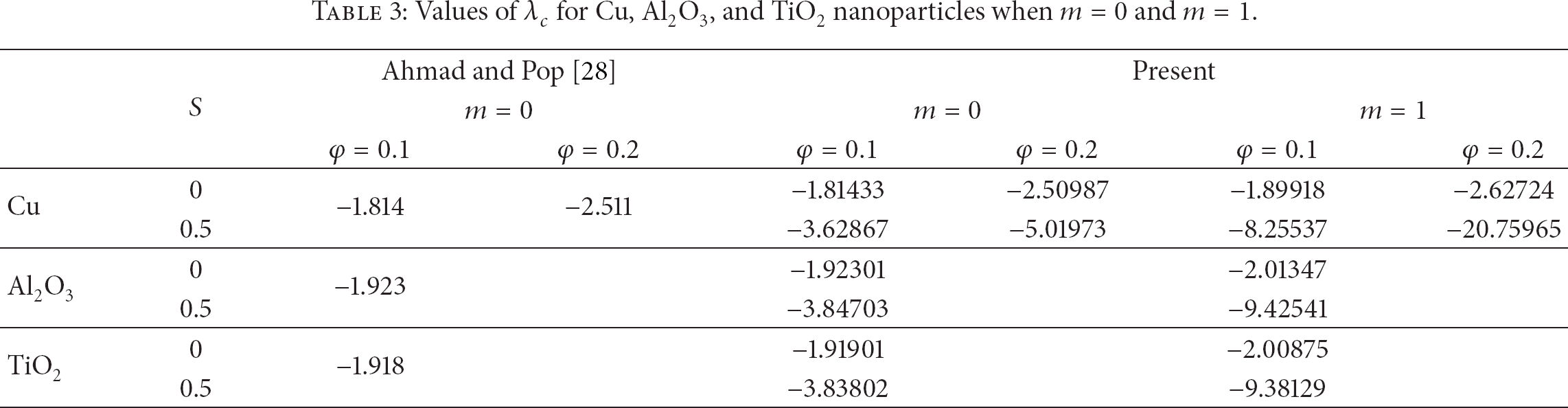
Equation (10) subjects to the boundary conditions (11) has been solved numerically by using the shooting method. This well-known technique is an iterative algorithm which attempts to identify appropriate initial conditions for a related initial value problem (IVP) that provides the solution to the original boundary value problem (BVP). The shooting method is based on MAPLE “dsolve” command and MAPLE implementation “shoot” (Meade et al. [40]). The effects of the nanoparticles volume fraction of nanofluid φ and the mixed convection parameter λ are analyzed for a porous medium filled with a regular fluid (φ = 0) and a porous medium filled with three different nanofluids as Cu-water, Al2O3-water, and TiO2-water as working fluids. Following Oztop and Abu-Nada [37], we have considered the range of nanoparticles volume fraction φ as 0 ≤ φ ≤ 0.2. Volume fraction parameter φ of the nanoparticles is a key parameter for studying the effect of nanoparticles on the flow fields and heat transfer characteristics. Thus, Figures 1–3 are prepared to present the effect of volume fraction of nanoparticles. In order to validate the present results, we have compared them with those for a regular fluid (φ = 0), m = 0, and S = 0, 0.5 (Ishak et al. [19]) as shown in Table 2. We have also compared the present results with those by Ahmad and Pop [28] when φ = 0.1, m = 0, and S = 0 for different types of nanoparticles (Cu, Al2O3, and TiO2) as shown in Table 3. It is clearly seen that the comparison shows very good agreement. We have also considered the case when m = 0, S = 0.5 and m = 1, S = 0 for φ = 0 for qualitative comparison with previously published results by Ishak et al. [19] as presented in Figures 1 and 2, and it is found again to be in a very good agreement. We are, therefore, confident that the present results are accurate.
Values of λ c for Cu nanoparticles when m = 0.

Values of λ c for Cu, Al2O3, and TiO2 nanoparticles when m = 0 and m = 1.
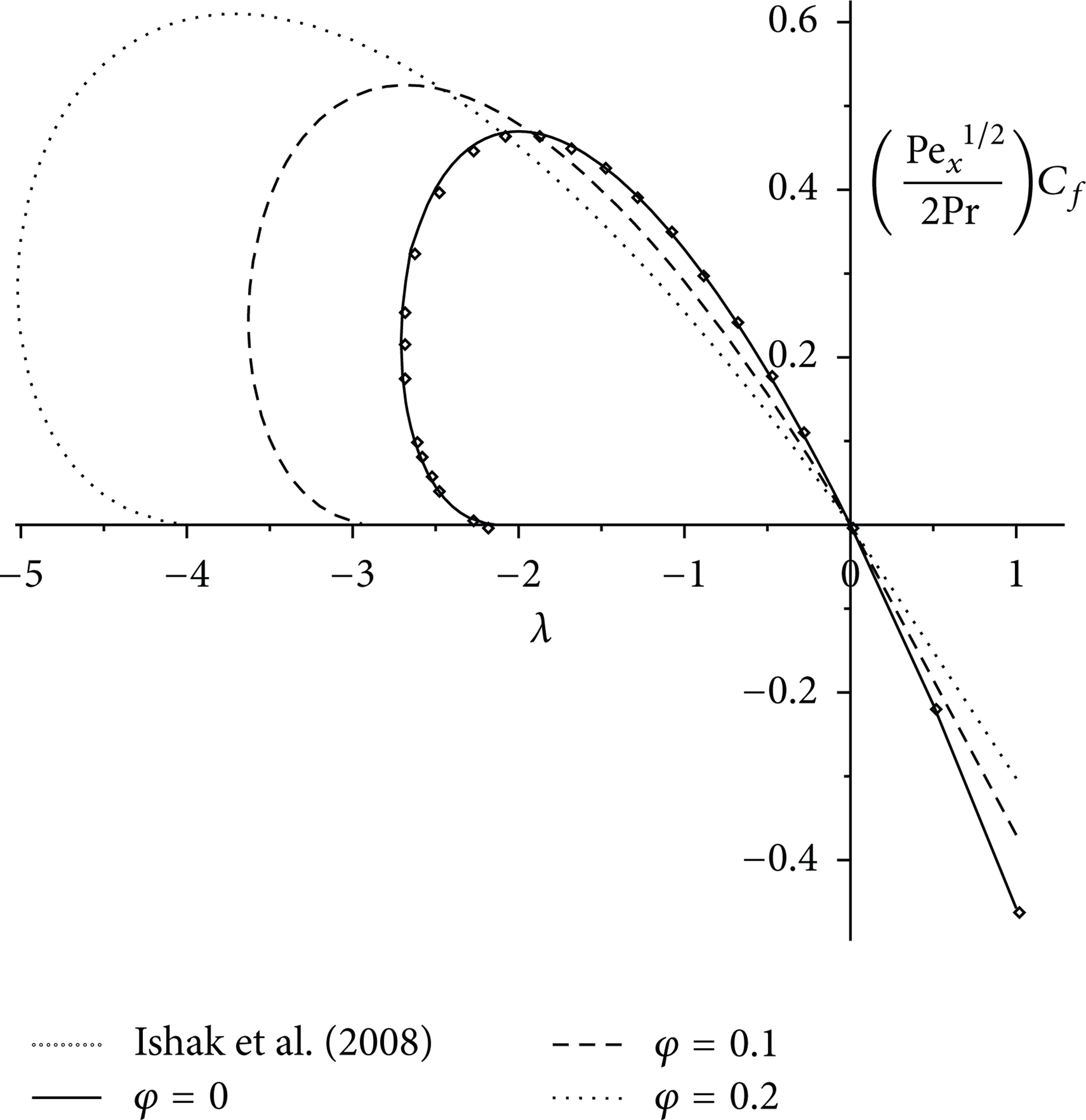
Variation of skin friction coefficient with λ for Cu nanoparticles when m = 0 and S = 0.5 for φ = 0, 0.1, and 0.2.
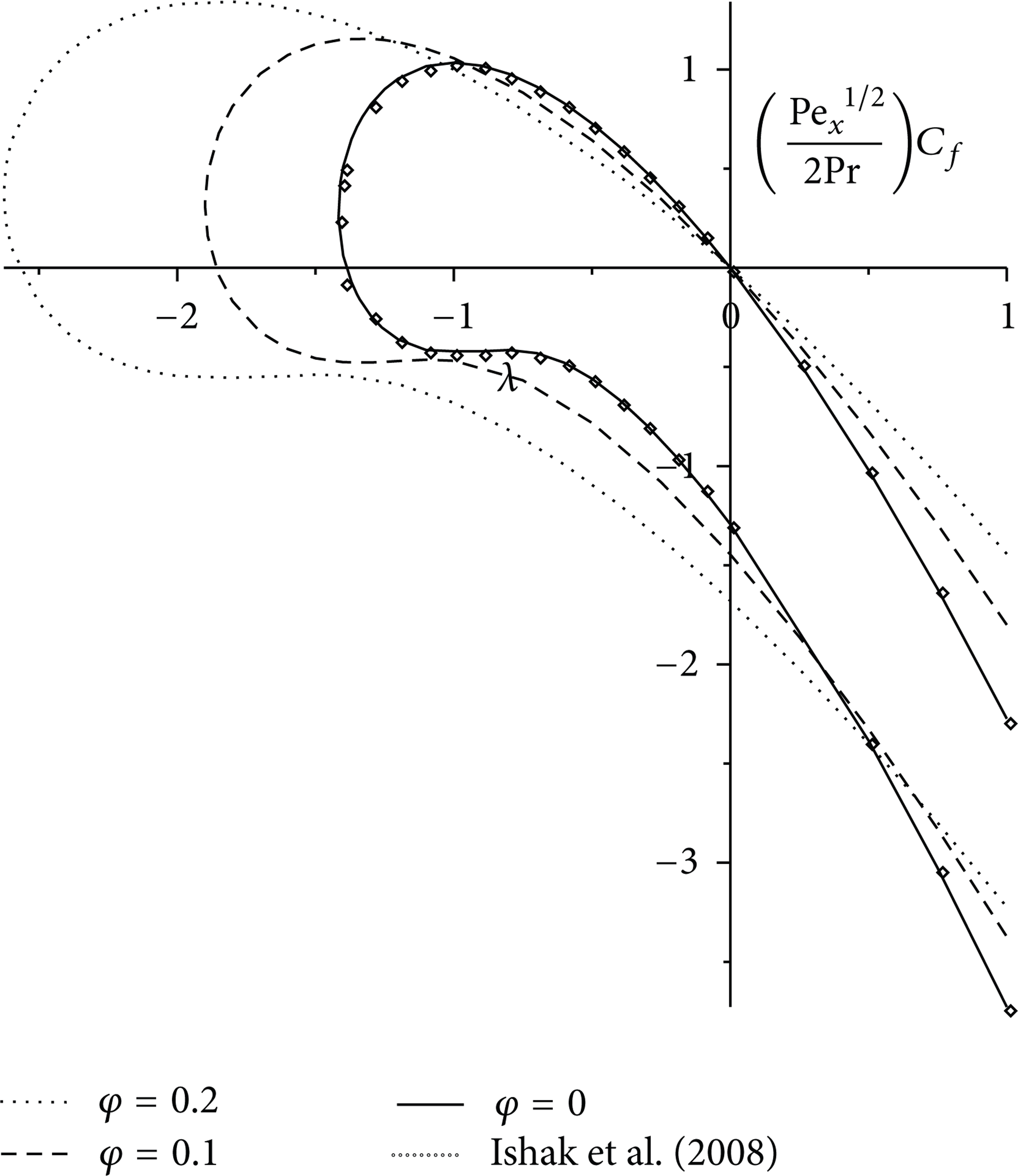
Variation of skin friction coefficient with λ for Cu nanoparticles when m = 1 and S = 0 for φ = 0, 0.1, and 0.2.
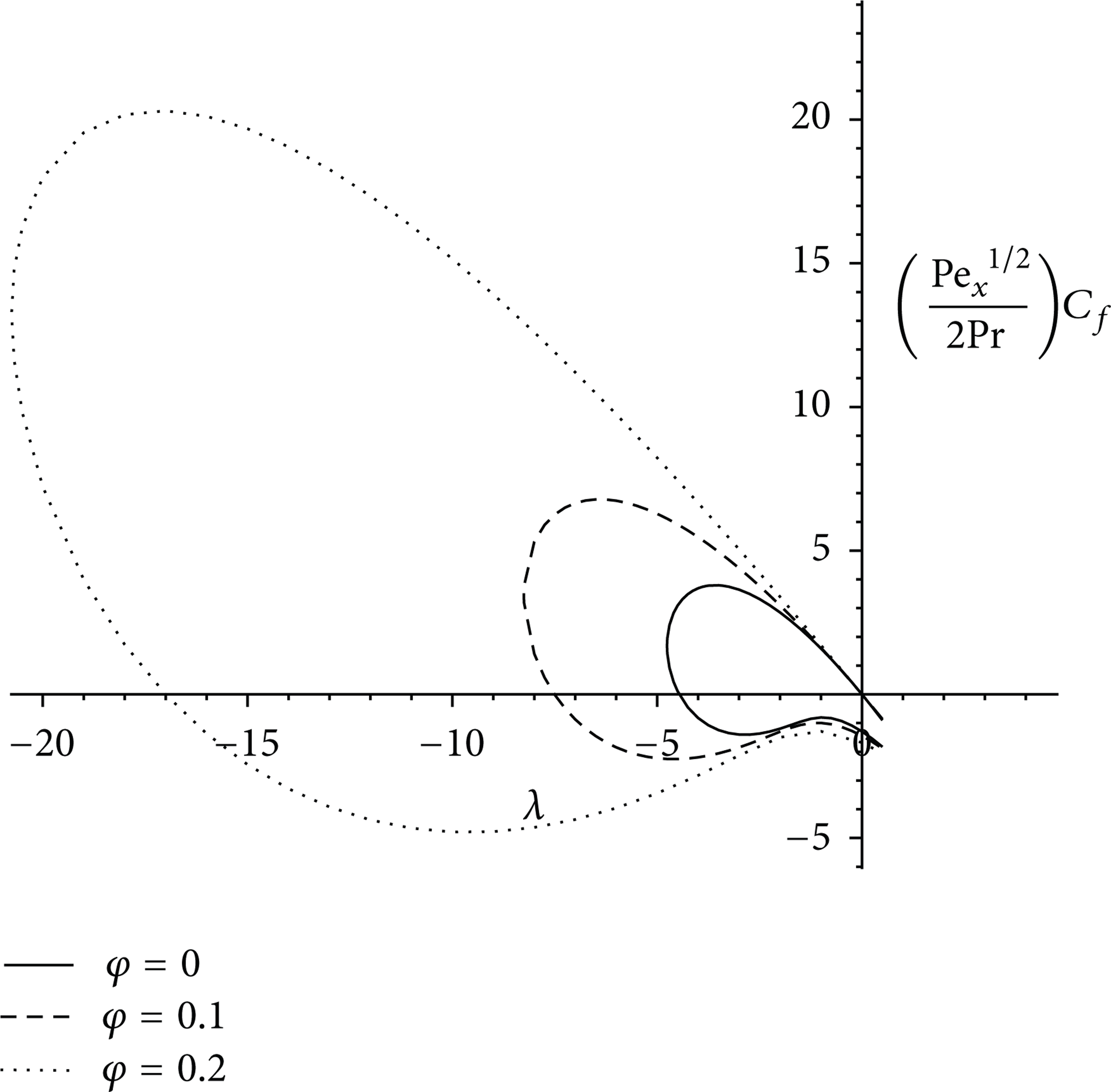
Variation of skin friction coefficient with λ for Cu nanoparticles when m = 1 and S = 0.5 for φ = 0, 0.1, and 0.2.
Figures 1–3 present the variations of the skin friction coefficient (Pe x 1/2/2Pr)C f with λ for Cu nanoparticles and various values of the nanoparticles volume fraction parameter φ. We found that there are two (dual) solutions, an upper branch and a lower branch solution, when m = 0 for a range of values of λ c < λ < λ s < 0 (opposing flow) as shown in Figure 1, where λ c (<0) is the critical value of λ(<0) for which we are unable to get the solutions of (10) subjects to (11) and λ c (<0) is the value of λ(<0) for which the boundary layer separates from the plate; that is, f″(0) = 0 (see (12)). However, dual solutions are found to exist also in the case of the assisting flow regime λ > 0, as well as in the opposing flow regime λ < 0 when m = 1 as presented in Figures 2 and 3. It is seen that the value of |λ c | increases as the nanoparticles volume fraction parameter φ increases, suggesting that nanofluid delays the boundary layer separation. Furthermore, the effects of stratified porous medium also delay the boundary layer separation as shown in Tables 2 and 3; that is, the value of |λ c | also increases when we increase the value of S, which means that the parameter S can also serves as a controlling parameter to delay or accelerate the boundary layer separation.
Figures 4–6 display the variations of the skin friction coefficient (Pe x 1/2/2Pr)C f with λ for different types of nanoparticles (Cu, Al2O3, and TiO2) when φ = 0.1. Referring to Figure 5, for m = 1, dual (upper and lower branches) solutions are found to exist also in both the assisting (λ > 0) as well as the opposing (λ < 0) flow regimes. We can also observe that for the nanoparticles Cu, Al2O3, and TiO2, the boundary layer starts to separate the fastest for the nanoparticles Cu, followed by TiO2 and Al2O3. This means that the nanoparticles Al2O3 delay the start of the boundary layer separation. However, there are not much differences in the values of λ c and λ s between TiO2 and Al2O3 for both Figures 5 and 6. Finally, the dimensionless velocity profiles f′(η) and the upper branch (first) and lower branch (second) solutions for Cu nanoparticles and various values of λ in the case φ = 0.1 when m = 0, S = 0.5 and m = 1, S = 0 are presented in Figures 7 and 8, respectively. The dashed lines refer to the lower branch (second) solution, and these profiles prove the existence of dual solutions. Both figures also show that the boundary conditions (11) are satisfied, which support the validity of the present results. However, it should be noticed that the upper branch (first) solutions are stable, and therefore, the results are physically realizable, while the lower branch (second) solutions are not stable.

Variation of skin friction coefficient for Cu, Al2O3, and TiO2 nanoparticles when m = 0 and S = 0.5 for φ = 0.1.
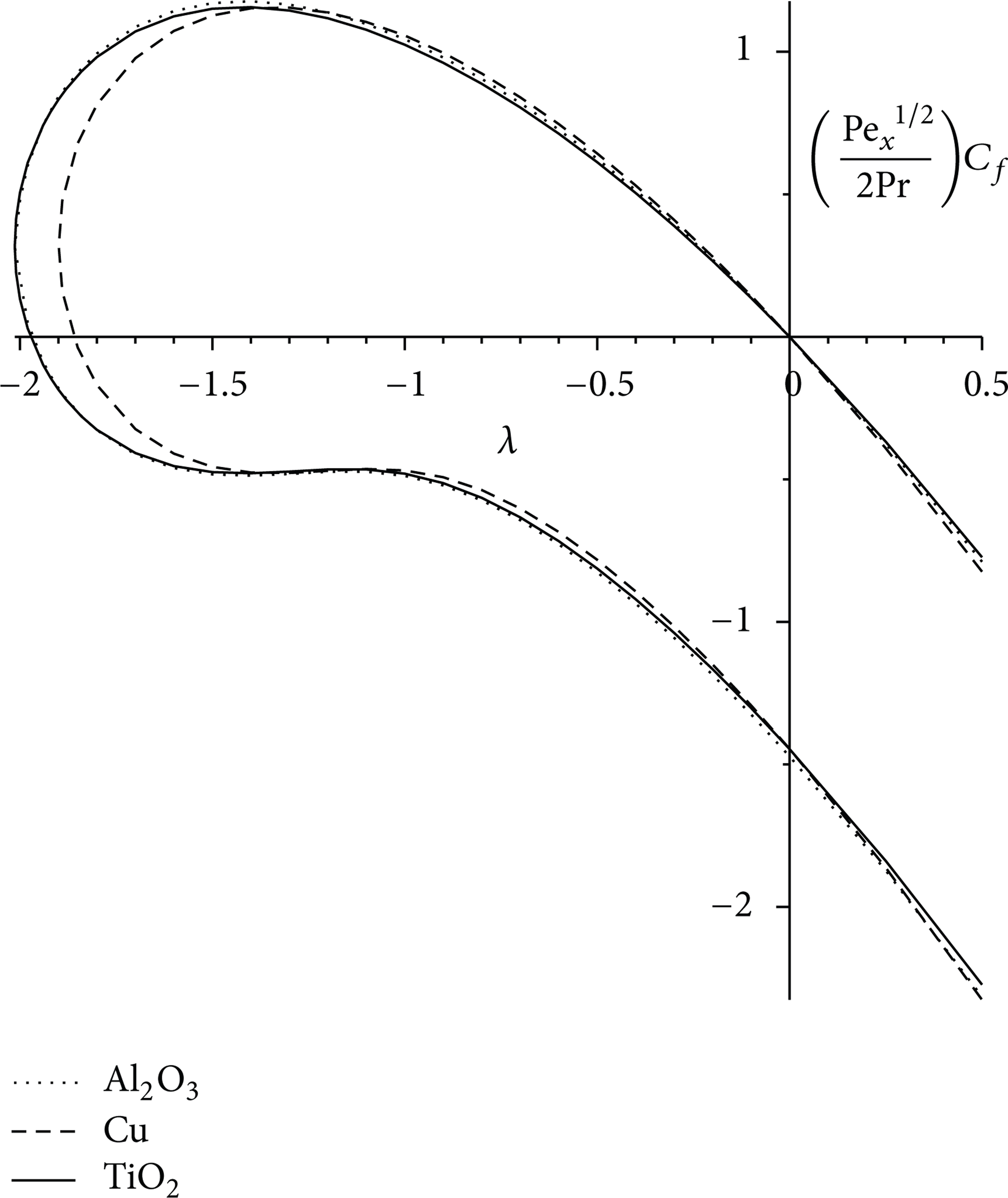
Variation of skin friction coefficient for Cu, Al2O3, and TiO2 nanoparticles when m = 1 and S = 0 for φ = 0.1.

Variation of skin friction coefficient for Cu, Al2O3, and TiO2 nanoparticles when m = 1 and S = 0.5 for φ = 0.1.

Velocity profile f′(η) for Cu nanoparticles when m = 0 and S = 0.5 for φ = 0.1.

Velocity profile f′(η) for Cu nanoparticles when m = 0 and S = 0.5 for φ = 0.
4. Conclusion
The steady mixed convection boundary layer flow over a vertical surface embedded in a thermally stratified porous medium saturated by a nanofluid is studied numerically. The similarity equations are solved numerically for three types of metallic or nonmetallic nanoparticles, namely, copper (Cu), alumina (TiO2), and titania (TiO2), in a water-based fluid. The effects of the governing parameters, such as the nanoparticles volume fraction parameter φ, the mixed convection parameter λ, the power law exponent m, and the stratification parameter S on the flow and heat transfer characteristics are examined in details. It is concluded that the addition of nanoparticles showed an improvement in the heat transfer rate from the surface. Therefore, the type of nanofluid is a key factor for heat transfer enhancement.
Footnotes
Nomenclature
Acknowledgments
The authors gratefully acknowledged the financial support received in the form of a FRGS research grant from the Ministry of Higher Education, Malaysia. They also wish to express their sincere thanks to the reviewers for the valuable comments and suggestions.