




Abstract
Two-way relay (TWR) communication, a new cooperation paradigm that allows two terminals to share one relay node to communicate with each other in two phases, has played an increasingly valuable role in wireless networks to meet the stringent throughput requirement. In this paper, we focus on the designing of automatic repeat-request (ARQ) protocols for the two-way wireless relay systems. According to different feedback schedules, we propose three basic ARQ protocols to improve the throughput of two-way relay systems, namely, relay-only ARQ (Ro-ARQ), terminal only ARQ (To-ARQ) and relay-terminal ARQ (RT-ARQ). Through analyzing the outage throughput of these three ARQ protocols, it is verified that all three protocols can improve the system performance. In addition, simulation results reveal that the RT-ARQ protocol has the closest performance to the theoretical throughput upperbound among all given methods without severe deterioration on system complexity.
1. Introduction
Wireless communication has experienced tremendous progress in the past two decades. The development of relative technologies, for example, coding schemes, multiple-input, multiple-output (MIMO), and orthogonal frequency-division multiplexing (OFDM), and so forth, has contributed on accelerating the transmission rate sharply from a few kilo-bits per second (e.g., AMPS) to more than 300 Mb/s (e.g., 3GPP LTE) accompanied with the appearance of high-rate-requiring services [1]. On the other hand, however, it can also be predicted that the challenge of transmission data rate would be more serious in the near future on considering such rate-demanding applications and the limited radio resources. To cope with the insufficiency of rate caused by a variety of factors including fading, noise accumulation and interference, and so forth, the implementation of relay is introduced to assist the communication where the radio resources are not ideal, such as edge of cellular systems [2]. In this paper, two-way relay (TWR) channel, also known as physical-layer network coding (PNC) [3–6], is discussed for its improved spectral efficiency over the one-way relay or any other conventional relay strategies. The key idea of two-way relay is that two participating terminals can simultaneously transmit packets to the relay in the same phase, after which the relay processes the received signal and broadcasts it to each destination in the following phase. In other words, different from sequential data rate [7], both interacting terminals can exchange information via transmitting or receiving synchronously.
Recent works on two-way relay channels have gained great achievements on promoting its performance. These papers [3, 4] mainly demonstrated the application and designing of PNC. In [8], transmission protocols for TWR were proposed and verified of their contribution on the multiplexing as well as the diversity gain. Also, [9] designed a method of optimization on two-way relay transmission which raised the sumrate and utilize Karush Kuhn Tucker (KKT) condition to transform a nonconvex problem of power-minimization into a feasible one, reaching a tradeoff between multiplexing and diversity gain. To mitigate error propagation, error check at relay was introduced in the work of [10], by setting a threshold at relay.
Departing from most previous works in TWR [1–10], an alternative method to improve system performance is applying the automatic repeat-request (ARQ) protocols at the data link layer to guarantee the system throughput performance [11], where cyclical redundancy check (CRC) is used for checking error packets, and retransmissions are requested if packets are received in error. The tasks of ARQ protocol designing for two-way relay channels were also conducted in previous works lately. In [12], a set of ARQ protocols were presented and analyzed but under the assumption that the bit-error rate (BER) between the relay and each individual terminal is directly assigned instead of taking the influence of transmitting power and rate into account. A unique set of ARQ protocols for TWR were also proposed and analyzed in [13] and it can be viewed as a special case of this work. Since there are two terminals and one relay in the two-way relay system, different feedback schedules can be designed to meet various transmission conditions for ARQ protocol [14]. For this reason, the ARQ protocols in our work are classified into 3 types according to where retransmissions are requested for an erroneous packet:
relay-only ARQ (RO-ARQ), where retransmissions are requested at relay and the link reliability from terminals to the relay is guaranteed only, terminal-only ARQ (TO-ARQ), where only the terminals execute repeat-request, and the end-to-end link between the terminals via relay will affect the performance, and relay-terminal ARQ (RT-ARQ), which combines the RO-ARQ and TO-ARQ protocol together.
In [15], we just proposed above three protocols and described the details but did not analyze the performances and performed complete simulations. In this journal paper, throughput performances are analyzed. Finite-state Markov chain is applied to decompose the procedure of ARQ protocol into discrete states like [16]. Computer simulations are performed to verify the performance analysis. It can be obtained that the proposed protocols promote the throughput, and RT-ARQ protocol has the best performance.
The paper is organized as follows. A brief description of the system model of two-way relay channels is introduced in Section 2, followed by the detailed procedures of all three ARQ protocols in Section 3. The method of finite-state Markov chain analysis of the given protocols is in Section 4. After that, in Section 5, Monte-Carlo simulations of all three protocols are conducted. Finally the work is concluded in Section 6.
2. System Model and Assumptions
This work considers a wireless network where two terminals,

The two-way relay channel.
In the MA phase, the symbols of


In the BC phase, the relay broadcasts

3. Protocol Descriptions
In this paper, we aim at improving the reliable transmission in the TWR systems; thus, we propose three basic ARQ protocols to fulfill this purpose: relay-only ARQ (RO-ARQ), terminal-only ARQ (TO-ARQ), and relay-terminal ARQ (RT-ARQ), which are named by where the retransmissions are requested and which link reliability is ensured. They are described in detail as follows. The analysis on their performance of throughput will be discussed in the next section.
3.1. RO-ARQ
Relay-only arq: only the relay feeds back the CRC, checking results of decoded packets
Case 1.
No packets are in error at relay. The relay transmits two ACK messages, which inform
Case 2.
One packet is in error at relay. If
Case 3.
Both the packets are in error at relay. The relay discards all the wrong packets and feeds back two NACK messages to inform the two terminals to retransmit copies of their packets. Retransmission will be started immediately on receiving the NACks. In other words, BC phase is skipped, and MA phase will be executed again. Figure 2 depicts the RO-ARQ protocol in detail.

The RO-ARQ protocol.
3.2. TO-ARQ
Terminal-only ARQ: only the terminal feeds back the CRC-checking results after the BC phase. The relay just decodes and forwards in the MA phase and feedback duration; thus, the whole end-to-end link between
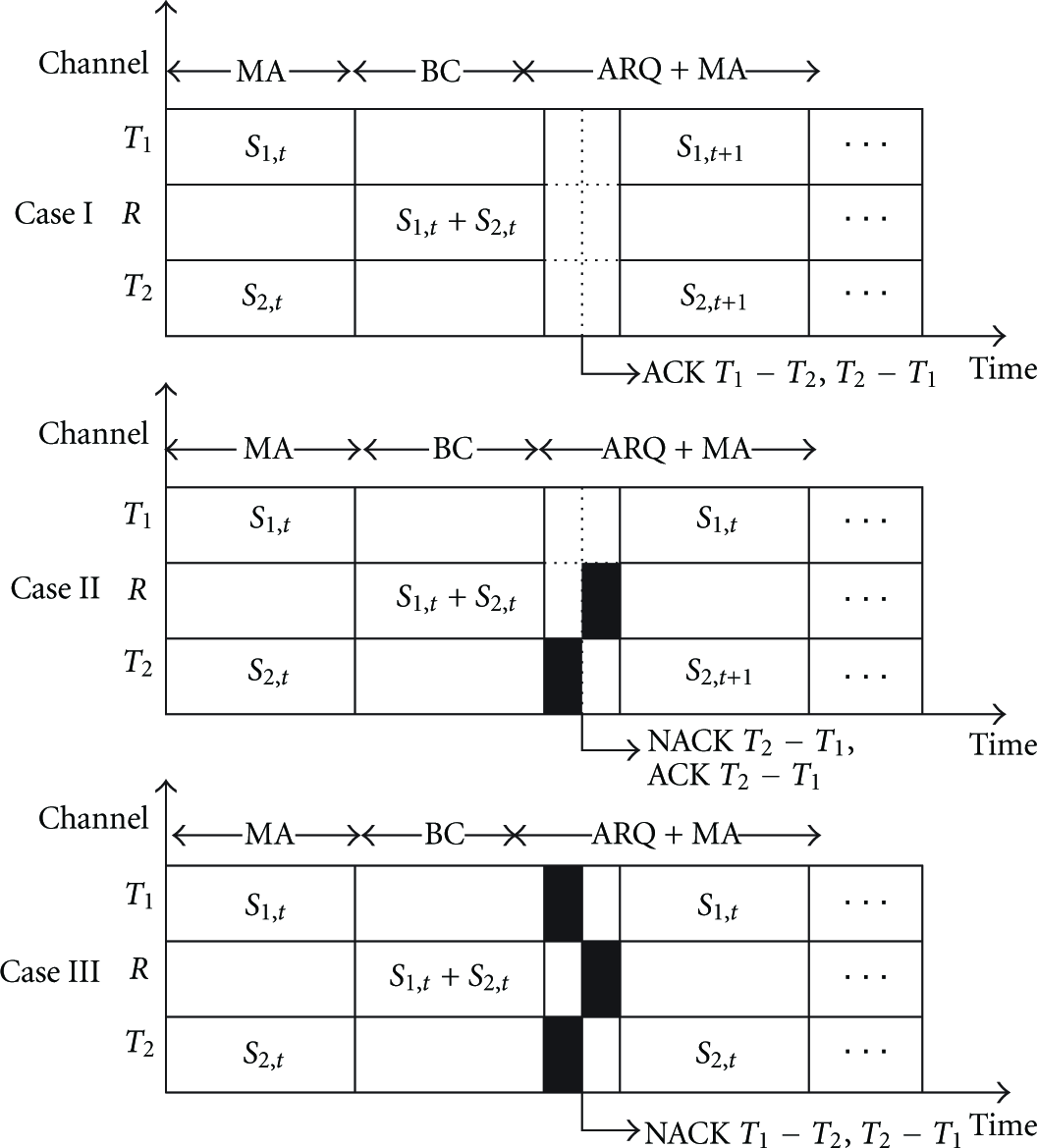
The TO-ARQ protocol.
Case 1.
No packets are in error at terminal. Each terminal transmits an ACK message to the other one via the relay, informing that the packet was received correctly. Then the next packet slot is started.
Case 2.
One packet is in error at terminal. If the packet received by
Case 3.
Both the packets are in error at terminal. Each terminal will feed back a NACK message to inform the other one to retransmit the packet in next packet slot.
3.3. RT-ARQ
Relay-terminal ARQ: both the relay and terminals feed back the CRC-checking results, which combine the RO-ARQ and TO-ARQ protocol together. The relay will retransmit the packet only if packets are received at relay correctly in the MA phase yet corrupted at terminals during the BC phase. Similarly, when the relay detects error packets, NACKs will be sent to terminals and retransmission will be executed correspondingly. Note that whenever a packet fails to transmit correctly, only the related phase (i.e., MA when error at relay, BC when error at terminals) will be re-executed instead of the whole packet slot. Six packet error cases are classified to describe the RT-ARQ protocol as shown in Figure 4.

The RT-ARQ protocol.
Case 1.
No packets are in error at relay and terminals. The relay sends ACK messages to both terminals. The terminals send their ACK messages back in the feedback duration.
Case 2.
No packets are in error at relay, while only one terminal's packet corrupted at terminal. The terminal who received the failed packet sends a NACK back in the feedback duration, and the BC phase will be executed again in which the relay retransmits the copy.
Case 3.
No packets are in error at relay, while both the packets corrupted at terminal. Each terminal sends a NACK back, and the relay carries out the same operation as Case 2.
Case 4.
Only one terminal's packet is in error at relay while no errors at terminal. The relay sends a NACK back for
Case 5.
Only one terminal's packet in error at relay, while the other's corrupted at the terminal. The relay sends a NACK back for
Case 6.
Both the packets in error at relay. The relay feeds back two NACK messages to inform the terminals to retransmit their incorrect packet again in next packet slot.
4. Throughput Analysis
Data reliability in this work is more considered rather than the transmitting latency, forasmuch the relay and terminals will discard all failed copies of packets and their decoding are based only on the most recent copies, which have the highest probability of transmitting successfully [13]. By taking this issue into considerations, the system long-term throughput could be defined as:

In this section, the procedures of all three types of ARQ protocol would be described and analyzed under the models of finite state Markov chains. Consequently, the proposed ARQ protocols satisfy appropriate assumptions of stationary and ergodicity. Thence, the long-term throughput can be re-written as

Before the analysis of proposed ARQ protocols is provided, several variables will be employed helping describe the outage probabilities of each model. In the MA phase, the outage probabilities could be depicted in Figure 5 [20].

Achievable region conditioned on channel state for two-user MAC. Note that
Each region represents an individual event when two packets arrive at relay in the MA phase.
Region 1: packet from Region 2: packet from Region 3: both packets fail; Region 4: both packets arrive successfully.
Variables

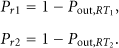
In the BC phase, the link between the relay and two terminals can be viewed as peer-to-peer links [13], and the outage probabilities on each link are defined as

In order to represent the expressions in the rest of the paper less complicated, the complements of
4.1. Upper Bound
The upper bound of the transmission can be obtained by assuming that two terminals can transmit without interfering each other. Thus, the maximum throughput of any terminal (e.g.,

Analogously, the maximum throughput
4.2. RO-ARQ
Under the protocol of RO-ARQ, the repeat request is only made at the relay node; therefore the model can be studied as a Markov chain with states of relay's buffer.
The states above can be depicted in Figure 6. As can be seen from the diagram, a successful transmission from

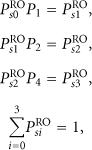



The state-transition diagram of RO-ARQ protocol.
4.3. TO-ARQ
In TO-ARQ model, the signals received at relay do not reveal whether the transmission is successful or not. Due to this reason, the analysis of TO-ARQ model adopts the combination of the relay's buffer together with terminals' rather than the relay's alone as the state variable. Under such circumstance, the state variable also has five possibilities:
The states above can be depicted in Figure 7. Here the state-transition probabilities are coded for the convenience of representation as follows:

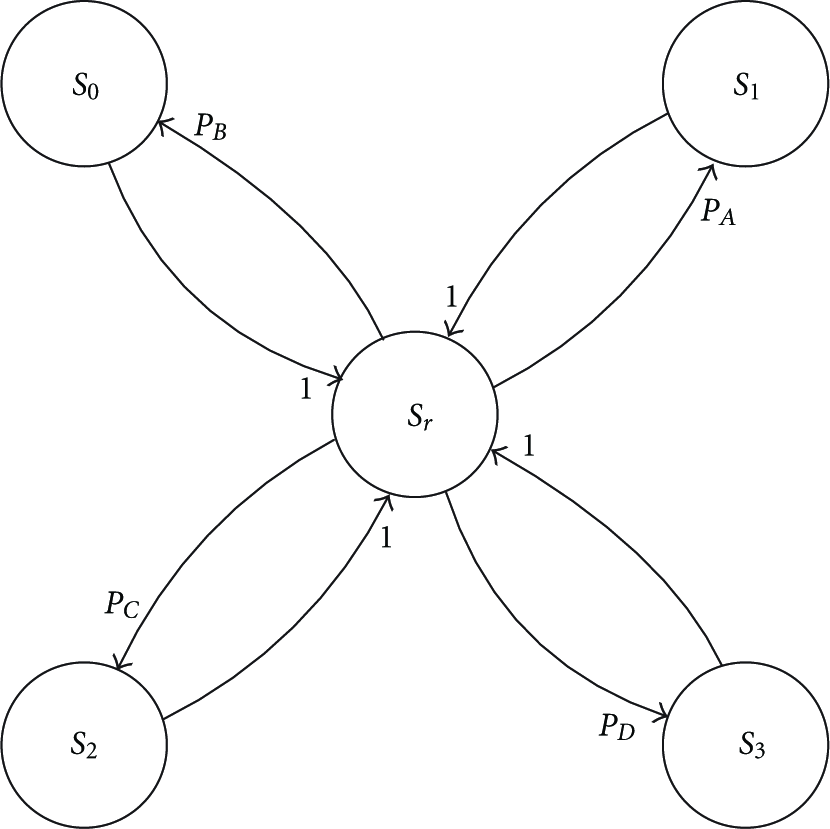
The state-transition diagram of TO-ARQ protocol.
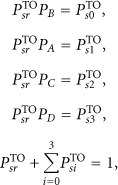
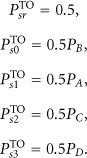
The state-transition equations of this Markov chain are the following:

4.4. RT-ARQ
In RT-ARQ model, the relay shares the same functions as in RO-ARQ while it executes the retransmission requested by terminals. Hence, the state variable can be similar with that of RO-ARQ yet it is not the representation of the relay's buffer alone, but also, the operations the relay going to take in the next phase. Therefore, the diagram of the state transition needs modification as well to suit the current protocol, which is shown in Figure 8. The definitions of RT-ARQ's state
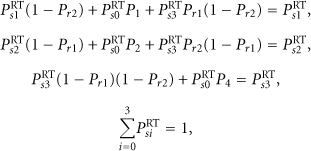
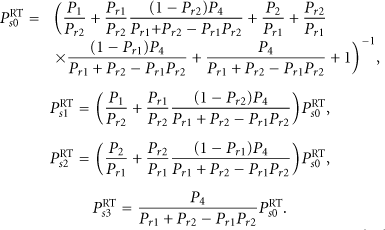
The state-transition equations of this Markov chain are the following:
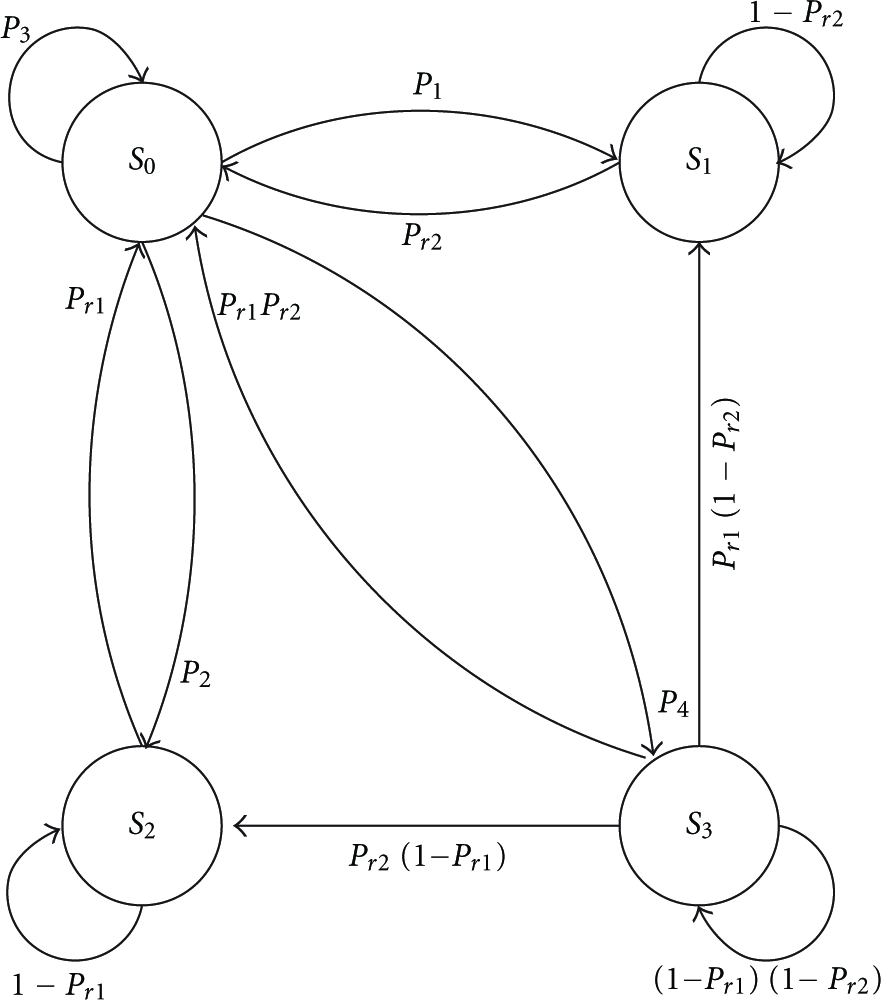
The state-transition diagram of RT-ARQ protocol.
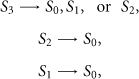
A successful transmission from

4.5. Throughput Comparisons of Different ARQ
By calculating the difference between each of
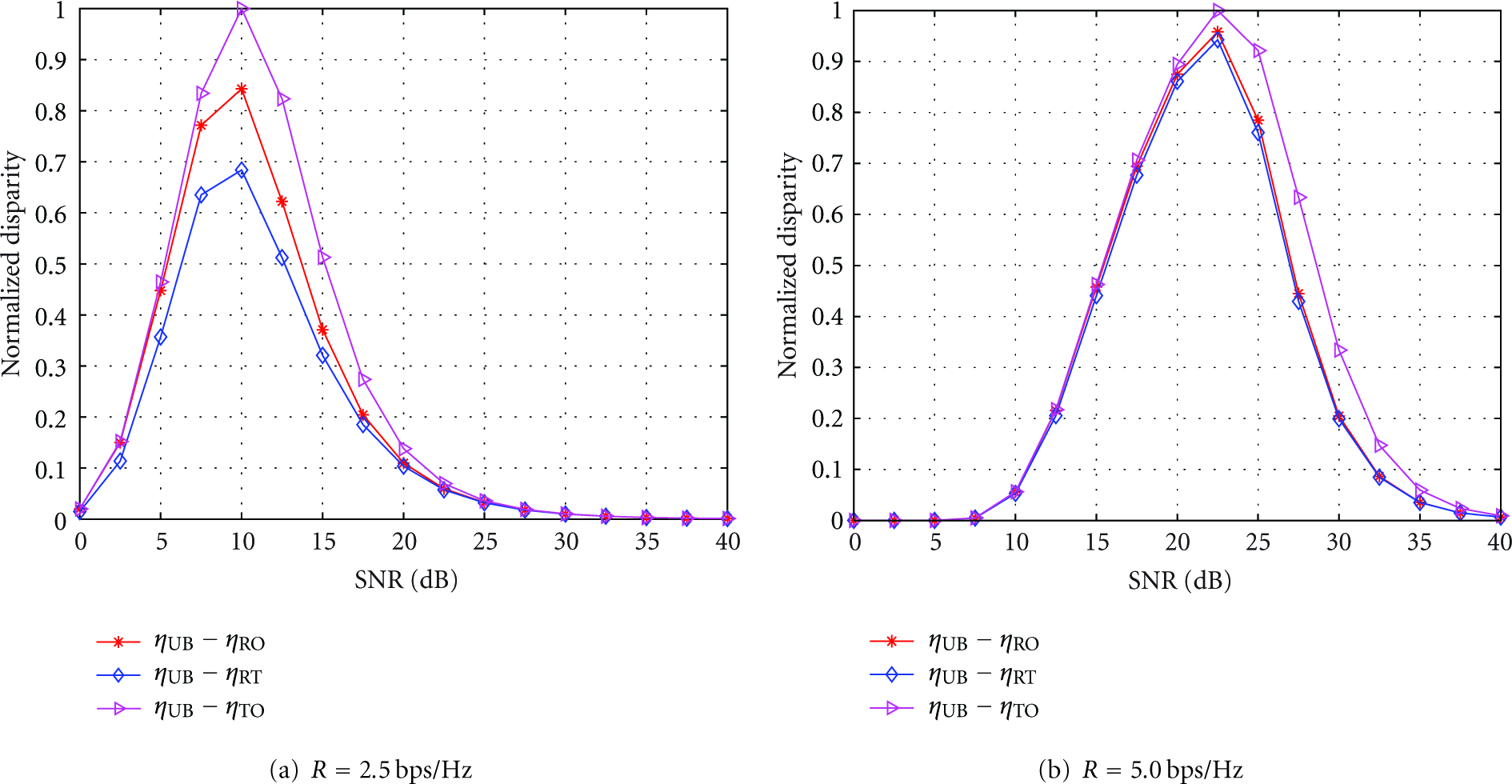
Throughput difference between the upper bound and each of the proposed ARQ protocols under the transmitting rate of
Thereby the mutual gap between each protocol's throughput performances can be predicted from each of their differences with the upper bound. The gap between the RT-ARQ and TO-ARQ is omitted because the combination of RT-RO gap and RO-TO gap can indirectly reflect the RT-TO gap which is shown in Figure 10. When the rate is relatively low, the performance of RO-ARQ is quite close to that of the TO-ARQ's. And when it rises, on the contrary, RO-ARQ's throughput performance will approach RT-ARQ's. Therefore, it will be much saving to choose RO-ARQ over RT-ARQ under high transmitting rate since they perform similarly while reducing the number of execution of ARQ by half. However, RT-ARQ is more preferable when the rate is low for the throughput performance can be guaranteed.
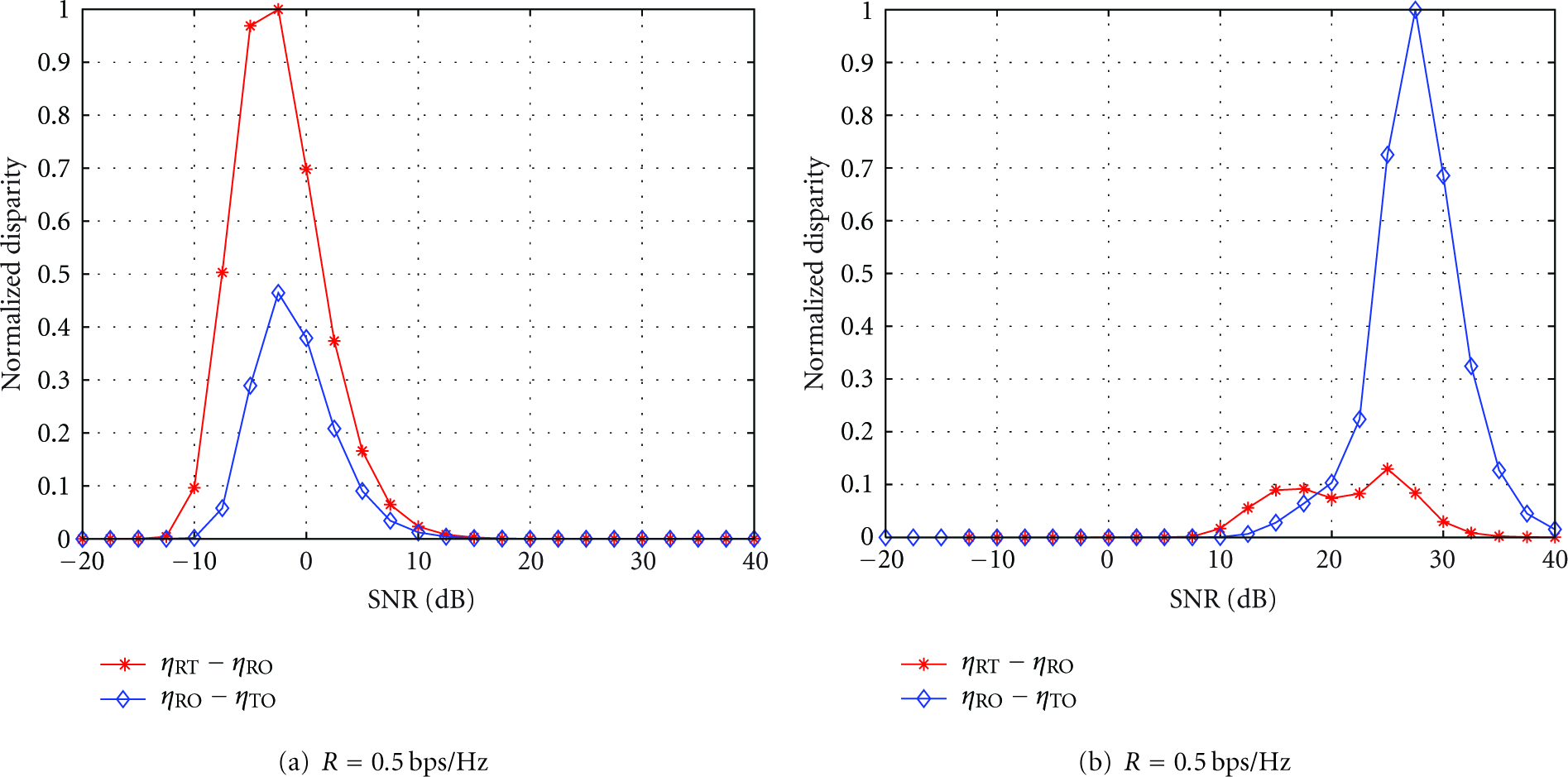
Throughput difference of RT-RO and RO-TO, under the transmitting rate of
5. Numerical Results
In this section, computer simulation results are presented to reveal the end-to-end throughput performance of proposed ARQ protocols. For the sake of comparison, the evaluation of the transmission's upper bound is also taken into the simulation. The simulation focused on symmetric case in which

Normalized throughput
As can be seen, for any given transmission rate, RT-ARQ protocol has the best throughput performance among all the proposed schemes, and RO-ARQ has better throughput efficiency than TO-ARQ under any circumstances. This is due to the reason that RT-ARQ has the most flexible slot procedure. To be specified, whenever an erroneous transmission occurs, the retransmission requirement can be sent immediately in the next phase under RT-ARQ protocol: consequently, the MA or BC phase can be reexecuted and need not have to wait for any idle phase. In other words, the retransmission of RT-ARQ takes half the period of a slot on average. RO-ARQ protocol has the ability to reexecute the MA phase when packets arrive at relay unsuccessfully; yet, links of the second hop are not guaranteed forasmuch the successful transmission of a packet will require the retransmission to take more than one phase while less than a whole slot. As for TO-ARQ protocol, the retransmission takes a whole slot to carry out in the long run, and the MA phase will be seen as an idle phase when mistakes appear. For example, if a packet arrives at relay with mistake, it will take RT-ARQ and RO-ARQ protocol one phase to accomplish the retransmission comparing that TO-ARQ will take a full slot.
When SNR is at low region, all protocols' curves including the upper bound are near zero and when SNR transcends a threshold value, throughput values rise dramatically and approach one. This is attributed to the fact that when SNR is abysmal, high-outage probability will stuck all the protocol at retransmitting states, causing decode-recode at relay unreliable. On the contrary, TWR system runs between the state of ready-to-send and the state of receiving successfully when SNR is very high. The rising range, observed from the figures, is approximately 20 dB, and the threshold floats with the transmission rate. However, comparing with the upper bound, the threshold of proposed protocols is rather more sensitive to the rate; thus, their curves move toward right side faster than the upper bound's curve as the rate increases.
Another set of curves are presented to demonstrate the performance of unequal transmission rate (i.e.,
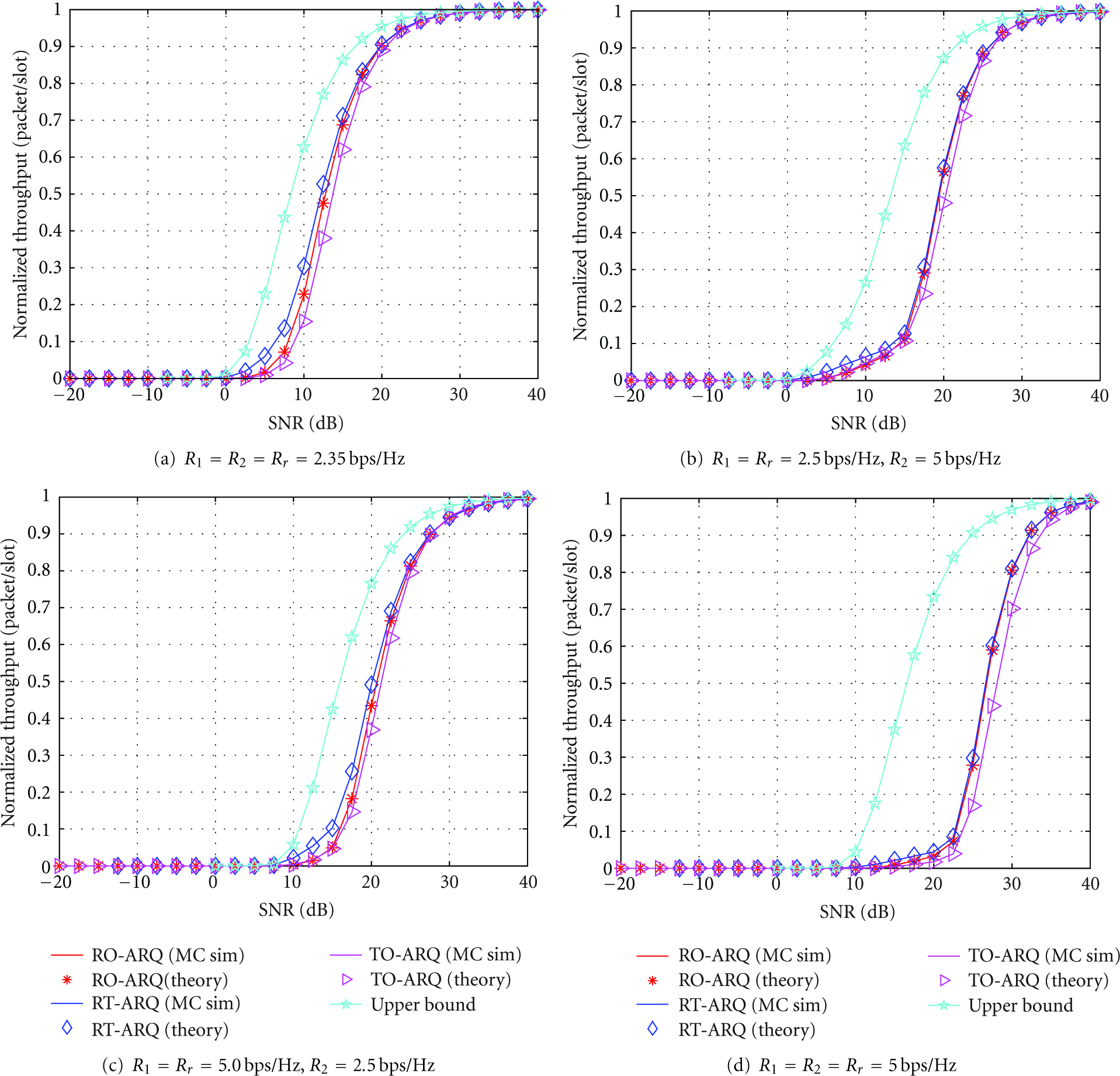
Normalized throughput
6. Conclusion
In this paper, three ARQ protocols are investigated which designed for two-way relay systems with physical-layer network coding according to different feedback schedules at the relay and terminals. Work mainly focuses on the link reliability improvement in terms of end-to-end throughput of TWR system over slow fading wireless channels. Through performance evaluations, we confirmed that the proposed protocols can offer a smoother increase of the throughput curve, and it can significantly improve the end-to-end throughput performance in two-way relay systems. It can be observed that the RT-ARQ protocol has a better performance than the other protocols and can best approach the upper bound under low transmission rate among all proposed schemes.
Footnotes
Acknowledgments
The work of C. Zhang is supported by the Fundamental Research Funds for the Central Universities, by the National Natural Science Foundation of China (No. 61102082), by the Open Research Fund of National Mobile Communications Research Laboratory, Southeast University (no. 2011D14) and National Hi-Tech Research Development Program, “863 Program,” (no. 2011AA01A105). This work is supported in part by Natural Science Foundation of Education Department of Anhui, China (no. KJ2010A333) and National High Tech. Development Program of China (no. 2010ZX03003-002 and 2011ZX03004-002-01).