




Abstract
This paper presents and puts forward an optimal automatic distributing of physical cell identity (ADPCI) scheme for the self-organizing network (SON). Considering the high number and the layered structure of the evolved node B (eNodeB, eNB) in the initial rollout phase, the assigning of PCI for cells would be quite complex. The PCI self-distributing problem is mapped to the well-known minimum spanning tree (MST) problem in order to optimize the PCI reuse distance and decrease the multiplexing interference. The correlation property of PCI is analyzed and taken into consideration in the assigning phase. Moreover, a suboptimal algorithm (SADPCI) is presented as it performs approximately to ADPCI but the computational complexity is lower. To demonstrate the proposal validity, performances of ADPCI and SADPCI are evaluated. Simulation results illustrate that these schemes can achieve significantly higher performance even under the condition of severe PCI deficiency.
1. Introduction
There is a strong momentum for self-organizing features in wireless communication networks, self-configuration and self-optimization are identified as two mechanisms to facilitate operation and manage the long term evolution (LTE) network [1, 2]. In parallel, the self-distribution of PCI is included in the self-configuration use cases defined by the Next Generation Mobile Networks (NGMN) Alliance [3].
The objective of this use case is to assign a PCI to each cell so that mobile terminals can identify neighboring cells without ambiguity. PCI indicates the primary and secondary synchronization signals which help user equipment (UE) to acquire frequency and time synchronization during the cell search phase. However, considering the high number and layered structure of eNodeBs, finite number of IDs need to be reused across the network. Therefore, PCI allocation must to be planned carefully to avoid multiplexing interference and conflict. Methods for managing other radio resources [4, 5] can also be applied in PCI allocation.
Some proposals are discussed in [6–10]. One suggests that eNB scans its own radio environment, especially in terms of reception of the down-link transmission band of neighboring radio cells to acquire PCI information. The scanning method helps eNB to identify unavailable PCI and thus avoid collision to a certain degree. However, in order to perform a confusion free selection of PCI, the PCI assigning information of neighbors' neighbors have to be measured, but the measurement result depends on the signal quality which cannot be guaranteed. Another method has performed a distributed solution that relies on the use of a temporary PCI. The new eNB chooses a random PCI from a predefined set provided by operation administration and Maintenance (OAM) and starts to operate. The automatic neighbor relationship (ANR) function is utilized to acquire neighbors' PCI information supported by UEs. The method performs more effectively to address both collision and confusion requirements than the previous method. However, it relies on the proper location of UEs to identify each of all the neighbors; furthermore, PCI reconfiguration causes UE dropping and brings too much overhead to the system. A centralized approach [9] has mapped the PCI assignment problem to the well-known and well-understood problem of graph coloring. The coloring algorithm is used and simply extended in the approach, and it provides an efficient initial assignment even for complex networks. The scheme has analyzed the properties of the colored graph that is used for extending the network with new cells, and the results show that only minimal interruptions have occurred while still retaining the properties of a colored graph. Another centralized approach (HCPCI) [10] has introduced a hyper graph coloring PCI assigning scheme. The neighbor's relationship degree N is regarded to be the reuse distance; only when
This paper proposes an automatic distributing PCI scheme. At first, the correlations between different PCIs are analyzed and the interinfluence IDs are classified into different groups. The PCI distributing problem is mapped to the well-known MST problem and the reuse distance is taken into account in order to decrease the multiplexing interference throughout the entire network. A suboptimal scheme is proposed as a second solution which has a good performance approximated to ADPCI but with much lower computational complexity.
The remainder of this paper is organized as follows. Section 2 contains a detailed description of scenarios and the framework of PCI management, the distributing principles as well. Section 3 analyzes the correlation property of IDs and represents the proposed schemes of ADPCI and SADPCI. The performance evaluation is presented in Section 4, followed by a conclusion in Section 5.
2. PCI Assigning Framework and Principles
2.1. PCI Distributing Scenario and Framework
Two typical scenarios are defined in the SON description specification [6]. In a macrocell deployment, a large number of eNBs are deployed and requiring PCI configuration during the initial network establishment. However, the number of PCIs is limited and insufficient to guarantee that each cell gets an individual PCI. Thus, PCI has to be reused in the network which brings the multiplexing interference inevitably. Another scenario is the assignment for individual eNB during the network growth.
To minimize the human interventions and decrease the planning, deployment, optimization, and maintenance activities, the newly deployed eNBs are configured by automatic installation procedures by OAM to get basic parameters and download necessary software for operation. The support for PCI assignment is translated into concrete functionalities, interfaces, and procedures as shown in Figure 1.

The framework of PCI self-configuration.
Centralized SON function: according to centralized SON function, the newly deployed eNBs obtains relevant PCI allocating information, including antenna location, cell identity, cell radius, down tilt, and height of antenna. The geographic coordinates can be obtained with the help of the global position system (GPS) and other information is acquired during the base station establishment phase. The information of eNBs are classified and provided to upper layer OAM through Itf-N (interface-north).
Data processing/configuration interface: this module has the responsibility to process the data obtained from the network, like cell type, cell state, and the neighbor relations are classified and transmitted to the database. When the PCI allocating decision is made, it indicates eNBs to update the results.
Policy management base: this module indicates the PCI self-configuring policy. Operators can provide specific groups of IDs which meet specific requirements for example to ensure uniqueness in border regions. The policy can be created, edited, and modified by the operators or through the PCI allocation feedback information.
PCI algorithm execution: based on the information from database, PCI algorithm analyzes the allocating policy and executes for PCI distribution.
PCI resources management bases: PCI usage status is stored in resource bases, including PCI reuse frequency, the PCI number for macro cell, and heterogeneous nodes.
Database: mainly contains related information that obtained from lower layer or indicated from other modules. It provides indispensible information for the algorithm, for example, cell state information, cell type information, and neighbor list.
2.2. Allocation Issues and Principles
Despite the existence of 504 different IDs, the actual available identities are limited to a smaller number. IDs are grouped into 168 groups and three sequential PCIs are generally corresponding to three sectors in an eNodeB. Furthermore, IDs are divided into subsets for macro-, micro-, and femtocells in order to simplify the new eNB introduction in one layer without impacting on other layers. The available PCI number for macro cell is not as redundant as expected, therefore PCI reuse is inevitable. The optimization of PCI assigning relies on the location and basic orientation of eNBs and the reuse distance should be taken into account. The objective of ADPCI is to optimize the reuse distance and minimize interference to achieve global optimum.
In addition, each cell identity corresponds to a unique combination of an primary synchronization signal (PSS) sequence and an secondary synchronization signal (SSS) sequence, each of which comprises of a sequence of length 62 symbols and perforce a great correlation property. However, a number of SSS sequences are high correlated to others, which affects UE to recognize the target cell. The cross-correlation properties are analyzed in the next section. On the other hand, the automatic configuration is specified to meet the requirements of collision and confusion free [6]. The former means two neighbor cells cannot use identical ID; the latter one implies that one cell cannot have any two neighbor cells that assigned with identical ID, thus allowing for ID reuse by 3rd degree neighbors, as shown in Figure 2.
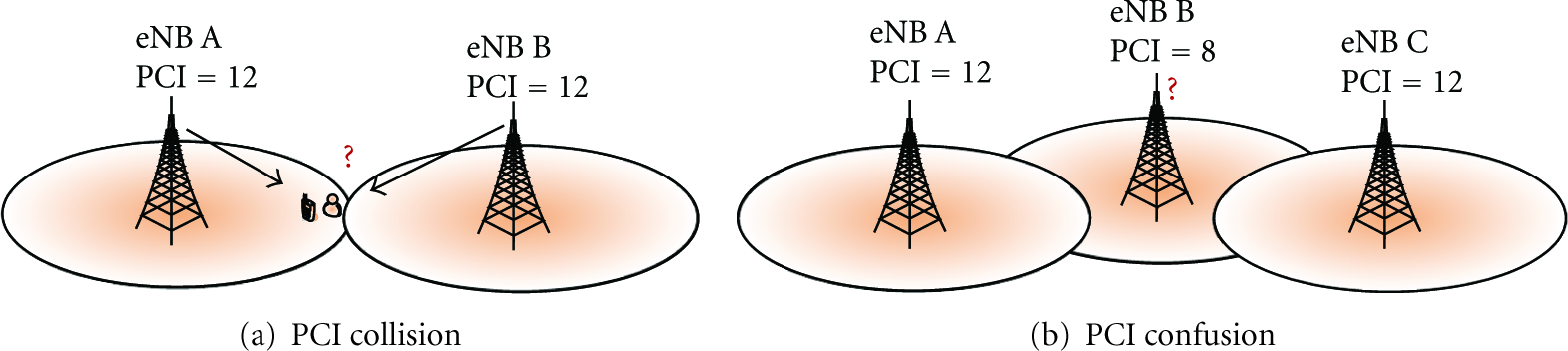
Cell identity collision and confusion.
Based on the above factors, the principles of PCI assigning mainly include the following.
To satisfy the collision free and confusion free, identical ID reuse is allowed by 3rd degree neighbors. SSS sequences with high cross-correlation should be widely separated. The reuse distance should be regarded to be as far as possible.
3. PCI Self-Distributing Algorithm
3.1. Synchronization Signals Sequences Correlation Analysis
In this section, the property of synchronization code is analyzed and the result will be provided. Highly correlated IDs are grouped together based on the results, and will be distributed separately. As described in [11], each ID can be expressed by the following equation:

Based on the understanding of SSS sequences, all SSS sequences are generated and the correlations between any two of codes are estimated. Figure 3 illustrates the cross-correlation of sequence
Groups of SSS sequences with high correlation.


Cross-correlation of a pair of SSS sequences.
3.2. Optimal PCI Self-Distributing Algorithm
The procedure of ADPCI is illustrated step by step in Figure 4 and cell identities sets are defined to facilitate the description of the algorithm in Table 2. The algorithm consists of three stages. In Stage I, the assigning order of eNBs will be given according to the well-known minimum spanning tree (MST) algorithm. In Stages II and III, PCI distributing and reuse methods are discussed in detail.
PCI sets for ADPCI algorithm.

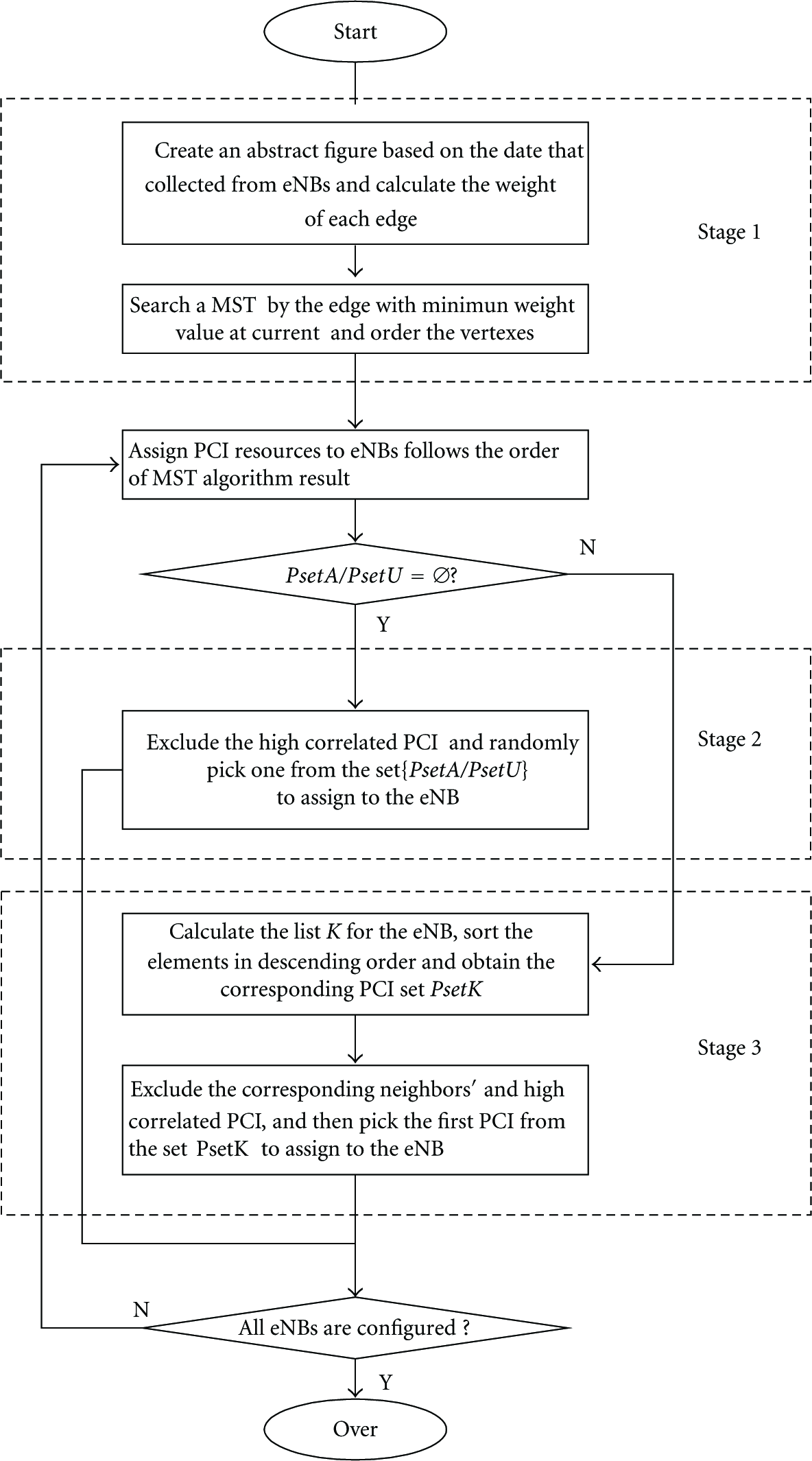
The Flow chart of the proposed ADPCI.
In the first stage, the network deployment is mapped into an abstract graph to reflect the actual network environment based on the location of nodes. The network deployment is mapped into a fully connected and undirected graph Define a set of vertexes Define a set of edges Define an where

The MST algorithm (see the Appendix) is applied and extended to search the minimum propagation loss values. Figure 5 shows the procedure of adding edges with minimum weights and the growth of the MST. Independent trees are connected by edge with minimum weight till a spanning tree is formed. The algorithm result returns the assigning order of eNBs, allowing assignment to avoid reuse interference by using different identities.

MST searching procedure.
In Stage II, PCIs are assigned to eNBs one by one following the order. Suppose that there are N IDs for the macro-eNBs, thus the top N eNBs in the MST result can acquire ID without causing reuse interference; as long as the high correlated IDs are separated.
Let m be the neighbors' identities of the ith eNB. Different PCIs are randomly picked from the unused set
However, when all unused PCIs have been assigned, PCI reuse is inevitable, which leads to the third state. It is more accurate to estimate the reuse effect before actually using it. Let If If Otherwise, pick the first element from set 


Calculation of RIFs (
The calculation of RIF helps eNB to evaluate the potential multiplexing interference and to make the best decision of assigning at current state. Meanwhile, removal of neighbors' PCIs can be done to avoid collision and confusion.
3.3. Suboptimal Algorithm for PCI Self-Distributing
The ADPCI provides an optimal algorithm for self-distributing, however, the high-performance causes high computational complexity. In this section, a suboptimal solution with relatively low computational complexity is given.
Define a concept of use frequency factor (UFF) for each PCI as it indicates the identity reuse times, let Select a PCI
Pick an eNB if it satisfies If there is no eNB that can satisfy Select a PCI
Pick the first element from top to bottom of the set If no eNB can meet the requirement above, pick the suboptimal selection that satisfies Otherwise, pick the first element from set 
The major difference between SADPCI and ADPCI is that PCI is preselected before estimating the interfering influence for different eNBs. The calculation for eNBs' assigning order is unnecessary and the high computation of searching MST could be omitted; moreover, during the PCI reuse phase, the calculation for all PCI resources' RIF needs high computational complexity; however, only a few numbers of RIF for individual PCI has to be calculated in SADPCI.
4. Evaluation and Analysis
In this section, the proposed ADPCI and SADPCI are evaluated and analyzed through the performance of users' carrier to interference ratio (CIR). We consider the simulations using a densely deployed scenario where a macrodeployment with 50 eNBs and 1000 users involved, and these eNBs and UEs are randomly distributed in the area. In order to illustrate the influence of transmission propagation models, two different signal transmission models are used to reflect the environmental changes that impacted the result of PCI distribution. The propagation loss calculation is based on the COST231 Hata urban propagation model [12]:
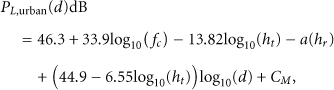
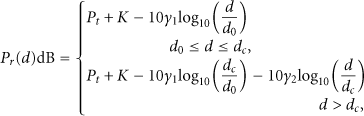
Furthermore, the available identity number N has been reduced to only 6 in order to make the solution more compelling. To compare with this extreme situation, 30 IDs are used in simulation as well. The system parameters in simulation are presented in Table 3.
Simulation parameters.

To demonstrate the proposal superiority, different schemes are used in simulation for comparison. A randomly distributing scheme (RDPCI) has been introduced to assign eNB randomly; it represents the worst situation of assignment without any optimization. Besides, a hypergraph coloring PCI assigning scheme (HCPCI) uses the neighbor's relationship degree N to indicate the degree of neighbors' relationship, which is regarded to be the reuse distance. ENBs with
Figure 7 shows the performance comparisons among the four schemes when the number of PCI N varies from 6 to 30. The simulation results show that there are huge performance gaps between ADPCI and RDPCI. The gaps are becoming larger when the number of PCIs are richer, for example, the average CIR (

Users' CIR distribution when PCI number changes.
Figure 8 shows the CDF curves of CIR where different propagation loss models are used. The choice of models should be based on the practical environment; the selection also affects the calculation of weight, thus influences the algorithm results. Although varied models have shown mixed results where the COST231 Hata urban propagation model performs a sharper slope of CIR curve and Broken-Line model has a smooth one, the performance of different schemes are obvious. However, the results suggest that the performances of ADPCI and SADPCI over the others schemes are similar to that of previous simulation.
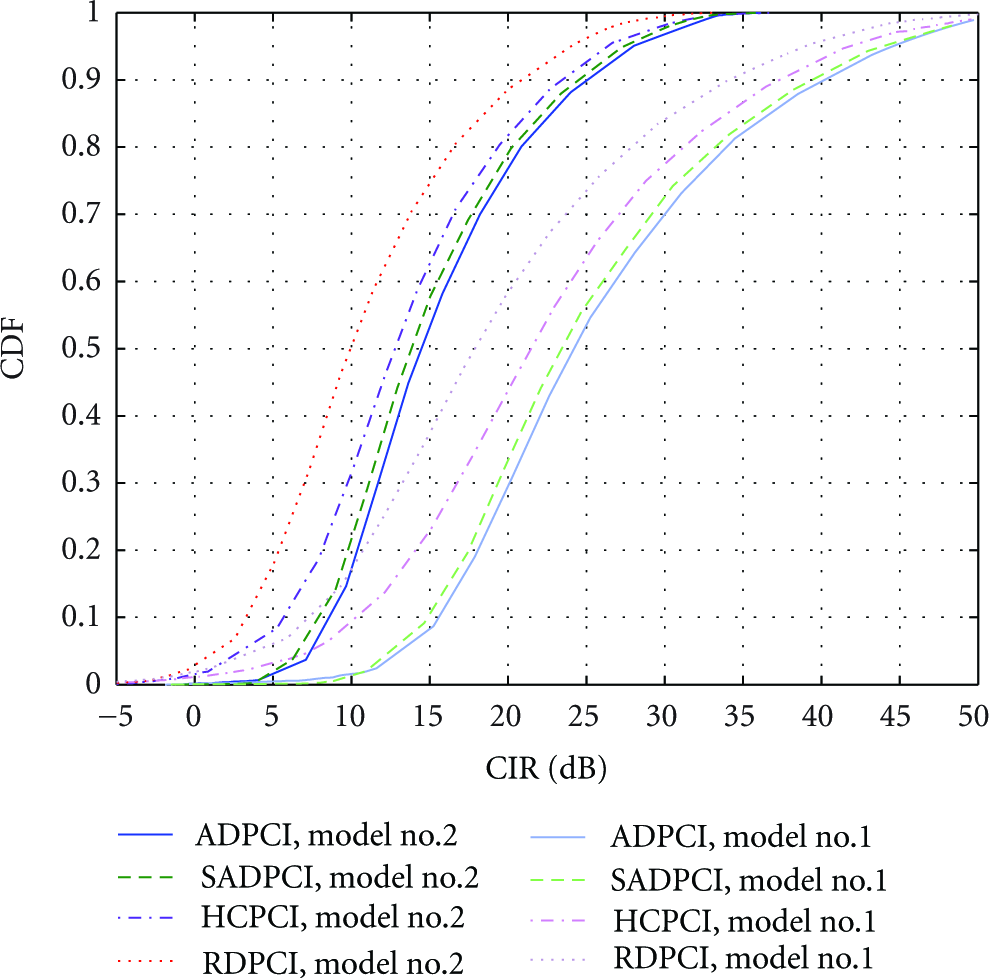
Users' CIR distribution when different models are applied.
5. Conclusions
The ADPCI is presented to improve the performance of PCI management by greedy search to achieve the global optimum. The mechanism benefits from two aspects: utilizing the grouped PCI resources to avoid multiplex interference; decreasing reuse interference through estimating the reuse influence of different IDs. The SADPCI has a similar property as ADPCI but needs less computational complexity. The performance of the ADPCI and SADPCI are evaluated and compared to traditional scheme in initial rollout macro scenario. As the results shown, the proposed ADPCI achieves higher users' CIR than the other schemes in condition of applying different PCI numbers and different signal transmission models.
Footnotes
Appendix
Acknowledgments
This work was supported by the State Major Science and Technology Special Projects (Grant no. 2011ZX03003-002-01), the Fok Ying Tong Education Foundation Application Research Projects (Grant no. 122005), and the Program for New Century Excellent Talents in University.