




Abstract
In wireless sensor networks (WSN), broadcasting could allow the nodes to share their data efficiently. Due to the limited energy supply of each sensor node, it has become a crucial issue to minimize energy consumption and maximize the network lifetime in the design of broadcast protocols. In this paper, we propose a Broadcast Algorithm with Least Redundancy (BALR) for WSN. By identifying the optimized number of induced forwarders as 2, BALR establishes a weighted sum model, taking both rebroadcast efficiency and residual energy into consideration, as a new metric to compute the self-delay of the nodes before rebroadcasting. BALR further incorporates both strategies based on distance and coverage degree which means the number of neighbors that have not yet received the broadcast packet, to optimize the rebroadcast node selections. To reveal the performance bounds, rebroadcast ratios in the ideal and worst case are theoretically analyzed, indicating that the rebroadcast ratio of BALR decreases with the increase of node density. BALR can significantly prolong the network lifetime of WSN and is scalable with respect to network size and node density, as demonstrated by simulations.
1. Introduction
Wireless sensor networks (WSN) are envisioned as consisting of a number of static sensor nodes that are densely deployed over a region of interest. A wide variety of applications of such networks include inventory managing, disaster areas monitoring, patient assisting, water quality monitoring, target tracking, and health monitoring of civil infrastructures. Recent advances in wireless communications and electronics have enabled the development of such low-cost sensor networks. Unfortunately, wireless sensor nodes, which are generally microelectronic devices, could only be equipped with limited power sources. Therefore, energy efficiency is of particular importance in WSN [1–4].
Broadcasting is a common means for nodes in WSN to efficiently share their data with each other. Broadcasting could be utilized to initialize the network configuration for network discovery, discover multiple routes between a given pair of nodes, and query for a piece of desired data in a network [5]. In WSN, broadcasting could also be served as an efficient approach for sensors to share their local measurements with each other. A straightforward way of broadcasting is the so-called flooding, under which each node will rebroadcast when it receives the broadcast packet for the first time. Although attractive for its simplicity, flooding will cause serious broadcast redundancy, packets collision, and bandwidth waste, referred to as broadcast storm problems [2]. An efficient broadcast strategy should be able to effectively reduce the broadcast redundancy, for both energy and bandwidth efficiency, especially in a band and power limited sensor networks.
With the aim of solving the broadcast storm problems and maximizing the network lifetime, we propose a Broadcast Algorithm with Least Redundancy (BALR) for wireless sensor networks, which possess the following properties.
Scalable Algorithm
Scalability is a critical issue for sensor networks which is composed of thousands of densely deployed nodes. BALR is designed in mind with the goal of obtaining satisfying broadcast performance in a high-density and large-scale network. With BALR, the number of saved rebroadcasts increases with the increase of the network node density.
Localized Algorithm
Each node makes the decision of rebroadcast according to its one-hop local information. BALR needs not maintain any global topology information at each node, thus the overhead is small.
Energy-Efficient Approach
BALR cuts down the total energy consumption by reducing the redundancy of rebroadcast effectively which is also capable of relieving the broadcast storm problems significantly. To maximize network lifetime, BALR balances the energy consumption among all nodes when rebroadcast nodes are selected.
This paper is organized as follows. In Section 2, we analyze existing related works in the literature. In Section 3, we discuss system model and optimized number of forwarders in WSN. Based on the system model, our proposed Broadcast Algorithm with Least Redundancy (BALR) and its performance analysis are presented in Sections 4 and 5, respectively. We present computer simulation results in Section 6 for performance verification before concluding with Section 7.
2. Related Works
There have been a number of existing works on the broadcast storm problem of wireless multihop networks in the literature. In [3, 4, 6], each node computed a local cover set, consisting of as fewer neighbors as possible, to provide its whole 2-hop coverage area by exchanging connectivity information with its neighbors. However, each node in these works is required to update the information of its k-hop (
Among related works in the literature, many proposed energy-efficient broadcast protocols are centralized, of which the topology of the whole network is required. Various protocols are proposed to search the minimizing energy cost of the broadcast tree. The authors of [7–9] accomplished the searching based on geometry or graph of the network. Alternatively, a connected dominating set (CDS) could be constructed, and only permitting nodes which belong to the CDS are allowed to rebroadcast packets. To minimize the overhead of broadcast, various strategies reducing the size of CDS were investigated in [10–16].
Since the centralized approach needs much more overhead in WSN, alternative localized algorithms have been proposed [17–21]. Under such protocols, each node establishes the network topology in a distributed way [18]. In [19, 20], each node should be aware of the geometry within its 2-hop neighborhood range. In order to ameliorate broadcasting, [10] utilize the information of all nodes that have been visited by the broadcast message. The authors of [16] proposed an algorithm suitable for a dynamic mobile Ad Hoc network, which did not require neither the k-hop neighbors information nor the entire network topology. To reduce the broadcast overhead, [21] proposed a Maximum Life-time Localized Broadcast (ML2B) protocol, of which the information of only one-hop neighbors was required. ML2B utilized the number of neighbors that have not received the broadcast message to reduce the rebroadcast redundancy.
Some broadcast mechanisms designed based on the features of WSN have been proposed recently [20–30]. In [20], two types of broadcasting protocols for WSN, called one-to-all and all-to-all broadcasting, were proposed. Both protocols are suitable for fixed and regular WSN topologies. An energy-efficient broadcasting strategy based on cooperative transmission was investigated in [23]. The cooperation was provided through a system, called Opportunistic Large Array (OLA), in which network broadcasting was accomplished by signal processing techniques at the physical layer. Some works [5, 24, 25] dealt with the query execution in large sensor networks. Their purpose is not to broadcast a packet to the whole network but to obtain or locate data or services for nodes within a large population, high-density WSN based on network partial broadcast. Several robust data delivery protocols [26–28] have been proposed for large sensor networks to disseminate data to interested sensors.
This paper focuses on the broadcasting strategy for WSN to efficiently forward a broadcasted packet from broadcast originator to all other nodes in the network. By identifying the optimized number of induced forwarders as 2, a broadcasting algorithm with least redundancy (BALR) is proposed, which optimizes broadcasting by reducing redundant rebroadcasts and balancing energy consumption among all nodes. In [29], a broadcast protocol for sensor networks (BPS) was proposed, which utilized an adaptive-geometric approach that enables a considerable reduction of retransmissions by maximizing each hop length. Simulation results regarding the rebroadcast ratio demonstrate the feasibility of applying adaptive-geometric approach to WSN broadcasting. Based on [29], the authors extended the ideas of BPS for broadcasting in the energy-constrained network consisting of nodes that sleep and wake up alternatively in [30]. And they proposed a protocol called Activecast to effectively transmit a packet to all active (awake) nodes in the network. However, this paper does not consider the WSN consisting of nodes that sleep and wake up alternatively but considers the homogeneous WSN consisting of nodes that have the identical transmission range and that are always active until their battery exhaustion. Furthermore, most of these literatures focus on rebroadcast ratio performances, without looking at the network lifetime which is one of the main design purposes for any broadcast schemes. Motivated by the optimized selection of induced forwarder, BALR establishes a weighted sum model, taking both rebroadcast efficiency and residual energy into consideration, as a new metric to compute the self-delay of the nodes before rebroadcasting. BALR further incorporates both strategies based on distance and coverage-degree, to optimize the rebroadcast node selections; thus, its scalability and high energy-efficiency being achieved. Besides, as each node makes the decision of rebroadcast according to only its one-hop local information, BALR is a localized algorithm.
3. System Model
A wireless sensor network can be abstracted as a graph
In particular, we use the radio transmission energy model as in [31]. To transmit a k bits packet over a distance d, the radio expends energy of


As location is more important than a specific node's ID in WSN, location awareness is necessary to make the sensor data meaningful. The proposed BALR utilizes geographic location to make localized broadcast decisions. Each node is required to be aware of only the positions of its one-hop neighbors.
3.1. Optimized Number of Induced Forwarders
Given a forward node that has done the rebroadcast, its neighbors that do the rebroadcast after hearing the rebroadcast from it are called its induced forwarders. To reduce the rebroadcast redundancy, the number of induced forwarders of each forward node should be minimized.
During the broadcast of a packet, as shown in Figure 1, a forward node S rebroadcasts a broadcast packet received from its preceding node U. Then its induced forwarders are chosen from its neighbors locally by themselves. Lastly the induced forwarders of S will do the rebroadcast as their preceding node S. Let n be the number of the induced forwarders of a forward node. We use

Selection of induced forwarders. The shadowed regions are the induced coverage region of node S.
To obtain a high coverage ratio of broadcast, large n is desired. But large n also leads to much redundant rebroadcasts. Therefore, an optimal n is required to obtain a satisfying delivery ratio and as fewer rebroadcasts as possible.
For
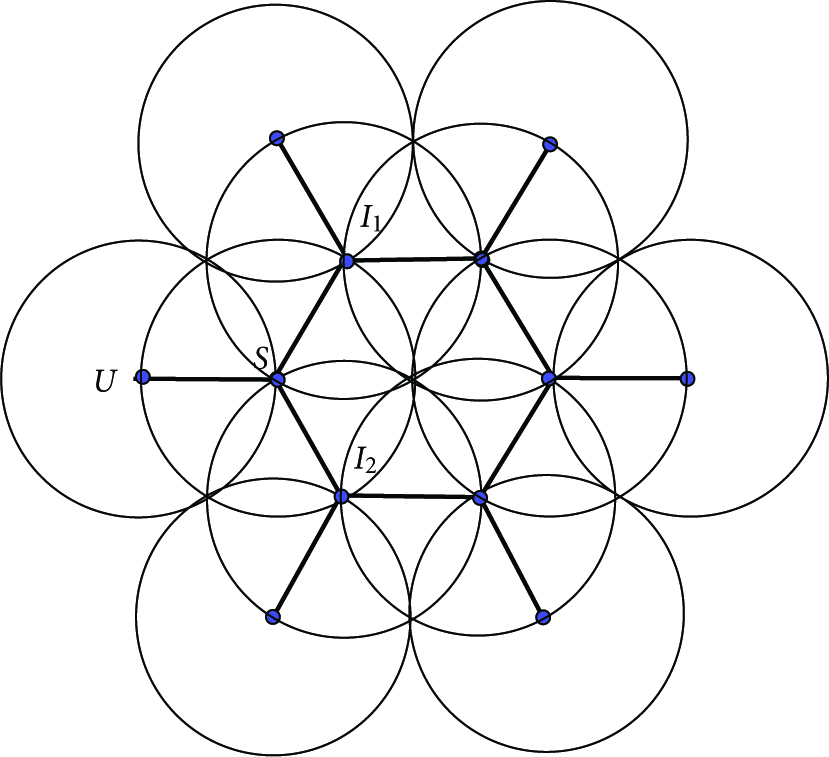
Path for delivering the broadcast packet in ideal conditions using BALR.
When two induced forwarders are selected as in Figure 1(b), the network could obtain a satisfying delivery ratio with the highest broadcast efficiency [32]. Therefore, BALR optimizes a number of the induced forwarders by setting
3.2. Ideal Coordinates of Induced Forwarders
Let

When transmitting node S is the broadcast originator, there are three optimized (ideal) locations for
4. Broadcasting with Least Redundancy (BALR)
As discussed in the previous section, nodes forward the broadcasted packet following patterns shown in Figure 1(b). Ideally, as shown in Figure 2, the broadcast packet is delivered along hexagons with edge length equal to the radius of the coverage of each node. And all rebroadcast nodes are located at vertices of the hexagons which are called ideal locations. To determine the ideal locations, each broadcasted packet contains a field
4.1. Weighted Sum Metric for Self-Delay
Nonetheless, in practical situations, nodes may not be located at ideal points. Naturally the nodes nearest to the ideal locations are selected as forwarders. However, this scheme would lead to the situation that nodes located at the ideal or quasi-ideal locations are exhausted rapidly with respect to energy. We hence propose to take energy metric into consideration, besides the location metric, for forwarder selections. BALR incorporates these two metrics together to form a new metric, via following a weighted sum model (SMD), and utilizes the self-delay mechanism to complete the rebroadcast node selection:

When forall node i receives the broadcasted packet for the first time, it defers a period of
Clearly there is a tradeoff between rebroadcast efficiency and network lifetime based on our new metric. In practice, we could regulate the tradeoff by adjusting the relative weights α and β. In addition, the tradeoff between broadcast reachability and network lifetime could be regulated by adjusting the threshold
Based on the new metric, our protocol further reduces the rebroadcast redundancy by incorporating both strategies based on distance and coverage degree as follows.
4.2. Strategy Based on Distance
We propose to reduce the rebroadcast redundancy by confining the location of quasi-forwarders. More specifically, only neighbors within a specified distance
4.3. Strategy Based on Coverage Degree
It is noted that a node might receive a broadcast packet several times from different nodes in different directions, leading to redundant rebroadcasts. Define coverage degree as the number of neighbors that have not received the broadcast packet yet. Note that the coverage degree implies the rebroadcast efficiency of a node. To minimize rebroadcasts, we propose to have each node maintain its coverage degree, and rebroadcast only when its coverage degree is above the threshold
4.4. Broadcasting Algorithm with Least Redundancy
Let s and Neighbor Neighbor set Uncovered set Coverage degree Preceding node Preceding node set

For
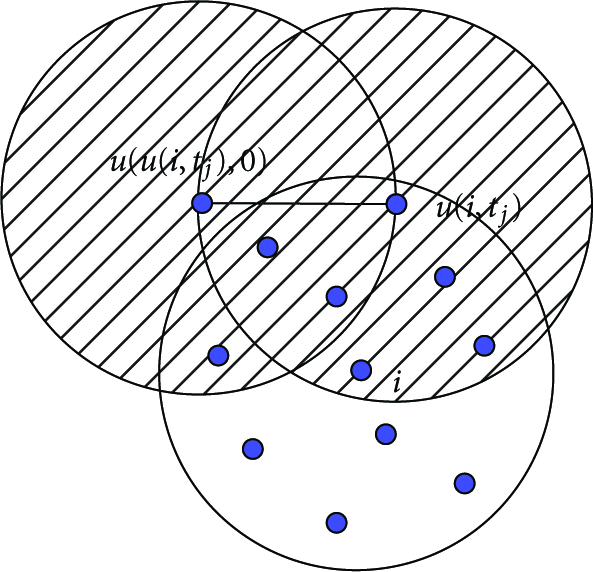
Node i obtains
Following the previous discussion, our proposed Broadcast Algorithm with Least Redundancy (BALR) for forall
(1) (2) (3) (4) node i has received the broadcast packet where j indicates the times of the repeated reception of (5) Let node of node i at time (6) node i updates its uncovered set by (7) Check current time t: (8)
We remark that our BALR maximizes the lifetime of WSN by minimizing redundant rebroadcast and balancing the broadcast energy consumption of neighborhood. It utilizes the node self-delay scheme to reduce the redundancy of nodes' rebroadcast and energy consumption. This scheme guarantees that nodes with smallest distance from the ideal location and satisfying value of residual energy are self-selected as rebroadcast nodes. To further minimize the redundant rebroadcast, each node i tracks its coverage-degree
5. Performance Analysis of BALR
5.1. Definitions
C is the area of the entire network. D is the node density of the network, which is the average number of nodes per region of g is the total number of all nodes in the network. h is the number of nodes that have rebroadcasted the packet after their reception of the packet in the network. R is the rebroadcast ratio, which is the ratio of the number of nodes that have rebroadcasted the packet to the number of nodes in the entire network.
Based on the above definitions, we get

5.2. Efficiency of the Broadcast Protocol
Rebroadcast ratio R manifests the efficiency of the broadcast protocols. R is inversely proportional to the broadcast efficiency. Large R results in a much redundant rebroadcast and low broadcast efficiency. Let
Firstly we analyze the ideal efficiency of BALR, which is determined by the minimum rebroadcast ratio under the ideal conditions. Based on the formula (7), we get

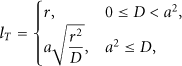
For a given sensor network, where values of C, D, and r are determinate, different broadcast protocols result in different values of h. From formula (8), we get that the rebroadcast ratio is determined by h, which is the number of nodes that have done the rebroadcast in the network. To obtain the minimum R in BALR, h should be minimized. Under ideal conditions, the network area is divided into many hexagons where, in each vertex, there is one node doing the rebroadcast. The side length of each hexagon in the network is equal to the radius of the coverage of each node. Then the number of hexagons in the entire network can be approximated as


Then, we examine the efficiency and rebroadcast ratio of the proposed broadcast protocol under the worst conditions. As shown in Figure 4, after a forward node S firstly receives the broadcast packet from its preceding node U, it rebroadcasts the packet. Only
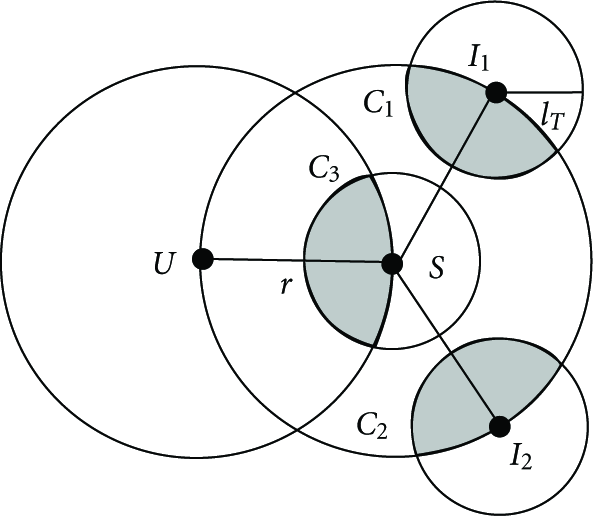
Limited shaded regions in which
We use

As the radius of the three limited sector regions are

The area of
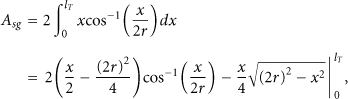

The area of


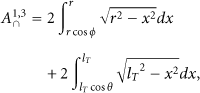
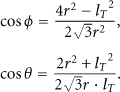

The rebroadcast ratio of BALR in the worst case is achieved when
6. Numerical Evaluation
We simulate BALR using OPNET and compare its performance with that of flooding and ML2B [19] which could reduced redundant rebroadcast efficiently. As Broadcast Protocol for Sensor networks (BPS) [27] is one of the protocols that perform well in large-scale sensor networks, we also compare BALR with it. For physical (PHY) and medium access control (MAC) layers, we use the IEEE 802.11 wireless LAN (WLAN) model. And each node has the same transmission range of 250 m. The initial power of each node is 1.0 J. For all simulation results, Poisson streams are used. Each source sends out packets with an average rate of 5 packets per second. The data packet size is 1024 bits. The maximum delay
6.1. Performance Metrics
We consider four performance metrics.
Rebroadcast ratio Reachability (RE): the ratio of the number of nodes that have received broadcasted packet to the number of all nodes in the simulated connected network. So RE also is known as the coverage rate. Maximum end-to-end delay (MED): the interval from the time the broadcasted message is transmitted by the broadcast originator to the time the last node in the network receiving the message. Lifetime (LT): the interval from the time the network is initiated to the time at which the first node dies in the network. We break the whole simulation time into many small time steps which are also called as rounds. The broadcast originator broadcasts each packet to all other nodes in the network in each round. To describe the network lifetime exactly, we use rounds to measure the network lifetime. LT is the round at which the first node dies in WSN.
6.2. Performance Comparisons
6.2.1. Performance Dependence on Network Scale
As wireless sensor networks consist of a large number of nodes, the broadcast protocol designed for WSN should adapt well to the large-scale network scenario. To study the influence of network scale on BALR, we simulate wireless sensor networks constituted by a different number of nodes. And nodes are randomly placed in the networks. As illustrated in Figures 5 and 6, compared with BPS, ML2B, and flooding, BALR has the smallest rebroadcast ratio R without sacrificing the RE and MED for varying network sizes. When simulating flooding, we use a random delay for each node in the network before their rebroadcast to alleviate collisions, which enhance the performance of flooding. As shown in Figure 6, BALR has a smaller maximum end-to-end delay than BPS, and flooding has the smallest MED under most conditions. It is clear that the rebroadcast ratio of flooding is 1 under all conditions. Therefore, we do not show it in Figures 5 and 7.

RE and R dependence on network scale.

MED dependence on network scale.
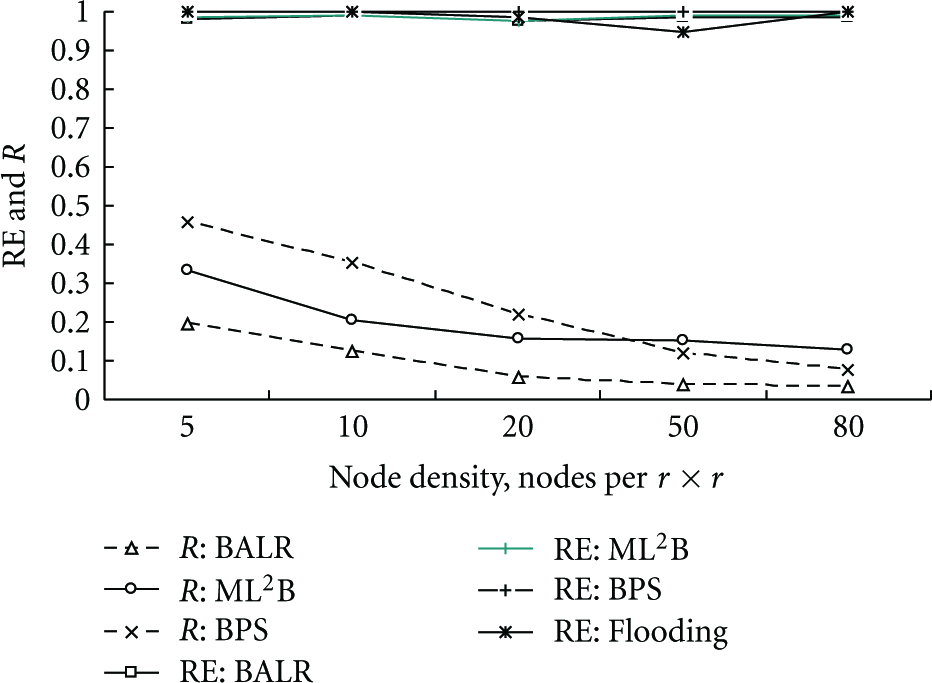
RE and R dependence on node density.
6.2.2. Performance Dependence on Node Density
Nodes are randomly placed in the network region of
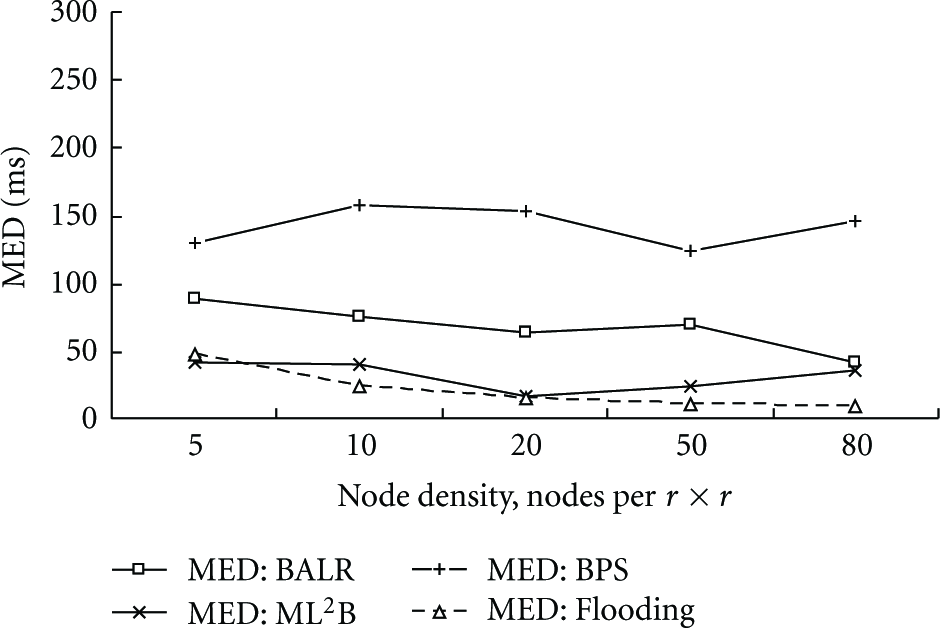
MED dependence on node density.
Figure 9 shows a comparison of the rebroadcast ratio between simulation values of BALR and theoretical values in the ideal case and worst case. The rebroadcast ratio in the ideal case and worst case is computed based on formula (11) and formula (20). The influences of node density on the rebroadcast ratio of BALR under these three conditions are similar. As the rebroadcast ratio in the worst case is obtained under conditions of

Simulation results versus analytical results.
6.2.3. Lifetime Evaluation
Each node's initial energy is 1.0 J. And the residual energy of each node decreases when it receives or transmits packets in the network. A node dies when its residual energy decreases to 0 J. As defined in Section 6.1, lifetime (LT) is the interval from the time the network is initiated to the time at which the first node dies in the network. Figure 10 shows the network lifetime of BALR, ML2B, BPS, and flooding by rounds. As shown by Figure 10, due to the super redundant rebroadcast, flooding shortens network lifetime significantly. Though BPS could reduce the rebroadcast redundancy greatly by maximizing each hop length, the adopted adaptive-geometric mechanism causes that network lifetime to be independent of node density. For ML2B, due to the lack of consideration of optimal induced forwarder selection, the number of nodes doing rebroadcast in the network increases when node density increases, which also can be calculated from Figure 8. Thus, when ML2B is used in broadcasting, network lifetime falls slowly with node density's increase as shown by Figure 10. Because of its least rebroadcast redundancy and energy balance consideration, BALR obtains longer network lifetime than ML2B, BPS, and flooding. It prolongs the network lifetime of wireless sensor networks.
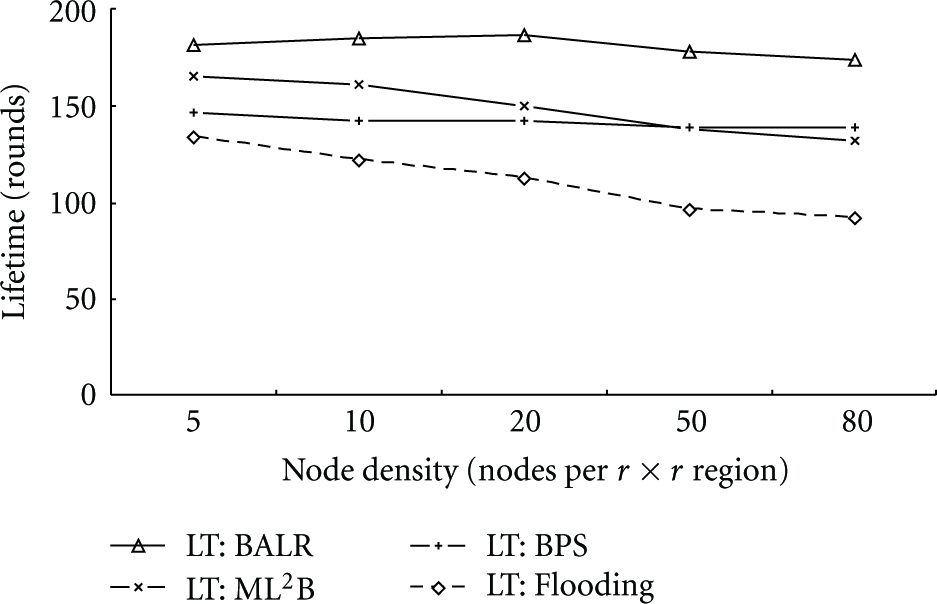
Lifetime of networks with different node densities.
7. Conclusion
To broadcast packets efficiently and maximize the network lifetime in large-scale wireless sensor networks with densely deployed nodes, we propose a broadcast protocol BALR. It uses the coverage degree which is the number of neighbors that have not yet received the broadcasted packet of a node to measure its rebroadcast efficiency. It utilizes the geographical relationship between a rebroadcast node and its neighbors to choose as fewer new rebroadcast nodes as possible. Theoretical analysis and simulation results show that the rebroadcast ratio of BALR decreases with the increase of node density. BALR reduces the rebroadcast redundancy and prolongs the network lifetime effectively for wireless sensor networks, especially in large-scale networks with high node density. Simulation results show that the BALR strategy outperforms flooding, ML2B, and BPS strategies.
Footnotes
Abbreviations
Acknowledgments
This work was supported by the National Natural Science Foundation of China (Grant no. 51249005 and 60972153), the Specialized Research Fund for the Doctoral Program of Higher Education of China (Grant no. 20106102120013; 20096102110038), and the Northwestern Polytechnical University Foundation for Fundamental Research (NPU-FFRJC201004).